Reps in Reserve (RIR) and RPE: What the Scale Means and How Accurate It Is
Reps in reserve explained: how RPE 10 = 0 RIR, how to rate a set, and what studies say about how accurately lifters judge it, with a simple gym method.
TL;DR. The short answer
- Reps in reserve (RIR) is how many more good reps you could have done when you stopped the set. RPE 10 = 0 RIR (failure), RPE 9 = 1 RIR, RPE 8 = 2 RIR.
- Trained lifters can judge RIR fairly well on a barbell bench press: in one study of 24 lifters, the average miss was about 0.65 reps when predicting 1 or 3 RIR.
- Accuracy gets worse the further you are from failure, and in one small study of older adults, predictions at 2 RIR were off by about 2 reps.
- Use RIR to adjust load set to set: if a set felt easier than the target, add weight; if it felt harder, trim it.
- Log your RIR guesses and test one set near failure now and then on a safe machine or cable exercise to keep your internal scale honest.
Part of our complete guide: Reps in Reserve, Rep Ranges and Rest Times: The Evidence-Based Guide to How Hard Every Set Should Be
Table of contents
Reps in reserve (RIR) is the number of good reps you could still have done when you ended a set. Two left in the tank is 2 RIR. On the lifting version of the RPE scale, RPE 10 = 0 RIR (failure), RPE 9 = 1 RIR and RPE 8 = 2 RIR.
That is the whole idea. The rest of this guide covers how to rate a set, how accurate lifters actually are at it, and how to use the numbers without turning your training into homework. It sits inside our wider guide to load, rep ranges, RIR and rest intervals, so think of this page as the vocabulary lesson that everything else builds on.
What do reps in reserve and RPE actually mean?
RPE stands for rating of perceived exertion. The classic version is a general 1-10 “how hard was that?” score, which is vague. The lifting-specific version ties each number to a count of reps left, so a “9” means something concrete.
That version was proposed by Zourdos and colleagues in 2016, who set RPE 10 = 0 RIR, RPE 9 = 1 RIR “and so forth” (Zourdos et al., 2016). A companion paper by Helms and colleagues explained how to build the scale into a training plan, noting that it adjusts loads to match the lifter from set to set and may gauge intensity more precisely near the limit (Helms et al., 2016).
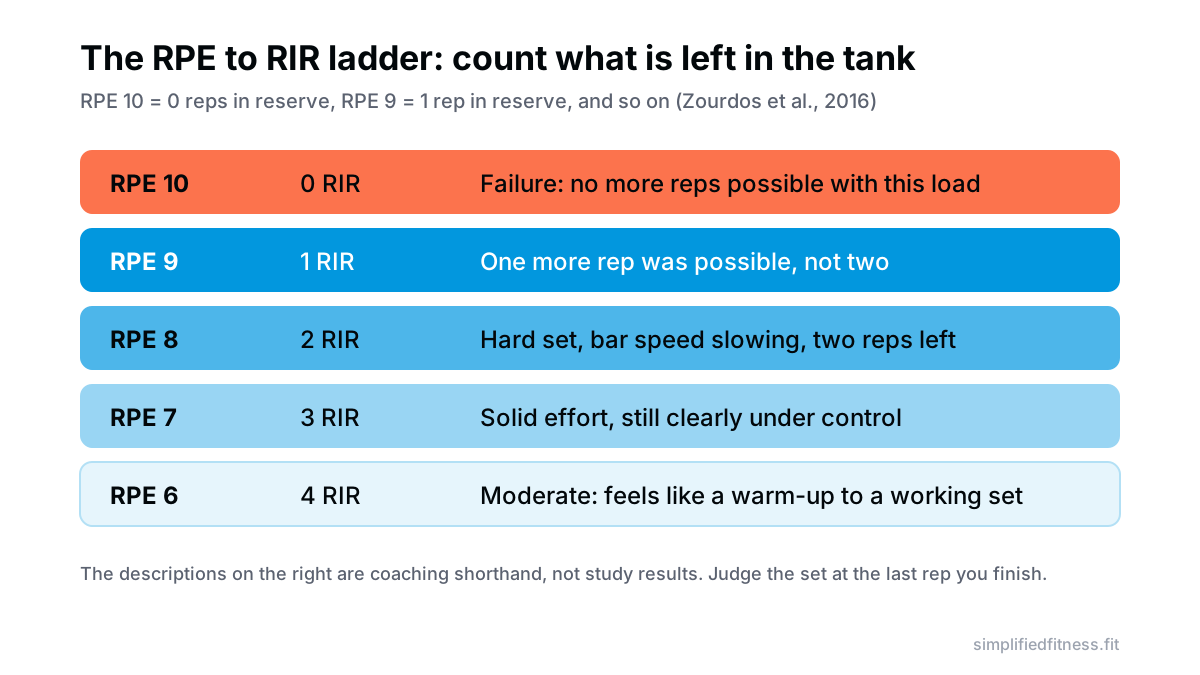
So what is the difference between RIR and RPE? Mostly wording. RPE is a score, RIR is a count. If you like numbers on a 10-point scale, say RPE 8. If you prefer thinking in reps, say 2 RIR. A free RIR and RPE calculator on this site converts between the two if you want a quick check.
How do you calculate RIR in the gym?
You do not calculate it. You estimate it, and the estimate has to be honest about what counts as a rep. A grinding rep with your hips shooting up is not a good rep. A rep that is slow but looks like the previous ones is.
A simple way to rate a set:
- Finish the set at the rep count you planned.
- Ask: could I have done one more with the same form? If clearly yes, ask again for a second.
- Stop counting when you honestly say “no” or “maybe, but it would be ugly”.
- Write the number down next to the weight and reps.
That last step matters more than it looks. A log of “80 kg x 9 @ 2 RIR” gives you something to compare with next week. Without it, RIR becomes a mood.
Does the RPE scale line up with real effort?
There is decent support for the idea that the scale tracks something measurable. Bar speed drops as sets get harder, and ratings drop with it.
In the original 2016 study of 29 people (15 experienced and 14 novice squatters), there was a strong inverse relationship between average bar velocity and RPE across intensities (r = -0.88 in experienced lifters and r = -0.77 in novices) (Zourdos et al., 2016). A bench press study of 27 college-aged men found strong inverse correlations between bar speed and RPE in both experienced and novice groups (reported as r = 0.85 each), and the authors concluded the scale may work for autoregulating bench press load and volume in that population (Ormsbee et al., 2019).
Both studies were small, short, and used young adults, and the lifting version of the scale was developed by the same research group. A broader 2025 systematic review of 18 studies reported moderate positive correlations among RPE scales, movement velocity and training load, and concluded RPE can serve as a practical, low-cost way to monitor training load (Petro et al., 2025). Its authors also say that training level, motivation and environmental conditions can affect perceived exertion.
One more detail worth knowing: experienced squatters and benchers rated a max single higher than novices did, which hints that experience changes how you read the scale at the extremes (Zourdos et al., 2016); (Ormsbee et al., 2019).
How accurately can lifters judge reps in reserve?
Better than most people assume, with caveats.
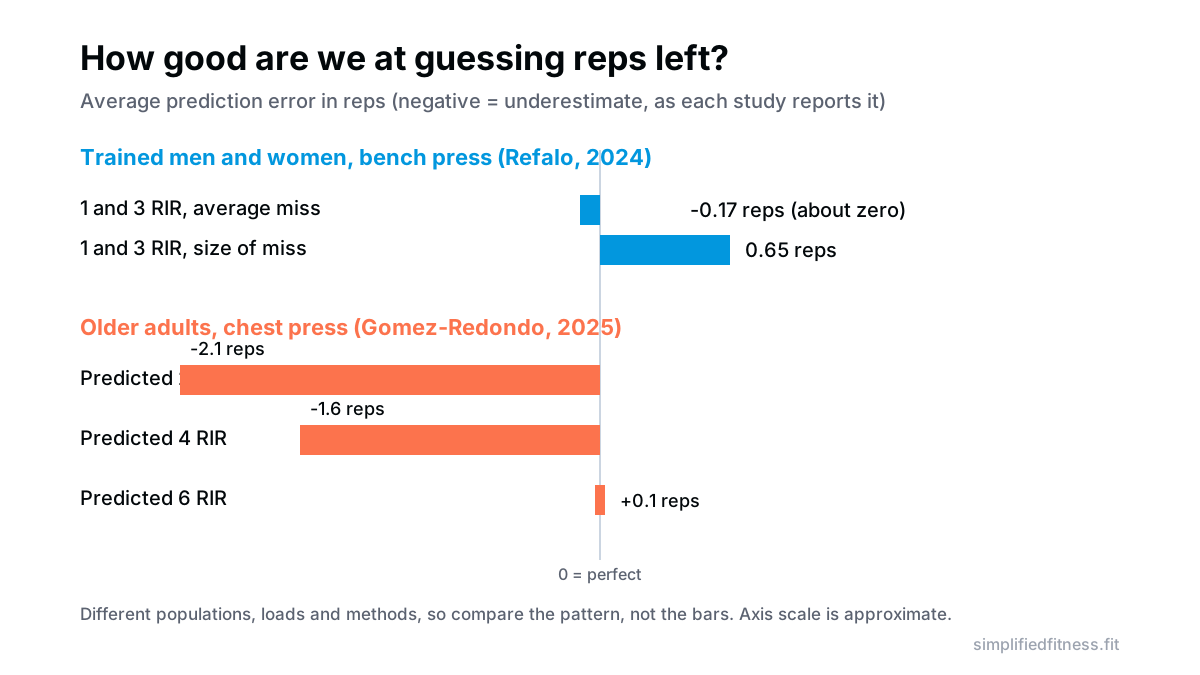
In a 2024 study, 24 resistance-trained men and women (12 each) did bench press sets to failure at 75% of 1RM, and said “stop” when they felt they hit either 1 RIR or 3 RIR. The average error was small: -0.17 reps in direction and 0.65 reps in absolute size. Accuracy did not differ between 1 RIR and 3 RIR guesses, and the researchers found no link with sex, years of training or relative strength (Refalo et al., 2024).
On machine-based single-joint moves, a 2023 study of 27 men and 31 women (trained and untrained) found guesses were more accurate when closer to failure and in later sets, while sex and training experience did not significantly change the error (Remmert et al., 2023).
So what is the catch? Distance from failure. If you are guessing at 5 reps left, you have more room to be wrong than at 1 rep left. A 2024 scoping review of 31 studies suggested that RIR predictions should be made close to task failure to improve accuracy (Bastos et al., 2024).
Where the evidence is weaker
Not every group does as well. In a 2025 trial of 25 community-dwelling older adults (average age 68), predicted RIR on chest press at 65% of 1RM was off. The authors report that participants underestimated the number of reps by about 2.1 at a predicted 2 RIR and 1.6 at 4 RIR, though not at 6 RIR. RPE barely moved across those sets (8.0, 7.6 and 7.3). The authors concluded RIR may lack precision for prescribing load in this group but could be useful for volume monitoring alongside RPE (Gomez-Redondo et al., 2025).
Why do the results differ from the trained-lifter studies? Different people, different exercise, a different load and a different method for locating “predicted” RIR. It is not a clean head-to-head. The practical read: RIR is usable, but the less experience you have with an exercise, and the further from failure you are guessing, the more padding you should leave. For a deeper dive, see our article on how accurately lifters gauge RIR and failure.
How do I use RIR to autoregulate my training?
Autoregulation just means adjusting the work based on how you are doing today. A fixed percentage of your max cannot know you slept five hours or that it is 38 degrees in a gym without AC. Your read on a set can.
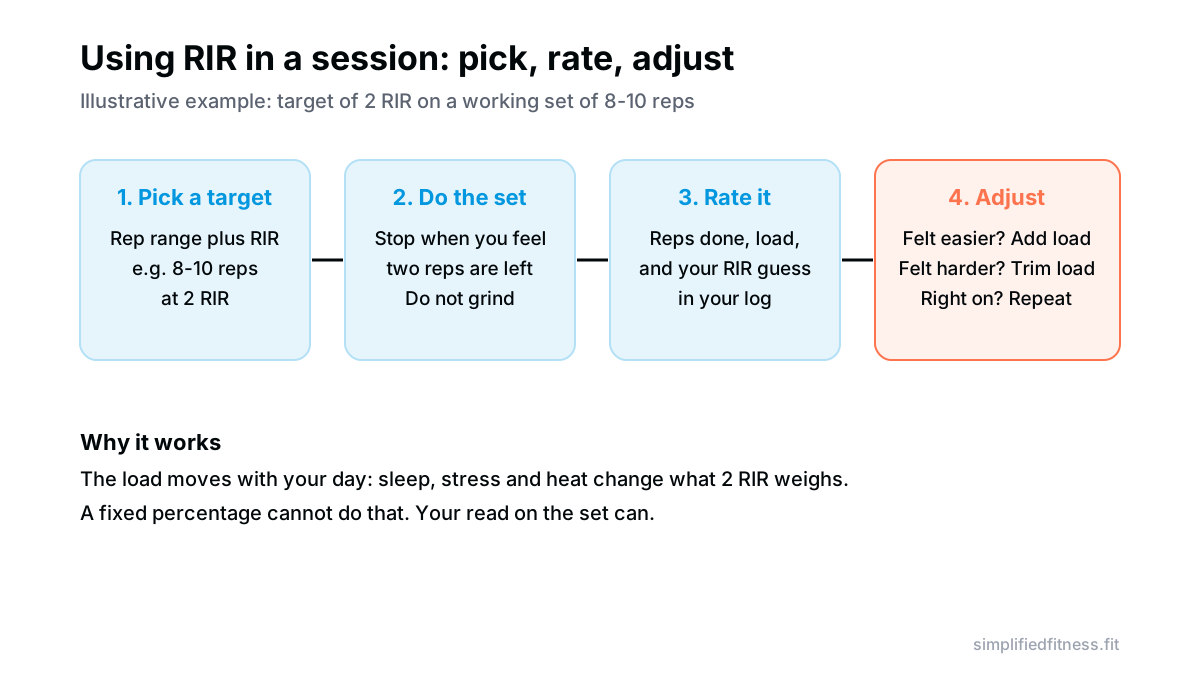
A simple pattern for an upper-body press:
- Target: 8-10 reps at about 2 RIR.
- Set 1: 70 kg for 10 felt like 4 RIR. Too easy. Add weight.
- Set 2: 77.5 kg for 9 felt like 2 RIR. On target. Repeat.
- Set 3: 77.5 kg for 8 felt like 1 RIR. Fine, but do not add weight yet.
That is an example, not a prescription. Your numbers will differ. The point is that the load follows the target instead of the other way round. For a structured version of this, see autoregulated progressive overload (APRE) rules.
For heavy powerlifting-style work, many lifters use the same scale for top singles and back-off sets, covered in RPE-based powerlifting.
What RPE or RIR should I aim for on warm-ups and working sets?
Warm-ups are not rated, since their job is to get you ready rather than to train you. Ramp up so the last warm-up feels fast and light, then start rating your working sets. Our guide to warm-up ramping without fatigue shows a simple way to do it.
For working sets, here is a practical starting map. It is a coaching guideline, not a research-derived prescription.
| Situation | Typical RIR target | RPE |
|---|---|---|
| Learning a new exercise | 3-4 | 6-7 |
| Most compound working sets | 2-3 | 7-8 |
| Most isolation and machine sets | 1-2 | 8-9 |
| Last set of an exercise, safe machine or cable | 0-1 | 9-10 |
Whether closer to failure builds more muscle is a separate question that depends on the study and on volume. That is covered in training to failure versus RIR for hypertrophy, so we will not rehash it here. For this page, the point is that you need the language before you can pick a target.
How do I get better at judging RIR?
Accuracy is a skill, and the research suggests practice and closeness to failure both help.
- Use the same exercises for a while. You learn the feel of a lift by repeating it.
- Check against reality now and then. On a cable or machine exercise, stop where you think you have 2 left, rest a minute, and then see how many reps you actually get. That is your error, measured.
- Watch the bar. Compare your last rep’s speed to your first rep.
- Lean cautious early on. If you are unsure whether you have 3 left or 5, assume fewer.
- Do not chase certainty. Even trained lifters miss by a rep on average, so use the number as a guide, not a measurement.
A fuller protocol is in our piece on calibrating true RIR with gym protocols.
What should you remember about reps in reserve?
Reps in reserve is a simple count of the reps you had left, and RPE is the same idea on a 10-point scale. The research supports it as a practical tool for trained lifters, particularly on familiar exercises and close to failure, and it is less precise for beginners, for older adults, and when you are guessing from far away.
Pick a target, rate your sets honestly, log it, and let the numbers nudge your load. If you want a starting plan that uses these ideas, our free workout plans are a place to begin.
Frequently Asked Questions
What is the difference between RIR and RPE?
RPE (rating of perceived exertion) is a 1-10 score of how hard a set felt, while RIR counts how many reps you had left. On the lifting version of the scale, RPE 10 = 0 RIR, RPE 9 = 1 RIR and RPE 8 = 2 RIR, so they describe the same thing in two ways. Pick whichever you can say faster in the gym and stick with it.
What does RPE 8 mean in the gym?
RPE 8 means you finished the set with about 2 reps still in reserve. In the original scale, a rating of 8 on a set to failure would be 'two more reps possible', which is why trainers use it as a hard but not grinding target. If the last rep looked slow but clean and you think you had two left, call it an 8.
How do you calculate RIR?
You do not calculate it with maths, you estimate it: finish the set, then ask how many more clean reps you could have done with that load. If you stopped and think you had two left, that is 2 RIR. Studies in trained lifters show these guesses are usually within about one rep, especially close to failure, so write the number down and compare it with your next set.
Is RIR accurate?
Reasonably accurate for trained lifters on a familiar exercise, but not perfect. In a 2024 study of 24 resistance-trained men and women, the average absolute error on bench press was about 0.65 reps, with the average direction of error close to zero. Accuracy is worse when you are far from failure, so treat a 4 RIR guess as a rougher estimate than a 1 RIR guess.
Are beginners able to use RIR?
Beginners can use it. On machine exercises, one study found training experience did not significantly change RIR accuracy, though beginners have less feel for what failure looks like on a given lift. A 2016 comparison of novice and experienced squatters found both groups showed a strong link between RPE and bar speed, although experienced lifters rated a max single higher. Start with easy targets like 3-4 RIR, use a coach or training partner as a sanity check, and learn the feel gradually.
How close to failure should I train?
For most working sets, stopping around 1-3 reps before failure is a common and practical target. That keeps stimulus high while leaving enough in the tank to repeat the work next set and next session. The parent guide on load, reps and RIR covers how this changes by exercise and goal.
Is RPE 10 the same as failure?
Yes, on the RIR-based scale RPE 10 means 0 reps in reserve, so you could not complete another rep with the same load. It is momentary muscular failure, not a feeling of tiredness. Because it is hard on the body and often hard to judge safely, reserve true failure for machines and cables, and use a spotter on free weights.
Does RPE work as well as using percentages of 1RM?
They answer different questions. A percentage of 1RM sets a fixed load, while RPE and RIR adjust the load to how strong you are today. A 2025 systematic review found moderate positive correlations between RPE scales, bar speed and training load, which supports using RPE as a practical monitoring tool rather than a replacement for everything else.
Can I use RIR for every exercise?
You can, but it is easier on simple, stable movements such as machine presses, rows and cable work than on heavy, technique-heavy lifts. One study found RIR prediction accuracy on machine-based single-joint exercises did not differ by sex or training experience. Start with those, then apply it to heavier compounds once your numbers feel steady.
Do I need to count RIR on warm-up sets?
No, warm-ups are about preparing for the work, not measuring effort. Ramp the weight up so the last warm-up feels light and fast, then start rating your working sets. Our warm-up guide shows a simple ramp that does not eat into your working sets.
Why does my RIR guess feel different on bad days?
Sleep, stress, heat and mood change how hard a given weight feels, which is the exact reason RIR is useful. A load that is 2 RIR on a fresh day may be closer to 0 RIR when you are run down. Rate the set you actually did, then adjust the next set instead of forcing yesterday's numbers.
Should I train to failure to check my RIR?
Occasionally and carefully, yes, on a safe exercise like a cable or machine movement. Rating a set and then taking it to failure shows you how many reps you really had left, which retrains your internal gauge. A 2024 scoping review notes that RIR predictions made closer to failure tend to be more accurate, so use these checks sparingly rather than every set.
Is the RIR scale useful for older adults?
It may be less precise, based on one small 2025 study of 25 older adults. Their predictions were off by about 2 reps at predicted 2 RIR and 1.6 reps at 4 RIR, but not at 6 RIR, and RPE barely changed across them. The authors suggest it may be more useful for volume monitoring than precise load prescription, so older lifters can pair it with a coach or a simple rep and load log.
Sources & References
Every claim above is checked against peer-reviewed research (PubMed, U.S. National Library of Medicine) or guidance from established health bodies. How we fact-check.
- Zourdos MC, et al. Novel resistance training-specific rating of perceived exertion scale measuring repetitions in reserve. J Strength Cond Res. 2016. PMID: 26049792
- Helms ER, et al. Application of the repetitions in reserve-based rating of perceived exertion scale for resistance training. Strength Cond J. 2016. PMID: 27531969
- Ormsbee MJ, et al. Efficacy of the repetitions in reserve-based rating of perceived exertion for the bench press in experienced and novice benchers. J Strength Cond Res. 2019. PMID: 28301439
- Refalo MC, et al. Accuracy of intraset repetitions-in-reserve predictions during the bench press exercise in resistance-trained male and female subjects. J Strength Cond Res. 2024. PMID: 37967832
- Remmert JF, et al. Accuracy of predicted intraset repetitions in reserve (RIR) in single- and multi-joint resistance exercises among trained and untrained men and women. Percept Mot Skills. 2023. PMID: 37036795
- Gomez-Redondo P, et al. Validity of repetitions in reserve for prescribing resistance exercise in older adults. Exp Gerontol. 2025. PMID: 40902458
- Petro JL, et al. Validity of rating of perceived exertion scales in relation to movement velocity and exercise intensity during resistance-exercise: a systematic review. Sports Health. 2025. PMID: 38910451
- Bastos V, et al. Feasibility and usefulness of repetitions-in-reserve scales for selecting exercise intensity: a scoping review. Percept Mot Skills. 2024. PMID: 38563729

Umair Hazrami · Founder & Head Coach, Simplified Fitness
Umair Hazrami founded Simplified Fitness and the Simplified Lifter channel to cut through fitness noise. With 4+ years of consistent training and 10+ coaching clients, he writes every guide from the peer-reviewed research and links the sources so you can check them. Our editorial standards.
Educational content only, not medical advice. If you have a medical condition, are pregnant, or take medication, talk to a qualified doctor before changing your diet, supplements or training. Full disclaimer.
Keep reading

Programming
Blood Flow Restriction (BFR) Practical Guide: Cuff Pressures, Rep Schemes, and Light Loads
How to do BFR training safely: cuff placement, pressure as a percentage of occlusion, the 30-15-15-15 scheme and who should skip it. Every study linked.
8 min read
Programming
Calibrating True RIR: A Safe Gym Test for Technical vs Absolute Failure
Calibrating RIR means testing how many reps you really have left. Use this safe machine protocol to find true failure and fix your 2 RIR guesses.
8 min read
Programming
CNS Fatigue vs Peripheral Fatigue: How Failure Hits Squats and Curls Differently
CNS fatigue vs peripheral fatigue: why failing a squat flattens you for days while failing a curl barely registers, and how many reps to leave in reserve.
9 min read
Programming
Failure on Machines and Cables vs Free Barbells: Managing Injury Risk and Axial Fatigue
Failure on machines vs barbells: why machine sets feel safer and less draining, what the research says, and where to push hard or stop at 1-2 RIR.
8 min read