Rest Intervals for Hypertrophy: Why 2-3+ Minutes Beats 60 Seconds on Hard Sets
How long should you rest between sets to build muscle? Rest intervals for hypertrophy explained: what the 1 vs 3 minute studies found and how to rest.

TL;DR. The short answer
- For hard sets of compounds, resting about 2-3 minutes between sets is a safe default for muscle growth. It lets you keep reps and load up across sets, and total volume probably explains most of the growth difference.
- In the best-known trial (21 trained men, 8 weeks), 3-minute rests produced greater squat and bench strength and more thigh muscle thickness than 1-minute rests.
- A 2024 Bayesian meta-analysis found a small hypertrophy benefit for resting longer than 60 seconds, with no clear extra benefit beyond about 90 seconds. So 'longer is better' has a ceiling and the evidence is not huge.
- Short rests mostly cost you reps. They feel harder and give a bigger pump, but the pump is not the growth signal, and no study here showed that short rests burn more fat.
- Isolation work like curls and lateral raises needs less rest (about 1.5-2 minutes) than squats or rows. Rest until you can hit your target reps again.
Part of our complete guide: Reps in Reserve, Rep Ranges and Rest Times: The Evidence-Based Guide to How Hard Every Set Should Be
Table of contents
If you want to know how long to rest between sets, here is the short answer. For hard sets of big lifts, 2-3 minutes is a good default, and the research leans toward it over 60 seconds. The reason is mostly practical: longer rests let you keep your reps and load up from set to set, so you do more total work on the muscle.
That makes rest intervals for hypertrophy one of the cheapest upgrades in your program. It costs nothing, and it fixes the habit of rushing between sets because someone told you short rests “keep the pump going.” This article sits under our guide to load, rep ranges, RIR and rest intervals. We will go through the key studies, where they disagree, and what to do on Monday.
Where the “short rest for growth” idea came from
The old advice was simple. Rest 30-60 seconds for size, 3-5 minutes for strength. A 2009 review of 35 studies landed on exactly that split: 3-5 minute rests allowed more reps across multiple sets and produced bigger strength gains, while the authors suggested 30-60 second rests with moderate loads “might be most effective” for hypertrophy, partly because of higher acute growth hormone levels (de Salles et al., 2009).
Notice the logic. It was built on acute hormone spikes and the burn you feel in the gym, not on direct measurements of muscle growth over weeks. Later research with better measurement did not back it up well, which is where the rest of this article starts.
Does resting 3 minutes beat 1 minute for muscle growth?
The study most people mean by “the Schoenfeld rest period study” is a 2016 randomized trial (Schoenfeld et al., 2016). Twenty-one young, resistance-trained men trained for 8 weeks, three full-body workouts a week, doing 3 sets of 8-12RM on 7 exercises. One group rested 1 minute (SHORT), the other 3 minutes (LONG). Everything else was held constant.
Results:
- Strength: 1RM squat and bench press improved significantly more in the 3-minute group.
- Muscle thickness: Significantly greater in the front of the thigh for the 3-minute group. The triceps showed a trend toward greater growth (p = 0.06), which is not statistically significant.
- Muscle endurance: Both groups improved, with no difference between them.
The authors concluded that longer rests promote greater strength and hypertrophy gains in young, trained men.
What the bigger picture says (and why it is less dramatic)
Single trials can mislead, so here are the reviews.
A 2017 systematic review of six studies comparing short (60 seconds or less) with long (over 60 seconds) rests called the overall findings “equivocal.” Both approaches can work, but the newer studies in trained people, using more sensitive measures, hinted at an advantage for longer rests (Grgic et al., 2017). They said more research was needed.
A 2024 Bayesian meta-analysis pooled 19 measurements from 9 studies. Its conclusion was a small hypertrophy benefit for resting longer than 60 seconds, “perhaps mediated by reductions in volume load.” It also found no appreciable difference when resting more than 90 seconds, in line with evidence that the volume penalty from short rests tends to level off past that point. Heterogeneity between studies was substantial, and the credible intervals for arm and thigh differences included zero (Singer et al., 2024).
A 2024 umbrella review of 44 systematic reviews went further in the cautious direction. For inter-set rest, it found insufficient evidence to draw a firm conclusion about effects on muscle mass (Mcleod et al., 2024).
So which is it? The honest reading is this: short rests are not a disaster for hypertrophy, but longer rests have a small edge in most analyses, and that edge probably comes through volume. The “2-3+ minutes beats 60 seconds” headline is directionally right. It is not a huge effect.
| Source | What it found | Caveat |
|---|---|---|
| Schoenfeld 2016 (21 trained men, 8 wk) | 3 min beat 1 min for thigh thickness and strength | Small sample, triceps only a trend |
| Grgic 2017 (6 studies) | Equivocal overall, hint of benefit for long rests in trained people | Few studies |
| Singer 2024 (9 studies) | Small benefit for over 60 s, plateau beyond about 90 s | Wide uncertainty, high heterogeneity |
| Mcleod 2024 (umbrella review) | Insufficient evidence on inter-set rest for muscle mass | Reviews of reviews, lower resolution |
Why rest changes growth: it is mostly about volume
Here is a study that explains a lot. In 2022, 28 people trained their legs with unilateral knee extensions, twice a week for 10 weeks, at 80% of 1RM. Each leg got one of four protocols: 3-minute rest, 1-minute rest, 1-minute rest with volume load matched to the 3-minute leg, or 3-minute rest with volume matched to the 1-minute leg (Longo et al., 2022).
Strength improved in all four, with no differences. Quadriceps cross-sectional area grew about 13% in the 3-minute leg and about 13% in the 1-minute leg that matched its volume. The 1-minute leg and the 3-minute leg held to the lower volume grew only about 7%.
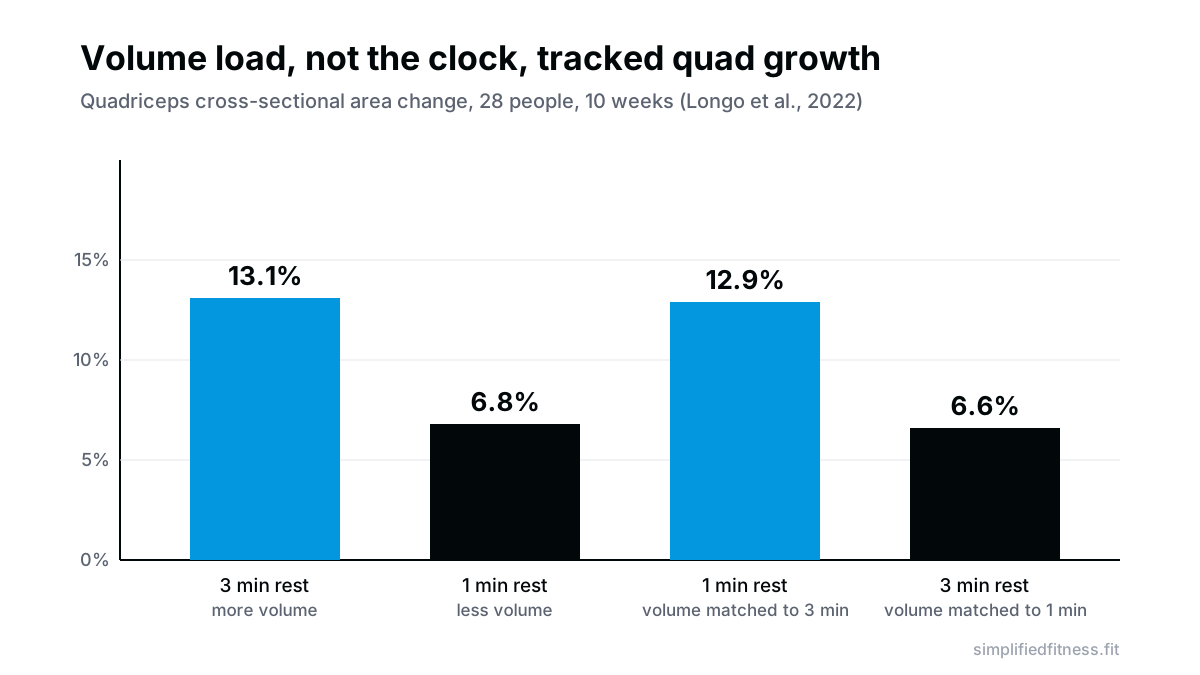
The authors’ conclusion: a greater volume load plays the primary role for hypertrophy, regardless of rest interval. Treat that as a single study with a unilateral, single-exercise design in a small sample. But it fits the pattern in the meta-analyses, and it changes how you should think about rest. Rest is not a magic variable. It is a lever on how much quality work you can pile up.
If you want to track that work, our training volume calculator is a quick way to see your weekly sets and tonnage. The deeper picture of how much volume helps is in the weekly set volume dose-response guide.
How much rest does a hard set actually need?
What does rest buy you physically? Two things are plausible, and the evidence for them is stronger in some places than others.
1. Energy recovery. During a hard set, your muscle burns through phosphocreatine, a fast fuel reserve that rebuilds ATP. In intense exercise it can drop below 30% of resting levels, and restoring it depends on aerobic metabolism. Resynthesis has a fast phase and a slower one (McMahon and Jenkins, 2002). In a cycling study with eight men, phosphocreatine fell to about 17% of resting after a 30-second sprint and was back to about 79% after 3.8 minutes. The recovery of power in the next sprint correlated closely with how much phosphocreatine came back (Bogdanis et al., 1996).
Caveat: those are sprint data, not barbell data, and a set of 10 reps at 70-75% 1RM leans on other systems too. Still, it gives a believable reason why a minute feels so much harder than three.
2. Nervous system output. In a small crossover study of 8 young people doing maximal isometric contractions, 5-minute rests beat 2-minute rests for torque, muscle activation (EMG) and total volume. After the session, peak torque was down 17% with 2-minute rests versus 4% with 5-minute rests (McMahon et al., 2024). That is an acute, isometric, tiny-sample study. It supports the idea that short rests reduce neuromuscular output within a session, but it does not show a long-term hypertrophy result.
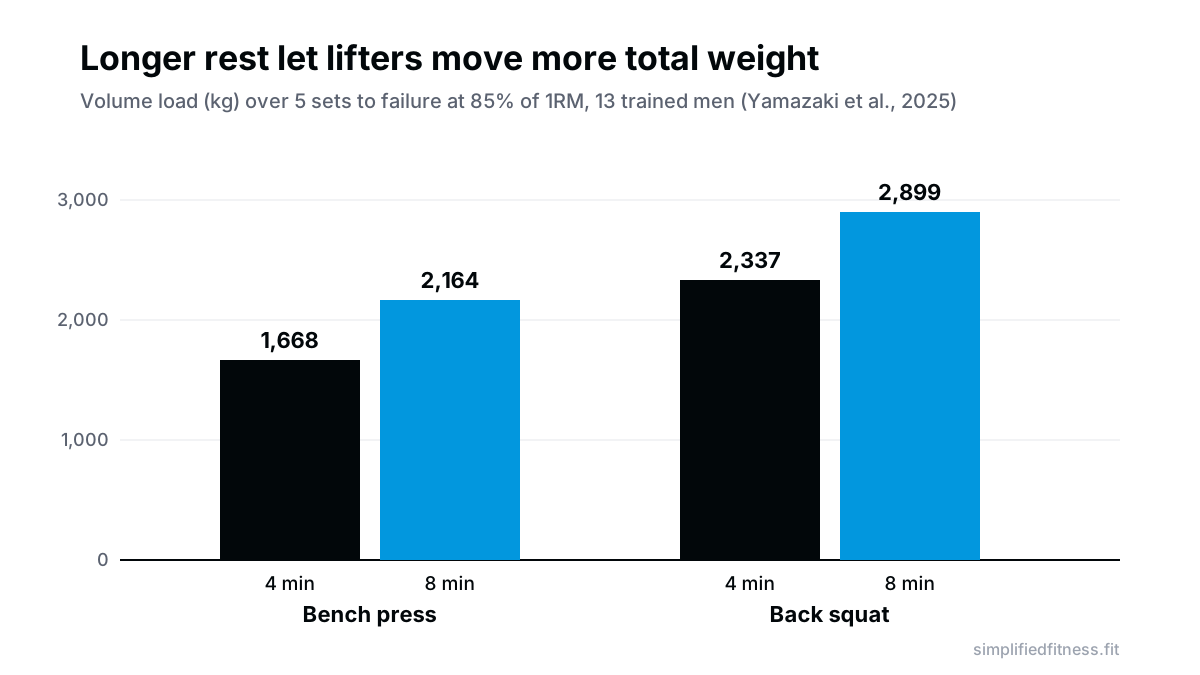
Then there is the plain gym result: more total weight moved. In 13 recreationally trained men doing 5 sets to failure at 85% of 1RM, an 8-minute rest gave a bench volume load of about 2,164 kg versus 1,668 kg for 4 minutes, and about 2,899 kg versus 2,337 kg in the squat (Yamazaki et al., 2025). Those are very long rests, but they show the direction clearly.
Why chasing the pump with short rests backfires
Short rests feel productive. Your muscles burn, your heart pounds, the pump comes up fast. It is easy to read that as “growth happening.” But the pump is swelling and metabolic fatigue. In the volume-matched leg study above, the 1-minute leg grew no more than the 3-minute leg doing the same work.
Here is how it plays out on paper, with made-up but typical numbers. A lifter does 4 sets of 10, rests 45 seconds, gets 10, 8, 6, 5 reps and calls it intensity. Resting 3 minutes, the same lifter might get 10, 9, 8, 8 on the same load. That is 35 reps at the same weight instead of 29. Over a month, that gap compounds.
Short rests also do not have good support as a fat-loss trick. None of the studies cited here measured fat loss. If your goal is leaner, hold your training quality and fix the calorie deficit instead of rushing sets. Our pump versus true hypertrophy article covers the pump question in more depth, and short rest interval penalties and uses covers when short rests are still the right tool.
How long to rest between sets: a practical guide
Here is a usable starting point. These are illustrative, not rules carved in stone.
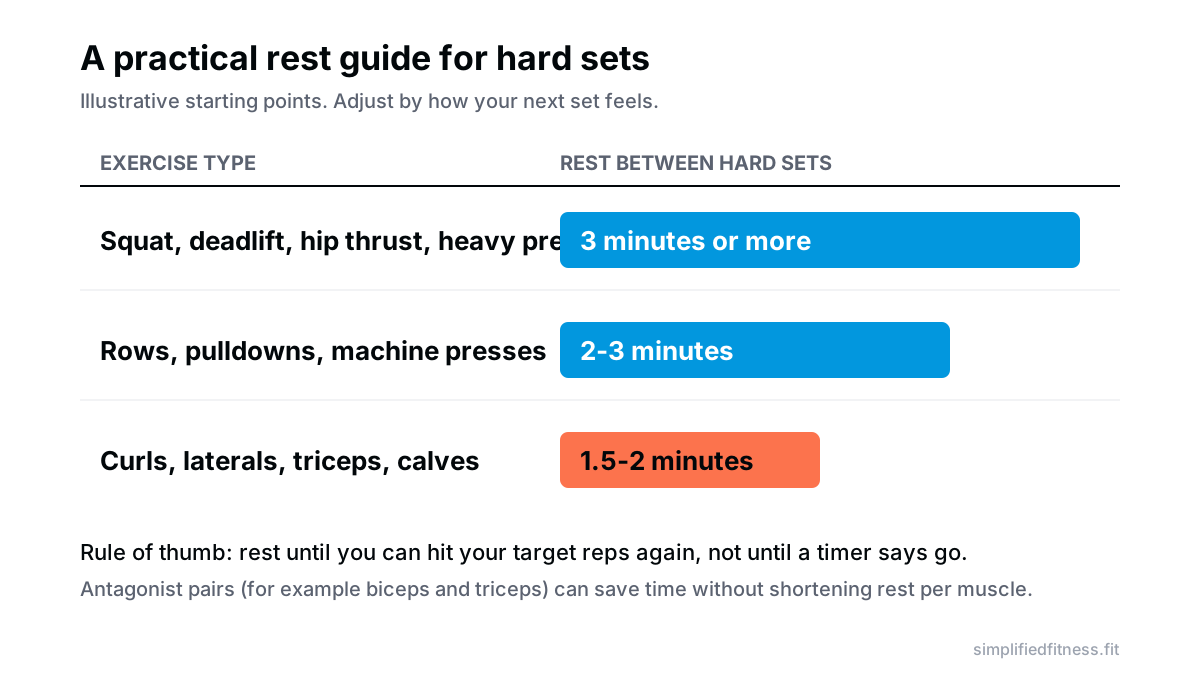
- Heavy compounds (squat, deadlift, hip thrust, barbell press): 3 minutes or more. These tax the whole body and your breathing.
- Moderate compounds (rows, pulldowns, machine presses): 2-3 minutes.
- Isolation (curls, lateral raises, triceps pushdowns, calf raises): about 1.5-2 minutes. Isolation sets hit a smaller muscle and often have less systemic fatigue, though the research on exactly how much shorter is thin. Treat this as a coaching starting point.
A few details that help:
- Use reps, not the clock, as the final judge. Rest until you can hit your target reps again. If you drop from 10 to 6 on set two, rest longer next time.
- Time your rests for two weeks. Rest guessed by feel is easy to get wrong in both directions, especially if you are chatting or on your phone. A timer takes the guesswork out.
- Leave 1-3 reps in reserve on most sets. If you take every set to failure, you will need more rest. Our RIR and RPE calculator helps you pick loads for a target proximity to failure, and the failure versus RIR meta-analysis article covers how close to failure to train.
- Do not be a slave to the timer on long rests. Singer 2024 found no clear extra benefit above about 90 seconds, so the 2-3 minute range is a sensible compromise, not a magic number.
What if I do not have time to rest 3 minutes?
This is the real objection in most Indian gyms where you have a 60-minute slot, the machines are busy and the afternoon heat makes you want to rush. A few options that protect growth:
- Superset opposing muscles. Pair biceps with triceps, or chest with rows, and rest per muscle properly. The rest clock for chest keeps running while you row. Our antagonist arm superset guide shows how to pair them. In the 2025 Yamazaki study, alternating bench press and squat with 4 minutes between exercises gave more squat volume than straight sets with 4-minute rests. Bench volume fell between the 4-minute and 8-minute conditions and did not differ significantly from either. It was a small crossover study of 13 men.
- Cut an exercise, not the rest. Three well-rested lifts beat five rushed ones. This links to the junk volume idea.
- Use lighter isolation rests. Keep the 3-minute rests for your first one or two lifts and shorten the finishers.
- Use a short-rest technique on purpose. Rest-pause and similar methods can compress sets in a controlled way. See our rest-pause, myo-reps and cluster sets guide.
When shorter rests are fine
Short rests are not forbidden. They make sense when:
- You are a beginner with light loads, where fatigue between sets is small.
- You are doing light isolation work, warm-ups or finishers.
- The goal is time efficiency and you can offset it with an extra set.
- You are doing conditioning or circuits, where heart rate is the goal.
The 2024 meta-analysis found both short and long rests produced meaningful growth, so a rushed session still beats skipping the gym.
Limits of this evidence
- Most trials use trained young men and short durations of 8-10 weeks. Results may differ in women, older adults, or longer programs.
- Many studies use one or two exercises, so extending them to a full routine is an assumption.
- Acute studies on volume load, EMG and torque (like the 5-minute and 8-minute ones) show what happens in a session, not what happens in months.
- Hypertrophy is measured with ultrasound or similar tools, which have error margins.
If you have chest pain, unusual shortness of breath, dizziness or fainting during heavy sets, stop and see a doctor before continuing.
The bottom line
Rest 2-3 minutes on hard sets of compound lifts and about 1.5-2 minutes on isolation lifts, and let reps decide. The 1 versus 3 minute trial favored the longer rest. The meta-analyses say the advantage is small and probably runs through volume. Both point the same way: protect your reps, and growth takes care of itself.
For the full framework around load, rep ranges and proximity to failure, go back to the load, rep ranges, RIR and rest intervals guide.
Frequently Asked Questions
How long should I rest between sets to build muscle?
About 2-3 minutes is a solid default for hard sets of compound lifts, and 1.5-2 minutes is often enough for isolation work. Longer rests let you repeat your reps and load, which keeps total volume high, and volume load is closely linked to hypertrophy. Use a timer for a couple of weeks until you learn what 2 minutes actually feels like.
Is 1 minute rest enough for muscle growth?
Yes, you can still grow with 1-minute rests, especially on lighter isolation exercises and if you are newer to training. In trained men, though, a 2016 trial found 3-minute rests produced more thigh growth and strength. If you do rest 1 minute, expect to drop reps or load on later sets and compensate with an extra set if needed.
Does the Schoenfeld rest period study prove 3 minutes is better?
It is strong evidence but not proof. It had only 21 trained men over 8 weeks, and thigh thickness differed significantly while triceps thickness only showed a trend (p = 0.06). A later 2024 meta-analysis of 9 studies found the benefit of longer rests to be small, so treat 3 minutes as a good option rather than a requirement.
Do short rest periods burn more fat?
There is no good evidence from the rest-interval hypertrophy studies that short rests burn more fat. Fat loss depends mainly on a sustained calorie deficit, and the studies here measured muscle and strength, not fat. If you are cutting, protect your training volume and quality and handle the deficit through food.
Do short rests build a better pump and does that matter?
Short rests do give a bigger pump and more burn because blood lactate and swelling build up faster. That sensation is not what drives growth, though, and the extra fatigue cuts the reps you can do on later sets. Chase hard, close-to-failure sets with enough rest instead.
Why does rest time affect muscle growth if the muscle is trained to failure anyway?
If you start set two still fatigued, you complete fewer reps at the same load, so the total work on the muscle falls. Ten weeks of leg training in one trial showed that when volume was matched, 1-minute and 3-minute rests grew muscle about equally. In practice, rest matters mostly because it protects your volume.
How fast does phosphocreatine recover between sets?
It recovers in two phases, a fast one in the first minute or so and a slower one afterwards. In one cycling sprint study, phosphocreatine was back to about 79% of resting levels after 3.8 minutes. Those are sprint data, not lifting data, but they explain why 3 minutes feels much better than 60 seconds on heavy sets.
Is resting 5 minutes or more between sets worth it?
Sometimes. In small acute studies, 5-minute and 8-minute rests produced more volume than 2-minute and 4-minute rests, but the hypertrophy meta-analysis saw no clear extra growth beyond about 90 seconds. For most people, going past 3-4 minutes is only worth it on very heavy squats, deadlifts or low-rep sets.
Can I use supersets to save time without losing growth?
Yes, if you pair muscles that do not fight each other, like biceps with triceps or chest with a row. A 2025 trial found that alternating bench press and squat with a 4-minute gap between them gave more squat volume than straight sets with 4-minute rests, while bench volume landed in between and did not differ significantly from either. Rest still applies per muscle, so the pair should not shorten the gap before the same muscle works again.
Should I rest longer on compound lifts than on isolation lifts?
Generally yes. Big lifts like squats, deadlifts and barbell rows tax your whole body and your breathing, so they take longer to recover from. A small muscle exercise like a lateral raise recovers faster, so 1.5-2 minutes is often enough.
What if I only have 45 minutes in the gym?
Cut the number of exercises or use antagonist supersets before you cut rest on your main lifts. Three solid exercises with proper rest beat six exercises with 45-second gaps, because the short rests quietly shrink your reps. Start with the lifts that matter most for your goal.
Does the rest interval matter if my goal is strength rather than size?
It matters more for strength. In the same 2016 trial, 3-minute rests gave larger gains in squat and bench 1RM than 1-minute rests. Heavy sets need full recovery to keep load high, so 3 minutes or more is a sensible starting point.
How do I know I have rested enough?
Rest until your breathing has settled and you could realistically repeat your target reps at the same load. If your reps fall off a cliff on set two, you probably rested too little. A rep or two of drop-off across sets is normal.
Sources & References
Every claim above is checked against peer-reviewed research (PubMed, U.S. National Library of Medicine) or guidance from established health bodies. How we fact-check.
- Schoenfeld BJ, et al. Longer interset rest periods enhance muscle strength and hypertrophy in resistance-trained men. J Strength Cond Res. 2016. PMID: 26605807
- Grgic J, et al. The effects of short versus long inter-set rest intervals in resistance training on measures of muscle hypertrophy: a systematic review. Eur J Sport Sci. 2017. PMID: 28641044
- Singer A, et al. Give it a rest: a systematic review with Bayesian meta-analysis on the effect of inter-set rest interval duration on muscle hypertrophy. Front Sports Act Living. 2024. PMID: 39205815
- Longo AR, et al. Volume load rather than resting interval influences muscle hypertrophy during high-intensity resistance training. J Strength Cond Res. 2022. PMID: 35622106
- Yamazaki Y, et al. Effects of rest interval configuration between sets on volume load during five sets of bench press and back squat exercise. J Strength Cond Res. 2025. PMID: 40644659
- McMahon G, et al. Increased neuromuscular activity, force output, and resistance exercise volume when using 5-minute compared with 2-minute rest intervals between the sets. J Strength Cond Res. 2024. PMID: 38953795
- Bogdanis GC, et al. Contribution of phosphocreatine and aerobic metabolism to energy supply during repeated sprint exercise. J Appl Physiol. 1996. PMID: 8964751
- McMahon S, Jenkins D. Factors affecting the rate of phosphocreatine resynthesis following intense exercise. Sports Med. 2002. PMID: 12238940
- de Salles BF, et al. Rest interval between sets in strength training. Sports Med. 2009. PMID: 19691365
- Mcleod JC, et al. The influence of resistance exercise training prescription variables on skeletal muscle mass, strength, and physical function in healthy adults: an umbrella review. J Sport Health Sci. 2024. PMID: 37385345

Umair Hazrami · Founder & Head Coach, Simplified Fitness
Umair Hazrami founded Simplified Fitness and the Simplified Lifter channel to cut through fitness noise. With 4+ years of consistent training and 10+ coaching clients, he writes every guide from the peer-reviewed research and links the sources so you can check them. Our editorial standards.
Educational content only, not medical advice. If you have a medical condition, are pregnant, or take medication, talk to a qualified doctor before changing your diet, supplements or training. Full disclaimer.
Keep reading

Programming
Blood Flow Restriction (BFR) Practical Guide: Cuff Pressures, Rep Schemes, and Light Loads
How to do BFR training safely: cuff placement, pressure as a percentage of occlusion, the 30-15-15-15 scheme and who should skip it. Every study linked.
8 min read
Programming
Calibrating True RIR: A Safe Gym Test for Technical vs Absolute Failure
Calibrating RIR means testing how many reps you really have left. Use this safe machine protocol to find true failure and fix your 2 RIR guesses.
8 min read

Programming
CNS Fatigue vs Peripheral Fatigue: How Failure Hits Squats and Curls Differently
CNS fatigue vs peripheral fatigue: why failing a squat flattens you for days while failing a curl barely registers, and how many reps to leave in reserve.
9 min read
Programming
Failure on Machines and Cables vs Free Barbells: Managing Injury Risk and Axial Fatigue
Failure on machines vs barbells: why machine sets feel safer and less draining, what the research says, and where to push hard or stop at 1-2 RIR.
8 min read