The Hypertrophy Rep Spectrum: Why 5-30 Reps Build Similar Muscle When Sets Are Hard
The hypertrophy rep range spectrum explained: why 5-30 reps can build similar muscle when sets are hard, plus the real trade-offs of heavy and light sets.
TL;DR. The short answer
- Muscle growth is similar across a wide load range, roughly 5 to 30 reps, as long as sets are taken close to failure. The old 8-12 'hypertrophy zone' is a useful default, not a biological requirement.
- Heavier loads (about 5-8 reps) build more maximal strength. Meta-analyses find strength favours heavy training while hypertrophy is comparable across loads.
- Light sets (20-30 reps) work only when they are genuinely hard. In one 8-week trial in untrained men, light sets stopped well short of failure grew far less muscle than light sets taken to failure.
- For most people 6-15 reps is the practical sweet spot, with heavy work on big compound lifts and lighter, higher-rep work on isolations and machines.
- This is not a licence to coast. Closer to failure tends to mean more growth, so count your reps in reserve (RIR) honestly.
Part of our complete guide: Reps in Reserve, Rep Ranges and Rest Times: The Evidence-Based Guide to How Hard Every Set Should Be
Table of contents
Which rep range is best for muscle growth? Research suggests there is no single winner. When sets are taken close to failure, the hypertrophy rep range spectrum is wide: roughly 5 to 30 reps can build similar amounts of muscle.
That does not mean every rep range feels the same or costs the same. It means the old “8-12 reps for size, under 6 for strength, over 15 for endurance” rule is much blurrier than the gym folklore says. This article is a focused piece of our guide to load, rep ranges, RIR and rest intervals, so here we stay on rep ranges and the trade-offs between them.
Where the 8-12 “hypertrophy zone” came from
The traditional model is called the repetition continuum. Heavy loads (1-5 reps) build maximal strength, moderate loads (8-12 reps) build muscle, and light loads (15+ reps) build muscular endurance. It is tidy. It is also on shaky ground.
A 2021 review by Schoenfeld and colleagues re-examined it directly. The authors argued that current research fails to support some of the model’s underlying presumptions and proposed a new model: muscular adaptations can be obtained, and in some cases optimised, across a wide spectrum of loading zones (Schoenfeld et al., 2021).
The continuum is not completely wrong. Heavier training does favour maximal strength, and light training does improve local endurance. The part that falls apart is the claim that moderate loads are uniquely ideal for size.
Does the hypertrophy rep range spectrum really span 5-30 reps?
The strongest summary comes from a 2017 systematic review and meta-analysis of 21 studies. It included only trials that compared low-load training (60% of 1RM or less) with high-load training (over 60% of 1RM), with all sets taken to momentary muscular failure and lasting at least 6 weeks. Gains in 1RM strength were greater with high loads, there was no significant difference in isometric strength, and changes in muscle hypertrophy were similar between conditions (Schoenfeld et al., 2017).
A 2023 Bayesian network meta-analysis in the British Journal of Sports Medicine reached a similar picture across a much larger pool: 119 studies (3,364 participants) for hypertrophy. Higher loads (over 80% of 1RM) maximised strength gains, and all prescriptions comparably promoted muscle hypertrophy, with the highest-ranked hypertrophy prescription being higher-load, multi-set, twice-weekly training (Currier et al., 2023). Note the word “comparably”. The ranking differences were not large.
And this is not only a story about beginners. In a 2015 trial, 18 well-trained young men did either 25-35 reps or 8-12 reps per set, three sets of seven exercises, three times a week for 8 weeks, with sets to failure. Muscle thickness rose in both groups, with no significant differences in the elbow flexors, elbow extensors or quadriceps (Schoenfeld et al., 2015).
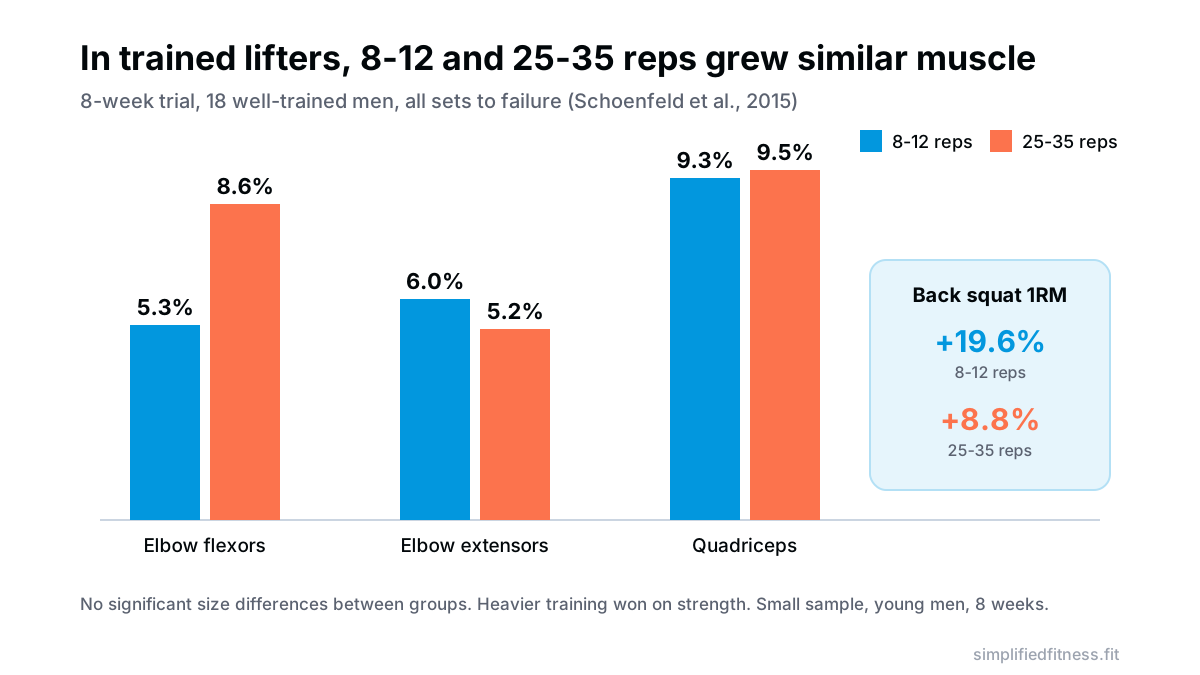
Two honest caveats. That trial was small (nine per group), short, and used young men. Meta-analyses also vary in how they define “failure” and “load”, so I would read the result as “growth is much less load-dependent than we assumed”, not “load never matters”.
The catch: light sets only work when they are hard
Here is where people misuse the finding. “Any rep range works” quietly depends on “if you train hard enough”.
A 2022 trial by Lasevicius and colleagues makes the point cleanly. Twenty-five untrained men trained each leg with a different unilateral knee extension protocol for 8 weeks: heavy (80% 1RM) or light (30% 1RM), each taken to failure or stopped short, with total volume equated. Quadriceps cross-sectional area rose significantly in heavy-to-failure (8.1%), heavy-not-to-failure (7.7%) and light-to-failure (7.8%). The light-not-to-failure leg (about 20 reps) showed no significant change (2.8%) (Lasevicius et al., 2022).
The authors concluded that with low loads, a high level of effort seems more important than total training volume, while with heavy loads, failure gave no additional benefit.
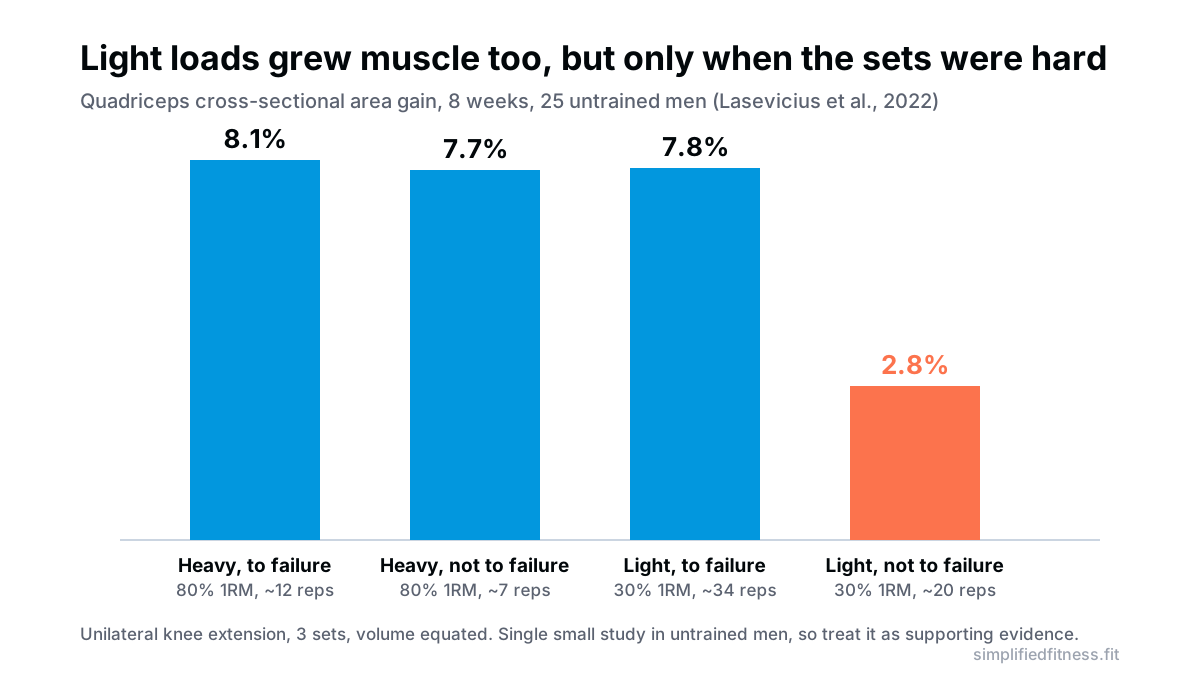
Why might this happen? A plausible explanation (not proven by this study) is that with light loads, the early reps are easy and do little. Only the last several reps, when fatigue forces more muscle fibres to work, are truly stimulating. In the study, the light sets stopped short averaged about 20 reps, while light sets to failure averaged about 34, so the stopped sets left a lot of reps unused.
This was untrained men, one exercise, one small study. It supports the idea rather than settling it.
Does proximity to failure matter more than rep count?
Evidence points that way, with nuance. A 2023 meta-analysis of 15 studies found a trivial advantage for training to set failure over non-failure (effect size 0.19), no advantage of momentary muscular failure over non-failure (effect size 0.12, confidence interval -0.13 to 0.37), and the authors concluded there was no evidence that momentary muscular failure beats stopping short of it (Refalo et al., 2023).
That sounds like “close to failure doesn’t matter”. But a 2024 series of meta-regressions, which estimated proximity to failure as reps in reserve, found a different pattern for hypertrophy: slopes were negative, meaning muscle size gains increased as sets were terminated closer to failure. The authors flagged that RIR had to be estimated from study descriptions and that the analysis was exploratory (Robinson et al., 2024).
Why might the two disagree? One tests failure versus not-failure as a category, the other models how close sets finish on a continuum, and each relies on imperfect data. A cautious takeaway: you do not need to hit absolute failure, but sets that finish far from it are probably leaving growth on the table. Reps in reserve (RIR) is the tool for this, and our guide to the RIR and RPE scale shows how to use it. For the full failure debate, see our breakdown of training to failure versus RIR.
The trade-offs between rep ranges
If growth is similar, why not pick whatever you like? Because the ranges differ in cost.
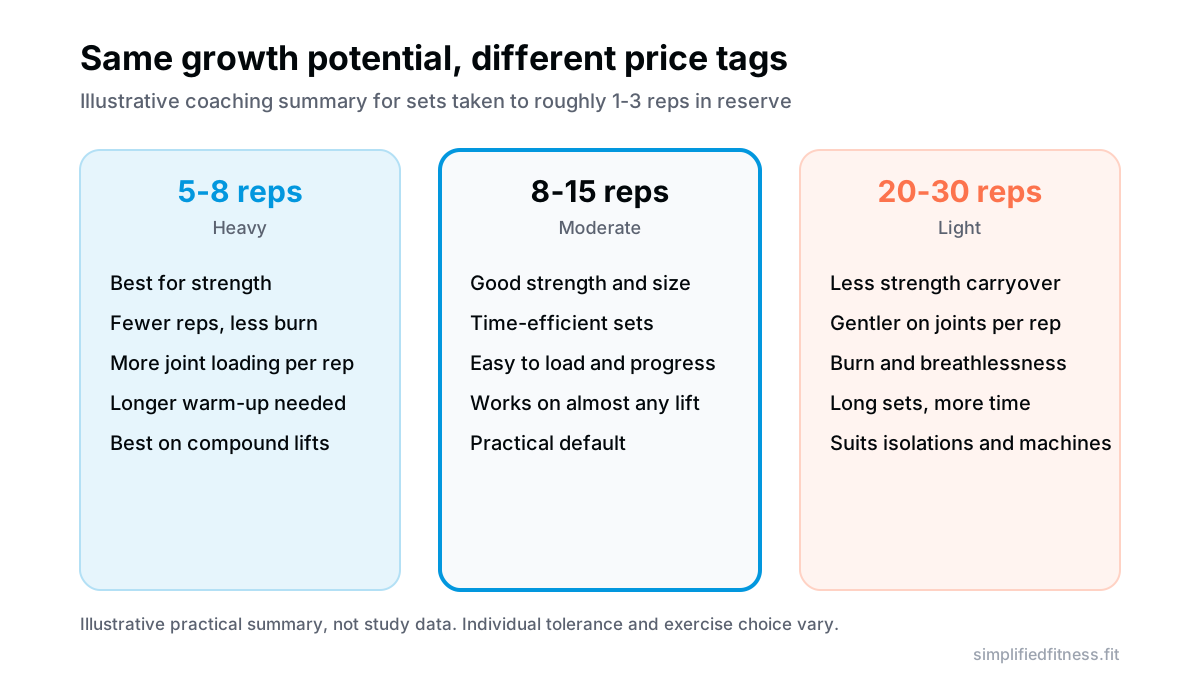
| Rep range | Strength | Main upside | Main downside |
|---|---|---|---|
| 5-8 (heavy) | Best | Builds strength alongside size, fewer reps to grind through | More load per rep, longer warm-up, harder to push safely to failure on some lifts |
| 8-15 (moderate) | Good | Efficient, easy to progress, works on nearly every exercise | None serious, which is why it is a practical default |
| 20-30 (light) | Lower | Lighter load per rep, can suit sensitive joints and isolations | Long, burning sets, heavy breathing, more time per set |
Heavy training reliably wins on strength. The 2017 meta-analysis found greater 1RM gains with high loads, and in the 2015 trained-men trial back squat strength rose 19.6% for the 8-12 group versus 8.8% for the 25-35 group (Schoenfeld et al., 2015). If you want a bigger squat, you need to practise heavy squats.
The 25-35 rep group in that trial improved upper-body muscle endurance more, which fits the old model’s endurance prediction.
On joints, I will be careful. Many lifters report that heavy singles and triples beat up their elbows and knees, and light sets feel kinder, but I have not found strong trial evidence that one range is clearly safer. Individual tolerance varies, so treat it as a practical preference. Our article on rep ranges and joint wear goes deeper. If a joint hurts and keeps hurting, see a doctor or physiotherapist rather than programming around it by guesswork.
For light sets, the cost is mostly fatigue and time. A set of 30 leg presses to near failure is as much a test of lungs as legs. That is why I rarely suggest 25-30 reps on big compounds like squats.
How to use this in your own training
Here is a simple way to turn the research into a plan.
- Big compound lifts (squat, bench, row, deadlift variations): 5-10 reps, which also serves strength.
- Machines, cables and dumbbell work: 8-15 reps as the default.
- Small isolations (lateral raises, curls, calf raises, leg extensions): 12-30 reps is perfectly reasonable.
- Everything: end most sets with roughly 1-3 reps in reserve.
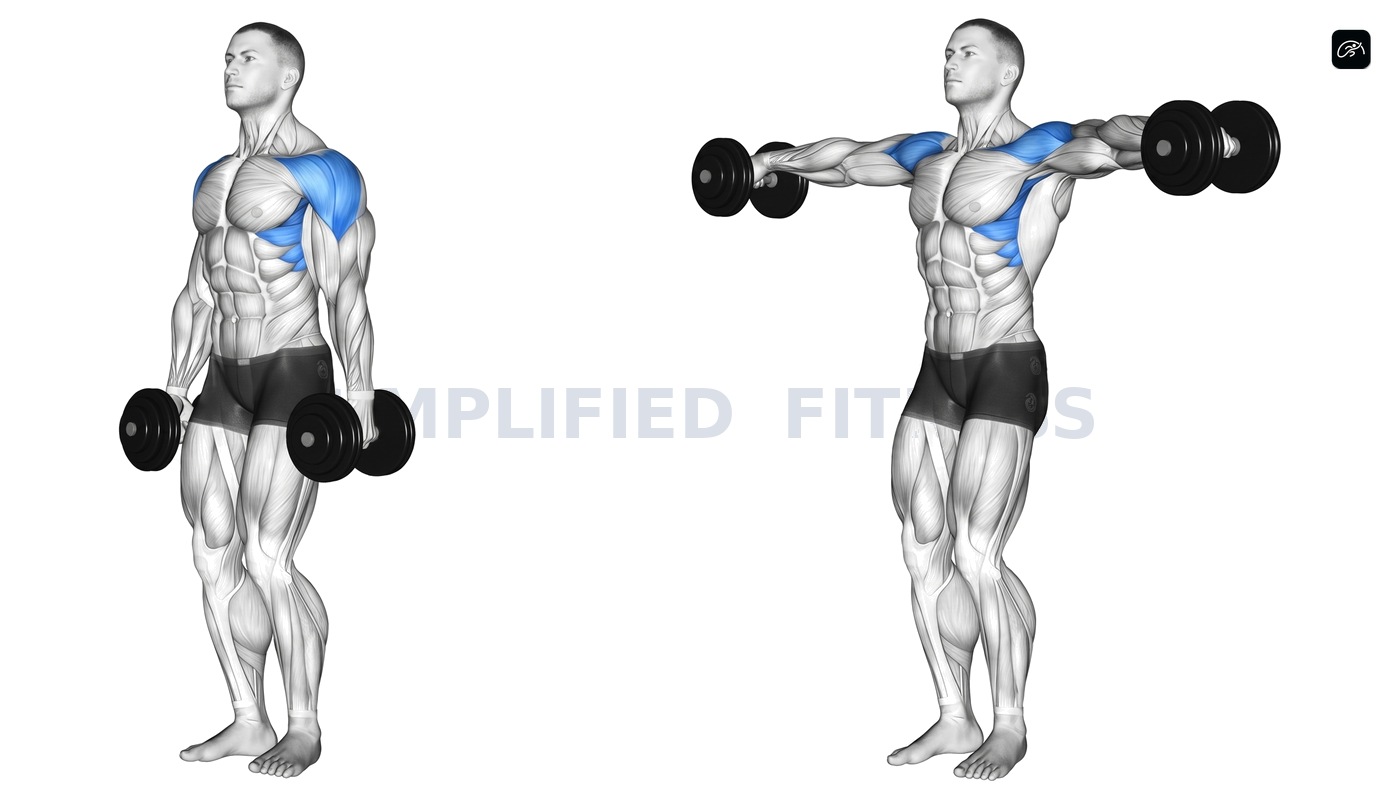
Lateral raises are a good example. Loading them heavy turns them into a swinging shrug, while 15-25 controlled reps with a lighter pair keeps the side delts doing the work.
If you are not sure how heavy “heavy” is, use the 1RM calculator to estimate loads from a recent set, and the RIR and RPE calculator to translate effort into percentages. For lifters on a budget or with limited equipment in a crowded Indian gym, the spectrum is genuinely helpful: when the heavy dumbbells are taken, a lighter pair taken close to failure is a legitimate substitute.
What this does not tell us
A few honest limits. Most of these trials ran 6-12 weeks, so we do not know how the spectrum plays out over years. Participants were mostly young men, with limited data in women and older adults. Studies often measured one or two muscles. And “close to failure” was frequently self-reported or estimated, which is notoriously imprecise.
The research is also about muscle size. If your goal is maximal strength for a competition or a sport, load matters a lot more. And if you have a medical condition or injury, check with your doctor before pushing sets close to failure.
Frequently Asked Questions
What is the best rep range for hypertrophy?
There is no single best range, because muscle growth appears similar across roughly 5 to 30 reps when sets are taken close to failure. A 2017 meta-analysis of 21 studies found hypertrophy was comparable between low-load and high-load training even though strength favoured heavy loads. For most people, 6-15 reps is the most practical zone, since it balances joint stress, time and effort.
Is 8-12 reps really the hypertrophy zone?
No, 8-12 is a convenient range, not a special biological zone. The traditional repetition continuum assumed moderate loads uniquely optimise muscle size, but a 2021 review argued current research fails to support that assumption. Keep 8-12 as your default if you like it, and feel free to use 5-8 or 15-30 where they suit the exercise better.
Can you build muscle with 20-30 reps?
Yes, if the sets are hard enough. In a 2015 trial of 18 well-trained men, 25-35 reps and 8-12 reps both increased muscle thickness with no significant differences between groups when sets went to failure. Use higher reps on isolations and machines, and stop only when you could do about 1-3 more reps at most.
Do heavy weights build more muscle than light weights?
Not clearly. Meta-analyses find similar hypertrophy with heavy and light loads when both are taken near failure, while heavy loads build more maximal strength. If you also want to get stronger on lifts like squat or bench, include some sets in the 5-8 rep range.
Do I have to train to failure to grow muscle?
No, but sets need to be hard. A 2023 meta-analysis found no evidence that momentary muscular failure beats stopping short of it for hypertrophy, though a 2024 meta-regression suggested growth tends to improve as sets finish closer to failure. A sensible target is roughly 1-3 reps in reserve on most sets, with the last set of an isolation exercise sometimes closer.
Why did light-weight training fail in some studies?
Light sets only recruit and fatigue enough muscle when they end near failure. In an 8-week trial of untrained men, light sets (about 20 reps) stopped short of failure produced a non-significant 2.8% quadriceps growth, versus roughly 8% for light sets taken to failure. If you use light loads, make the final reps genuinely slow and close to your limit.
What is the repetition continuum?
It is the idea that heavy loads build strength, moderate loads build size and light loads build endurance. A 2021 review proposed a new model in which muscular adaptations can be obtained across a wide spectrum of loading zones. Strength and local endurance do still show some load specificity, so the continuum is half right.
Are heavy sets of 5 worse for my joints?
They may feel harder on joints for some people, but good evidence that moderate loads protect joints is limited. Heavy sets mean more weight per rep, while light sets mean more total reps and more cumulative fatigue. Warm up well, pick exercise variations that feel comfortable and see a doctor or physiotherapist for pain that persists.
Should I use different rep ranges for different exercises?
Yes, this is a practical way to use the spectrum. Heavy compounds like squats and deadlifts are tiring in long sets and are often easier to train at 5-10 reps, while lateral raises, curls and leg extensions are comfortable at 12-30 reps. Choose the rep range that lets you reach near failure with good form and without breathless misery.
Is 5 reps good for muscle growth?
It can be, provided the set is close to failure, meaning you could do about 1-3 more reps. In the 2023 network meta-analysis, all prescriptions promoted hypertrophy comparably, while higher-load training maximised strength. Use sets of 5-8 on big compound lifts if strength is also a goal.
How many reps should a beginner do?
A beginner will make progress across a wide range, so choose a range you can perform with solid technique. Beginners often misjudge how close they are to failure, so start with 8-15 reps and stop 2-3 reps short. Track your weight and reps and add load or reps when the target range feels manageable.
Does the rep range matter more than the number of sets?
For growth, rep range seems to matter less than most people think. The 2023 network meta-analysis found all load prescriptions promoted hypertrophy comparably, and the authors noted that the highest-ranked hypertrophy prescriptions included multiple sets. Pick a rep range you can sustain, then manage total hard sets per muscle each week.
Sources & References
Every claim above is checked against peer-reviewed research (PubMed, U.S. National Library of Medicine) or guidance from established health bodies. How we fact-check.
- Schoenfeld BJ, et al. Loading Recommendations for Muscle Strength, Hypertrophy, and Local Endurance: A Re-Examination of the Repetition Continuum. Sports (Basel). 2021. PMID: 33671664
- Refalo MC, et al. Influence of Resistance Training Proximity-to-Failure on Skeletal Muscle Hypertrophy: A Systematic Review with Meta-analysis. Sports Med. 2023. PMID: 36334240
- Schoenfeld BJ, et al. Strength and Hypertrophy Adaptations Between Low- vs. High-Load Resistance Training: A Systematic Review and Meta-analysis. J Strength Cond Res. 2017. PMID: 28834797
- Robinson ZP, et al. Exploring the Dose-Response Relationship Between Estimated Resistance Training Proximity to Failure, Strength Gain, and Muscle Hypertrophy: A Series of Meta-Regressions. Sports Med. 2024. PMID: 38970765
- Lasevicius T, et al. Muscle Failure Promotes Greater Muscle Hypertrophy in Low-Load but Not in High-Load Resistance Training. J Strength Cond Res. 2022. PMID: 31895290
- Schoenfeld BJ, et al. Effects of Low- vs. High-Load Resistance Training on Muscle Strength and Hypertrophy in Well-Trained Men. J Strength Cond Res. 2015. PMID: 25853914
- Currier BS, et al. Resistance training prescription for muscle strength and hypertrophy in healthy adults: a systematic review and Bayesian network meta-analysis. Br J Sports Med. 2023. PMID: 37414459

Umair Hazrami · Founder & Head Coach, Simplified Fitness
Umair Hazrami founded Simplified Fitness and the Simplified Lifter channel to cut through fitness noise. With 4+ years of consistent training and 10+ coaching clients, he writes every guide from the peer-reviewed research and links the sources so you can check them. Our editorial standards.
Educational content only, not medical advice. If you have a medical condition, are pregnant, or take medication, talk to a qualified doctor before changing your diet, supplements or training. Full disclaimer.
Keep reading

Programming
Blood Flow Restriction (BFR) Practical Guide: Cuff Pressures, Rep Schemes, and Light Loads
How to do BFR training safely: cuff placement, pressure as a percentage of occlusion, the 30-15-15-15 scheme and who should skip it. Every study linked.
8 min read
Programming
Calibrating True RIR: A Safe Gym Test for Technical vs Absolute Failure
Calibrating RIR means testing how many reps you really have left. Use this safe machine protocol to find true failure and fix your 2 RIR guesses.
8 min read
Programming
CNS Fatigue vs Peripheral Fatigue: How Failure Hits Squats and Curls Differently
CNS fatigue vs peripheral fatigue: why failing a squat flattens you for days while failing a curl barely registers, and how many reps to leave in reserve.
9 min read
Programming
Failure on Machines and Cables vs Free Barbells: Managing Injury Risk and Axial Fatigue
Failure on machines vs barbells: why machine sets feel safer and less draining, what the research says, and where to push hard or stop at 1-2 RIR.
8 min read