Training to Failure vs Leaving 1-3 RIR: What the Hypertrophy Meta-Analysis Shows
Does training to failure build more muscle than stopping 1-3 reps short? A 15-study meta-analysis, recovery data and rules for which lifts to push.
TL;DR. The short answer
- Training to momentary failure has not been shown to build more muscle than stopping a few reps short. A 2023 meta-analysis of 15 studies found no hypertrophy advantage for momentary failure (effect size 0.12, 95% CI -0.13 to 0.37).
- When failure is defined loosely as 'set failure', the meta-analysis found a trivial edge (effect size 0.19, CI 0.00 to 0.37). So the honest summary is 'little to no benefit', not 'identical'.
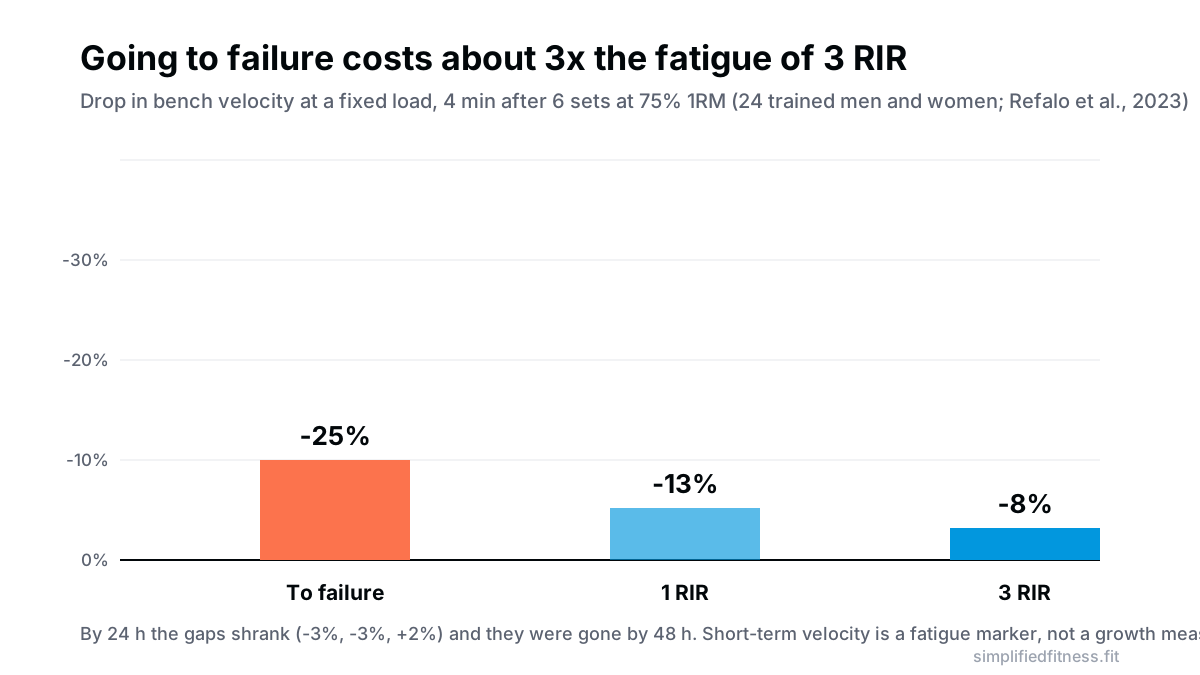
- Failure costs more recovery. In trained lifters, six bench sets to failure cut bar speed by 25% four minutes later, versus 13% at 1 RIR and 8% at 3 RIR.
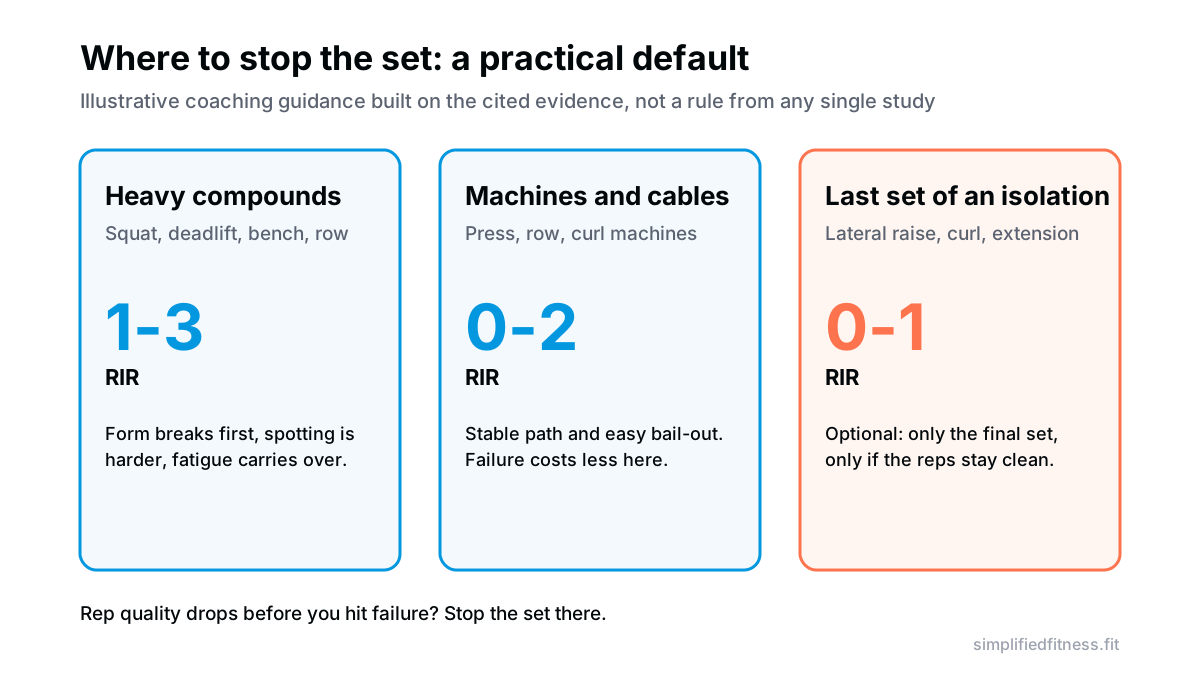
- A sensible default is 1-3 RIR on heavy compound lifts, with 0-1 RIR optional on the last set of safe machine or cable isolations.
- Not everyone judges RIR well. Beginners and anyone unsure can end some sets at true failure on safe machines to calibrate.
Part of our complete guide: Reps in Reserve, Rep Ranges and Rest Times: The Evidence-Based Guide to How Hard Every Set Should Be
Table of contents
No, you do not need to train to failure to build muscle. The best pooled evidence on training to failure vs RIR for hypertrophy shows no clear growth advantage for pushing every set to the wall, and a clear recovery cost. This is one piece of our complete guide to load, rep ranges, RIR and rest intervals.
Here we stay on a single question: how close to failure do your sets really need to be? If you are new to the scale itself, start with our RIR and RPE explainer.
What does the meta-analysis say about failure vs non-failure training?
The main evidence is a 2023 systematic review and meta-analysis of 15 studies in healthy adults, comparing sets taken to failure (or to a bigger drop in bar speed) against sets stopped shorter (Refalo et al., 2023). It split the data three ways, because “failure” is defined differently from study to study.
- Any definition of set failure vs non-failure: a trivial advantage for failure (effect size 0.19, 95% CI 0.00 to 0.37).
- Momentary muscular failure vs non-failure: no advantage either way (effect size 0.12, CI -0.13 to 0.37).
- High vs moderate velocity loss thresholds (a way of ending sets by bar speed, here over 25% vs 20-25%): no advantage for the higher threshold (effect size 0.08, CI -0.16 to 0.32).
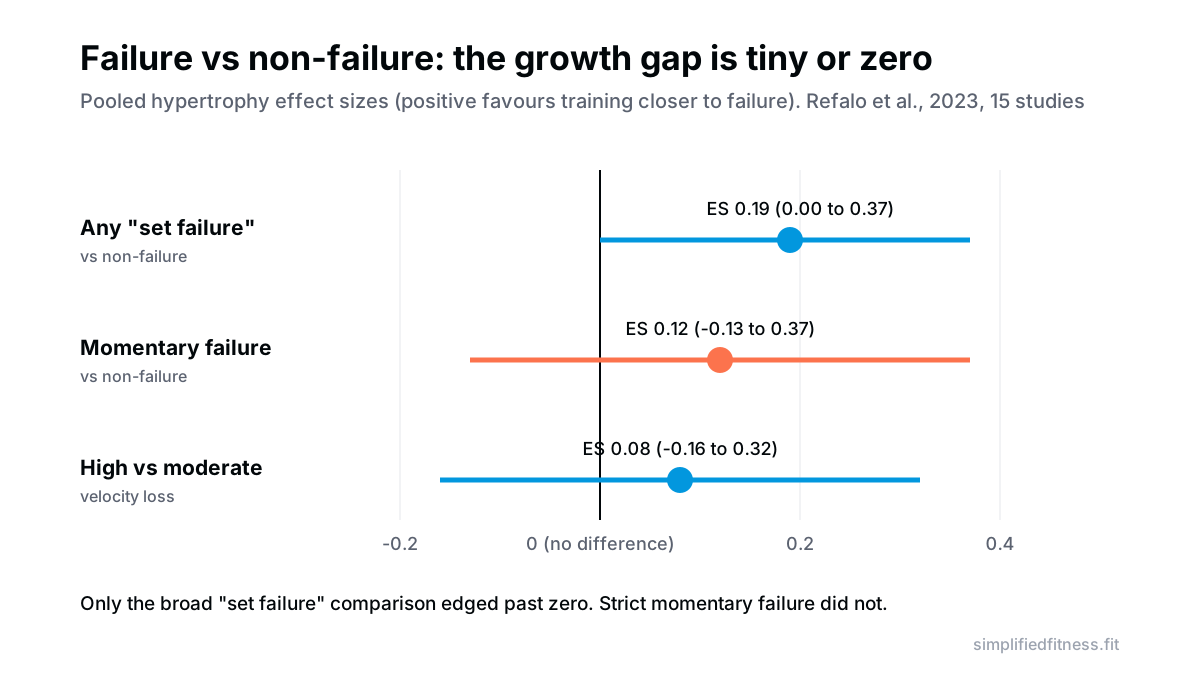
The authors concluded there is no evidence that momentary failure is superior for hypertrophy, and that more proximity to failure does not always mean more growth, which hints at a non-linear relationship (Refalo et al., 2023).
A note on wording. You will see this research summarised as “identical muscle growth”. That overstates it. A trivial edge for failure showed up under the loosest definition, and a meta-analysis cannot prove two approaches are exactly equal. The fair reading is: little to no extra growth, with uncertainty on both sides.
There is also a counterweight. A 2024 series of meta-regressions estimated how many reps in reserve each study’s sets ended at, and found muscle growth tended to increase as sets finished closer to failure, while strength did not change much across RIR. The authors stressed that RIR had to be estimated from study descriptions and called the analysis exploratory (Robinson et al., 2024). Read together, the two analyses suggest sets should be genuinely hard, but they do not show that the last rep to true failure is required.
Do individual trials in trained lifters agree?
Mostly, with one interesting wrinkle. Study results are small and noisy, so look at the direction of several rather than any single paper.
Santanielo et al. (2020) trained each leg of 14 trained participants differently for 10 weeks: one leg to failure, the other short of it. Muscle cross-sectional area rose in both (13.5% for failure, 18.1% for non-failure) with similar strength gains and no significant difference between protocols (Santanielo et al., 2020).
Ruple et al. (2023) put 19 previously trained adults on squat, bench and deadlift for 5 weeks, ending sets at 0-1 RIR or at 4-6 RIR. Total volume did not differ significantly. Strength rose in both groups and there was no significant group difference in muscle size, though motor unit firing rates changed differently between groups (Ruple et al., 2023). Five weeks is short, so treat it as a hint.
Hermann et al. (2025) is the wrinkle. In 42 resistance-trained men and women doing a single set per exercise, twice a week for 8 weeks, several hypertrophy measures tended to favour failure over 2 RIR, though absolute differences were generally modest. Strength and local muscular endurance were similar (Hermann et al., 2025).
Why might that one lean the other way? With only one set per exercise, there is little fatigue to pay for, so each set is doing all the work and failure may add a bit. Add more sets and the fatigue bill rises. That is a reasoned explanation, not a tested one.
Does training to failure hurt recovery?
This is where the evidence is clearest, and it is the practical reason most coaches prefer leaving reps in the tank.
In a 2023 trial, 24 resistance-trained men and women did six bench press sets at 75% of 1RM, ending each set at failure, 1 RIR or 3 RIR on different days. Four minutes later, lifting velocity at a fixed load was down 25% after failure, 13% after 1 RIR and 8% after 3 RIR. At 24 hours, velocity was still down 3% for failure and for 1 RIR, but up 2% for 3 RIR. By 48 hours the differences were gone (Refalo et al., 2023).
Two other trials in trained men point the same way:
- Ten men trained bench press and squat with 3 sets of 10 reps taken to failure, versus 6 sets of 5 (same total volume, not to failure). Failure caused a larger drop in jump height and bar speed, and recovery between 24 and 48 hours was slower (Morán-Navarro et al., 2017).
- Nine men did 3 sets of 8 reps (to failure) or 3 sets of 4 reps (half the possible reps) at 80% 1RM. Jump height stayed down up to 48 hours after the failure protocol but had recovered by 6 hours after the half-effort protocol (González-Badillo et al., 2016).
These are small samples, mostly men, measured over a few days. They show fatigue, not injury, and not long-term outcomes. Still, the direction is consistent: closer to failure, more fatigue, longer to bounce back. Refalo’s team also reported that discomfort, exertion and soreness climbed as sets got closer to failure (Refalo et al., 2023).
When is training to failure actually useful?
Failure has real uses. It is just a tool for specific jobs, not a daily default.
- The last set of a safe isolation. Lateral raises, cable curls, leg extensions, pec dec. The path is fixed, so a missed rep is low risk.
- Single-set or very low-volume plans. The 2025 trial above hints that failure may help a little when each exercise gets only one set.
- Calibrating your RIR. If you think you are stopping at 2 RIR but have never seen true failure on that lift, an occasional all-out set on a safe machine fixes the guess.
- Time-crunched sessions. Fewer sets, each taken hard, can be a decent trade when you only have 30 minutes.
When does failure cause disproportionate cost?
Heavy compounds. Squats, deadlifts, heavy rows and bench without a spotter all load the whole body, and form is the first thing to go near the limit. A grinding last rep of a squat is more than a hard rep; it costs you recovery for the next leg session and raises the stakes if the bar stalls.
In the gym, this looks like a lifter who hits failure on every set of squats on Monday, then wonders why Thursday’s leg day feels flat. The most common mistake here is treating “hard” and “failure” as the same word. You can train hard at 2 RIR.
Here is a simple working table. It is coaching guidance built on the evidence above, not a rule from any one study.
| Exercise type | Suggested RIR | Why |
|---|---|---|
| Heavy barbell squat, deadlift, hip hinge | 2-3 | Form breakdown, high systemic fatigue |
| Barbell bench, overhead press, heavy rows | 1-3 | Spotting is harder, shoulders and back tire quickly |
| Machine presses, rows, leg press | 0-2 | Fixed path, easier to bail out |
| Cable and machine isolations (curls, raises, extensions) | 0-1 on the last set | Low systemic cost, safe to push |
For a deeper rule set, read our breakdown of proximity to failure for compounds vs isolations and the piece on failure on machines and cables vs free barbells.
How do you know where 1-3 RIR actually is?
The catch with “stop at 2 RIR” is that you have to guess. People tend to be imperfect at this, and accuracy depends on the lift. In the 2025 trial of 42 lifters, participants estimated RIR more accurately on bench press than on squat, and improved over the 8 weeks, especially on bench (Hermann et al., 2025).
Practical ways to sharpen it:
- Take one set per month to true failure on a safe machine and compare it with what you predicted.
- Watch bar speed. When reps slow noticeably, you are close.
- Judge squats more conservatively than bench, since estimates seem harder there.
- Log your RIR next to each set. You will spot patterns within a few weeks.
Our guide to calibrating true RIR goes through these drills in detail, and the RIR and RPE calculator turns RIR into a percentage of your 1RM.
How should you structure a week using these findings?
Here is a default that follows the evidence without being fancy. Adjust to your own recovery.
- Main compound lifts: 3 sets ending around 2 RIR.
- Secondary machine or dumbbell work: 2-3 sets at 1-2 RIR.
- Isolation work: first sets at 1-2 RIR, last set at 0-1 RIR if it stays clean.
- If performance drops across the week or joints feel beaten up, add one rep of reserve everywhere.
- If you feel under-stimulated and recover easily, move the last set of safe lifts a rep closer.
For vegetarian lifters in India eating dal, paneer and curd, recovery depends partly on whether protein and total food are adequate. Getting these wrong makes failure feel worse than it should. Our protein calculator gives a target for your body weight, and the wider muscle hypertrophy guide for natural lifters shows how effort, volume and food fit together.
What if you want to go beyond failure?
Techniques like rest-pause and lengthened partials push past the first failure on purpose. The evidence on them is more limited and they stack extra fatigue, so they are best kept for rare, safe, single-joint use. See our guides to rest-pause, myo-reps and cluster sets and lengthened partials beyond failure.
Limits of the evidence
Be honest about what these studies cannot tell you.
- Most trials are 5-10 weeks. Long-term effects across years are unknown.
- Samples are small, many of them young men, and results can differ by sex and training age. In the bench study, the velocity drop after failure was greater for men (-29%) than women (-21%) (Refalo et al., 2023).
- Fatigue markers like bar velocity are not injury rates. Nothing here proves failure causes joint damage.
- Studies define “failure” differently, which is why the meta-analysis split its comparisons.
If you have pain that does not settle, dizziness, chest symptoms or a known heart, blood pressure or joint condition, check with a doctor before pushing sets hard.
The practical bottom line
Leave 1-3 reps in reserve on most work, save failure for safe isolation sets, and judge your RIR against the occasional true failure set. On current evidence you give up little growth, if any, and you recover faster for the next session.
Frequently Asked Questions
Do you need to train to failure to build muscle?
No, current evidence does not show that you need to. A 2023 meta-analysis of 15 studies found no hypertrophy advantage for training to momentary muscular failure compared with stopping short. Finishing most sets with 1-3 reps left lets you keep your volume high without wrecking the next session.
Does training to failure build more muscle?
Probably not by much, if at all. The meta-analysis found an effect size of 0.12 for momentary failure (confidence interval crossing zero) and a trivial 0.19 for looser definitions of set failure. If you like going to failure on safe exercises it will not hurt growth, but it is not a requirement.
What does RIR mean in training?
RIR stands for reps in reserve, the number of clean reps you could still do when you stop a set. 2 RIR means you could have done about two more. Pick a load, stop the set at your target RIR, and use our RIR and RPE calculator to line it up with your 1RM.
Is training to failure bad for you?
There is no good evidence that it is harmful in itself for healthy lifters, but it is more tiring. In trained lifters, failure produced larger drops in lifting velocity and slower recovery over the following 24-48 hours than stopping short. Save it for movements where form holds up and a missed rep is safe.
How many reps in reserve should I leave for hypertrophy?
A practical range is about 1-3 RIR for most working sets, which keeps the stimulus high with less fatigue. Heavy compounds like squats and deadlifts sit toward the 2-3 end. Isolation work on machines can finish at 0-1 RIR on the final set if you feel recovered.
Does training to failure slow recovery?
Yes, in the studies we have. Sets taken to failure produced larger acute drops in jump height and bar velocity than non-failure sets, and in one trial recovery was slower up to 24-48 hours. If you train a muscle two or three times a week, that slower recovery can eat into your next session.
Is it better to do more sets short of failure or fewer sets to failure?
Neither is proven superior, but more sets short of failure is easier to recover from. A 2025 trial with single sets found failure modestly favoured some hypertrophy measures, but that was one set per exercise, where fatigue cost is low. At higher volumes, leaving reps in reserve helps you finish all your sets with decent quality.
Should I train to failure on squats and deadlifts?
Usually not. Heavy compounds load the whole body, form degrades quickly near failure, and the recovery cost spills into later sessions. Stopping at 1-3 RIR keeps the sets hard while leaving a wider safety margin.
Is it safe to train to failure on machines and cables?
Generally it is the safest place to do it, since the path is fixed and you can usually let go of the handle without a crash. That is why the final set of a machine or cable isolation is the most common place to use failure. Warm up properly and stop the set if form falls apart, since failure is a means, not a goal.
Can beginners train to failure?
Beginners can, but they rarely need to. New lifters misjudge how many reps are left, so going to failure on safe exercises now and then can teach what hard feels like. Otherwise most sets can end around 2-3 reps short while you learn technique.
How accurate is RIR?
Imperfect, and it varies by exercise. In a 2025 trial of 42 trained lifters, RIR estimates were more accurate on bench press than on squat, and improved across the 8 weeks. Treat your RIR as a rough guide and check it against a few sets taken to true failure on a safe lift.
How do I know if I am too close to failure?
Warning signs are grinding reps with slowing bar speed, form breakdown, and needing extra rest before the next set or session. Your performance across sets also drops quickly. Back off by one rep per set and see whether your total weekly reps go up.
Does training to failure matter when cutting?
Recovery is often tighter in a calorie deficit, so there is a case for leaving a little more in reserve. That said, direct evidence on failure in a deficit is limited, so it is a reasoned guess rather than a proven rule. Keep your loads and reps stable and judge by how you recover.
Sources & References
Every claim above is checked against peer-reviewed research (PubMed, U.S. National Library of Medicine) or guidance from established health bodies. How we fact-check.
- Refalo MC, et al. Influence of Resistance Training Proximity-to-Failure on Skeletal Muscle Hypertrophy: A Systematic Review with Meta-analysis. Sports Med. 2023. PMID: 36334240
- Refalo MC, et al. Influence of Resistance Training Proximity-to-Failure, Determined by Repetitions-in-Reserve, on Neuromuscular Fatigue in Resistance-Trained Males and Females. Sports Med Open. 2023. PMID: 36752989
- Morán-Navarro R, et al. Time course of recovery following resistance training leading or not to failure. Eur J Appl Physiol. 2017. PMID: 28965198
- González-Badillo JJ, et al. Short-term Recovery Following Resistance Exercise Leading or not to Failure. Int J Sports Med. 2016. PMID: 26667923
- Ruple BA, et al. The effects of resistance training to near failure on strength, hypertrophy, and motor unit adaptations in previously trained adults. Physiol Rep. 2023. PMID: 37144554
- Hermann T, et al. Without Fail: Muscular Adaptations in Single-Set Resistance Training Performed to Failure or with Repetitions-in-Reserve. Med Sci Sports Exerc. 2025. PMID: 40249908
- Robinson ZP, et al. Exploring the Dose-Response Relationship Between Estimated Resistance Training Proximity to Failure, Strength Gain, and Muscle Hypertrophy: A Series of Meta-Regressions. Sports Med. 2024. PMID: 38970765
- Santanielo N, et al. Effect of resistance training to muscle failure vs non-failure on strength, hypertrophy and muscle architecture in trained individuals. Biol Sport. 2020. PMID: 33343066

Umair Hazrami · Founder & Head Coach, Simplified Fitness
Umair Hazrami founded Simplified Fitness and the Simplified Lifter channel to cut through fitness noise. With 4+ years of consistent training and 10+ coaching clients, he writes every guide from the peer-reviewed research and links the sources so you can check them. Our editorial standards.
Educational content only, not medical advice. If you have a medical condition, are pregnant, or take medication, talk to a qualified doctor before changing your diet, supplements or training. Full disclaimer.
Keep reading

Programming
Blood Flow Restriction (BFR) Practical Guide: Cuff Pressures, Rep Schemes, and Light Loads
How to do BFR training safely: cuff placement, pressure as a percentage of occlusion, the 30-15-15-15 scheme and who should skip it. Every study linked.
8 min read
Programming
Calibrating True RIR: A Safe Gym Test for Technical vs Absolute Failure
Calibrating RIR means testing how many reps you really have left. Use this safe machine protocol to find true failure and fix your 2 RIR guesses.
8 min read

Programming
CNS Fatigue vs Peripheral Fatigue: How Failure Hits Squats and Curls Differently
CNS fatigue vs peripheral fatigue: why failing a squat flattens you for days while failing a curl barely registers, and how many reps to leave in reserve.
9 min read
Programming
Failure on Machines and Cables vs Free Barbells: Managing Injury Risk and Axial Fatigue
Failure on machines vs barbells: why machine sets feel safer and less draining, what the research says, and where to push hard or stop at 1-2 RIR.
8 min read