Rep Range Periodization: Daily Undulating (DUP) vs Block Rep Distribution
Daily undulating periodization (DUP) vs block training for muscle: what meta-analyses show, when mixing heavy and light days helps, and sample weekly templates.

TL;DR. The short answer
- Daily undulating periodization (DUP) means changing the rep range from session to session within a week, for example heavy 5-6 reps, medium 8-10 reps and light 12-15 reps.
- A 2017 meta-analysis of 13 studies found linear and DUP programs produce similar muscle growth, and a 2022 meta-analysis of volume-equated trials agreed (no difference in hypertrophy).
- Where a difference shows up, it is in 1RM strength: a 2022 meta-analysis found a small edge for undulating models in trained people, with a confidence interval that barely excludes zero.
- Mixing rep ranges is mainly a practical tool: it spreads joint stress, adds variety and lets you practise heavy sets without living at heavy loads. Total hard sets still matter most.
- If you already progress well on a fixed rep range, you do not need DUP. If you are bored, stalled or achy, a simple heavy/medium/light week is a low-risk change.
Part of our complete guide: Reps in Reserve, Rep Ranges and Rest Times: The Evidence-Based Guide to How Hard Every Set Should Be
Table of contents
Daily undulating periodization (DUP) means you change the rep range from one session to the next, for example heavy sets of 5-6 on Monday, 8-10 on Wednesday and 12-15 on Friday. For muscle size, research suggests it works about as well as training in blocks, so the real question is which one you will follow and enjoy. It is one piece of the Intensity Blueprint pillar guide on load, reps, effort and rest.
Here we stay on one decision: mix rep ranges within the week, or change them in blocks? You will also get sample weekly templates, a plain view of who benefits, and the mistakes that make DUP pointless.
What is daily undulating periodization?
Periodization just means planning how training changes over time. Two common ways to do it with rep ranges:
- Daily undulating (DUP): the rep range changes every session. A week has a heavy, a medium and a light day.
- Block or linear: you stay in one rep range for several weeks (say 12-15 reps), then move to the next (8-10), then the next (5-6).
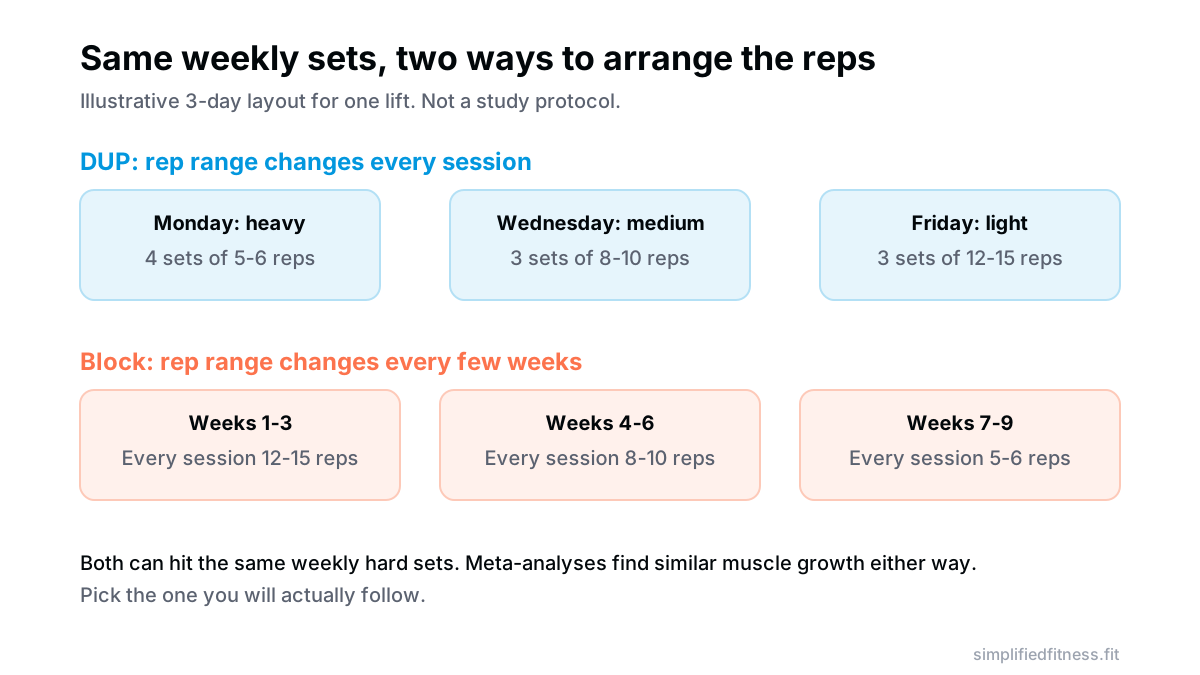
The idea behind DUP is that no single rep range is magic. Muscle can grow across a wide spectrum of loads, and strength is built best with heavier ones. A 2021 review argued that the old “repetition continuum” (heavy for strength, moderate for size, light for endurance) is not supported in its strict form, and that adaptations can be obtained across a wide spectrum of loading zones (Schoenfeld et al., 2021). DUP is one way to use that spectrum on purpose.
Does DUP build more muscle than block training?
Probably not, and that is a useful finding rather than a disappointing one. One note on terms: most trials compare DUP with linear periodization, where the rep range shifts across weeks. That is the closest research stand-in for block rep distribution, but it is not identical to a formal block model.
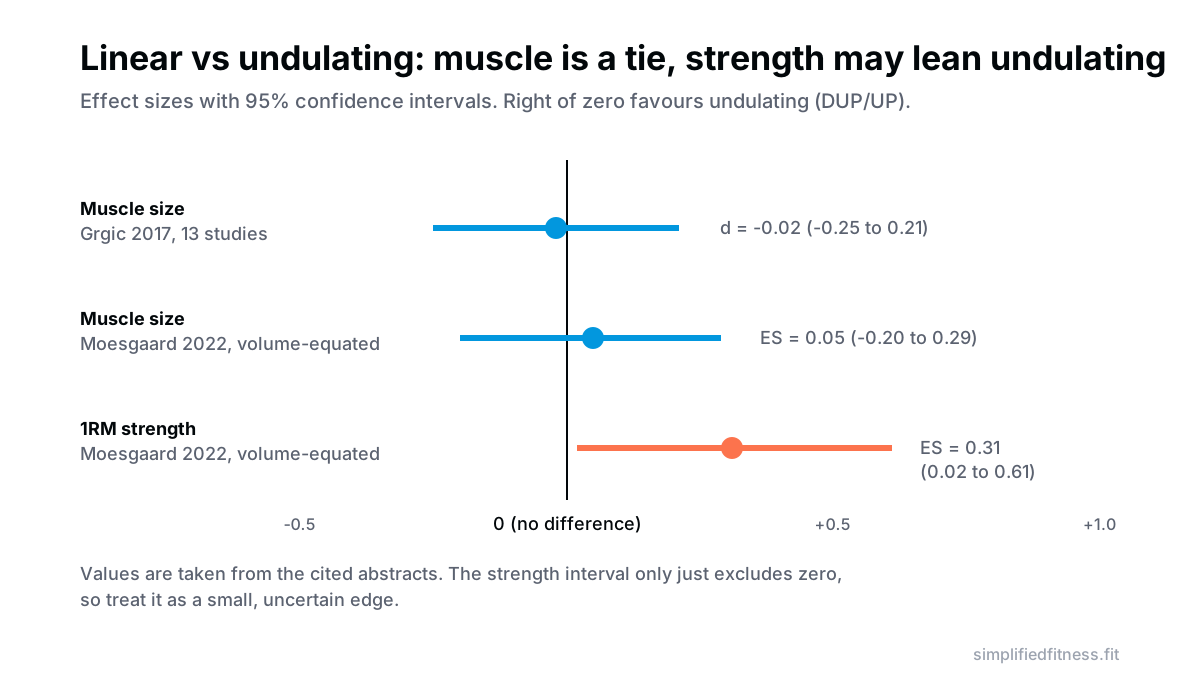
Grgic and colleagues pooled 13 trials comparing linear periodization with DUP on muscle hypertrophy. The standardized difference was -0.02 (95% CI -0.25 to 0.21), which the authors read as the two models likely having similar effects. They also noted more research is needed, especially in trained people (Grgic et al., 2017).
A later meta-analysis of 35 studies looked only at volume-equated programs, where both groups did the same total work. Hypertrophy did not differ between linear and undulating models (ES 0.05, 95% CI -0.20 to 0.29). Periodizing also did not beat non-periodized training for muscle size (Moesgaard et al., 2022).
What about strength?
Here the picture leans slightly toward undulating models. In the same 2022 meta-analysis, undulating training favoured 1RM strength over linear (ES 0.31, 95% CI 0.02 to 0.61). In the trained subgroup the effect was 0.61 (CI 0.00 to 1.22), while untrained people showed no difference (Moesgaard et al., 2022).
The overall interval only just clears zero and the trained-subgroup interval touches it, so this is a small and uncertain edge. The authors suggest it may relate to neural adaptations from practising a range of loads. That matches a 2017 meta-analysis of 21 studies where sets were taken to failure: 1RM gains were greater with high loads, while muscle growth was similar between low and high loads (Schoenfeld et al., 2017).
Is the rep range itself what matters?
Probably less than total work and effort. A study of 16 resistance-trained men compared two volume-equated DUP programs: one with 12, 10 and 8 reps, the other with 6, 4 and 2 reps, for 8 weeks. Strength and muscle thickness improved in both, with no group differences. The authors concluded that, in previously trained males, training volume is a significant contributor to adaptation, independent of specific repetition ranges (Klemp et al., 2016).
Similarly, 17 well-trained young men did either 3 sets of 10 (90 seconds rest) or 7 sets of 3 (3 minutes rest) for 8 weeks. Biceps muscle thickness grew similarly, though the 3-rep group gained more in bench press 1RM (Schoenfeld et al., 2014).
These are small studies in young men, so cautious interpretation is wise. Still, they point in the same direction as the meta-analyses: if sets are hard and total work is matched, growth is not very picky about rep range.
Block vs DUP: is one safer or more sustainable?
Direct evidence is thin. One RCT in 47 adolescent American football players compared block with DUP over 12 weeks (3 full-body sessions per week). Both groups improved muscle mass, strength and power, with no difference between groups (Gavanda et al., 2019). That is a young athletic population, so it may not map to a 40-year-old desk worker.
Another trial in 18 college-aged powerlifters compared two DUP orders. The modified order (hypertrophy, power, then strength day) gave greater bench press 1RM and more total volume lifted in squat and bench than the traditional order (hypertrophy, strength, then power day) (Zourdos et al., 2016). It is a small trial in powerlifters, but it hints that the order of days within a week can matter for performance.
Beyond that, the common arguments for DUP are practical and mostly untested in trials:
- Joint relief. Heavy sets load tendons more per rep. Limiting them to one or two days leaves other days gentler.
- Variety and motivation. Three different days feel less repetitive than twelve weeks of 4 x 10.
- Skill practice. You keep touching heavy loads, so strength does not fade while you do high-rep work.
- Fatigue management. Light days are usually easier to recover from, which can help when life is busy.
The downside: a heavy-day PR and a light-day PR are tracked separately, which makes progress harder to read. Block training has the opposite trade-off: simple to track, but you rarely touch heavy loads during a high-rep block.
Sample weekly DUP templates
Keep weekly hard sets roughly equal to what you do now. DUP redistributes work, it does not add magic.
Template A: 3 days, full body (one main lift per muscle)
| Day | Rep range | Sets | Effort |
|---|---|---|---|
| Monday (heavy) | 5-6 | 4 | 1-3 reps in reserve |
| Wednesday (medium) | 8-10 | 3 | 1-2 reps in reserve |
| Friday (light) | 12-15 | 3 | 0-2 reps in reserve |
Template B: push pull legs run twice a week
Run push, pull and leg day as usual. Make the first push, pull and leg session of the week heavy (6-8 reps on the main compound) and the second session moderate to light (10-15 reps). Keep isolation work at 10-20 reps throughout, since heavy isolation work is hard on elbows and shoulders.
Who should use DUP, and who should not?
DUP is a good fit if:
- you have a few years of training and your fixed rep range has stopped feeling productive
- you train a lift two or three times a week
- you want more strength without losing size
- your joints complain after weeks of one rep range
Stay with something simpler if:
- you are a beginner. In the meta-analysis, the strength edge appeared in trained lifters only (Moesgaard et al., 2022).
- your plan already works and you track progress easily
- you hit each muscle only once a week, where there is no room for a heavy/medium/light mix
How it fits with the rest of your plan
Rep-range variety is a small lever. Before using it, check the bigger ones: enough weekly sets (see weekly set volume and the hypertrophy curve), sets taken near failure, progressive overload, protein and sleep. If you want the long-term structure around weekly rep changes, read mesocycle architecture. For the evidence that a wide range of reps can build the same muscle, see the 5 to 30 rep spectrum.
For Indian lifters on a budget, this is a free change: same exercises, same gym, just different rep targets on different days. Eat enough protein through dal, paneer, curd, eggs or soya to support the work, since no rep scheme compensates for under-eating.
A simple way to decide
Ask three questions. Do your lifts still go up on a fixed rep range? If yes, stay put. Do you train each muscle at least twice a week? If not, DUP has little room to work. Is your main frustration boredom, flat strength or achy joints? Then try one heavy, one medium and one light session per week for 6-8 weeks, keep total hard sets the same, and compare your logbook before and after.
One caution on interpreting any of this: most trials here are short, use young men, and compare programs that were volume-matched on paper. Real life is messier. Missed sessions, sleep and food usually swing results more than the rep scheme does.
The bottom line
Daily undulating periodization and block training build similar muscle. DUP might add a small strength edge for trained lifters, and it spreads joint stress and boredom more evenly. Pick DUP if variety helps you show up; pick blocks if you like simplicity. If a joint hurts or pain lingers during any rep range, see a doctor or physiotherapist rather than just rearranging your week.
If you want a ready structure, try our free workout plans and track your numbers for 6-8 weeks before judging.
Frequently Asked Questions
What is daily undulating periodization?
Daily undulating periodization (DUP) is a way of planning training where the rep range and load change from one session to the next within the same week. A typical week might have a heavy day, a medium day and a light day for the same lift. It works because muscle growth responds to a wide range of loads, so cycling through them keeps training varied without dropping total volume.
Is DUP better than linear periodization for muscle growth?
Probably not for muscle size. A 2017 meta-analysis of 13 studies found a standardized difference of -0.02 between linear and DUP programs, and a 2022 meta-analysis found no hypertrophy difference when volume was equated. Choose the model you will stick with, and keep weekly hard sets and effort high.
Does mixing rep ranges in a workout build more muscle?
Evidence suggests it does not build clearly more muscle than staying in one moderate range, as long as sets are taken close to failure. Reviews of load research show muscle growth across a wide spectrum of loads. The practical benefit is variety and joint relief, so use it if it helps you train consistently.
What is a good heavy, medium, light day template?
A simple version is heavy day 4 sets of 5-6 reps, medium day 3 sets of 8-10 reps and light day 3 sets of 12-15 reps for each major lift. This puts each muscle under tension at three different loads while keeping weekly sets reasonable. Run it for 6-8 weeks, then judge your logbook, not your mood.
How many days a week do I need for DUP?
Two or three sessions per muscle group per week fits DUP best, because each session gets a different rep range. Studies of undulating programs commonly use three nonconsecutive training days. With an upper/lower or push pull legs split, you can rotate heavy, medium and light days across the weeks instead.
Should I train to failure on heavy, medium and light days?
Not necessarily. Leaving 1-3 reps in reserve on most sets still gives a strong growth stimulus and is easier to recover from. Light days are the ones where stopping short of failure is most tempting, and also where sets need to be genuinely hard to count. See our guide to reps in reserve for how to judge effort.
Is block periodization still worth using?
Yes, for specific goals. In an RCT of adolescent football players, block and DUP training produced equal gains in muscle and strength over 12 weeks. Blocks make sense when you want to peak a certain rep range for a test or competition, or when you prefer fewer changes in the gym.
Is DUP better for strength than for size?
The research leans that way. A 2022 meta-analysis found undulating models gave a small 1RM advantage over linear ones in trained lifters, while hypertrophy was equal. The interval for that strength effect only just excluded zero, so treat it as a possible small edge, not a rule.
Do heavy days build more muscle than light days?
Not clearly. A 2017 meta-analysis found hypertrophy was similar between low-load and high-load training when sets were taken to failure, while heavy training gave bigger 1RM gains. Heavy sets mainly build the skill and strength to use bigger loads, which supports progressive overload later.
Will DUP help if I am a beginner?
Beginners do not need it. In the 2022 meta-analysis, the strength advantage for undulating training appeared in trained lifters and not in untrained ones. A beginner progresses on almost any sensible plan, so start with a simple full-body routine and add variety later.
Can mixing heavy and light days help sore joints?
It may, but this has not been tested head to head in trials. Heavy sets load tendons and joints more per rep, so limiting them to one or two days per week and doing the rest at moderate loads is a sensible way to spread stress. If a joint hurts during a movement, see a doctor or physiotherapist rather than just changing rep ranges.
How long should I stay on a DUP program?
Most studies of DUP run 6-12 weeks, so 6-8 weeks is a reasonable block before reviewing progress. Track the load and reps on each day type so you can see whether strength is rising. Change the plan only if lifts stall for several weeks despite good sleep and food.
Sources & References
Every claim above is checked against peer-reviewed research (PubMed, U.S. National Library of Medicine) or guidance from established health bodies. How we fact-check.
- Grgic J, et al. Effects of linear and daily undulating periodized resistance training programs on measures of muscle hypertrophy: a systematic review and meta-analysis. PeerJ. 2017. PMID: 28848690
- Moesgaard L, et al. Effects of Periodization on Strength and Muscle Hypertrophy in Volume-Equated Resistance Training Programs: A Systematic Review and Meta-analysis. Sports Med. 2022. PMID: 35044672
- Klemp A, et al. Volume-equated high- and low-repetition daily undulating programming strategies produce similar hypertrophy and strength adaptations. Appl Physiol Nutr Metab. 2016. PMID: 27218448
- Gavanda S, et al. The Effect of Block Versus Daily Undulating Periodization on Strength and Performance in Adolescent Football Players. Int J Sports Physiol Perform. 2019. PMID: 30569761
- Schoenfeld BJ, et al. Loading Recommendations for Muscle Strength, Hypertrophy, and Local Endurance: A Re-Examination of the Repetition Continuum. Sports (Basel). 2021. PMID: 33671664
- Schoenfeld BJ, et al. Strength and Hypertrophy Adaptations Between Low- vs. High-Load Resistance Training: A Systematic Review and Meta-analysis. J Strength Cond Res. 2017. PMID: 28834797
- Schoenfeld BJ, et al. Effects of different volume-equated resistance training loading strategies on muscular adaptations in well-trained men. J Strength Cond Res. 2014. PMID: 24714538
- Zourdos MC, et al. Modified Daily Undulating Periodization Model Produces Greater Performance Than a Traditional Configuration in Powerlifters. J Strength Cond Res. 2016. PMID: 26332783

Umair Hazrami · Founder & Head Coach, Simplified Fitness
Umair Hazrami founded Simplified Fitness and the Simplified Lifter channel to cut through fitness noise. With 4+ years of consistent training and 10+ coaching clients, he writes every guide from the peer-reviewed research and links the sources so you can check them. Our editorial standards.
Educational content only, not medical advice. If you have a medical condition, are pregnant, or take medication, talk to a qualified doctor before changing your diet, supplements or training. Full disclaimer.
Keep reading

Programming
Blood Flow Restriction (BFR) Practical Guide: Cuff Pressures, Rep Schemes, and Light Loads
How to do BFR training safely: cuff placement, pressure as a percentage of occlusion, the 30-15-15-15 scheme and who should skip it. Every study linked.
8 min read
Programming
Calibrating True RIR: A Safe Gym Test for Technical vs Absolute Failure
Calibrating RIR means testing how many reps you really have left. Use this safe machine protocol to find true failure and fix your 2 RIR guesses.
8 min read

Programming
CNS Fatigue vs Peripheral Fatigue: How Failure Hits Squats and Curls Differently
CNS fatigue vs peripheral fatigue: why failing a squat flattens you for days while failing a curl barely registers, and how many reps to leave in reserve.
9 min read
Programming
Failure on Machines and Cables vs Free Barbells: Managing Injury Risk and Axial Fatigue
Failure on machines vs barbells: why machine sets feel safer and less draining, what the research says, and where to push hard or stop at 1-2 RIR.
8 min read