Intent to Move Explosively: Why Pushing the Bar Hard Matters Even When It Moves Slowly
Intent to move explosively means pushing the bar as hard as you can on the way up, even when it crawls. See what the research says and how to cue it.

TL;DR. The short answer
- Intent to move explosively means trying to accelerate the bar as hard as you can on the way up, even when heavy weight or fatigue makes it move slowly. It is a cue for effort, not a rule about bar speed.
- A 1993 trial found that training with the intent to move fast, even when the limb could not actually move, produced the same velocity-specific strength gains as moving fast. Intent, not actual speed, drove the response.
- For muscle size, the research does not show that fast lifting beats slow lifting. A 2025 meta-analysis of 14 studies found tempo had minimal overall effect on hypertrophy, so explosive intent is not a growth hack.
- Explosive intent is not bouncing. Lower the bar under control, drive up hard, and stop the set when reps slow down a lot or form breaks.
Part of our complete guide: Reps in Reserve, Rep Ranges and Rest Times: The Evidence-Based Guide to How Hard Every Set Should Be
Table of contents
Intent to move explosively means trying to accelerate the bar as hard as you can on the way up, even when the weight is so heavy that it crawls. It is a cue about effort, not a promise about bar speed.
This is one of the most common coaching cues in the gym, and it is also one of the most misunderstood. In this article, part of our complete guide to load, rep ranges, RIR and rest intervals, we will cover what the research shows, what it does not show, and how to use the cue without turning your sets into a jerky mess.
What does “intent to move explosively” actually mean?
Say you load 100 kg on the squat and the bar rises at a pace you could time with a calendar. If you were trying to push it through the roof, that is explosive intent. If you were trying to gently ease it up, it is not, even if the bar speed looked identical on a video.
That distinction is the whole point. Bar speed is decided by the weight, your fatigue and your leverages. Intent is decided by you.
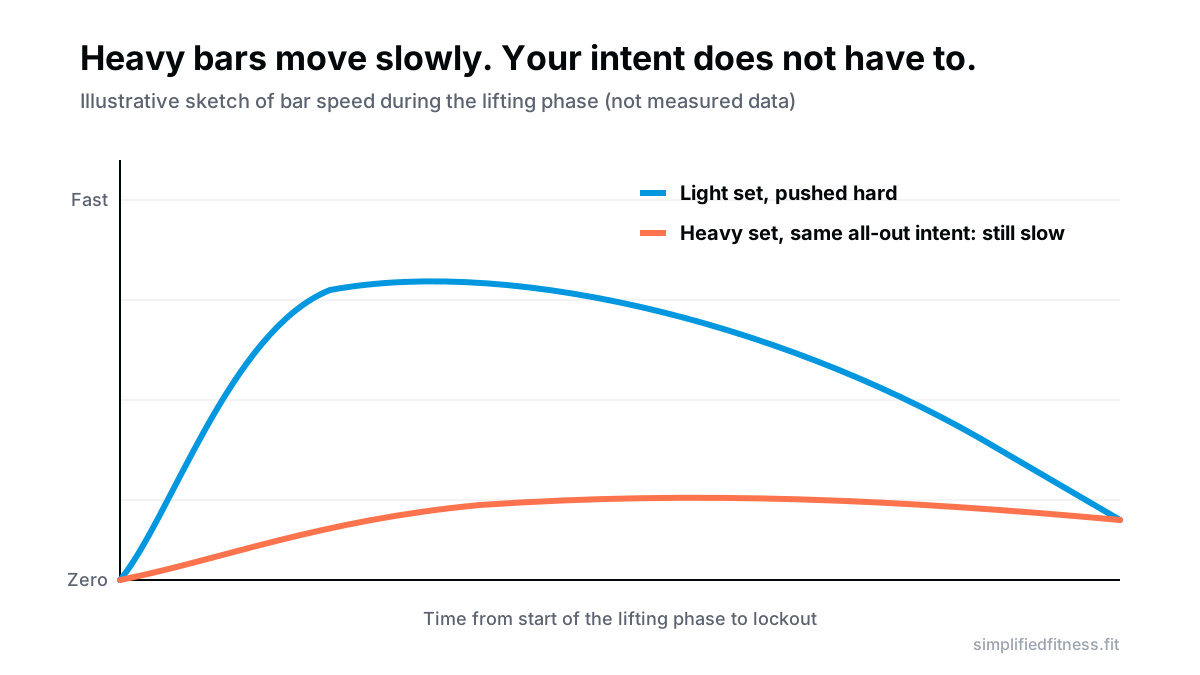
Explosive intent applies to the lifting (concentric) phase. The lowering phase is a separate question, and it is where tempo comes in. If you want the full story on that, see our deep dive on rep tempo and hypertrophy.
Why do coaches say to push the bar fast even with heavy weights?
The neuromuscular logic runs like this. Your muscles are made of motor units: one motor neuron plus the fibres it controls. Low-threshold units, mostly the smaller, fatigue-resistant ones, are recruited first. Larger, high-threshold units are recruited as the demand for force rises. This ordering is the size principle, and it is textbook physiology. Beyond recruitment, you can also raise force by firing each unit faster, which is called rate coding.
A fast, forceful attempt asks the nervous system for both at once: quick recruitment and high firing rates. That is the theory behind “push the bar as fast as possible.”
There is real human data behind part of it. In a 2019 study of 20 men performing explosive isometric contractions of the ankle muscle (tibialis anterior), motor neurons were recruited in a short burst and discharged at high rates, in some cases above 200 Hz. The maximal discharge rate explained a large share of explosive force (r2 about 0.71), and the activation that happened before force was generated dictated how fast force could rise (Del Vecchio et al., 2019).
That is a strong link between neural drive and explosive force. But it is a small lab study in one muscle, in men, using isometric contractions. It does not prove that adding explosive intent to a heavy barbell set recruits extra motor units that the load was not already demanding.
Does intent matter more than actual bar speed?
This is the best direct evidence we have for the cue. In a 1993 study, eight men and eight women trained ankle dorsiflexion for 16 weeks, three days a week. One leg did ballistic attempts against a resistance that made the contraction isometric (no real movement). The other leg did the same attempt but was allowed to move fast. Both legs produced the same high-velocity-specific training response. Peak torque rose most at the fastest tested speed (38%), and both limbs improved isometric rate of torque development (26%) (Behm and Sale, 1993).
The authors concluded that the repeated attempts to perform ballistic contractions, and the high rate of force development they produce, were the principal stimulus. The actual movement was of lesser importance.
Two cautions are worth stating. First, this was a small trial on a single small muscle group, not a barbell lift. Second, it tells us about speed-specific strength and force development. It does not tell us about muscle size.
Does lifting fast build more muscle than lifting slow?
Here the research is much less exciting for the “fast is better” crowd. A 2025 meta-analysis pooled 14 studies that compared faster and slower tempos while controlling other training variables. Faster tempos averaged about 1 second per rep, and slower ones about 3.5 seconds. Pooled within-group effects were similar (0.43 for faster, 0.34 for slower). The between-condition difference trivially favoured faster reps (0.09, 95% credible interval -0.04 to 0.22), and the authors concluded tempo has minimal overall effect on hypertrophy (Enes et al., 2025).
So the honest summary is that rep speed itself is not a big lever for muscle size. The same goes for a related, older idea from the “repetition continuum”: a 2021 review argued that muscular adaptations can be obtained across a wide spectrum of loading zones, not only inside one narrow band (Schoenfeld et al., 2021).
How much should bar speed drop before I stop a set?
Even with maximal intent, the bar slows as you fatigue. Researchers measure this as velocity loss: how much slower your last rep is than your fastest rep. Studies have compared different velocity loss thresholds to see how much slowing is worth it.
One trial randomized 64 resistance-trained young men to squat for 8 weeks with sets stopped at 0%, 10%, 20% or 40% velocity loss, using 70-85% of 1RM, 3 sets and 4 minutes of rest. Strength, sprint and jump gains did not differ between groups, even though total volume did. The 20% and 40% groups showed significant within-group increases in muscle hypertrophy (the between-group difference just missed significance, P = 0.06), while only the 40% group showed negative neuromuscular changes, including slower muscle delay time and a decrease in early rate of force development (Pareja-Blanco et al., 2020).
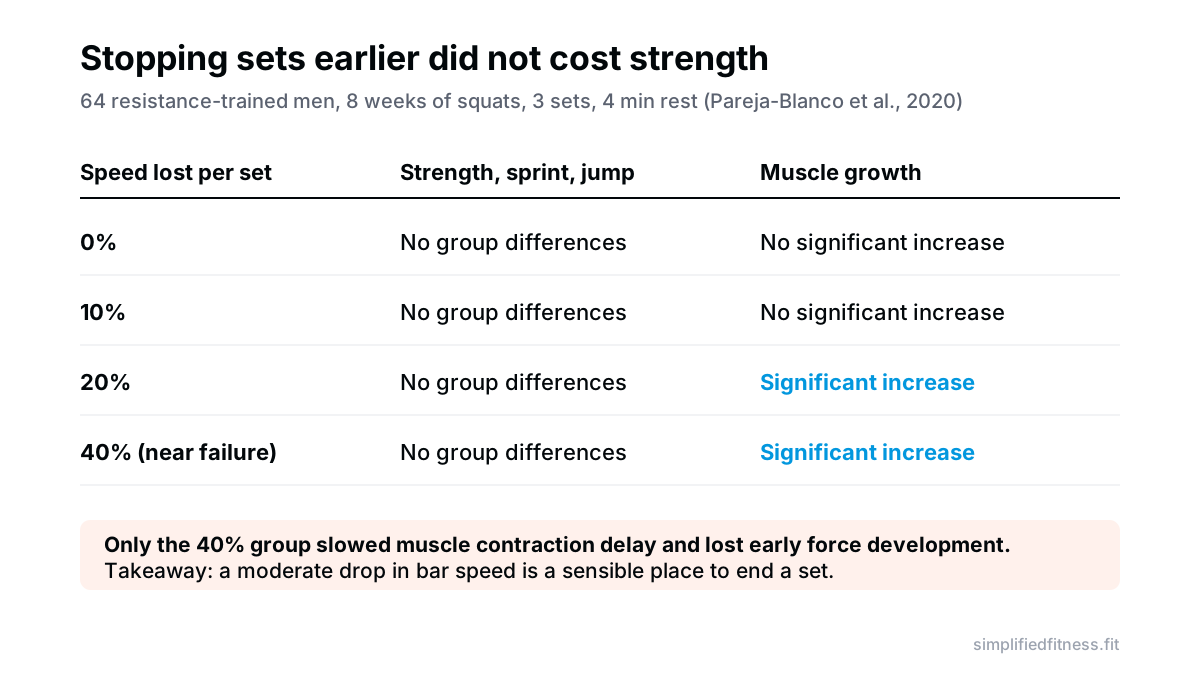
A wider review of 18 acute and 19 longitudinal studies lines up. Velocity loss did not influence strength or muscular endurance gains, higher velocity loss was associated with more hypertrophy, and lower velocity loss was better for jumping, sprinting and speed against submaximal loads (Jukic et al., 2023).
Not every study agrees on the details. In a smaller trial of 16 strength-trained people over 6 weeks, a high threshold gave a small extra gain in vastus lateralis thickness (about 6%) while 1RM improved similarly in both groups (Myrholt et al., 2023). And a meta-analysis of proximity to failure found that higher velocity loss thresholds, and theoretically closer proximity to failure, did not always produce more hypertrophy (Refalo et al., 2023).
Why might these differ? Samples are small, programs differ in volume and rest, and “more hypertrophy” in one trial may come from more total work, not from the speed threshold itself. The practical takeaway is a moderate one: if you care about both size and staying sharp, ending sets with some reps still in the tank is a reasonable default, and pushing to a big slowdown is optional, not essential. For more on this trade-off, see our guide to reps in reserve and RPE.
How do I apply explosive intent without bouncing?
This is where lifters get it wrong. “Push fast” does not mean “drop fast and bounce.” The most common mistake is to rush the lowering phase, bounce out of the bottom and use momentum to skip the hard part. That is a different thing from intent.
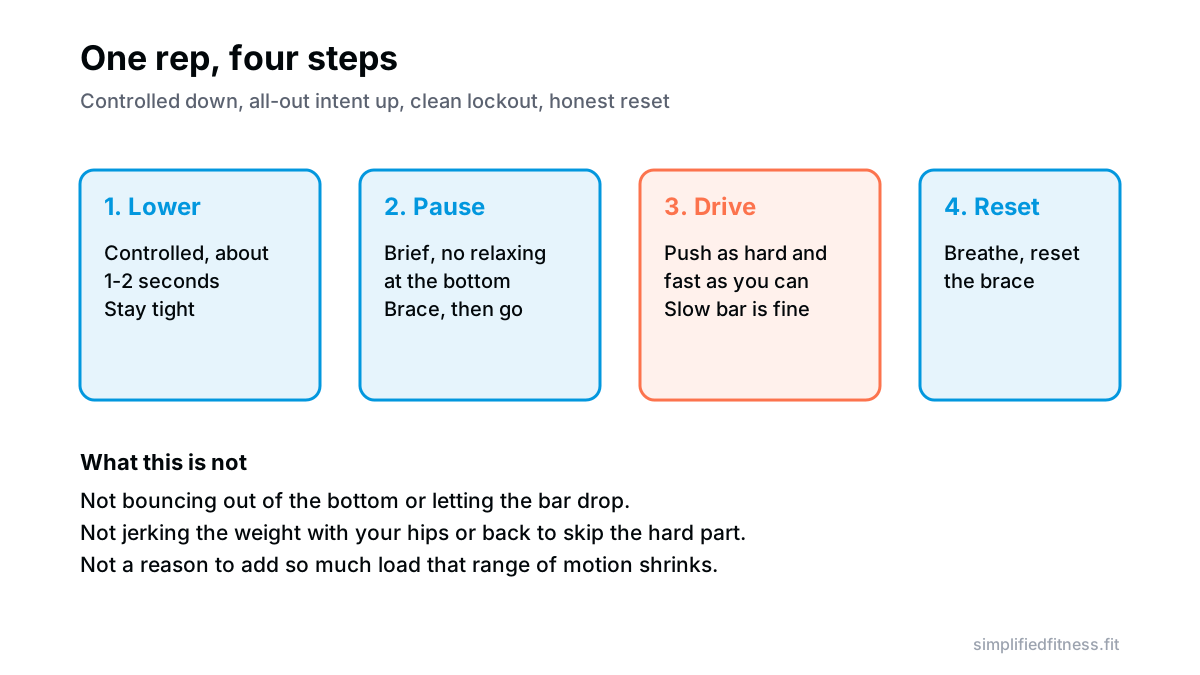
Here is a simple way to run it:
- Lower the bar under control, roughly 1-2 seconds on compound lifts.
- Stay tight at the bottom. Do not relax into the stretch.
- Drive up with maximum effort, picturing the bar flying even if it does not.
- Lock out cleanly, reset your brace, and repeat.
Should you use it on every exercise?
Not equally. On heavy compounds like squats, deadlifts and presses, explosive intent is natural and useful. On isolation work and machines, such as lateral raises or leg curls, you can still push the lifting phase hard, but keep it smooth and keep tension on the target muscle. Whipping a dumbbell up with momentum on a lateral raise takes the work away from the delts.
It also matters how close you are to failure. On a near-failure rep, the bar will crawl no matter what you intend, and that is expected. If you want help judging how hard a set was, our RIR and RPE calculator is a quick way to match your effort to a target. The relationship between fatigue and the nervous system is covered separately in our article on central versus peripheral fatigue, and the techniques that push past failure are in the guide to rest-pause, myo-reps and cluster sets.
What does the evidence not tell us?
A few honest limits are worth keeping in mind.
- The strongest intent evidence (1993) is from a small trial of ankle muscles, not barbell lifts.
- The motor neuron data (2019) is from 20 men and isometric contractions.
- The velocity loss trials mostly used young, trained people in squats, so findings may not carry over to everyone, including older lifters or beginners.
- None of these studies shows that explosive intent on its own builds more muscle.
Explosive intent is best viewed as a low-cost habit that supports force production and keeps your sets honest. It is not a magic trick.
A practical way to use it
- On your heaviest sets, aim every rep at maximum effort up and a controlled lowering phase.
- Do not rush the lowering phase or bounce.
- Accept slow bars on heavy sets and late reps.
- End sets before form degrades. If you are using RIR, leaving 1-3 reps in reserve keeps the quality of reps high.
- Spend your real attention on progressive overload, enough weekly sets and consistent effort.
If you are not sure how to structure the rest of your training week, our free push, pull and leg day plans give you a starting framework.
If you have joint, tendon or back pain, or a medical condition affecting your heart or blood pressure, check with a doctor or physiotherapist before pushing hard through heavy lifts.
Frequently Asked Questions
What does intent to move explosively mean?
It means trying to accelerate the bar as hard and fast as you can during the lifting phase of every rep. The bar may still move slowly if the load is heavy or you are fatigued. What matters is the effort you send into the bar, not the speed the bar reaches.
Should I lift the bar as fast as possible on every rep?
You should try to, but the lowering phase should stay controlled and you should keep your form. A 1993 study showed that the attempt to move fast drives velocity-specific adaptations, not the speed achieved. Aim for a hard, clean push and let the load decide how fast the bar actually moves.
Does lifting fast build more muscle than lifting slow?
Probably not by much. A 2025 meta-analysis of 14 trials found faster and slower tempos produced similar hypertrophy, with the difference trivially favouring faster reps (pooled difference 0.09, interval -0.04 to 0.22). Pick a tempo you can repeat safely and spend your attention on load, effort and volume.
Why do coaches tell you to push the bar fast even with heavy weights?
Coaches use the cue because trying to move fast raises the rate of force development, and neural drive before force is produced is closely tied to how quickly people can generate force. In 20 men, the peak motor unit discharge rate explained a large share of explosive force (r2 about 0.71). That is a correlation in one small isometric study, so treat the cue as sensible coaching rather than a proven growth tool.
Does intent to move fast recruit more motor units?
Fast, forceful attempts require rapid recruitment and high firing rates, which is what high-threshold motor units provide. Direct evidence in barbell lifters that the intent itself increases recruitment beyond what the load already demands is limited, so treat it as a plausible mechanism, not a proven one. Use the cue because it is free and safe, not because it is guaranteed to add growth.
Is it bad to lift slowly on purpose?
No. Slow tempos build similar muscle to faster ones in the research, so slow is not bad for size. The catch is that deliberately slowing a rep means you cannot also use explosive intent, and heavier loads may not be possible. Choose slow reps for control or joint comfort, and fast intent when your goal includes strength or power.
Is a slow rep a failed rep?
Not at all. Near the end of a hard set every rep slows down, even when you are pushing with full intent, and that is normal fatigue. The slow, grinding reps are often where the useful stimulus lives. Stop when form would suffer, not just because the bar speed dropped.
What is velocity loss and should I track it?
Velocity loss is the percentage drop in bar speed from your fastest rep to your last rep in a set. A review of 19 longitudinal studies found it did not change strength gains, while higher thresholds were linked to more hypertrophy. You do not need a device to use the idea: end sets when reps clearly slow or technique breaks.
What is the difference between explosive intent and bouncing?
Explosive intent is pushing hard through the lifting phase after a controlled lowering phase. Bouncing uses the stored elastic energy of a dropped bar or relaxed muscles to skip the hard part. Lower under control, stay tight at the bottom, and then drive up with maximum effort.
Does explosive lifting increase injury risk?
It can if intent turns into jerking, bouncing or ego loading. The research here is mostly in healthy, young, trained people, so it does not settle injury questions for everyone. Keep form strict, build load gradually, and see a doctor or physio if you have joint or tendon pain.
Should beginners use explosive intent?
Beginners can use a gentle version, but learning the movement pattern comes first. Practise a smooth, controlled rep with the right range of motion, then add effort into the lifting phase once the pattern is steady. Lighter weights make this easier to learn.
Does explosive intent help with strength?
Probably, especially for how quickly you produce force. The 1993 study showed higher-velocity-specific torque and a faster rate of torque development after training with fast intent. For maximal strength in a slow grind, just lifting heavy with strong effort is what the evidence supports.
How should I apply this to squats, bench press and rows?
On compound lifts, lower the bar under control for about 1-2 seconds, then push as hard as you can until lockout. On isolation work and machines, you can keep the same push but stay a little more deliberate to keep tension on the target muscle. Track how hard the set felt with our RIR and RPE calculator.
Sources & References
Every claim above is checked against peer-reviewed research (PubMed, U.S. National Library of Medicine) or guidance from established health bodies. How we fact-check.
- Behm DG, et al. Intended rather than actual movement velocity determines velocity-specific training response. J Appl Physiol. 1993. PMID: 8444715
- Del Vecchio A, et al. You are as fast as your motor neurons: speed of recruitment and maximal discharge of motor neurons determine the maximal rate of force development in humans. J Physiol. 2019. PMID: 30768687
- Enes A, et al. How slow should you go? A systematic review with meta-analysis of the effect of resistance training repetition tempo on muscle hypertrophy. J Strength Cond Res. 2025. PMID: 42709703
- Pareja-Blanco F, et al. Velocity loss as a critical variable determining the adaptations to strength training. Med Sci Sports Exerc. 2020. PMID: 32049887
- Jukic I, et al. The acute and chronic effects of implementing velocity loss thresholds during resistance training: a systematic review, meta-analysis, and critical evaluation of the literature. Sports Med. 2023. PMID: 36178597
- Refalo MC, et al. Influence of resistance training proximity-to-failure on skeletal muscle hypertrophy: a systematic review with meta-analysis. Sports Med. 2023. PMID: 36334240
- Myrholt RB, et al. Effects of low- versus high-velocity-loss thresholds with similar training volume on maximal strength and hypertrophy in highly trained individuals. Int J Sports Physiol Perform. 2023. PMID: 36754062
- Schoenfeld BJ, et al. Loading recommendations for muscle strength, hypertrophy, and local endurance: a re-examination of the repetition continuum. Sports. 2021. PMID: 33671664

Umair Hazrami · Founder & Head Coach, Simplified Fitness
Umair Hazrami founded Simplified Fitness and the Simplified Lifter channel to cut through fitness noise. With 4+ years of consistent training and 10+ coaching clients, he writes every guide from the peer-reviewed research and links the sources so you can check them. Our editorial standards.
Educational content only, not medical advice. If you have a medical condition, are pregnant, or take medication, talk to a qualified doctor before changing your diet, supplements or training. Full disclaimer.
Keep reading

Programming
Blood Flow Restriction (BFR) Practical Guide: Cuff Pressures, Rep Schemes, and Light Loads
How to do BFR training safely: cuff placement, pressure as a percentage of occlusion, the 30-15-15-15 scheme and who should skip it. Every study linked.
8 min read
Programming
Calibrating True RIR: A Safe Gym Test for Technical vs Absolute Failure
Calibrating RIR means testing how many reps you really have left. Use this safe machine protocol to find true failure and fix your 2 RIR guesses.
8 min read
Programming
CNS Fatigue vs Peripheral Fatigue: How Failure Hits Squats and Curls Differently
CNS fatigue vs peripheral fatigue: why failing a squat flattens you for days while failing a curl barely registers, and how many reps to leave in reserve.
9 min read
Programming
Failure on Machines and Cables vs Free Barbells: Managing Injury Risk and Axial Fatigue
Failure on machines vs barbells: why machine sets feel safer and less draining, what the research says, and where to push hard or stop at 1-2 RIR.
8 min read