Calibrating True RIR: A Safe Gym Test for Technical vs Absolute Failure
Calibrating RIR means testing how many reps you really have left. Use this safe machine protocol to find true failure and fix your 2 RIR guesses.
TL;DR. The short answer
- Calibrating RIR means doing one test set on a safe machine, noting where you think you have 2 reps left, then continuing until a rep clearly breaks down. The reps after your call are your real reserve.
- Technical failure is the point where form can no longer stay clean. Absolute (mechanical) failure is where the weight stops moving. For a calibration test, technical failure on a machine is enough and much safer.
- Research finds lifters usually underpredict reps left. A 2022 pooled analysis of 414 people put the average miss at about 0.95 reps, but single studies range from under 1 rep (bench press) to about 2 reps (knee extension).
- Test on a leg press or chest-supported row, never a heavy barbell lift without a spotter or safeties. Repeat every 8-12 weeks (a coaching convention, not a studied interval).
Part of our complete guide: Reps in Reserve, Rep Ranges and Rest Times: The Evidence-Based Guide to How Hard Every Set Should Be
Table of contents
Calibrating RIR means checking, once, how many reps you really have left when you think you have two. You do it with one safe test set on a machine: call your 2 RIR, keep going until a rep clearly breaks down, and count what you had in the tank.
Most lifters find the number is bigger than they guessed. This article gives you the exact drill, how to keep it safe, and how to read the result. For the full picture of load, rep ranges, RIR and rest, see our complete guide to load, rep ranges, RIR and rest intervals.
Why bother calibrating RIR at all?
Reps in reserve only works if your “2” is close to a real 2. If your felt 2 is actually 5, a whole programme built on “stop 2 reps short” is quietly much easier than you think. If you want a refresher on the scale itself, start with our RIR and RPE scale guide.
The research on this is mixed, so let’s be fair to both sides.
A 2022 scoping review with exploratory meta-analysis pooled 12 studies and 414 participants. On average, people underpredicted reps to failure by about 0.95 reps, but between-study differences were huge (I2 of 97.9%) (Halperin et al., 2022). Training status did not clearly change accuracy, and predictions were better when made closer to the end of the set. We dig into the full accuracy research in how accurately lifters gauge RIR; this article is about testing your own number.
On the optimistic side, 24 resistance-trained men and women predicting 1 and 3 RIR on barbell bench press were off by only 0.65 reps on average (absolute error), with a minor tendency to underpredict (Refalo et al., 2024).
On the other side, 14 and then 24 people with at least a year of training predicting failure on knee extensions typically underpredicted by about 2.0 reps (95% CI 0.0 to 4.0) (Armes et al., 2020).
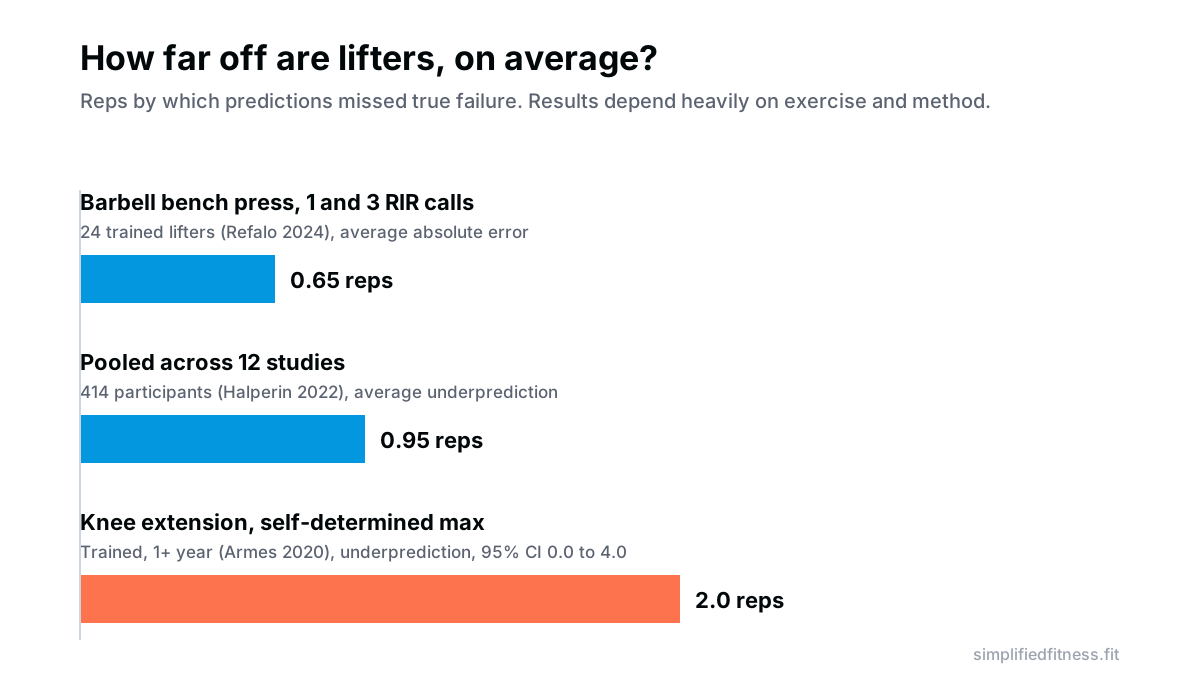
Why might they disagree? Different exercises, different loads, and different ways of asking the question. Heavier, lower-rep sets and predictions made close to failure were more accurate in the pooled analysis. The practical takeaway: expect to be off by 1 rep or so, sometimes 2, and find out your own number.
An important caveat: these are mostly short, lab-based studies in young adults, often men. Your result in a crowded gym on a tired day can differ.
Technical failure vs absolute failure: what is the difference?
People use “failure” for at least two different moments.
- Technical failure: the next rep cannot be done with your normal form and tempo. You might still grind out an ugly rep, but you would not count it.
- Absolute (mechanical or momentary muscular) failure: you try your hardest and the weight stops moving. Research papers usually define it as momentary muscular failure.
Between those two sits the zone where reps get slower and sloppier but still move. If you want to standardise where you draw that line across a training block, see technical vs mechanical failure.
This matters for another reason too. A 2023 meta-analysis of 15 studies found no evidence that training to momentary muscular failure beats stopping short for muscle growth (Refalo et al., 2023). So calibration is not about making you train to failure. It is about knowing where failure is so you can stop confidently short of it. We cover that debate in training to failure vs RIR.
Which exercise should you use for the test?
Pick an exercise where a failed rep is harmless.
Good choices
- Leg press (set the safety stops, never lock your knees hard)
- Chest-supported row or chest-supported T-bar row
- Seated cable row, lat pulldown, pec deck, leg extension or leg curl
Poor choices for this test
- Barbell back squat, bench press, overhead press or deadlift, unless you have safety arms and a spotter you trust
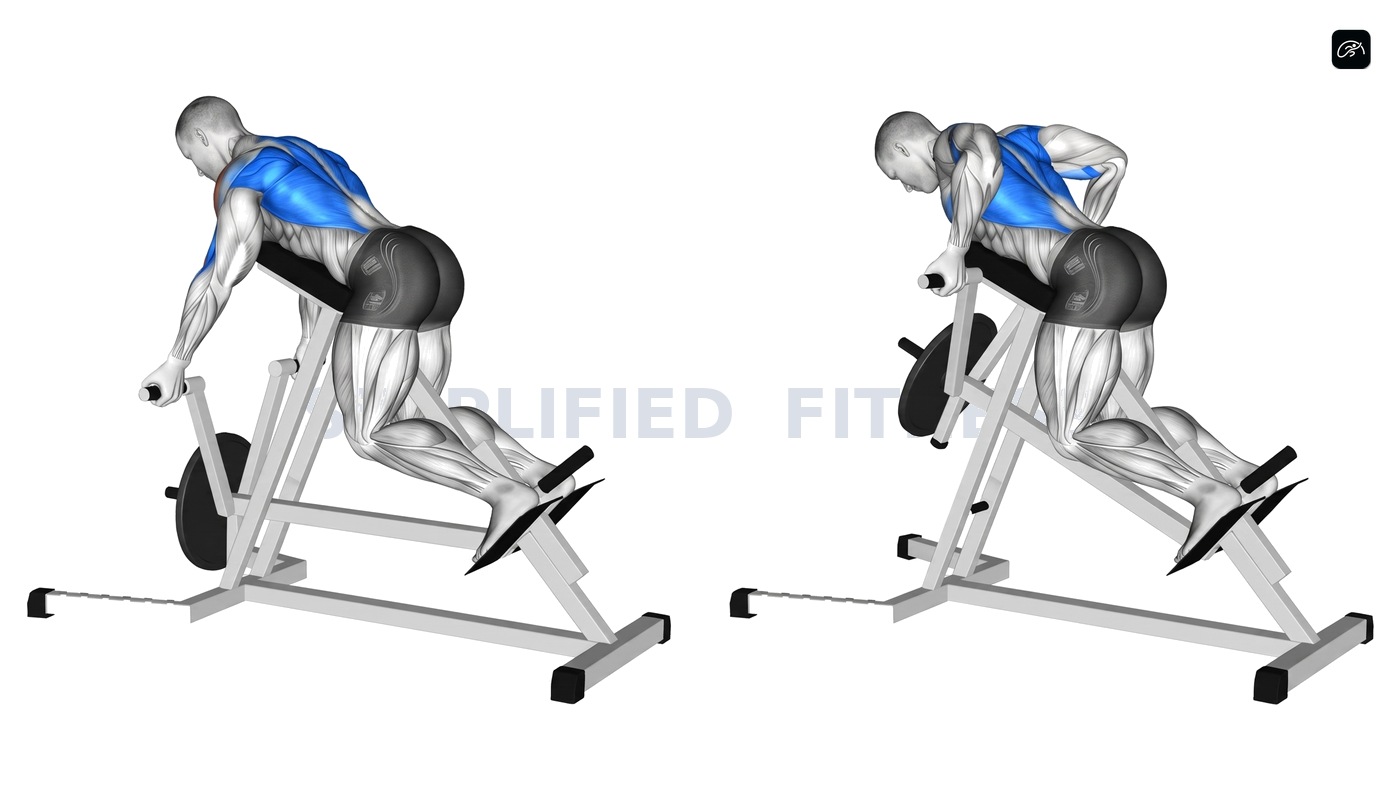
The chest-supported row is great because the pad removes lower back fatigue as an excuse. If the load becomes too much you simply let it down. Our guide to failure on machines vs barbells goes deeper on why.
The step-by-step calibration protocol
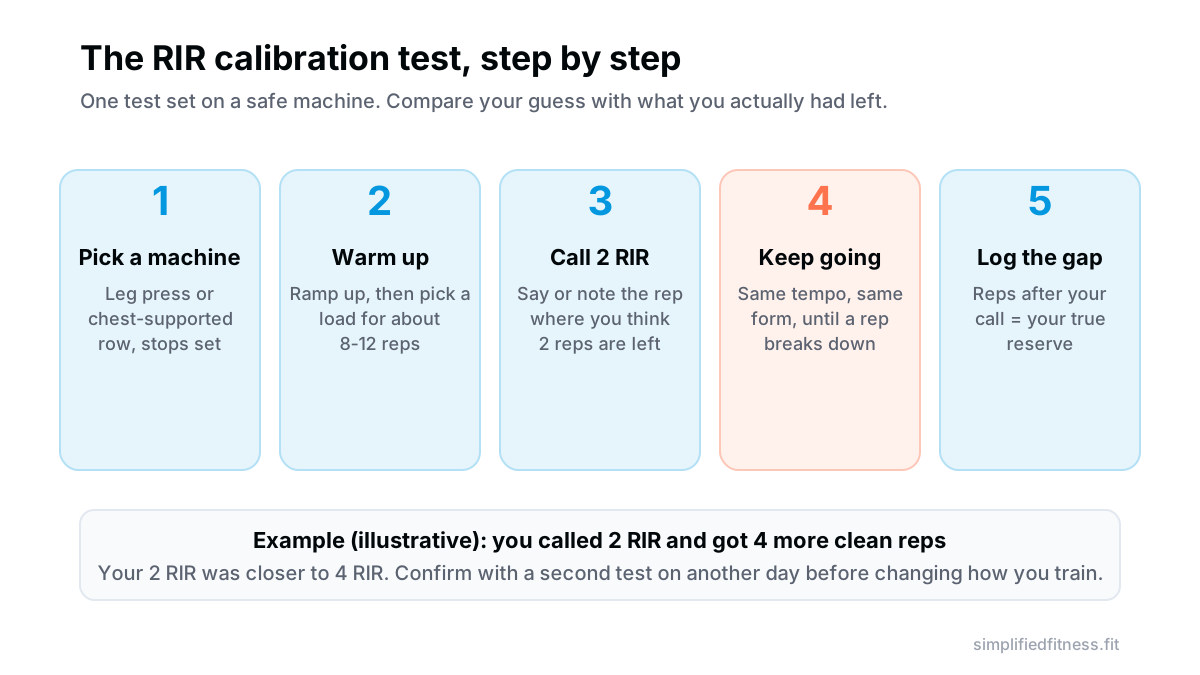
- Choose a machine exercise. Leg press or chest-supported row. Check the safety stops or pins first.
- Warm up properly. Ramp up over 2-3 lighter sets. Do not do the test cold.
- Pick a load for roughly 8-12 reps. Aim for a set that would normally be moderately hard. Very high-rep sets (above about 12 reps) were less accurate in the pooled analysis, so staying in this range keeps the test cleaner (Halperin et al., 2022).
- Call your 2 RIR. As you lift, say “two” out loud (or tap a note) at the rep where you honestly believe you could do exactly 2 more. Do not stop. If you have a training partner, have them mark the rep number.
- Keep going with the same tempo and form. Each rep must meet your normal standard: full range, no bouncing, no hips lifting, no jerking.
- Stop at technical failure. The set ends when a rep slows dramatically or form breaks, or when you would not count the next one.
- Count the gap. Reps completed after your call is your true reserve at that moment. If you called 2 and got 4 more, your “2” was really about a 4.
How to read your result
| Reps you got after calling “2” | What it suggests | What to do next |
|---|---|---|
| 0-1 | You were closer to failure than you thought (you overpredicted) | Make your call a rep or so earlier, then retest |
| 2 | Your call was accurate on this lift | Keep going, retest in 8-12 weeks |
| 3-4 | You tend to underpredict (common in research) | To hit a true 2 RIR, go 1-2 reps past the point that feels like 2 |
| 5+ | Your “hard” sets may be far from hard | Choose a heavier load and retest |
Treat these as starting points, not laws. One test set is a single data point, and your result can shift with sleep, fatigue and food that day.
How to stop safely near failure
Safety is the point of doing this on a machine, but a few habits apply to everyone.
- Set the safeties first. On the leg press, set the stoppers so the sled cannot crush you if your legs give out.
- Do not lock out knees hard at the top of a leg press set, since fatigued joints and heavy sleds are a poor mix.
- Never test to technical failure on a free barbell lift alone. If you do try it, use safety arms or a spotter.
- Keep breathing. Do not hold your breath through a grinding last rep.
- Stop at pain, not at burn. The muscle should burn and feel heavy. Sharp joint or tendon pain, dizziness or chest pain means stop.
If you have a heart or blood pressure condition, or are returning from injury, ask your doctor before pushing sets near failure.
Does your RIR accuracy improve with practice?
Less than most people hope. In nine trained men who bench pressed three times a week for six weeks and went to failure on the last set, absolute prediction error did not significantly improve over time (Remmert et al., 2023). Participants tended to underestimate their reserve more in later sessions.
That is a small, short study, so do not treat it as the final word. A broader trained-and-untrained study of 27 men and 31 women on machine curls, pushdowns and seated rows found that sex, training experience and prior experience rating RIR did not significantly affect accuracy, but predictions were better closer to failure and in later sets (Remmert et al., 2023).
What this suggests: just training for years does not automatically calibrate you. No study has tested whether periodic self-tests sharpen your feel either, but they do tell you your current gap, which is the number you actually need.
How often should you recalibrate?
A reasonable habit is every 8-12 weeks, or any time you:
- start a new exercise or machine
- change your rep range substantially (for example 6-8 reps to 12-15)
- return after a long break
- feel that your sets have become too easy
To be clear, the 8-12 week interval comes from coaching practice, not a trial. The research simply shows that accuracy is imperfect and varies, so occasional rechecks make sense. A scoping review of 31 studies concluded RIR scales appear feasible and useful for setting intensity, and that predictions made closer to failure are more accurate (Bastos et al., 2024).
Using what you learn
Once you know your gap, apply it simply.
- If you underpredict by about 2, a “2 RIR” call really means about 4 left. To train at a true 2, go 2 reps further.
- Judge effort late in the set. Predictions closer to failure were more accurate (Halperin et al., 2022).
- Keep a short note in your log: exercise, load, rep of call, extra reps. Over a few tests you will see a pattern per exercise.
- Use our RIR and RPE calculator to convert between RIR and an estimated percentage of your max, and think about where your compound lifts and isolations should sit in proximity to failure rules for compounds vs isolations.
For many lifters, a simple rule works: compound lifts a few reps short, isolations and machines closer to failure. How close is a decision for your program and recovery, not for this one test.
If you want exact numbers to go with this, our free push, pull and leg plans give you structured sessions where you can run this test in week one.
Common mistakes with the RIR test
- Calling 2 RIR too early, then stopping. The test only works if you keep going.
- Letting form drift to squeeze out more reps. Cheat reps inflate your number. Stop at technical failure.
- Testing once and treating it as permanent. It is a snapshot.
- Using an exercise you never train. Calibrate on your real lifts.
- Testing when exhausted or underfed. Compare on typical days.
The bottom line
Calibrating RIR is simple: one safe machine set, a 2 RIR call, and a count of the reps you really had left. Studies show lifters usually miss by about 1 rep on average, sometimes 2, and that experience alone does not close the gap. Test on machines, stop at technical failure, repeat every 8-12 weeks or when something changes, and treat the result as a rough guide, not a rule.
Frequently Asked Questions
How do I test my true failure in the gym?
Pick a machine like the leg press or a chest-supported row, warm up, then take one set with a load you can do for about 8-12 reps. Note the rep where you think you have 2 left, keep going with the same form until a rep slows badly or form breaks, and count the extra reps. Those extra reps show how honest your 2 RIR call really was.
What is the difference between technical failure and absolute failure?
Technical failure is when you can no longer complete a rep with your normal form and tempo. Absolute failure, also called mechanical or momentary muscular failure, is when the weight stops moving despite maximal effort. Research on proximity to failure often uses momentary muscular failure as the end point, but for your own test, stopping at technical failure on a machine is the safer choice.
Is training to absolute failure dangerous?
It carries more risk on free-weight lifts like squats and bench press, because a failed rep can trap you without a safe way out. On machines and cables the weight can usually be racked or released, so risk is lower. Use safeties, a spotter, or choose a machine, and stop earlier if you feel sharp pain or lose control.
How accurate are lifters at guessing reps in reserve?
Imperfectly. A 2022 scoping review with meta-analysis of 12 studies and 414 participants found people underpredicted reps to failure by about 0.95 reps on average, with very large differences between studies. Accuracy improves when you judge closer to failure, so make your calls late in the set.
Do I need to calibrate RIR if I am a beginner?
It helps, but expect a rougher estimate. Studies in trained and untrained people found sex and training experience did not clearly change accuracy, so experience alone does not fix the gap. A beginner can run the same machine test and simply use the result as a rough guide.
Which exercise is best for an RIR calibration test?
A leg press or chest-supported row is a good choice because the load is stable, the path is fixed and you can stop safely. Single-joint machines also work. Avoid heavy squats, bench press or deadlifts for the test unless you have safety arms or a competent spotter.
How many reps should I leave when I think I am at 2 RIR?
By definition, 2 RIR means you could do 2 more good reps. Your test set shows whether that was true. If you managed 4 more, your felt 2 RIR is closer to 4 RIR, and you can nudge your next guess accordingly.
How often should I recalibrate my RIR?
Every 8-12 weeks is a sensible habit, though that interval is coaching practice rather than something research has tested. In a 6-week bench press study of nine trained men, accuracy did not significantly improve over time, so practice alone may not sharpen your feel. Retest whenever you change exercises, loads or rep ranges.
Does RIR accuracy change by exercise?
It can. A bench press study in 24 trained lifters found an average absolute error of 0.65 reps, while a knee extension study found people underpredicted by about 2 reps. A study using machine curls, pushdowns and seated rows found the exercise itself was not a significant factor, so results are mixed. Calibrate on the lifts you actually train.
Is it better to just train to failure so I never have to guess?
Not necessarily. A 2023 meta-analysis of 15 studies found no evidence that training to momentary muscular failure beats stopping short for muscle growth. Failure also adds fatigue, which is why many programs reserve it for the last set of isolation work. Use calibration to stop confidently short instead.
Why do I feel like I hit failure but then manage more reps?
Effort can feel close to maximal before you are actually at failure. In one knee extension study, trained lifters who stopped where they believed the next rep would fail could usually do more, and in pooled data predictions made further from failure were less accurate. Next time, pause briefly and ask whether the next rep would truly fail or just feel uncomfortable.
Can I use a velocity or bar speed to judge failure instead?
Bar speed slowing is a good sign you are near failure, and some studies use velocity loss thresholds to stop sets. In one meta-analysis, higher velocity loss thresholds did not clearly give more growth. Without a device, watching for a rep that is clearly slower than your first is a rough, free substitute.
When should I see a doctor about training near failure?
Stop and get checked if you get chest pain, dizziness, fainting, sharp joint or tendon pain, or pain that lingers for days. Training hard is meant to feel uncomfortable, not painful. If you have heart conditions, high blood pressure or are returning from injury, talk to your doctor before pushing near failure.
Sources & References
Every claim above is checked against peer-reviewed research (PubMed, U.S. National Library of Medicine) or guidance from established health bodies. How we fact-check.
- Refalo MC, et al. Influence of Resistance Training Proximity-to-Failure on Skeletal Muscle Hypertrophy: A Systematic Review with Meta-analysis. Sports Med. 2023. PMID: 36334240
- Halperin I, et al. Accuracy in Predicting Repetitions to Task Failure in Resistance Exercise: A Scoping Review and Exploratory Meta-analysis. Sports Med. 2022. PMID: 34542869
- Refalo MC, et al. Accuracy of Intraset Repetitions-in-Reserve Predictions During the Bench Press Exercise in Resistance-Trained Male and Female Subjects. J Strength Cond Res. 2024. PMID: 37967832
- Armes C, et al. Just One More Rep! Ability to Predict Proximity to Task Failure in Resistance Trained Persons. Front Psychol. 2020. PMID: 33424678
- Remmert JF, et al. Accuracy of Predicted Intraset Repetitions in Reserve (RIR) in Single- and Multi-Joint Resistance Exercises Among Trained and Untrained Men and Women. Percept Mot Skills. 2023. PMID: 37036795
- Remmert JF, et al. Changes in Intraset Repetitions in Reserve Prediction Accuracy During Six Weeks of Bench Press Training in Trained Men. Percept Mot Skills. 2023. PMID: 37436724
- Bastos V, et al. Feasibility and Usefulness of Repetitions-In-Reserve Scales for Selecting Exercise Intensity: A Scoping Review. Percept Mot Skills. 2024. PMID: 38563729

Umair Hazrami · Founder & Head Coach, Simplified Fitness
Umair Hazrami founded Simplified Fitness and the Simplified Lifter channel to cut through fitness noise. With 4+ years of consistent training and 10+ coaching clients, he writes every guide from the peer-reviewed research and links the sources so you can check them. Our editorial standards.
Educational content only, not medical advice. If you have a medical condition, are pregnant, or take medication, talk to a qualified doctor before changing your diet, supplements or training. Full disclaimer.
Keep reading

Programming
Blood Flow Restriction (BFR) Practical Guide: Cuff Pressures, Rep Schemes, and Light Loads
How to do BFR training safely: cuff placement, pressure as a percentage of occlusion, the 30-15-15-15 scheme and who should skip it. Every study linked.
8 min read
Programming
CNS Fatigue vs Peripheral Fatigue: How Failure Hits Squats and Curls Differently
CNS fatigue vs peripheral fatigue: why failing a squat flattens you for days while failing a curl barely registers, and how many reps to leave in reserve.
9 min read
Programming
Failure on Machines and Cables vs Free Barbells: Managing Injury Risk and Axial Fatigue
Failure on machines vs barbells: why machine sets feel safer and less draining, what the research says, and where to push hard or stop at 1-2 RIR.
8 min read
Programming
How Accurately Do Lifters Gauge RIR? Research on Subjective Failure vs Actual Failure
How accurate is RIR in lifting? Studies show most lifters underpredict reps to failure by about 1-2 reps. See why it happens and how to calibrate your effort.
8 min read