Proximity to Failure in a Caloric Deficit: How Hard to Push While Cutting
Proximity to failure during a cut: should you train to failure in a calorie deficit? What the research says, plus practical RIR targets by exercise type.
TL;DR. The short answer
- You do not need to train to failure to keep muscle on a cut. A meta-analysis of 15 hypertrophy studies found no evidence that momentary failure beats stopping short of it.
- A sensible starting range on a cut is about 1-3 reps in reserve (RIR), with the heavy, tiring lifts at the safer end (2-3 RIR) and single-joint lifts allowed closer.
- No trial has directly tested failure versus non-failure in a calorie deficit, so the case for staying shy of failure is partly indirect. It rests on fatigue cost and on how hard recovery gets when you eat less.
- Keeping weight on the bar, protein high and the deficit moderate protects muscle more than grinding every set to failure.
- If you feel flat, sleep badly or your lifts keep dropping for 2 weeks, reduce effort or volume before you cut more food.
Part of our complete guide: Reps in Reserve, Rep Ranges and Rest Times: The Evidence-Based Guide to How Hard Every Set Should Be
Table of contents
Proximity to failure during a cut should usually sit around 1-3 reps in reserve (RIR), not zero. Research on muscle growth has not shown that going to absolute failure beats stopping a rep or two short, and a calorie deficit makes the recovery cost of failure harder to afford. This is a focused look at one dial inside our complete guide to load, rep ranges, RIR and rest intervals.
Here is the situation. You are eating less, the scale is moving, and a voice says “every set must go to failure or you will lose your muscle.” That voice is mostly wrong, and listening to it is one of the quickest ways to burn out in week five.
Do you need to train to failure when cutting?
No, not as a rule. The best summary we have is a 2023 systematic review and meta-analysis of 15 studies in healthy adults. Overall it found a trivial advantage for set failure (effect size 0.19, 95% CI 0.00 to 0.37), and when it looked specifically at momentary muscular failure versus non-failure there was no advantage (effect size 0.12, CI -0.13 to 0.37) (Refalo et al., 2023). The authors concluded there is no evidence that momentary failure is superior for hypertrophy.
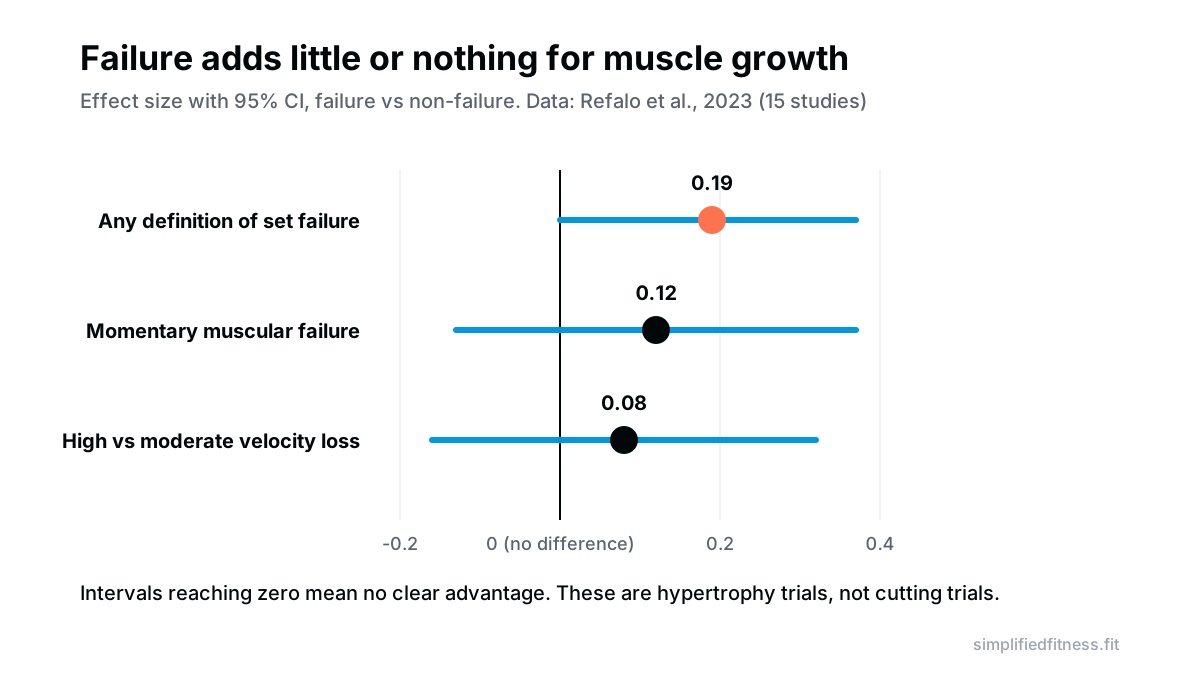
A fair caveat. These were mostly trials with people eating at maintenance or in a surplus. As far as I could find, nobody has run a clean trial of failure versus non-failure specifically in a calorie deficit. So the cutting advice below is a reasoned extension of the general evidence plus what we know about recovery, not a proven protocol.
What actually keeps your muscle on a cut
If failure is not the lever, what is? The signal that matters is continuing to train with enough tension (meaningful load, close enough to failure that the reps are hard) while you diet. That is what you can do at 1-3 RIR.
The bigger threats are elsewhere:
- The size of the deficit. A meta-analysis of randomized trials found lean mass gains were impaired when training in an energy deficit (effect size -0.57), though strength gains were comparable. The meta-regression suggested a deficit of about 500 kcal per day prevented lean mass gains, and the authors advise people trying to preserve lean mass to avoid deficits above that (Murphy and Koehler, 2022). Treat that as a rough guide, since it pools varied studies.
- How fast you lose weight. In 24 elite athletes, a planned loss of 0.7% of body weight per week led to a 2.1% rise in lean body mass, whereas a planned 1.4% per week left it unchanged. All trained with weights four times weekly (Garthe et al., 2011). Small sample, elite athletes, so apply it loosely.
- Protein. A systematic review of resistance-trained lean athletes suggested needs of roughly 2.3-3.1 g per kg of fat-free mass, scaled up with severity of restriction and leanness (Helms et al., 2014). Our high-protein cutting guide turns that into Indian meals.
Failure is nowhere on that list. Spend your energy on the things that move the needle.
Why failure costs more when you are eating less
Here is the logical part, and I want to be clear about what is established and what is inference.
Established: eating in a deficit impairs lean mass gain, and short-term deficits impair muscle protein synthesis and anabolic hormones according to the meta-analysis authors above. Your recovery budget is smaller.
Inference: a set to absolute failure costs extra fatigue for little extra stimulus (per the meta-analysis), and you pay that fatigue from a smaller budget. The result tends to be sessions that feel harder, lifts that stall, and a slow slide toward skipping workouts. I am not claiming a specific cortisol number or injury rate, because the studies I checked do not measure those in this setting. Treat these as practical risks, not proven mechanisms.
The injury angle is simpler. At failure, form degrades. On a heavy squat or deadlift, that is where lifters get hurt. Being under-fuelled and tired does not help.
What RIR targets should you use during a cut?
Contest-prep recommendations from a review by Helms and colleagues say muscle groups should be trained twice weekly or more, most reps in the 6-12 range, and that training to failure should be limited on heavy, taxing exercises and mainly reserved for single-joint exercises and higher reps (Helms et al., 2015). That maps neatly onto a simple RIR plan. If RIR itself is new to you, start with what RIR and RPE mean.
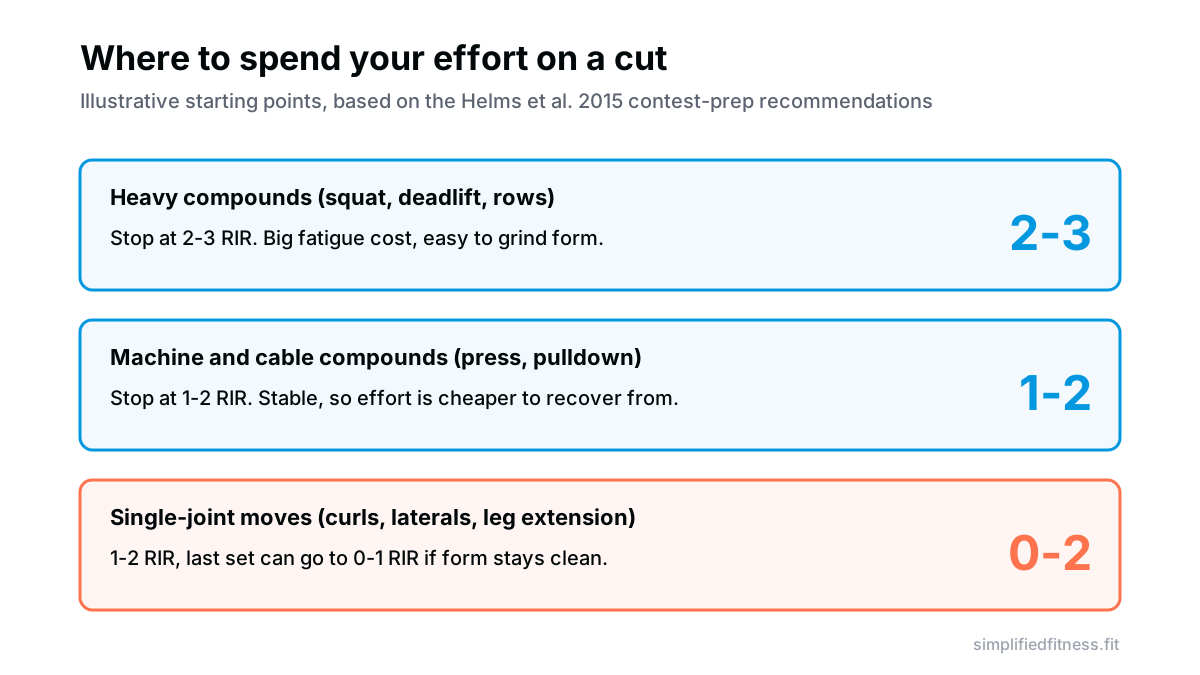
| Exercise type | Examples | Suggested RIR on a cut |
|---|---|---|
| Heavy compounds | Squat, deadlift, barbell row | 2-3 |
| Machine and cable compounds | Chest press, lat pulldown, seated row | 1-2 |
| Single-joint lifts | Curls, lateral raises, leg extension | 1-2, last set 0-1 if form is clean |
These are starting points, not laws. The numbers are my practical reading of the review above. If your reps are dropping fast across sets, you are probably too close.
Can you actually judge 2 RIR?
Fairly well, with limits. In a study of 24 resistance-trained men and women doing barbell bench press at 75% of 1RM, mean absolute error for 1-RIR and 3-RIR predictions was 0.65 reps, with a slight tendency to underpredict (Refalo et al., 2024). In the 2025 single-set trial, participants were more accurate on the bench press than the squat and improved over the 8 weeks (Hermann et al., 2025).
Practical takeaway: you will be a bit off, especially on squats and especially if you are new. That is fine, because a miss of one rep still keeps you in a useful range. For more detail, see our articles on how accurately lifters gauge RIR and calibrating your RIR.
Should you also cut volume?
Maybe not. In a trial of 38 resistance-trained men, a 5-set-per-exercise group and a 3-set group both trained for 6 weeks at 30 kcal/kg with protein fixed at 2.8 g/kg of fat-free mass. Lean mass fell in both groups with no difference between them, and sleep, mood and contractile properties held up (Roth et al., 2023). The takeaway is flexibility: moderate or higher volumes can both work. Note the sample was trained men, only the lower-body sessions were supervised, and muscle thickness was measured only in the thigh.
So when recovery gets tight, you have two dials, effort and volume. The cheaper one to turn first is usually effort: add a rep in reserve. For the volume side, see volume adjustments during a cut.
A simple cutting week
- Keep the load. Hold your usual weights where you can. Strength is mostly preserved in a deficit per the meta-analysis, so a sudden drop is a signal to look at recovery.
- Work at 1-3 RIR per the table above.
- Hold volume if you recover well. Trim one set per exercise if you do not.
- Eat protein at every meal. Dal, paneer, curd, eggs, soya chunks, chicken or fish all work. Use the protein calculator for a number.
- Pick a moderate deficit. If you are not sure, the calorie calculator and our guide to setting a moderate deficit are where to start.
In hot weather, hydration and sleep matter even more, because both affect how hard a set feels. The goal is simple: finish each session feeling like you could have done more, then come back and beat last week.
When to see a doctor
Fatigue on a cut is normal. Persistent dizziness, fainting, chest pain, missed periods, a racing heart at rest or a loss of interest in training or food that does not lift are not “just a hard cut.” If you notice these, stop the deficit and speak to a doctor. This article cannot diagnose the cause.
Failure on a cut: the bottom line
Training to failure is a tool, not a requirement. Muscle growth research has not shown it to be necessary, a deficit makes recovery pricier, and the bigger levers are protein, deficit size and keeping load on the bar. Stay at 1-3 RIR on most sets, go closer on stable single-joint lifts if you feel good, and judge your cut by whether your strength holds, not by how wrecked you feel after leg day.
Frequently Asked Questions
Should I train to failure when cutting?
Not as a default. In a meta-analysis of 15 studies, training to momentary failure showed no clear hypertrophy advantage over stopping short of it. Since recovery is tighter in a deficit, keep most sets at 1-3 reps in reserve and save true failure for the occasional safe, single-joint set.
What RIR should I use during a cut?
A practical range is 1-3 RIR, using 2-3 on heavy compounds and 1-2 on machines and isolations. This keeps the sets hard enough to count while leaving some recovery in reserve. If your reps and loads are holding steady, you are in the right zone.
Does training to failure prevent muscle loss in a deficit?
There is no evidence that it does. Muscle is kept mainly by continuing to train hard with enough load, eating enough protein and not cutting calories too aggressively. Add a set or keep the load up before you reach for failure.
Is failure training dangerous in a calorie deficit?
It is not inherently dangerous, but the risk rises with heavy, technically demanding lifts when you are tired and under-fuelled. Form tends to break down at failure, and a deficit can leave you feeling flatter. Take barbell squats, deadlifts and bench presses well short of failure and use a spotter or safeties.
How many reps in reserve should I leave on squats and deadlifts while cutting?
About 2-3 RIR is a reasonable target. These lifts load many muscles and the spine, so grinding reps costs more recovery than it returns. Stop when bar speed visibly slows and your form starts to change.
Can I still go to failure on isolation exercises during a cut?
Yes, with some care. Contest-prep recommendations suggest limiting failure on heavy, taxing lifts and mainly using it on single-joint exercises and higher reps. Try it on the last set of a lateral raise, curl or leg extension, and only if form stays clean.
Why do my workouts feel so hard in a calorie deficit?
Eating less lowers the energy and glycogen available for training, and you also recover more slowly from hard sessions. Meta-analytic data show muscle gain is impaired in a deficit, though strength is mostly preserved. Expect sets to feel harder at the same load and adjust RIR rather than judging yourself by your bulking numbers.
Should I lower my training volume when cutting?
Not necessarily. In one trial of 38 resistance-trained men, 5 sets per exercise and 3 sets per exercise led to a similar, small lean mass change during 6 weeks of restriction. Hold your volume if you recover well, and trim a set or two per exercise if you do not.
How do I know if I am training too close to failure?
Warning signs are lifts that keep dropping across 2 weeks, joints that ache more than usual, poor sleep and dreading sessions. These are signals, not diagnoses. Add a rep in reserve to your working sets and see if performance stabilises within a week or two.
Is the 2 RIR rule accurate if I cannot judge failure well?
Trained lifters can be fairly accurate, but not perfectly. In one bench press study of 24 trained men and women, the average absolute error was about 0.65 reps at 1 and 3 RIR, and accuracy was better on the bench than on the squat in another trial. If you are unsure, use the stable exercises to calibrate first.
How much protein do I need while cutting?
A systematic review of resistance-trained lean athletes suggested 2.3-3.1 g per kg of fat-free mass, scaled up with leaner physiques and bigger deficits. That is above standard guidelines, so treat it as a ceiling for very lean lifters, not a target for everyone. Use our protein calculator to get a starting number.
Do I need to deload on a cut?
Not by default, but a lighter week can help if performance keeps sliding. The goal is to restore quality, not to stop training. Keep your loads where they are and drop the sets or the effort for a week.
Sources & References
Every claim above is checked against peer-reviewed research (PubMed, U.S. National Library of Medicine) or guidance from established health bodies. How we fact-check.
- Refalo MC, et al. Influence of Resistance Training Proximity-to-Failure on Skeletal Muscle Hypertrophy: A Systematic Review with Meta-analysis. Sports Med. 2023. PMID: 36334240
- Murphy C, et al. Energy deficiency impairs resistance training gains in lean mass but not strength: A meta-analysis and meta-regression. Scand J Med Sci Sports. 2022. PMID: 34623696
- Roth C, et al. Resistance training volume does not influence lean mass preservation during energy restriction in trained males. Scand J Med Sci Sports. 2023. PMID: 36114738
- Helms ER, et al. Recommendations for natural bodybuilding contest preparation: resistance and cardiovascular training. J Sports Med Phys Fitness. 2015. PMID: 24998610
- Hermann T, et al. Without Fail: Muscular Adaptations in Single-Set Resistance Training Performed to Failure or with Repetitions-in-Reserve. Med Sci Sports Exerc. 2025. PMID: 40249908
- Helms ER, et al. A systematic review of dietary protein during caloric restriction in resistance trained lean athletes: a case for higher intakes. Int J Sport Nutr Exerc Metab. 2014. PMID: 24092765
- Garthe I, et al. Effect of two different weight-loss rates on body composition and strength and power-related performance in elite athletes. Int J Sport Nutr Exerc Metab. 2011. PMID: 21558571
- Refalo MC, et al. Accuracy of Intraset Repetitions-in-Reserve Predictions During the Bench Press Exercise in Resistance-Trained Male and Female Subjects. J Strength Cond Res. 2024. PMID: 37967832

Umair Hazrami · Founder & Head Coach, Simplified Fitness
Umair Hazrami founded Simplified Fitness and the Simplified Lifter channel to cut through fitness noise. With 4+ years of consistent training and 10+ coaching clients, he writes every guide from the peer-reviewed research and links the sources so you can check them. Our editorial standards.
Educational content only, not medical advice. If you have a medical condition, are pregnant, or take medication, talk to a qualified doctor before changing your diet, supplements or training. Full disclaimer.
Keep reading

Programming
Blood Flow Restriction (BFR) Practical Guide: Cuff Pressures, Rep Schemes, and Light Loads
How to do BFR training safely: cuff placement, pressure as a percentage of occlusion, the 30-15-15-15 scheme and who should skip it. Every study linked.
8 min read
Programming
Calibrating True RIR: A Safe Gym Test for Technical vs Absolute Failure
Calibrating RIR means testing how many reps you really have left. Use this safe machine protocol to find true failure and fix your 2 RIR guesses.
8 min read

Programming
CNS Fatigue vs Peripheral Fatigue: How Failure Hits Squats and Curls Differently
CNS fatigue vs peripheral fatigue: why failing a squat flattens you for days while failing a curl barely registers, and how many reps to leave in reserve.
9 min read
Programming
Failure on Machines and Cables vs Free Barbells: Managing Injury Risk and Axial Fatigue
Failure on machines vs barbells: why machine sets feel safer and less draining, what the research says, and where to push hard or stop at 1-2 RIR.
8 min read