Proximity to Failure by Movement Type: Compound Squats vs Isolation Lateral Raises
Failure proximity compounds vs isolations: should squats and lateral raises end at the same RIR? A practical rule backed by meta-analyses and recovery studies.

TL;DR. The short answer
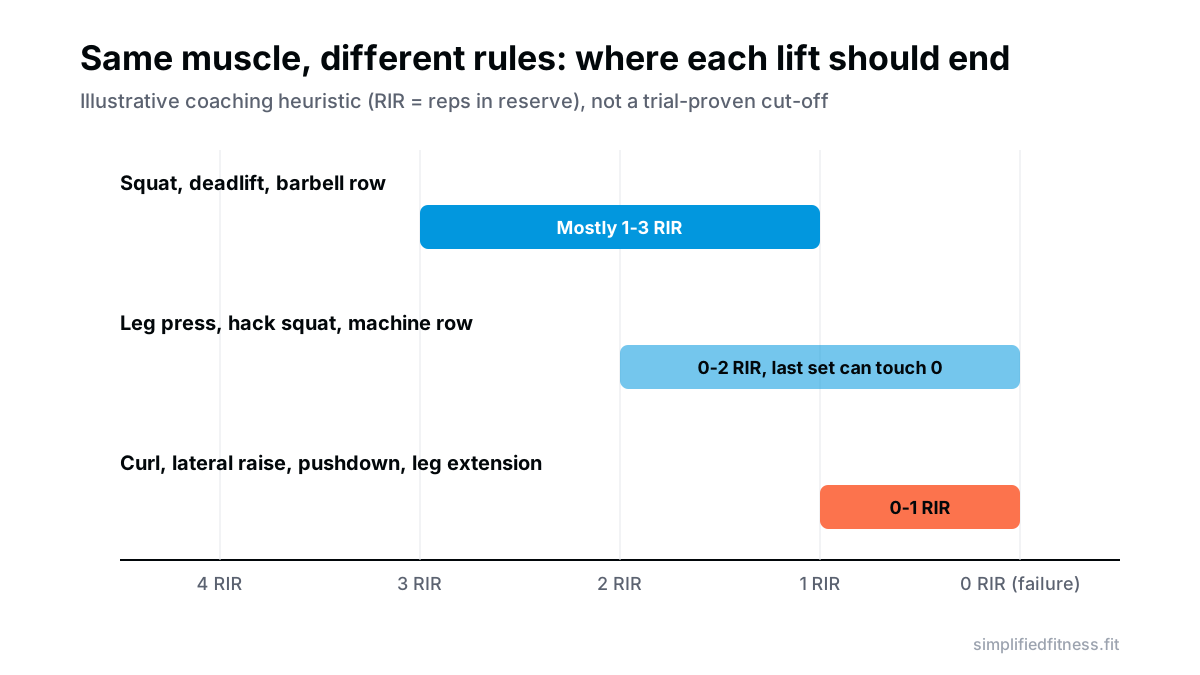
- No, squats and lateral raises do not need the same proximity to failure. A sensible rule is to leave about 1-3 reps in reserve on heavy compound lifts and allow 0-1 RIR on the last sets of simple isolation lifts.
- A 2023 meta-analysis found no clear hypertrophy advantage for momentary failure over stopping short, though a 2024 meta-regression suggests closer is somewhat better. Compounds probably give up little by staying a rep or two away.
- Training to failure slows recovery. In trained men doing squats and bench press, failure sets needed longer than non-failure sets to restore jump height and bar speed.
- The movement-type rule is a coaching heuristic built on this evidence, not something a trial has tested head to head. Treat it as a default and adjust to your own recovery.
- Pain, sharp joint symptoms or a form breakdown mean the set ends, whatever the exercise. See a doctor or physio if pain persists.
Part of our complete guide: Reps in Reserve, Rep Ranges and Rest Times: The Evidence-Based Guide to How Hard Every Set Should Be
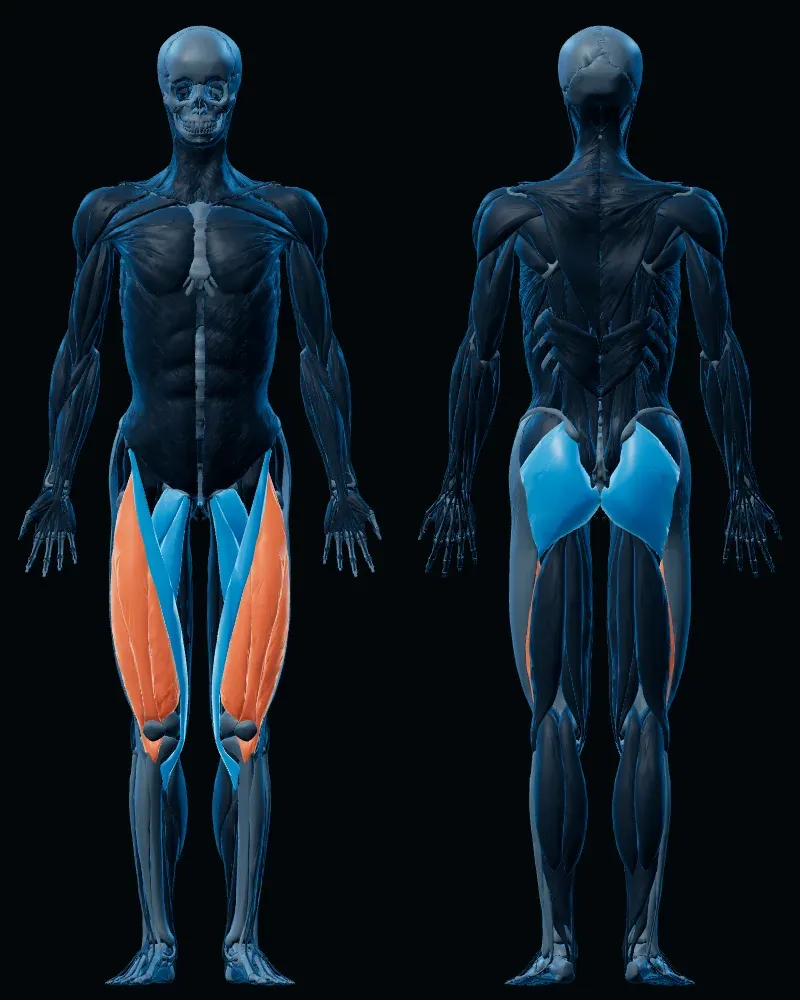
Muscles worked: quads
Main movers: rectus femoris and the three vasti
Assisting: adductors, sartorius and glutes
Table of contents
No, squats and lateral raises should not end at the same distance from failure. For heavy compound lifts like squats, deadlifts and barbell rows, stopping around 1-3 reps in reserve (RIR) is the safer, more sustainable default. For simple single-joint lifts like lateral raises, curls and pushdowns, taking the last sets to 0-1 RIR costs far less.
That is the working answer to failure proximity compounds vs isolations. It sits inside the bigger picture in our guide to load, rep ranges, RIR and rest intervals, and below we look at what the research does and does not say.
Is there a different failure rule for compounds and isolations?
Be clear about one thing first. No trial has randomised lifters to “squats to failure, lateral raises to failure” versus the reverse and measured the difference. The rule above is a coaching heuristic, built from three solid pieces of evidence and a bit of common sense about risk.
- Failure does not clearly build more muscle.
- Failure makes you recover more slowly.
- A failed rep is far more dangerous with a heavy bar on your back than with an 8 kg dumbbell in your hand.
Put those together and the movement-type rule almost writes itself. Where the cost of failure is high, stay back. Where it is low, push.
Does training to failure build more muscle?
Less than gym culture suggests. A 2023 systematic review and meta-analysis of 15 studies found a trivial advantage for training to “set failure” overall (effect size 0.19), but no advantage for momentary muscular failure versus non-failure (effect size 0.12, confidence interval -0.13 to 0.37) (Refalo et al., 2023). The authors concluded there was no evidence that momentary failure is superior for hypertrophy.
A 2024 meta-regression took a different approach. It treated proximity to failure as a continuous number (estimated RIR) and found that hypertrophy improved as sets ended closer to failure, while strength gains were similar across a wide range of RIR (Robinson et al., 2024). The authors flagged that the RIR values were estimated from study descriptions and called the analysis exploratory.
So do these two conflict? Not really. The first asks “failure or not?”, the second asks “how close?”. A reasonable reading is that closer is somewhat better, but the gain flattens near the end, so the last rep or two probably adds little. That is why 1-3 RIR on hard compounds likely gives up only a small amount of growth.
What does failure cost you in fatigue and recovery?
This is where compounds differ most. In a crossover study, ten resistance-trained men did three protocols on bench press and full squat, including 3 sets of 10 reps with 10 possible (failure) versus 6 sets of 5 reps with 10 possible (same total volume, no failure). Failure sets caused a larger acute drop in jump height and bar velocity, and recovery between 24 and 48 hours was slower (Morán-Navarro et al., 2017). The authors suggested that avoiding failure leaves you in better condition for the next session.
Squat-specific data point the same way. In 15 resistance-trained men doing three sets of full squats at 70% of 1RM, protocols that allowed more velocity loss within the set (30% and 40%) produced more fatigue and slower recovery than a 20% velocity-loss protocol, with performance dips still showing at 24-48 hours (Cornejo-Daza et al., 2024). Velocity loss is a proxy for how close you got to failure, so this fits the same story.
A small 2026 crossover of six trained men found a full-body session to failure raised markers of muscle damage and soreness and delayed jump recovery through 72 hours versus a non-failure session with similar total volume (Vieira et al., 2026). Six participants is tiny, so the authors themselves urged cautious interpretation, but it matches the larger-sample pattern.
Notice what most of these studies used: squats and bench press. Large-muscle, heavy lifts. That is exactly where fatigue costs pile up.
Why compounds need a bigger buffer
Fatigue is only half of it. The other half is mechanics.
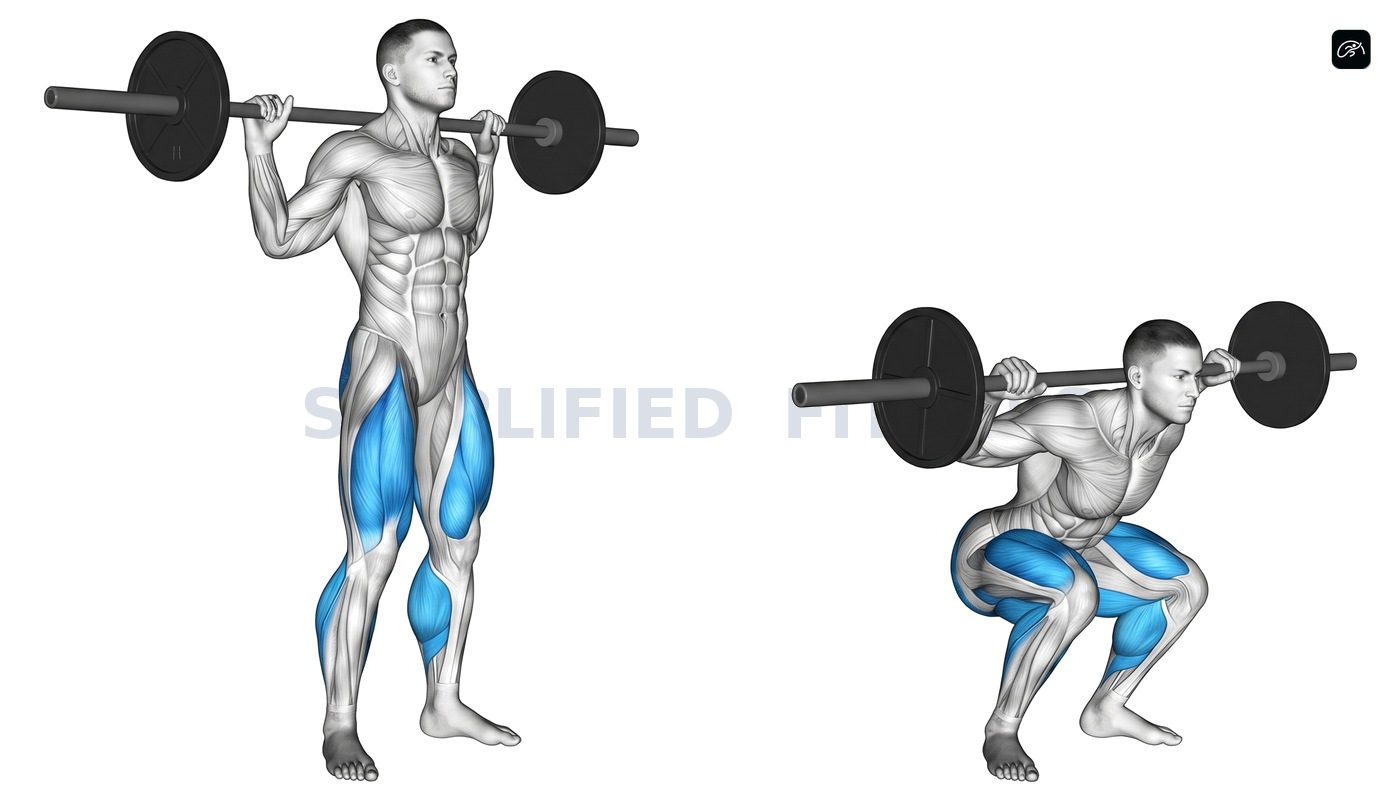
On a heavy squat, a bad last rep means your hips shoot up first, your lower back rounds, or the bar drifts forward. All of that happens while the bar sits on your upper back. A deadlift or barbell row asks your back to hold a position under load while your legs and grip also tire.
In gym terms, this looks like the “last rep” that looks nothing like your first rep. If you could not film the rep without wincing, it was one too many.
Compounds also use a lot of muscle at once, so they are tiring for the whole body and slow your recovery for the next session. For a deeper look at that, read our piece on how central and peripheral fatigue limit lifting.
Why isolations can go to failure with a smaller penalty
Take lateral raises. The load is light, the joint is simple, and the muscle that fails (the lateral deltoid) is small. You are not balancing a heavy bar and your spine is not under axial load. If a rep stalls, you just lower the dumbbells.
Evidence supports using failure on isolations. A 2025 trial had 24 resistance-trained men and women train lateral raises for five sets to momentary failure, twice a week for eight weeks. Lateral deltoid thickness rose by 3.3-4.6%, with similar results from dumbbells and cables (Larsen et al., 2025). That shows failure on lateral raises is workable and productive, not that it beat stopping short, since the study did not include a non-failure group.
The fatigue cost is also smaller because less total muscle is involved. Raising 7 kg for the last three reps of a set does not leave you tired for two days the way grinding squats can.
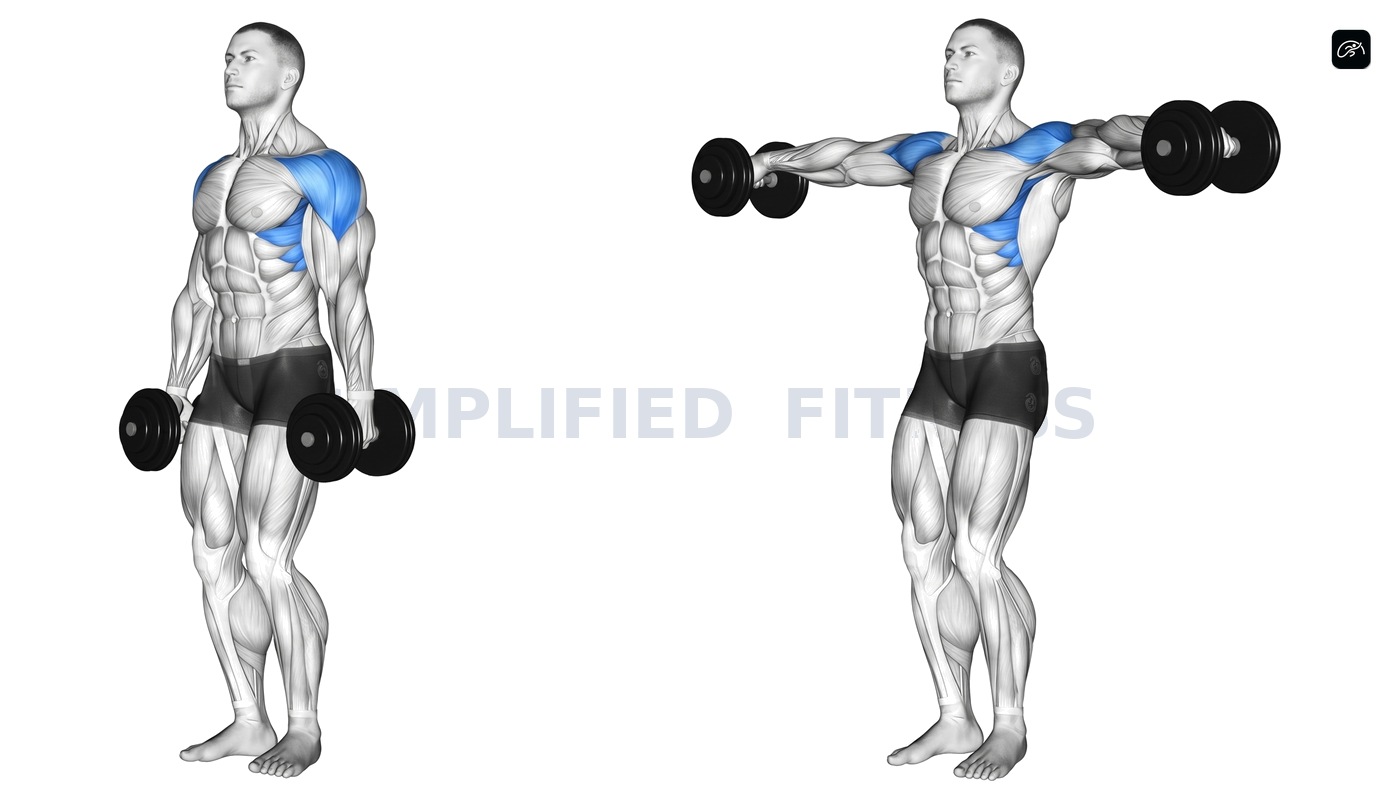
For setup and technique, see our lateral deltoid guide on dumbbells versus cables and machines.
So what does a smart mix look like?
Think of failure as a tool you spend, not a badge.
- Early sets: leave 2-3 RIR on every lift.
- Last set of an isolation: go to 0-1 RIR.
- Last set of a compound: 1-2 RIR, rarely lower.
- Machine compounds (leg press, chest-supported rows): somewhere in between, 0-2 RIR.
This idea fits a broader principle: choose exercises and effort so you get the most stimulus per unit of fatigue. We cover that in stimulus-to-fatigue ratio and exercise selection. If you want the meta-analysis story in more depth, see training to failure versus RIR for hypertrophy.
How to decide set by set
Use three questions before pushing a set past about 1 RIR.
- Does a bad rep put your spine, a barbell or a joint at risk?
- Does your form stay the same on the final reps?
- Will you recover before the next session that uses this muscle?
If the answer to the first is yes, stop at 1-3 RIR. If your form changes, end the set a rep or two earlier. Only when all three are clear should you go to 0.
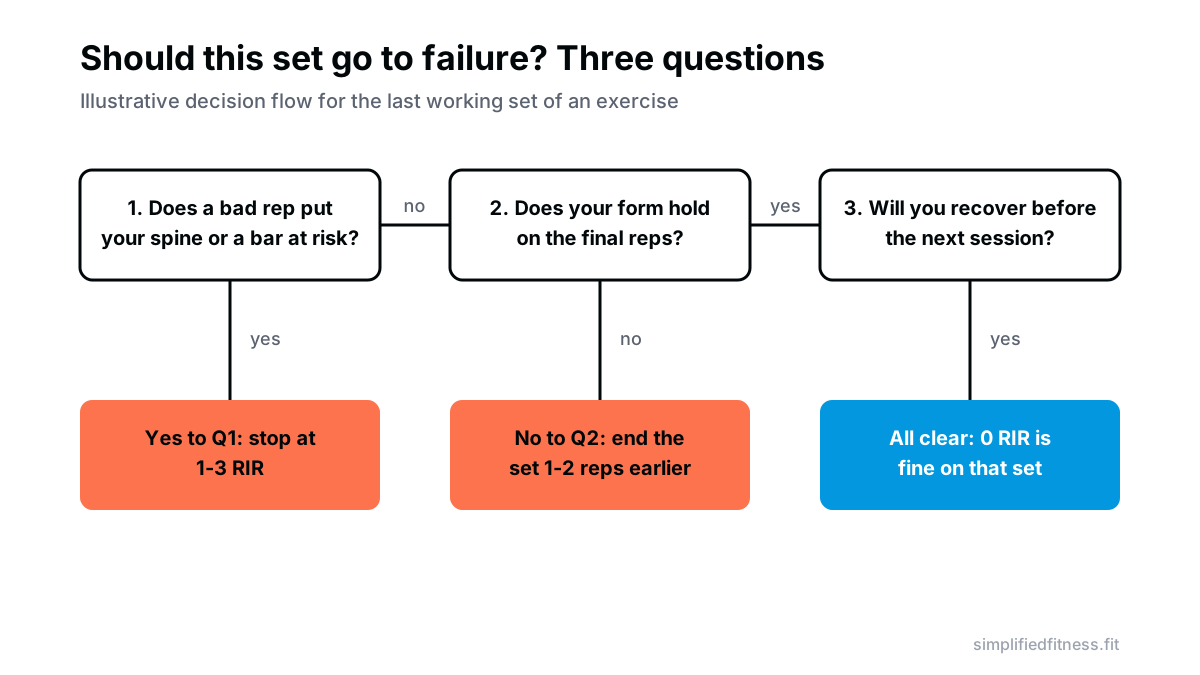
You can also set loads by effort with our RIR and RPE load calculator.
Can you actually judge failure accurately?
Reasonably, but not precisely. On average, lifters tend to underpredict how many reps they have left, usually by a rep or two, and guesses are less accurate far from failure. That is why the 1-3 RIR zone is forgiving: even a guess that is off by one rep keeps you out of real trouble. We break down the studies in how accurately lifters gauge RIR, and our RIR and RPE scale guide covers the scale itself.
What about velocity loss and bar speed?
If you have a way to track bar speed, velocity loss is a more objective stop signal than “feels hard”. In 64 resistance-trained men squatting for 8 weeks, groups stopping at 20% and 40% velocity loss showed significant hypertrophy increases, but only the 40% group showed negative neuromuscular changes such as slower early rate of force development (Pareja-Blanco et al., 2020). The authors suggested moderate thresholds for strength and to avoid negative adaptations. Most lifters do not own a velocity tracker, but the lesson transfers: when the bar slows a lot, the set has done its work.
Who should be extra careful?
Use extra margin if you are new to a lift, returning from injury, training alone without safety pins or a spotter, dieting hard, sleeping badly or training in heavy heat. In Indian summer conditions, with long commutes and short sleep, recovery is often the thing that runs out first. Cut your effort a notch before cutting your frequency.
Sharp pain, pinching or joint symptoms are a stop sign at any RIR. If pain lingers beyond a day or two, or you feel numbness or pain shooting down a limb, see a doctor or physiotherapist rather than training through it.
The bottom line
Squats and lateral raises should not share one failure rule. Leave 1-3 reps in reserve on heavy compound lifts, let simple isolations reach 0-1 RIR on the last set, and treat failure as occasional seasoning rather than the main meal. The studies behind this show that failure adds little growth but real fatigue, and that the practical risk lies mostly in the big lifts.
Want a structure that puts this into practice? Try our free leg day plan, and see our guide to junk volume and diminishing returns if your sessions feel endless.
Frequently Asked Questions
Should you take squats to failure?
For most lifters, no. Leaving about 1-3 reps in reserve gets you nearly the same muscle growth with less fatigue and a lower chance of an ugly, unsafe rep under a heavy bar. If you ever do grind a squat set to failure, do it in a power rack with safety pins set, and keep it rare.
Do isolation exercises need to go to failure?
Not strictly, but they are the safest place to do it. A 2023 meta-analysis found no clear hypertrophy advantage for failure over non-failure training, so failure is optional rather than required. Using 0-1 RIR on the last set of curls or lateral raises is a reasonable way to push without much systemic cost.
Why is failure riskier on compound lifts?
Squats, deadlifts and barbell rows load the spine, hips and knees while you balance a heavy bar, so a failed rep has more ways to go wrong. When fatigue builds, technique drifts exactly where the load is highest. Stop the set when your rep speed and bracing start to fade, not when the bar stops moving.
What RIR should I use for squats?
A working range of about 1-3 RIR suits most trained lifters, with the lighter end of effort in early sets. This keeps bar speed and technique intact across all your sets. Use an RIR calculator or video your sets to check that your guess matches reality.
Can I train lateral raises to failure every set?
You can, but you may not need to. In a 2025 trial in resistance-trained lifters, five sets of lateral raises to momentary failure twice weekly grew the lateral deltoid by roughly 3-5% over eight weeks. Because failure also adds fatigue, many lifters do better with early sets at 1-2 RIR and the final set near 0.
Does training to failure build more muscle?
Not clearly. A 2023 meta-analysis of 15 studies found no advantage for momentary failure over non-failure for hypertrophy, and a 2024 meta-regression suggested growth rises modestly as sets get closer to failure. The two fit together if the benefit is small and levels off near the end. Staying 1-2 reps short likely captures most of it.
How does failure training affect recovery?
It slows it. In ten resistance-trained men, sets taken to failure on bench press and squat caused a bigger drop in jump height and bar velocity, and recovery between 24 and 48 hours was slower than with non-failure sets. If your next session is within two days, keep a rep or two in the tank on heavy lifts.
Is failure on machines safer than on free weights?
Generally yes, because a machine or cable limits balance demands and often lets you release the load safely. That makes machines good places to reach 0 RIR if you want to. Stay careful with ranges where the stack can jerk or your shoulder or knee feels pinched.
How do I know I am actually at failure?
True failure is a rep you cannot complete with the same form despite a maximal effort, and most people underestimate how many reps they have left. Reps often slow sharply before you stall, which is a useful warning sign. Practising with a spotter or on safe machines tightens your estimate.
Should beginners go to failure?
Beginners usually progress well with 2-3 RIR while they learn technique. Practising clean reps matters more than chasing burn in the first few months. Save failure sets for simple machine or cable movements until your form on free weights is steady.
What about the last set only?
Keeping early sets short of failure and pushing only the last set is a common compromise. It limits fatigue across the session while still testing your limit once. On heavy compounds keep that last set at 1-2 RIR, and on isolations let it reach 0-1.
Do I need to go to failure when cutting calories?
Recovery is usually tighter when eating less, so extra fatigue costs more. Many lifters do better keeping compounds at 2-3 RIR and using isolations for the harder sets. Watch your sleep, bar speed and joint comfort, and back off if they slide.
How many reps in reserve is too few for deadlifts?
Deadlifts are tiring for the whole body, so most lifters recover better staying around 2-3 RIR. A grinding deadlift also tends to round the back or lose bracing. If your last rep looks different from your first, it was one rep too many.
Sources & References
Every claim above is checked against peer-reviewed research (PubMed, U.S. National Library of Medicine) or guidance from established health bodies. How we fact-check.
- Refalo MC, et al. Influence of Resistance Training Proximity-to-Failure on Skeletal Muscle Hypertrophy: A Systematic Review with Meta-analysis. Sports Med. 2023. PMID: 36334240
- Robinson ZP, et al. Exploring the Dose-Response Relationship Between Estimated Resistance Training Proximity to Failure, Strength Gain, and Muscle Hypertrophy: A Series of Meta-Regressions. Sports Med. 2024. PMID: 38970765
- Morán-Navarro R, et al. Time course of recovery following resistance training leading or not to failure. Eur J Appl Physiol. 2017. PMID: 28965198
- Pareja-Blanco F, et al. Velocity Loss as a Critical Variable Determining the Adaptations to Strength Training. Med Sci Sports Exerc. 2020. PMID: 32049887
- Cornejo-Daza PJ, et al. Time Course of Recovery From Different Velocity Loss Thresholds and Set Configurations During Full-Squat Training. J Strength Cond Res. 2024. PMID: 37972985
- Larsen S, et al. Dumbbell versus cable lateral raises for lateral deltoid hypertrophy: an experimental study. Front Physiol. 2025. PMID: 40692697
- Vieira JG, et al. Acute fatigue and recovery responses to resistance training performed to momentary muscular failure: an exploratory multimodal physiological study. Sci Rep. 2026. PMID: 42374131

Umair Hazrami · Founder & Head Coach, Simplified Fitness
Umair Hazrami founded Simplified Fitness and the Simplified Lifter channel to cut through fitness noise. With 4+ years of consistent training and 10+ coaching clients, he writes every guide from the peer-reviewed research and links the sources so you can check them. Our editorial standards.
Educational content only, not medical advice. If you have a medical condition, are pregnant, or take medication, talk to a qualified doctor before changing your diet, supplements or training. Full disclaimer.
Keep reading

Programming
Blood Flow Restriction (BFR) Practical Guide: Cuff Pressures, Rep Schemes, and Light Loads
How to do BFR training safely: cuff placement, pressure as a percentage of occlusion, the 30-15-15-15 scheme and who should skip it. Every study linked.
8 min read
Programming
Calibrating True RIR: A Safe Gym Test for Technical vs Absolute Failure
Calibrating RIR means testing how many reps you really have left. Use this safe machine protocol to find true failure and fix your 2 RIR guesses.
8 min read
Programming
CNS Fatigue vs Peripheral Fatigue: How Failure Hits Squats and Curls Differently
CNS fatigue vs peripheral fatigue: why failing a squat flattens you for days while failing a curl barely registers, and how many reps to leave in reserve.
9 min read
Programming
Failure on Machines and Cables vs Free Barbells: Managing Injury Risk and Axial Fatigue
Failure on machines vs barbells: why machine sets feel safer and less draining, what the research says, and where to push hard or stop at 1-2 RIR.
8 min read