Rest-Pause, Myo-Reps, and Cluster Sets: Accumulating Effective Reps in Compressed Time
Myo reps rest pause training can build similar muscle in less time. See how to do myo-reps and cluster sets, what the trials show, and where they fail.

TL;DR. The short answer
- Myo reps and rest-pause training stack hard reps with very short pauses, so you collect a lot of near-failure reps in a few minutes. In trained lifters they have matched traditional sets for muscle growth when total volume and effort were comparable.
- A common myo-rep template is one activation set of 12-15 reps near failure, about 5 breaths of rest, then 3-5 mini-sets of 3-5 reps with the same weight.
- A 2026 trial in resistance-trained men found myo-reps and straight sets gave similar muscle size and strength after 8 weeks, with the myo-rep group doing roughly 30% less volume load. The study was small (22 lifters).
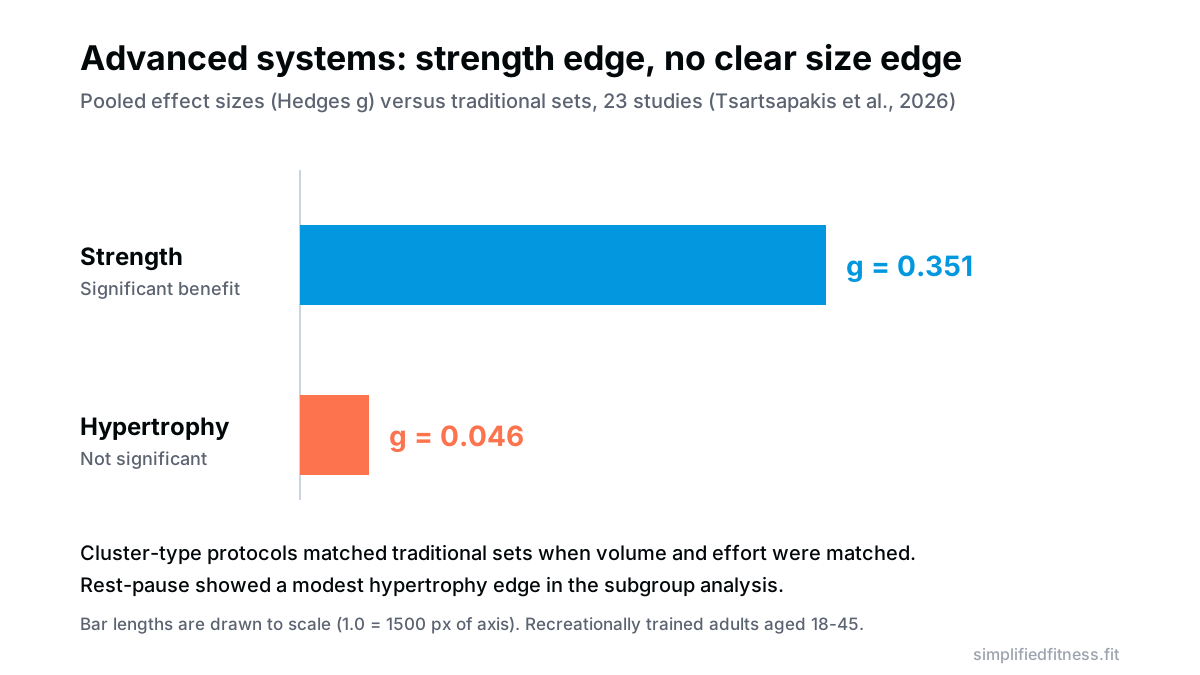
- A 2026 meta-analysis found advanced systems gave a moderate strength edge (g = 0.351) but no significant hypertrophy edge (g = 0.046) over traditional sets.
- Use these techniques on machines, cables and isolation lifts. Heavy compound barbell lifts are a poor fit because technique breaks down when you are tired.
Part of our complete guide: Reps in Reserve, Rep Ranges and Rest Times: The Evidence-Based Guide to How Hard Every Set Should Be
Table of contents
Myo reps rest pause training squeezes a lot of hard reps into a few minutes by replacing long rests with very short ones. In trained lifters, the trials so far show it can build about the same muscle as ordinary straight sets, usually with less time and less total volume. It does not build more muscle. It builds the same muscle faster, and only if you choose the right exercises.
This is the execution guide for the technique. For the bigger picture on load, reps in reserve and rest, start with our pillar guide to rep ranges, RIR and rest intervals.
What are myo reps, rest-pause and cluster sets?
Three techniques, one idea: split one hard effort into pieces with tiny pauses so you can keep lifting at a tough effort level.
- Rest-pause: take a set to or near failure, rest briefly, then do more reps with the same load. Often just two or three bursts.
- Myo-reps: one longer activation set (12-15 reps, near failure), then a series of short mini-sets of 3-5 reps after about 5 breaths each. The method was popularised by coach Borge Fagerli.
- Cluster sets: a planned set where you break the reps into small groups with a fixed short rest inside the set, such as 3 clusters of 4 reps with 20 seconds between them.
The difference is mostly intent. Rest-pause and myo-reps chase fatigue inside the muscle. Cluster sets are often used to keep bar speed and technique up. In the gym they look nearly identical: you lift, take a few breaths, lift again.
The effective reps idea (and its limits)
The popular argument for myo-reps goes like this. In a long set, the early reps are easy and probably do little. The last handful before failure are slow, hard and recruit your biggest muscle fibres. Those are the “effective reps.” So instead of grinding through 15 reps to find 5 good ones, you reach the hard zone once and then keep re-entering it with short pauses.
It is a neat model. Treat it as a coaching heuristic, not as settled physiology. A 2023 meta-analysis of 15 studies found a trivial advantage for training to set failure versus non-failure (effect size 0.19), no advantage for momentary failure specifically, and suggested a possible non-linear relationship between proximity to failure and growth (Refalo et al., 2023). Translation: getting close to failure matters, but hitting absolute failure on every set is not a requirement.
If you are unsure how close “close” is, our guide to reps in reserve and the RPE scale will help, and the RIR / RPE load calculator is a quick way to pick a starting weight. The question of failure itself is covered in training to failure versus leaving 1-3 reps in the tank.
How to do myo reps: the step-by-step protocol
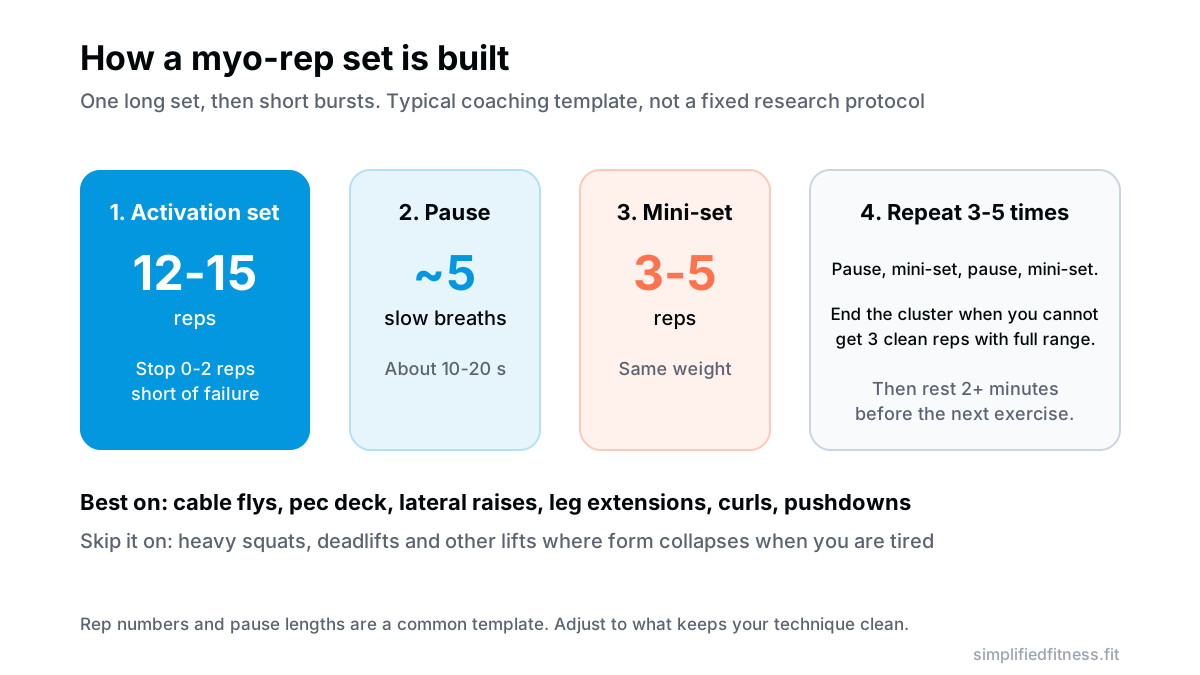
Here is the common template. It is a coaching convention, not a protocol validated in a single standard study, so adjust it to what keeps your reps clean.
- Warm up and choose the weight. Pick a load you could lift for about 12-15 reps. On a cable fly, that is usually lighter than you think.
- Activation set. Do 12-15 reps and stop about 0-2 reps short of failure. Controlled tempo, full range.
- Pause. Rest for roughly 5 slow breaths, about 10-20 seconds. Shake the arms out. Do not sit down.
- Mini-set. Do 3-5 reps with the same weight. They will feel heavy.
- Repeat. Pause, mini-set, pause, mini-set. Most people manage 3-5 mini-sets.
- End the cluster. Stop when you cannot get 3 clean reps with full range. Reps that look like a different exercise do not count.
- Rest 2+ minutes before the next exercise, and move on.
The whole thing takes only a few minutes. One cluster usually replaces what would have been two to four straight sets for that exercise, though there is no fixed exchange rate in the research.
Do they work? What the research found
The honest summary: similar results in less time, from small studies, in trained people.
Myo-reps. A 2026 trial in resistance-trained men had 22 lifters train flat barbell bench, incline barbell bench and seated cable fly twice a week for 8 weeks, in either a myo-rep or a traditional straight-set group. Both groups gained muscle and strength with no difference between them, even though the myo-rep group did roughly 30% less volume load (Bradshaw et al., 2026). In an acute crossover with 9 lifters, session duration was significantly shorter with myo-reps while muscle excitation and bar velocity did not differ. Small samples, one lab, upper body only.
Rest-pause. A trial in 28 resistance-trained men compared rest-pause, drop sets and traditional sets with equal volume for 8 weeks. Hypertrophy (thigh muscle thickness) was similar in all groups, while rest-pause showed slightly higher squat 1RM than traditional training (Enes et al., 2021). A smaller trial of 18 trained people over 6 weeks found similar strength gains but greater thigh thickness with rest-pause (Prestes et al., 2019).
Cluster sets. A 2021 meta-analysis of 29 studies found no differences between cluster and traditional sets for strength, power, hypertrophy or endurance, though cluster sets may produce less fatigue during training (Davies et al., 2021). A 2025 within-person trial in 10 resistance-trained people had both legs do 5 sets of 12 reps on leg press and leg extension. One leg did straight sets; the other split each set into 3 clusters of 4 reps with 20 seconds of intra-set rest, with loads adjusted to the same RIR range. Thigh muscle thickness and lean mass rose similarly (Vargas-Molina et al., 2025).
The big picture. A 2026 meta-analysis of 23 studies in recreationally trained adults found advanced systems gave a moderate, significant strength benefit (g = 0.351) but a small, non-significant hypertrophy effect (g = 0.046). Rest-pause showed a modest hypertrophic advantage, while drop sets, tempo-controlled training and cluster-type protocols matched traditional sets when volume and effort were matched (Tsartsapakis et al., 2026).
Do myo reps really save time?
Yes, that part is the least disputed. A narrative review of time-efficient training notes that advanced techniques such as supersets, drop sets and rest-pause roughly halve training time compared with traditional training while keeping training volume similar, and that these methods are probably better suited to hypertrophy than to strength (Iversen et al., 2021). Note that the review said rest-pause, not myo-reps specifically, and its conclusions on strength differ from the 2026 meta-analysis, which found a strength edge. Longitudinal data are limited either way.
You may see claims that myo-reps save “70% of your workout time.” We did not find a trial that measured that figure. Savings depend on how long you normally rest and how many straight sets the cluster replaces. Expect it to be large, but do not plan your week around an exact number.
For a full 30-minute plan built on this idea, see our 30-minute high-density hypertrophy workouts, and for pairing exercises instead of clustering sets, our guide to antagonist-paired sets and supersets.
Best exercises for myo reps (and where to avoid them)
Pick exercises where taking a muscle close to failure is safe and technique does not fall apart when fatigue builds.
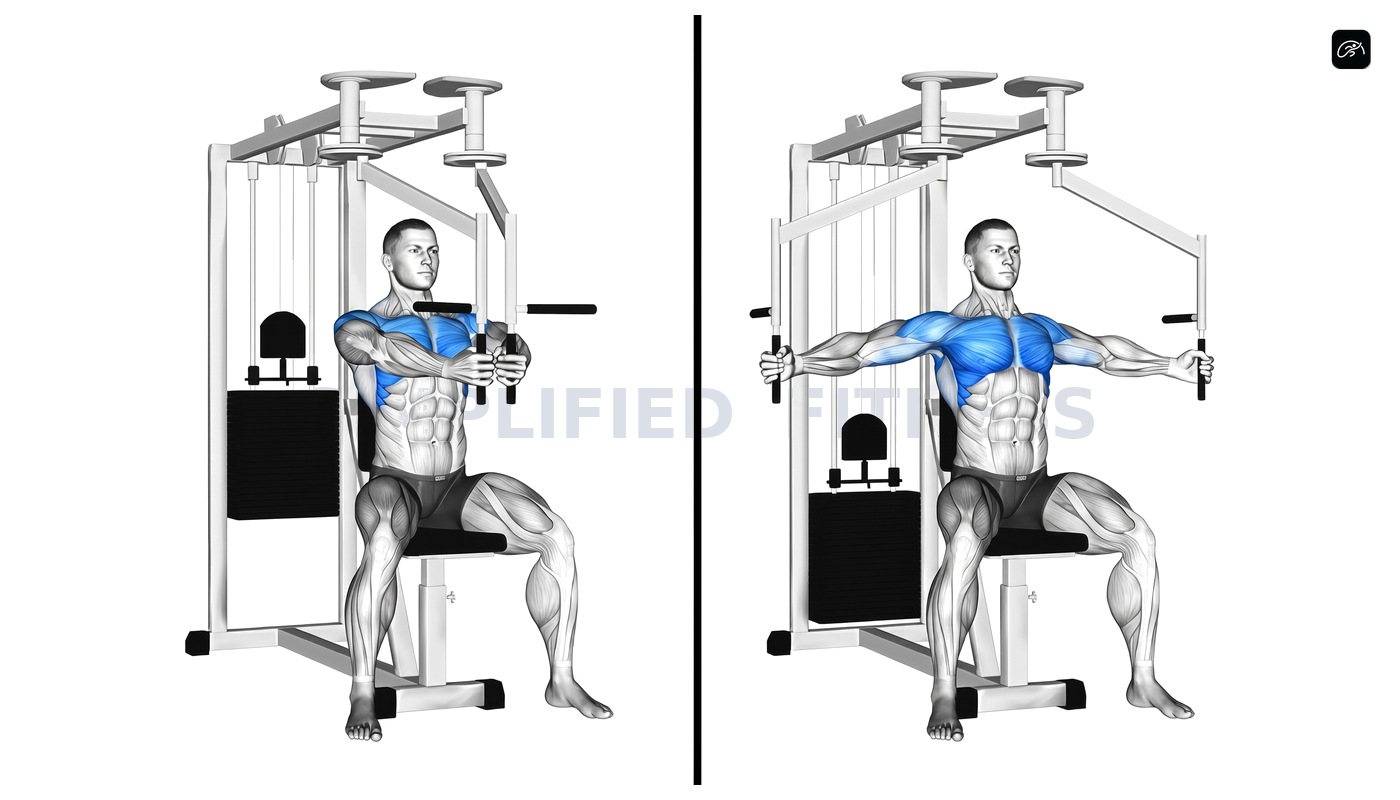
Good fits:
- Pec deck and cable flys
- Lateral raises (cable or dumbbell)
- Leg extensions and seated leg curls
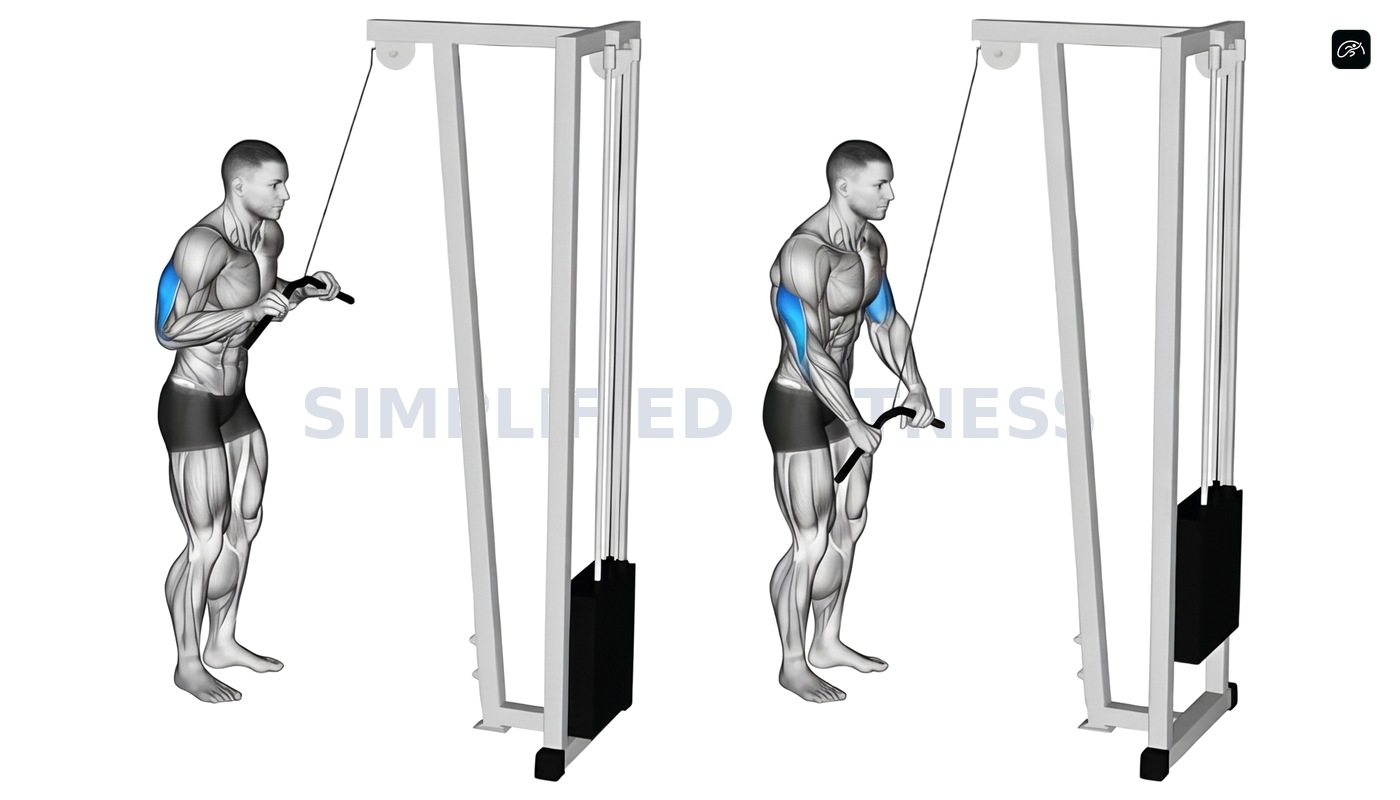
- Triceps pushdowns and overhead extensions
- Preacher and cable curls
- Calf raises
Poor fits:
- Heavy barbell squats and deadlifts
- Anything where a failed rep could trap you without a safety setup
Why? Short rests mean you start each mini-set already fatigued. On a pec deck, the worst outcome is slower reps. On a heavy back squat, the worst outcome is a collapsed brace and a bar you cannot control. The 2026 myo-rep trial did use barbell bench press, so it is not impossible, but those were trained lifters in a lab. If you want more on the machine versus barbell trade-off, read failure on machines and cables versus free barbells.
Myo-reps vs short rest intervals: what is the catch?
The catch is that every pause is short. If you simply cut rest between full sets to 30-60 seconds, your reps per set drop and your volume goes down. Myo-reps get around this by making the fatigue part of the plan and judging effort by reps close to failure, not by weight on the bar. Our guides to why 2-3 minute rests help hard sets and when short rests are worth the penalty explain the trade-off in more depth.
Practical rules:
- Use myo-reps for the last exercise for a muscle, not the first.
- Keep your heavy compound work on normal 2-3 minute rests.
- Do not use myo-reps on every exercise in a session. Joints and effort levels do not like it.
- Count each cluster as one or two hard sets toward weekly volume, since the research does not give an exact conversion.
Who should skip these techniques?
Do not rely on myo-reps if:
- You are a beginner. Straight sets with clean technique are enough, and judging proximity to failure is hard when you are new. The trials are in resistance-trained people.
- You have joint pain, a recent injury, high blood pressure or a heart condition. Hard sets with short rests can raise heart rate and blood pressure, and fatigue changes technique. Check with your doctor or physiotherapist first, and choose machines.
- You need maximal strength for a specific lift. Heavy, well-rested sets on that lift remain the cleanest practice, even though the pooled analysis found a strength edge for advanced systems in recreationally trained adults.
A vegetarian lifter eating dal, paneer, curd and soya does not need anything different here. The technique cares about effort and recovery, not diet type. Eat enough protein and sleep.
A simple way to use myo-reps this week
Here is a sensible starting point, built from the template above rather than from a tested protocol:
- Run your normal training for the main lifts.
- Choose one isolation exercise per muscle on your last slot, such as cable fly for chest.
- Do one myo-rep cluster: 12-15 activation reps, then 3-5 mini-sets.
- Log total reps across the cluster and try to beat it next week by one rep.
- If form slips or joints complain, go back to straight sets.
Keep it boring and repeatable. The technique is a time-saver, not a trick.
Frequently Asked Questions
What are myo reps?
Myo-reps are a set structure where you do one longer activation set close to failure, then add several short mini-sets of 3-5 reps after very brief rests. The idea is to collect many hard, near-failure reps in a few minutes. Try it on a cable fly or leg extension before using it anywhere else.
How do you do myo reps step by step?
Pick a weight you can lift for 12-15 reps, take that activation set to within 0-2 reps of failure, rest for about 5 slow breaths, then do 3-5 more reps with the same weight. Repeat the pause and mini-set until you cannot get 3 clean reps with full range, usually after 3-5 mini-sets. Stop the cluster there and rest properly before the next exercise.
Do myo reps build more muscle than normal sets?
Not in the research so far. A 2026 trial in resistance-trained men found similar muscle size and strength gains with myo-reps and straight sets, and a 2026 meta-analysis found no significant hypertrophy advantage for advanced systems overall. The practical win is time, not extra growth.
Is rest-pause training the same as myo reps?
They are close cousins but not identical. Rest-pause usually means taking a set to or near failure, resting briefly, then squeezing out more reps with the same load, often only a few times. Myo-reps start with a longer activation set and then use several fixed mini-sets, so they usually involve more pauses.
What are cluster sets?
Cluster sets split one set into small groups of reps with a short rest inside the set, for example 3 clusters of 4 reps with 20 seconds between them. The rests let you keep better bar speed and technique with a given load. In a 2025 trial in trained people, cluster sets and traditional sets gave similar thigh growth when effort was matched.
How many reps count as effective reps?
There is no proven fixed number, but a common coaching idea is that the last few reps before failure, when the bar slows down and the effort is high, do most of the growth work. Research on proximity to failure suggests the relationship is not a straight line, since training to momentary failure was not shown to beat stopping short. Treat the effective reps idea as a useful heuristic, not a law.
Which exercises are best for myo reps?
Machines, cables and single-joint exercises work best: pec deck, cable flys, lateral raises, leg extensions, leg curls, pushdowns and curls. Failure is safer there and the bar path is fixed, so technique holds up when you are tired. Avoid them on heavy squats and deadlifts.
Can I use myo reps on squats, deadlifts or bench press?
It is possible but not ideal. A 2026 trial used barbell bench press, incline press and cable flys with myo-reps and saw similar results to straight sets, in trained lifters under lab supervision. For heavy leg and back lifts, short rests plus fatigue raise the risk of sloppy reps, so use a machine variation instead.
How long should I rest between myo-rep mini-sets?
About 5 slow breaths, roughly 10-20 seconds, is the usual template. The pause is long enough to recover some reps but short enough that the muscle stays fatigued. If you take 60 seconds or more, you are doing normal sets with extra steps.
How many myo-rep sets should I do per muscle per week?
There is no tested weekly dose for myo-reps specifically. Count each full myo-rep cluster as roughly one to two hard sets, and keep your total hard sets per muscle within your normal range. If you are unsure, start with one cluster per exercise on the last exercise for that muscle.
Do myo reps work for beginners?
Beginners do not need them. Straight sets with good technique and steady progression drive early growth, and judging proximity to failure is harder when you are new. The trials we have involved resistance-trained people, so the results should not be assumed for novices.
Are myo reps safe if I have an injury or high blood pressure?
Hard sets taken near failure with short rests can raise heart rate and blood pressure, and fatigue can worsen technique around a sore joint. This article cannot diagnose anything, so if you have a heart or blood pressure condition, joint pain or a recent injury, ask your doctor or physiotherapist before using high-effort techniques. Choose machines and stop any set that causes sharp pain.
Can I do myo reps with dumbbells at home?
Yes, on isolation movements like lateral raises, curls and overhead extensions. Keep the weight light enough that you can stay controlled through the activation set. Do not use them on heavy dumbbell presses unless you have a spotter or a safe way to drop the weights.
How do I progress with myo reps?
Add reps to the activation set first, then add a mini-set, then raise the load once you can complete the template cleanly. Track the total reps across the cluster, not just the first set. Progress is a trend over weeks, so keep your technique and range of motion the same each time.
Sources & References
Every claim above is checked against peer-reviewed research (PubMed, U.S. National Library of Medicine) or guidance from established health bodies. How we fact-check.
- Bradshaw JT, et al. Similar Strength and Hypertrophic Adaptations in Less Time? Myo-Reps vs. Traditional Straight-Sets in Resistance-Trained Men. J Strength Cond Res. 2026. PMID: 42112925
- Enes A, et al. Rest-pause and drop-set training elicit similar strength and hypertrophy adaptations compared with traditional sets in resistance-trained males. Appl Physiol Nutr Metab. 2021. PMID: 34260860
- Prestes J, et al. Strength and Muscular Adaptations After 6 Weeks of Rest-Pause vs. Traditional Multiple-Sets Resistance Training in Trained Subjects. J Strength Cond Res. 2019. PMID: 28617715
- Vargas-Molina S, et al. Cluster sets and traditional sets elicit similar muscular hypertrophy: a volume and effort-matched study in resistance-trained individuals. Eur J Appl Physiol. 2025. PMID: 39932536
- Tsartsapakis I, et al. Effects of Advanced Resistance Training Systems on Muscle Hypertrophy and Strength in Recreationally Trained Adults: A Systematic Review and Meta-Analysis. J Funct Morphol Kinesiol. 2026. PMID: 41718208
- Iversen VM, et al. No Time to Lift? Designing Time-Efficient Training Programs for Strength and Hypertrophy: A Narrative Review. Sports Med. 2021. PMID: 34125411
- Davies TB, et al. Chronic Effects of Altering Resistance Training Set Configurations Using Cluster Sets: A Systematic Review and Meta-Analysis. Sports Med. 2021. PMID: 33475986
- Refalo MC, et al. Influence of Resistance Training Proximity-to-Failure on Skeletal Muscle Hypertrophy: A Systematic Review with Meta-analysis. Sports Med. 2023. PMID: 36334240

Umair Hazrami · Founder & Head Coach, Simplified Fitness
Umair Hazrami founded Simplified Fitness and the Simplified Lifter channel to cut through fitness noise. With 4+ years of consistent training and 10+ coaching clients, he writes every guide from the peer-reviewed research and links the sources so you can check them. Our editorial standards.
Educational content only, not medical advice. If you have a medical condition, are pregnant, or take medication, talk to a qualified doctor before changing your diet, supplements or training. Full disclaimer.
Keep reading

Programming
Blood Flow Restriction (BFR) Practical Guide: Cuff Pressures, Rep Schemes, and Light Loads
How to do BFR training safely: cuff placement, pressure as a percentage of occlusion, the 30-15-15-15 scheme and who should skip it. Every study linked.
8 min read
Programming
Calibrating True RIR: A Safe Gym Test for Technical vs Absolute Failure
Calibrating RIR means testing how many reps you really have left. Use this safe machine protocol to find true failure and fix your 2 RIR guesses.
8 min read

Programming
CNS Fatigue vs Peripheral Fatigue: How Failure Hits Squats and Curls Differently
CNS fatigue vs peripheral fatigue: why failing a squat flattens you for days while failing a curl barely registers, and how many reps to leave in reserve.
9 min read
Programming
Failure on Machines and Cables vs Free Barbells: Managing Injury Risk and Axial Fatigue
Failure on machines vs barbells: why machine sets feel safer and less draining, what the research says, and where to push hard or stop at 1-2 RIR.
8 min read