Blood Flow Restriction (BFR) Practical Guide: Cuff Pressures, Rep Schemes, and Light Loads
How to do BFR training safely: cuff placement, pressure as a percentage of occlusion, the 30-15-15-15 scheme and who should skip it. Every study linked.

TL;DR. The short answer
- BFR training means wrapping a cuff high on the arm or thigh, partly limiting blood flow out of the muscle, and lifting very light weights (roughly 20-30% of 1RM). A 2018 meta-analysis found similar muscle growth to heavy training, but smaller strength gains.
- Cuff pressure is set as a percentage of the pressure that fully stops arterial flow, and that number depends on cuff width, limb size and body position. Guessing a pressure in mmHg or tightening by feel is the main way people get this wrong.
- The classic scheme is 30-15-15-15 reps with 30 seconds of rest, cuffs left on between sets. One six-week trial in 29 recreationally trained men found similar hamstring gains to heavy training.
- Used correctly, BFR looks low-risk: a 2025 survey of 134 US physical therapists reported no major adverse events and minor, passing ones in 8%. It is still not for everyone, so get screened if you have clot, heart, or circulation concerns.
Part of our complete guide: Reps in Reserve, Rep Ranges and Rest Times: The Evidence-Based Guide to How Hard Every Set Should Be
Table of contents
If you want to know how to do BFR training safely, the short answer is this: use a wide cuff high on the limb, set pressure as a percentage of your own occlusion pressure (never full occlusion), lift about 20-30% of your 1RM for 30-15-15-15 reps, and stop at numbness or sharp pain. Done that way, it is a useful tool when heavy loading is not an option. It is one of the light-load options covered in our guide to load, rep ranges, RIR and rest intervals.
This is the hands-on version. For why restricting blood flow changes muscle growth, see our explainer on BFR hypertrophy mechanisms.
One note before we start. This is general education, not medical advice. If you are coming back from surgery or an injury, your surgeon or physio decides whether BFR fits your rehab, and this article should not replace that.
What BFR training actually is
Blood flow restriction (BFR) training uses a cuff on the upper arm or upper thigh. It is inflated enough to slow the blood leaving the muscle, while still letting blood in. You then train with very light loads.
A 2021 clinical review in the Journal of Athletic Training describes BFR as a way to limit weakness and atrophy after musculoskeletal injury without overloading healing tissue, and calls it a reasonable bridge between early rehab (when heavy loads are not tolerated) and later phases (Lorenz et al., 2021). The same review is clear that training with higher loads still produces the biggest strength and hypertrophy gains.
That last point matters. BFR is not a magic shortcut. It is a way to get a training effect when you cannot lift heavy.
Does BFR work as well as heavy lifting?
A 2018 systematic review and meta-analysis compared high-load training (above 65% 1RM) with low-load BFR training (below 50% 1RM). Muscle growth was similar between the two. Strength gains were higher with heavy lifting, even after accounting for cuff width and how pressure was prescribed (Lixandrao et al., 2018).
A 2024 trial in 29 recreationally trained men tested exactly the scheme in this article. One group did lying leg curls with BFR (30-15-15-15 reps, 30 seconds of rest, 30% 1RM, 60% of limb occlusion pressure). The other did 3 x 12 at 70% 1RM without cuffs. Both groups improved hamstring strength, thickness and stiffness over six weeks with no differences between them (Kamis et al., 2024). It is one small trial, so treat it as supporting evidence rather than proof.
In older adults, a meta-analysis of 11 studies (238 people) found the same pattern: similar hypertrophy to high-load training but lower strength gains (Centner et al., 2019).
How to place the cuff
Put the cuff as high up the limb as you can.
- Arms (biceps, triceps, shoulders): top of the upper arm, below the shoulder.
- Legs (quads, hamstrings, glutes, calves): top of the thigh, near the groin crease.
Keep it flat and snug, not twisted. For calf training, the cuff still goes on the thigh.
Position matters for the pressure number too, as the next section shows.
How tight should BFR cuffs be?
This is where most people go wrong, and where “feel” is a poor guide.
Pressures are set relative to the lowest pressure that completely stops arterial flow with that specific cuff, called arterial or limb occlusion pressure (AOP or LOP). That number is not the same for everyone.
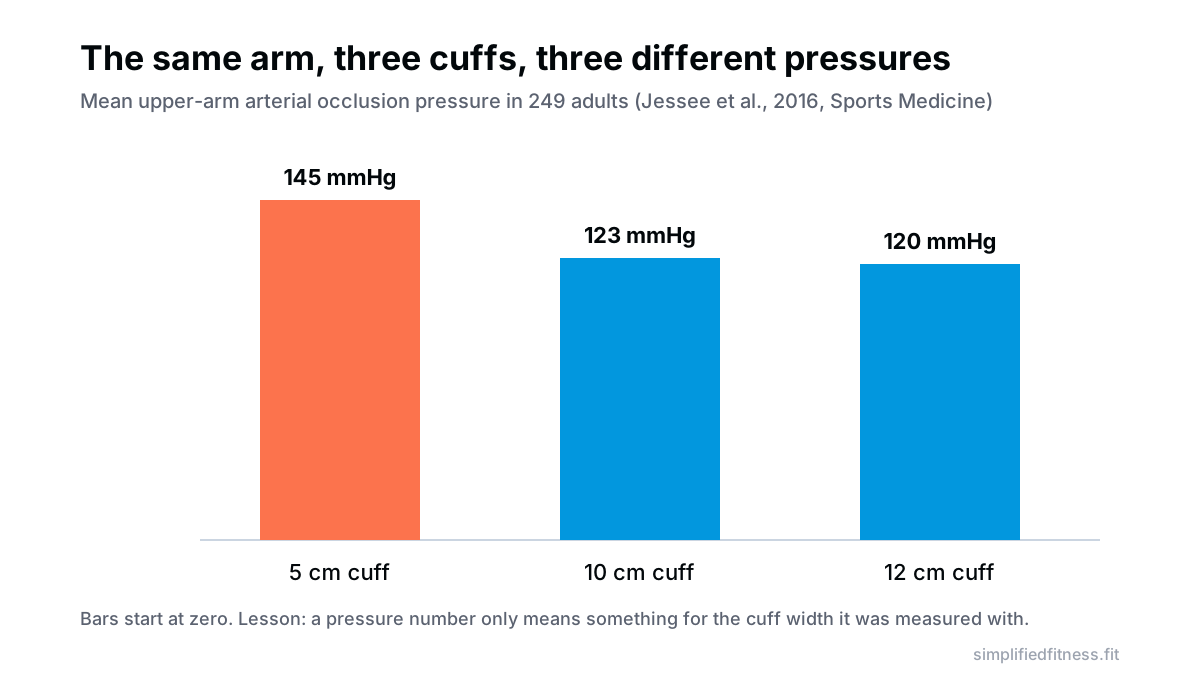
In 249 adults, the pressure needed to stop upper-arm blood flow averaged 145 mmHg with a 5 cm cuff, 123 mmHg with a 10 cm cuff and 120 mmHg with a 12 cm cuff. Arm circumference explained the most variation, and men and women differed (Jessee et al., 2016).
In the legs the gap is bigger. In 29 healthy people, a wide 11.5 cm cuff reached complete occlusion at about 239 mmHg on average, while the narrow 5 cm cuff could not achieve complete occlusion even at the device’s 500 mmHg maximum (Weatherholt et al., 2019). A later study of 170 people concluded that narrow-cuff leg pressure cannot be estimated with precision, and recommended wider cuffs for the lower body when possible (Spitz et al., 2024).
Body position changes it as well. In 51 healthy adults, lower-limb occlusion pressure was lower lying down than sitting or standing, and a large cuff needed less pressure than a medium one (de Queiros et al., 2024).
So what does that mean in the gym?
- Use a wide cuff, especially on the legs.
- Prefer a device that measures your occlusion pressure over one that makes you guess.
- Measure and train in a consistent position.
- Commonly quoted starting ranges are about 40-50% of AOP for arms and 60-80% for legs. Treat those as practitioner starting points, not trial-proven numbers. The 2024 hamstring trial used 60% of LOP in the legs.
The 30-15-15-15 protocol, step by step
The standard scheme looks like this.
- Warm up normally without cuffs.
- Apply cuffs and set pressure.
- Do 30 reps with about 20-30% of your 1RM.
- Rest 30 seconds with the cuffs still on.
- Do 15 reps. Rest 30 seconds. Do 15 reps. Rest 30 seconds. Do a final 15.
- Take the cuffs off, rest, then move on to the next exercise or limb.
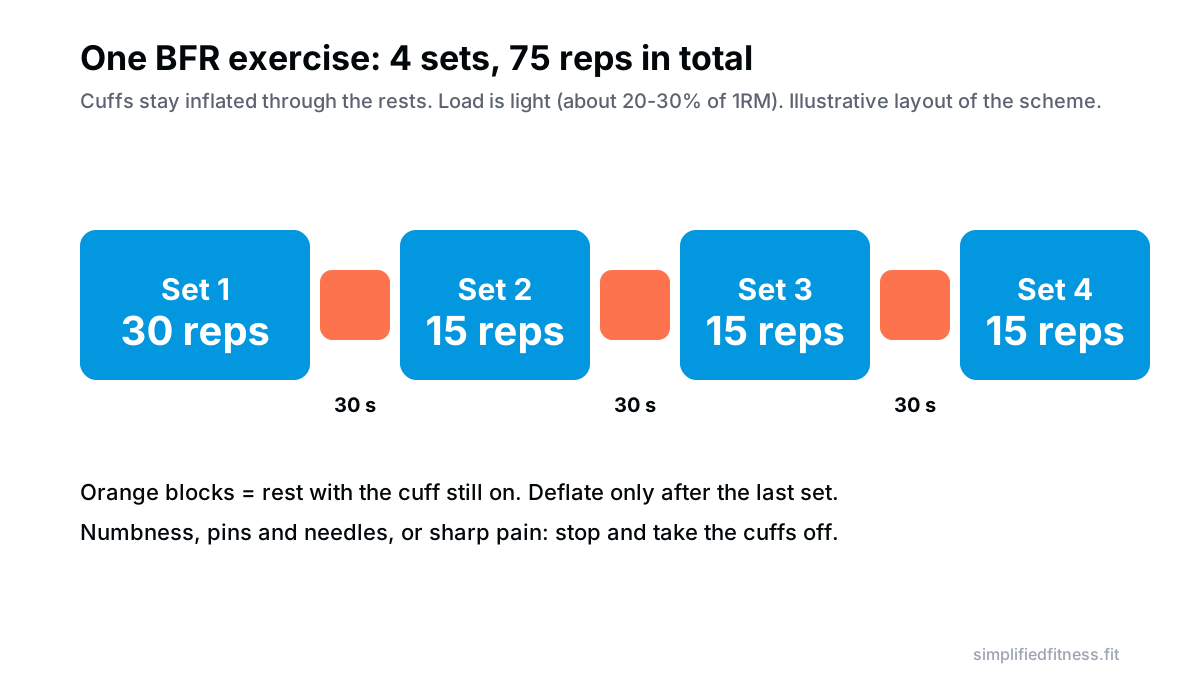
Rep counts are a target, not a test. The sets are meant to end close to failure, so you will probably slow down by the last set. If you hit 30 reps and it still feels easy, the load is too light. Our RIR and RPE calculator can help you judge how hard the last set really was.
The 2024 hamstring trial above used this exact scheme (30-15-15-15, 30 seconds of rest, 30% 1RM) three times a week for six weeks. That is one data point on frequency, not a rule.
Exercises that work well: leg extensions, leg curls, leg press, biceps curls, triceps pushdowns, lateral raises and calf raises. Keep movements controlled and avoid exercises where you could get stuck under a heavy bar.
Is BFR training painful?
It is uncomfortable but usually tolerable. In a 2020 lab study of 29 young adults comparing four conditions, heavy 80% 1RM sets felt harder (higher RPE) than any low-load option. Clinical-grade BFR and heavy sets produced similar discomfort, while a “practical” setup produced less than both (Miller et al., 2020). Men also reported higher exertion than women on some sets. That was acute, short-term data in young people, so it says nothing about long-term comfort.
Expect a deep burn in the muscle. Numbness, pins and needles, a pale or bluish limb, or sharp pain are not part of the plan. Remove the cuff.
Dedicated cuffs vs elastic wraps vs knee wraps
| Option | What you gain | What you give up |
|---|---|---|
| Wide pneumatic cuffs with a pressure readout | Measurable, repeatable pressure | Cost |
| Narrow cuffs | Cheaper, common | Higher pressures needed, leg pressure harder to estimate precisely |
| Elastic wraps, knee wraps, bands | Cheap, easy to find | No pressure readout, hard to repeat, easy to over-tighten |
The research behind this table is the cuff-width work above. No study I have cited proves wraps are dangerous, but they remove the one thing that makes BFR safer: knowing your pressure. If budget is tight, spend it on a wide cuff with a gauge before spending on anything else. Where equipment is unavailable, normal light training near failure is a sensible alternative to improvised tourniquets.
How safe is BFR training?
A 2019 position stand written by a team of BFR researchers covers methodology, application and safety of BFR training (Patterson et al., 2019). The abstract does not list individual safety numbers, so read the full paper if you want those.
Practice data looks reassuring. In a 2025 survey of 134 licensed US physical therapists who currently use BFR, none reported major adverse effects (thrombosis, rhabdomyolysis or nerve damage). Minor effects such as dizziness, numbness, nausea and muscle soreness were reported by 8% (Weatherholt et al., 2025). Surveys depend on self-report, and these therapists use proper devices with trained screening, so the figures may not carry over to home setups.
Who should get medical clearance first
Speak to a doctor before trying BFR if any of these apply:
- a history of blood clots or deep vein thrombosis
- peripheral artery disease or other circulation problems
- heart disease or uncontrolled high blood pressure
- recent surgery, fracture or injury in the limb you want to train
- pregnancy, or any condition that affects clotting
Stop immediately and seek medical help for chest pain, severe shortness of breath, calf pain with swelling, or a limb that stays numb or discoloured after the cuff comes off. This list is not a screening tool. Your doctor will know which factors apply to you.
How to use BFR in a real programme
BFR works best in three situations.
- Rehab. Early after injury, when heavy loads hurt. Do this with your physio. Our return-to-gym traffic light model shows how to progress once you are cleared.
- Deloads or travel. You want muscle stimulus with minimal joint stress. See low-load vs high-load training for how light sets fit alongside heavy ones.
- Extra volume. A short finisher after normal training. If your main concern is stretch under load rather than light-weight burn, lengthened partials are a separate option.
In the Indian gym context, most commercial gyms will not have a BFR device, and cheap cuffs vary in quality. You can build a lot of muscle without any of this. Regular training with 6-30 rep sets near failure covers most people, and BFR is an add-on, not a requirement.
The bottom line
BFR training looks low-risk and has decent evidence behind it when you use wide cuffs, measured pressure, light loads and the 30-15-15-15 scheme. It grows muscle similarly to heavy training in many studies, but it does not replace heavy work for max strength. Do not guess the pressure, and get cleared by a doctor if you have any clot, heart or circulation concern.
Frequently Asked Questions
How do you do BFR training safely?
Use a wide cuff high on the arm or thigh, set the pressure as a percentage of your own occlusion pressure rather than a random number, and never fully stop arterial flow. Wide cuffs need less pressure and the numbers shift with limb size and body position, which is why a measured, individual setting is safer than guessing. Start lighter than you think, keep sessions short, and stop if you get numbness, tingling or sharp pain.
What is the 30-15-15-15 BFR protocol?
It is four sets of one exercise: 30 reps, then three sets of 15, with about 30 seconds of rest between sets. The load is light, around 20-30% of your one-rep max, and trials of this scheme have compared it directly with heavy training. Pick one or two exercises per limb and keep the cuffs on between sets.
How tight should BFR cuffs be?
Tight enough to restrict blood leaving the muscle but never so tight that arterial blood flow stops. Pressure is normally prescribed as a percentage of arterial occlusion pressure, and one trial used 60% of limb occlusion pressure with a 30-15-15-15 scheme in the legs. If you cannot measure occlusion pressure, use a device that does, rather than cranking a strap until it feels tight.
Where do you put BFR cuffs?
As high as possible on the working limb: the top of the upper arm for arm exercises and the top of the thigh, near the groin crease, for leg exercises. The cuff sits above the muscle so blood pooling happens in the muscle you are training. Keep it snug and flat, not twisted or bunched.
Can you do BFR training with knee wraps or resistance bands?
It is possible but much harder to control. Elastic wraps and bands cannot show you the pressure you are applying, and research shows narrower cuffs need higher pressure than wide ones to restrict flow. If you use them anyway, go lighter than you think and treat any numbness or colour change as a reason to remove them immediately.
Does BFR training build as much muscle as heavy lifting?
In a 2018 meta-analysis, low-load BFR training produced similar muscle growth to high-load training but smaller strength gains. The likely reason is that BFR makes light sets demanding for the muscle, while heavy lifting trains your ability to produce maximal force. Use BFR when heavy loading is not possible and keep heavy work in your plan when it is.
What weight should I use for BFR training?
Roughly 20-30% of your one-rep max. In the 2024 hamstring trial the BFR group used 30% of 1RM, while the heavy-training comparison groups in the meta-analysis used above 65%. If you do not know your 1RM, choose a weight you could lift for comfortably more than 30 reps without the cuffs.
How often can you do BFR training?
The hamstring trial used three sessions a week for six weeks, which is one data point rather than a rule. Because the loads are light, joint stress is low, but muscle soreness and local fatigue still add up. Start with two sessions a week and judge by how you recover.
Is BFR training good for injury rehab?
It can be, particularly early on when heavy loads are not tolerated. A 2021 Journal of Athletic Training review describes BFR as a reasonable option for bridging early rehab and later phases, with higher loads still producing the biggest strength gains. Use it with your physiotherapist or surgeon's approval, not as a way to skip the rehab plan.
Who should not do BFR training?
Anyone with a history of blood clots, circulation problems, uncontrolled high blood pressure, heart conditions, or recent surgery or injury in that limb should speak to a doctor first. Cuffs change blood flow and pressure, so existing vascular problems change the risk. If you are unsure, ask a doctor or physiotherapist before buying any equipment.
Does BFR training hurt?
It is uncomfortable, mostly a deep burn and a tight cuff. In a 2020 lab study of 29 young adults, heavy 80% 1RM sets felt harder than light BFR sets, though discomfort with a clinical-grade BFR setup was similar to the heavy sets. Sharp pain, pins and needles or numbness are warning signs, not normal.
Can older adults use BFR training?
Evidence exists in older adults. A 2019 meta-analysis of 11 studies (238 people) found low-load BFR gave similar muscle growth to high-load training but smaller strength gains. Older adults and anyone with heart or vascular conditions should be screened and supervised.
Do I need to do BFR on every set of every exercise?
No. BFR is a tool for specific situations such as rehab, deloads or adding low-joint-stress volume, not something every set needs. Use it for one or two exercises at the end of a session and keep your main lifts conventional.
Sources & References
Every claim above is checked against peer-reviewed research (PubMed, U.S. National Library of Medicine) or guidance from established health bodies. How we fact-check.
- Lorenz DS, et al. Blood Flow Restriction Training. J Athl Train. 2021. PMID: 34530434
- Patterson SD, et al. Blood Flow Restriction Exercise: Considerations of Methodology, Application, and Safety. Front Physiol. 2019. PMID: 31156448
- Lixandrao ME, et al. Magnitude of Muscle Strength and Mass Adaptations Between High-Load Resistance Training Versus Low-Load Resistance Training Associated with Blood-Flow Restriction: A Systematic Review and Meta-Analysis. Sports Med. 2018. PMID: 29043659
- Centner C, et al. Effects of Blood Flow Restriction Training on Muscular Strength and Hypertrophy in Older Individuals: A Systematic Review and Meta-Analysis. Sports Med. 2019. PMID: 30306467
- Kamis O, et al. Low-Load Resistance Exercise With Blood Flow Restriction Versus High-Load Resistance Exercise on Hamstring Muscle Adaptations in Recreationally Trained Men. J Strength Cond Res. 2024. PMID: 39110578
- Jessee MB, et al. The Influence of Cuff Width, Sex, and Race on Arterial Occlusion: Implications for Blood Flow Restriction Research. Sports Med. 2016. PMID: 26820301
- Weatherholt AM, et al. The Effect of Cuff Width for Determining Limb Occlusion Pressure: A Comparison of Blood Flow Restriction Devices. Int J Exerc Sci. 2019. PMID: 30761200
- Spitz RW, et al. Blood flow restriction pressure for narrow cuffs (5 cm) cannot be estimated with precision. Physiol Meas. 2024. PMID: 38330491
- de Queiros VS, et al. Body position and cuff size influence lower limb arterial occlusion pressure and its predictors. Front Physiol. 2024. PMID: 39189031
- Miller RM, et al. Perceptual responses: Clinical versus practical blood flow restriction resistance exercise. Physiol Behav. 2020. PMID: 32798570
- Weatherholt AM, et al. Blood Flow Restriction Use by U.S. Physical Therapists: A Survey on Settings, Equipment, and Adverse Effects. Int J Exerc Sci. 2025. PMID: 40909299

Umair Hazrami · Founder & Head Coach, Simplified Fitness
Umair Hazrami founded Simplified Fitness and the Simplified Lifter channel to cut through fitness noise. With 4+ years of consistent training and 10+ coaching clients, he writes every guide from the peer-reviewed research and links the sources so you can check them. Our editorial standards.
Educational content only, not medical advice. If you have a medical condition, are pregnant, or take medication, talk to a qualified doctor before changing your diet, supplements or training. Full disclaimer.
Keep reading
Programming
Calibrating True RIR: A Safe Gym Test for Technical vs Absolute Failure
Calibrating RIR means testing how many reps you really have left. Use this safe machine protocol to find true failure and fix your 2 RIR guesses.
8 min read
Programming
CNS Fatigue vs Peripheral Fatigue: How Failure Hits Squats and Curls Differently
CNS fatigue vs peripheral fatigue: why failing a squat flattens you for days while failing a curl barely registers, and how many reps to leave in reserve.
9 min read
Programming
Failure on Machines and Cables vs Free Barbells: Managing Injury Risk and Axial Fatigue
Failure on machines vs barbells: why machine sets feel safer and less draining, what the research says, and where to push hard or stop at 1-2 RIR.
8 min read
Programming
How Accurately Do Lifters Gauge RIR? Research on Subjective Failure vs Actual Failure
How accurate is RIR in lifting? Studies show most lifters underpredict reps to failure by about 1-2 reps. See why it happens and how to calibrate your effort.
8 min read