Failure on Machines and Cables vs Free Barbells: Managing Injury Risk and Axial Fatigue
Failure on machines vs barbells: why machine sets feel safer and less draining, what the research says, and where to push hard or stop at 1-2 RIR.
TL;DR. The short answer
- Failure on machines and cables is usually the lower-risk option because the path is fixed, there is no bar to get pinned under, and your technique has less to lose. There are no trials comparing injury rates at failure by equipment, so this is biomechanical reasoning, not a measured result.
- Machine failure is not free. A 2022 meta-analysis found that sets taken to failure caused more acute fatigue and muscle damage than stopping short, whatever the equipment.
- Training to failure is not required for growth. A 2023 meta-analysis found no evidence that momentary failure beats non-failure training for hypertrophy.
- A sensible split: push isolation, cable and pin-loaded machine work to failure when you want to, and keep barbell squats, deadlifts and rows around 2-3 reps in reserve (RIR).
- Pain, numbness or a sharp pinch means stop the set. If symptoms persist, see a doctor or physiotherapist.
Part of our complete guide: Reps in Reserve, Rep Ranges and Rest Times: The Evidence-Based Guide to How Hard Every Set Should Be
Table of contents
Failure on machines vs barbells is not a fair fight, and your gut already knows it. Grinding out a last rep on a chest press machine feels clean. Grinding one out on a barbell bench with nobody behind you feels like a bad idea, because it is.
Machines and cables are the safer place to push to failure: the path is guided, there is no bar to get pinned under, and your technique has less to lose. But “safer” is not “free”, and nobody has run a trial comparing injuries at failure by equipment. This guide sits inside our load, rep ranges, RIR and rest intervals guide and covers where to go all-out, where to stop short, and why.
Why does failing on a machine feel safer?
Because several of the things that go wrong on a barbell simply cannot happen.
- No pinning. A failed machine rep stops. A failed barbell rep can leave the bar on your chest or force you to dump it.
- No balance tax. You do not spend effort keeping a load centred, so more of the effort lands in the muscle you are training.
- Technique holds longer. On a fixed path, an ugly last rep has fewer ways to go wrong than a squat that turns into a good morning.
- Easy to quit. Let go of a cable handle or park the pin-loaded stack and you are done.
Notice what that list is: biomechanical reasoning. It is how experienced coaches think about risk, and it makes sense. It is not the same thing as a study showing fewer injuries, and I will not pretend otherwise.
Is failure on machines really free of cost?
No. This is where people overshoot the “safe” idea. Safe from injury and cheap on your recovery are two different things.
A 2022 meta-analysis of 12 crossover studies found sets taken to failure produced a bigger drop in jump height, speed and power than non-failure sets, plus higher muscle damage markers and higher perceived exertion (Vieira et al., 2022). The velocity loss was larger in upper-limb exercises than lower-limb ones. The authors also noted the extra fatigue can lengthen the time needed to recover.
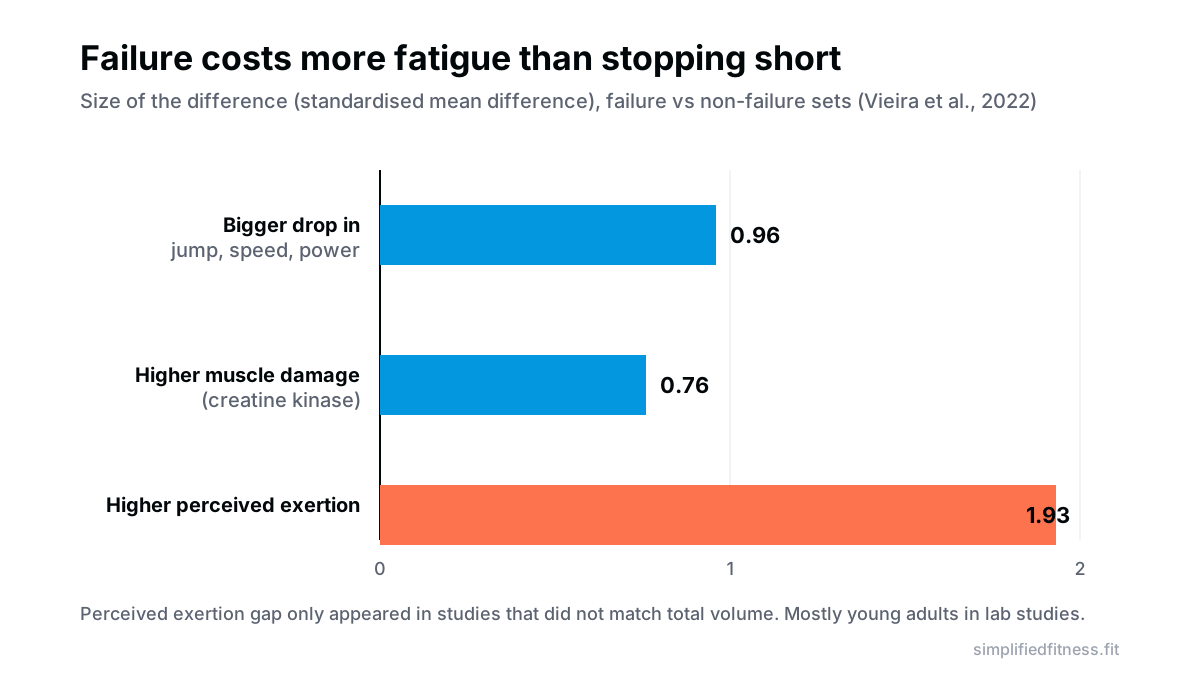
How long does that last? In one small study, 10 resistance-trained men did bench press and full squat protocols, and the sets taken to failure slowed recovery by up to 24-48 hours, even compared with a different protocol that matched the total volume (Morán-Navarro et al., 2017). Ten men is a tiny sample, but the direction matches the larger meta-analysis.
That is the real trade. On a machine you buy lower injury risk. You do not buy back the recovery bill.
What is axial fatigue, and why do barbells cause more of it?
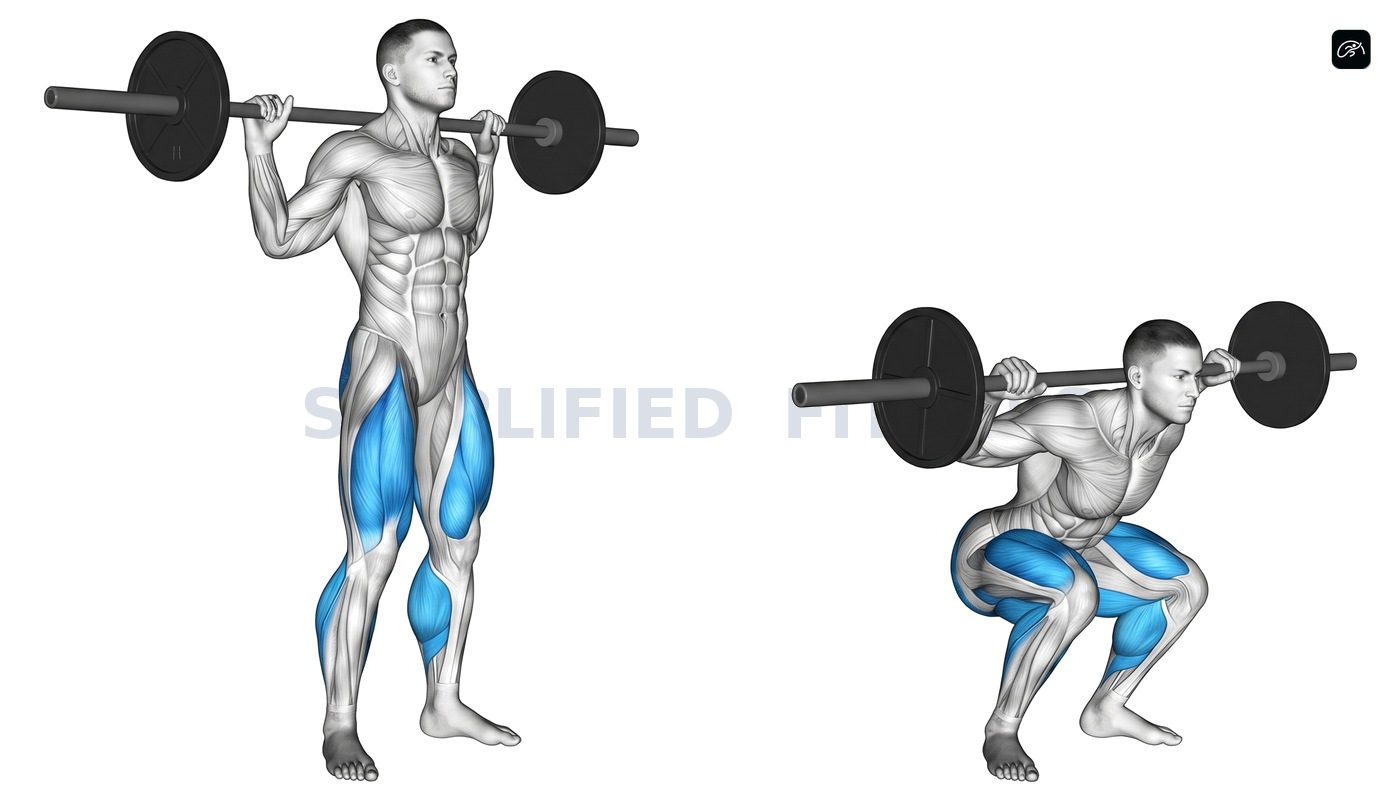
“Axial” means along the spine. When a bar sits on your back, or hangs from your hands in a deadlift, your trunk muscles and spine carry the load. Finish a heavy set of squats and your lower back is tired in a way your quads alone would not explain.
Direct research on axial fatigue as a named outcome is thin. What we do have is lab work showing that exercise choice changes spinal load a lot. In a 2009 study of 7 healthy young men, the standing bent-over row produced the largest lumbar spine load of three row variations, while the inverted row produced the lowest (Fenwick et al., 2009). Small sample, surface EMG, one lab, so I would not stretch it far. But it fits what you feel: supported or guided options spare the low back, free spine-loaded options do not.
For the full breakdown of spine-loaded versus supported lifts, see axial loading vs non-axial exercises and spinal recovery.
Do you even need to reach failure?
Often, no. And that changes the whole question.
A 2023 systematic review and meta-analysis of 15 studies found no evidence that training to momentary muscular failure beats non-failure training for hypertrophy (effect size 0.12, 95% CI -0.13 to 0.37) (Refalo et al., 2023). Under looser definitions of “set failure” there was a trivial advantage (effect size 0.19), which is why the authors suggest a non-linear relationship between proximity to failure and growth.
Another 2022 meta-analysis of 15 studies in young adults found no significant difference for strength or hypertrophy overall, but in resistance-trained subjects there was a small hypertrophy advantage for failure (effect size 0.15, 95% CI 0.03-0.26) (Grgic et al., 2022). When training volume was not equated between groups, non-failure training favoured strength gains.
So A found no growth edge for true failure, B found a small edge in trained people. Why the gap? Different definitions of failure, mostly young adults, and different pooling of subgroups. The cautious takeaway: failure is a tool that sometimes adds a little, never a requirement. For the deeper evidence, see our training to failure vs RIR meta-analysis breakdown.
Are machines as good as barbells for growth?
Close enough that the choice comes down to preference and goals. A 2023 meta-analysis of 13 studies with 1,016 participants found no difference in hypertrophy between free-weight and machine training (SMD -0.055, 95% CI -0.397 to 0.287), though only 5 of those studies measured muscle size. Strength gains were specific to the tool you trained on (Haugen et al., 2023). These were adults aged 18-60 training for at least 6 weeks.
An 8-week trial in 37 sport-science students compared free-weight and Smith machine squat and bench press, and muscle cross-sectional area improved comparably in both groups (Marcos-Frutos et al., 2025). Small, short, and mostly recreational, so hold the conclusion loosely. For a deeper look, see free weights vs cables vs machines for hypertrophy and the Smith machine vs free barbell comparison.
The point: if machines grow muscle about as well, using them for your hardest sets costs you very little.
Where to push to failure and where to stop at 1-2 RIR
Here is the framework I would use. It is coaching logic, built on the evidence above and on risk management. It is not a study result.
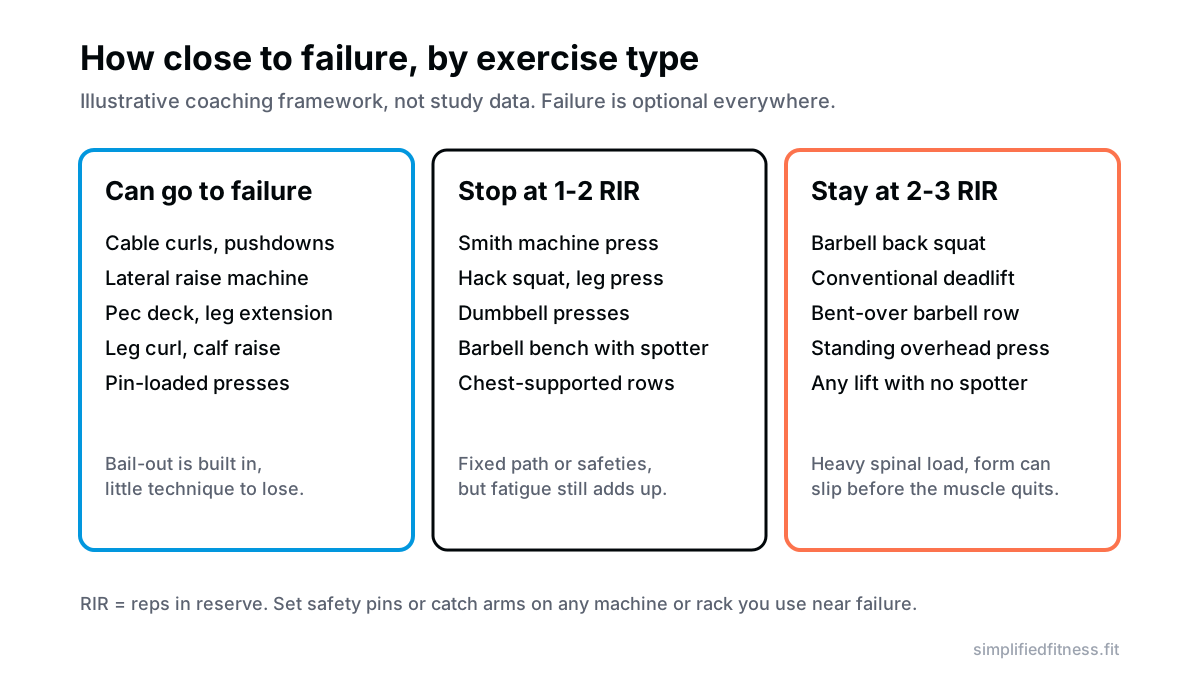
Fine to take to failure (when you choose to):
- Cable curls, rope pushdowns, cable lateral raises
- Pec deck, leg extension, seated leg curl, standing calf raise
- Pin-loaded presses and pulldowns with the stops set
Stop at about 1-2 RIR:
- Smith machine and plate-loaded presses (fixed path, but they can still trap you)
- Hack squat and leg press: see hack squat stimulus-to-fatigue ratio
- Dumbbell presses (you have to get them down safely)
- Barbell bench press with a spotter or safety arms
Stay at about 2-3 RIR, or skip failure entirely:
- Barbell back squat and conventional deadlift
- Bent-over barbell rows and standing overhead press
- Any heavy lift with no spotter and no safeties
The same logic applies at the exercise level: our proximity to failure for compounds vs isolations rules goes into set-by-set detail.
A practical way to use this in a week
Keep it boring.
- Heavy barbell lifts: first, at 2-3 RIR. Build them with warm-up sets and stay clean.
- Machine and cable compounds: 1-2 RIR for the first sets, last set to failure if you feel fine.
- Isolations: last set to failure, occasionally.
- Back-to-back days: if your lower back is tired, swap the barbell move for a supported one.
On a leg day, for example, that could mean back squats at 2-3 RIR, then leg press at 1-2 RIR, then leg extension and leg curl with the last set to failure. Our free leg day plan follows this kind of structure.
Not sure how close you really are? RIR guesses take practice and are often off by a rep or more. Log your sets with the RIR and RPE calculator and compare what you thought you had left with what you did.
Safety basics that matter more than the theory
- Set the stops. Pins, hooks and safety arms before the first rep, every time.
- Know your bail-out. Practise dropping the load or racking it while you are fresh.
- Fit the machine. Adjust the seat and pad so joints line up. A bad setup hurts even at light loads.
- Do not train through sharp pain. Discomfort from effort is one thing. Sharp pain, numbness or tingling is a stop sign.
- Heat and hydration. In a hot gym, form goes first. Back off failure on days you feel wrecked or dehydrated.
A 2014 survey of 71 competitive bodybuilders reported a low overall injury rate (0.24 injuries per 1,000 hours of training), with injuries mostly in the shoulder, elbow, lumbar spine and knee (Siewe et al., 2014). It was self-reported and in a specialised group, so it does not tell you what happens to a beginner. It does show that no equipment is injury-free.
When to see a doctor
If you get sharp or pinching pain during a lift, pain that lingers for days, numbness or tingling down an arm or leg, or you feel something give, stop and get assessed by a doctor or physiotherapist. This guide is education, not a diagnosis. If you are returning from an injury, check with a professional before testing yourself near failure.
The bottom line
Failure on machines and cables is the lower-risk way to find your limit, because the path is guided and a failed rep just stops. Barbell squats, deadlifts and rows are better kept around 2-3 RIR, since spine load and technique breakdown are the real risks. Failure is optional for growth, and it always carries a fatigue bill that machines do not remove.
Use it where it is safe, sparingly, and let consistency do the work.
Frequently Asked Questions
Is it safer to train to failure on machines than on barbells?
Generally yes, in practical terms. A machine fixes the path and a failed rep usually just stops, while a failed barbell rep can leave you pinned or forced to dump the bar. No study has directly compared injury rates at failure by equipment, so treat this as sound risk management rather than proven fact. Put your hardest sets on machines and keep barbells further from failure.
Why does failing on a chest press machine feel less draining than a barbell bench?
On a machine the movement is guided, so you do not spend effort balancing the load or fighting the bar drifting, and the effort goes mostly into the target muscles. A 2022 meta-analysis still found failure sets cause more acute fatigue than non-failure sets in general, so it is less draining, not drain-free. Judge it by how your next session feels, not just the set itself.
What is axial fatigue?
Axial fatigue is the tiredness that comes from compressive load running down your spine and trunk, as in a back squat or deadlift. Research on this exact term is thin, but a 2009 lab study found lumbar spine load differed a lot between row variations. The practical move is to limit how many heavy spine-loaded sets you stack in a week and to take them well short of failure.
Should I train to failure on every set?
No. A 2023 meta-analysis found no evidence that momentary failure is superior to non-failure training for muscle growth, and a 2022 meta-analysis found no significant difference for strength or hypertrophy overall. Failure mainly adds fatigue and recovery cost. Use it selectively on safe exercises, often on the last set only.
Can I take barbell squats and deadlifts to failure?
You can, but the risk and cost are higher than the benefit for most lifters. Technique often breaks down before the muscle actually quits, and the spinal load is high. Stopping 2-3 reps short keeps a safer margin, and the failure meta-analyses suggest you give up little or no growth by doing so.
Is the Smith machine safe to take to failure?
It is safer than a free bar in one way: you can rotate the hooks to rack the bar at any point, and the fixed path removes balance demands. It is not risk-free, because the fixed path can force awkward joint angles for some lifters. Set the safety stops and find a foot position that feels natural.
Does training to failure build more muscle?
Not clearly. The 2023 meta-analysis found a trivial advantage for set failure under loose definitions but no advantage for true momentary muscular failure. A 2022 meta-analysis of trained lifters did find a small hypertrophy benefit in that subgroup. If you do use failure, keep the volume modest so recovery does not suffer.
How long does it take to recover from a set taken to failure?
Longer than stopping short. In a small study of 10 resistance-trained men, sets to failure slowed recovery by up to 24-48 hours compared with sets that stopped short, even when total volume was matched. If your next session suffers, pull failure back to the final set of one or two exercises.
Where should I fail on a leg day?
Isolation and supported movements are the best places: leg extension, seated leg curl, calf raise and often the leg press or hack squat. Keep the barbell back squat or stiff-leg deadlift at about 2-3 RIR. This way the heavy spine-loaded lift stays fresh and technically clean.
Do I need a spotter if I train to failure on machines?
Usually not, but set the safety stops or pins first. Cable stacks and pin-loaded machines let you simply stop. Plate-loaded machines can still trap a limb if you fail past the catch point, so check the stops.
Can machines and cables cause injuries?
Yes. Any exercise can irritate a joint if the load, range or position does not suit you. A 2014 survey of 71 competitive bodybuilders found most injuries involved the shoulder, elbow, lumbar spine and knee, and the overall injury rate was low. Adjust the seat and range to fit your body, and stop if pain is sharp or lingers.
How do I know how close to failure I am?
Use reps in reserve: after a set, estimate how many more clean reps you could have done. These guesses are often off by a rep or more, so they take practice. Practise on machines and cables, where failure is safe to find, and use the RIR calculator to log it.
What should I do if I get pain while training near failure?
Stop the set, because pain is a signal to change something, not a rep to push through. Reduce the load or adjust the setup next time. If you get sharp pain, numbness, tingling down a limb or pain that lasts days, see a doctor or physiotherapist.
Sources & References
Every claim above is checked against peer-reviewed research (PubMed, U.S. National Library of Medicine) or guidance from established health bodies. How we fact-check.
- Refalo MC, et al. Influence of resistance training proximity-to-failure on skeletal muscle hypertrophy: a systematic review with meta-analysis. Sports Med. 2023. PMID: 36334240
- Vieira JG, et al. Effects of resistance training to muscle failure on acute fatigue: a systematic review and meta-analysis. Sports Med. 2022. PMID: 34881412
- Morán-Navarro R, et al. Time course of recovery following resistance training leading or not to failure. Eur J Appl Physiol. 2017. PMID: 28965198
- Grgic J, et al. Effects of resistance training performed to repetition failure or non-failure on muscular strength and hypertrophy: a systematic review and meta-analysis. J Sport Health Sci. 2022. PMID: 33497853
- Haugen ME, et al. Effect of free-weight vs. machine-based strength training on maximal strength, hypertrophy and jump performance: a systematic review and meta-analysis. BMC Sports Sci Med Rehabil. 2023. PMID: 37582807
- Marcos-Frutos D, et al. Comparative effects of the free weights and Smith machine squat and bench press: the important role of specificity for strength adaptations. Int J Sports Physiol Perform. 2025. PMID: 39740659
- Fenwick CM, et al. Comparison of different rowing exercises: trunk muscle activation and lumbar spine motion, load, and stiffness. J Strength Cond Res. 2009. PMID: 19620925
- Siewe J, et al. Injuries and overuse syndromes in competitive and elite bodybuilding. Int J Sports Med. 2014. PMID: 24886919

Umair Hazrami · Founder & Head Coach, Simplified Fitness
Umair Hazrami founded Simplified Fitness and the Simplified Lifter channel to cut through fitness noise. With 4+ years of consistent training and 10+ coaching clients, he writes every guide from the peer-reviewed research and links the sources so you can check them. Our editorial standards.
Educational content only, not medical advice. If you have a medical condition, are pregnant, or take medication, talk to a qualified doctor before changing your diet, supplements or training. Full disclaimer.
Keep reading

Programming
Blood Flow Restriction (BFR) Practical Guide: Cuff Pressures, Rep Schemes, and Light Loads
How to do BFR training safely: cuff placement, pressure as a percentage of occlusion, the 30-15-15-15 scheme and who should skip it. Every study linked.
8 min read
Programming
Calibrating True RIR: A Safe Gym Test for Technical vs Absolute Failure
Calibrating RIR means testing how many reps you really have left. Use this safe machine protocol to find true failure and fix your 2 RIR guesses.
8 min read
Programming
CNS Fatigue vs Peripheral Fatigue: How Failure Hits Squats and Curls Differently
CNS fatigue vs peripheral fatigue: why failing a squat flattens you for days while failing a curl barely registers, and how many reps to leave in reserve.
9 min read
Programming
How Accurately Do Lifters Gauge RIR? Research on Subjective Failure vs Actual Failure
How accurate is RIR in lifting? Studies show most lifters underpredict reps to failure by about 1-2 reps. See why it happens and how to calibrate your effort.
8 min read