CNS Fatigue vs Peripheral Fatigue: How Failure Hits Squats and Curls Differently
CNS fatigue vs peripheral fatigue: why failing a squat flattens you for days while failing a curl barely registers, and how many reps to leave in reserve.
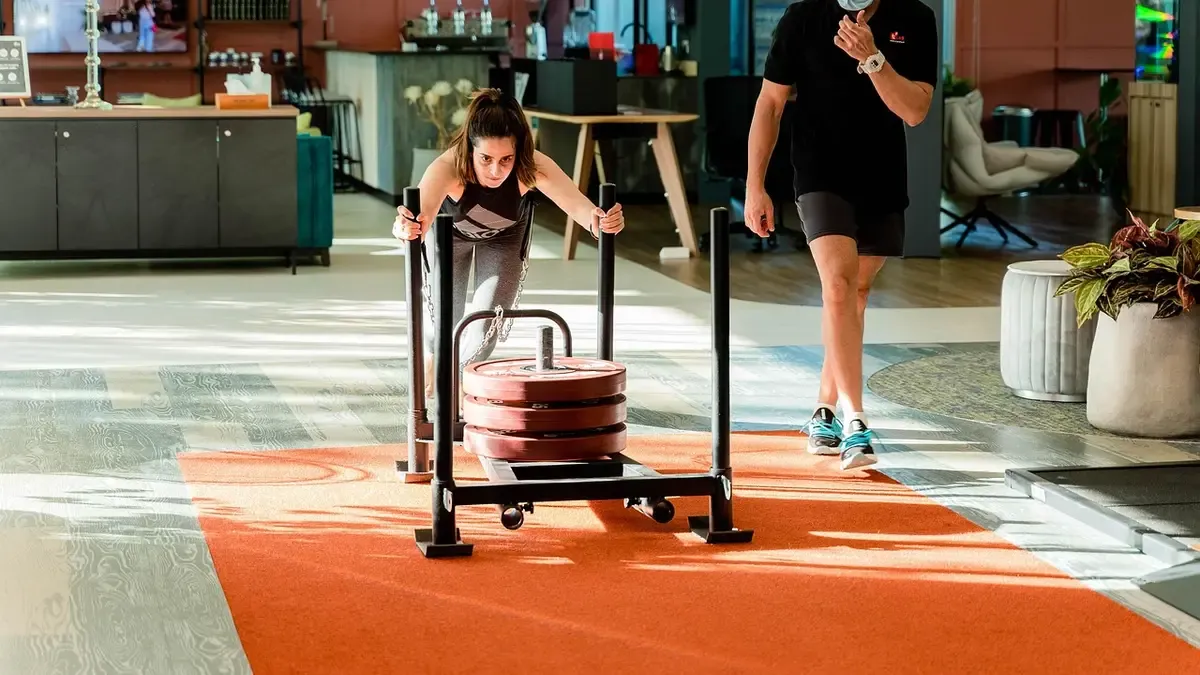
TL;DR. The short answer
- Failing a heavy squat or deadlift feels far worse than failing a curl mainly because more muscle, heavier loads and higher effort are involved. Labs have not shown that a 'fried CNS' is the main reason.
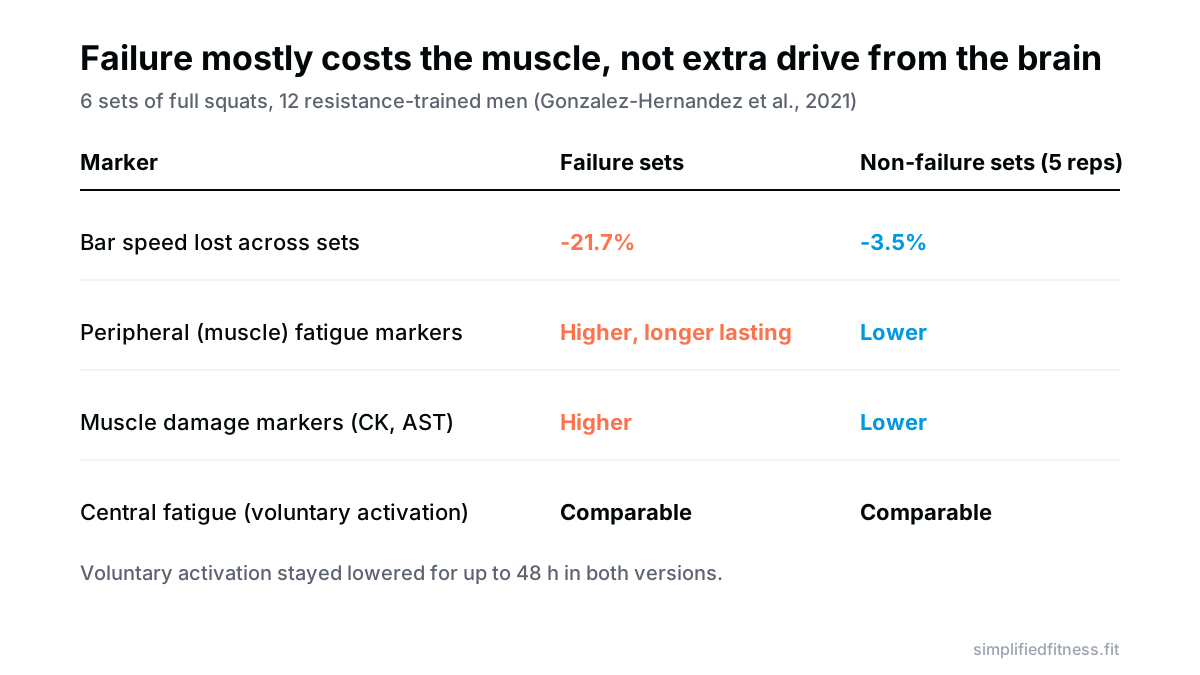
- In 24 trained lifters, the drop in bar speed 4 minutes after six bench sets was about 25% at failure, 13% at 1 rep in reserve and 8% at 3 reps in reserve.
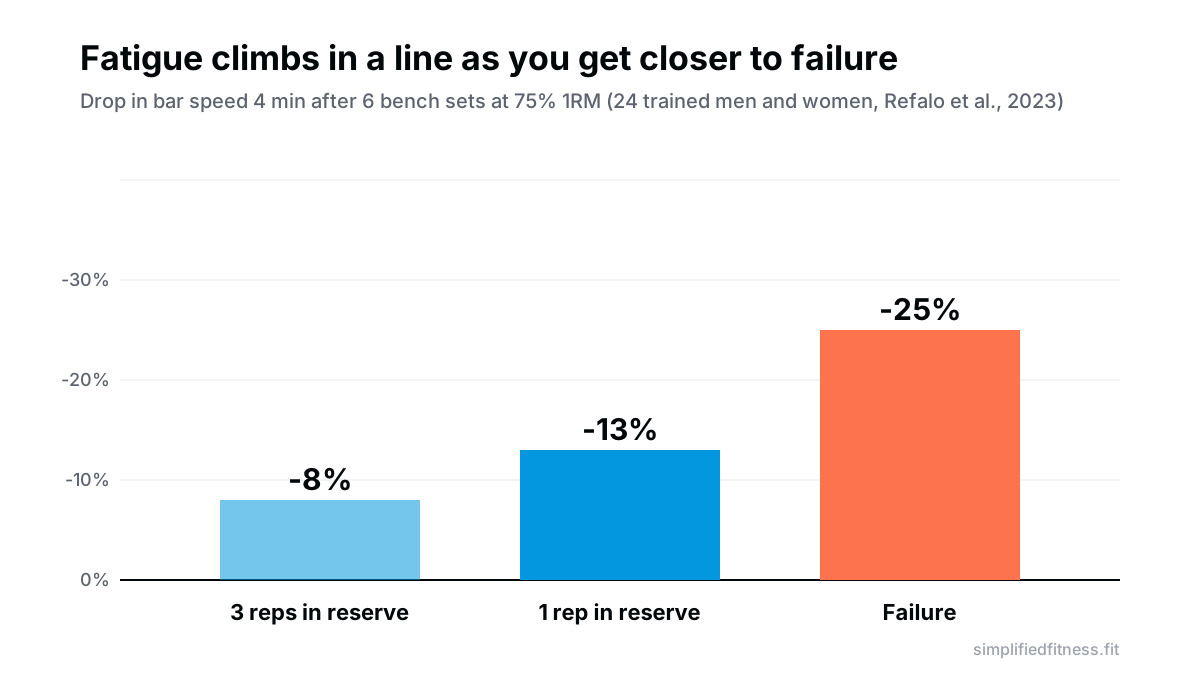
- In 12 trained men doing squats, sets to failure raised muscle-level fatigue and damage markers more than non-failure sets, while the central measure (voluntary activation) was comparable.
- In an 18-person trial, back squats produced more fatigue than prone rows when taken close to failure, so the exercise matters as much as the distance from failure.
- A practical default: leave 2-4 reps in reserve on most big compound sets and save true failure for small isolation work.
Part of our complete guide: Reps in Reserve, Rep Ranges and Rest Times: The Evidence-Based Guide to How Hard Every Set Should Be
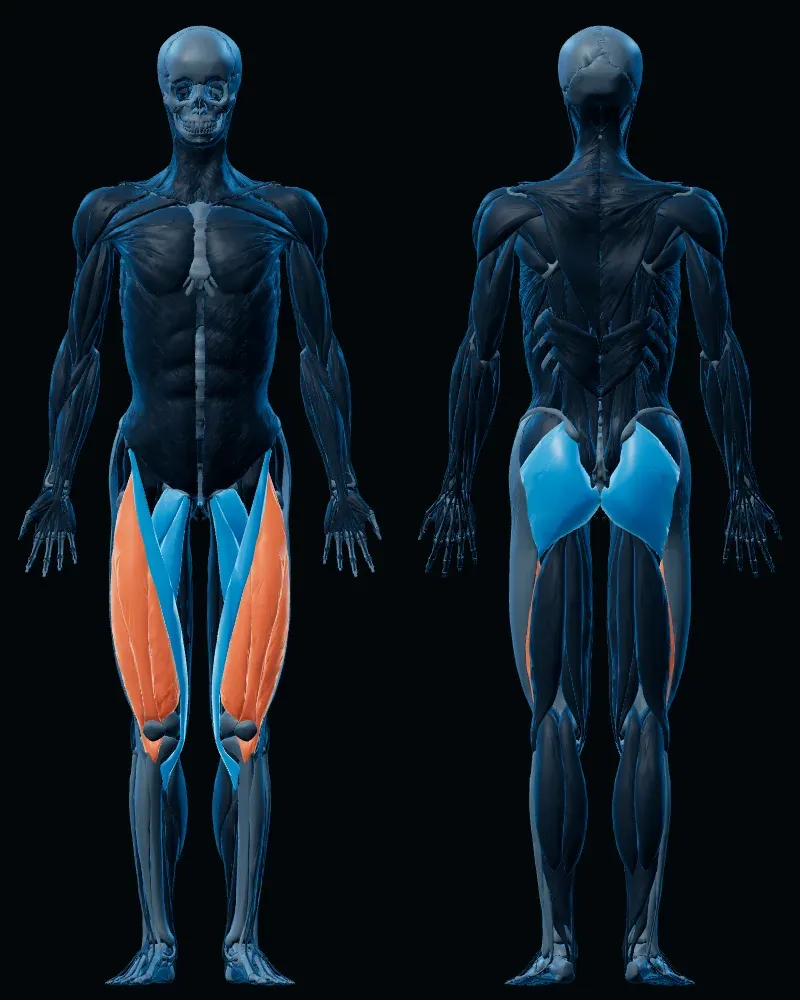
Muscles worked: quads
Main movers: rectus femoris and the three vasti
Assisting: adductors, sartorius and glutes
Table of contents
Failing a heavy deadlift can leave you wrecked for days. Failing a set of curls usually costs you five minutes. The usual explanation is that big lifts “fry your CNS,” but the research points to a less dramatic answer: compound lifts involve more muscle, heavier loads and more effort, and the muscle itself pays most of the bill. In the CNS fatigue vs peripheral fatigue debate, distance from failure is the dial that turns both up.
This article sits inside our guide to load, rep ranges, RIR and rest intervals. If you want the general definitions first, read CNS fatigue vs muscle fatigue. Here we focus on one question: how does getting close to failure change fatigue on a squat compared with a curl?
What is the difference between CNS fatigue and peripheral fatigue?
Peripheral fatigue is a loss of force produced inside the muscle: the signal arrives, but the fibres deliver less. Central fatigue is a loss of drive upstream, in the brain and spinal cord, so the muscle gets a weaker command. Labs separate the two by stimulating the nerve electrically and comparing that force with a maximal voluntary effort.
Gym language blurs this. “My CNS is fried” is used for anything from sore quads to a bad mood. A cleaner way to think about it is three layers:
- Local (peripheral): the working muscle is tired, sore or damaged.
- Central: the drive to that muscle is somewhat reduced.
- Perceived: the effort feels harder, motivation drops, you feel “off.”
Hard sets move all three. The interesting question is which layer dominates, and when.
Does failing a squat really tire your nervous system more?
Less than the gym folklore suggests. In a study of 10 male athletes, heavy back squats (10 sets of 5 at 80% 1RM), jump squats and sprints all produced fatigue that took up to 72 hours to resolve, but the authors concluded it was not mainly caused by decrements in CNS function (Thomas et al., 2018). Voluntary activation did drop for 24 to 48 hours, so central fatigue was present, just not the main story. Ten male athletes is a small sample, so treat it as a strong hint, not a rule.
The next question is what failure itself adds. In 12 resistance-trained men doing six sets of full squats, either to failure or stopping at 5 reps with a 10RM load, the failure session produced a much bigger loss of bar speed between sets (21.7% vs 3.5%), higher and longer-lasting markers of peripheral fatigue, and higher muscle damage markers (creatine kinase and AST). Central fatigue, measured as voluntary activation, was comparable in both and stayed depressed for up to 48 hours (Gonzalez-Hernandez et al., 2021).
How does proximity to failure change fatigue?
It raises fatigue in a fairly steady line. In 24 resistance-trained men and women, six sets of bench press at 75% 1RM were taken to failure, to 1 rep in reserve, or to 3 reps in reserve. Four minutes later, bar speed with a fixed load had dropped about 25% after failure, 13% after 1-RIR and 8% after 3-RIR. At 24 hours the drop was about 3% for failure and 1-RIR versus a slight gain for 3-RIR, and differences were gone by 48 hours. Males lost more speed than females after failure (29% vs 21%). Discomfort, exertion and soreness ratings also rose as sets got closer to failure (Refalo et al., 2023).
A 2025 systematic review of 51 studies agrees on the direction: set duration, proximity to failure and total volume were the main determinants of impairments, and higher fatigue came as sets approached failure with high volumes and densities, especially with light loads (Varela-Olalla et al., 2025).
Notice what the bench study measured: the muscles you used. It does not say the whole body was equally drained. That brings us to the exercise itself.
Why do squats cause more fatigue than curls?
Nobody has run the perfect deadlift-versus-curl trial, so this section mixes evidence and reasoning, and I will flag which is which.
What the data show. In 18 participants who did six sets of barbell back squats and prone rows at 65% or 85% of 1RM, taken to failure, 1-RIR or 3-RIR, fatigue and metabolic stress rose as sets approached failure. Back squats produced more fatigue than prone rows, and 65% 1RM more than 85% 1RM. Within-session performance dropped as failure neared, except for prone rows at 85% 1RM (Cowley et al., 2026). So the exercise and the load change the cost of the same distance from failure.
What is reasonable to infer (not directly tested against curls):
- A squat or deadlift uses a large share of your muscle mass, so more total tissue is stressed per set.
- Loads are heavy and the effort is high, so the set feels like an all-out event.
- Breathing, bracing and cardiovascular strain are bigger than in a seated curl.
- You often do these lifts first, when you are freshest, so they take your best effort.
On the cardiovascular side, 16 young trained men did four compound exercises to failure at 40%, 60% or 80% 1RM. The 80% session produced more post-exercise sympathetic activity (lower heart rate variability markers over 40 minutes) than the lighter sessions (Gungor et al., 2024). The authors went on to recommend lighter loads, but a short heart rate variability study in 16 healthy men cannot show real cardiac risk, so treat that as a hint rather than a rule. If you have high blood pressure or a heart condition, ask your doctor before pushing heavy sets to failure.
The “neurotransmitter drainage” and “cytokine storm” explanations you see online are mostly extrapolated from endurance exercise and animal work. I did not find resistance-training trials that show them explain why deadlifts feel worse than curls, so I would not build a program on them.
Why does failing on curls feel so easy to recover from?
A curl involves one small muscle group moved through a short range with a light load. Fatigue is local, so the rest of you is not tired. You can do another exercise, a different muscle, or the same muscle again soon after.
I would call this a likely explanation rather than a proven one for curls specifically. Most of the research above used squats, bench press and rows. In one 8-week trial of trained lifters, the legs were randomised to leg press and leg extension either to failure or at a perceived 2 and 1 reps in reserve. Quadriceps growth was similar, and velocity and rep loss were consistently higher at failure (Refalo et al., 2024). Fatigue was higher at failure with no measured growth advantage.
A key point for isolation work: if the fatigue is mostly local and you are not pre-fatiguing anything important, the cost of going to failure on the last set is low. That is why failure is more acceptable there. Our proximity-to-failure rules for compounds and isolations article goes deeper into the choices.
Do I need failure to build muscle?
No. A 2023 meta-analysis of 15 studies found no evidence that momentary muscular failure is superior to non-failure training for hypertrophy, and it noted a trivial advantage for “set failure” under looser definitions (effect size 0.19, confidence interval 0.00 to 0.37). It concluded that closer proximity to failure does not always give more growth (Refalo et al., 2023). We unpack that evidence in training to failure vs RIR.
Putting the pieces together, fatigue rises steadily toward failure, but growth does not rise in step. The extra cost buys little on the big lifts.
What does the evidence disagree about?
A fair summary has a few open questions.
- A 2026 small trial (6 men) found a full-body session to failure produced higher lactate, cortisol, creatine kinase and soreness, and delayed jump recovery through 72 hours versus a non-failure session with similar total volume (Vieira et al., 2026). With six participants, the authors themselves urge caution.
- The bench trial found most gaps closed by 48 hours.
- The squat trial found central fatigue was similar with or without failure.
They differ in exercise, number of exercises, load and sample size. The practical overlap is that failure costs more recovery on big lifts, and that cost mostly fades in two to three days for trained lifters. How long it takes for you will depend on sleep, food, age and weekly volume.
How should I program failure on compound lifts?
Start with the exercise, then the effort. This is a starting point, not a study result.
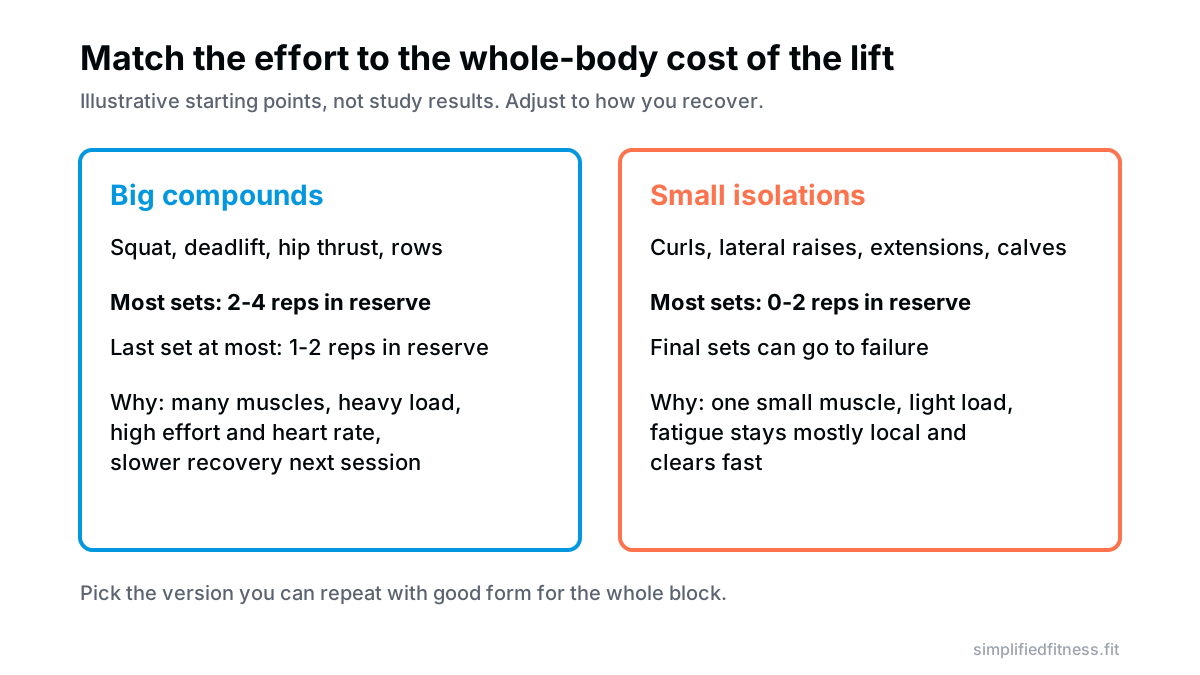
| Exercise type | Typical reps in reserve | Where failure fits |
|---|---|---|
| Deadlift, squat, hip thrust, heavy rows | 2-4 on most sets, 1-2 on a final set | Rarely, if ever |
| Machine presses, leg press, pulldowns | 1-3 | Occasionally on the last set |
| Curls, lateral raises, extensions, calf raises | 0-2 | Reasonable on the last set |
A few practical rules:
- Do the heavy compound first, stop 2-4 reps short, and keep technique identical across all reps.
- Use lighter or machine variations for sets you want to push near failure, such as leg press instead of a free-bar squat.
- Take isolations to failure on the last set if joints feel fine and recovery is good.
- Use a fixed load and watch speed. If your first rep is clearly slower than usual, treat that as a signal to add a rep in reserve.
- Do not mix a failure deadlift session and a heavy leg day in the same 48 hours unless you recover well.
Our RIR and RPE calculator converts a target into a load. If you struggle to judge reps in reserve, read how accurately lifters gauge RIR first.
What else changes how fatigued you feel?
Sleep is the big one. A systematic review of 17 studies (rated moderate or weak quality) found consecutive nights of sleep restriction could reduce force output of multi-joint but not single-joint movements, and that sleep deprivation alone had little effect on muscle strength (Knowles et al., 2018). That fits the lived experience of squats feeling heavier after a bad week. See our sleep and recovery guide.
Food, total weekly sets, stress and heat also matter. In Indian summers, a 5 pm deadlift session after a long workday and a light lunch of dal and rice is not the same stimulus as the same session on a cool morning. Adjust reps in reserve, not just the load.
When should I worry about fatigue?
Normal fatigue after hard training clears in a few days. See a doctor if exhaustion persists for weeks without a clear training cause, you have chest pain, fainting, unusual breathlessness, dark urine or severe muscle pain, or your mood and sleep keep getting worse. Those are not “CNS fatigue,” and they should not be self-managed through more training.
Bottom line
Failure raises fatigue in a steady line, and big lifts raise it more than small ones. The evidence says most of that cost lands in the muscles and in effort, not in a mysterious nervous system crash. Take compounds a few reps short, take isolations closer, and let sleep and food do their work. For the structure around all this, go back to the load, rep range and rest interval guide.
Frequently Asked Questions
What is the difference between CNS fatigue and peripheral fatigue?
Peripheral fatigue is a loss of force inside the muscle, while central (CNS) fatigue is a drop in the drive the brain and spinal cord send to it. Researchers separate them by electrically stimulating the nerve and comparing that with a maximal voluntary effort. Hard sets usually produce both, so treat the labels as a guide rather than a diagnosis.
Why do squats and deadlifts leave me more tired than curls?
Compounds recruit far more muscle, use heavier loads and demand more effort and cardiovascular work, so the whole-body cost per set is bigger. Studies that compared squats with rows or leg extensions point to exercise choice as a real driver of fatigue, though no study has proven a special nervous system toll. Count squats and deadlifts as your most expensive sets and plan around them.
Is CNS fatigue real?
Reduced voluntary activation after hard lifting has been measured in labs, so some central fatigue exists. In a 10-athlete study, though, fatigue after heavy squats lasted up to 72 hours and was not mainly caused by changes in the nervous system. Use the term cautiously and check sleep, food and weekly volume before blaming your CNS.
How long does it take to recover from training to failure?
It depends on the exercise and load, but lab data show most of the gap between failure and non-failure sets fades within two to three days in trained lifters. In one bench press study, bar-speed differences between protocols were small at 24 hours and gone by 48 hours. If you still feel flat after three days, look at sleep and total training load.
Does training to failure cause more muscle damage?
Yes, in the studies we have, failure sets raised muscle damage markers such as creatine kinase and soreness more than sets stopped short. A 12-man squat trial and a small 6-man full-body trial both found this. If soreness is wrecking your next session, stop one or two reps earlier on the heaviest lifts.
Do I need to train to failure to build muscle?
No. A 2023 meta-analysis of 15 studies found no evidence that momentary failure beats stopping short for hypertrophy. Because failure adds fatigue without a clear growth advantage, stopping 1-3 reps short on most sets is a sensible default, especially on big lifts.
Is it safe to fail on deadlifts?
Failing a conventional deadlift is not impossible to do safely, but it carries more risk than failing a machine curl because of the load and spinal position when form slips. Research on fatigue does not test injury risk directly, so this is coaching judgment. Stop deadlift sets while your back position is still clean and your next rep would look like the last one.
Can I train to failure on isolation exercises more often?
Usually yes. Single-joint movements involve less muscle and lighter loads, so fatigue tends to stay local, and this is a reasonable inference rather than a proven rule. Use failure on the last set of curls, lateral raises or extensions, and keep an eye on elbow and shoulder comfort.
What does 'leave reps in reserve' mean on compound lifts?
It means ending a set while you could still do a few more good reps. The meta-analysis and fatigue trials suggest the cost of extra fatigue rises steadily as you approach failure, so a few in reserve is a cheap safety margin. Use our RIR/RPE calculator to turn a target into a load.
Do heavy loads cause more fatigue than light loads at failure?
Not necessarily. In an 18-person trial, 65% 1RM squats and rows produced more fatigue than 85% 1RM when taken near failure, and lighter loads also allowed more total reps in some conditions. A 2025 systematic review also notes high fatigue with light loads taken close to failure. Do not assume that light means easy once you push close to failure.
Does lack of sleep make compound lifts feel harder?
It can. A systematic review found that consecutive nights of sleep restriction could reduce force output in multi-joint lifts but not single-joint ones, though study quality was moderate to weak. Protect your sleep and add an extra rep in reserve to big lifts on short-sleep days.
How do I know if I am too fatigued to train hard today?
Warm up and check whether your first working set moves at its usual speed and feels like its usual effort. If it is clearly slower or harder, drop a set or add reps in reserve rather than forcing a PR. Persistent exhaustion, poor sleep or mood changes lasting weeks are worth discussing with a doctor.
Does failure affect my heart rate and blood pressure more?
In 16 young trained men who took every session to failure, the 80% 1RM session produced more sympathetic nervous system activity afterwards than the 40% and 60% sessions. That study compared loads rather than failure versus non-failure, and a small study of healthy men does not diagnose a risk. If you have high blood pressure or a heart condition, talk to your doctor before taking heavy sets to failure.
Sources & References
Every claim above is checked against peer-reviewed research (PubMed, U.S. National Library of Medicine) or guidance from established health bodies. How we fact-check.
- Refalo MC, et al. Influence of resistance training proximity-to-failure, determined by repetitions-in-reserve, on neuromuscular fatigue in resistance-trained males and females. Sports Med Open. 2023. PMID: 36752989
- Gonzalez-Hernandez JM, et al. Resistance training to failure vs. not to failure: acute and delayed markers of mechanical, neuromuscular, and biochemical fatigue. J Strength Cond Res. 2021. PMID: 33306589
- Thomas K, et al. Neuromuscular fatigue and recovery after heavy resistance, jump, and sprint training. Med Sci Sports Exerc. 2018. PMID: 30067591
- Cowley N, et al. Effects of different resistance training loads, exercises, and volume-regulated proximities to failure on acute and short-term neuromuscular, perceptual, and metabolic responses. J Sports Sci. 2026. PMID: 42458937
- Varela-Olalla D, et al. Influence of proximity to failure, relative intensity, and volume on voluntary performance and fatigue symptoms after resistance training: a systematic review. J Strength Cond Res. 2025. PMID: 40644670
- Refalo MC, et al. Influence of resistance training proximity-to-failure on skeletal muscle hypertrophy: a systematic review with meta-analysis. Sports Med. 2023. PMID: 36334240
- Refalo MC, et al. Similar muscle hypertrophy following eight weeks of resistance training to momentary muscular failure or with repetitions-in-reserve in resistance-trained individuals. J Sports Sci. 2024. PMID: 38393985
- Vieira JG, et al. Acute fatigue and recovery responses to resistance training performed to momentary muscular failure: an exploratory multimodal physiological study. Sci Rep. 2026. PMID: 42374131
- Gungor AK, et al. Resistance training to muscle failure with variable load intensities: implications for post-exercise blood pressure and heart rate variability in trained men. J Clin Med. 2024. PMID: 38673569
- Knowles OE, et al. Inadequate sleep and muscle strength: implications for resistance training. J Sci Med Sport. 2018. PMID: 29422383

Umair Hazrami · Founder & Head Coach, Simplified Fitness
Umair Hazrami founded Simplified Fitness and the Simplified Lifter channel to cut through fitness noise. With 4+ years of consistent training and 10+ coaching clients, he writes every guide from the peer-reviewed research and links the sources so you can check them. Our editorial standards.
Educational content only, not medical advice. If you have a medical condition, are pregnant, or take medication, talk to a qualified doctor before changing your diet, supplements or training. Full disclaimer.
Keep reading

Programming
Blood Flow Restriction (BFR) Practical Guide: Cuff Pressures, Rep Schemes, and Light Loads
How to do BFR training safely: cuff placement, pressure as a percentage of occlusion, the 30-15-15-15 scheme and who should skip it. Every study linked.
8 min read
Programming
Calibrating True RIR: A Safe Gym Test for Technical vs Absolute Failure
Calibrating RIR means testing how many reps you really have left. Use this safe machine protocol to find true failure and fix your 2 RIR guesses.
8 min read
Programming
Failure on Machines and Cables vs Free Barbells: Managing Injury Risk and Axial Fatigue
Failure on machines vs barbells: why machine sets feel safer and less draining, what the research says, and where to push hard or stop at 1-2 RIR.
8 min read
Programming
How Accurately Do Lifters Gauge RIR? Research on Subjective Failure vs Actual Failure
How accurate is RIR in lifting? Studies show most lifters underpredict reps to failure by about 1-2 reps. See why it happens and how to calibrate your effort.
8 min read