Low-Load (30% 1RM) vs High-Load (80% 1RM) Training: Motor Unit Recruitment and Acidosis
Low load vs high load motor units: how 30% 1RM sets taken near failure can recruit the same fast-twitch fibres as heavy training, and what the burn means.

TL;DR. The short answer
- A 30% 1RM set does not recruit your biggest motor units on rep 1, but as the slow-twitch fibres tire, the nervous system draws in high-threshold fast-twitch units. Taken close to failure, light sets can end up activating both fibre types.
- In a 2019 biopsy study of 10 young men, glycogen depletion in both Type I and Type II fibres was similar for heavier and lighter loads when sets went to task failure.
- A 2017 meta-analysis of 21 studies (all sets to failure) found similar hypertrophy between low-load (60% 1RM or less) and high-load training, but greater 1RM strength gains with heavy loads.
- The burn likely reflects hard, fatiguing work and rising acidity in the muscle, but it is not proven to be a growth signal on its own. Effort near failure is the part that seems to matter.
- Light sets work only if they are genuinely close to failure. Stopping a 30% set at rep 15 with plenty left in the tank is a warm-up, not a growth stimulus.
Part of our complete guide: Reps in Reserve, Rep Ranges and Rest Times: The Evidence-Based Guide to How Hard Every Set Should Be
Table of contents
Can a set at 30% of your one-rep max really recruit the same muscle fibres as a set at 80%? Partly, and with a catch. When you reach or approach failure, the answer in the best available studies is yes: fatigue forces your nervous system to call in the big, fast-twitch motor units that a light weight does not need on rep one.
That is the core of low load vs high load motor units. It is one piece of the wider debate about load, rep ranges and proximity to failure, and here we focus on the physiology: who gets recruited, when, and what the burning has to do with it.
What does low load vs high load do to your motor units?
A motor unit is one nerve plus the muscle fibres it controls. Small units drive slow-twitch (Type I) fibres. Large, high-threshold units drive fast-twitch (Type II) fibres, which have the most growth potential.
Your nervous system recruits them roughly in order of size: small first, large later. That is Henneman’s size principle, which we unpack in our guide to the size principle.
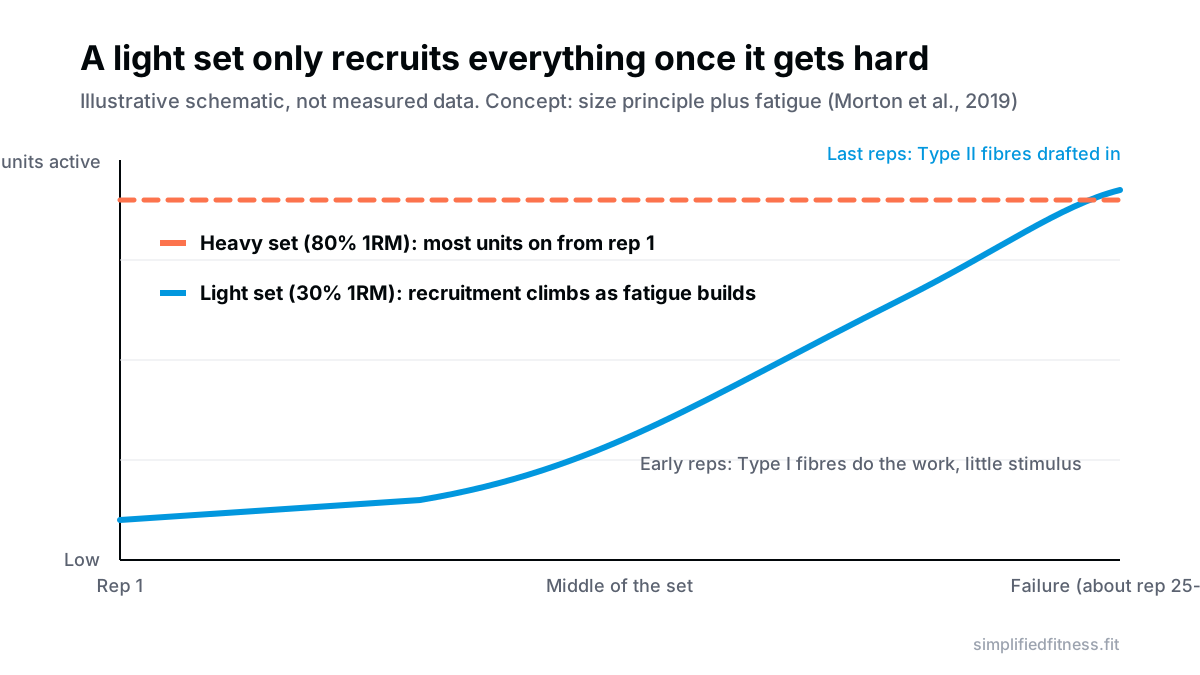
With 80% of your max, the demand is high from the first rep, so large units are involved straight away. With 30%, the first reps are easy. Small units handle them. The large units sit mostly idle.
Then fatigue does the work. As the slow-twitch fibres tire and cannot produce enough force, the brain recruits more and larger units to keep the bar moving. By the last reps of a 25-30 rep set, much of the pool is working, and the bar speed is crawling.
Is there evidence that light sets reach fast-twitch fibres?
Older work leaned on surface EMG, the electrical signal on the skin. EMG amplitude is higher with heavier loads, and that was taken to mean heavier loads activate more Type II tissue. The problem: EMG is an indirect read and it does not measure which fibres actually did the work.
A 2019 study went to the muscle itself. Ten recreationally trained young men did leg exercise to task failure with heavier and lighter loads and with faster and slower rep tempos, and researchers took muscle biopsies. Glycogen depletion (a marker that a fibre was used) in both Type I and Type II fibres did not differ by load or by rep duration, and EMG amplitude was unrelated to glycogen depletion (Morton et al., 2019). The authors concluded that both fibre types were activated when heavier and lighter loads were lifted to task failure.
Two honest caveats. It was 10 men, measured after single bouts of exercise rather than a training block. And glycogen depletion is a proxy for activation, not a direct recording of motor units firing. So read it as strong supporting evidence, not final proof.
What did the training studies find?
The mechanism would be academic if it did not show up in results. It does, mostly.
In a 12-week trial of 49 resistance-trained men, one group lifted about 30-50% 1RM for 20-25 reps and another about 75-90% 1RM for 8-12 reps, all sets to volitional failure. Lean mass and Type I and Type II fibre area rose in both, with no significant difference between groups. Bench press 1RM went up more in the heavy group (14 kg versus 9 kg) (Morton et al., 2016).
A 2017 systematic review and meta-analysis pooled 21 studies of low-load (60% 1RM or less) versus high-load training with every set to failure. Hypertrophy was similar. Maximal strength favoured heavy loads (Schoenfeld et al., 2017). A 2021 review built on this and argued for a wider view of the old “repetition continuum”, where muscle can be built across a wide spectrum of loads (Schoenfeld et al., 2021).
The acute side points the same way. In 15 young men, 30% 1RM to failure raised myofibrillar protein synthesis at 4 hours about as much as 90% 1RM to failure, and it stayed elevated at 24 hours only in the light-load condition. A volume-matched 30% set that stopped short produced a smaller response (Burd et al., 2010). That matches the “close to failure” rule.
Where the evidence is less tidy
Not everything lines up, and it would be dishonest to pretend otherwise.
A 2018 within-subject study of 30 men trained each limb at 20, 40, 60 or 80% 1RM for 12 weeks with volume matched. Thigh muscle size rose about 8.9%, 20.5%, 20.4% and 19.5% respectively. Only 20% 1RM lagged, and 80% was reported as superior to 20% for size and strength (Lasevicius et al., 2018).
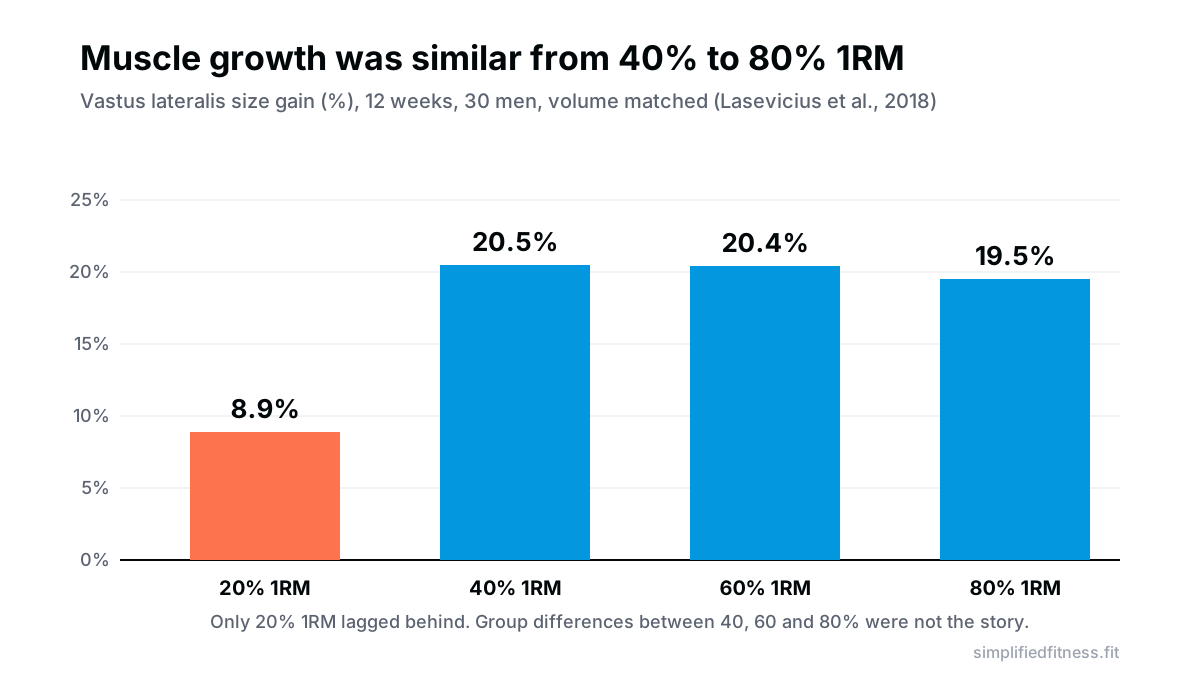
Why might that differ from the 30-50% study? Possibly because 20% 1RM is so light that sets become a test of discomfort tolerance, and people stop before the biggest units are fully drafted in. Note the design, too: only the 20% limb went to failure, and the heavier limbs simply matched its volume. We cannot say for sure why it lagged.
Also worth saying out loud: these participants were mostly young men, so results may not transfer cleanly to older adults, to women, or to people with joint problems.
What is acidosis, and does it grow muscle?
During hard sets, working muscle makes ATP using fast, non-oxygen pathways. That releases lactate and hydrogen ions (H+), and the muscle becomes more acidic. A 2025 review estimates intracellular pH falls from about 7.1-7.0 to 6.9-6.3 across the whole muscle, with small changes in slow-twitch fibres and larger changes (to about 6.2) in fast-twitch fibres (Cairns and Lindinger, 2025).
Two things from the same review matter for gym talk.
- Lactate itself is not the villain. Raised lactate on its own had little detrimental effect on muscle performance.
- Severe acidosis in fast-twitch fibres can contribute to force and power fatigue, and raised H+ and lactate add to perceived exertion and the sensation of fatigue.
So the burn is best read as a symptom: a rough sign that the muscle is working hard and becoming more acidic, which usually means you are in the right zone. But whether acidosis itself drives growth is another question. A 2025 narrative review lists metabolite accumulation as a proposed direct route and extra fibre recruitment and tension as proposed indirect ones, and it treats the mechanisms as open (Flewwelling et al., 2025).
Why light sets take real grit
Here is the practical downside. A heavy set of 8 ends when the weight wins. A 30% set ends when you decide it does.
Around rep 15 the load still feels easy, but the muscle is stinging, your breathing is loud, and a voice says “that is enough”. If you stop there, you have likely not recruited what you came for.
A common mistake with light training is quitting at the first real discomfort, which is roughly where the useful reps begin. It is easy to do 15 reps at 40% and call it a failure set when there were several more reps available. Research on rep predictions suggests lifters are least accurate on long sets, as we cover in how accurately lifters gauge RIR.
Low-load vs high-load: a quick comparison
| Heavy (about 75-90% 1RM) | Light (about 30-50% 1RM) | |
|---|---|---|
| Typical reps to failure | 8-12 or fewer | 20-30 |
| Motor unit recruitment | Large units early | Large units late, as fatigue builds |
| Muscle size (sets to failure) | Similar | Similar |
| Max strength (1RM) | Greater gains | Smaller gains |
| Main difficulty | Joint and tendon load | Burn, breathing, willpower |
| Fails when | You go too far from failure | You stop early |
How to use low-load sets in your training
- Pick the right exercises. Machine leg extensions, cable curls, lateral raises and pec-dec flys let you grind to failure safely. Heavy barbell squats at 30 reps are a bad idea for most people.
- Anchor the weight. Choose a load you can lift roughly 20-30 times with good form.
- Go to 0-2 reps in reserve. Our RIR and RPE calculator can help you calibrate, and the case for failure is in training to failure vs RIR.
- Keep some heavy work. If maximal strength matters, include heavier sets for the main lifts.
- Mind the heat. In an Indian summer, long burning sets in a hot, humid gym drain you fast. Hydrate, use a fan and consider shorter rests only if the muscle, not your breathing, is the limiter.
If you cannot get a barbell or heavy dumbbell in a crowded or small gym, light-load work is a legitimate way to train hard with what is available. See also the wider rep spectrum guide and the muscle hypertrophy guide for natural lifters. If you want a ready template, try our free push day plan.
The bottom line
Light and heavy training are not rivals for muscle size, as long as the light sets are taken close to failure. Fatigue recruits the big motor units that the weight alone did not. Heavy training still wins on maximal strength, and it takes less time per set.
The burn is real, and it is a decent sign of effort. It is not a magic growth switch. Use both ends of the rep spectrum, and make the hard reps count.
Frequently Asked Questions
Can lifting 30% of your 1RM build muscle?
Yes, if the sets are taken at or very near failure. In a 12-week trial of 49 resistance-trained men, a group using about 30-50% 1RM for 20-25 reps gained similar lean mass and muscle fibre size to a group using about 75-90% 1RM, with all sets to failure. Pick a light load you can lift 25-30 times and stop only when another clean rep is not possible.
Does low-load training recruit the same motor units as heavy training?
Not at the start of the set, but possibly by the end. Heavy loads call on large motor units immediately, while light loads rely on smaller units first and add larger ones as fatigue builds. A 2019 biopsy study found that both fibre types were activated, judged by glycogen depletion, when light and heavy sets went to failure, so the end of a hard light set is where the work happens.
What is Henneman's size principle?
It is the idea that motor units are recruited in order from small to large as the demand on the muscle rises. Small units connect to slow-twitch fibres and large units connect to fast-twitch fibres. Fatigue raises that demand, which is why a light set eventually pulls in the bigger units too, as we cover in our guide to [Henneman's size principle](/blog/hennemans-size-principle-motor-unit-recruitment).
Is the burn in your muscles lactic acid?
Not exactly. Hard exercise raises lactate and hydrogen ions (H+) together, and it is the hydrogen ions and related changes that make the muscle more acidic, not lactate itself. A 2025 review reports that raised lactate on its own has little detrimental effect on muscle performance, and the burn is better treated as a sign of intense effort than as a damage signal.
Does muscle acidosis cause muscle growth?
That has not been shown. A review of fatigue-driven hypertrophy lists metabolic by-products such as lactate as a proposed direct mechanism, but it presents these as hypotheses that still need testing. The safer reading is that acidosis comes along with the fatigue and extra fibre recruitment that probably do the heavy lifting for growth.
Why does low-load training feel so much harder to finish?
Because you have to push through a long, burning set while the weight itself feels easy. The discomfort comes from rising acidosis and perceived exertion, which a 2025 review links to activation of muscle afferents. Plan for it: choose single-joint or machine exercises where you can safely grind, and use a spotter or a stable setup.
Is high-load training better than low-load for muscle size?
For muscle size, not clearly. A 2017 meta-analysis of 21 studies found similar hypertrophy across loads when sets went to failure, though heavy loads gave more 1RM strength. If your goal is strength or you dislike long burning sets, heavier work is the practical choice.
Is 20% 1RM enough to grow muscle?
It looks suboptimal. In a 12-week within-subject study of 30 men, thigh muscle size rose 8.9% at 20% 1RM versus about 19.5-20.5% at 40-80% 1RM, with volume matched. If you go light, stay around 30% or above and still push close to failure.
How many reps is a 30% 1RM set?
Often somewhere around 20-30 reps to failure, though it varies by person and exercise. The 2016 trained-men study used about 30-50% 1RM for 20-25 reps. Use our [RIR and RPE calculator](/tools/rir-rpe-calculator) to practise judging how close to failure you really are.
Do I need to train to failure with light weights?
Close to it, yes. The research showing similar growth between light and heavy loads used sets taken to or near volitional failure. A light set that stops well short of failure is unlikely to deliver the same result, so aim for 0-2 reps in reserve on your last sets.
Is low-load training safer for joints?
It can feel gentler on joints and tendons because each rep is lighter, but I would not call this proven. The evidence in this article is about muscle growth, not injury rates. If a joint hurts, see a physiotherapist or doctor rather than assuming light weights fix it.
Should I mix heavy and light sets in the same programme?
Often yes. Heavy work builds maximal strength more reliably, and lighter sets add volume with less joint load. A sensible mix is heavy compounds first and lighter, high-rep isolation work later, covered in the [hypertrophy rep spectrum guide](/blog/hypertrophy-rep-spectrum-5-to-30-reps-guide).
Sources & References
Every claim above is checked against peer-reviewed research (PubMed, U.S. National Library of Medicine) or guidance from established health bodies. How we fact-check.
- Morton RW, et al. Muscle fibre activation is unaffected by load and repetition duration when resistance exercise is performed to task failure. J Physiol. 2019. PMID: 31294822
- Schoenfeld BJ, et al. Strength and hypertrophy adaptations between low- vs. high-load resistance training: a systematic review and meta-analysis. J Strength Cond Res. 2017. PMID: 28834797
- Morton RW, et al. Neither load nor systemic hormones determine resistance training-mediated hypertrophy or strength gains in resistance-trained young men. J Appl Physiol. 2016. PMID: 27174923
- Burd NA, et al. Low-load high volume resistance exercise stimulates muscle protein synthesis more than high-load low volume resistance exercise in young men. PLoS One. 2010. PMID: 20711498
- Lasevicius T, et al. Effects of different intensities of resistance training with equated volume load on muscle strength and hypertrophy. Eur J Sport Sci. 2018. PMID: 29564973
- Flewwelling LD, et al. What are the potential mechanisms of fatigue-induced skeletal muscle hypertrophy with low-load resistance exercise training? Am J Physiol Cell Physiol. 2025. PMID: 39726254
- Cairns SP, et al. Lactic acidosis: implications for human exercise performance. Eur J Appl Physiol. 2025. PMID: 40088272
- Schoenfeld BJ, et al. Loading recommendations for muscle strength, hypertrophy, and local endurance: a re-examination of the repetition continuum. Sports (Basel). 2021. PMID: 33671664

Umair Hazrami · Founder & Head Coach, Simplified Fitness
Umair Hazrami founded Simplified Fitness and the Simplified Lifter channel to cut through fitness noise. With 4+ years of consistent training and 10+ coaching clients, he writes every guide from the peer-reviewed research and links the sources so you can check them. Our editorial standards.
Educational content only, not medical advice. If you have a medical condition, are pregnant, or take medication, talk to a qualified doctor before changing your diet, supplements or training. Full disclaimer.
Keep reading

Programming
Blood Flow Restriction (BFR) Practical Guide: Cuff Pressures, Rep Schemes, and Light Loads
How to do BFR training safely: cuff placement, pressure as a percentage of occlusion, the 30-15-15-15 scheme and who should skip it. Every study linked.
8 min read
Programming
Calibrating True RIR: A Safe Gym Test for Technical vs Absolute Failure
Calibrating RIR means testing how many reps you really have left. Use this safe machine protocol to find true failure and fix your 2 RIR guesses.
8 min read

Programming
CNS Fatigue vs Peripheral Fatigue: How Failure Hits Squats and Curls Differently
CNS fatigue vs peripheral fatigue: why failing a squat flattens you for days while failing a curl barely registers, and how many reps to leave in reserve.
9 min read
Programming
Failure on Machines and Cables vs Free Barbells: Managing Injury Risk and Axial Fatigue
Failure on machines vs barbells: why machine sets feel safer and less draining, what the research says, and where to push hard or stop at 1-2 RIR.
8 min read