How Accurately Do Lifters Gauge RIR? Research on Subjective Failure vs Actual Failure
How accurate is RIR in lifting? Studies show most lifters underpredict reps to failure by about 1-2 reps. See why it happens and how to calibrate your effort.
TL;DR. The short answer
- Across a 2022 scoping review and meta-analysis (12 studies, 414 people), lifters underpredicted reps to failure by about 0.95 reps on average, with huge differences between studies.
- Accuracy is much better close to failure. In one study, error was about 1 rep within 0-5 reps of failure and more than 2 reps when failure was 7-10 reps away.
- Results conflict. Some trials in trained lifters find errors under 1 rep on bench press, while others find average misses of about 2 reps on knee extensions.
- Training experience helps a little at best. Several studies found it did not clearly change accuracy.
- A practical fix is an occasional, safe test set on a machine, then adding your typical miss to your next guess. This is coaching practice, not a proven method.
Part of our complete guide: Reps in Reserve, Rep Ranges and Rest Times: The Evidence-Based Guide to How Hard Every Set Should Be
Table of contents
So, how accurate is RIR (the reps-in-reserve part of our load, rep ranges and RIR guide)? Reasonably good, but not exact. Studies in gym-goers and trained lifters find that most people stop short of failure and guess that they have fewer reps left than they really do, usually by somewhere around 1-2 reps, and sometimes by more.
That matters because “leave 2 reps in the tank” only works if your 2 is really 2. We cover what the research found, why studies disagree, and how to check yourself safely. For the scale basics, see the RIR and RPE definitions explainer.
What does “accurate RIR” actually mean?
Researchers test it in a simple way. You do a set, say out loud when you think you have a set number of reps left, and then keep going until you truly cannot finish a rep. The gap between your prediction and what you actually got is your error.
A negative or positive sign tells you direction. Underprediction means you thought you had fewer reps left than you did. The studies below report it as “reps off”, so 1 means you stopped one rep earlier than you said.
The RIR-based RPE scale most lifters use came from Zourdos and colleagues in 2016. They found that, in squats, the reported RPE tracked bar speed closely (r = -0.88 in experienced squatters). That showed the scale is related to something real. It did not show that the numbers lifters pick are always right.
Do lifters underestimate reps to failure?
On average, yes. Here is what the larger studies found.
- Steele et al., 2017. 141 people did single sets to failure on a full-body session and predicted their reps beforehand. They underpredicted, the standard error of measurement across exercises ran from roughly 2.6 to 3.4 reps, and there was a tendency toward better accuracy with experience (Steele et al., 2017). The authors suggested using RIR cautiously.
- Armes et al., 2020. People with at least a year of training did knee extensions and predicted when they would hit failure. Across two experiments they underpredicted by about 2.0 reps, with a very wide confidence interval (0.0 to 4.0) (Armes et al., 2020).
- Halperin et al., 2022. The meta-analysis pooled 12 studies with 414 participants. People underpredicted by 0.95 reps on average (95% CI 0.17-1.73), but the differences between studies were enormous (Halperin et al., 2022).
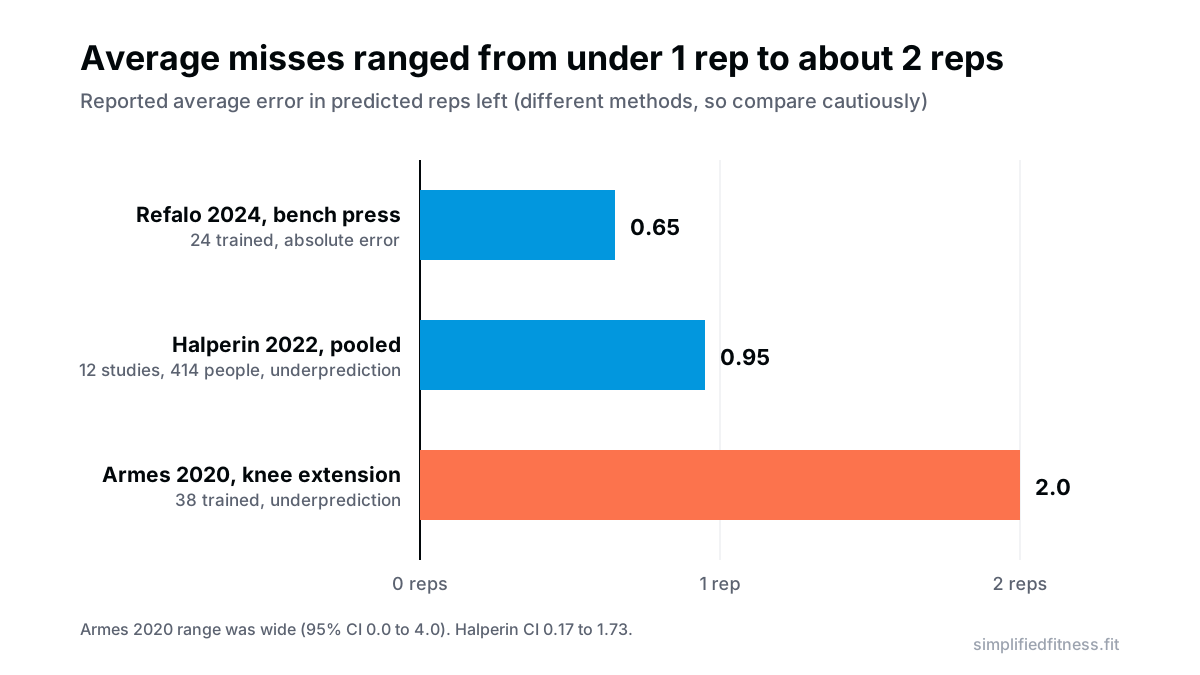
So the brief version you may have seen online, that lifters routinely think they are at 2 reps from failure when they are 5 away, is stronger than the data support on average. Individual sets can miss by that much, especially long ones, but the averages in these studies sit closer to 1-2 reps.
Why do the studies disagree?
They do disagree, and it is worth being fair about it.
A 2024 trial from Refalo and colleagues had 12 trained men and 12 trained women predict 1 RIR and 3 RIR on bench press at 75% of 1RM. Accuracy was high: the average absolute error was 0.65 reps, with a minor tendency to underpredict, and no link with sex, years of training or relative strength (Refalo et al., 2024).
Armes found about 2 reps on knee extensions. Why the gap? A few likely reasons, which are my reading and not proven:
- How far from failure you predict. Both Halperin and the 2024 scoping review noted that predictions made closer to the end of a set are more accurate (Bastos et al., 2024).
- Exercise and load. The meta-analysis found error grew when sets went beyond 12 reps. Armes used knee extensions at 70% of maximum (1RM in one experiment, isometric strength in the other), a single-joint setup that can produce a long, burning set.
- How failure was defined and confirmed. Halperin flagged that studies explained task failure differently, which adds noise.
The pooled result also had very high heterogeneity (I2 = 97.9%). When studies vary that much, the average hides a lot. Your own number could sit anywhere in that spread.
Why does effort feel closer to failure than it is?
The honest answer is that the studies measure it, but do not fully explain it. Armes and colleagues argued that perceived effort may not match the actual effort required. A plausible explanation, not a proven one, is that discomfort, breathing and the burn rise well before the muscle can no longer produce force.
In gym terms: the set gets heavy and horrible, so your brain calls it. The last two reps would have moved, slowly.
Does the error depend on how far from failure you are?
Yes, and this is the most useful finding for training.
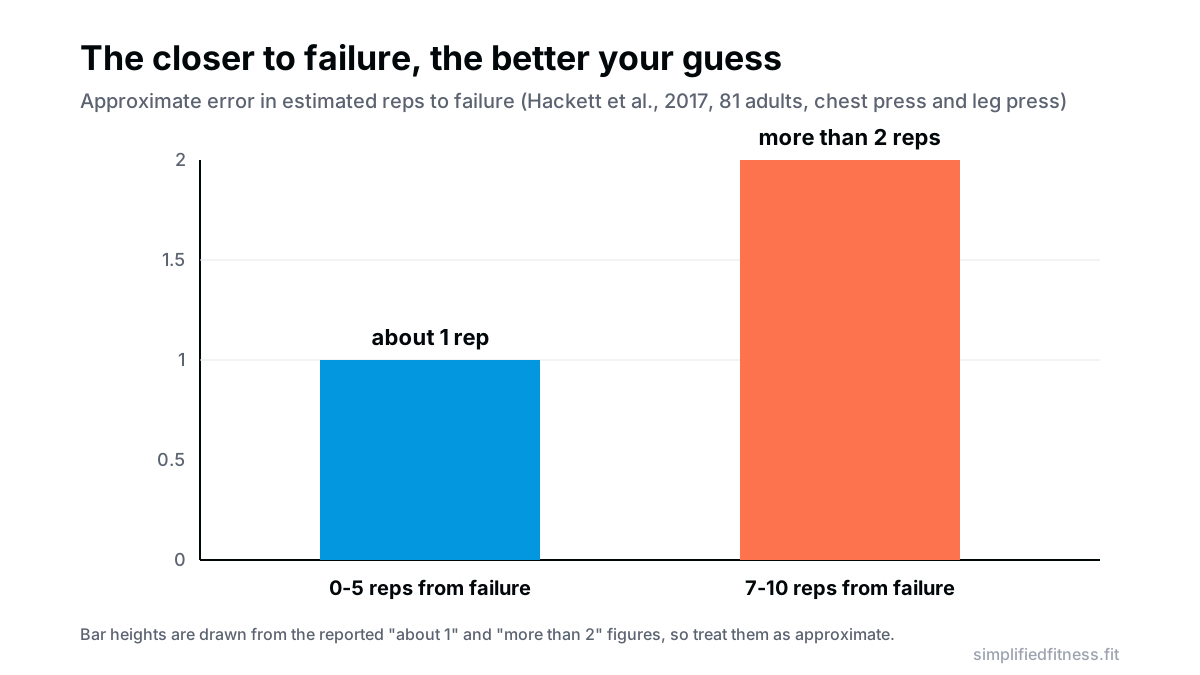
Hackett and colleagues had 81 adults do up to 10 sets of 10 on chest press and leg press, estimate reps to failure at the end of each set, then continue to failure. The error was about 1 rep when failure was 0-5 reps away, and more than 2 reps when failure was 7-10 reps away (Hackett et al., 2017). Chest press was more accurate than leg press, and training experience did not affect accuracy.
Does experience fix it?
Mostly not, or at least not reliably.
- Steele saw a tendency toward better accuracy with more experience.
- The meta-analysis found training status did not seem to influence accuracy.
- Hackett found no effect of experience.
- Nine trained men who took the last bench set of each session to failure for six weeks did not significantly improve their absolute error (Remmert et al., 2023). Their raw error tended to shift toward more underestimation in later sessions and on higher-rep sets.
- Davies and colleagues found that six weeks of bench training with two different set structures did not change prediction error in experienced male trainers (Davies et al., 2023).
These are small samples, mostly young men, mostly bench press. They do not prove that calibration never works. They do mean you should not assume that lifting for five years has made your RIR trustworthy.
Do I even need to hit failure for muscle growth?
Probably not. A 2023 meta-analysis of 15 studies found no evidence that training to momentary muscular failure beats stopping short for hypertrophy, though sets taken to set failure (any definition) showed a trivial advantage (effect size 0.19, 95% CI 0.00 to 0.37) (Refalo et al., 2023). For the deeper comparison see our failure versus RIR meta-analysis article.
So why care about accuracy? Because if “2 RIR” is secretly 5, a lot of your sets may be well short of challenging. Too far from failure and the stimulus drops. The meta-analysis does not tell us exactly where that line is, so a mid-range estimate with a safe check is a sensible hedge.
How to calibrate your RIR safely
This part is coaching practice built on the studies above. No trial has proven this exact routine, so treat it as a sensible way to test yourself.
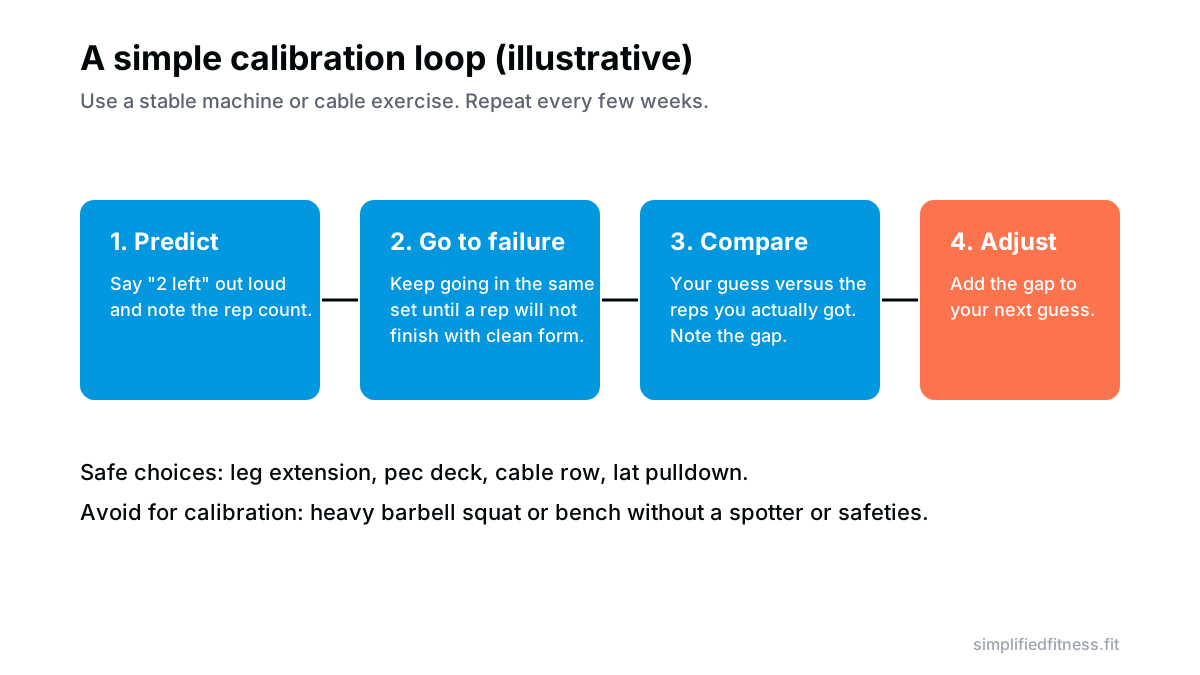
- Pick a safe exercise. A leg extension, pec deck, cable row or lat pulldown. A fail on a machine will not pin you.
- Do a normal working set and note the rep where you think you have 2 left. Say it out loud or have a partner note it.
- Do not rack it. Keep going to true failure in the same set. Keep form clean. Stop at the first rep that will not complete, not the first ugly one. This mirrors how the studies above tested people.
- Compare. If you called “2 left” at rep 10 and failed on rep 16 (so 15 completed), you really had 5 in reserve, not 2. Add that gap to your guesses for a few weeks.
For a longer protocol, see calibrating true RIR with practical gym protocols. For injury risk on specific lifts, read failure on machines and cables versus free barbells. You can also log your sets in our RIR and RPE calculator.
Practical rules that hold up
- Treat RIR as plus or minus 1-2 reps. If you want about 2 reps in reserve, be happy anywhere from roughly 1 to 3.
- Use bar speed as a second signal. If the last rep was still moving at a decent pace, you were not close. Zourdos found that RPE and bar speed track each other.
- Judge late, not early. Make the call near the end of the set.
- Shorter sets calibrate better. Practise on 5-10 rep sets before trusting your read on 20-rep sets.
- Be a little cautious on compound lifts. Safety matters more than precision on a squat or heavy bench.
- Re-check every few weeks, not every session. A failure set adds fatigue. Between checks, keep using RIR as your steering tool; a 2024 scoping review of 31 studies found RIR scales feasible and useful for setting intensity (Bastos et al., 2024).
When to see a doctor
Failure testing should never involve sharp pain, chest pain, dizziness, or pins and needles. If you get any of these during training, stop and speak to a doctor. If you have a heart or blood pressure condition, ask a clinician before pushing sets to maximal effort.
Bottom line
Most lifters can read effort reasonably well close to failure and poorly far from it. The average miss in the research is about 1-2 reps toward under-estimating what you have left, with plenty of variation. Use RIR, but check it occasionally on a safe machine, and add your typical gap to your guess.
Frequently Asked Questions
How accurate is RIR in lifting?
It is decent but imperfect. A 2022 meta-analysis of 12 studies found people underpredicted reps to failure by about 0.95 reps on average, with very large variation between studies. Treat your RIR number as a rough guide of 1-2 reps either way, and check it against a real failure set now and then.
Do lifters underestimate how many reps they have left?
Yes, on average. Steele and colleagues (2017) had 141 people take single sets to failure and found they underpredicted what they could do. The likely reason is that effort feels heavy before the muscle has actually run out, so you stop while a few clean reps are still available.
How far from failure is RPE 8 really?
RPE 8 is meant to be 2 reps in reserve, but studies suggest the real number can be higher, especially early in a long set. Error is roughly 1 rep close to failure and more than 2 reps when failure is far away. If a set at RPE 8 feels easy to repeat, you were probably further from failure than you thought.
Does training experience make RIR more accurate?
Only slightly, if at all. Steele found a tendency toward better accuracy with experience, but the 2022 meta-analysis found training status did not seem to influence accuracy, and Hackett's 2017 study found experience did not affect it. Do not assume that years in the gym automatically fix your read on effort.
Is RIR less accurate on high-rep sets?
Yes. The meta-analysis found error grew when sets lasted more than 12 reps, and Hackett found bigger errors when failure was 7-10 reps away. Long sets let fatigue and discomfort build slowly, which makes it harder to judge what is left. Use a heavier, shorter set to practise RIR first.
How can I tell if I am quitting early or truly 2 reps from failure?
You cannot tell for sure without testing. Run a safe test set to failure, record how many reps you stopped short of, and compare that with your guess. If your bar speed on the last reps stays smooth and the set still feels repeatable, you probably had more in the tank.
Should I train to failure to calibrate my RIR?
An occasional failure set on a safe exercise is a reasonable way to check yourself. The 2023 meta-analysis found no evidence that failure training beats stopping short for muscle growth, so this is for calibration, not a weekly habit. Use machines or cables, and avoid it on heavy squats or bench presses without safeties.
Which exercises are best for testing true failure?
Machines and cables such as leg extensions, pec deck, cable rows and lat pulldowns are the safest choices. They let you fail without a bar pinning you or a spot you cannot recover. Keep reps smooth and stop at the first rep you cannot finish.
Does RIR accuracy improve if I practise it?
The evidence is not convincing. In nine trained men who took the last set of each bench session to failure for six weeks, accuracy did not significantly improve, and a six week bench training trial in experienced lifters found no change in error either. Calibration may still help individuals, but do not expect it to be automatic.
Is RIR accurate for compound lifts like squats?
It varies by exercise. Hackett found error of 1 rep or less within 0-5 reps of failure on chest press, but only within 0-3 reps on leg press. Expect to be a little less precise on big lower-body lifts, and keep a safety margin there.
Are men or women more accurate at predicting failure?
Evidence is mixed. A 2024 bench press study of 12 men and 12 women found no relationship between accuracy and sex, while Hackett found men more accurate than women at some points on leg press. Neither result is a reason to change how you train.
Do I need RIR at all if it is this inaccurate?
Yes, it is still useful. A 2024 scoping review of 31 studies found RIR scales appeared feasible and useful for setting intensity, and predictions made near the end of a set are more accurate. Use it as a rough steering tool, not as a precise measurement.
What is the difference between technical failure and absolute failure?
Technical failure is where form breaks down, while absolute (momentary) failure is the rep you cannot complete even when you try. Studies of RIR use true momentary failure as the yardstick. For calibration, stop at the rep that stalls, not the rep that merely looks ugly.
Sources & References
Every claim above is checked against peer-reviewed research (PubMed, U.S. National Library of Medicine) or guidance from established health bodies. How we fact-check.
- Halperin I, et al. Accuracy in predicting repetitions to task failure in resistance exercise: a scoping review and exploratory meta-analysis. Sports Med. 2022. PMID: 34542869
- Steele J, et al. Ability to predict repetitions to momentary failure is not perfectly accurate, though improves with resistance training experience. PeerJ. 2017. PMID: 29204323
- Armes C, et al. Just one more rep! Ability to predict proximity to task failure in resistance trained persons. Front Psychol. 2020. PMID: 33424678
- Hackett DA, et al. Accuracy in estimating repetitions to failure during resistance exercise. J Strength Cond Res. 2017. PMID: 27787474
- Refalo MC, et al. Accuracy of intraset repetitions-in-reserve predictions during the bench press exercise in resistance-trained male and female subjects. J Strength Cond Res. 2024. PMID: 37967832
- Remmert JF, et al. Changes in intraset repetitions in reserve prediction accuracy during six weeks of bench press training in trained men. Percept Mot Skills. 2023. PMID: 37436724
- Davies TB, et al. Effect of high-volume cluster sets vs. lower-volume traditional sets on accuracy of estimated repetitions to failure. J Strength Cond Res. 2023. PMID: 36730216
- Bastos V, et al. Feasibility and usefulness of repetitions-in-reserve scales for selecting exercise intensity: a scoping review. Percept Mot Skills. 2024. PMID: 38563729
- Refalo MC, et al. Influence of resistance training proximity-to-failure on skeletal muscle hypertrophy: a systematic review with meta-analysis. Sports Med. 2023. PMID: 36334240
- Zourdos MC, et al. Novel resistance training-specific rating of perceived exertion scale measuring repetitions in reserve. J Strength Cond Res. 2016. PMID: 26049792

Umair Hazrami · Founder & Head Coach, Simplified Fitness
Umair Hazrami founded Simplified Fitness and the Simplified Lifter channel to cut through fitness noise. With 4+ years of consistent training and 10+ coaching clients, he writes every guide from the peer-reviewed research and links the sources so you can check them. Our editorial standards.
Educational content only, not medical advice. If you have a medical condition, are pregnant, or take medication, talk to a qualified doctor before changing your diet, supplements or training. Full disclaimer.
Keep reading

Programming
Blood Flow Restriction (BFR) Practical Guide: Cuff Pressures, Rep Schemes, and Light Loads
How to do BFR training safely: cuff placement, pressure as a percentage of occlusion, the 30-15-15-15 scheme and who should skip it. Every study linked.
8 min read
Programming
Calibrating True RIR: A Safe Gym Test for Technical vs Absolute Failure
Calibrating RIR means testing how many reps you really have left. Use this safe machine protocol to find true failure and fix your 2 RIR guesses.
8 min read
Programming
CNS Fatigue vs Peripheral Fatigue: How Failure Hits Squats and Curls Differently
CNS fatigue vs peripheral fatigue: why failing a squat flattens you for days while failing a curl barely registers, and how many reps to leave in reserve.
9 min read
Programming
Failure on Machines and Cables vs Free Barbells: Managing Injury Risk and Axial Fatigue
Failure on machines vs barbells: why machine sets feel safer and less draining, what the research says, and where to push hard or stop at 1-2 RIR.
8 min read