Tempo Training and Repetition Duration: Does Slowing Down the Eccentric Build More Muscle?
Tempo training for hypertrophy explained: what two meta-analyses say about 4-second negatives, super-slow reps and the simple rep speed worth using.
TL;DR. The short answer
- Tempo training for hypertrophy does not need a stopwatch. A 2025 meta-analysis of 14 studies found muscle growth was about the same whether reps took roughly 1 second or roughly 3.5 seconds.
- A 2015 meta-analysis found similar growth across rep durations from 0.5 to 8 seconds, and suggested that very slow reps (over 10 seconds) are inferior, though the evidence was thin.
- Very slow reps force you to use much lighter weights, which is the likely (not proven) reason super-slow training seems to underperform.
- A practical default is a controlled 1.5-2.5 second lowering phase, an optional brief pause at the stretch and a firm lift. The pause detail is coaching judgement, not a trial result.
- Slowing the eccentric is a fine tool for control and joint comfort, but it is not a growth hack and it will not rescue a program with too few hard sets.
Part of our complete guide: Reps in Reserve, Rep Ranges and Rest Times: The Evidence-Based Guide to How Hard Every Set Should Be
Table of contents
Slow negatives do not clearly build more muscle, and tempo training for hypertrophy is mostly a matter of control, not a growth hack. Across the best current reviews, reps lasting anywhere from about half a second to about eight seconds produce similar growth when sets are taken hard, and the main thing that goes wrong with very slow reps is that you end up lifting a lot less weight.
This article is the tempo deep-dive inside our complete guide to load, rep ranges, RIR and rest intervals. If you have ever stood at the cable stack counting “one, two, three, four” on every lowering phase and wondered whether it was worth the effort, here is what the data says about tempo training for hypertrophy.
What does tempo training actually mean?
Tempo is just rep speed, broken into phases. The eccentric is the lowering part (the bar descending to your chest, the dumbbell going back down in a curl). The concentric is the lifting part. Some programs also add pauses at the bottom or top.
You will often see this written as four numbers, like 3-1-1-0: three seconds lowering, one second pause, one second lifting, no pause at the top.
Add all the phases up and you get repetition duration. A 3-1-1-0 rep lasts five seconds. A standard “just lift it” rep might last two.
The idea behind slowing things down is easy to like. More time under load should mean more stimulus, right? And the eccentric is where muscles can handle the most force, so surely lingering there must do something special.
That is a reasonable hypothesis. The question is whether it holds up when you measure muscle.
Does slowing down the eccentric build more muscle?
The most recent and most complete answer is a 2025 systematic review and meta-analysis by Enes and colleagues, with Schoenfeld among the authors (Enes et al., 2025). Here is what they did and found:
- They pooled 14 studies in healthy adults that compared different tempos while holding the other training variables the same.
- Slower interventions lasted about 1.7-4.5 seconds per rep (averaging roughly 3.5 seconds). Faster ones lasted 0.3-2 seconds (averaging roughly 1 second).
- Within-group growth was similar: an effect size of 0.43 for faster tempos and 0.34 for slower ones.
- The direct comparison between the two came out at 0.09 (credible interval -0.04 to 0.22), which the authors describe as trivially favouring faster tempos, with a low probability of any meaningful gap.
- Subgroups (eccentric versus concentric manipulation, upper versus lower body, training to failure or not) mostly showed trivial to small effects, though the certainty varied.
Their own conclusion is cautious and worth quoting in spirit: tempo appears to have minimal overall effect on muscle hypertrophy, with potential differences emerging under specific conditions.
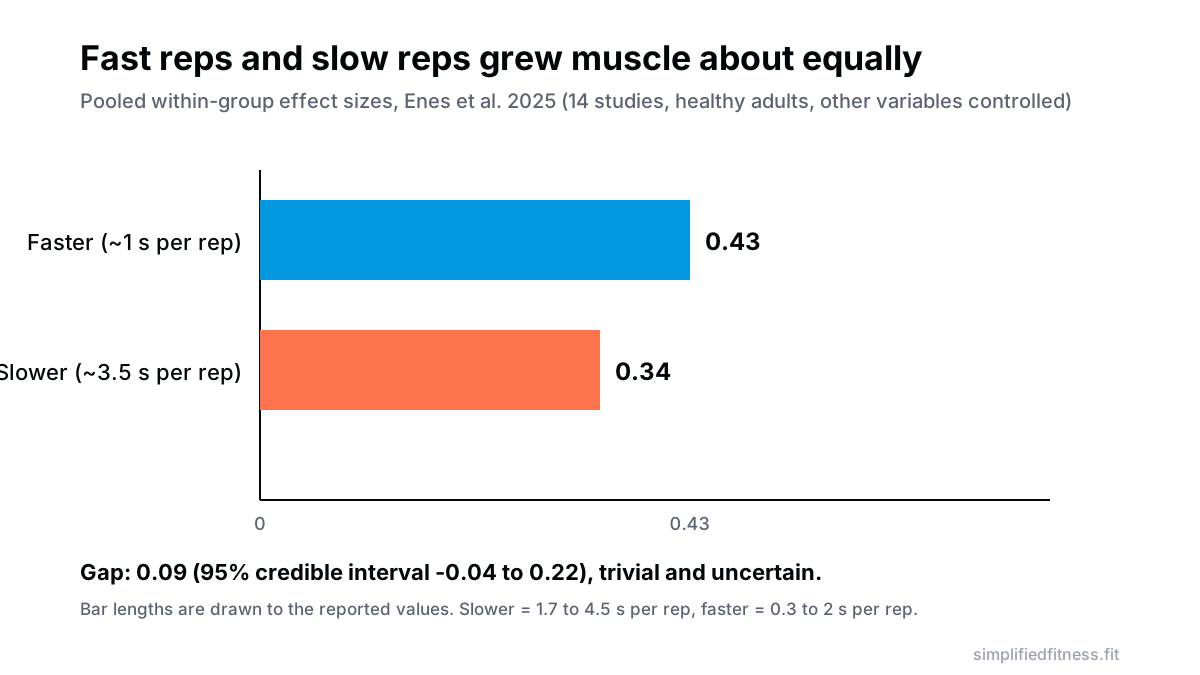
So if you were hoping a 4-second eccentric was a hidden multiplier, the meta-analysis does not support that.
What does the repetition duration meta-analysis say about rep speed?
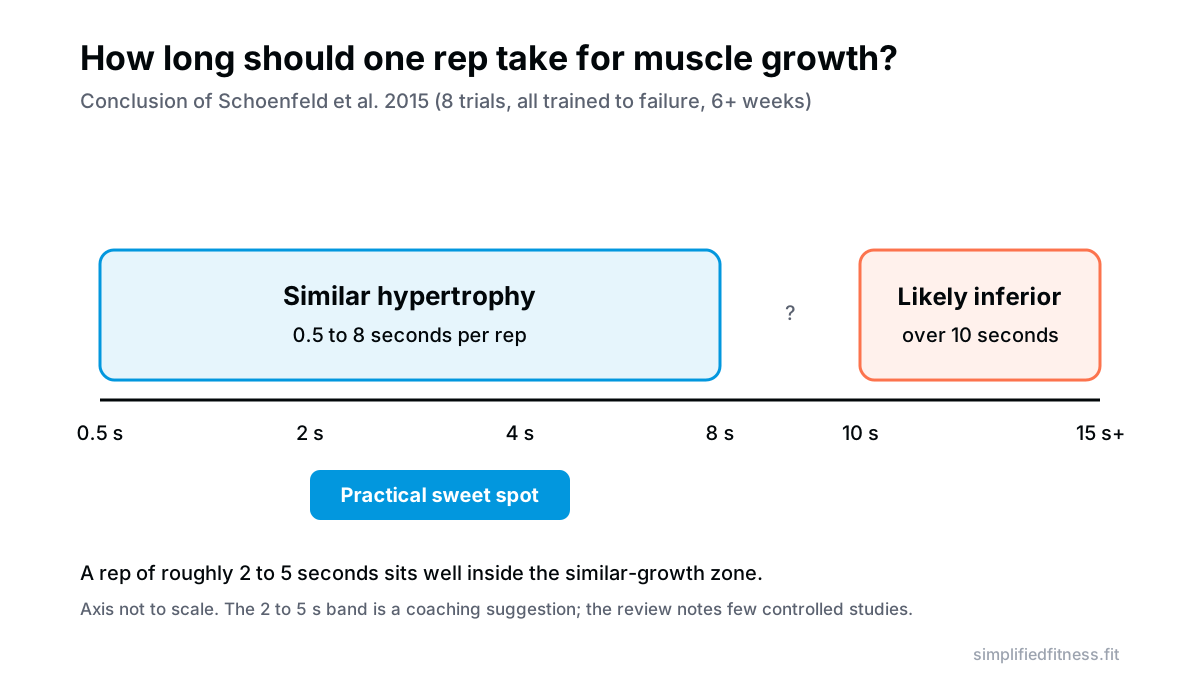
Ten years earlier, Schoenfeld and colleagues ran the first meta-analysis on this question (Schoenfeld et al., 2015). It was strict. They only included trials that lasted at least six weeks, trained to muscle failure, measured muscle through biopsy, imaging or densitometry, and used healthy people. Only eight studies met the bar.
Their results were consistent with the 2025 paper:
- Similar growth from rep durations between 0.5 and 8 seconds.
- A suggestion that very slow reps, over 10 seconds each, were inferior.
- A caveat that too few controlled studies exist to be definitive.
That caveat matters. The over-10-second finding comes from a small pile of studies and the authors flagged it as tentative. I would treat it as “very likely not helpful” rather than “proven harmful.”
A 2023 narrative review (not a meta-analysis, so treat it as expert interpretation rather than pooled data) landed on a similar practical range, recommending reps of roughly 2-8 seconds and noting that more research is needed on eccentric versus concentric duration (Androulakis Korakakis et al., 2023).
Why do super-slow reps underperform?
The most likely explanation is load, though no trial has isolated it. If a rep takes 10 or 15 seconds, you cannot use the weight you would use for a normal set. Load drops sharply.
Muscle growth works across a wide spread of loads, as long as sets are taken near failure (Schoenfeld et al., 2021). That does not mean any load works. It means the load needs to be demanding enough, and stretching a rep into a slow crawl tends to make the load too easy to challenge the muscle the way a properly loaded set does.
There is a second, boring cost: fatigue and boredom. Longer reps mean fewer reps and sets inside a session, and fewer people actually finish them.
In the gym, this looks like someone doing a lat pulldown with a 6-second lowering phase using a weight they could handle for a fast set of 20. It feels brutal. It is not necessarily productive.
What about the individual trials? A fair look at conflicting results
Meta-analyses hide the messy bits, so here are a few single studies. They do not all point the same way, which is exactly why pooled data helps.
Slower eccentric came out slightly ahead.
- A 2022 trial gave 10 young adults unilateral knee extensions with each leg randomized to a 2-second or a 4-second eccentric, five sets to failure at 70% 1RM for 8 weeks. Most thigh muscles grew similarly; the vastus medialis grew more with the 4-second tempo (Azevedo et al., 2022).
- A 2024 squat trial in 18 people who had not trained for the past 8 months compared a 1-second with a 4-second eccentric for 7 weeks. The slow group had greater strength gains and more vastus lateralis growth (Kojic et al., 2024).
Faster tempo came out slightly ahead.
- A 2022 within-subject trial of 13 resistance-trained men compared a 3-second with a 1-second eccentric on leg extensions (written 1-0-3 and 1-0-1 in the paper) over 8 weeks. Growth was similar at the proximal thigh, but the faster leg grew more at the distal site (about 5.5% versus 2.2%). Strength gains were similar, and the slow leg felt harder (higher RPE) (Pearson et al., 2022).
Why might they disagree? The samples are tiny (10 to 18 people). Several used one leg per condition. The Kojic participants had not lifted in the previous 8 months. Muscle thickness measured at different sites, with different techniques, can give different answers, and with so few people noise is hard to rule out.
A 2025 meta-analysis focused only on eccentric duration (9 studies, 166 participants, 46% trained) found uncertain hypertrophy effects (g = 0.05 with a wide interval) and uncertain strength effects overall (Amdi et al., 2025). In trained people, and in studies matching volume-load, longer eccentric phases looked similar or slightly better for strength. Faster eccentrics seemed better for countermovement jump height. The authors say more research is needed.
Cautious takeaway: the single trials swing a little in both directions, and the pooled data lands in the middle. If slow negatives suit you, use them. If they do not, you are not missing a growth secret.
What is the best lifting tempo for muscle growth in practice?
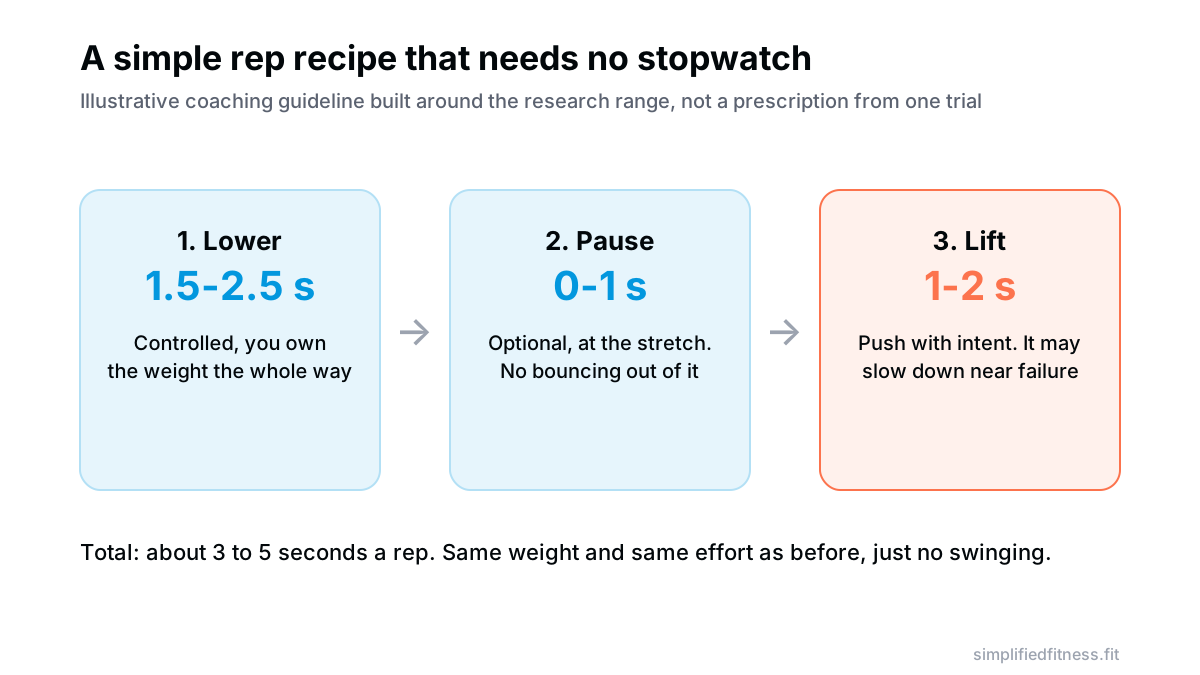
Combining the evidence, here is a default that is safe, simple and consistent with the research range. This is a coaching suggestion built around the data, not a protocol any single trial tested.
- Lower with control for about 1.5-2.5 seconds. You should be able to stop the weight at any point.
- Optionally pause for up to a second in the stretched position. This is mostly about removing the bounce. No study here shows the pause itself drives growth.
- Lift with firm intent. It can take 1-2 seconds, and it will naturally slow down on the last hard reps. That is fine.
That makes a rep of roughly 3-5 seconds, comfortably inside the 0.5-8 second range where growth looked similar.
Should you pause at the bottom of a rep?
Possibly, sometimes. Pauses are useful for exercises where you tend to bounce (squats, bench, dumbbell presses). They remove momentum and make you own the stretched position. A related technique is training in the lengthened range of motion; see our guides on full versus partial range of motion and lengthened partials.
But a one-second pause on every rep of every exercise is overkill. Use it where bouncing is a problem.
Tempo, proximity to failure and rest: how they fit together
Tempo is a small lever. The bigger ones sit around it.
- Proximity to failure: how hard you push each set matters more than how long each rep lasts. Our article on training to failure versus RIR covers that, and you can use the RIR / RPE load calculator to pick weights.
- Rest intervals: slower reps can make sets feel harder, which interacts with how long you rest. See rest intervals for hypertrophy.
- Concentric speed: whether you should deliberately try to lift fast is a separate question, covered in intent to move explosively.
The one thing tempo does well is protect your technique. Lifting with swing and momentum lets other muscles take over and robs the target muscle of the work. A controlled lowering is a cheap way to avoid that.
Who should be careful with tempo manipulation?
Most of the studies above are in healthy young adults training for 6-12 weeks, so we know much less about older adults, people returning from injury and long-term training over years.
If you have pain during lifting, a diagnosed tendon or joint problem, or you are recovering from an injury, a slower, controlled lowering phase can be a sensible way to reduce jerky loading. That is a technique choice and not something these hypertrophy trials tested. If pain is sharp, persistent, or comes with swelling or weakness, see a doctor or physiotherapist rather than tinkering with tempo.
Also remember that lifting to failure with slow eccentrics on heavy compound lifts without a spotter or safety pins is a bad idea. Machines and cables are friendlier for this kind of work.
A simple plan for putting this into practice
For most lifters on a standard push, pull, legs routine (try our push day plan if you need one):
- Default to a controlled 2-second lowering and a firm lift on everything.
- Add a one-second stretched pause on exercises where you bounce.
- Keep reps under about 5 seconds each. Do not crawl.
- Track load and reps across weeks. Progressive overload still wins.
- Use a slower 3-4 second eccentric occasionally on isolation moves like leg extensions or curls if you enjoy it, but do not expect magic.
Then spend your attention on what matters more: enough hard sets per muscle each week, adequate protein, and sleep. In India that might simply mean dal, paneer, curd or soya at each meal and a regular training schedule you can keep up through a hot summer. The tempo tweak is the cherry, not the cake.
What we still do not know
Honesty check on the research gaps:
- Most studies are short (about 6-12 weeks) with small samples.
- Several tested a single exercise, often leg extension, so we cannot assume the same results for every movement.
- Few studies separate the eccentric, the pause and the concentric cleanly.
- Differences might emerge in specific muscles or conditions, as the 2025 authors note, but the evidence is not yet strong enough to prescribe on.
None of that changes the practical advice, but it is a reason to avoid dogma in either direction.
Frequently Asked Questions
Does slow eccentric training build more muscle?
Not clearly. A 2025 meta-analysis of 14 trials found only a trivial, statistically uncertain difference between slower and faster tempos, and a separate 2025 review of eccentric duration found uncertain hypertrophy effects. If you like slower negatives for control, use them, but do not expect extra growth just from counting seconds.
What is the best tempo for hypertrophy?
There is no single best tempo, because a wide range of rep speeds produces similar growth. A 2015 meta-analysis found comparable results from 0.5 to 8 seconds per rep. A controlled lowering of about 2 seconds and a firm lift is a sensible default that keeps the weight heavy.
Is a 4-second eccentric better than a 2-second eccentric?
Evidence is mixed and mostly small. In a leg extension study, 4-second negatives gave similar growth to 2-second negatives in most thigh muscles, with only the vastus medialis favouring the slower version. In another trial in trained men, a faster tempo gave slightly more growth at one thigh site. Pick one you can repeat with the same load and stick with it.
Is super slow training good for muscle growth?
Probably not. The 2015 review suggested reps slower than 10 seconds were inferior for hypertrophy, although few controlled studies existed. The likely reason is that very slow reps force you to drop the weight a lot, which reduces how hard the muscle is working. Keep reps in the 1-5 second range and put your effort into load and proximity to failure.
What does tempo 3-1-1-0 mean?
Tempo notation lists seconds for the lowering phase, the pause at the bottom, the lifting phase and the pause at the top, in that order. So 3-1-1-0 means lower for 3 seconds, pause for 1, lift for 1 and do not pause at the top. It is just a way to describe rep speed, and most lifters do not need to track it set by set.
What is time under tension and does it matter for muscle growth?
Time under tension is the total seconds a muscle spends working during a set. Research suggests it matters less than it sounds, because a set of fast reps and a set of slower reps taken near failure can produce similar growth. What matters more is training hard enough, with enough weekly sets, so the muscle is challenged.
Should I pause at the bottom of the rep?
A brief pause is optional. Pausing can reduce bouncing and keep tension on the muscle in the stretched position, but no study cited here isolates the pause as a growth driver. Try a one-second pause on exercises where you tend to bounce, such as squats or dumbbell presses.
Do slow reps make exercises easier on the joints?
They can feel kinder because you control the weight and avoid jerking at the bottom. That is a technique benefit, not something the hypertrophy studies measured. If a joint hurts, adjust the load, range of motion or exercise, and see a doctor or physio if pain persists.
Do I need to lift the weight fast on the way up?
You do not need to lift fast, but you should try to push firmly rather than grind slowly on purpose. Reps naturally slow down near failure, and that is fine. Aim for a smooth, strong lift and read our guide on intent to move explosively for the nuances.
Does tempo matter more for beginners or advanced lifters?
Tempo appears to matter little for either group, and most of the data comes from young adults training for 6-12 weeks. Beginners benefit most from learning control, so a steady 2-second lowering phase helps. Advanced lifters gain more from tracking load, reps and effort than from tracking seconds.
Can I use a slow eccentric on lighter weights to save my joints?
Yes, as long as the set is still taken close to failure. Muscle growth has been shown across a wide spread of loads when sets are hard enough. If a joint is irritated, a lighter load with a controlled lowering phase is a reasonable short-term option.
How do I count tempo without a stopwatch?
Say 'one-one thousand, two-one thousand' in your head while lowering, which lands close to two seconds. Record a set on your phone once to calibrate. After that, simply lower the weight so that you could stop it at any point.
Do eccentric-only or negative reps build more muscle?
The evidence reviewed here compared slower and faster eccentric durations inside normal reps, not eccentric-only training. So these studies cannot say whether heavy negatives beat standard reps. Treat them as an advanced technique to try with a spotter, not a requirement.
Sources & References
Every claim above is checked against peer-reviewed research (PubMed, U.S. National Library of Medicine) or guidance from established health bodies. How we fact-check.
- Enes A, et al. How slow should you go? A systematic review with meta-analysis of the effect of resistance training repetition tempo on muscle hypertrophy. J Strength Cond Res. 2025. PMID: 42709703
- Schoenfeld BJ, et al. Effect of repetition duration during resistance training on muscle hypertrophy: a systematic review and meta-analysis. Sports Med. 2015. PMID: 25601394
- Amdi CH, et al. The effect of eccentric phase duration on maximal strength, muscle hypertrophy and countermovement jump height: a systematic review and meta-analysis. J Sports Sci. 2025. PMID: 40692176
- Kojic F, et al. The effects of eccentric phase tempo in squats on hypertrophy, strength, and contractile properties of the quadriceps femoris muscle. Front Physiol. 2024. PMID: 39850448
- Pearson J, et al. Does varying repetition tempo in a single-joint lower body exercise augment muscle size and strength in resistance-trained men? J Strength Cond Res. 2022. PMID: 34351728
- Azevedo PHSM, et al. Effect of different eccentric tempos on hypertrophy and strength of the lower limbs. Biol Sport. 2022. PMID: 35309524
- Androulakis Korakakis P, et al. Optimizing resistance training technique to maximize muscle hypertrophy: a narrative review. J Funct Morphol Kinesiol. 2023. PMID: 38249086
- Schoenfeld BJ, et al. Loading recommendations for muscle strength, hypertrophy, and local endurance: a re-examination of the repetition continuum. Sports (Basel). 2021. PMID: 33671664

Umair Hazrami · Founder & Head Coach, Simplified Fitness
Umair Hazrami founded Simplified Fitness and the Simplified Lifter channel to cut through fitness noise. With 4+ years of consistent training and 10+ coaching clients, he writes every guide from the peer-reviewed research and links the sources so you can check them. Our editorial standards.
Educational content only, not medical advice. If you have a medical condition, are pregnant, or take medication, talk to a qualified doctor before changing your diet, supplements or training. Full disclaimer.
Keep reading

Programming
Blood Flow Restriction (BFR) Practical Guide: Cuff Pressures, Rep Schemes, and Light Loads
How to do BFR training safely: cuff placement, pressure as a percentage of occlusion, the 30-15-15-15 scheme and who should skip it. Every study linked.
8 min read
Programming
Calibrating True RIR: A Safe Gym Test for Technical vs Absolute Failure
Calibrating RIR means testing how many reps you really have left. Use this safe machine protocol to find true failure and fix your 2 RIR guesses.
8 min read
Programming
CNS Fatigue vs Peripheral Fatigue: How Failure Hits Squats and Curls Differently
CNS fatigue vs peripheral fatigue: why failing a squat flattens you for days while failing a curl barely registers, and how many reps to leave in reserve.
9 min read
Programming
Failure on Machines and Cables vs Free Barbells: Managing Injury Risk and Axial Fatigue
Failure on machines vs barbells: why machine sets feel safer and less draining, what the research says, and where to push hard or stop at 1-2 RIR.
8 min read