Rep Ranges and Joint Wear: Are Heavy Triples Worse for Your Joints Than Moderate Reps?
Heavy low reps vs moderate reps joint wear: what trials show for cartilage and tendons, why 8-15 reps suit aching joints, and when to see a doctor.
TL;DR. The short answer
- No study has tracked joint wear in healthy lifters doing heavy triples versus moderate reps for years, so nobody can claim heavy sets of 3-5 are proven to wreck cartilage, or that moderate reps are proven to protect it.
- Trials in people with knee osteoarthritis, a group with already vulnerable joints, found that loaded exercise did not appear harmful to cartilage (low quality evidence) and often reduced pain.
- A meta-analysis of 21 studies found muscle growth was similar across light and heavy loads, while 1RM strength favoured heavy loads, so 8-15 reps is a reasonable, lower-load way to build muscle.
- If a joint aches, use moderate reps (8-15, around 1-3 reps from failure) for most work and keep heavy sets optional, rather than avoiding loading altogether.
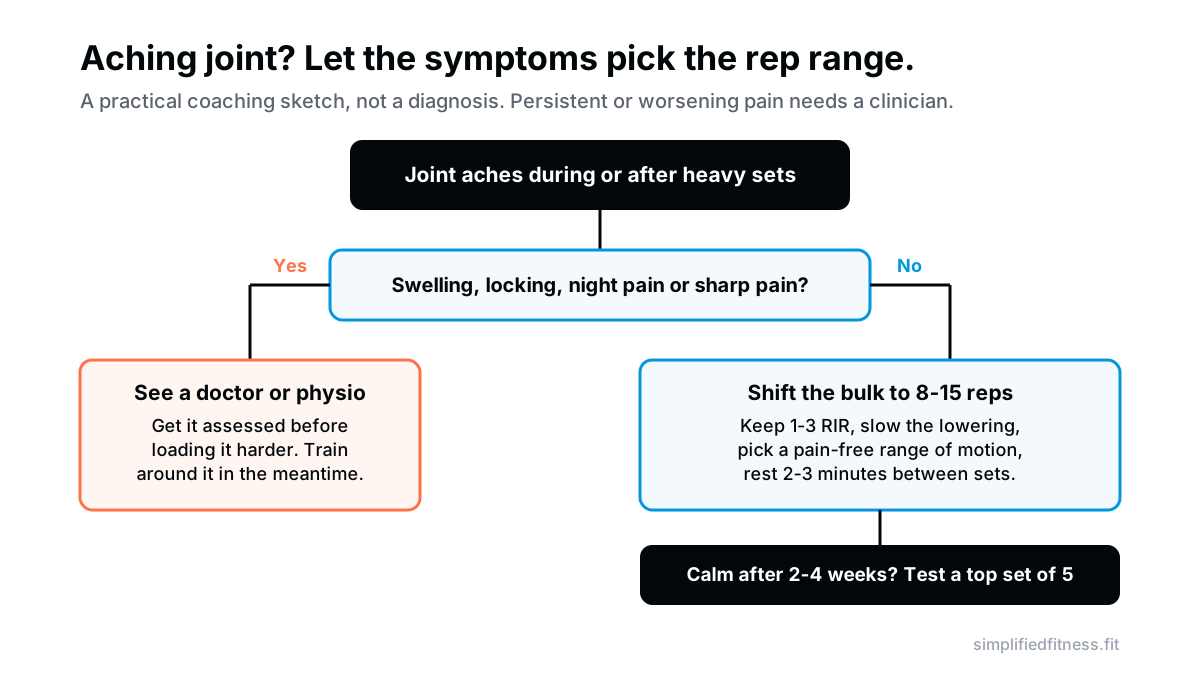
- Swelling, locking, night pain, sharp pain or pain that keeps worsening needs a doctor or physiotherapist, not a new rep scheme.
Part of our complete guide: Reps in Reserve, Rep Ranges and Rest Times: The Evidence-Based Guide to How Hard Every Set Should Be
Table of contents
Nobody can tell you that heavy sets of 3-5 reps wear out your joints, and nobody can tell you that moderate reps protect them either. The long-term trial that would settle it has not been done.
What we do have is a fair amount of indirect evidence, and it points to a practical answer. On the heavy low reps vs moderate reps joint wear question, a sensible default is to build most of your volume in the 8-15 rep range and treat heavy triples as optional extras. This sits inside the wider picture in our guide to load, rep ranges, RIR and rest intervals.
What is the real worry with heavy triples?
If you are asking this, you probably have a joint that aches. A knee after squats, a shoulder after bench, an elbow after rows. Then you read that heavy lifting “grinds down cartilage” and start wondering whether your 5x3 block is to blame.
The logic behind the worry is simple. A heavy triple is typically around 85% of your one-rep max or more, so each rep puts a lot of load through tendons and joint surfaces. A set of 10 at 70% puts less on the bar per rep but includes more reps. Which pattern is harder on the tissue over years is the open question.
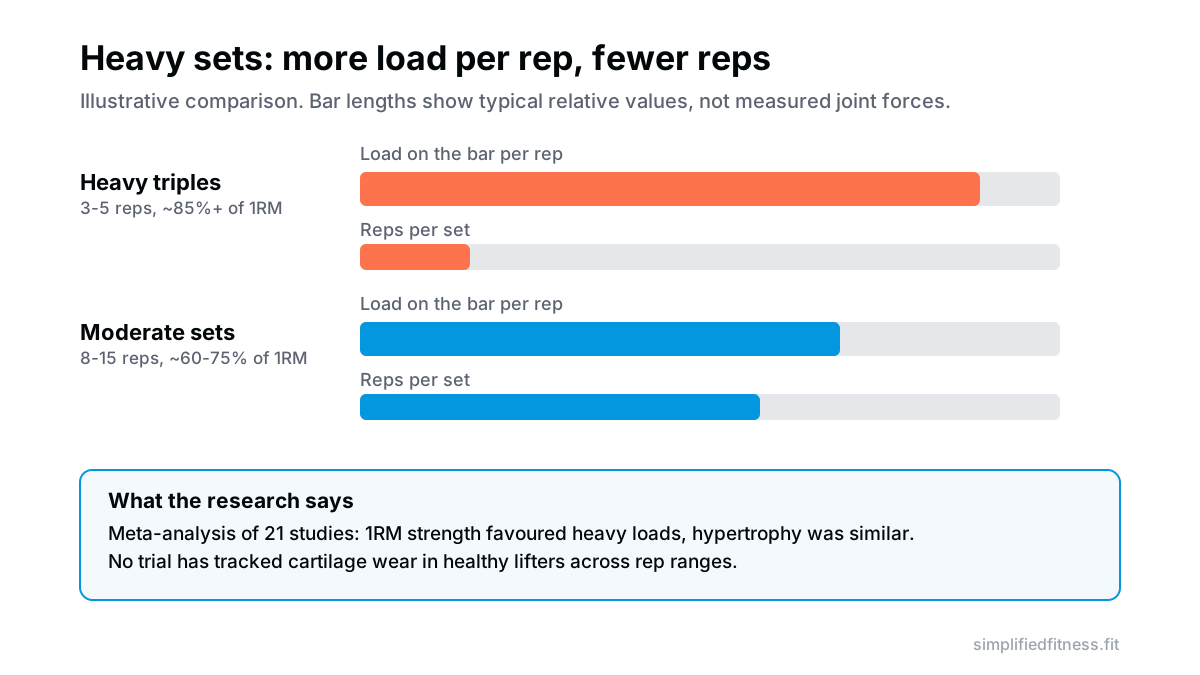
Here is the honest bit. The brief version of this story you will see online, that heavy low reps are “massive joint stress” while moderate reps are “just as good with far less risk”, is plausible but it is mostly inference. Peak force per rep is lower with moderate loads, yes. Whether that translates into less cartilage or tendon wear in healthy lifters over decades has not been shown.
Does lifting heavy actually wear out cartilage?
Cartilage is not a passive pad. It has no blood vessels of its own, and loading is part of how it gets nutrients and keeps its structure. So the question is not “load or no load”, it is “how much, and in which joint”.
The best direct evidence is a 2019 systematic review of nine randomised trials that measured cartilage on MRI (Bricca et al., 2019). It covered people at increased risk of knee osteoarthritis or with established disease. Most comparisons found no effect on cartilage thickness, volume or defects. The authors concluded that knee loading exercise seems not to be harmful for cartilage, but they rated the quality of evidence as low.
Two things matter here. First, these were mostly people with joint problems, not healthy lifters. If loaded exercise did not harm already compromised joints, that is reassuring. Second, “not harmful” in nine mostly short trials is not “proven safe for 30 years of heavy lifting.”
The one trial that pointed the other way
A 2023 randomised trial in people with knee OA compared high and low intensity resistance training for 3 months, followed by 6 months of unsupervised training (Thudium et al., 2023). The researchers measured blood biomarkers of cartilage turnover. Two markers rose in both groups, and one (huARGS, linked to aggrecan remodelling) rose more in the high intensity group.
The authors read this as exploratory signs of more cartilage breakdown with high intensity work, and, since clinical outcomes did not differ, said it may argue against high intensity training in knee OA. But blood biomarkers are not MRI or symptoms. Turnover can reflect remodelling as well as degradation, and the paper itself calls the results exploratory. I would read it as a reason for caution in people who already have knee OA, not as proof that heavy triples harm healthy joints.
Why the studies seem to disagree
The cartilage review pooled MRI findings, mostly in OA patients, and saw no clear harm. The 2023 trial looked at blood markers in one OA population and saw more remodelling with higher intensity. Different outcome measures, small samples and short follow-up can all produce different headlines. The cautious takeaway: loading is probably fine and often helpful, but in a joint that already hurts, there is no evidence that heavier is better and some hint that it may not be.
Do moderate reps really give the same muscle growth?
This part of the claim is well supported. A 2017 meta-analysis of 21 studies compared low-load training (60% of 1RM or less) with high-load training (above 60%), with sets taken to muscular failure (Schoenfeld et al., 2017). Gains in 1RM strength favoured heavy loads. Hypertrophy was similar between conditions.
A 2021 review by the same group argued that the classic “repetition continuum”, where heavy is for strength, moderate for size and light for endurance, is not fully supported and that adaptations can be obtained across a wide spectrum of loading zones (Schoenfeld et al., 2021). For more on how far that spectrum stretches, see our 5 to 30 reps guide.
So if you care about muscle size, you do not need heavy triples. If you care about maximal strength, such as a powerlifting total, heavy work still has a role. Joint comfort can reasonably tilt your choice toward the first goal.
Heavy low reps vs moderate reps joint wear: what to do in practice
Here is a comparison of how the two approaches usually play out in a joint-conscious programme. The “joint feel” column is coaching experience, not a trial result.
| Heavy triples (3-5 reps, ~85%+ 1RM) | Moderate sets (8-15 reps, ~60-75% 1RM) | |
|---|---|---|
| Muscle growth (meta-analysis) | Similar when near failure | Similar when near failure |
| Max strength (1RM) | Greater gains | Smaller gains |
| Load on bar per rep | Highest | Lower |
| Total reps per set | Few | More |
| Typical joint feel when sore | Often aggravates first | Usually easier to tolerate |
| Best use | Strength phases, healthy joints | Default volume work |
That last row is the part to hold loosely. It is how many lifters report it, but it is not the same as a proven injury-risk difference.
A simple template
- Keep your main lifts at 6-12 reps for most sets, with 1-3 reps left in the tank. Our RIR and RPE guide explains how to judge that.
- Use 12-20 reps on exercises that irritate a joint, such as leg extensions or lateral raises.
- Rest 2-3 minutes after hard compound sets so you do not have to grind through junk reps.
- Include a top set of 3-5 only if the joint feels fine, and cap it at one or two sets.
- Estimate loads with a 1RM calculator so you are not guessing at 85%.
What about tendons and connective tissue?
Tendons are the other half of the joint story, and they respond differently from muscle. Muscle recovers in days. Tendons adapt more slowly, which is why elbow and patellar tendon pain often shows up after a jump in load.
Loading is also often how tendons get better. A randomised trial in patellar tendinopathy compared steroid injections, eccentric decline squats and heavy slow resistance training over 12 weeks (Kongsgaard et al., 2009). All groups improved at 12 weeks, but at half-year follow-up the benefits held up in the exercise groups and deteriorated after injections. Heavy slow resistance had good short and long term results. That trial involved 39 men with an existing tendon problem, so it does not tell us what healthy tendons need, only that heavy, slow, controlled work was well tolerated under supervision.
For more on structuring training around painful joints, see joint friendly hypertrophy for pain free lifting.
What if I already have aching or arthritic joints?
Resistance training helps a lot of people with knee osteoarthritis, and the usual dose is not heavy triples. A 2020 systematic review of 12 randomised trials found 11 reported improved pain and or function. The most common regimen was 2-3 sets of 8-12 reps at an initial 50-60% of maximum resistance, progressed over three sessions a week for 24 weeks (Turner et al., 2020). Large effects were linked to 24 total sessions and an 8-12 week duration. No optimal number of reps or sets was found.
A 2025 randomised trial in older adults with knee OA compared low-load (20% 1RM) and high-load (70% 1RM) strengthening over 4 weeks (Bersotti et al., 2025). All groups reduced pain and improved function scores, with benefits maintained for up to 12 months. The high-load groups gained more strength, while the low-load group was the only one with reduced stiffness. That points to “both work”, which suggests you have room to pick the version that suits your joint on the day.
These are older adults with a diagnosed condition, so do not copy their programme without advice. The pattern is the useful part: moderate loading helps symptoms, and heavier loading is not required.
Are deep squats and heavy lifts the problem, or is it the load jump?
A 2013 review of more than 160 articles asked whether half and quarter squats are safer for the knee than deep squats (Hartmann et al., 2013). It concluded that concerns about degenerative changes in deep squats are unfounded, and that provided technique is learned properly with progressive training loads, the deep squat is an effective exercise that does not raise injury risk to passive tissues. It also argued that partial squats with comparatively supra-maximal loads may favour degenerative changes over the long term.
That is a narrative review, so treat it as an informed argument, not a trial. But it supports the idea that how you load matters more than whether you load. Full range, learned technique and gradual progression look safer in this analysis than ego loads at short range. We cover the depth question in more detail in squat depth science and knee-specific changes in leg workouts for knee pain.
A practical plan for lifters with aching joints
- Find the trigger. Is it the heavy sets, the bottom of the squat, the volume, or a recent jump in load? Change one thing at a time.
- Move most work to 8-15 reps for 4-6 weeks, 1-3 reps from failure.
- Slow the lowering to about 2-3 seconds and own the bottom position.
- Use a range of motion that is pain-free, and shorten it only as a temporary step.
- Rest long enough between sets. In an Indian summer gym without good air conditioning, rest a bit longer and drink water so you are not forcing sloppy reps when you are overheated.
- After 2-4 calm weeks, test a single top set of 5 at a moderate-heavy load. If the joint stays quiet for 48 hours, you can add it back gradually.
- Keep protein and total calories adequate, since a deficit can make recovery feel worse. Our protein calculator gives a starting number.
Eating enough dal, paneer, curd, eggs or soya chunks is not glamorous joint advice, but under-eating while training hard is a common reason everything feels sore.
When should you see a doctor?
Rep ranges will not fix everything. See a doctor or physiotherapist if you have:
- joint swelling or warmth
- locking, catching or giving way
- night pain or pain at rest
- sharp pain during a lift that does not ease
- pain that keeps getting worse over several weeks
- numbness, tingling or weakness
This article cannot diagnose what is wrong with your joint. If something is off, get it examined and train around it in the meantime.
The bottom line
Heavy triples are not proven to wreck your joints, and moderate reps are not proven to save them. What the research does support is simpler: muscle growth is similar across a wide range of loads when you train near failure, loading is generally not harmful in people with knee OA and often helps symptoms, and the best programme is the one your joints tolerate.
If your joints ache, 8-15 reps most of the time is a low-drama default. Keep heavy work in small doses, progress it gradually, and let symptoms tell you when to back off. If you want a structured plan, see our full training plans.
Frequently Asked Questions
Are heavy triples bad for your joints?
There is no good evidence that heavy sets of 3-5 reps damage healthy joints, and also no long-term trial proving they are safe. Cartilage, tendon and bone adapt to loading, but a joint that already aches may tolerate lots of heavy reps less well than moderate ones. If your knees or shoulders complain, shift most sets to 8-15 reps and see how they respond.
Do heavy low reps wear out cartilage?
Cartilage has no direct blood supply and relies on loading to move nutrients, so some loading is normal and probably needed. A 2019 systematic review of randomised trials found loading exercise did not appear to harm cartilage in people with or at risk of knee osteoarthritis, though the evidence quality was low. No trial has compared triples with moderate reps for cartilage in healthy lifters.
What is the most joint friendly rep range for hypertrophy?
Moderate reps of about 8-15 at a load you can control are a sensible default for sore joints. Meta-analysis data show muscle growth is similar across light and heavy loads when sets are taken near failure. Use the lighter end of the load range on exercises that irritate a specific joint.
Can I build muscle with lighter weights if my joints hurt?
Yes. A 2017 meta-analysis of 21 studies found hypertrophy was similar between low-load (60% of 1RM or less) and high-load training when sets were taken to muscular failure. The catch is effort, since lighter sets only work when they are genuinely hard. Pick a weight you can lift for 12-20 clean reps and stop within a couple of reps of failure.
Is it safe to lift heavy with osteoarthritis?
Resistance training generally improves pain and function in knee osteoarthritis, but the right load is individual. A 2020 review found 11 of 12 trials showed improvements, most using 2-3 sets of 8-12 reps at about 50-60% of maximum. Ask your doctor or physiotherapist before adding heavy sets, and progress gradually.
Does lifting heavy cause arthritis?
Current evidence reviewed here does not show that resistance training causes arthritis. The trials studied people who already had or were at risk of knee osteoarthritis and did not find loaded exercise harmful to cartilage. Those trials were short, so they cannot settle what decades of very heavy lifting do.
Why do my joints hurt after heavy sets but not light ones?
Heavy sets put high load through tendons and joint surfaces on every rep, and a tendon or joint that is already irritated often reacts first to that. Soreness does not prove damage, but it is useful feedback. Drop the load by 10-20%, add reps, slow the lowering and see if symptoms settle within a week or two.
Should I stop training heavy if my knees hurt?
Not necessarily, but you should reduce how much heavy work you do while the knee settles. A trial in patellar tendinopathy used heavy slow resistance training and found good short and long term clinical results, so loading is often part of recovery. If you have swelling, locking or sharp pain, get assessed first.
How many reps should I do for joint health?
There is no proven magic number. A systematic review in knee osteoarthritis found no optimal repetition scheme, with large effects linked to about 24 sessions over 8-12 weeks. Most programmes used 8-12 reps, so that range is a good starting point.
Do slow reps reduce joint stress?
Slower lowering reduces momentum, which lets you control the load through the range, though the studies reviewed here did not measure joint wear directly. Controlled reps also make it easier to notice when a joint is irritated. Try a 2-3 second lowering on the exercises that bother you.
Are deep squats bad for knees?
A 2013 review concluded that fears about deep squats causing degenerative knee changes are unfounded when technique is learned properly and load progresses gradually. It also argued that partial squats with supra-maximal loads may be worse for the joints over time. If depth hurts, reduce the load before you cut the range.
When should I see a doctor about joint pain from lifting?
See a doctor or physiotherapist for joint swelling, locking or catching, pain at night, sharp pain, or pain that keeps worsening over several weeks. These can signal problems that a rep range change will not fix. Stop loading the painful movement until it has been assessed.
Sources & References
Every claim above is checked against peer-reviewed research (PubMed, U.S. National Library of Medicine) or guidance from established health bodies. How we fact-check.
- Schoenfeld BJ, et al. Loading Recommendations for Muscle Strength, Hypertrophy, and Local Endurance: A Re-Examination of the Repetition Continuum. Sports (Basel). 2021. PMID: 33671664
- Schoenfeld BJ, et al. Strength and Hypertrophy Adaptations Between Low- vs. High-Load Resistance Training: A Systematic Review and Meta-analysis. J Strength Cond Res. 2017. PMID: 28834797
- Bricca A, et al. Impact of exercise on articular cartilage in people at risk of, or with established, knee osteoarthritis: a systematic review of randomised controlled trials. Br J Sports Med. 2019. PMID: 29934429
- Thudium CS, et al. Cartilage tissue turnover increases with high- compared to low-intensity resistance training in patients with knee OA. Arthritis Res Ther. 2023. PMID: 36765372
- Turner MN, et al. The Role of Resistance Training Dosing on Pain and Physical Function in Individuals With Knee Osteoarthritis: A Systematic Review. Sports Health. 2020. PMID: 31850826
- Bersotti FM, et al. Impact of strength training on physical function, biomechanical variables, and pain management in older adults with knee osteoarthritis: a randomized controlled trial. J Bodyw Mov Ther. 2025. PMID: 41316581
- Hartmann H, et al. Analysis of the load on the knee joint and vertebral column with changes in squatting depth and weight load. Sports Med. 2013. PMID: 23821469
- Kongsgaard M, et al. Corticosteroid injections, eccentric decline squat training and heavy slow resistance training in patellar tendinopathy. Scand J Med Sci Sports. 2009. PMID: 19793213

Umair Hazrami · Founder & Head Coach, Simplified Fitness
Umair Hazrami founded Simplified Fitness and the Simplified Lifter channel to cut through fitness noise. With 4+ years of consistent training and 10+ coaching clients, he writes every guide from the peer-reviewed research and links the sources so you can check them. Our editorial standards.
Educational content only, not medical advice. If you have a medical condition, are pregnant, or take medication, talk to a qualified doctor before changing your diet, supplements or training. Full disclaimer.
Keep reading

Programming
Blood Flow Restriction (BFR) Practical Guide: Cuff Pressures, Rep Schemes, and Light Loads
How to do BFR training safely: cuff placement, pressure as a percentage of occlusion, the 30-15-15-15 scheme and who should skip it. Every study linked.
8 min read
Programming
Calibrating True RIR: A Safe Gym Test for Technical vs Absolute Failure
Calibrating RIR means testing how many reps you really have left. Use this safe machine protocol to find true failure and fix your 2 RIR guesses.
8 min read
Programming
CNS Fatigue vs Peripheral Fatigue: How Failure Hits Squats and Curls Differently
CNS fatigue vs peripheral fatigue: why failing a squat flattens you for days while failing a curl barely registers, and how many reps to leave in reserve.
9 min read
Programming
Failure on Machines and Cables vs Free Barbells: Managing Injury Risk and Axial Fatigue
Failure on machines vs barbells: why machine sets feel safer and less draining, what the research says, and where to push hard or stop at 1-2 RIR.
8 min read