Lengthened Partials Beyond Failure: Mechanical Overload and Practical Execution
Lengthened partials past failure: what the calf and arm trials show, how to run 3-6 stretched partials safely, which lifts suit them and how to cap the volume.
TL;DR. The short answer
- Lengthened partials past failure means finishing a set with full reps, then adding about 3-6 short reps in the bottom, stretched half of the movement once you cannot complete a full one.
- The best direct evidence is on calf raises in untrained people. One trial found more growth with the extra partials (9.6% vs 6.7%), another found equal growth from fewer sets, so it looks promising but not proven.
- Use it on cables, machines, flyes, curls and calf raises. Skip it on free barbell squats and deadlifts, where grinding extra reps in a fatigued bottom position is a poor risk trade.
- Treat it as an extension of your last set or two, not an every-set habit. The extra reps are tiring, so count them toward your weekly volume.
Part of our complete guide: Reps in Reserve, Rep Ranges and Rest Times: The Evidence-Based Guide to How Hard Every Set Should Be
Table of contents
Lengthened partials past failure are short reps done only in the stretched half of an exercise, after you can no longer finish a full-range rep. The early research is encouraging, mostly from calf training, but it is not strong enough to call this a must-do. Used sparingly on the right exercises, it is a reasonable way to squeeze a little more out of a set.
This sits inside the wider question of how hard to push each set, which we cover in our guide to load, rep ranges, RIR and rest intervals. If you want the biomechanics of why the stretched position matters at all, start with lengthened partials explained. Here we stick to the practical question: how do you actually add partials to the end of a set, and how much is too much?
What does “lengthened partials past failure” actually mean?
Two ideas get mixed up, so let’s separate them.
Lengthened partials as the whole set. You train only the stretched portion of the range, for every rep. Think of a pec dec where you never squeeze the handles together.
Lengthened partials past failure. You do normal full reps first. When the next full rep stalls, you keep going with short reps in the bottom half. The set is extended, not replaced.
This article is about the second one. Most gym talk calls it an extended set or a “burn-out” finisher.
The reasoning is simple. At the bottom of a lift the muscle is stretched, and many muscles can still produce force there when they cannot finish the top half. Partials let you keep loading that position.
Does the research support partials past failure?
Short answer: maybe, and mostly for calves.
There is no large trial of past-failure partials on big muscles like quads or chest. What we have are a handful of small studies on the calf, which is a convenient muscle to measure and one that responds well to stretched-position work.
Study A, favourable. A 10-week trial in 23 untrained men trained one leg to failure and the other leg to failure plus extra lengthened partials, using standing Smith machine calf raises (four sets, twice a week). Medial gastrocnemius thickness rose 6.7% on the failure-only leg and 9.6% on the partials leg (Larsen et al., 2025). The authors reported strong evidence for the partials and suggested the technique as a likely superior option for maximal gastrocnemius growth over a short period.
Study B, equal growth. A 10-week trial in 16 untrained men matched total volume-load. One leg did 4-6 failure sets per session. The other leg did half as many sets (2-3), each followed by partials in the more dorsiflexed range. Both legs grew about 8%, so the partials leg got the same result from fewer sets (Goli et al., 2026).
Study C, partials versus starting in the stretch. In 23 resistance-trained participants over 8 weeks, one calf did initial (lengthened) partials from the start of every set, and the other did full reps then past-failure partials. The initial-partials side grew slightly more on average, but the authors called the difference uncertain, with only anecdotal Bayesian support (Larsen et al., 2025b). Both approaches produced meaningful growth.
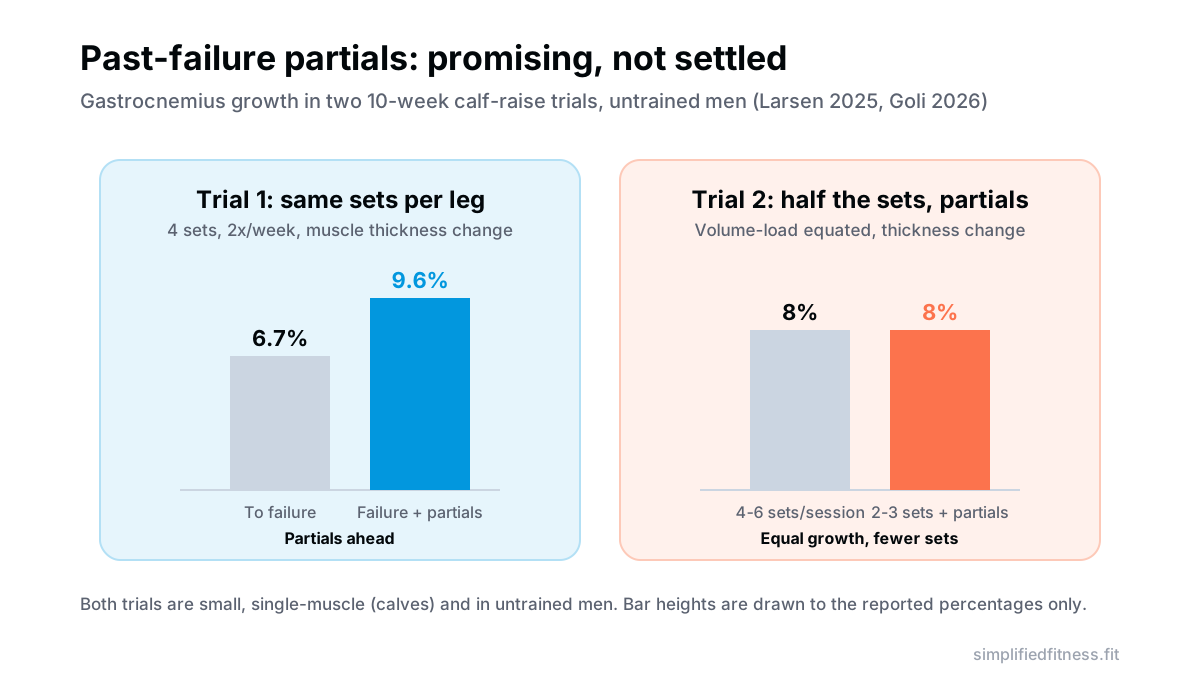
Why might A and B differ? A matched the number of sets and added extra work to one leg, so that leg simply did more. B equated volume-load, which removes that advantage. Read together, the fair takeaway is that partials past failure add useful stimulus, and the benefit looks more like “more work in the stretch” than a special trick.
Do lengthened partials beat full range of motion?
Past failure is one question. Partials versus full range for the whole set is another, and the answers there are more even.
- Upper body, trained lifters. In 30 resistance-trained people over 8 weeks, one arm trained with lengthened partials and the other with full range. Muscle thickness and lat pulldown strength-endurance improved similarly, and the authors concluded trainees should likely emphasize the stretched position, whether by full range or partials (Wolf et al., 2025).
- Large multi-site trial. Across 15 sites, 297 people were randomised to lengthened-partial or full-range training for 12 weeks. Arm and thigh muscle area changes were small and practically equivalent (Gschneidner et al., 2025).
- Calves in young women. Training only the initial (stretched) range of a calf raise gave bigger medial gastrocnemius gains (15.2%) than full range (6.7%) over 8 weeks (Kassiano et al., 2023).
- The older review. A 2020 systematic review of six studies concluded full range looked better for lower-body hypertrophy, while upper-body evidence was limited and conflicting (Schoenfeld and Grgic, 2020). Newer trials have since complicated that picture, partly because many older studies compared very different partial ranges.
The pattern: stretched-position work is clearly worth doing. Whether it needs to be a partial, a full rep or a bit of both is still open. For the cleaner head-to-head, see full vs partial range of motion for hypertrophy.
Should I even go beyond failure?
Be honest about the baseline. A 2023 meta-analysis of 15 studies found no evidence that training to momentary failure beats stopping short for muscle growth (effect size 0.12, 95% CI -0.13 to 0.37) (Refalo et al., 2023). If pushing to failure is not clearly better than leaving reps in the tank, going past it is an optional extra, not a requirement.
So where does it fit? It can make sense when you are short on time, want a bit more stimulus from one set on an isolation exercise, or are on a stubborn muscle like calves. It is a poor fit if you are already struggling to recover. If you are unsure how close you really get to failure, our guide to reps in reserve and RPE helps, and the RIR / RPE load calculator gives you a starting load.
Which exercises work best for lengthened partials?
You want a clear stretched position, a stable path and a safe way to stop. That points to cables, machines and some dumbbell work.
| Muscle | Good choices | Where the partials happen |
|---|---|---|
| Chest | Pec dec, high-to-low cable fly, incline dumbbell fly | Arms wide, chest stretched |
| Biceps | Preacher curl, incline curl, cable curl | Arm extended at the bottom |
| Triceps | Overhead cable or dumbbell extension | Elbows bent, triceps stretched |
| Calves | Standing calf raise, leg-press calf raise | Heel dropped at the bottom |
| Quads | Leg extension, sissy-style machine work | Knee bent at the bottom |
| Hamstrings | Seated leg curl | Knee extended at the start |
| Back | Lat pulldown, cable row | Arms overhead or reaching forward |
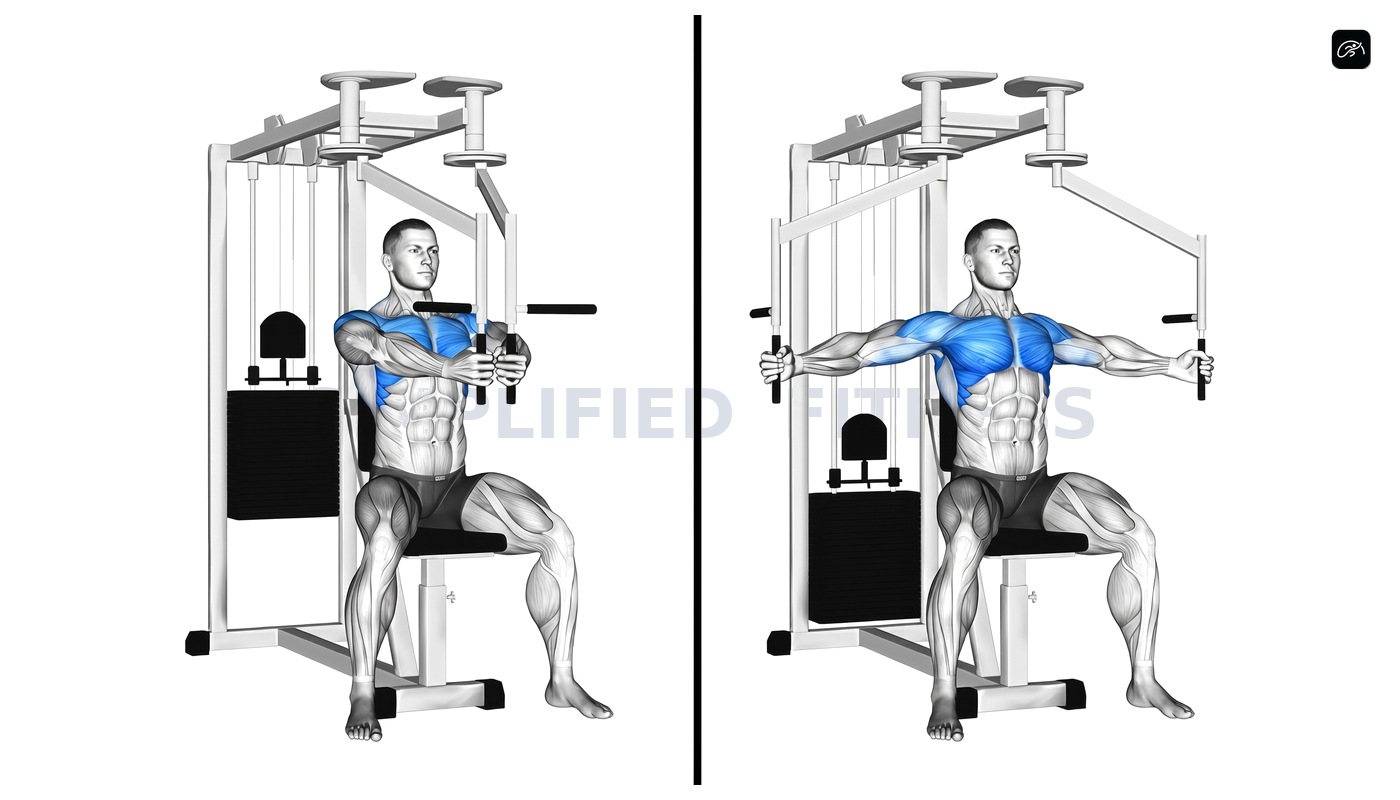
The pec dec is a good example. At the point where your arms are open wide, the chest is lengthened, and a few short pulses there are easy to control.
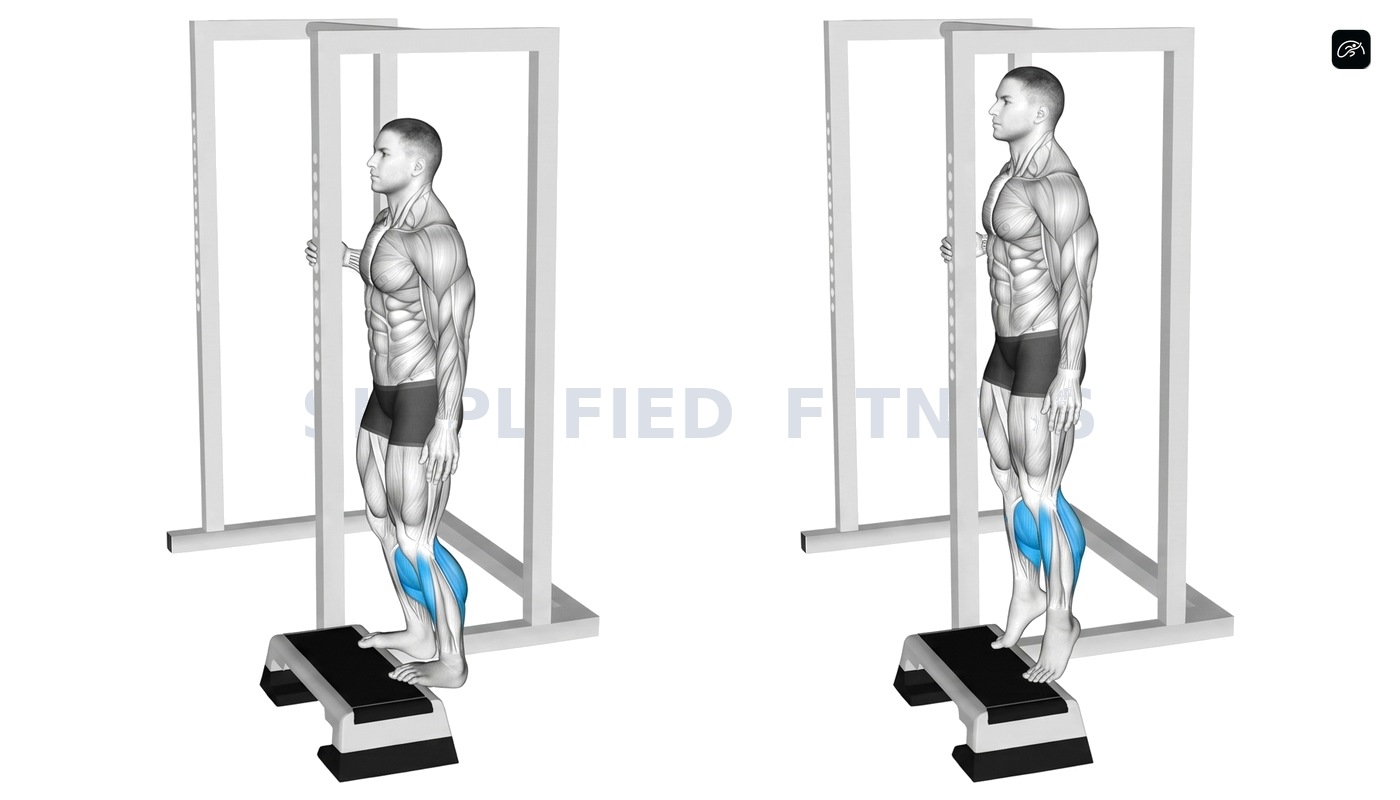
Calf raises are the other classic, since that is where most of the research sits. Drop the heel as low as you can, then pulse in that bottom range.
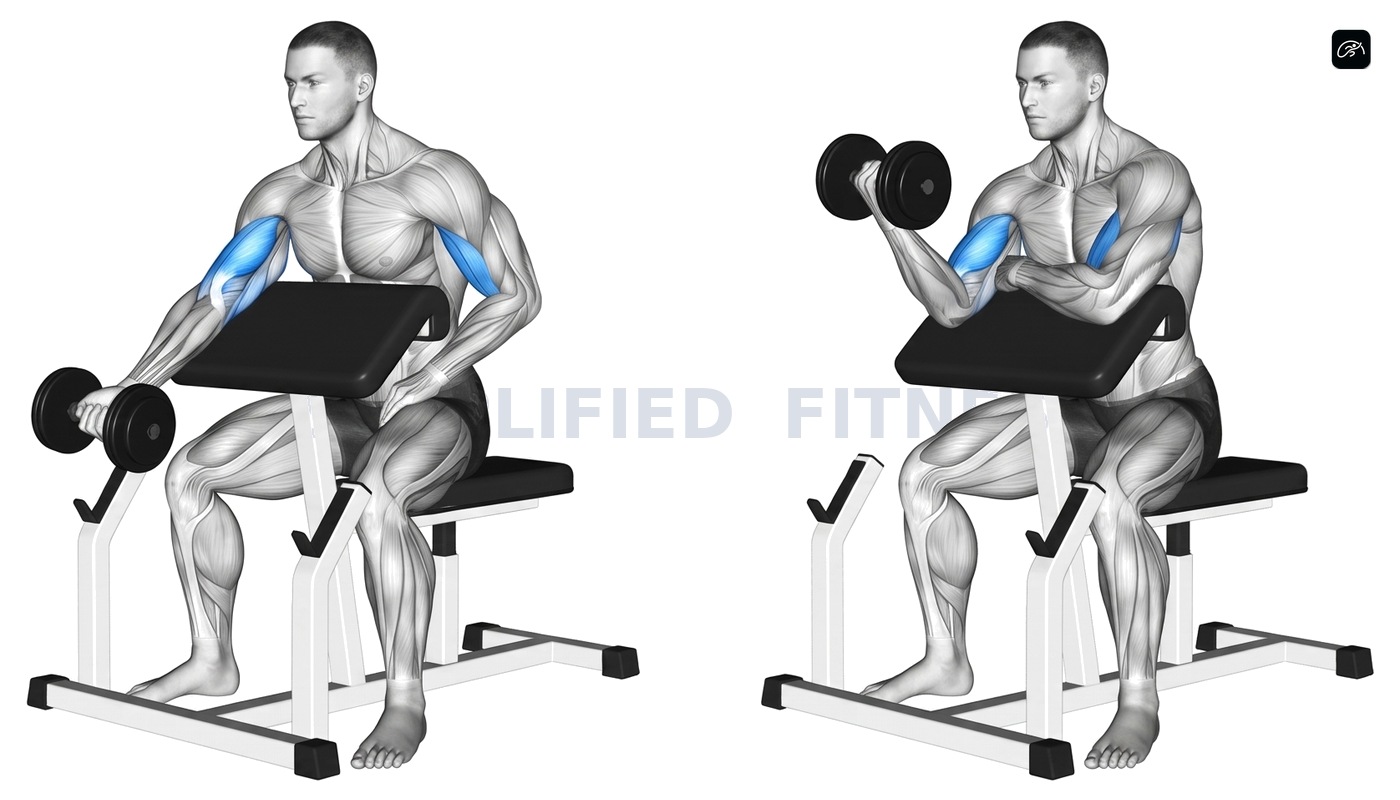
Preacher curls work well too, because the bench holds your upper arm still and the bottom of the curl is the hard part.
What about squats, deadlifts and other free-weight lifts?
Skip them. In a barbell back squat the bottom is also where your balance, bracing and spinal load are most fragile, and that is exactly when you are tired. Grinding ugly partial reps there is a bad trade. If you want an extended set for quads, use a leg extension or a machine instead. We cover the risk side in failure on machines and cables vs free barbells.
How to do partials at the end of a set, step by step
Here is the template I would use. The numbers are practical conventions, not tested protocols, and I say so because the studies simply continued partials after failure without a fixed count.
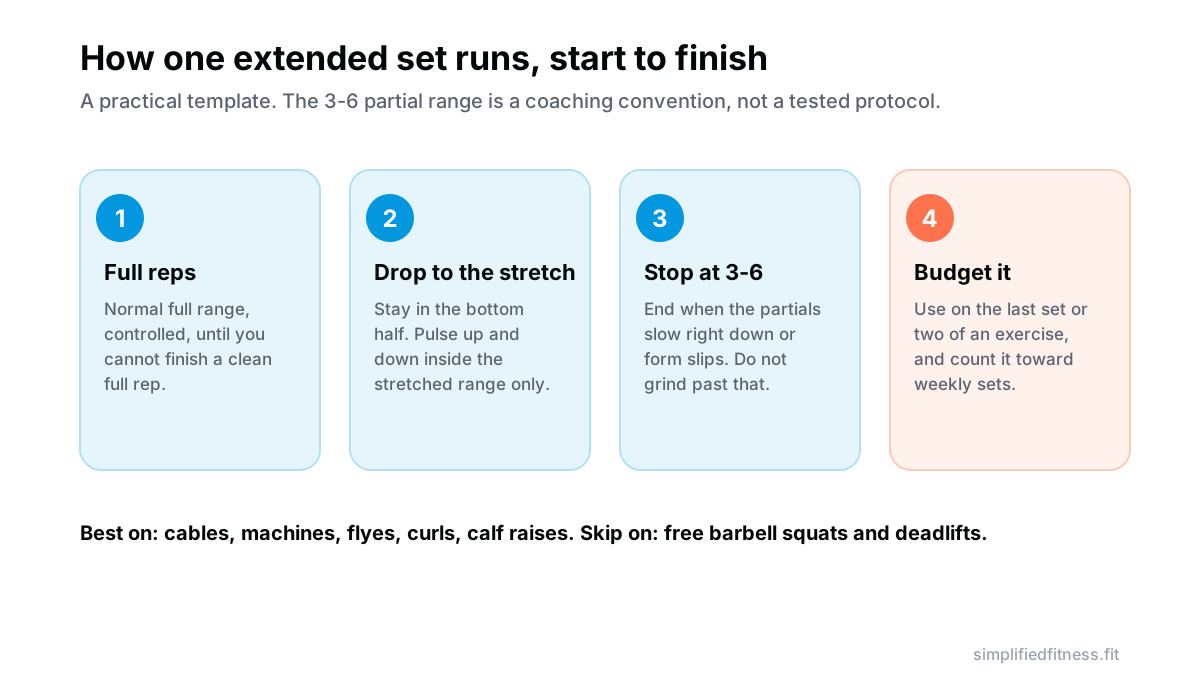
- Do full reps first. Normal, controlled range until you cannot finish a clean full rep. This is your technical failure, not a grind where your form falls apart.
- Drop to the stretch, do not rest. Stay in the bottom half and work in a short range, roughly the part of the movement where the muscle is longest. No bouncing.
- Stop at about 3-6 partials. Quit when the reps slow right down or your form slips. Chasing extra partials past that point mostly adds fatigue.
- Keep the load the same. Do not add weight for the partials. The point is to use the load you already have.
- Rest properly afterwards. After an extended set you will usually want your normal rest, or a bit more.
How do I manage the fatigue and cap the volume?
This is where most people go wrong. Partials are tiring, and the cost does not show up until the next session.
- One or two extended sets per exercise. The last set, sometimes the last two. Not every set.
- One or two exercises per muscle per session. Not every exercise in the workout.
- Count it as volume. Extended sets are hard sets. If you add them, you may need to trim a set elsewhere. You can check your totals with the training volume calculator.
- Do not stack techniques. If you add partials, skip the drop set and rest-pause on the same set. Compare options in our guide to rest-pause, myo-reps and cluster sets.
- Watch your recovery. If your strength drops across sessions, or your joints feel cranky, pull the technique back.
A related point: lifters who already train close to failure on most sets do not have much recovery left for extras. Our piece on proximity to failure for compounds vs isolations explains why isolation lifts are the better home for this.
A simple weekly example
Say you train chest twice a week. On each day, you do an incline press for two straight sets, then a pec dec for two sets. On the last pec dec set only, you add 3-6 stretched partials.
That is one extended set per session, two per week. The rest are normal sets. It is a small dose, and a small dose is how you find out whether your body likes it.
Training on an Indian-friendly budget? None of this needs equipment beyond what a regular commercial gym has. Cable stacks and pec decks are common, and if all you have is a pair of dumbbells, dumbbell flyes and curls work fine. Eat enough protein from dal, paneer, curd, eggs or soya to support the extra work, and sleep. Those matter more than any finisher.
Who should skip this technique?
- Beginners. Plain full-range sets, a couple of reps short of failure, will give you most of the progress. Extended sets add fatigue for an uncertain benefit.
- Anyone returning from a muscle or tendon injury. Heavy stretched-position work stresses those tissues. Check in with a doctor or physiotherapist first.
- Anyone with joint pain in the movement. Partials in a painful range do not make the pain go away. See a professional if it persists.
- Lifters on a big calorie deficit, or who are sleeping badly. Recovery is already tight.
The bottom line
Lengthened partials past failure are a decent finisher, not a breakthrough. The calf trials hint at extra growth or the same growth from fewer sets, but they are small and focused on one muscle. The wider partial-versus-full literature says stretched-position training works and that the exact method matters less than doing it hard and consistently.
So use it sparingly. Pick cables, machines or flyes, do 3-6 stretched partials on the last set or two, count the work in your weekly volume and move on. If your recovery or progress suffers, drop it.
Frequently Asked Questions
What are lengthened partials past failure?
They are short reps done only in the stretched half of an exercise after you can no longer finish a full-range rep. For example, after your last full cable curl, you keep pulsing in the bottom half of the curl for a few more reps. The idea is to keep the muscle under tension at long lengths when full reps are no longer possible.
How many partial reps should I do at the end of a set?
Roughly 3-6 is a sensible starting range, though that number comes from coaching practice rather than a tested protocol. The trials simply had people continue partials after failure, so there is no proven optimal count. Stop when the partials slow to a crawl or your form changes, and keep the total modest.
Do lengthened partials build more muscle than full range of motion?
Not clearly. Trained lifters who used lengthened partials for the whole set grew arm muscle about the same as with full range in an 8-week trial, and a 12-week multi-site trial of 297 people found small, practically equivalent effects. Both approaches seem to work when the stretched position is trained hard, so choose the one you can do consistently.
Are partials past failure better than just stopping at failure?
Possibly for some muscles, but the evidence is thin. A 10-week calf trial favoured the extra partials, while a second calf trial with equated volume found the same growth in half the sets. Try it on one or two isolation exercises rather than rebuilding your program around it.
Which exercises are best for lengthened partials?
Cable and machine isolation moves, plus dumbbell flyes, curls and calf raises, suit this technique best. They have a clear stretched position, fixed paths and a safe way to fail. Pec dec flyes, preacher curls, overhead triceps extensions and standing calf raises are good examples.
Can I do lengthened partials on squats or deadlifts?
It is better not to. The bottom of a free barbell squat is where fatigue, balance and spinal load collide, so grinding extra partial reps there is a poor risk trade. Use a leg extension, leg curl or a machine variation if you want an extended set for the same muscle.
Do partials past failure count as extra sets?
Yes, treat them as extra work. They add mechanical tension and local fatigue, so they should come out of your weekly hard-set budget rather than sit on top of it. If you add partials to the last set of an exercise, you may need to trim a set elsewhere.
Will lengthened partials make me too sore to train again?
They can, because stretched-position work is demanding and soreness often follows. No trial here tracked soreness closely, so this is a practical caution rather than a finding. Start with one extended set per muscle per session and watch how you recover before adding more.
How is this different from drop sets or rest-pause?
Drop sets lower the weight and rest-pause adds rest to squeeze out more full reps. Lengthened partials keep the same load and change the range, working only the bottom half. All three are intensity techniques that push beyond failure, so use only one at a time.
Do I need to go to failure to use lengthened partials?
Yes, by definition you reach the point where a full rep is no longer possible first. A 2023 meta-analysis found no clear hypertrophy advantage for training to momentary failure over stopping short. So partials are an optional extra, not a requirement for growth.
Is it safe to do partials past failure with a heavy load?
Heavy loads in a stretched, fatigued position raise the demand on joints and tendons, so keep the load you used for the set and avoid chasing it. Machines and cables let you stop safely. If you feel sharp pain, rather than muscle burn, stop and see a doctor or physiotherapist.
Do beginners need partials past failure?
No. Beginners gain muscle from plain, well-executed full-range sets a couple of reps short of failure. Extended sets add fatigue for an uncertain extra benefit, so they make more sense once your basic training is consistent.
Sources & References
Every claim above is checked against peer-reviewed research (PubMed, U.S. National Library of Medicine) or guidance from established health bodies. How we fact-check.
- Larsen S, et al. Resistance training beyond momentary failure: the effects of past-failure partials on muscle hypertrophy in the gastrocnemius. Front Psychol. 2025. PMID: 39995432
- Larsen S, et al. Resistance Training Beyond Momentary Failure: The Effects of Past-Failure Partials Versus Initial Partials on Calf Muscle Hypertrophy Among a Resistance-Trained Cohort. Eur J Sport Sci. 2025. PMID: 40850937
- Goli A, et al. Does Performing Partial Repetitions Beyond Momentary Failure Enhance Muscle Hypertrophy in Volume-Load-Equated Calf-Raise Resistance Training? Int J Exerc Sci. 2026. PMID: 42006449
- Wolf M, et al. Lengthened partial repetitions elicit similar muscular adaptations as full range of motion repetitions during resistance training in trained individuals. PeerJ. 2025. PMID: 39959841
- Gschneidner D, et al. The effects of lengthened-partial range of motion resistance training of the limbs on arm and thigh muscle area: A multi-site randomised trial. J Sports Sci. 2025. PMID: 41055237
- Kassiano W, et al. Greater Gastrocnemius Muscle Hypertrophy After Partial Range of Motion Training Performed at Long Muscle Lengths. J Strength Cond Res. 2023. PMID: 37015016
- Schoenfeld BJ, Grgic J. Effects of range of motion on muscle development during resistance training interventions: A systematic review. SAGE Open Med. 2020. PMID: 32030125
- Refalo MC, et al. Influence of Resistance Training Proximity-to-Failure on Skeletal Muscle Hypertrophy: A Systematic Review with Meta-analysis. Sports Med. 2023. PMID: 36334240

Umair Hazrami · Founder & Head Coach, Simplified Fitness
Umair Hazrami founded Simplified Fitness and the Simplified Lifter channel to cut through fitness noise. With 4+ years of consistent training and 10+ coaching clients, he writes every guide from the peer-reviewed research and links the sources so you can check them. Our editorial standards.
Educational content only, not medical advice. If you have a medical condition, are pregnant, or take medication, talk to a qualified doctor before changing your diet, supplements or training. Full disclaimer.
Keep reading

Programming
Blood Flow Restriction (BFR) Practical Guide: Cuff Pressures, Rep Schemes, and Light Loads
How to do BFR training safely: cuff placement, pressure as a percentage of occlusion, the 30-15-15-15 scheme and who should skip it. Every study linked.
8 min read
Programming
Calibrating True RIR: A Safe Gym Test for Technical vs Absolute Failure
Calibrating RIR means testing how many reps you really have left. Use this safe machine protocol to find true failure and fix your 2 RIR guesses.
8 min read

Programming
CNS Fatigue vs Peripheral Fatigue: How Failure Hits Squats and Curls Differently
CNS fatigue vs peripheral fatigue: why failing a squat flattens you for days while failing a curl barely registers, and how many reps to leave in reserve.
9 min read

Programming
Failure on Machines and Cables vs Free Barbells: Managing Injury Risk and Axial Fatigue
Failure on machines vs barbells: why machine sets feel safer and less draining, what the research says, and where to push hard or stop at 1-2 RIR.
8 min read