Warm-Up Sets for Lifting: How to Ramp Up Weight Without Wasting Energy
A warm up sets protocol lifting guide: how many sets, which percentages and how many reps, so you reach heavy working sets fresh. Includes a ramp example.
TL;DR. The short answer
- Most lifters need 2-4 warm-up sets on the first heavy lift of the day: the bar, then roughly 50%, 70% and 85% of the working weight, with reps falling from about 10 to 1.
- Warm-up reps should never be hard. In one crossover trial, a warm-up of 5 reps at 80% of 10RM led to more total training volume than lighter, higher-rep warm-ups (15 reps at 40%, 10 at 60%) in 15 trained men.
- Not every 'potentiation' trick pays off. Heavy singles and explosive reps have mixed results, and a 2024 trial in trained men found no gain in squat volume over a usual warm-up.
- Later exercises for the same muscles need far fewer warm-up sets, often zero or one.
- Sharp pain, not stiffness, is a reason to stop and see a doctor or physio rather than add more warm-up sets.
Part of our complete guide: Reps in Reserve, Rep Ranges and Rest Times: The Evidence-Based Guide to How Hard Every Set Should Be
Table of contents
Most lifters need 2-4 warm-up sets before their first heavy exercise: the empty bar, then roughly 50%, 70% and 85% of the working weight, with reps dropping from about 10 down to 1. The goal is to practise the movement and load it gradually, not to do any real work. If a warm-up set leaves you breathing hard, it was a working set in disguise.
This is the simple warm-up sets protocol for lifting that I wish every gym had on the wall. It sits inside our complete guide to load, rep ranges, RIR and rest intervals, and it focuses only on barbell and dumbbell ramping. For the general joint-prep side, see our 7-minute dynamic warm-up.
What a warm-up set is actually for
A warm-up has a few jobs, and they are not equally well proven.
- Raise temperature and blood flow. Warm muscle tends to work better. This is the classic reason.
- Practise the pattern. Your first rep of the day is clumsier than your fifth. Lighter sets let you groove bar path, bracing and depth before the load matters.
- Prime the nervous system. Heavier, low-rep sets are thought to improve readiness to produce force. The evidence for this is mixed, as you will see below.
- Check how you feel. If 70% feels like 85% today, that is useful information before you commit to heavy work.
You may also hear that warm-ups “lubricate your joints with synovial fluid.” It is a popular line, but I could not find a trial in lifters that measured it, so treat it as a plausible idea rather than a proven mechanism.
A systematic review of 32 high-quality studies found that warm-up improved performance in 79% of the outcomes examined, and found little evidence that warming up hurts. The authors also noted that few randomized controlled trials existed, so the picture is not as tidy as it sounds (Fradkin et al., 2010). That review included many activity types, not only lifting.
What is the best warm-up for heavy working sets?
Here is a ramp that works for most people. The numbers are illustrative, a starting template and not a studied formula.
Say your working weight on squat is 100 kg for 5 reps:
| Set | Load | Reps | Rest |
|---|---|---|---|
| 1 | Empty bar (20 kg) | 10 | 30 s |
| 2 | 50 kg (about 50%) | 5 | 45 s |
| 3 | 70 kg (about 70%) | 3 | 60 s |
| 4 | 85 kg (about 85%) | 1 | 90 s |
| 5 (optional) | 93 kg (about 93%) | 1 | 2 min |
| Working sets | 100 kg | 5 | 2-3 min |
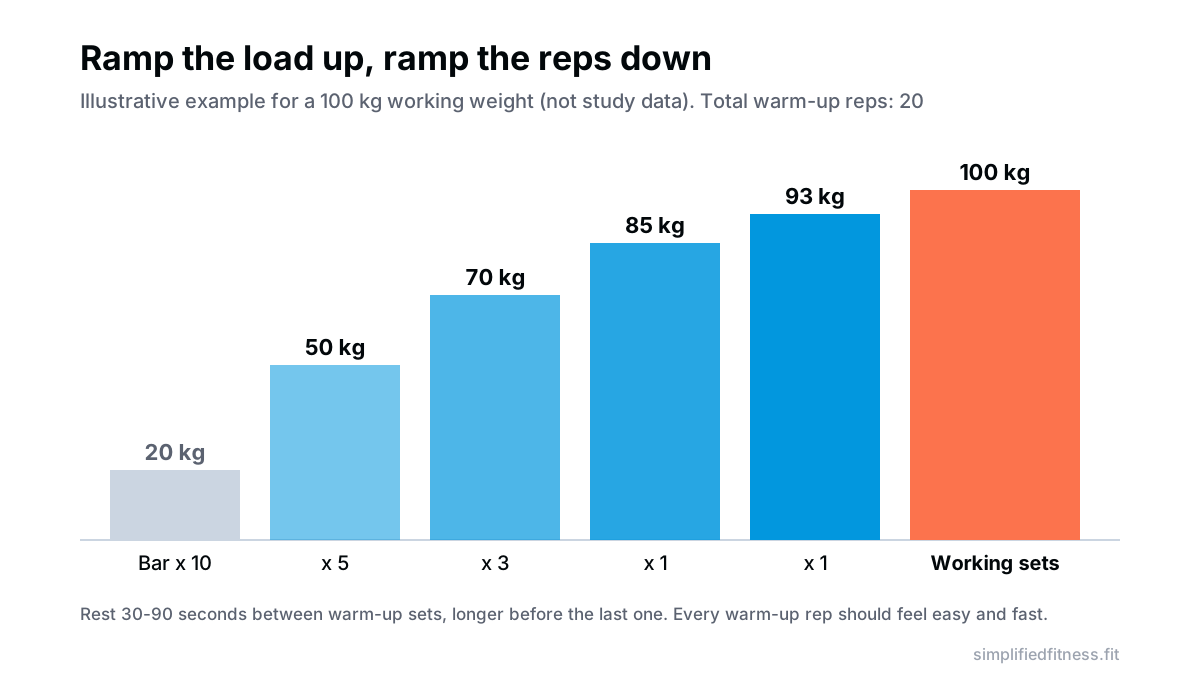
Three principles sit behind this table.
- Load goes up, reps come down. Ten reps with the bar is a movement rehearsal. One rep at 85% is a heavy feel without any fatigue to speak of.
- Jumps shrink as you get closer. Going from 50 kg to 100 kg is a big leap. Going from 85 kg to 93 kg is a nudge. Small final jumps are easier to control.
- Rest enough that the last set is fresh. Quick sets early, a bit longer later. If you are rushing the 85% single, you are rehearsing sloppy reps.
Do the single only if you want it. It is not magic, and plenty of people do fine skipping it.
Why smaller jumps may help
A small 2024 study in nine male college weightlifters compared warm-up ramps before a heavy snatch at 85% of max. A slow progression in 10% steps (50, 60, 70, 80% of 1RM) produced higher peak vertical ground reaction force in the second pull than a 15% step ramp or a self-selected warm-up, and the authors concluded the slower progression was preferable for power output (Yang et al., 2024).
It is a very small sample of Olympic-style lifters on a technical lift, so do not transfer it directly to a bench press session. Still, it fits the common coaching intuition: bigger jumps close to the working weight leave less room to find your rhythm.
Do warm-up sets steal energy from your working sets?
This is the fear that makes people skip warm-ups or rush them. The research on repetition performance is reassuring, with a caveat about how you build the ramp.
In a crossover trial of 15 resistance-trained men, three sessions used different warm-ups before three exercises (bench press, inclined leg press, lat pulldown): 40% of 10RM for 15 reps, 60% for 10 reps, or 80% for 5 reps. The 80% warm-up produced significantly more total training volume than the 60% and 40% ones, and the authors recommended warming up each exercise at 80% of the initial workout load (Viveiros et al., 2024). So the heavier, lower-rep warm-up did better. Five reps at 80% of a 10RM is still well short of failure, so it was heavier without being hard.
Now the conflicting piece. Another crossover study in 15 trained men used four sets of bench, squat and curl to failure at 80% of 1RM after a control, specific, aerobic or combined warm-up. Sum of reps and fatigue index did not differ between conditions, so warm-up did not influence performance (Ribeiro et al., 2014).
Why the difference? Possibly the loading: one study compared different warm-up loads before a session, the other compared types of warm-up against a control, in different exercises and testing protocols. Both used small samples of men, and neither shows that warm-up sets harm your working sets. The cautious takeaway is that a short, heavier-feeling ramp is a safe default, and an extra-long warm-up is probably not buying you reps.
Is a heavy “potentiation” single worth it?
This is where lifters get fancy. The idea, called post-activation performance enhancement, is that a heavy or explosive conditioning set leaves you temporarily stronger or more explosive. If you want more background, see our piece on post-activation performance potentiation.
The results are mixed:
- In 14 trained men, a heavy triple at 90% 1RM or six fast reps at 45% did not improve total reps or total volume load for multiple squat sets to failure versus a usual warm-up. Only the first set’s volume load was higher after the heavy triple (Souza et al., 2024).
- In three crossover trials on jump height, potentiation protocols did not improve jumping beyond what a general and specific warm-up did, and the authors suggested PAPE may largely be a warm-up effect (Rappelt et al., 2024).
- In 18 resistance-trained male students, a ballistic warm-up led to higher barbell velocity around the bench press sticking region than the other two strategies tested (dynamic stretching and a high-resistance option) (Hedayati and van den Tillaar, 2025). That is a one-off bench press result in young men.
Putting them together, there might be a small benefit for a one-rep max attempt or a power lift, and little benefit for hypertrophy sets taken to failure. If you want to try it, keep it to a single rep at 90-93%, then rest a couple of minutes.
How many warm-up sets for each exercise?
Not every exercise needs a full ramp. Your first heavy compound does the general warming, so later lifts for the same muscles need less.
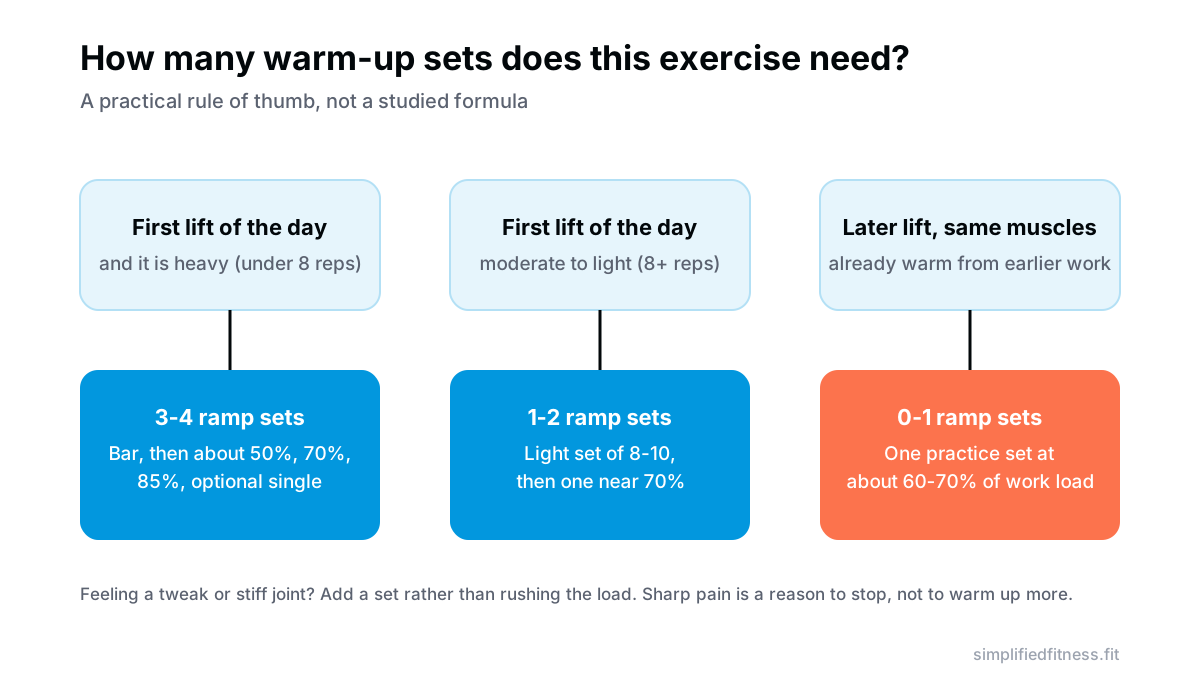
A typical push day looks like this:
- Incline dumbbell press (first lift, heavy-ish): 3 ramp sets.
- Shoulder press (same muscles, already warm): 1 lighter set.
- Lateral raises: often zero, or one set of 12 with half the working weight.
- Triceps pushdown: zero.
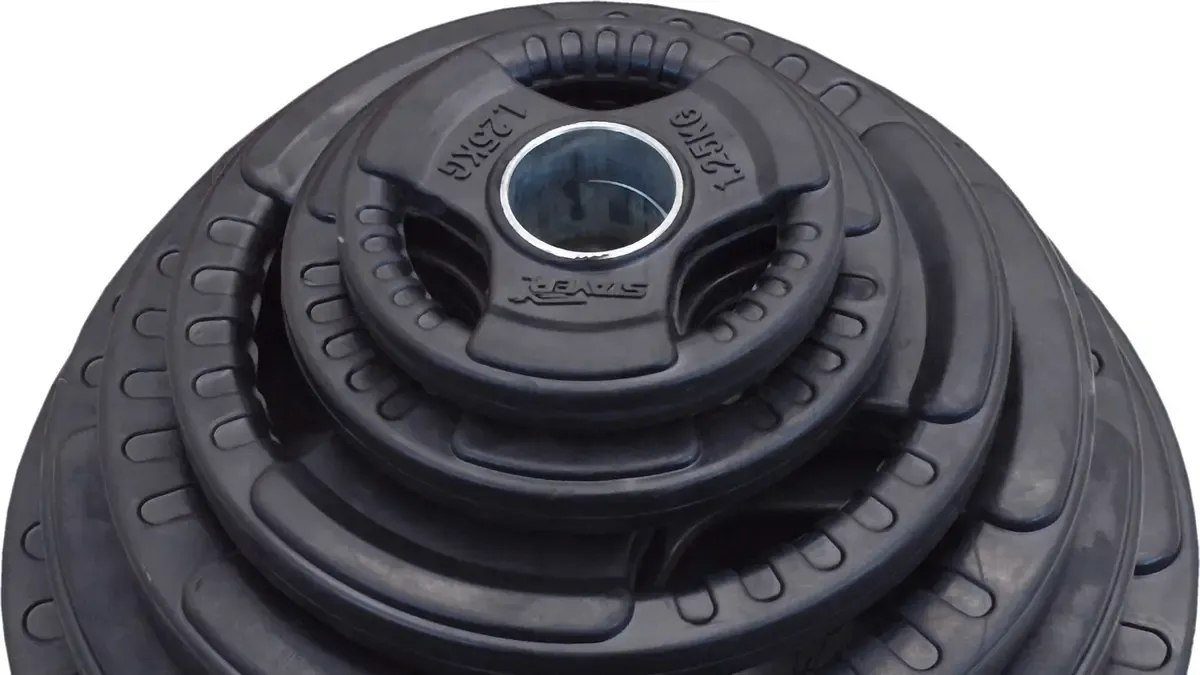
If you are doing bench press with straight bar loading, our barbell plate calculator helps you plan the plates for each jump so you are not doing mental math between sets.
How to pick warm-up weights from your working weight
Use percentages of the weight you plan to lift today, not your all-time max. A 5-rep working set at 100 kg means 50 kg, 70 kg and 85 kg. A 12-rep set at 60 kg is lighter overall, so you might only need the bar for 10, then 40 kg for 4 or 5.
If you are building your ramp from a max, the 1RM calculator can estimate your top load. For hypertrophy sets taken close to failure, the logic is the same, and our guide to rest intervals for muscle growth explains how long to rest before the first working set.
One more detail from velocity-based training: a study in 20 trained people found that using warm-up sets at 50%, 70% and 90% of estimated 1RM gave near-perfect correlations with measured 1RM, and that an extra warm-up set only slightly improved accuracy (Perez et al., 2021). That study was about predicting a bench press max from bar speed, not about fatigue. Still, it fits the idea that 3 well-spaced sets give you a fair read on how heavy the day will feel, and extra jumps add little.
Common mistakes with warm-up sets
- Too many reps at high load. If it takes 8 reps to reach 80%, you are doing real work.
- Jumping from the bar to 90%. Your first heavy set will feel awful.
- Warming up the wrong thing. Foam rolling and a long treadmill session do not replace a few specific sets of the lift.
- Skipping the warm-up on light days. You still need at least one practice set.
- Chasing a feeling. If a heavy single feels sluggish, do not add more singles. Move on.
When warm-up is not the problem
Stiffness that fades after a few light sets is normal. Pain is different. Sharp, one-sided, worsening or pinching pain, swelling, numbness, or a joint that catches or gives way is not something you warm up through. See a doctor or physiotherapist if this is happening. No ramp protocol replaces a proper assessment, and this article is general education, not medical advice.
If you do not have a program to attach these sets to, our free training plans show where warm-up sets fit into a full session.
The simple version
- Start with a few minutes of general movement.
- On the first heavy exercise, do the bar for about 10, then roughly 50% for 5, 70% for 3 and 85% for 1.
- Add a single at about 93% only if you want it.
- Rest a little longer as the weight rises, then start your working sets.
- On later exercises for the same muscles, do one practice set or none.
That is the whole protocol. It is dull, and that is the point.
Frequently Asked Questions
How many warm-up sets should I do before heavy working sets?
Most people do well with 2-4 warm-up sets on their first heavy exercise, and 0-1 on later exercises for the same muscles. Each set bridges the gap between the empty bar and your working weight so the first working set is not a shock. Add a set if the weight is very heavy or you feel stiff, and drop one if you are already warm.
What percentages should I use for warm-up sets?
A common ramp is the bar, then about 50%, 70% and 85% of your working weight, with an optional 90-93% single before the heaviest work. There is no studied 'perfect' set of percentages, so treat these as a sensible starting point. Adjust by feel: if 85% moves slowly, add a smaller jump.
How many reps should warm-up sets be?
Reps should fall as the weight rises, roughly 10, 5, 3, 1. Fewer reps at higher loads keeps fatigue low while still letting your body practise the heavy movement. If a warm-up rep ever looks like a working rep, you went too far.
Do warm-up sets tire you out and hurt your working sets?
Short, low-rep warm-up sets do not appear to reduce working-set performance, and may help. In a crossover study of 15 trained men, a warm-up of 5 reps at 80% of 10RM produced more total volume than lighter, higher-rep warm-ups. The takeaway is to keep reps low and stop well short of effort.
Do I need a warm-up set for every exercise?
No. Once your muscles and joints are warm from the first lift, later exercises for the same muscles usually need one practice set or none. Think of the first heavy compound as doing the general warming for the session. Add a single lighter set for any new movement pattern or a very heavy isolation lift.
Does warming up actually improve performance?
Usually yes, though not always. A systematic review of 32 studies found warm-ups improved performance in 79% of the outcomes examined, but a trial in trained men found no effect of different warm-ups on bench press, squat and curl repetitions. Warm up for the reps you want to perform, not for ritual.
Should I do a heavy single before my working sets?
It is optional. Studies on post-activation performance enhancement are mixed, and one 2024 trial found a heavy triple at 90% 1RM did not beat a usual warm-up for total squat volume, although it helped the first set slightly. If a heavy single makes you feel sharper, keep it to one rep and rest 2-3 minutes after.
Is static stretching a good warm-up for lifting?
You do not need it for a lifting warm-up. The lighter sets of the lift itself are what rehearse the movement you are about to load. If you like stretching before lifting, keep it brief, or save longer holds for after the session or rest days.
How long should a warm-up take?
Roughly 5-10 minutes is plenty for most sessions: a few minutes of general movement and then the ramp sets. A big squat day may take a little longer because there are more jumps. If your warm-up takes longer than your working sets, trim it.
Do I need to warm up if the gym is hot?
Yes, though a hot gym may let you shorten the general part. The ramp sets are mostly about practising the movement and loading it gradually, and heat does not do that for you. Keep at least one practice set at about 70% of working weight even on warm days.
What is a warm-up for a beginner on a 20 kg bar?
Beginners often just need the empty bar for 8-10 reps, one set at a lighter weight, and then work up. Practising technique matters more at this stage than percentages. Keep the sets crisp and stop before it feels like work.
When should I see a doctor instead of warming up more?
See a doctor or physiotherapist if you have sharp, localised or worsening pain, swelling, numbness or a joint that catches or gives way. Stiffness that eases in a few warm-up sets is normal, but pain that does not fade is a different problem. More warm-up sets will not fix an injury.
Sources & References
Every claim above is checked against peer-reviewed research (PubMed, U.S. National Library of Medicine) or guidance from established health bodies. How we fact-check.
- Fradkin AJ, et al. Effects of warming-up on physical performance: a systematic review with meta-analysis. J Strength Cond Res. 2010. PMID: 19996770
- Viveiros L, et al. High-load and low-volume warm-up increases performance in a resistance training session. J Bodyw Mov Ther. 2024. PMID: 39593476
- Ribeiro AS, et al. Effect of different warm-up procedures on the performance of resistance training exercises. Percept Mot Skills. 2014. PMID: 25153744
- Souza D, et al. Effect of warm-up protocols using lower and higher loads on multiple-set back squat volume-load. PeerJ. 2024. PMID: 39006036
- Rappelt L, et al. Post-activation performance enhancement (PAPE) protocols do not further increase jumping performance beyond warm-up effects: findings from three acute randomized crossover trials. Front Physiol. 2024. PMID: 39206386
- Yang WC, et al. Effect of different resistance increments during warm-up on the snatch performance of male weightlifters. Heliyon. 2024. PMID: 39149053
- Hedayati Y, et al. A comparison of three post-activation potentiation enhancement warm up strategies on bench press performance. Front Sports Act Living. 2025. PMID: 41487939
- Perez GL, et al. Evaluation of load velocity profiles with varying warm-up sets and relative intensities. Int J Exerc Sci. 2021. PMID: 34567373

Umair Hazrami · Founder & Head Coach, Simplified Fitness
Umair Hazrami founded Simplified Fitness and the Simplified Lifter channel to cut through fitness noise. With 4+ years of consistent training and 10+ coaching clients, he writes every guide from the peer-reviewed research and links the sources so you can check them. Our editorial standards.
Educational content only, not medical advice. If you have a medical condition, are pregnant, or take medication, talk to a qualified doctor before changing your diet, supplements or training. Full disclaimer.
Keep reading

Programming
Blood Flow Restriction (BFR) Practical Guide: Cuff Pressures, Rep Schemes, and Light Loads
How to do BFR training safely: cuff placement, pressure as a percentage of occlusion, the 30-15-15-15 scheme and who should skip it. Every study linked.
8 min read
Programming
Calibrating True RIR: A Safe Gym Test for Technical vs Absolute Failure
Calibrating RIR means testing how many reps you really have left. Use this safe machine protocol to find true failure and fix your 2 RIR guesses.
8 min read

Programming
CNS Fatigue vs Peripheral Fatigue: How Failure Hits Squats and Curls Differently
CNS fatigue vs peripheral fatigue: why failing a squat flattens you for days while failing a curl barely registers, and how many reps to leave in reserve.
9 min read
Programming
Failure on Machines and Cables vs Free Barbells: Managing Injury Risk and Axial Fatigue
Failure on machines vs barbells: why machine sets feel safer and less draining, what the research says, and where to push hard or stop at 1-2 RIR.
8 min read