Target Rates of Weight Gain for Natural Lifters: Monthly Scale Goals by Training Age
How fast should you gain weight bulking? Monthly scale targets for novice, intermediate and advanced natural lifters, plus how to track and adjust calories.

TL;DR. The short answer
- A common coaching range is about 1.0-1.5% of body weight per month for novices, 0.5-1.0% for intermediates and 0.25-0.5% for advanced lifters. For an 80 kg lifter that is roughly 0.8-1.2, 0.4-0.8 and 0.2-0.4 kg a month.
- These tiers are coaching heuristics, not trial results. No study has validated an exact surplus that maximises muscle gain relative to fat gain in trained lifters.
- Faster gaining mostly adds fat once you are past the beginner stage. In a controlled overfeeding trial, fat made up 50% to over 90% of the stored excess calories.
- Weigh yourself every morning and judge the 7-day average, not single days. Compare averages about two weeks apart before you change calories.
- If the average sits below your range for two weeks, add roughly 100-200 kcal a day. If it sits above, trim by about the same amount.
Part of our complete guide: The No-BS Guide to Energy Balance, Fat Loss, Bulking & Body Recomposition
Table of contents
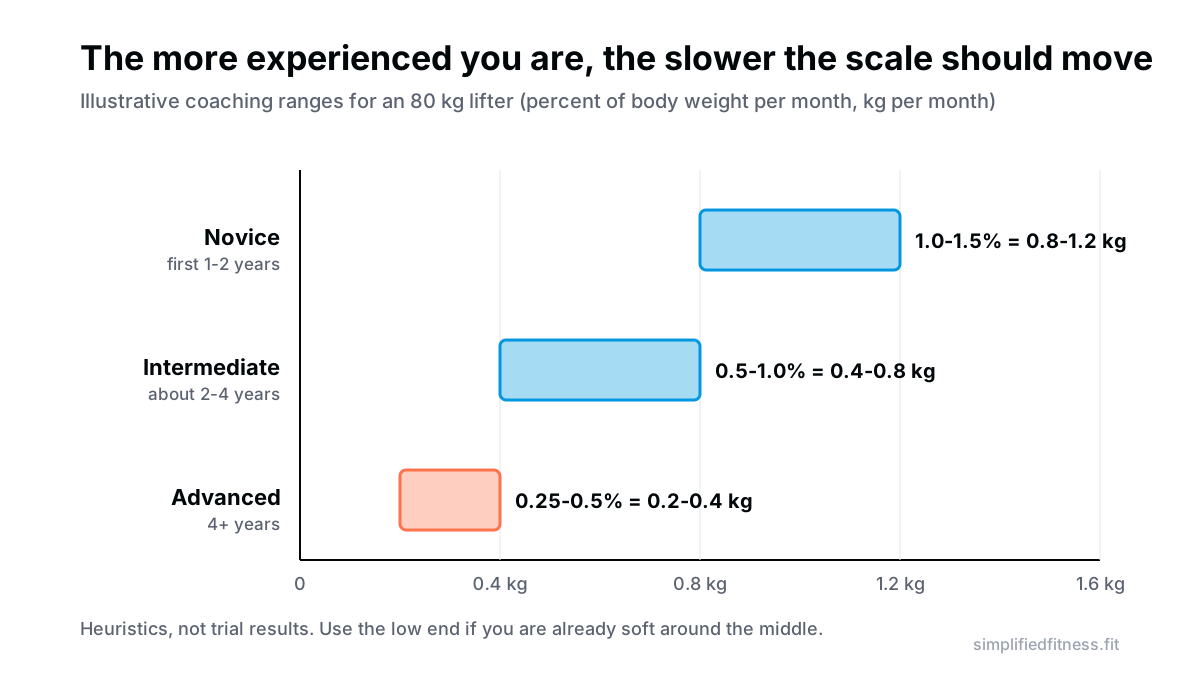
How fast should you gain weight bulking? As a rough guide, about 1.0-1.5% of body weight per month if you are a novice, 0.5-1.0% if you are intermediate, and 0.25-0.5% if you are advanced. For an 80 kg lifter, that is roughly 0.8-1.2 kg, 0.4-0.8 kg and 0.2-0.4 kg a month.
Those numbers are coaching ranges, not laws of nature, and I will be clear about that as we go. This article sits under our complete guide to energy balance, fat loss, bulking and recomposition. It gives you the exact scale targets by training age. For how to set the calories and food quality behind them, see lean bulking vs clean vs dirty bulking.
Monthly weight gain targets by training age
Here are the working ranges, shown for an 80 kg person. They are on the conservative side of what coaches commonly suggest.
| Training age | % body weight per month | 80 kg lifter, per month |
|---|---|---|
| Novice (first 1-2 years of consistent lifting) | 1.0-1.5% | 0.8-1.2 kg |
| Intermediate (about 2-4 years) | 0.5-1.0% | 0.4-0.8 kg |
| Advanced (4+ years, near your genetic ceiling) | 0.25-0.5% | 0.2-0.4 kg |
A few honest caveats.
The year cut-offs are approximate. “Training age” means years of proper, progressive training, not years since you first joined a gym. Someone who has done random machine circuits for three years is still closer to a novice.
The sources are not unanimous either. A narrative review of off-season nutrition for natural bodybuilders suggests a surplus of about 10-20% and a target gain of roughly 0.25-0.5% of body weight per week for novice and intermediate bodybuilders, with advanced lifters being more conservative (Iraki et al., 2019). That is faster than my intermediate tier when you convert it to a month. Narrative reviews like this one are expert synthesis, not trials. If you care about staying lean, the slower end of any range is the safer pick.
Why does gaining weight faster just make you fatter?
Your muscles can only grow so quickly. Past the beginner stage, the speed limit gets lower, but your appetite does not care.
The cleanest evidence that extra calories end up as fat comes from overfeeding research in non-lifters. In a 2012 randomized trial, 25 healthy young adults were overfed by about 40% more energy for 8 weeks under inpatient conditions. Body fat gain was similar across the low, normal and high protein diets, and fat made up 50% to more than 90% of the stored excess calories (Bray et al., 2012). The same trial found that normal and high protein diets also increased lean mass (about 2.9 and 3.2 kg), while the low protein group did not gain lean mass.
So when you hear “faster weight gain is mostly fat,” that is directionally supported, but with a caveat. Those participants were not trained lifters and were not on a structured lifting program. Trained lifters probably direct more of a surplus to muscle than that, and beginners the most.
What the studies in lifters and athletes show
Evidence in trained people is thin and a bit contradictory, which is worth knowing.
In 2011, 21 elite athletes were randomized to a meal plan giving a surplus of about 506 kcal a day or to eating freely, while doing strength training 4 times a week for 8-12 weeks. The planned-surplus group gained more body mass (4.3% vs 1.0%) and also gained lean body mass (2.8%), whereas the free-eating group’s lean mass did not change (Garthe et al., 2011).
In 2013, the same research group ran a similar trial in 39 elite athletes. Body weight rose more with nutritional guidance (3.9% vs 1.5%), but fat mass also rose far more (15% vs 3%) and the gain in lean body mass was not different between groups. The authors concluded that excess energy intake in a weight-gain protocol should be considered carefully (Garthe et al., 2013).
Why might A and B differ? Small samples, different athletes and sports, and different starting energy intakes in the free-eating groups are all plausible reasons. Neither study was in a typical gym-goer. The cautious takeaway: a planned surplus can help you gain lean mass, but pushing the surplus higher mainly buys more scale weight and often more fat.
Two more short-term findings point the same direction.
- In a 2025 trial of 17 well-trained men and women eating a 10% surplus with 2.2 g/kg protein for 8 weeks, the group that ate more spread across the day gained 1.4 kg more fat mass than the group eating inside an 8-hour window, while both groups gained fat-free mass (Blake et al., 2025). It is a very small trial and the TRE group also trained with less volume, so I would not read much into the exact numbers.
- In a 2016 trial, 21 resistance-trained men lifted for 8 weeks while taking a large daily calorie supplement, either protein plus carbohydrate or carbohydrate alone. Fat mass and total body mass rose in both groups, lean mass did not rise significantly in either, and adding protein to the supplement gave no extra benefit (Spillane and Willoughby, 2016). The ISSN position stand likewise notes that both the size of the surplus and the training status of the person shape the nature of the gains (Aragon et al., 2017).
How to track your rate of gain: the 7-day average
Your scale is noisy. Water, salt, carbohydrates and how full your gut is can move it by a kilo or more between days, which has nothing to do with muscle or fat. (We unpack why in our guide to daily scale weight fluctuations.)
The fix is simple and costs nothing.
- Weigh every morning, after the toilet, before food or water, in the same clothes (or none).
- Write the number down or log it in an app.
- Every 7 days, average the 7 readings.
- Compare this week’s average with the average from two weeks ago.
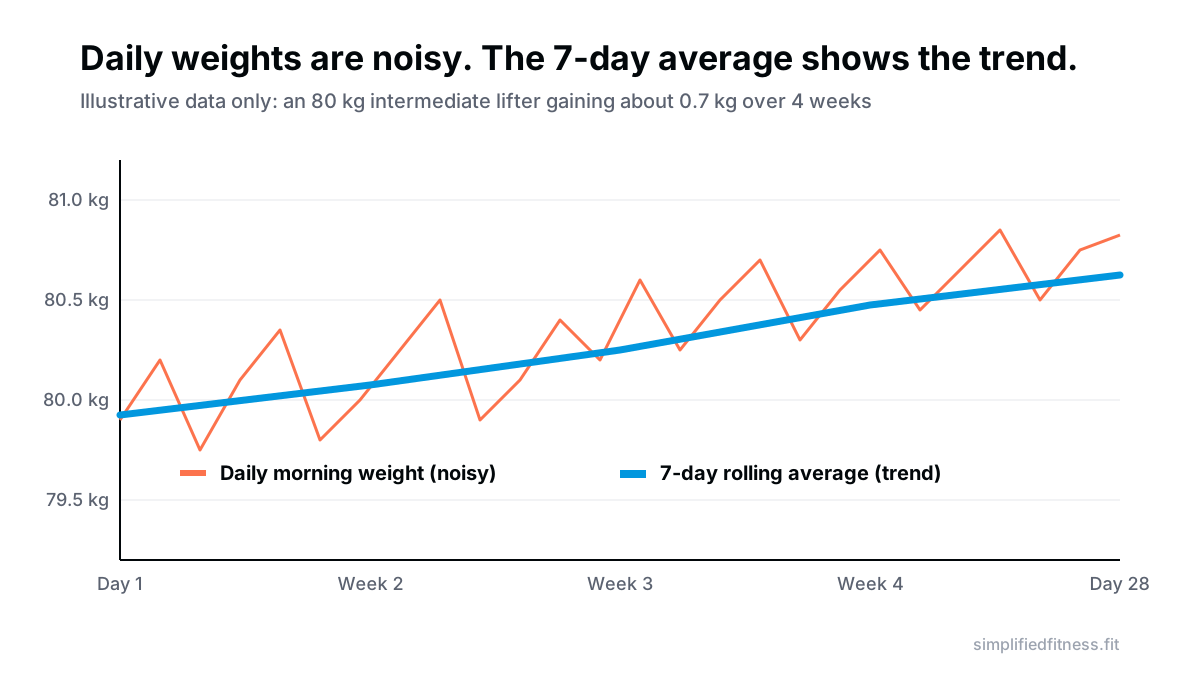
Example: Your averages are 80.0 kg, then 80.2 kg, then 80.4 kg. That is about 0.2 kg per week, or roughly 0.8 kg a month. For an 80 kg novice that is dead on target. For an 80 kg advanced lifter it is double the target, so you would trim a little.
What to do when the scale stalls (or runs too fast)
Use a simple two-week rule.
- Average is below your range for two weeks: add about 100-200 kcal a day. Carbohydrates are the easiest place, for example an extra 150-200 g of cooked rice, or a couple of rotis.
- Average is inside your range: change nothing. Keep training hard.
- Average is above your range for two weeks: trim about 100-200 kcal a day, and check your waist and photos too.
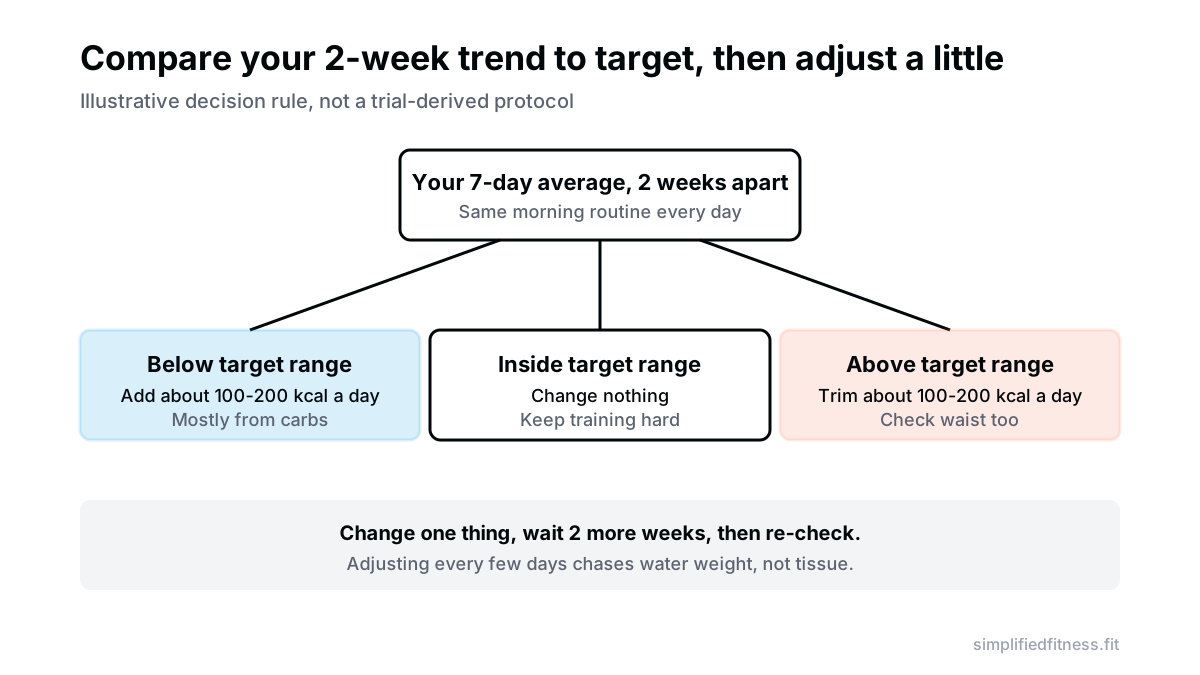
The 100-200 kcal step is an illustrative rule of thumb, not a trial-derived number. The idea is a small nudge rather than a big swing. The usual 7,700 kcal per kg of body weight rule would say 0.5 kg a month needs only about 130 kcal a day above maintenance, but Slater’s review warns that this kind of simple arithmetic probably underestimates the real energy cost of building muscle (Slater et al., 2019). That is another reason to let your own trend overrule the math.
Not sure where maintenance starts? Use our calorie calculator for a starting estimate, then add a modest surplus. Our guide to TDEE, BMR and NEAT explains why your real number may differ.
Protein, carbs and the Indian vegetarian bulk
Calories set the speed of the scale. Protein helps make sure the weight you gain has a chance to be muscle. The off-season review above suggests 1.6-2.2 g/kg a day of protein, moderate fat (0.5-1.5 g/kg) and the remaining calories from carbohydrate (Iraki et al., 2019). Work out your own number with our protein intake calculator, and see how to calculate macronutrient splits for the full method.
If you are vegetarian, getting a surplus is not the hard part. Getting enough protein inside it is. A practical day might use dal, paneer, curd, soya chunks, milk and eggs if you eat them, with extra rice or roti to add the calories. Very small surpluses of 100-200 kcal are easy to build from one extra roti with a bowl of curd. The research in this area is mostly in young men, so use these as starting points and adjust to your own trend.
When to slow down, and when to see a doctor
Slow your rate if your waist is rising faster than your lifts, your belt is tighter every week, or you already carry a lot of body fat. If you are unsure which situation you are in, our guide to the skinny-fat dilemma helps you decide between cutting, bulking and recomping.
Check in with a doctor before bulking if you have diabetes or prediabetes, high blood pressure, a history of disordered eating, or other medical conditions. Also talk to a doctor if you are gaining weight rapidly without changing your food, or if you are unable to gain at all despite eating a lot. This article is general education, not medical advice.
The bottom line
How fast should you gain weight bulking? A decent starting rule is about 1.0-1.5% of body weight per month as a novice, 0.5-1.0% as an intermediate and 0.25-0.5% as an advanced lifter. The evidence for those exact tiers is coaching experience and expert reviews, not trials, and faster gaining mostly adds fat once you are no longer a beginner. Weigh daily, judge the 7-day average, adjust by small steps every two weeks, and pair it with a free push pull legs plan that gives you something worth gaining for.
Frequently Asked Questions
How fast should you gain weight when bulking?
Most natural lifters do well gaining about 0.25-1.5% of body weight per month, with beginners at the top of that range and advanced lifters at the bottom. These ranges come from coaching experience and narrative reviews rather than controlled trials. Pick the tier that matches your training age and check your 7-day average every two weeks.
How many kilos should I gain per month on a bulk?
An 80 kg novice might aim for roughly 0.8-1.2 kg a month, an intermediate 0.4-0.8 kg and an advanced lifter 0.2-0.4 kg. The reason is that muscle gain slows as you get more experienced, so the extra weight beyond that tends to be fat. Multiply your own body weight by the percentage for your tier instead of copying someone else's kilos.
Is gaining 2 kg a month too fast?
For most lifters past the first year or two, yes, it is probably too fast. Two trials in elite athletes found that a planned surplus raised body weight more than eating freely. In one, the planned group also gained lean mass; in the other, the extra gain was mostly fat and lean mass gains did not differ. If you are very lean or a true beginner it can be reasonable for a short stretch, so judge it against your waist and gym numbers.
Why does gaining weight faster just make me fatter?
Your body can only build muscle at a limited speed, and calories beyond what that process needs are stored mostly as fat. In a 2012 overfeeding trial, body fat gain was similar across protein levels and made up 50% to over 90% of the excess calories. Slow the surplus so more of each gained kilo has a chance to be muscle.
What is a lean bulk and how many calories does it need?
A lean bulk is a small, controlled surplus aimed at slow scale gain. A narrative review for natural bodybuilders suggests a surplus of roughly 10-20% above maintenance for novices and intermediates, and more conservative for advanced lifters. Start near the low end, then adjust using your weekly average.
How do I track weight gain properly?
Weigh yourself every morning after using the toilet and before eating or drinking, on the same scale. Day-to-day readings swing from water, salt, carbs and bowel contents, so average the last 7 days. Compare one week's average with the average two weeks earlier.
What do I do if my weight stops going up?
First confirm it is a real stall: look at the 7-day average across two full weeks, not one flat morning. If the average has not moved and you want it to, your maintenance is higher than you estimated, so add about 100-200 kcal a day. Wait two more weeks before touching it again.
How much should I eat to gain 0.5 kg a month?
Using the rough 7,700 kcal per kg rule, 0.5 kg a month works out to only about 130 kcal a day above maintenance. That rule is imperfect for muscle gain, so treat it as a starting point rather than a promise. Use our calorie calculator for maintenance, then adjust from your own trend.
Can beginners gain weight faster than advanced lifters?
Yes. Beginners respond quickly to training, so a larger share of the scale gain can be muscle, which is why coaching ranges let them gain a higher percentage per month. Advanced lifters have less room left to grow, so the same surplus is more likely to end up as fat. Match your target to training age, not to how hungry you feel.
Does eating more protein let me gain weight faster without fat?
Not really. In the 2012 overfeeding trial, higher protein increased lean mass and energy expenditure but did not change how much fat was stored. Protein supports muscle gain, but calories still decide how fast the scale moves. Aim for 1.6-2.2 g/kg a day, then use the surplus to control the rate.
Is it normal to gain 1-2 kg in the first week of a bulk?
Yes, a quick early jump is common and is mostly water, glycogen and extra food in the gut. More carbohydrate and salt hold more water in the body. Do not judge the bulk until you have two to three weeks of 7-day averages.
Should I weigh myself daily or weekly during a bulk?
Daily weighing with a 7-day average is more reliable than one weekly reading. A single weigh-in can be off by a kilo or more from water alone, while an average smooths that out. If daily weighing stresses you, weigh three to four mornings a week and average those.
When should I stop bulking and cut?
There is no single trial-backed trigger, so it comes down to waist, photos, how you feel and how long you have been gaining. If your waist is growing faster than your lifts and your trend has run above your range for several weeks, a short fat loss phase makes sense. If you are unsure whether to bulk at all, read our guide on the skinny-fat dilemma.
Do these rates apply to women and to Indian vegetarian lifters?
The percentage approach works for both, since it scales to body weight, though women often sit at the lower end of each range in kilos. Vegetarian diets can reach a surplus with dal, paneer, curd, soya and extra roti or rice. The research in this area is mostly in young men, so treat the numbers as a starting point and adjust to your own trend.
Sources & References
Every claim above is checked against peer-reviewed research (PubMed, U.S. National Library of Medicine) or guidance from established health bodies. How we fact-check.
- Iraki J, et al. Nutrition Recommendations for Bodybuilders in the Off-Season: A Narrative Review. Sports (Basel). 2019. PMID: 31247944
- Slater GJ, et al. Is an Energy Surplus Required to Maximize Skeletal Muscle Hypertrophy Associated With Resistance Training. Front Nutr. 2019. PMID: 31482093
- Bray GA, et al. Effect of dietary protein content on weight gain, energy expenditure, and body composition during overeating: a randomized controlled trial. JAMA. 2012. PMID: 22215165
- Garthe I, et al. Long-term effect of nutritional counselling on desired gain in body mass and lean body mass in elite athletes. Appl Physiol Nutr Metab. 2011. PMID: 21851204
- Garthe I, et al. Effect of nutritional intervention on body composition and performance in elite athletes. Eur J Sport Sci. 2013. PMID: 23679146
- Blake DT, et al. Hypercaloric 16:8 time-restricted eating during 8 weeks of resistance exercise in well-trained men and women. J Int Soc Sports Nutr. 2025. PMID: 40241374
- Spillane M, et al. Daily Overfeeding from Protein and/or Carbohydrate Supplementation for Eight Weeks in Conjunction with Resistance Training Does not Improve Body Composition and Muscle Strength or Increase Markers Indicative of Muscle Protein Synthesis and Myogenesis in Resistance-Trained Males. J Sports Sci Med. 2016. PMID: 26957922
- Aragon AA, et al. International society of sports nutrition position stand: diets and body composition. J Int Soc Sports Nutr. 2017. PMID: 28630601

Umair Hazrami · Founder & Head Coach, Simplified Fitness
Umair Hazrami founded Simplified Fitness and the Simplified Lifter channel to cut through fitness noise. With 4+ years of consistent training and 10+ coaching clients, he writes every guide from the peer-reviewed research and links the sources so you can check them. Our editorial standards.
Educational content only, not medical advice. If you have a medical condition, are pregnant, or take medication, talk to a qualified doctor before changing your diet, supplements or training. Full disclaimer.
Keep reading
Nutrition
Body Recomposition: Who Can Lose Fat and Build Muscle at the Same Time?
How to do body recomposition: who can lose fat and build muscle at once, what the trials show, and a protein, training and calorie protocol you can start today.
8 min read

Nutrition
Breaking Fat Loss Plateaus: Check Fluid, Hidden Calories and NEAT
How to break a fat loss plateau: a 3-step check of water masking, hidden calories and lower daily steps, plus the exact fix to restart steady fat loss.
8 min read

Nutrition
How to Calculate Macros: Step-by-Step Grams per Kilogram Formula for Protein, Fat and Carbs
How to calculate macros in grams per kg: set protein, set fat, fill the rest with carbs. Worked examples for 70, 80 and 90 kg lifters on a cut or a bulk.
9 min read

Nutrition
Daily Scale Weight Fluctuations: Sodium, Bowels, Glycogen and Water
Daily scale weight fluctuations are mostly water, glycogen and gut contents, not fat. Learn why your weight jumps overnight and how a 7-day average fixes it.
8 min read