Skinny Fat? Cut, Bulk or Recomp: The Waist-to-Height Test and a 12-Month Roadmap
Skinny fat cut or bulk? Use your waist-to-height ratio to decide, then follow a 12-month roadmap of maintenance calories, protein and progressive lifting.

TL;DR. The short answer
- Most skinny-fat people should not do a big bulk or a crash cut. Eating near maintenance (or a small deficit) while lifting with progressive overload is the sensible default.
- A waist-to-height ratio above 0.5 is a practical flag to cut gently first. Browning et al. found 0.5 to be the mean boundary for cardiometabolic risk across 78 studies.
- Normal-weight obesity (normal BMI, high body fat) is linked to higher odds of metabolic syndrome, hypertension and diabetes in observational meta-analyses, so this is a health issue and not just a looks issue.
- Protein of roughly 1.6-2.0 g/kg a day plus three lifting sessions a week gives you the best chance of gaining muscle while fat comes down.
- Give the plan 12 weeks before judging it. Track waist, strength and photos, because the scale barely moves during a recomp.
Part of our complete guide: Body Composition, Muscle Memory and Habits: A Lifter's Guide to Tracking
Table of contents
If you are stuck on “skinny fat cut or bulk”, the short answer is usually neither. Eat around maintenance calories (or a small deficit if your waist is big), eat plenty of protein and lift with progressive overload. That combination adds muscle and trims waist fat together, which is what a skinny-fat body needs.
This sits inside our wider guide to body composition, muscle memory and adherence. Here we apply it to one specific, very common problem: a normal number on the scale, a soft midsection and not much muscle underneath.
What does “skinny fat” actually mean?
Skinny fat is gym slang. The clinical term is normal-weight obesity: a normal BMI with a high body fat percentage. You look slim in a shirt, but the arms are thin, the belly is soft and nothing feels strong.
It matters beyond the mirror. A 2022 meta-analysis of 25 studies (177,792 participants) found higher odds of metabolic syndrome, hypertension, dyslipidemia and diabetes in normal-weight obesity compared with normal-weight non-obese people (Mohammadian Khonsari et al., 2022). A second meta-analysis of 24 cross-sectional studies (75,201 subjects) reached a similar conclusion, with an odds ratio of 2.24 for metabolic syndrome (Rakhmat et al., 2022).
Both are observational, so they show an association and not proof that the fat caused the disease. Even so, they point the same way: BMI alone misses people who carry too much fat and too little muscle.
What causes the skinny-fat look?
There is no single cause, but the usual pattern is easy to spot:
- A desk job or study routine with very little walking
- Low protein days (tea, biscuits, rice and a little dal)
- Years of on-off crash dieting that drop weight but never build muscle
- No lifting, or only cardio
Put those together and you end up with a body that has little muscle to hold it up and a bit of fat sitting around the middle. Nothing is “broken”. It is the predictable result of low muscle stimulus and low protein.
Skinny fat: should I cut or bulk first?
Both traditional options backfire in a skinny-fat body, for opposite reasons.
A big bulk adds fat to a waist that already has some. You gain weight, the waist grows faster than the arms, and you feel fatter without looking bigger. A harsh cut does the reverse. You drop a few kilos, but with so little muscle to start with, the leaner you get, the more “emaciated” you look.
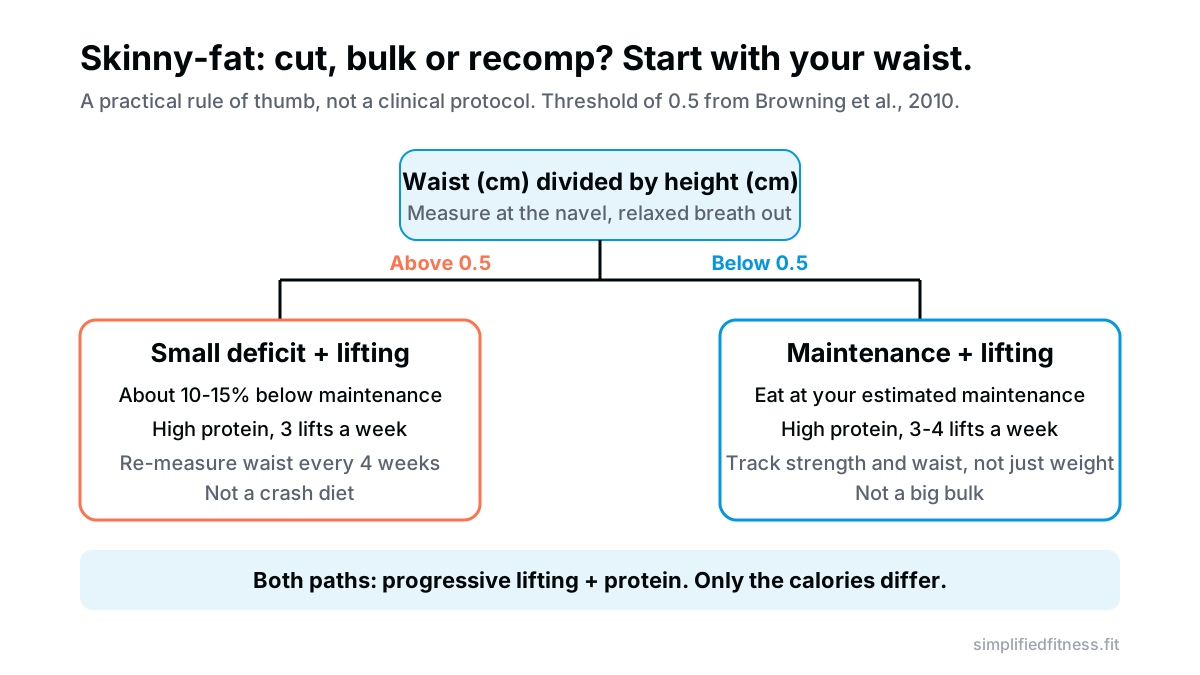
The better question is how much of a calorie gap you can afford, because lifting and protein stay the same either way. That is the logic of the decision tree below.
Step 1: measure waist-to-height ratio
Divide your waist (cm, at the navel) by your height (cm). You can use our waist-to-height ratio calculator to do it in seconds.
A systematic review of 78 studies found that waist-to-height ratio predicted diabetes and cardiovascular disease at least as well as waist circumference and better than BMI, with a mean boundary value of 0.50 for both men and women (Browning et al., 2010). Their public message: keep your waist under half your height.
Step 2: pick your starting point
- Ratio above 0.5: start with a small deficit (about 10-15% below maintenance) while lifting. That is a practical coaching rule and not a trial-proven cutoff.
- Ratio below 0.5: eat at maintenance and lift. You are skinny-fat mainly because of low muscle, so adding muscle is the job.
The Indian context matters here. Many South Asians carry more abdominal fat at a given BMI, so a “normal” BMI can mislead. In 509 adults in Delhi, waist circumference and waist-to-height ratio were better than BMI at flagging cardiometabolic risk factors (Vikram et al., 2016). That is a single cross-sectional study, but it supports checking your waist and not just your BMI.
Can you really build muscle and lose fat at the same time?
For many skinny-fat people, yes. If you are new to lifting your body tends to respond quickly, and you have some fat to spare. No trial has tested recomposition in skinny-fat people specifically, so the evidence below comes from young adults in general.
Two trials are worth knowing about, both in young adults and both small:
- Longland et al., 2016. Young men (n = 20 per group) ate a hypoenergetic diet (about 40% below requirements) and trained resistance plus intervals six days a week for four weeks. The group eating 2.4 g/kg of protein gained 1.2 kg of lean mass and lost 4.8 kg of fat. The 1.2 g/kg group gained 0.1 kg of lean mass and lost 3.5 kg of fat (Longland et al., 2016).
- Vargas-Molina et al., 2026. Thirty resistance-trained participants (average age 23) trained four days a week for 10 weeks with protein around 2.5 g/kg. Fat-free mass rose by about 1 kg on both a maintenance-calorie diet and a moderate-deficit diet, with no meaningful change in the control group. The deficit group lost more fat (2.94 kg vs 1.41 kg), although the difference between the two diet groups was not statistically significant (Vargas-Molina et al., 2026).
Be careful about what these studies can and cannot tell you. Both used very high protein (2.4-2.5 g/kg), very structured training and young participants over weeks, not months. The 2026 trial had only 10 people per group. Your result will likely be slower. We cover who recomposes best, and who does not, in body recomposition limits: who can recomp, and the general principle in our guide to losing fat and building muscle simultaneously.
How much protein does a skinny-fat person need?
Aim for roughly 1.6-2.0 g per kg of body weight a day. A meta-analysis of 49 randomized trials (1,863 participants) found that protein supplementation increased fat-free mass and strength during prolonged resistance training, with no further gains in fat-free mass beyond total intakes of about 1.62 g/kg/day (Morton et al., 2018). The ISSN position stand gives 1.4-2.0 g/kg/day as sufficient for most exercising people, with higher intakes sometimes helpful for lean-mass retention in trained people during a calorie deficit (Jäger et al., 2017).
For a 65 kg person that is about 105-130 g a day. Work out your own number with the protein calculator.
In Indian terms, that looks like:
- Eggs, chicken or fish if you eat them
- Paneer, curd and milk
- Dal, rajma, chole and soya chunks
- A whey scoop only if food falls short
Our guide to daily protein intake for hypertrophy covers the numbers in more depth, and the protein-per-calorie food ranking helps on a budget.
The skinny-fat workout routine
Keep it boring and consistent.
- Months 1-3: full-body, three days a week. A squat or leg press, a press (dumbbell or machine), a row, a hinge (Romanian deadlift or hip thrust) and some arm and core work.
- Months 4-9: upper/lower or push/pull/legs four days a week, once the basic lifts are familiar.
- Every session: try to beat last time by one rep or a small weight jump.
Our free push, pull and leg day plans give you the exercises, sets and reps. The most common mistake here is changing the routine every two weeks, which means you never actually progress on any lift. A simple training logbook stops that.
For cardio, aim for 8,000-10,000 steps a day. It is low-cost for recovery and nudges the waist down without eating into lifting performance.
A 12-month skinny-fat roadmap
Here is how the year can look. It is an illustrative structure from standard coaching practice, not a trial protocol.
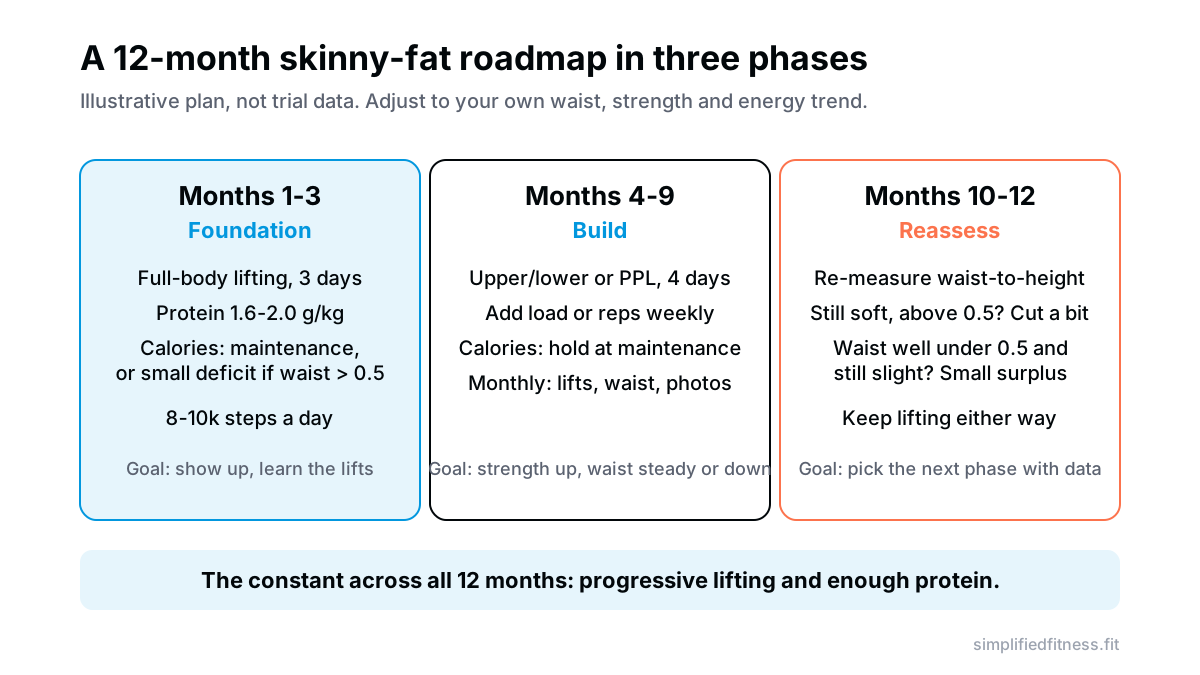
- Months 1-3 (foundation): learn the lifts, hit protein daily, hold calories at maintenance (or a small deficit if your ratio is above 0.5).
- Months 4-9 (build): add a fourth day, push weights up steadily and hold maintenance. Expect strength to rise before your body visibly changes.
- Months 10-12 (reassess): re-measure waist-to-height and look at photos. Still soft with a ratio above 0.5? Run a gentle cut. Ratio well under 0.5 and still slight? A small surplus (a modest 5-10% above maintenance) is now reasonable, as covered in lean bulking.
If you would rather decide by estimated body fat percentage than by waist measurement, our body-fat-based skinny-fat decision guide takes that route. Get a calorie starting point from the calorie calculator.
How do I know it is working?
The scale is a poor judge. During a recomp, you can lose fat and gain muscle and see almost no change in body weight.
Track these instead, every four weeks:
- Waist at the navel (the number that matters most)
- Your main lifts (are they going up?)
- Two photos in the same light
- Energy and sleep
Our guide to DIY physique tracking with waist, photos and scale averages shows how to do this properly. Give any plan at least 12 weeks before you decide it has failed.
When to see a doctor
Normal-weight obesity is linked to metabolic risk, and the only way to know your own numbers is to test. Consider seeing a doctor if your waist-to-height ratio is above 0.5, if diabetes or heart disease runs in your family, or if you have unusual thirst, tiredness or frequent urination. Do not diagnose yourself from BMI or the mirror. Ask about fasting glucose, lipids and blood pressure.
The bottom line
For most skinny-fat people, the answer to cut or bulk is a middle path. Measure your waist-to-height ratio, then eat at maintenance (or slightly below it if the ratio is above 0.5). Lift three to four days a week, hit 1.6-2.0 g/kg of protein and track waist and strength. Give it a full year, and reassess with data and not with panic.
Frequently Asked Questions
Should a skinny-fat person cut or bulk first?
Most should do neither in the extreme: eat around maintenance, or a small deficit if the waist is large, and lift progressively. A big bulk adds fat to a body that already carries it around the middle, while a hard cut removes the little muscle you have. Measure your waist-to-height ratio first and pick maintenance if it is under 0.5, a small deficit if it is above.
How do I fix skinny fat?
You fix it by adding muscle and slowly reducing waist fat at the same time, which means lifting three to four days a week, eating enough protein and holding calories near maintenance. Resistance training with higher protein has produced simultaneous fat loss and fat-free mass gain in young trained lifters over 10 weeks. Start with full-body sessions, add load or reps each week, and give it several months.
What is a skinny-fat body?
It is a popular term for a normal or low weight with low muscle mass and a relatively high body fat percentage, which the research calls normal-weight obesity. Observational meta-analyses link it to higher odds of metabolic syndrome, hypertension and diabetes compared with normal-weight lean adults. If you are worried, a waist measurement and a check-up with your doctor are better guides than the mirror.
Is skinny fat unhealthy?
It can be, because BMI hides the fat that matters. A 2022 meta-analysis of 25 studies (177,792 participants) found higher odds of metabolic syndrome, high blood pressure and diabetes in normal-weight obesity, though these are observational links and not proof of cause. Building muscle, walking more and trimming waist size are sensible steps, and a doctor can check blood sugar, lipids and blood pressure.
How long does it take to fix skinny fat?
Expect visible change in about 3-6 months and a clear transformation over 12 months if you train and eat consistently. Trials in this area run only 4-10 weeks, so long timelines are coaching experience and not trial data. Judge progress every four weeks using waist, lifts and photos, not the scale.
Can I build muscle and lose fat at the same time if I am skinny fat?
Often yes, because many skinny-fat people are new to lifting and carry spare fat, the conditions in which recomposition is most commonly reported. A 2026 trial of 30 young resistance-trained adults found both a maintenance-calorie and a moderate-deficit high-protein diet increased fat-free mass by about 1 kg over 10 weeks compared with a control group. Treat that as encouraging but small, and keep protein high and training progressive.
How much protein does a skinny-fat person need?
Around 1.6-2.0 g per kg of body weight a day is a solid target for most people lifting to gain muscle. A meta-analysis of 49 trials found no extra muscle gain from supplemental protein beyond about 1.62 g/kg/day, and the ISSN gives 1.4-2.0 g/kg/day for most exercisers. Use the protein calculator and spread it across three or four meals.
What is the best skinny-fat workout routine?
A three-day full-body routine built on squats, presses, rows and hinges is a strong start, moving to four days once the lifts feel familiar. Muscle grows from progressive tension, so adding weight or reps over time matters more than exercise variety. Use our free push, pull and leg plans and log every session.
Should I do cardio if I am skinny fat?
Do some, but do not let it replace lifting. Walking 8,000-10,000 steps a day raises energy use with little recovery cost, while a lot of hard running on top of a calorie deficit makes it harder to recover from lifting. Keep lifting as the priority and treat cardio as a way to nudge the waist down.
Will bulking make me look fatter if I am skinny fat?
Often yes, because a surplus adds fat across the waist first and the small amount of muscle you have does not yet frame it. A large surplus is also not necessary for a beginner, since the lifting stimulus is the main driver of early growth. A maintenance diet with high protein avoids the soft look while strength rises.
Should I see a doctor if I am skinny fat?
It is worth it if your waist-to-height ratio is above 0.5, you have a family history of diabetes or heart disease, or you feel unusually tired or thirsty. Normal-weight obesity is linked to metabolic risk markers, and only blood tests can tell you where you stand. Ask for fasting glucose, lipids and blood pressure, and do not self-diagnose from a scale or mirror.
Do Indians have a higher risk of being skinny fat?
South Asians are often described as carrying more abdominal fat at a lower BMI, so a normal BMI can be misleading. In a study of 509 adults in Delhi, waist circumference and waist-to-height ratio identified cardiometabolic risk factors better than BMI. Check your waist-to-height ratio rather than relying on BMI alone.
Do I need supplements to fix skinny fat?
No, food, protein and lifting do the heavy work. Protein powder is a convenience if dal, paneer, curd, eggs or soya do not get you to your target, and it is not magic. Fix your training and daily protein first, and spend money on supplements only after that.
Sources & References
Every claim above is checked against peer-reviewed research (PubMed, U.S. National Library of Medicine) or guidance from established health bodies. How we fact-check.
- Mohammadian Khonsari N, et al. Normal Weight Obesity and Cardiometabolic Risk Factors: A Systematic Review and Meta-Analysis. Front Endocrinol (Lausanne). 2022. PMID: 35399938
- Rakhmat II, et al. Cardiometabolic risk factors in adults with normal weight obesity: A systematic review and meta-analysis. Clin Obes. 2022. PMID: 35412026
- Browning LM, et al. A systematic review of waist-to-height ratio as a screening tool for the prediction of cardiovascular disease and diabetes: 0.5 could be a suitable global boundary value. Nutr Res Rev. 2010. PMID: 20819243
- Vikram NK, et al. Waist-to-Height Ratio Compared to Standard Obesity Measures as Predictor of Cardiometabolic Risk Factors in Asian Indians in North India. Metab Syndr Relat Disord. 2016. PMID: 27740885
- Longland TM, et al. Higher compared with lower dietary protein during an energy deficit combined with intense exercise promotes greater lean mass gain and fat mass loss: a randomized trial. Am J Clin Nutr. 2016. PMID: 26817506
- Vargas-Molina S, et al. Comparison of two nutritional protocols in body re-composition of resistance-trained participants. Eur J Appl Physiol. 2026. PMID: 41940947
- Morton RW, et al. A systematic review, meta-analysis and meta-regression of the effect of protein supplementation on resistance training-induced gains in muscle mass and strength in healthy adults. Br J Sports Med. 2018. PMID: 28698222
- Jager R, et al. International Society of Sports Nutrition Position Stand: protein and exercise. J Int Soc Sports Nutr. 2017. PMID: 28642676

Umair Hazrami · Founder & Head Coach, Simplified Fitness
Umair Hazrami founded Simplified Fitness and the Simplified Lifter channel to cut through fitness noise. With 4+ years of consistent training and 10+ coaching clients, he writes every guide from the peer-reviewed research and links the sources so you can check them. Our editorial standards.
Educational content only, not medical advice. If you have a medical condition, are pregnant, or take medication, talk to a qualified doctor before changing your diet, supplements or training. Full disclaimer.
Keep reading

Health & Longevity
Overcoming the All-or-Nothing Mindset: How Perfectionism Wrecks Long-Term Fitness
The all-or-nothing mindset in fitness turns one missed workout into a lost month. Here is the research, the never-miss-twice rule and a 20-minute fallback plan.
10 min read

Health & Longevity
How to Build a Gym Habit: The Behavioral Science of Sticking With It
How to build a gym habit using habit science: how long it takes, why cues and low friction beat willpower, and what identity can and cannot do for consistency.
8 min read

Health & Longevity
Best Way to Measure Body Fat: DEXA, Bod Pod, Calipers and 4C Compared
The best way to measure body fat percentage is the same tool, under the same conditions, every time. See how DEXA, Bod Pod, calipers and 4C really compare.
8 min read

Health & Longevity
Body Recomposition Limits: Who Can Recomp, and When Advanced Lifters Must Choose a Surplus or Deficit
Body recomposition limits explained: who can still lose fat and gain muscle at once, why advanced lifters stall, and how to choose a cut or lean bulk.
9 min read