Food Logging Precision: Digital Scales vs Measuring Cups and Hidden Calorie Errors
Food scale vs measuring cups macros: why spoons and cups hide hundreds of calories, plus fixes for oil, dressings and raw vs cooked logging errors.
TL;DR. The short answer
- A digital gram scale is more accurate than cups or spoons for dense foods like peanut butter, rice, oil and paneer, because the same 'tablespoon' can weigh 16 g or 30 g.
- Research on self-reported intake, including doubly labeled water studies, shows people usually under-report what they eat. In one NEJM study of people who said they could not lose weight, actual intake was about 47% higher than reported.
- The biggest hidden errors are usually cooking oil and ghee, nut butters, sauces and dressings, bites you never log, and mixing up raw and cooked weights.
- Apps like MyFitnessPal can be accurate for total energy and macros in a validation study, but only when you pick the right database entry and enter a true weight.
- You do not need to weigh everything forever. Weigh the dense, high-calorie foods for a few weeks to calibrate your eye, then spot-check.
Part of our complete guide: The No-BS Guide to Energy Balance, Fat Loss, Bulking & Body Recomposition
Table of contents
If you are asking about a food scale vs measuring cups for macros, the short answer is this: use a digital gram scale for anything dense or high in calories. Cups and spoons measure volume, and volume changes with how heaped, packed or sloppy your scoop is. Grams do not.
This guide is part of our wider energy balance, fat loss and recomposition guide. If you are hitting your numbers in the app and the scale will not move, the log itself is often the first thing worth checking, not your metabolism.
Quick version first, then the details.
Why you are “hitting your macros” but not losing weight
Fat loss needs a real calorie deficit. If the number in your app is lower than what you actually ate, the deficit on screen does not exist in your body.
This is not a new idea. In a 1992 New England Journal of Medicine study, researchers looked at people who reported eating under 1,200 kcal a day yet were not losing weight (Lichtman et al., 1992). They measured the diet-resistant group’s energy expenditure and intake over 14 days. Expenditure was within 5% of what was predicted for their body composition, but they under-reported food intake by an average of 47% and over-reported physical activity by 51%. The authors concluded the failure to lose weight came from intake being higher than reported, not from broken thermogenesis.
Two cautions. That study was small (ten people in the diet-resistant group) and in people with obesity, so do not treat 47% as a number for you. And it is not a story about lying: the authors found no distinct psychopathology in the group. People simply do not see the extra spoon.
A 2001 review of doubly labeled water studies, which measure real energy expenditure, found the same pattern. When people recorded their own intake, it was generally lower than their measured expenditure (Hill and Davies, 2001). Even people who had kept weight off for over a year under-reported in a 2021 study, by a median of about 605 kcal a day (Dahle et al., 2021). That was a small case-control study (26 maintainers), but it shows how common the gap is.
Food scale vs measuring cups: how big is the error?
I want to be honest here. I could not find a trial that measures the exact error of cups versus a scale across many foods, so I will not quote a precise percentage. What we can do is the arithmetic, and the arithmetic is simple.
Take peanut butter. A “tablespoon” is commonly listed as about 16 g, which at roughly 6 kcal per gram is about 95 kcal. Scoop it the way most people do, rounded and heaped, and 30 g is easy. That is about 180 kcal. Same spoon, almost double the energy.
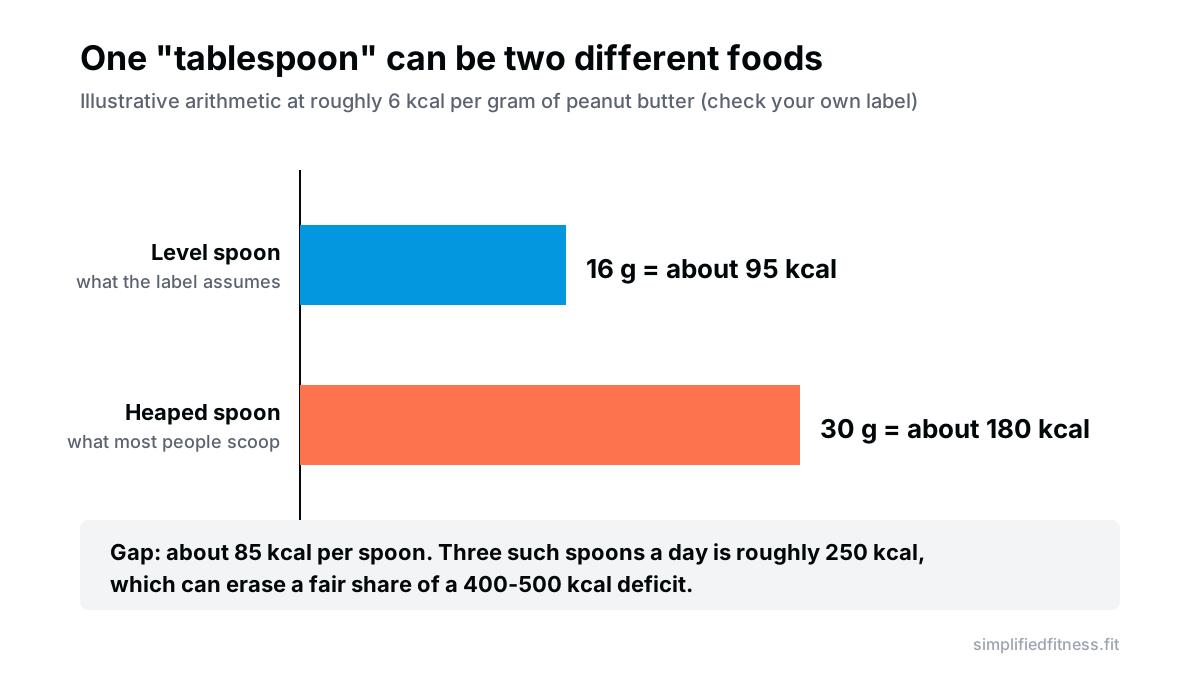
The error shrinks when the food is light and airy (leafy greens, puffed foods) and grows when it is dense or sticky (nut butters, oats, rice, flour, paneer crumbles, sugar). That is why one “cup of cooked rice” can be 150 g for one person and 250 g for another.
Here is how the main methods compare.
| Method | Typical weakness | Best use |
|---|---|---|
| Digital gram scale | Needs a minute and a clean bowl | Dense foods, oils, grains, protein |
| Measuring cups and spoons | Heaping, packing, shape of the food | Liquids like milk, when levelled |
| Eyeballing portions | Biggest drift over time | Low-calorie vegetables |
| Package serving or count | Serving may not match what you eat | Eggs, single-serve items |
Hidden calories in cooking oil, ghee and salad dressing
Fat has about 9 kcal per gram, more than double protein or carbohydrate. That is why fats are where small amounts do the most damage to a log.
A tablespoon of oil is around 120 kcal (roughly 13-14 g). Many home cooks use two or three tablespoons for a sabzi, a tadka or a stir-fry without thinking. If you cook oil-heavy Indian food, our guide to hidden calorie traps in Indian cooking oil, ghee and tadka goes deeper.
Salad dressing works the same way. A salad looks like a low-calorie meal, then a generous pour of dressing, mayo or a spoon of olive oil adds a few hundred kcal. Sauces, chutneys with oil, and creamy gravies behave the same.
Practical fixes:
- Weigh oil by pouring it into a small bowl on the scale before it goes into the pan, or weigh the bottle before and after.
- Use a spray or a teaspoon measure if you want to cut oil, and log what you actually used.
- For dressings, weigh the amount in grams and pick the matching entry. “1 serving” in an app can mean very different amounts.
- Remember that frying leaves some oil in the food, so do not log only the oil you can see left in the pan.
Raw vs cooked: the logging mistake that quietly breaks macros
Cooking changes weight. Rice and dal absorb water and get heavier. Chicken and paneer lose water and get lighter. The calories in the food do not change much, but the calories per gram do.
So if you weigh cooked rice and log it against a dry rice entry, you will under-count. Weigh dry and log dry, or weigh cooked and use a cooked entry. Never mix the two. For a full walkthrough of meat, grains and vegetables, see our guide to raw vs cooked weight differences. This article only covers the foundation: match the weight state to the database entry.
Are MyFitnessPal and label numbers accurate?
Reasonably, with caveats. In a 2020 validation study, 50 participants completed 4-day records using MyFitnessPal, and cleaned values correlated strongly with a Belgian food composition database for energy (r=0.96) and macros, but weakly for sodium and cholesterol (Evenepoel et al., 2020). Note the word “cleaned”: the authors removed implausible entries (2.8% of values), which reflects a real problem with user-submitted data.
Labels and menus are imperfect too. In a lab study of 24 packaged snacks, metabolizable energy was a median of 4.3% above the label (Jumpertz et al., 2013). In a JAMA study of 269 restaurant items, the average stated energy was accurate, but 19% of items had at least 100 kcal more than stated (Urban et al., 2011). Both samples were US-based, so apply them to Indian restaurants and packets with caution.
What to do:
- Prefer entries marked verified, or scan the barcode.
- If two entries for the same food differ a lot, check against the package.
- Eating out? Pick the higher plausible entry, or add a buffer.
- Do not trust “1 serving” entries without checking the grams.
An illustrative day of small errors
None of these errors feels big alone. Together they can remove a deficit. The figure below is a made-up example, not study data, but each piece is realistic.
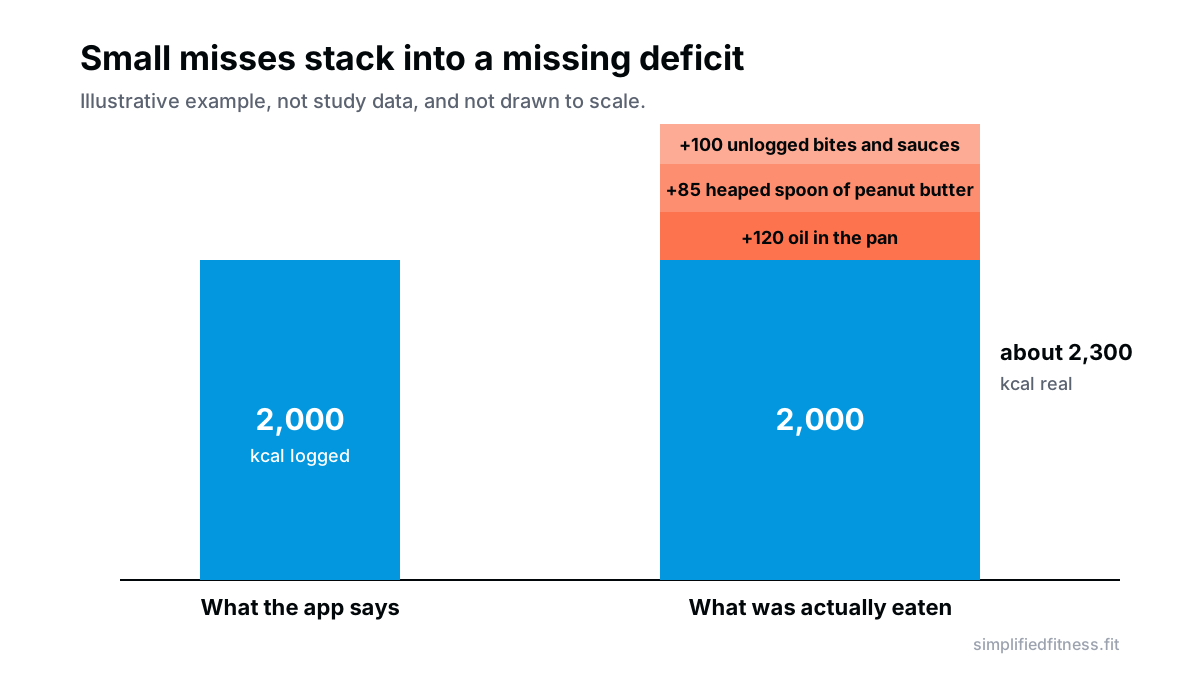
If your target deficit is around 400-500 kcal, a 300 kcal log error leaves you close to maintenance. That is why the scale seems stuck even though your app says you are cutting. For how big a deficit should be in the first place, see setting the optimal caloric deficit.
The unlogged bites, drinks and weekends
Not every error is a spoon. Many are things that never reach the log.
- Tasting while cooking, finishing a child’s plate, a handful of nuts from the jar.
- Chai with sugar, juice, cold drinks, a splash of cream.
- Weekend meals, outings and festival food, which often get “estimated” or skipped.
- Cooking for the family and logging only your own portion by guess.
If you only log after the day ends, you will forget items. Log before you eat when you can. Then weekly averages, not single days, tell you the truth. If you see a plateau, our guide to breaking fat loss plateaus covers the other suspects, including activity and water.
What to weigh and what to estimate
You do not need to weigh a cucumber. Precision matters most where calories per spoon are highest.
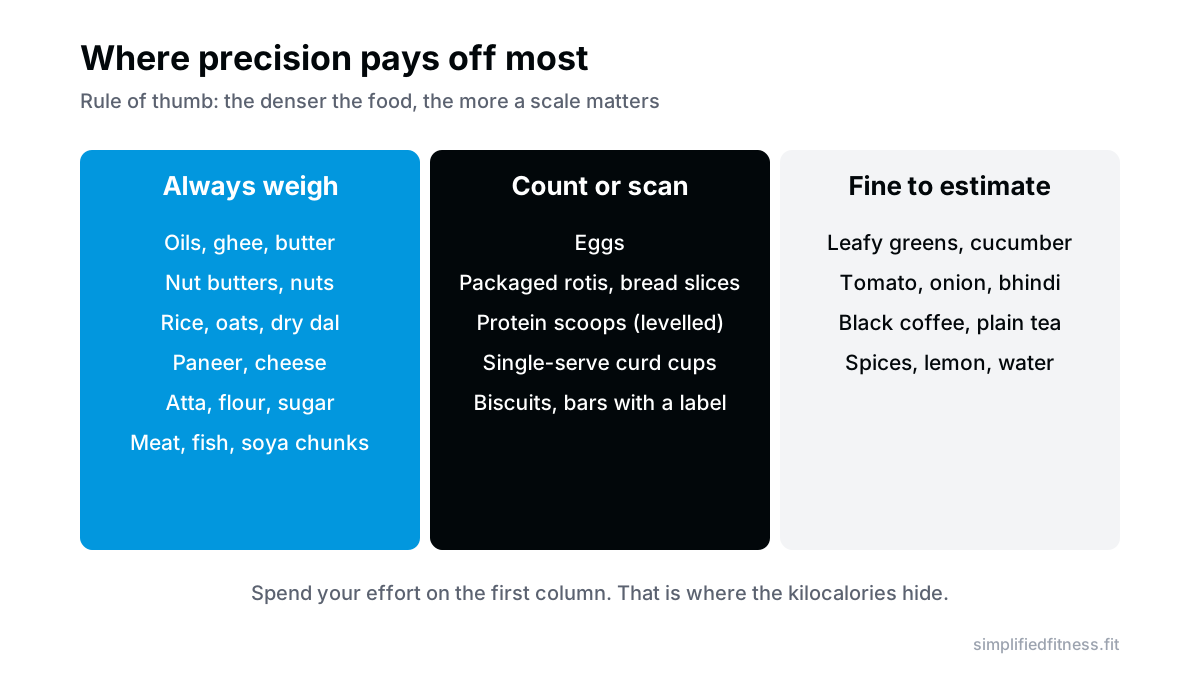
Indian staples worth weighing include ghee, oil, peanuts, rice, dry dal, atta, paneer, curd and soya chunks. For roti, count the pieces but weigh the atta once to see how many grams go in. A basic gram scale costs little and often pays for itself in clearer results.
A simple 3-step protocol to log accurately
- Calibrate for two weeks. Weigh everything calorie-dense. Notice how your usual scoops compare with the grams.
- Cook by weight. Log recipes as ingredients, weigh the finished pot, and log your portion as a fraction.
- Compare logs with the trend. Use your weekly average body weight. If the log says you are 3,500 kcal under maintenance a week, you would expect roughly half a kilo of loss, though this rule of thumb is a rough guide, not a law. If the trend does not move, assume the log is too low before assuming your metabolism is broken.
You can use our calorie calculator or macro calculator to set the target, and the free diet plan for portions in grams. When you want to pick a split, see how to calculate your macronutrient split step by step.
Daily weight moves with water, salt and food in the gut, so judge progress over 2-3 weeks. Our guide on daily scale weight fluctuations explains why.
When to see a doctor
Most stalled progress comes from intake or activity, not disease. But if you log carefully with a scale for several weeks and still see no change, or you also have unexplained fatigue, hair loss, feeling cold, big changes in your cycle or other symptoms, talk to a doctor. Some medicines and conditions affect weight, and this article cannot diagnose them. If tracking makes you anxious or leads to restrictive eating, take a break and speak to a professional.
Key takeaway
Accuracy beats perfection. A gram scale on the dense foods, honest logging of oil and sauces, and matching raw or cooked entries will fix most of the gap between what you think you ate and what you ate.
Frequently Asked Questions
Is a food scale more accurate than measuring cups?
Yes, for most foods a gram scale is more accurate than cups or spoons. Volume depends on how packed or heaped the food is, while grams do not change. For dense foods like nut butter, rice and flour, use the scale.
How much can a tablespoon of peanut butter really vary?
A level tablespoon is often listed as about 16 g, but a heaped spoon can easily reach 30 g or more. At roughly 6 kcal per gram, that is about 95 kcal versus about 180 kcal. Weigh it on a scale once and you will see how much your usual scoop holds.
Why am I not losing weight even though I hit my calories in MyFitnessPal?
The most common reason is that the logged number is lower than what you actually ate. Studies using objective methods show people tend to under-report intake, often through unlogged oils, sauces, drinks and portion size. Weigh your dense foods for two weeks and compare your scale trend with your logged deficit.
How much do people under-report their calorie intake?
It varies a lot by person and method. A 2001 review of doubly labeled water studies found self-reported intake was generally lower than measured expenditure, and a 2021 study of weight loss maintainers found they under-reported by a median of about 605 kcal a day. Treat your own log as an estimate and check it against real weight trends.
How many calories are in a tablespoon of cooking oil?
A tablespoon of oil is roughly 120 kcal, because fat provides about 9 kcal per gram and a tablespoon holds around 13-14 g. Ghee and butter are in a similar range. Weigh the oil you pour into the pan, or weigh the bottle before and after cooking.
Should I weigh food raw or cooked?
Either works if your app entry matches the state you weigh, but raw weights are usually less ambiguous for meat, rice and dal. Cooked weights change with water, so a cooked rice entry and a dry rice entry are not interchangeable. Pick one method per food and stay consistent.
Are restaurant and packaged food labels accurate?
Mostly, but not perfectly. A 2013 lab study of packaged snacks found metabolizable calories a median of about 4% above the label, and a 2011 JAMA study of restaurant foods found stated values accurate on average, but 19% of items carried at least 100 kcal more than stated. Add a small buffer when eating out.
Do I need to weigh my food forever?
No. Weighing for a few weeks trains your eye for portion sizes, so you can later weigh only the high-calorie items. The goal is a log that is close enough to predict your weight trend. Re-check with the scale for a week if progress stalls.
How do I log homemade dal or sabzi with oil accurately?
Log the recipe as separate ingredients by weight, then divide the finished dish by portions. Weigh the oil, ghee, dry dal and vegetables before cooking, and weigh the whole pot after cooking. Then log your serving as a fraction of the pot weight.
Is MyFitnessPal accurate?
For total energy and macros, a 2020 validation study found it correlated strongly with a national food database (energy r=0.96). It was weaker for sodium and cholesterol, and user-submitted entries can be wrong. Choose verified or barcode entries and check the numbers against the package.
Do liquid calories like chai, juice and cooking sauces count?
Yes, they count and they are a common blind spot. Sugar in chai, a splash of cream, juice and sauces add up even when each looks small. Log them the moment you have them.
What is the easiest first step to log more accurately?
Buy a digital gram scale and start with oil, nut butter, rice and anything calorie-dense. These foods carry the most calories per spoon, so errors there matter most. A basic kitchen scale is inexpensive and does the job.
How long should I track before deciding my calories are wrong?
Give accurate tracking at least two to three weeks and compare your weekly average weight, not single days. Daily scale weight moves with water and food volume, so one weigh-in tells you little. If your average does not change, lower intake slightly or raise activity, and see a doctor if you suspect a medical issue.
Sources & References
Every claim above is checked against peer-reviewed research (PubMed, U.S. National Library of Medicine) or guidance from established health bodies. How we fact-check.
- Lichtman SW, et al. Discrepancy between self-reported and actual caloric intake and exercise in obese subjects. N Engl J Med. 1992. PMID: 1454084
- Hill RJ, et al. The validity of self-reported energy intake as determined using the doubly labelled water technique. Br J Nutr. 2001. PMID: 11348556
- Dahle JH, et al. Underreporting of energy intake in weight loss maintainers. Am J Clin Nutr. 2021. PMID: 33742193
- Burke LE, et al. Self-monitoring in weight loss: a systematic review of the literature. J Am Diet Assoc. 2011. PMID: 21185970
- Evenepoel C, et al. Accuracy of nutrient calculations using the consumer-focused online app MyFitnessPal: validation study. J Med Internet Res. 2020. PMID: 33084583
- Urban LE, et al. Accuracy of stated energy contents of restaurant foods. JAMA. 2011. PMID: 21771989
- Jumpertz R, et al. Food label accuracy of common snack foods. Obesity (Silver Spring). 2013. PMID: 23505182

Umair Hazrami · Founder & Head Coach, Simplified Fitness
Umair Hazrami founded Simplified Fitness and the Simplified Lifter channel to cut through fitness noise. With 4+ years of consistent training and 10+ coaching clients, he writes every guide from the peer-reviewed research and links the sources so you can check them. Our editorial standards.
Educational content only, not medical advice. If you have a medical condition, are pregnant, or take medication, talk to a qualified doctor before changing your diet, supplements or training. Full disclaimer.
Keep reading
Nutrition
Body Recomposition: Who Can Lose Fat and Build Muscle at the Same Time?
How to do body recomposition: who can lose fat and build muscle at once, what the trials show, and a protein, training and calorie protocol you can start today.
8 min read
Nutrition
Breaking Fat Loss Plateaus: Check Fluid, Hidden Calories and NEAT
How to break a fat loss plateau: a 3-step check of water masking, hidden calories and lower daily steps, plus the exact fix to restart steady fat loss.
8 min read

Nutrition
How to Calculate Macros: Step-by-Step Grams per Kilogram Formula for Protein, Fat and Carbs
How to calculate macros in grams per kg: set protein, set fat, fill the rest with carbs. Worked examples for 70, 80 and 90 kg lifters on a cut or a bulk.
9 min read
Nutrition
Daily Scale Weight Fluctuations: Sodium, Bowels, Glycogen and Water
Daily scale weight fluctuations are mostly water, glycogen and gut contents, not fat. Learn why your weight jumps overnight and how a 7-day average fixes it.
8 min read