The Starvation Mode Myth: What Really Happens to Metabolism in a Long Calorie Deficit
Starvation mode myth debunked: eating 1,200 calories does not make you store fat. See what the Minnesota experiment showed and what really stalls the scale.

TL;DR. The short answer
- Starvation mode, meaning a body that gains or holds fat while truly eating too little, is not supported by the research. In the Minnesota experiment, men on a prolonged severe deficit kept losing weight until many had lost over 25% of body mass.
- Metabolism does adapt to dieting. Energy expenditure can fall by more than the loss of body mass predicts (adaptive thermogenesis), but this slows loss rather than stopping it.
- When the scale stalls on a 'low' intake, the usual causes are under-logged food, a quiet drop in daily movement, and water retention, not fat storage.
- Very low calorie diets are still a bad idea for most lifters: they lack long-term advantages over moderate deficits and may cost extra lean mass.
- Stalled for weeks while eating very little, or feeling dizzy, cold and exhausted? See a doctor rather than cutting further.
Part of our complete guide: The No-BS Guide to Energy Balance, Fat Loss, Bulking & Body Recomposition
Table of contents
The starvation mode myth, debunked in one line: a body that is genuinely eating too little does not hold on to fat or gain it. It loses weight, and a lot of it. Metabolism does adapt to a long deficit, but that adaptation slows progress, it does not reverse it.
If you have been told that eating 1,200 calories will make your body “store everything as fat”, this article is for you. It sits inside our wider guide to energy balance, fat loss, bulking and recomposition, and it focuses on one question: what really happens when you eat very little for a long time, and why the scale sometimes stops moving anyway.
What is “starvation mode” supposed to be?
The claim usually goes like this. Eat too little, your body panics, metabolism shuts down, and from then on every meal turns to fat. So you should eat more to lose weight.
There is a true seed buried in there. Your body does respond to dieting. It just does not respond in the way the claim says. Two things get mixed up: metabolic adaptation (a real but limited drop in energy use) and fat gain on a deficit (not supported by evidence). Let’s separate them.
What did the Minnesota Starvation Experiment actually show?
This is the study everyone cites and few read. During World War II, 36 conscientious objectors took part in a study led by Ancel Keys at the University of Minnesota. They went through prolonged semi-starvation, and most lost more than 25% of their body weight (Kalm and Semba, 2005). Many developed anemia, fatigue, apathy, extreme weakness, irritability and lower-leg edema.
Read that again. The outcome of severe, prolonged under-eating was emaciation. Nobody stalled at a comfortable weight and nobody gained fat while eating less.
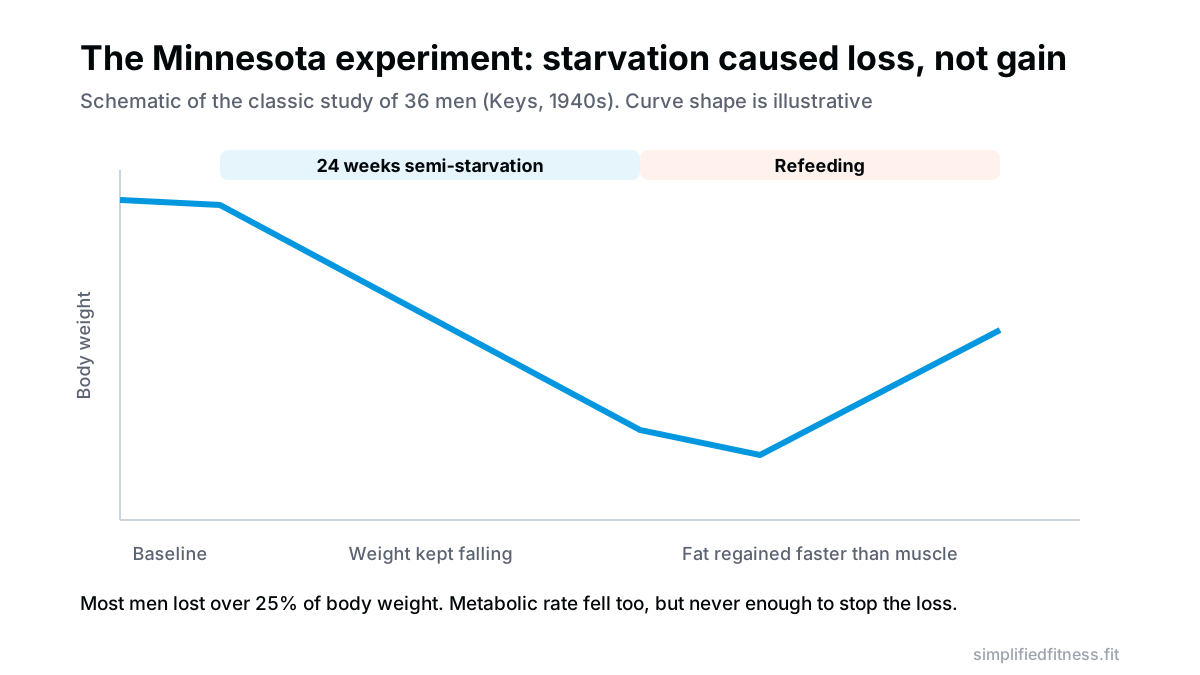
Later re-analyses of the data from 32 of the men found that basal metabolic rate fell by more than changes in lean and fat mass explained, and that this extra drop was linked to how much fat mass had been depleted (Dulloo and Jacquet, 1998). So metabolic slowdown was real. It just was not strong enough to stop the men wasting away.
Does metabolism stop in starvation mode?
No. It slows. The technical name is adaptive thermogenesis, a reduction in energy expenditure beyond what the loss of body mass alone would predict.
A review in the Journal of the International Society of Sports Nutrition describes energy restriction as bringing changes in hormones, mitochondrial efficiency and energy expenditure that work to minimise the deficit, attenuate weight loss and promote regain (Trexler et al., 2014). Note the wording: attenuate, not abolish.
The ISSN position stand adds two cautions. Adaptive thermogenesis can occur with weight loss, but it is not an inevitable response, and it may attenuate substantially once weight is stable (Aragon et al., 2026). Part of the slowdown is also simply that a lighter body burns less. For the full picture, see our deep dive on metabolic adaptation and adaptive thermogenesis.
Why did my weight loss stall if I eat so little?
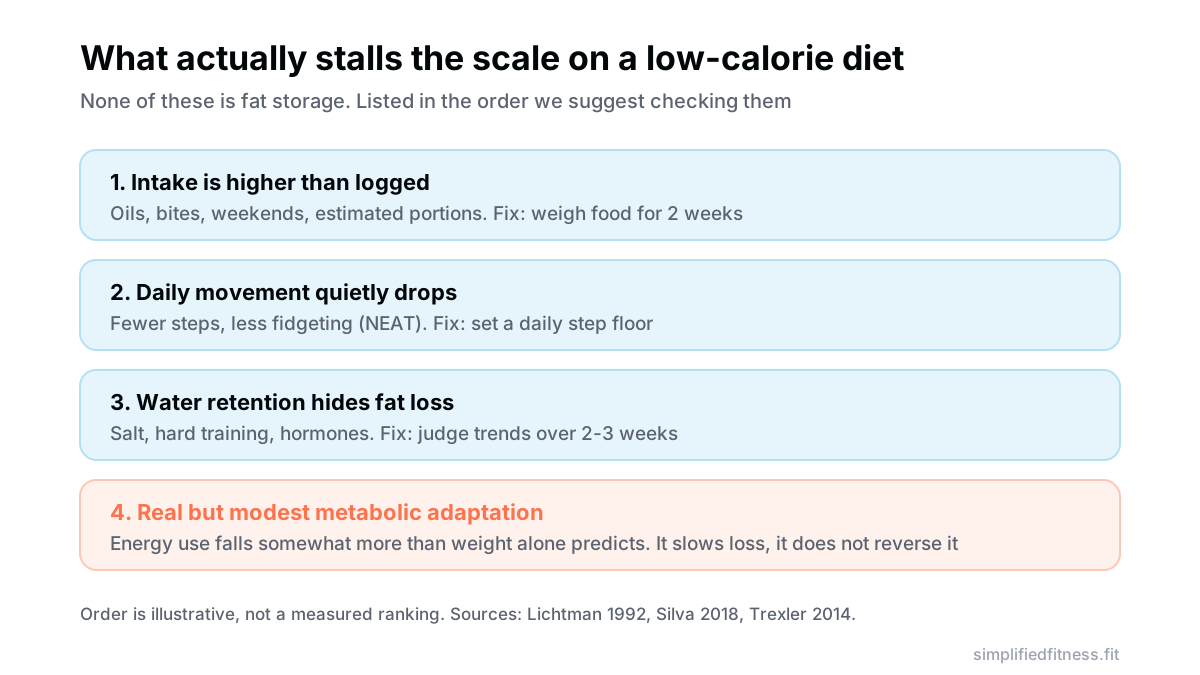
This is the real question behind the myth. Three explanations are far more likely than “starvation mode”.
1. You are eating more than you think
The best-known test is a 1992 New England Journal of Medicine study. Researchers examined obese people who reported being unable to lose weight on under 1,200 kcal a day. Their measured energy expenditure was within 5% of predicted values. Their actual intake, however, was underreported by an average of 47%, and they overreported physical activity by 51% (Lichtman et al., 1992). The authors concluded the failure to lose weight was due to higher real intake and overestimated activity, not abnormal thermogenesis.
This is one small study of ten diet-resistant patients, so do not assume it applies to you. But it points to the first thing to check: the log. Cooking oil, ghee on rotis, a handful of nuts, weekend meals, restaurant portions and “just a bite” rarely get written down. Our guide to food logging precision shows how to close it.
2. You are moving less without noticing
When calories drop, many people unconsciously stand less, fidget less and take fewer steps. This is non-exercise activity thermogenesis, or NEAT. A systematic review of 36 articles (1,561 participants) found compensation in NEAT or non-exercise activity in 63% of diet-only intervention arms. The authors note that the studies were underpowered and the evidence does not clearly confirm the effect in healthy adults (Silva et al., 2018).
So the effect may be real, but it is not proven. The cheap fix is the same either way: set a daily step floor and keep it.
3. Water is hiding the fat loss
Body weight is fat plus water plus food in your gut plus glycogen. A hard training week, a salty dinner or monthly hormonal swings can add a kilo or more of water, which can mask a real drop in fat for days or weeks. You will often see people blame cortisol for this. I would be cautious: the idea is popular, but the studies I reviewed for this article do not establish it, so treat it as plausible, not proven. We cover the pattern in water retention and the whoosh effect.
Does eating less than 1,200 calories backfire?
Not through fat storage, but there are good reasons to avoid it. The ISSN position stand says very-low-energy (under 800 kcal) and low-energy (800-1,200 kcal) diets produce greater short-term weight loss but lack long-term advantages over less aggressive restriction. It adds that they may increase lean mass loss, though adequate protein and resistance training may mitigate this, and it warns about vitamin, mineral and fibre insufficiencies (Aragon et al., 2026).
For a lifter, that is the actual cost: hunger, low energy in training, poorer adherence and extra muscle loss. Not a magical fat-storing switch. To pick a pace that fits your situation, read moderate versus aggressive caloric deficits, and get a starting number from the calorie calculator.
| Claim | What the evidence supports |
|---|---|
| “Eating too little makes you gain fat” | Not supported. Severe restriction caused weight loss in the Minnesota men |
| “Metabolism shuts off” | Not supported. Energy use can fall more than expected, which slows loss |
| “I eat 1,200 kcal and cannot lose” | Often under-logged intake (47% underreported in one study) |
| “It is permanent” | Uncertain. ISSN says adaptation is not inevitable and can attenuate at stable weight |
| “Crash dieting is fine then” | No. Low-energy diets lack long-term advantages and may cost muscle |
What happens when you eat more again after a very low calorie diet?
Here is where the myth gets its kernel of truth. In the Minnesota experiment, the men who were refed regained fat faster than lean tissue. A re-analysis found that the drop in thermogenesis during weight loss persisted at week 12 of refeeding and was linked to disproportionate fat recovery, and that people with higher starting body fat tended to deposit more fat on refeeding (Dulloo et al., 1996). A later review describes these “famine reactions” as driving weight regain and obesity relapse (Dulloo, 2021).
So the danger is not gaining fat while you starve. It is the rebound after you stop. That is a case against crash diets, not for eating more during a diet. A slow, moderate deficit, a gradual return to maintenance, and planned diet breaks all make rebound less likely, though human data on the best approach are still limited.
A practical plan if you think you are stuck
- Audit for two weeks. Weigh food, count oils and sauces, and use the same cooking measures daily.
- Set a step floor. Pick a number you can hit every day, such as 8,000-10,000, and stay there as weight drops.
- Keep protein high and lift. The ISSN calls resistance training and sufficient protein indispensable for limiting lean mass loss in a deficit, and notes 1.6-2.2 g/kg with training may optimise muscle anabolism. Use our protein calculator.
- Judge trends, not days. Use two to three week averages, not a single morning weigh-in.
- Cut small if needed. A further 100-200 kcal, or more steps, beats dropping to 1,000 kcal.
- Plan the exit. Move to maintenance gradually. For an Indian-style starting framework, see our diet plan, which uses dal, paneer, curd and rotis in realistic portions.
When to see a doctor
If you are eating very little and feeling dizzy, cold, weak, losing hair, missing periods, or you are preoccupied with food and weight, speak to a doctor or registered dietitian. Those signs can point to under-fuelling or an eating disorder, and neither is something to fix with willpower. Likewise, if your weight is flat or rising despite verified low intake, ask a doctor to check for thyroid or other medical causes. Nothing here is a diagnosis.
The bottom line
Starvation mode, as the internet tells it, is a myth. Severe restriction causes wasting, as the Minnesota men showed. Metabolism does adapt, but modestly, and in a way that slows loss rather than stopping it. When the scale stalls, audit your intake, your movement and your water trends first. If you want help setting this up, start with the energy balance guide and a calorie target you can actually sustain.
Frequently Asked Questions
Is starvation mode real?
Not in the way the internet describes it. Your body does reduce energy use during a long deficit, but there is no evidence it switches into fat storage while you are genuinely under-eating. The Minnesota experiment showed men on severe restriction kept losing weight, which is the opposite of the myth. If your weight is not moving, check your logging and daily movement first.
Can you stop losing weight by eating too little?
Weight loss can slow, but a true halt in a real deficit is unlikely. Studies of people who said they could not lose weight on under 1,200 kcal found they were eating far more than they reported. Weigh your food for two weeks before concluding your body has stopped responding.
Does eating 1,200 calories put your body in starvation mode?
No. 1,200 kcal is a low-energy diet, not starvation, and it usually produces weight loss in the short term. The real problems are hunger, poor adherence and possibly extra muscle loss, which is why the ISSN notes these diets lack long-term advantages over moderate deficits. A moderate deficit you can sustain is usually the better choice for lifters.
Does metabolism stop in starvation mode?
No. Metabolism slows somewhat, partly because you weigh less and partly through adaptive thermogenesis, but it does not stop or reverse. Reviews describe this as a reduction in energy expenditure that attenuates weight loss, not one that prevents it. Keep protein high and train with weights to limit the slowdown.
What was the Minnesota Starvation Experiment?
It was a study run by Ancel Keys in the 1940s in which 36 healthy men underwent prolonged semi-starvation followed by refeeding. Most lost over 25% of their body weight and developed fatigue, apathy, weakness and edema. It is the main reason we know severe restriction causes wasting, not fat gain.
Why did my weight loss stall even though I eat very little?
The most common reasons are underestimated intake, reduced non-exercise movement, and water retention masking fat loss. In one NEJM study, diet-resistant patients underreported food intake by an average of 47%. Weigh food, track steps, and judge progress over two to three weeks.
Does eating too little slow your metabolism permanently?
Evidence suggests the slowdown is not an inevitable lifelong change; the ISSN says adaptive thermogenesis is not inevitable and may attenuate substantially once weight is stable. Long-term data are limited and individual responses vary. Avoiding crash diets and spending some time at maintenance after a long diet is a sensible precaution.
Does skipping meals cause your body to store fat?
No. Total daily energy and protein matter far more than meal timing, and the ISSN states meal frequency does not tend to crucially influence fat loss. Missing a meal does not flip a fat storage switch. Pick a meal pattern you can stick to.
Why do I gain weight when I start eating more after a very low calorie diet?
Some of it is glycogen, water and food bulk returning, which is not fat. The rest is real: in the Minnesota men, fat regain outpaced muscle regain during refeeding. Raise calories gradually and keep lifting.
How do I know if I am really in a calorie deficit?
Compare your average scale weight over two to three weeks with your logged intake. If weight is flat, your true intake is probably near maintenance, whatever the log says. Weigh food with a digital scale and use a calorie calculator to set a realistic target.
Is it bad to eat under 1,200 calories a day?
For most people it is not a good idea without medical supervision. The ISSN cautions about vitamin, mineral and fibre insufficiencies on aggressive diets and about greater lean mass loss. See a doctor or registered dietitian if you are considering going this low.
Do refeeds or diet breaks fix starvation mode?
There is no starvation mode to fix, but planned breaks can help adherence and may ease some adaptation. The evidence is still developing and results are mixed. Try a one to two week stretch at maintenance if you feel run down.
Sources & References
Every claim above is checked against peer-reviewed research (PubMed, U.S. National Library of Medicine) or guidance from established health bodies. How we fact-check.
- Kalm LM, et al. They starved so that others be better fed: remembering Ancel Keys and the Minnesota experiment. J Nutr. 2005. PMID: 15930436
- Dulloo AG. Physiology of weight regain: lessons from the classic Minnesota Starvation Experiment on human body composition regulation. Obes Rev. 2021. PMID: 33543573
- Dulloo AG, et al. Adaptive reduction in basal metabolic rate in response to food deprivation in humans: a role for feedback signals from fat stores. Am J Clin Nutr. 1998. PMID: 9734736
- Dulloo AG, et al. Autoregulation of body composition during weight recovery in human: the Minnesota Experiment revisited. Int J Obes Relat Metab Disord. 1996. PMID: 8696417
- Trexler ET, et al. Metabolic adaptation to weight loss: implications for the athlete. J Int Soc Sports Nutr. 2014. PMID: 24571926
- Lichtman SW, et al. Discrepancy between self-reported and actual caloric intake and exercise in obese subjects. N Engl J Med. 1992. PMID: 1454084
- Silva AM, et al. What is the effect of diet and/or exercise interventions on behavioural compensation in non-exercise physical activity and related energy expenditure of free-living adults? A systematic review. Br J Nutr. 2018. PMID: 29845903
- Aragon AA, et al. International Society of Sports Nutrition position stand: diets for body weight reduction. J Int Soc Sports Nutr. 2026. PMID: 42867412

Umair Hazrami · Founder & Head Coach, Simplified Fitness
Umair Hazrami founded Simplified Fitness and the Simplified Lifter channel to cut through fitness noise. With 4+ years of consistent training and 10+ coaching clients, he writes every guide from the peer-reviewed research and links the sources so you can check them. Our editorial standards.
Educational content only, not medical advice. If you have a medical condition, are pregnant, or take medication, talk to a qualified doctor before changing your diet, supplements or training. Full disclaimer.
Keep reading
Nutrition
Body Recomposition: Who Can Lose Fat and Build Muscle at the Same Time?
How to do body recomposition: who can lose fat and build muscle at once, what the trials show, and a protein, training and calorie protocol you can start today.
8 min read

Nutrition
Breaking Fat Loss Plateaus: Check Fluid, Hidden Calories and NEAT
How to break a fat loss plateau: a 3-step check of water masking, hidden calories and lower daily steps, plus the exact fix to restart steady fat loss.
8 min read

Nutrition
How to Calculate Macros: Step-by-Step Grams per Kilogram Formula for Protein, Fat and Carbs
How to calculate macros in grams per kg: set protein, set fat, fill the rest with carbs. Worked examples for 70, 80 and 90 kg lifters on a cut or a bulk.
9 min read
Nutrition
Daily Scale Weight Fluctuations: Sodium, Bowels, Glycogen and Water
Daily scale weight fluctuations are mostly water, glycogen and gut contents, not fat. Learn why your weight jumps overnight and how a 7-day average fixes it.
8 min read