Setting the Optimal Caloric Deficit: Moderate (15-20%) vs Aggressive (25%+) Compared
How big should your calorie deficit be? Compare moderate 15-20% and aggressive 25%+ cuts, the 0.5-1% weekly loss rule, and kcal examples for lifters.

TL;DR. The short answer
- For most lifters, a moderate deficit of about 15-20% below maintenance (roughly 300-500 kcal for many people) is the best default. It targets a loss of about 0.5-1% of body weight per week, the range recommended for muscle retention.
- In a randomized trial of 24 elite athletes, losing about 0.7% of body weight a week preserved and even added lean mass, while a faster plan (targeting 1.4% a week, about 1.0% achieved) did not. The sample was small, so treat it as a strong hint, not a law.
- A fixed 500 vs 1000 kcal cut means different things for different people. Set your deficit as a percentage of your own maintenance, then adjust using 2-3 weeks of scale trend.
- Aggressive deficits (25%+) are not forbidden. They can suit short phases, higher body fat and high protein intake, but they raise the odds of lost muscle, flat training and a failed diet.
- If you feel constantly drained, your lifts keep falling, or you have a history of disordered eating, scale back and speak to a doctor or registered dietitian.
Part of our complete guide: The No-BS Guide to Energy Balance, Fat Loss, Bulking & Body Recomposition
Table of contents
How big should a calorie deficit be? For most lifters, about 15-20% below maintenance, which usually means a cut of roughly 300-500 kcal a day and a loss of about 0.5-1% of body weight per week. That range is what the sports nutrition literature recommends when the goal is losing fat while holding on to muscle (see our energy balance and fat loss guide for the bigger picture).
Bigger cuts work faster on the scale. They also tend to cost more in training quality, hunger and, sometimes, muscle. This guide focuses on one question: how much to cut, and when going harder is worth it.
Moderate vs aggressive: what we mean
Percentages beat fixed numbers, because the same 500 kcal means very different things for different bodies.
- Moderate deficit: about 15-20% below maintenance (TDEE). Typical loss rate: about 0.5-0.75% of body weight a week.
- Aggressive deficit: about 25% or more below maintenance. Typical loss rate: about 1% or more per week.
Maintenance itself is an estimate. If you want to see how it is built, read TDEE deconstructed: BMR, TEF, EAT and NEAT, or just get a starting number from our calorie calculator.
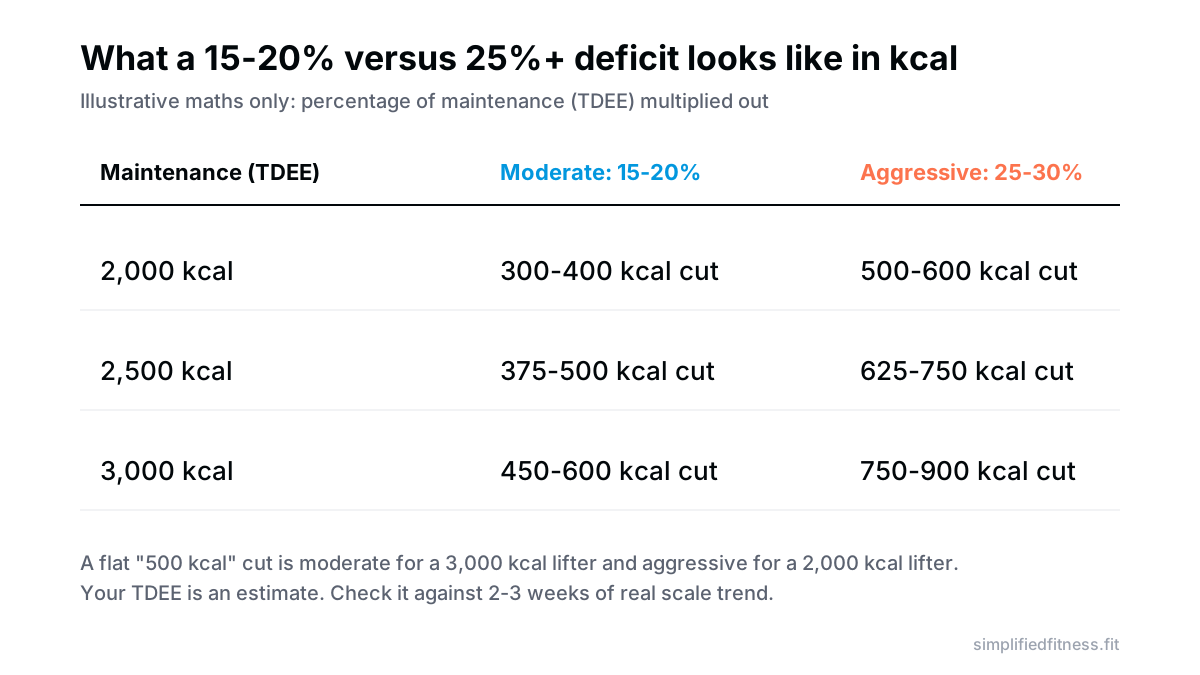
500 calorie deficit vs 1000: why the number alone misleads
People love asking “500 or 1000?” Here is the reality: it depends entirely on where you start.
A 90 kg lifter maintaining at 3,200 kcal who cuts 500 is at about 16%. Moderate. A 60 kg lifter maintaining at 2,000 who cuts 500 is at 25%. Aggressive. Same number, different diet.
A rough rule of thumb says about 7,700 kcal equals a kilo of body fat, so 500 kcal a day is around 0.45 kg a week. That rule is a simplification and tends to overpredict long-term loss, because your body adapts as you lose weight. Use it for planning, not for promises.
A 1,000 kcal daily cut is a 30%+ deficit for nearly everyone below 3,300 kcal maintenance. It is a short-phase tool at best.
What the research says about loss rate
The Garthe trial
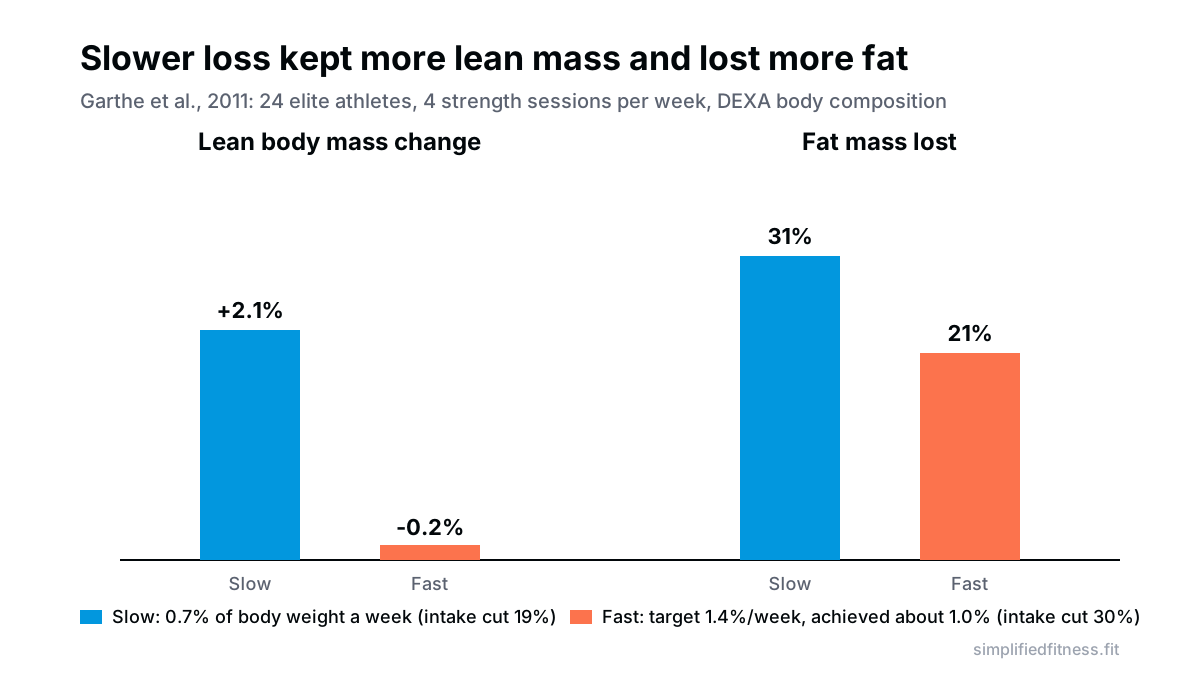
The best-known study here is Garthe and colleagues’ 2011 randomized trial. Twenty-four elite athletes were assigned to either a slow reduction (about 0.7% of body weight per week, intake cut about 19%) or a fast reduction (target 1.4% per week, intake cut about 30%). Everyone did four resistance sessions a week (Garthe et al., 2011).
Both groups lost about 5.5% of body weight, and the fast group actually averaged about 1.0% a week rather than the planned 1.4%. But lean body mass rose by 2.1% in the slow group and stayed unchanged (-0.2%) in the fast group. Fat mass fell 31% in the slow group versus 21% in the fast group.
The practical range
A review of natural bodybuilding preparation recommended setting calories to produce losses of about 0.5-1% of body weight per week to maximize muscle retention (Helms et al., 2014). This is expert-informed guidance based on the literature, not a result from one definitive trial, but it matches Garthe’s findings well.
For an 80 kg lifter, 0.5-1% is about 0.4-0.8 kg a week. For a 60 kg lifter, about 0.3-0.6 kg.
Where it gets murkier
A 2022 meta-analysis and meta-regression pooled randomized trials of resistance training in an energy deficit lasting 3 weeks or more. Lean mass gains were impaired compared with training in no deficit, while strength gains were comparable. The authors’ regression suggested a deficit of about 500 kcal a day prevented lean mass gains, and they advised people trying to preserve muscle to avoid deficits above 500 kcal a day (Murphy and Koehler, 2022).
That 500 kcal figure is an average across studies with different body sizes, training backgrounds and diets, so it is not a personal cut-off. It does point in the same direction as the percentage-based advice: smaller is safer for muscle.
A different picture comes from a 2016 trial in young men eating about 40% below requirements for four weeks while training hard six days a week. Lean mass rose by 1.2 kg on 2.4 g/kg of protein but was unchanged (+0.1 kg) on 1.2 g/kg (Longland et al., 2016). Why the difference? Very high protein, a large training stimulus, and a short window. These were also young men, and the work was done under tightly controlled conditions that most people cannot copy for months.
The cautious takeaway: a big deficit is not automatically muscle loss, but it removes your margin for error. Protein and training have to be right.
Moderate vs aggressive deficit: the comparison
| Factor | Moderate (15-20%) | Aggressive (25%+) |
|---|---|---|
| Typical weekly loss | About 0.5-0.75% of body weight | About 1% or more |
| Muscle retention | Better odds, easier to protect | Higher risk, needs excellent protein and training |
| Gym performance | Usually maintained | More likely to slip, especially volume and recovery |
| Hunger and mood | Manageable for most | Often harder, especially after several weeks |
| Adherence | Easier to sustain | Easier to break, then rebound |
| Best for | Most lifters, longer cuts | Short phases, higher body fat, deadline-driven |
Hunger and mood differences in this table reflect common coaching experience and the known hormonal and energy adaptations of dieting, not a single controlled comparison. Energy restriction is associated with changes in hormones, mitochondrial efficiency and energy expenditure that work to reduce the deficit (Trexler et al., 2014). One piece of that, covered in metabolic adaptation to weight loss, is that people often move less without noticing. Aggressive cuts probably amplify this, although the size of the effect varies a lot between people.
Who should pick which
Lean towards moderate if:
- you are already fairly lean (visible abs, or close to it)
- you have trained for several years and want to keep every kilo of muscle
- you plan to diet for more than 8-10 weeks
- you have a job, family or heat that already drains your energy
Aggressive can be reasonable if:
- you have a lot of body fat to lose, since the fat stores provide a buffer
- you are using a short, defined block (see the mini-cut strategy)
- protein is high and you are lifting heavy with full effort
- you have a plan to return to maintenance afterwards
A common mistake is picking the biggest deficit you can tolerate in week one, then discovering by week four that you cannot sustain it. The best deficit is the one you can still follow in week twelve.
How to set your deficit: step by step
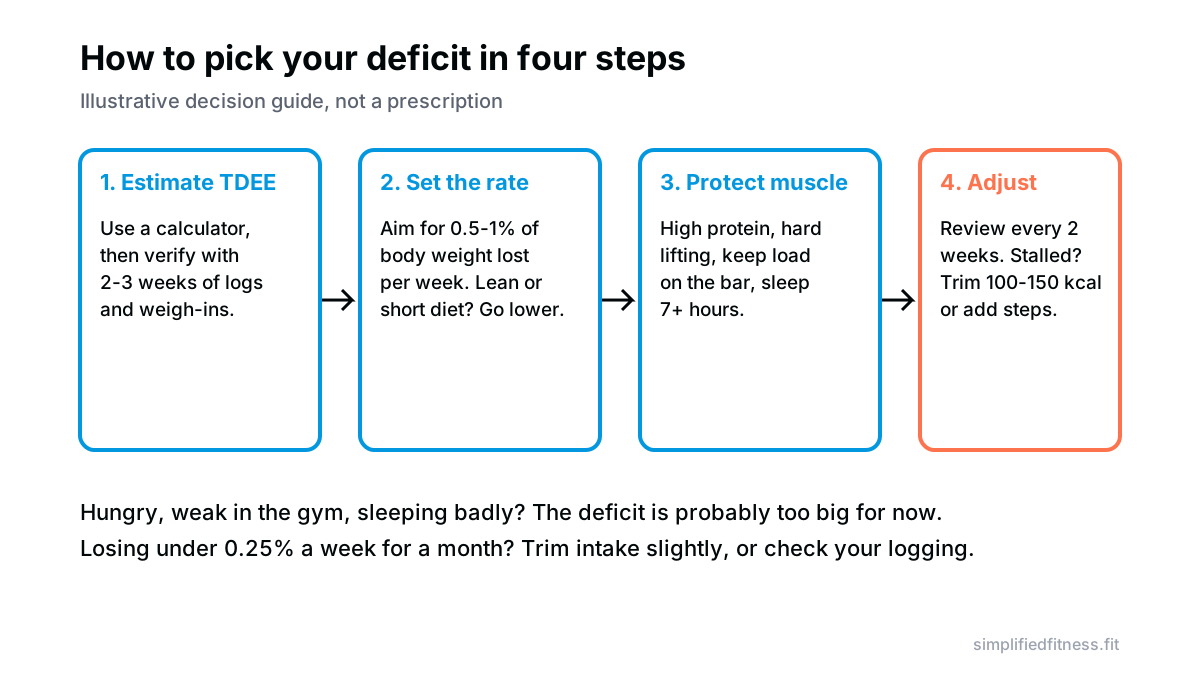
- Estimate maintenance. Use the calorie calculator as a starting point. Eat that amount for 2-3 weeks while logging honestly and weighing yourself daily (or at least four times a week). If your weight is flat, you found maintenance.
- Pick a percentage. Start with 15-20%. Example: maintenance 2,500 kcal, deficit 20%, target 2,000 kcal.
- Check the rate. Compare your 2-week average weight to the previous 2 weeks. You want roughly 0.5-1% per week. Losing less? Check logging first (see breaking fat loss plateaus). Losing more and feeling terrible? Add 100-200 kcal.
- Set protein and training. Hold protein high (our high protein while cutting guide goes deeper) and keep lifting with the same loads. Do not cut volume sharply. Steady steps also help, as covered in NEAT vs intense cardio for fat loss.
- Adjust every 2 weeks, not every 2 days. Daily weight swings of a kilo or more come from water and food, not fat.
An Indian lifter’s example
Say you are a 75 kg vegetarian lifter in Bengaluru, maintaining at about 2,600 kcal. A 20% deficit is about 2,080 kcal, roughly 520 kcal below maintenance. Target loss: about 0.4-0.75 kg a week.
On a budget, protein is the constraint, not calories. Dal, curd, paneer, soya chunks and milk can do much of the work, but vegetarian eating is naturally bulkier and lower in protein per calorie. You may need a whey scoop or extra soya to reach your target without blowing the calorie budget. Cutting roti and rice a little is enough; there is no need to drop carbs entirely, because they fuel training.
Heat matters too. In hot weather, you may find sessions feel harder during a deficit. Adjust with a slightly smaller cut or an extra rest day before you blame your discipline.
When to see a doctor
Dieting is not risk-free for everyone. See a doctor or registered dietitian before starting a deficit if you are pregnant or breastfeeding, have diabetes or are on glucose-lowering medication, have a heart or kidney condition, or have a history of an eating disorder. Stop and get advice if you notice missed periods, dizziness, fainting, persistently low mood, or food thoughts that feel out of control. The point of a cut is to improve your health and physique, not to cost you either.
The bottom line
Start with a moderate deficit of about 15-20%, aim for 0.5-1% of body weight lost per week, hold protein high and keep lifting hard. Move towards an aggressive deficit only for a short, planned phase and only if your body fat, protein and training support it. Evidence here comes from small trials in athletes and reviews, so expect to adjust based on your own data.
Want help setting numbers for your body? Start with the calorie calculator and our macro calculator.
Frequently Asked Questions
How big should my calorie deficit be?
For most lifters, a deficit of about 15-20% below maintenance is a sensible starting point. That usually produces a loss of about 0.5-1% of body weight per week, the range recommended for retaining muscle during a cut [(Helms et al., 2014)](https://pubmed.ncbi.nlm.nih.gov/24864135/). Calculate your maintenance with the calorie calculator, then adjust after two to three weeks of real data.
Is a 500 calorie deficit enough to lose fat?
Yes, for many people a 500 kcal daily deficit is a solid, sustainable rate of fat loss. It is moderate for someone eating around 2,500-3,000 kcal at maintenance and fairly aggressive for someone at 1,800-2,000 kcal. Judge it by your weekly weight trend, not the number alone.
Is a 1000 calorie deficit too much?
For most lifters it is too much, especially if maintenance is below about 3,000 kcal. A cut that large is a 30% or bigger deficit for most people and tends to cost training quality, hunger control and muscle. It can be used in short phases by larger or higher-body-fat individuals with high protein and hard training, but it is not a good everyday default.
What is the best rate of weight loss per week for lifters?
About 0.5-1% of body weight per week is the commonly recommended range for muscle retention. Leaner lifters should stay near the lower end, while people with more body fat can sit nearer the top. For an 80 kg person that is roughly 0.4-0.8 kg per week.
Do aggressive deficits cause muscle loss?
They can, but it is not automatic. A 2011 trial in elite athletes found that a faster loss plan (targeting 1.4% of body weight per week, about 1.0% achieved) did not add lean mass, while a slower one (about 0.7%) did, with both groups lifting four times a week [(Garthe et al., 2011)](https://pubmed.ncbi.nlm.nih.gov/21558571/). Keep protein high and lifting hard to limit the risk.
Can I build muscle in a calorie deficit?
Beginners, people returning after a break and those with higher body fat often can, especially with high protein and progressive training. A 2016 trial in young men found lean mass rose by 1.2 kg on 2.4 g/kg protein despite a large deficit over 4 weeks [(Longland et al., 2016)](https://pubmed.ncbi.nlm.nih.gov/26817506/). Experienced lifters at lower body fat should expect to maintain muscle rather than add it.
How do I calculate a 20% calorie deficit?
Multiply your maintenance calories by 0.8. If you maintain at 2,500 kcal, a 20% deficit is 2,000 kcal per day, a 500 kcal cut. Use our calorie calculator for the maintenance estimate, since the formula result is only a starting guess.
Does a bigger deficit burn fat faster?
Yes on the scale, up to a point. A bigger deficit produces faster weight loss, but more of that loss can come from lean mass, and the diet is harder to follow. Energy restriction also triggers adaptations in hormones and energy expenditure that work against further loss [(Trexler et al., 2014)](https://pubmed.ncbi.nlm.nih.gov/24571926/).
How long can I stay in a calorie deficit?
There is no single cut-off. Moderate deficits are easier to sustain for 8-16 weeks or longer, while aggressive ones are usually better kept to shorter blocks of a few weeks. If your performance, mood or sleep decline steadily, end the phase or take a planned break at maintenance.
Why am I not losing weight in a 500 calorie deficit?
The most common reasons are an overestimated maintenance, underreported food intake and fewer daily steps than you think. Weight also moves several hundred grams day to day with water and food volume, so judge 2-3 weeks of average, not a single weigh-in. Re-check portions with a food scale before cutting calories further.
Should women use a smaller deficit than men?
Use the same percentage-based approach, because a percentage already scales to body size and maintenance calories. Many smaller people will land on a smaller kcal number, and the sources used here do not set a separate weekly target for women. Watch for warning signs such as missed periods, constant fatigue or obsessive food thoughts, and see a doctor if they appear.
Do I need to cut protein or training when dieting hard?
No, protein and training are what protect your muscle while you cut. Higher protein (2.4 g/kg versus 1.2 g/kg) produced better lean mass and fat loss results in one 4-week deficit trial [(Longland et al., 2016)](https://pubmed.ncbi.nlm.nih.gov/26817506/). Keep lifting heavy with the same exercises and aim to hold your strength.
Sources & References
Every claim above is checked against peer-reviewed research (PubMed, U.S. National Library of Medicine) or guidance from established health bodies. How we fact-check.
- Garthe I, et al. Effect of two different weight-loss rates on body composition and strength and power-related performance in elite athletes. Int J Sport Nutr Exerc Metab. 2011. PMID: 21558571
- Garthe I, et al. Long-term effect of weight loss on body composition and performance in elite athletes. Int J Sport Nutr Exerc Metab. 2011. PMID: 21896944
- Helms ER, et al. Evidence-based recommendations for natural bodybuilding contest preparation: nutrition and supplementation. J Int Soc Sports Nutr. 2014. PMID: 24864135
- Trexler ET, et al. Metabolic adaptation to weight loss: implications for the athlete. J Int Soc Sports Nutr. 2014. PMID: 24571926
- Murphy C, et al. Energy deficiency impairs resistance training gains in lean mass but not strength: a meta-analysis and meta-regression. Scand J Med Sci Sports. 2022. PMID: 34623696
- Longland TM, et al. Higher compared with lower dietary protein during an energy deficit combined with intense exercise promotes greater lean mass gain and fat mass loss: a randomized trial. Am J Clin Nutr. 2016. PMID: 26817506

Umair Hazrami · Founder & Head Coach, Simplified Fitness
Umair Hazrami founded Simplified Fitness and the Simplified Lifter channel to cut through fitness noise. With 4+ years of consistent training and 10+ coaching clients, he writes every guide from the peer-reviewed research and links the sources so you can check them. Our editorial standards.
Educational content only, not medical advice. If you have a medical condition, are pregnant, or take medication, talk to a qualified doctor before changing your diet, supplements or training. Full disclaimer.
Keep reading

Nutrition
Body Recomposition: Who Can Lose Fat and Build Muscle at the Same Time?
How to do body recomposition: who can lose fat and build muscle at once, what the trials show, and a protein, training and calorie protocol you can start today.
8 min read

Nutrition
Breaking Fat Loss Plateaus: Check Fluid, Hidden Calories and NEAT
How to break a fat loss plateau: a 3-step check of water masking, hidden calories and lower daily steps, plus the exact fix to restart steady fat loss.
8 min read

Nutrition
How to Calculate Macros: Step-by-Step Grams per Kilogram Formula for Protein, Fat and Carbs
How to calculate macros in grams per kg: set protein, set fat, fill the rest with carbs. Worked examples for 70, 80 and 90 kg lifters on a cut or a bulk.
9 min read

Nutrition
Daily Scale Weight Fluctuations: Sodium, Bowels, Glycogen and Water
Daily scale weight fluctuations are mostly water, glycogen and gut contents, not fat. Learn why your weight jumps overnight and how a 7-day average fixes it.
8 min read