TDEE Deconstructed: What BMR, TEF, EAT and NEAT Really Burn
TDEE calculation components explained: BMR, NEAT, TEF and exercise, with typical percentages, what burns the most calories daily and which dial to turn.

TL;DR. The short answer
- Total daily energy expenditure (TDEE) has four parts: basal metabolic rate (BMR), non-exercise activity thermogenesis (NEAT), the thermic effect of food (TEF) and exercise activity thermogenesis (EAT).
- BMR is the biggest slice for most people, commonly cited at roughly 60-70% of the day. Gym sessions usually add only about 5-10%.
- NEAT (steps, chores, fidgeting, standing) is the most variable component between people and the one you can change most easily without extra recovery cost.
- Calculators estimate BMR with an equation and multiply by an activity factor. Even in athletes, equations can miss measured values by a wide margin, so treat the result as a starting estimate and adjust from your scale trend.
- Percentages are ballparks, not laws. Body size, muscle mass, diet and daily habits move every slice.
Part of our complete guide: The No-BS Guide to Energy Balance, Fat Loss, Bulking & Body Recomposition
Table of contents
Your body burns calories in four ways, and the gym is the smallest of them. The TDEE calculation components are basal metabolic rate (BMR), non-exercise activity thermogenesis (NEAT), the thermic effect of food (TEF) and exercise activity thermogenesis (EAT). BMR is usually the biggest slice, and NEAT is the one that varies most from person to person.
This guide is the full breakdown behind your calorie number, so you know what is in it and which part is worth changing. If you want the bigger picture on eating for fat loss, a surplus or recomposition, start with our energy balance pillar. For the basic calories-in, calories-out logic, see the science of energy balance.
What does TDEE actually include?
Total daily energy expenditure is every calorie you burn in 24 hours. One review of human energy expenditure describes it as mainly resting energy expenditure, physical activity energy expenditure and the thermic effect of food (Fernández-Verdejo et al., 2024). Physical activity then splits into two parts: the exercise you plan, and everything else you do while upright.
That gives four pieces:
- BMR: the cost of keeping you alive at rest.
- NEAT: walking, chores, standing, fidgeting, carrying shopping.
- TEF: the energy used to digest and absorb food.
- EAT: deliberate training, like a lifting session or a run.
Add them up and you have TDEE. Maintenance calories means eating about that number.
BMR: the biggest slice and the slowest dial
BMR is the energy your body spends doing nothing: heart beating, brain running, liver and kidneys working, muscle tissue ticking over. For most people it is commonly cited at roughly 60-70% of total daily burn. Those numbers are ballparks, not fixed laws, and they shift with body size, age and body composition.
Here is the part gym-goers miss. Organs, not biceps, do much of the work. In a study of 45 women on a low-calorie diet for about 12.7 weeks, resting energy expenditure fell 8%, and the change tracked with losses in organ mass as well as fat-free and fat mass. About half of the drop in measured resting expenditure was explained by losing fat-free and fat mass (Bosy-Westphal et al., 2009). That study was in overweight and obese women, so treat it as a mechanism, not a prediction for a lean lifter.
The practical read: you cannot hack BMR upward in a big way. A bigger body burns more, and a smaller one burns less. Chasing a “faster metabolism” with tricks is mostly wasted energy.
NEAT: the dial nobody tracks
NEAT is everything that is not sleeping, eating or deliberate exercise. Walking to the metro, climbing stairs, cooking, pacing during calls, fidgeting through a lecture.
A 2018 review describes NEAT as the main variable component of daily energy expenditure, differing considerably within and between individuals (Chung et al., 2018). Typical ballparks put it at around 15-20% of the day, but in an office worker with a car it can be far less, and in someone on their feet all day it can rival or beat a gym habit.
The classic experiment is worth knowing. Sixteen non-obese volunteers were overfed by 1,000 kcal a day for 8 weeks. Two-thirds of the rise in total daily expenditure came from NEAT, and changes in NEAT accounted for a 10-fold difference in fat storage between people (Levine et al., 1999). Some people fidget, shift and wander their way out of a surplus. Others do not. Small sample, but it shows how big the NEAT range can be.
In the gym, this looks like a lifter who trains five days a week, then sits for the other 14 waking hours. The training is great for muscle. It just does not carry the calorie math the way they think.
TEF: small, real, easy to overrate
TEF is the bump in energy use after a meal, from digesting, absorbing and storing food. It is commonly cited at about 10% of calories eaten.
A 2019 review found TEF tends to be higher after larger meals than frequent small ones, and higher with carbohydrate and protein than with fat. The same review says the effects of habitual diet and meal timing still need clarifying (Calcagno et al., 2019).
So protein-heavy dal, paneer, eggs and chicken do cost a bit more to digest. But the difference over a day is small. Eat protein for muscle and fullness. Treat the extra TEF as a minor bonus, not a strategy.
EAT: why your workout burns less than you think
EAT is your intentional exercise. A solid hour of lifting might burn a few hundred kcal, depending on your body weight and effort. For someone who trains 3-5 times a week, EAT is usually a small slice of the day, with 5-10% a common ballpark.
That is not a reason to skip the gym. Training builds and keeps muscle, improves strength, and protects health in ways calories burned cannot measure. It just means exercise is a poor main fat-loss tool compared with how you eat and how much you move the other 23 hours.
You can get a rough per-session figure from our calories burned calculator, but treat it as an estimate.
Which component should you change?
If the goal is a bigger deficit without more hunger or fatigue, the ranking is fairly clear.
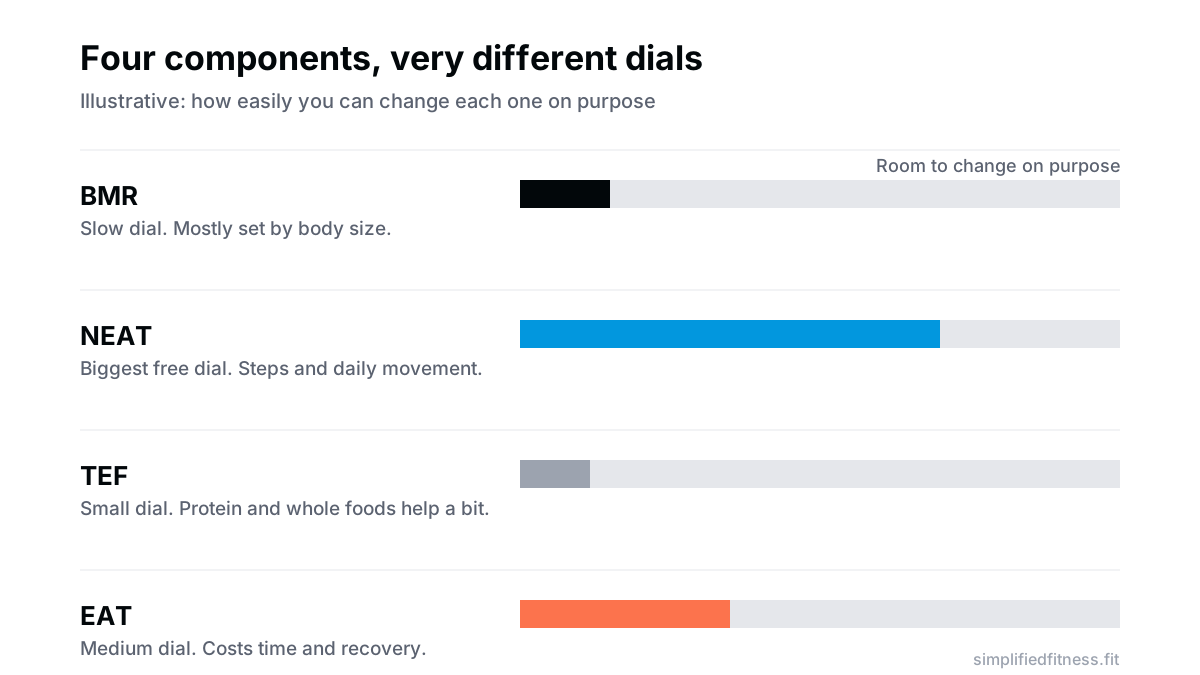
| Component | Typical share (ballpark) | How easily you can change it | Cost |
|---|---|---|---|
| BMR | ~60-70% | Slowly, mostly via body size | None |
| NEAT | ~15-20% | Easy, with steps and daily movement | Low |
| TEF | ~10% | Small, via protein and meal choices | None |
| EAT | ~5-10% | Moderate, with more sessions | Time and recovery |
NEAT wins because it asks the least of you. Taking 2,000 extra steps does not wreck tomorrow’s leg day. Another hard session might. For a deeper plan around hidden movement and plateaus, see breaking fat-loss plateaus.
Two cautions. First, NEAT can fall when you diet. A systematic review of 36 articles (1,561 participants) found compensation in about 63% of diet-only arms, but the authors said the overall findings did not support the idea that prescribed diet or exercise lowers NEAT, while noting that underpowered trials limit that conclusion (Silva et al., 2018). Second, researchers disagree on whether extra exercise is partly cancelled by savings elsewhere. A 2025 observational study found a straightforward additive link between physical activity and total energy expenditure, with no evidence of constraint (Howard et al., 2025). Because models differ and observational data cannot prove cause, the cautious takeaway is to assume activity adds calories, but not perfectly, and to verify with your own trend.
How to calculate total daily energy expenditure
The standard method has two steps.
- Estimate BMR with a predictive equation using age, sex, height and weight.
- Multiply by an activity factor that fits your whole week, not just your workouts.
Our calorie calculator does both, and the BMR calculator shows the first step alone.
Be honest about the error. A systematic review with meta-analysis of 29 studies (1,430 athletes, 100 different equations) found that predicted values did not differ significantly from measured values for only five of the eleven equations that could be pooled, and several others significantly over or underestimated. The Ten-Haaf equation looked most accurate and precise in most situations, though the authors say no single equation is guaranteed to be best (O’Neill et al., 2023). That was in athletes, so results for a casual lifter may differ.
So here is the simple way to use your number:
- Take the calculator result as your starting maintenance.
- Eat that amount for 2-3 weeks and log your weight daily.
- Look at the weekly average. If it is flat, the estimate is right. If it drifts, nudge intake by 100-200 kcal and repeat.
A bad estimate that you correct with data beats a “perfect” number you never test.
Recalculate as your body changes
TDEE is not fixed. As you lose weight, there is less body to run, so BMR falls, and you may move a little less. The review on athletes by Trexler and colleagues notes that energy restriction brings changes in hormones, mitochondrial efficiency and energy expenditure that tend to narrow the deficit (Trexler et al., 2014). How large that effect is in real life is covered in metabolic adaptation after weight loss.
A sensible rhythm: recalculate after every 4-5 kg of change, or whenever your trend stalls for two to three weeks.
A quick worked example
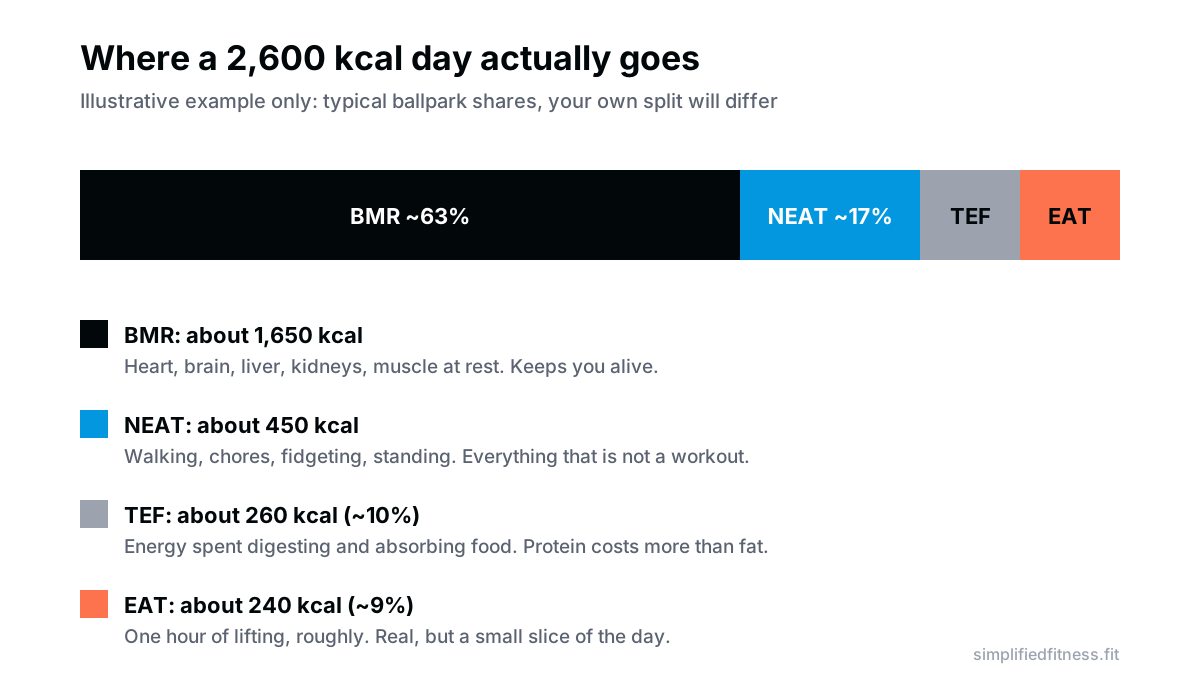
This is illustrative, not from a study. Say a 75 kg lifter lands at about 2,600 kcal per day: roughly 1,650 BMR, 450 NEAT, 260 TEF and 240 EAT from an hour of lifting.
If they want a gentle deficit, cutting 300 kcal from food is easy to follow. The alternative, adding 300 kcal of exercise, would mean roughly another full lifting session at this person’s numbers, every day. Meanwhile, adding about 3,000 steps a day often covers a decent chunk with little recovery cost, though the exact burn depends on body weight and pace.
The point is not the exact figures. It is the shape: food and movement outside the gym shift the number more easily than another workout.
When to see a doctor
If your weight changes a lot without trying, you feel unusually cold or tired, or you suspect a thyroid or other medical condition is behind a very low or high energy level, talk to a doctor. Equations assume a typical healthy adult, and they cannot tell you what is going on inside you.
Bottom line
TDEE has four parts. BMR runs the show, NEAT is the wild card, TEF is a small bonus and EAT is the smallest slice for most lifters. Use a calculator as a starting point, test it against your scale for a few weeks, and pull the NEAT lever first.
Next steps: get your starting number from the calorie calculator, then work out your split with the step-by-step macro formula. If you are planning a cut, see how big your deficit should be.
Frequently Asked Questions
What are the four components of TDEE?
TDEE is made of basal metabolic rate (BMR), non-exercise activity thermogenesis (NEAT), the thermic effect of food (TEF) and exercise activity thermogenesis (EAT). A review of human energy expenditure describes total daily energy expenditure as mainly resting energy expenditure, physical activity energy expenditure and the thermic effect of food, with activity split into exercise and non-exercise parts. Knowing the four slices helps you decide which one is worth changing.
What burns the most calories in a day?
For most people it is simply staying alive: BMR, commonly cited at around 60-70% of total daily burn. Your organs and muscle tissue use energy around the clock, even when you are lying still. That is why a bigger or more muscular body burns more at rest, and why a 60-minute workout rarely beats a full day of existing.
How do I calculate total daily energy expenditure?
Estimate your BMR with a predictive equation, then multiply it by an activity factor that matches your real week. Equations are estimates, and a 2023 meta-analysis in athletes found accuracy and precision varied widely between them. Use our calorie calculator for the first number, then adjust using 2-3 weeks of average scale weight.
What percentage of TDEE is exercise?
For many people who train 3-5 times a week, intentional exercise is a small slice of TDEE, with about 5-10% a commonly quoted ballpark rather than a measured rule. It varies with session length and body weight. A lifting session burns real energy, but it sits on top of a much bigger base. Do not eat back a big number from a workout tracker without checking your trend.
What is NEAT and why does it matter?
NEAT is the energy you spend on everything that is not sleeping, eating or deliberate exercise: walking, chores, standing, fidgeting. A 2018 review calls NEAT the main variable component of daily energy expenditure, differing considerably within and between people. Because it is so variable, a few thousand extra steps can matter more than adding another gym session.
Does the thermic effect of food really matter for fat loss?
TEF is real but small, commonly cited at about 10% of intake, so it is not a lever to build a diet around. A 2019 review found TEF tends to be higher with larger meals and with carbohydrate and protein than with fat. Eat enough protein for muscle reasons and treat the extra TEF as a minor bonus.
Is BMR the same as RMR?
They are used almost interchangeably, but strictly BMR is measured under tighter conditions (fasted, fully rested) while resting metabolic rate (RMR) is measured under looser ones. The difference is usually small compared with the error in a predictive equation. For planning your calories, either number works as a starting point.
Do muscle and weight training raise my BMR?
Muscle tissue does burn some energy at rest, and larger bodies generally have higher resting expenditure, but the effect of adding a few kilos of muscle is modest. Organs like the liver, brain, heart and kidneys account for a big share of resting burn, which is why body composition explains only part of the picture. Build muscle for strength and shape, not as a metabolism hack.
Why does my TDEE change when I lose weight?
A smaller body has less tissue to run, so BMR falls, and you also move a little less. In a 2009 study of 45 overweight and obese women after about 12.7 weeks of dieting, resting energy expenditure fell 8%, and roughly half of that decline was explained by losing fat-free and fat mass. Recalculate your numbers every 4-5 kg of change, or whenever progress stalls.
Do I move less when I diet?
Sometimes. A systematic review of 36 articles found compensation (lower NEAT or non-exercise activity) in about 63% of diet-only intervention arms, though the authors noted the trials were underpowered and could not firmly conclude. Track your steps while cutting, and set a daily floor so a deficit does not quietly turn into a sedentary week.
Does more exercise always mean more total calories burned?
Not always, but evidence is mixed. Some researchers have proposed that the body compensates by cutting energy use elsewhere, while a 2025 observational study found a straight additive relationship between physical activity and TEE with no sign of constraint. Practically, assume exercise adds calories but not one for one, and judge by your scale trend.
How accurate are TDEE calculators and wearables?
They are estimates. A meta-analysis of resting metabolic rate equations in athletes found only five of eleven equations showed no significant average difference from measured values, and individual error was large. Use the number as a starting point, eat to it for 2-3 weeks and let your real weight trend correct it.
Should I use a higher activity multiplier because I lift weights?
Usually not by much. Lifting is a small slice of the day, so your job, commute and steps often matter more for picking the multiplier. If you sit most of the day and train four times a week, choose the lighter option and add steps on purpose.
Does eating more protein raise TDEE meaningfully?
Protein has a higher thermic effect than fat, but the absolute difference is small over a day. The bigger gain from protein is muscle retention and fullness, which are covered in other guides. Do not rely on any food to meaningfully lift your burn.
Sources & References
Every claim above is checked against peer-reviewed research (PubMed, U.S. National Library of Medicine) or guidance from established health bodies. How we fact-check.
- Fernández-Verdejo R, et al. Energy Expenditure in Humans: Principles, Methods, and Changes Throughout the Life Course. Annu Rev Nutr. 2024. PMID: 38759093
- Chung N, et al. Non-exercise activity thermogenesis (NEAT): a component of total daily energy expenditure. J Exerc Nutr Biochem. 2018. PMID: 30149423
- Levine JA, et al. Role of nonexercise activity thermogenesis in resistance to fat gain in humans. Science. 1999. PMID: 9880251
- Calcagno M, et al. The Thermic Effect of Food: A Review. J Am Coll Nutr. 2019. PMID: 31021710
- O'Neill JER, et al. Accuracy of Resting Metabolic Rate Prediction Equations in Athletes: A Systematic Review with Meta-analysis. Sports Med. 2023. PMID: 37632665
- Bosy-Westphal A, et al. Contribution of individual organ mass loss to weight loss-associated decline in resting energy expenditure. Am J Clin Nutr. 2009. PMID: 19710198
- Silva AM, et al. What is the effect of diet and/or exercise interventions on behavioural compensation in non-exercise physical activity and related energy expenditure of free-living adults? A systematic review. Br J Nutr. 2018. PMID: 29845903
- Howard KR, et al. Physical activity is directly associated with total energy expenditure without evidence of constraint or compensation. Proc Natl Acad Sci U S A. 2025. PMID: 41118225
- Trexler ET, et al. Metabolic adaptation to weight loss: implications for the athlete. J Int Soc Sports Nutr. 2014. PMID: 24571926

Umair Hazrami · Founder & Head Coach, Simplified Fitness
Umair Hazrami founded Simplified Fitness and the Simplified Lifter channel to cut through fitness noise. With 4+ years of consistent training and 10+ coaching clients, he writes every guide from the peer-reviewed research and links the sources so you can check them. Our editorial standards.
Educational content only, not medical advice. If you have a medical condition, are pregnant, or take medication, talk to a qualified doctor before changing your diet, supplements or training. Full disclaimer.
Keep reading
Nutrition
Body Recomposition: Who Can Lose Fat and Build Muscle at the Same Time?
How to do body recomposition: who can lose fat and build muscle at once, what the trials show, and a protein, training and calorie protocol you can start today.
8 min read

Nutrition
Breaking Fat Loss Plateaus: Check Fluid, Hidden Calories and NEAT
How to break a fat loss plateau: a 3-step check of water masking, hidden calories and lower daily steps, plus the exact fix to restart steady fat loss.
8 min read

Nutrition
How to Calculate Macros: Step-by-Step Grams per Kilogram Formula for Protein, Fat and Carbs
How to calculate macros in grams per kg: set protein, set fat, fill the rest with carbs. Worked examples for 70, 80 and 90 kg lifters on a cut or a bulk.
9 min read

Nutrition
Daily Scale Weight Fluctuations: Sodium, Bowels, Glycogen and Water
Daily scale weight fluctuations are mostly water, glycogen and gut contents, not fat. Learn why your weight jumps overnight and how a 7-day average fixes it.
8 min read