Metabolic Adaptation to Weight Loss: Why Fat Loss Stalls and What Actually Helps
Metabolic adaptation to weight loss is real but usually modest. See what leptin, thyroid and NEAT do during a cut, and what the research says helps.

TL;DR. The short answer
- Metabolic adaptation is a drop in energy expenditure beyond what your smaller body explains. A 2022 systematic review of 33 studies found it in most, but the better-designed studies reported small or non-significant values.
- The mechanisms are lower leptin and thyroid hormone, more efficient muscle work and, in some people, less unconscious movement (NEAT). Hunger and low energy rise alongside.
- Extreme cases exist: Biggest Loser contestants had resting metabolism about 500 kcal/day lower than expected 6 years on. That is not what a lifter on a 12-week cut should expect.
- Most stalls come from tracking drift, fewer steps and normal water shifts before they come from metabolism. Check those first.
- Strategic diet breaks may reduce the slowdown and improve how you feel, though fat loss itself was not better in the one trial on trained lifters.
Part of our complete guide: The No-BS Guide to Energy Balance, Fat Loss, Bulking & Body Recomposition
Table of contents
Metabolic adaptation to weight loss means your body burns somewhat fewer calories than your new, lighter size would predict. It is real, it shows up in hormones and muscle efficiency, and it is usually smaller than gym forums make it sound. A 2022 systematic review found the better-designed studies reported small or non-significant values (Nunes et al., 2022).
This article is the physiology behind a stall: what actually changes, what is still debated, and what to do. It sits inside our energy balance, fat loss and body recomposition guide. If you just want the practical plateau checklist, go to breaking fat loss plateaus.
What is metabolic adaptation to weight loss?
Start with the part that is not adaptation. A person who loses 8 kg burns fewer calories at rest simply because there is less of them. That drop is expected, and it is why your maintenance calories at 72 kg are not the same as at 80 kg. You can see the baseline numbers with our calorie calculator.
Metabolic adaptation, also called adaptive thermogenesis, is the extra drop on top of that. Researchers define it as the residual change in energy expenditure after adjusting for changes in body composition and age (Fothergill et al., 2016).
A review aimed at athletes describes it as changes in circulating hormones, mitochondrial efficiency and energy expenditure that work to shrink the deficit, slow weight loss and promote regain (Trexler et al., 2014). That is the body doing its job. It does not know you want abs.
How big is the effect, really?
Here is where gym lore runs ahead of the data. The 2022 systematic review pulled together 33 studies and 2,528 adults. Adaptive thermogenesis showed up in 27 of them. But methods varied wildly, and the authors note that well-designed studies reported lower or non-significant values. It also seemed attenuated or absent after weight had been stable for a while (Nunes et al., 2022).
Read that carefully. It says “occurs in some components, sometimes small.” It does not say “your metabolism is wrecked.”
The headline numbers people quote come from extreme cases. In a follow-up of 14 Biggest Loser contestants, who lost about 58 kg on average over 30 weeks, resting metabolic rate fell by around 610 kcal/day. Six years later, after regaining about 41 kg, resting rate was 704 kcal/day below baseline and the adaptation beyond body size was about 499 kcal/day (Fothergill et al., 2016).
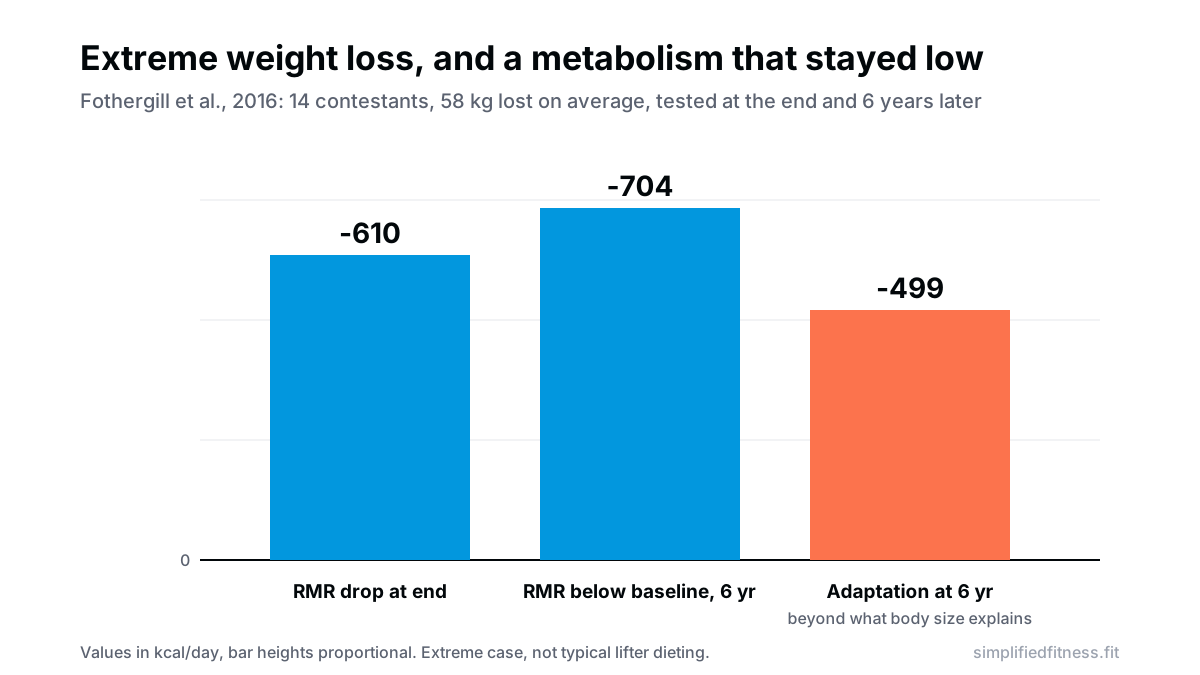
The gap came from only 14 people with obesity who lost a huge amount of weight in a televised competition. So the number is real, but the context is extreme.
Why metabolism slows down when you cut
Several things change at once, and they push in the same direction.
Leptin falls
Leptin is a hormone released by fat cells, so it tracks fat mass. When you diet, it falls, and during active weight loss it falls lower than your fat mass alone would predict. In a 50-person inpatient study, leptin was significantly lower during weight loss than at the same body composition during maintenance (Rosenbaum et al., 1997). Low leptin is read by the brain as “energy is scarce.” Hunger tends to follow.
Now the nuance. That same study found that changes in leptin between weight plateaus did not correlate with changes in energy expenditure. Its authors concluded leptin is probably not the primary signal driving the expenditure change (Rosenbaum et al., 1997). Later work with a different design found leptin does mediate part of the effect, likely via thyroid hormone (below). Science disagreeing with itself is normal here. The takeaway: leptin matters, but it is one dial among several.
Thyroid hormone drops and muscle gets more efficient
People holding a 10% or greater diet-induced weight loss show lower levels of bioactive thyroid hormone and higher skeletal muscle work efficiency, largely from a shift toward more efficient myosin fibre types. In a small study of 9 inpatients with obesity, replacing T3 reversed these changes to a similar degree as leptin replacement did (Rosenbaum et al., 2018).
Muscle that does the same work for less fuel is great in a famine and annoying on a cut. This was a small, controlled inpatient study, so treat it as mechanism, not a prescription. Do not self-medicate with thyroid hormones. That is a doctor’s territory.
Hunger and drive shift
Many people find that late in a diet they are hungrier, more tired and more tempted. That is physiology plus psychology, not weakness.
NEAT: the quiet part of the slowdown
NEAT is non-exercise activity: walking to the bus, fidgeting, standing, carrying shopping. It is the most flexible part of daily burn, and your body can trim it without asking you.
A systematic review of 36 articles (1,561 participants) found compensation, meaning lower NEAT or non-exercise activity, in 15 of 36 studies, in 63% of diet-only arms, 27% of combined diet and exercise arms, and 23% of exercise-only arms. People who did reduce NEAT lost about double the weight of those who did not, hinting that bigger deficits trigger more conservation. The authors were careful: the studies were underpowered, methods were limited, and the data did not confirm that diet reliably lowers NEAT (Silva et al., 2018).
So the honest summary is “it can happen, mostly with diet-only plans, and we cannot say how much.”
The gym version is easy to recognise. Week 1 you take the stairs and walk after dinner. Week 9 you take the lift, sit through calls and call it a rest day. Nobody decides that. It just drifts. A 40 degree Indian summer afternoon makes staying indoors very tempting.
Is it a metabolic slowdown or just a normal plateau?
Most “my metabolism is broken” messages are one of these instead.
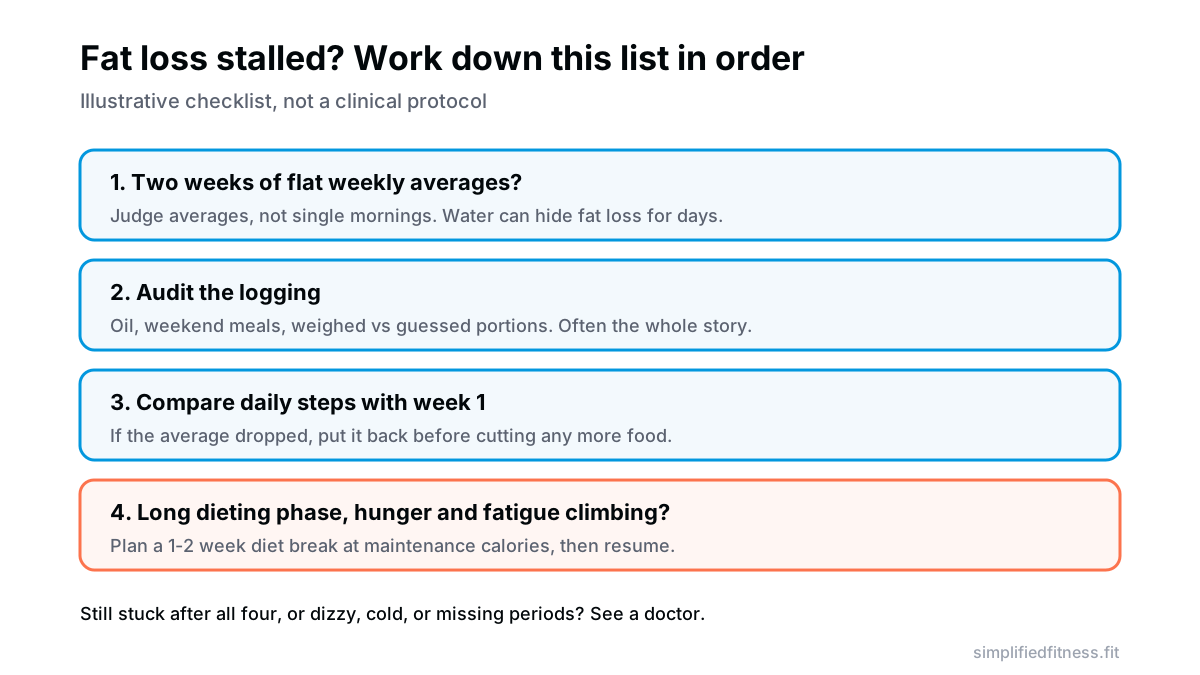
- Water masks fat loss. Weight can sit flat for a while even when fat is dropping. Weekly averages tell the truth. Single weigh-ins do not.
- Tracking drift. Portions creep. Cooking oil, ghee and a handful of nuts add up fast, and weekend meals rarely get logged.
- Smaller maintenance. You are lighter, so the same intake is a smaller deficit. Re-run the weight loss timeline calculator with your current weight.
- Fewer steps. The NEAT drift above.
- Actual adaptation. Possible, usually the smallest of the five.
If you want the full audit, our guide on hidden calories, NEAT and fluid plateaus goes step by step. For how the pieces of daily burn fit together, see TDEE deconstructed.
What helps: the evidence on diet breaks
If adaptation grows with the size and length of the deficit, one idea is to interrupt the deficit. Two trials are worth knowing, and they disagree a little.
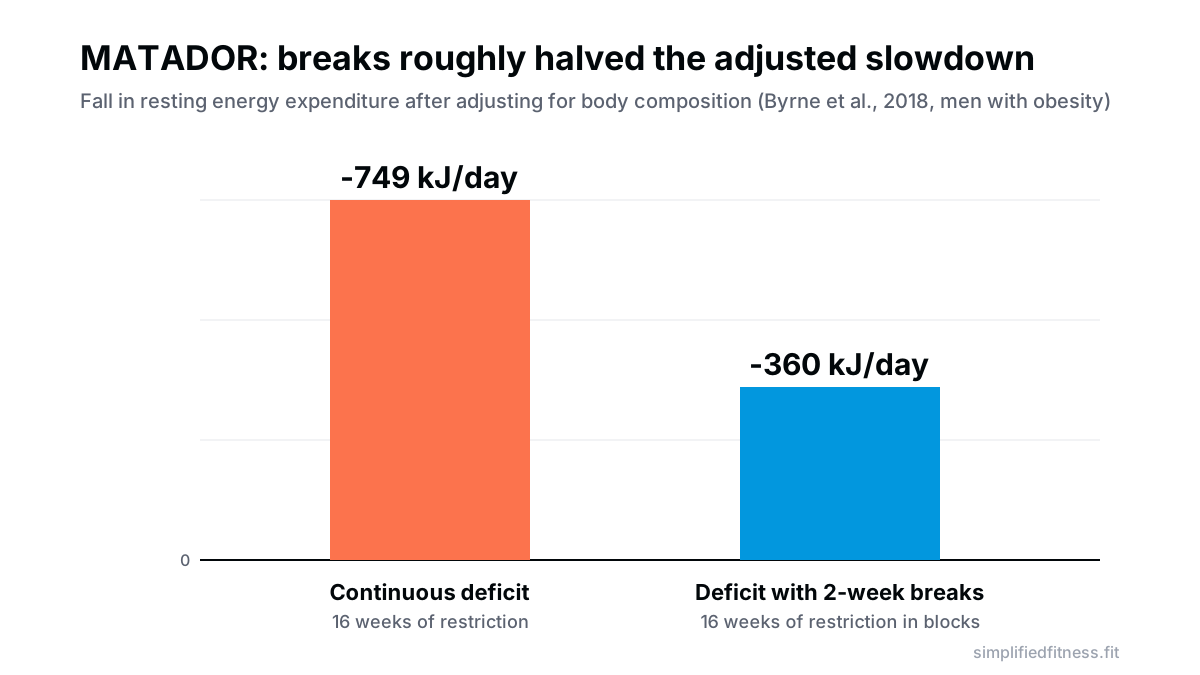
MATADOR (men with obesity). Men were randomised to 16 weeks of continuous restriction or the same 16 weeks split into 2-week blocks, alternating with 2-week blocks at maintenance. The metabolic result is the one that matters here: after adjusting for body composition, resting energy expenditure fell by about 360 kJ/day with breaks versus 749 kJ/day without them, roughly 85 vs 180 kcal/day. Absolute resting expenditure, before that adjustment, did not differ significantly between groups (Byrne et al., 2018).
ICECAP (resistance-trained adults). In 61 trained adults using 1-week maintenance breaks, resting energy expenditure, leptin and free T3 did not differ from continuous dieting, and neither did fat loss. The break group did report lower hunger (Peos et al., 2021).
Why might they differ? Different populations (men with obesity vs trained adults averaging about 25% body fat), different break lengths, and different deficit sizes. The cautious reading: diet breaks might reduce the physiological slowdown in larger-loss situations, and in trained dieters they mainly make the process easier to stick to.
Fat loss results, refeeds and how to schedule a break are covered in diet breaks vs refeeds.
How to limit the slowdown on your next cut
None of this is magic. It is the boring list, and the boring list works.
- Do not over-cut. A bigger deficit gives the body more to defend, and the Biggest Loser pattern fits that: contestants who held more weight loss had more metabolic slowing (Fothergill et al., 2016). Use a moderate rate, as in setting your deficit.
- Keep lifting heavy and eating enough protein. This protects muscle, which is the tissue that burns calories and is the reason you are cutting rather than just shrinking.
- Hold a step floor. Easy to measure, easy to fix.
- Keep dieting phases finite. The studies are measured in weeks, not many months. Plan an end date.
- Add a 1-2 week maintenance break when hunger, sleep and training quality are sliding and you are well into the phase.
- Exit gradually. Move up to maintenance rather than binging out of a diet. Our guide to reverse dieting vs immediate maintenance covers it.
A vegetarian example. A 70 kg lifter eating dal, curd, paneer and roti who has been dieting 10 weeks does not need to drop to 1,400 kcal when the scale stalls. Check steps, check logging of the ghee and oil, then take a week at maintenance. Two cheaper and kinder steps before a harsher one.
And no, you did not “break” your metabolism. We cover that fear directly in the starvation mode myth.
When to see a doctor
Normal dieting makes you hungrier and a bit flat. It should not make you ill. See a doctor if you feel persistently cold or dizzy, your periods stop, your hair thins quickly, your mood drops sharply, or you gain weight while eating very little. These can point to low energy availability, a thyroid condition or something else that no diet tweak will fix. This article is education, not a diagnosis.
The bottom line
Metabolic adaptation to weight loss exists, and the pieces are plausible: lower leptin and thyroid hormone, more efficient muscle, less unconscious movement and more hunger. The size is the open question. It looks large in extreme cases and small in better-designed studies of ordinary weight loss.
For a lifter, that means your plateau is usually a mix of a smaller body, drifting habits and normal water noise before it is a broken metabolism. Check those first, keep your deficit moderate, protect your steps and your muscle, and use a diet break when you are deep into a long phase.
Frequently Asked Questions
What is metabolic adaptation to weight loss?
It is a fall in energy expenditure larger than your lower body weight and muscle mass would predict. The body does this partly through lower leptin and thyroid hormone and more efficient muscle work. In practice it means the deficit you set in week 1 shrinks a bit as you get leaner, so you may need to re-check your numbers.
Why does my metabolism slow down when I cut?
Part of the slowdown is simply arithmetic, because a lighter body burns fewer calories. A smaller extra part is adaptive, driven by hormones such as leptin and thyroid hormone and by muscle becoming more efficient. Keep protein and lifting in place, and expect to adjust intake rather than assume your metabolism is broken.
What is adaptive thermogenesis?
Adaptive thermogenesis is the technical name for energy expenditure falling below what body size and composition predict after weight loss. A 2022 systematic review found it in 27 of 33 studies, but the magnitude was small or non-significant in the better-designed ones. Treat it as real but modest, and do not use it as the first explanation for a plateau.
How many calories does metabolic adaptation actually cost?
It varies a lot by person and by how much weight is lost. In the MATADOR trial of men with obesity, adjusted resting expenditure fell by about 360 to 750 kJ/day (roughly 85 to 180 kcal/day) depending on the dieting pattern. Extreme weight loss produced far bigger gaps, so do not apply one number to yourself.
Does leptin really crash during a calorie deficit?
Yes, circulating leptin falls as fat mass falls, and it falls more than fat loss alone predicts during active dieting. A 1997 study found leptin was lower during weight loss than at the same body composition during maintenance. Because leptin helps regulate hunger and expenditure, this is one reason cravings rise late in a cut.
Is leptin the main cause of the slowdown?
Probably not the only one. One inpatient study found changes in leptin did not correlate with changes in energy expenditure, while later work found thyroid hormone repletion reversed muscle efficiency changes much like leptin did. So leptin is part of a network, and no single hormone explains it.
Does NEAT really drop when you diet?
Sometimes. A systematic review of 36 articles found declines in non-exercise activity in 15, most often in diet-only interventions, and noted that the studies were underpowered. People who did lower their NEAT lost about twice as much weight, which suggests bigger deficits trigger more conservation. Track daily steps so you notice it.
Why did my fat loss stall after 8 weeks?
The usual causes are logging drift, fewer steps, water retention hiding fat loss, and a smaller maintenance requirement at a lower weight. Metabolic adaptation can contribute but is rarely the whole story. Compare two-week averages, audit your tracking, then restore your step count before cutting calories further.
Do diet breaks fix metabolic adaptation?
They may blunt it. In the MATADOR trial, alternating 2-week deficits with 2-week maintenance blocks led to a smaller adjusted drop in resting expenditure than continuous dieting. A trial in resistance-trained adults found similar fat loss either way but lower hunger with breaks, so use them when adherence is the problem.
Will eating at maintenance make me gain fat?
Not if it really is maintenance. In MATADOR, weight change during the maintenance blocks averaged 0.0 kg. The scale may still tick up a little from extra carbohydrate and water (about 0.6 kg after a 1-week break in trained lifters), which is not fat. Do not judge a diet break by the first morning weigh-in.
Can metabolic adaptation be permanent?
In extreme cases it can persist. Biggest Loser contestants still had a metabolic rate lower than predicted 6 years later, though this group lost around 58 kg through very intense effort. For ordinary dieters the evidence is much weaker, so avoid extreme deficits and keep your muscle.
When should I see a doctor about slow metabolism?
See a doctor if you feel persistently cold, exhausted or dizzy, lose your period, lose hair rapidly, or gain weight while eating very little. Those can point to low energy availability or a thyroid problem that dieting alone does not explain. A blood test is quick, and a doctor can sort it out rather than guessing.
Sources & References
Every claim above is checked against peer-reviewed research (PubMed, U.S. National Library of Medicine) or guidance from established health bodies. How we fact-check.
- Trexler ET, et al. Metabolic adaptation to weight loss: implications for the athlete. J Int Soc Sports Nutr. 2014. PMID: 24571926
- Nunes CL, et al. Does adaptive thermogenesis occur after weight loss in adults? A systematic review. Br J Nutr. 2022. PMID: 33762040
- Fothergill E, et al. Persistent metabolic adaptation 6 years after The Biggest Loser competition. Obesity. 2016. PMID: 27136388
- Rosenbaum M, et al. Effects of weight change on plasma leptin concentrations and energy expenditure. J Clin Endocrinol Metab. 1997. PMID: 9360521
- Rosenbaum M, et al. Triiodothyronine and leptin repletion in humans similarly reverse weight-loss-induced changes in skeletal muscle. Am J Physiol Endocrinol Metab. 2018. PMID: 29920214
- Silva AM, et al. What is the effect of diet and/or exercise interventions on behavioural compensation in non-exercise physical activity and related energy expenditure of free-living adults? A systematic review. Br J Nutr. 2018. PMID: 29845903
- Byrne NM, et al. Intermittent energy restriction improves weight loss efficiency in obese men: the MATADOR study. Int J Obes. 2018. PMID: 28925405
- Peos JJ, et al. Continuous versus intermittent dieting for fat loss and fat-free mass retention in resistance-trained adults: the ICECAP trial. Med Sci Sports Exerc. 2021. PMID: 33587549

Umair Hazrami · Founder & Head Coach, Simplified Fitness
Umair Hazrami founded Simplified Fitness and the Simplified Lifter channel to cut through fitness noise. With 4+ years of consistent training and 10+ coaching clients, he writes every guide from the peer-reviewed research and links the sources so you can check them. Our editorial standards.
Educational content only, not medical advice. If you have a medical condition, are pregnant, or take medication, talk to a qualified doctor before changing your diet, supplements or training. Full disclaimer.
Keep reading
Nutrition
Body Recomposition: Who Can Lose Fat and Build Muscle at the Same Time?
How to do body recomposition: who can lose fat and build muscle at once, what the trials show, and a protein, training and calorie protocol you can start today.
8 min read

Nutrition
Breaking Fat Loss Plateaus: Check Fluid, Hidden Calories and NEAT
How to break a fat loss plateau: a 3-step check of water masking, hidden calories and lower daily steps, plus the exact fix to restart steady fat loss.
8 min read

Nutrition
How to Calculate Macros: Step-by-Step Grams per Kilogram Formula for Protein, Fat and Carbs
How to calculate macros in grams per kg: set protein, set fat, fill the rest with carbs. Worked examples for 70, 80 and 90 kg lifters on a cut or a bulk.
9 min read

Nutrition
Daily Scale Weight Fluctuations: Sodium, Bowels, Glycogen and Water
Daily scale weight fluctuations are mostly water, glycogen and gut contents, not fat. Learn why your weight jumps overnight and how a 7-day average fixes it.
8 min read