Daily Scale Weight Fluctuations: Sodium, Bowels, Glycogen and Water
Daily scale weight fluctuations are mostly water, glycogen and gut contents, not fat. Learn why your weight jumps overnight and how a 7-day average fixes it.

TL;DR. The short answer
- Daily scale weight fluctuations are mostly water, glycogen and food still in your gut. Fat changes far too slowly to move the scale by a kilo overnight.
- Each gram of glycogen is commonly said to carry roughly 2.7-4 g of water, so a high-carb day can add a few hundred grams to a kilo without any fat gain.
- Salt, hard training, a late dinner, poor sleep and (for many women) the menstrual cycle can all push the number up for a few days.
- A 7-day average of daily weigh-ins shows the real trend. Judge fat loss by the average and by waist, photos and gym performance, not one morning.
- If weighing makes you anxious or triggers restrictive eating, weigh less often or stop, and talk to a doctor or dietitian if it is hard to stop.
Part of our complete guide: The No-BS Guide to Energy Balance, Fat Loss, Bulking & Body Recomposition
Table of contents
Daily scale weight fluctuations of 0.5-1.5 kg are common, and almost none of that is fat. Water, stored carbohydrate and food still travelling through your gut explain most of it (part of our energy balance and fat loss guide).
So if you woke up 1.5 kg heavier after a salty restaurant dinner, your fat did not grow overnight. Here we go through what actually moves the number, and the simple tracking habit that makes it stop mattering.
Why does scale weight fluctuate daily?
Your scale measures everything: fat, muscle, bone, organs, blood, the water in and around your cells, and whatever you ate in the last day or two. Fat is the slow one. To gain 1 kg of fat you need a surplus of thousands of calories, and you cannot eat that in one dinner.
Everything else on that list can shift by hundreds of grams in a day. That is the noise.
Daily weight fluctuations and carbs: the glycogen effect
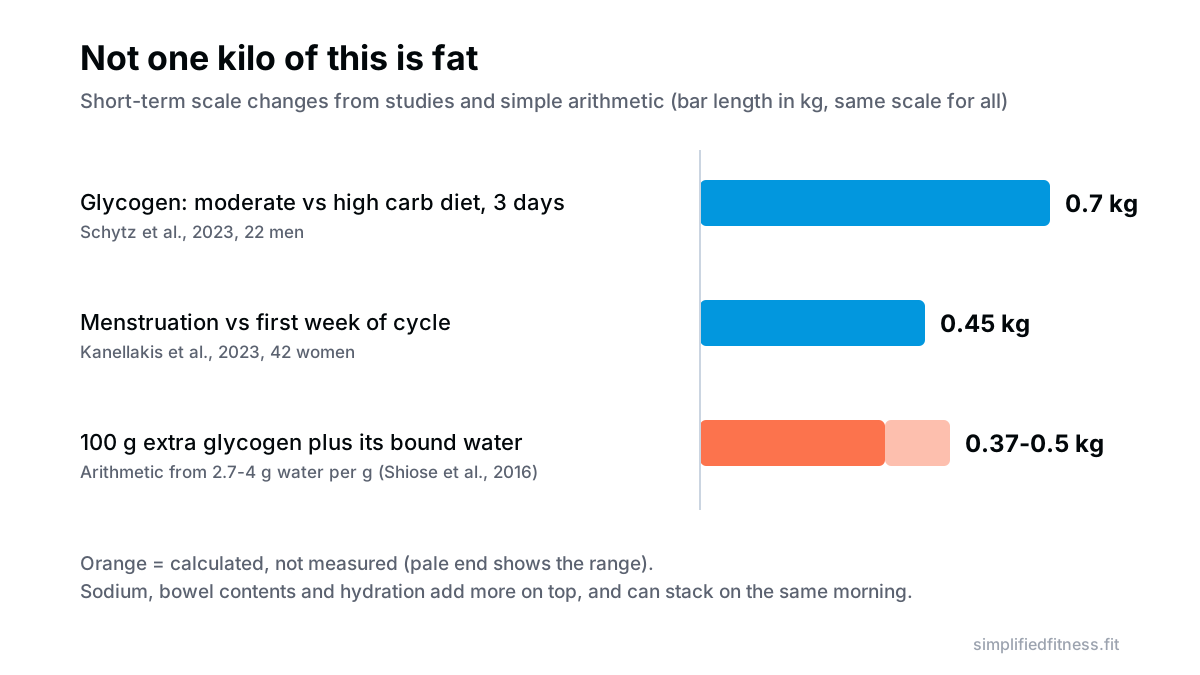
Your body stores carbohydrate as glycogen in muscle and liver, and it does not store it dry. A 2016 study opens with the commonly quoted figure: each gram of glycogen binds roughly 2.7-4 g of water. That ratio is a textbook estimate rather than something this study measured. In that study, eight people ate a very high carbohydrate diet (12 g per kg of body weight a day) for 72 hours after depleting their glycogen. Muscle glycogen more than doubled, and total body water rose by about 0.9 kg on average (Shiose et al., 2016). The extra water showed up as intracellular water, most clearly in the legs.
Run the arithmetic. An extra 100 g of glycogen plus 2.7-4 g of water per gram comes to roughly 0.37-0.5 kg on the scale. No fat involved.
A separate crossover trial gave 22 men a moderate or a high carbohydrate diet for three days. After the high-carb diet they had higher muscle glycogen and a body mass that was 0.7 kg higher than after the moderate diet, with no difference in short-term cycling performance (Schytz et al., 2023). These were men who had first depleted their glycogen with exercise, so the swing in a normal day will usually be smaller.
This also explains the opposite. When people start a diet and the weight drops fast in week one, glycogen and its water are leaving first. A classic paper on very-low-calorie diets makes the point that water-laden glycogen can create the illusion of easy weight loss, and exaggerated regain when carbohydrate returns (Kreitzman et al., 1992). That paper is old and based on very low calorie diets (a small group of 11 people was measured), so read it as an explanation of the mechanism, not a precise forecast for your diet.
Does sodium really change scale weight?
The gym version goes like this: salt makes you hold water, so a salty meal makes you heavier. There is something to that. Sodium is central to how your body regulates fluid outside your cells, and a salty, heavy meal commonly shifts fluid balance for a day or two.
But it is not that tidy. A review on sodium balance describes findings that remarkable amounts of sodium can be stored in muscle and skin without commensurate water retention, and that the body may also run slow weekly and monthly rhythms in sodium storage independent of intake (Titze, 2014). Much of that evidence comes from animal experiments and specialised imaging, so it is not a ready-made rule for your Saturday night.
The cautious reading: salt probably nudges your weight for a day or two, but the size varies between people and between weeks. Do not try to measure it with your bathroom scale. Cutting salt hard to “drop water” before a weigh-in is not a fat loss strategy.
Bowel contents: the boring, big one
Food has mass. A big dinner of dal, rice, roti, sabzi and a sweet is still in your gut when you step on the scale the next morning. So are fibre and fluid.
That is why a late dinner, a fibre-heavy day, a change in routine or travel can swing the reading either way. If you are constipated, you read higher. After a good clear-out, lower.
None of this is fat, and none of it tells you anything about your diet. If constipation or changes in your bowel habit are persistent, see a doctor and do not blame the scale.
Hydration, hard training, sleep and the menstrual cycle
Four more things stack on top.
- Hydration. Drinking a litre of water adds a litre of weight until you pass it. Dehydration after a hot day, a sweaty session or a night out can make you read lower, then rebound when you rehydrate. In Indian summers, this swing can be big.
- Hard training. Heavy sessions, especially new ones, can leave the muscle holding fluid while it repairs, and refilling glycogen pulls water in too. Leg day can show up on the scale for a few days.
- Sleep and stress. Poor sleep and a stressful week can change appetite, food choices and fluid balance. The effect on the scale is hard to isolate, so treat it as one more reason for noise.
- Menstrual cycle. In a 2023 study of 42 women weighed twice a week, body weight was about 0.45 kg higher during menstruation than in the first week of the cycle, mostly from extracellular water (Kanellakis et al., 2023). Earlier studies, the authors note, reached conflicting results, partly because methods differ, so patterns vary between women.
How to track weekly average weight
This is the fix. If the daily number is noisy, stop reading the daily number and read the average.
Here is the routine:
- Weigh every morning after you use the toilet, before you eat or drink.
- Same scale, same spot on the floor, same clothing (or none).
- Write each reading down in a notes app or spreadsheet.
- Once you have seven readings, add them up and divide by 7.
- Compare this week’s average with last week’s. That is your trend.
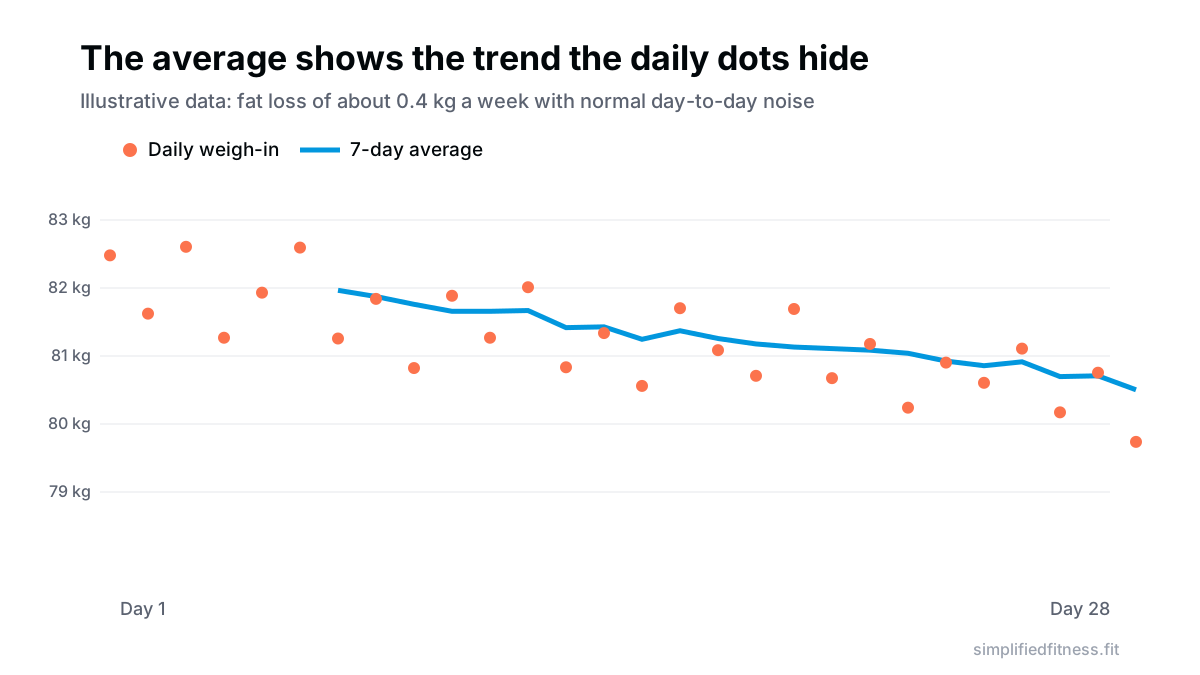
A rolling average (each day, the mean of the last seven days) gives a smoother curve and is what most tracking apps show. A weekly average gives you one clean number per week. Either works. Pick one.
What the trend should look like is covered in our guide to setting an optimal calorie deficit, and you can estimate your own pace with the weight loss timeline calculator.
What to do after a salty restaurant meal
Honest answer: almost nothing.
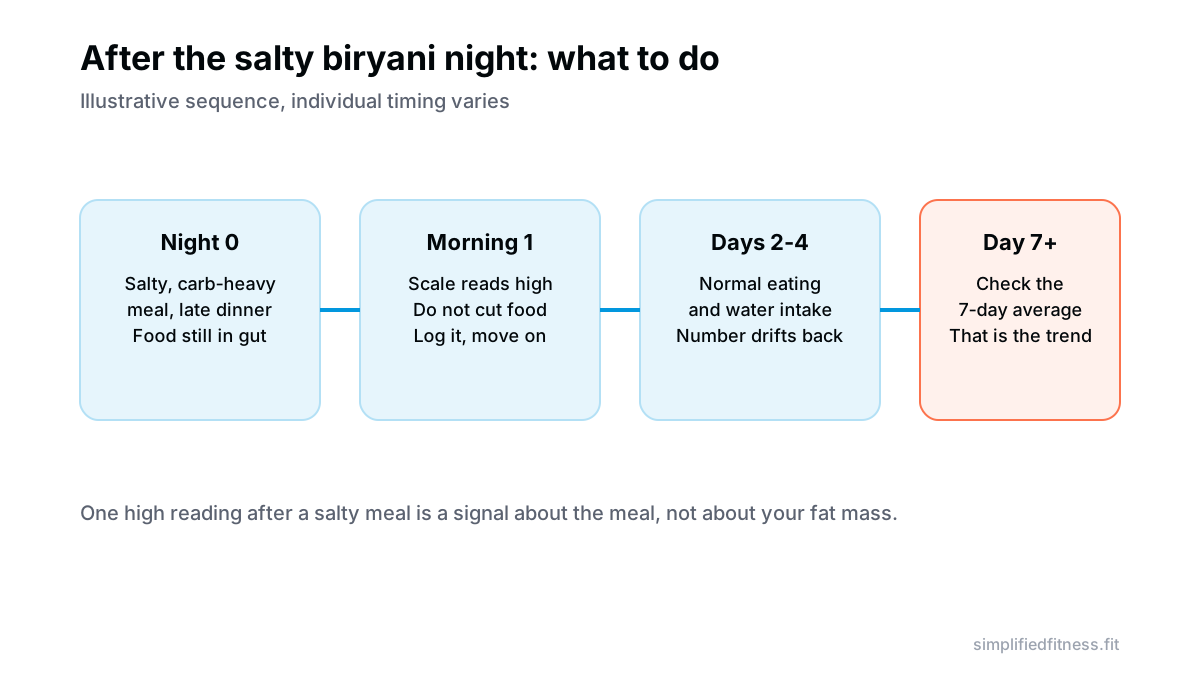
- Do not skip meals or crash-diet to chase the number down.
- Do not slash water intake. Drink to thirst, and use the water intake calculator if you want a starting point for your size and climate.
- Log the meal as best you can and return to your normal plan the next meal.
- Expect the reading to drift back within a few days if your calories and routine are normal.
Stalled scale for weeks while you are in a deficit? That is a different problem, and we cover it in breaking fat loss plateaus. Sudden drops after a flat stretch are covered in the whoosh effect. Both are mostly about water masking fat loss.
Is daily weighing a good idea for everyone?
Not necessarily, and the research is mixed.
A cohort of nearly 10,000 smart scale users found that a higher share of days with a weigh-in correlated with more favourable weight change over time, although the correlation was small (r=-0.111) and it was observational (Vuorinen et al., 2021). A randomized trial in 162 overweight adults used daily weighing with visual feedback and found a modest advantage over one year (2.6 kg versus 0.5 kg lost) (Pacanowski et al., 2015).
On the other side, a two-year study of 762 mostly female college students with weight concerns found that frequent self-weighing at baseline predicted more weight gain (most of all in those who also reported binge eating) and a higher chance of later unhealthy compensatory behaviours (Rohde et al., 2018).
Why the difference? Different people, different goals, different follow-up, and mostly different relationships with the number. The cautious takeaway: if you can treat the scale as data, daily weighing plus averaging works well. If a bad number ruins your day or tempts you to skip meals or purge, weigh less often, lean on waist measurements and photos, and talk to a doctor or dietitian. That is not a weakness. It is just good risk management.
Common mistakes with scale weight
- Reading one weigh-in as a verdict. It is a data point.
- Weighing at random times of day, then comparing the numbers.
- Cutting calories harder after a salty night, which makes the next week harder to follow.
- Ignoring waist, photos and strength because the scale “did not move”.
- Comparing your weight to someone else’s and assuming their pattern is yours.
- Starting a new diet, new training block and new supplement in the same week and then trying to work out what did what.
The bottom line
Your weight is a noisy signal that includes water, glycogen, salt, gut contents and fat. Only fat is what you are trying to change, and it moves slowly. So weigh consistently, average the numbers, and make decisions on trends measured over weeks. If the scale ever raises real alarm bells, such as fast gain with swelling, breathlessness, or unexplained loss, that is a conversation for a doctor, not an app.
Frequently Asked Questions
Why does my scale weight fluctuate daily?
Most day-to-day movement is water, stored carbohydrate and food that has not left your digestive system yet. Fat mass changes slowly, so it is almost never the cause of a sudden jump. Weigh under the same conditions each morning and watch the weekly average rather than single readings.
How much can weight change overnight?
A swing of about 0.5-1.5 kg is common, and studies show how large pieces of that are. One trial in 22 men found about 0.7 kg lower body mass after three days of moderate versus high carbohydrate intake. Treat anything in that range as noise unless it persists for a week or more.
Does sodium really make the scale go up?
It can, but the story is more complicated than the gym myth suggests. Sodium helps set how much fluid your body holds, yet research shows the body can also store sodium in muscle and skin without matching water retention. Expect a salty meal to nudge your weight for a day or two at most, then keep eating normally and let it settle.
Why did I gain 1.5 kg after a restaurant meal?
Restaurant food is usually heavy in salt, carbohydrate and total volume, and all three add weight that is not fat. You would need a very large calorie surplus to gain 1.5 kg of fat in one night. Log the meal, resume your normal routine and compare the 7-day average a week later.
How much water does glycogen hold?
The commonly quoted figure, repeated in a 2016 study on carbohydrate loading, is roughly 2.7-4 g of water per gram of glycogen, though one older animal study did not find a consistent ratio. That is why a few extra hundred grams of carbohydrate stored as glycogen can add a noticeable amount of weight. Going low-carb does the reverse, which is why early diet weight loss often looks faster than it is.
What is the best way to track weight accurately?
Weigh every morning after using the toilet and before eating or drinking, on the same scale, in the same clothing. Average the readings over seven days and compare each week's average with the previous week. Use that number, plus waist measurement, to decide whether to change your calories.
Should I weigh myself every day?
Daily weighing helps many people, but it is not mandatory. Observational and trial data link frequent weighing with better weight loss, yet one study of college students found more frequent weighing predicted later weight gain and unhealthy compensatory behaviours in some of them. Weigh daily only if you can treat the number as data, and drop to weekly if it affects your mood or eating.
Does constipation or a bowel movement change my weight?
Yes, because food, fibre and fluid have mass until they leave your body. Being backed up can make you read higher, and a clear-out can bring you down. Do not compare weights on days when your usual bowel habit is clearly off, and see a doctor if constipation or other bowel changes are persistent.
Do periods affect scale weight?
For many women, yes. A 2023 study of 42 women found weight was about 0.45 kg higher during menstruation than in the first week of the cycle, mostly from extracellular water. Compare weeks at the same point in your cycle where you can, and see a doctor if bloating or weight swings are severe or sudden.
Why is my weight higher the day after a hard workout?
Hard training causes small muscle damage and inflammation, and your body can hold extra fluid around the muscle while it repairs. Glycogen refilling after the session also pulls water in. This is temporary and usually settles within a few days, so do not judge a cut by the morning after leg day.
Why does my weight drop fast when I start a diet?
Much of the early drop is water and glycogen, not fat. Lower carbohydrate intake and a calorie deficit empty glycogen stores, and the water bound to them goes too. The pace then slows to the real rate of fat loss, which is normal and not a sign that the diet stopped working.
My weight is not changing but my clothes fit looser. What does that mean?
It can mean you are losing fat while holding extra water, or gaining a little muscle. Scales cannot tell fat, muscle and water apart. Check the 7-day average, waist measurement, photos and lifts over three to four weeks before changing anything.
When should I see a doctor about weight changes?
See a doctor if you gain weight rapidly over a few days, notice swelling in your legs, face or around your eyes, get breathless, or lose weight without trying. These patterns can signal fluid, heart, kidney, thyroid or other medical problems rather than normal fluctuation. Do not self-diagnose from the scale.
Sources & References
Every claim above is checked against peer-reviewed research (PubMed, U.S. National Library of Medicine) or guidance from established health bodies. How we fact-check.
- Shiose K, et al. Segmental extracellular and intracellular water distribution and muscle glycogen after 72-h carbohydrate loading using spectroscopic techniques. J Appl Physiol. 2016. PMID: 27231310
- Schytz CT, et al. Lowered muscle glycogen reduces body mass with no effect on short-term exercise performance in men. Scand J Med Sci Sports. 2023. PMID: 36932633
- Sherman WM, et al. Muscle glycogen storage and its relationship with water. Int J Sports Med. 1982. PMID: 7068293
- Kreitzman SN, et al. Glycogen storage: illusions of easy weight loss, excessive weight regain, and distortions in estimates of body composition. Am J Clin Nutr. 1992. PMID: 1615908
- Kanellakis S, et al. Changes in body weight and body composition during the menstrual cycle. Am J Hum Biol. 2023. PMID: 37395124
- Titze J. Sodium balance is not just a renal affair. Curr Opin Nephrol Hypertens. 2014. PMID: 24401786
- Vuorinen AL, et al. Frequency of self-weighing and weight change: cohort study with 10,000 smart scale users. J Med Internet Res. 2021. PMID: 34075879
- Pacanowski CR, et al. Frequent self-weighing and visual feedback for weight loss in overweight adults. J Obes. 2015. PMID: 26064677
- Rohde P, et al. Relation of self-weighing to future weight gain and onset of disordered eating symptoms. J Consult Clin Psychol. 2018. PMID: 30035584

Umair Hazrami · Founder & Head Coach, Simplified Fitness
Umair Hazrami founded Simplified Fitness and the Simplified Lifter channel to cut through fitness noise. With 4+ years of consistent training and 10+ coaching clients, he writes every guide from the peer-reviewed research and links the sources so you can check them. Our editorial standards.
Educational content only, not medical advice. If you have a medical condition, are pregnant, or take medication, talk to a qualified doctor before changing your diet, supplements or training. Full disclaimer.
Keep reading

Nutrition
Body Recomposition: Who Can Lose Fat and Build Muscle at the Same Time?
How to do body recomposition: who can lose fat and build muscle at once, what the trials show, and a protein, training and calorie protocol you can start today.
8 min read

Nutrition
Breaking Fat Loss Plateaus: Check Fluid, Hidden Calories and NEAT
How to break a fat loss plateau: a 3-step check of water masking, hidden calories and lower daily steps, plus the exact fix to restart steady fat loss.
8 min read

Nutrition
How to Calculate Macros: Step-by-Step Grams per Kilogram Formula for Protein, Fat and Carbs
How to calculate macros in grams per kg: set protein, set fat, fill the rest with carbs. Worked examples for 70, 80 and 90 kg lifters on a cut or a bulk.
9 min read
Nutrition
Diet Breaks vs Refeeds: Do Hormones, Glycogen and Sanity Really Matter?
Diet breaks vs refeeds: which one helps a long cut? See what MATADOR, ICECAP and other trials found on fat loss, metabolism and hunger, and how to schedule one.
9 min read