Optimal Body Fat Percentage for Natural Lifters: Men 10-15%, Women 18-23%
What is the optimal body fat percentage for natural lifters? See the 10-15% (men) and 18-23% (women) range, plus what extreme leanness does to hormones.
TL;DR. The short answer
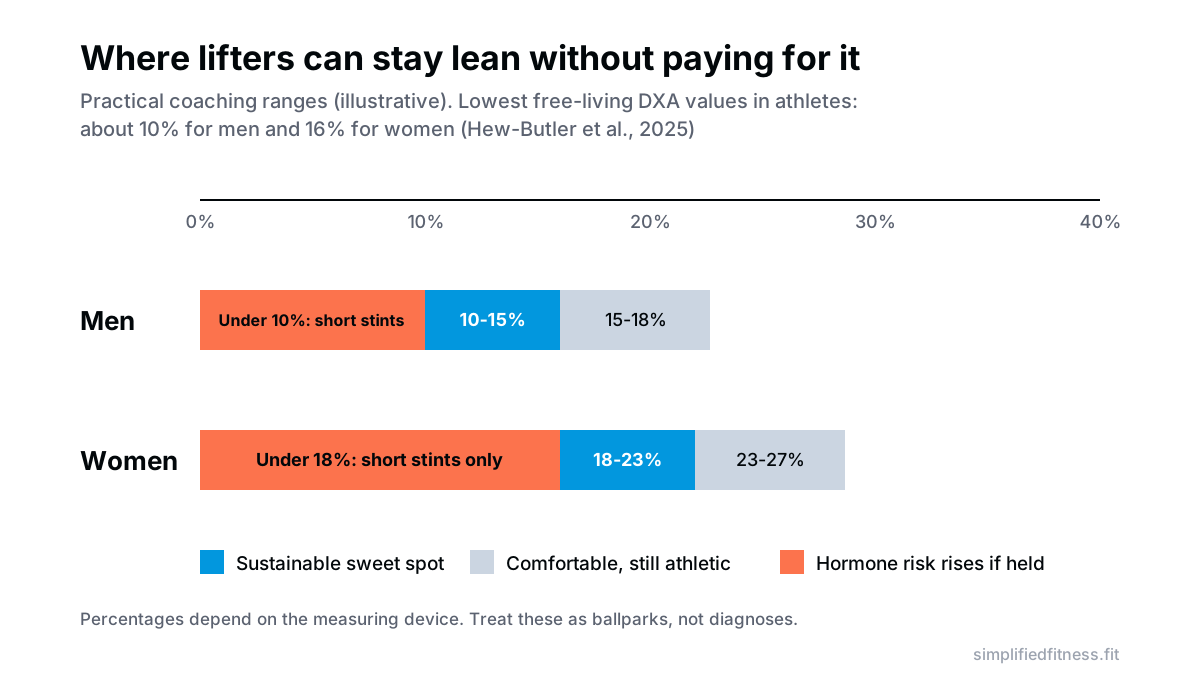
- For most natural lifters, a sustainable lean range is roughly 10-15% body fat for men and 18-23% for women. This is a practical coaching range, not a research-defined optimum.
- In free-living competitive athletes with unrestricted food access, the lowest measured whole-body fat was about 10% for men and 16% for women (DXA, 2025). Going below that usually takes active dieting.
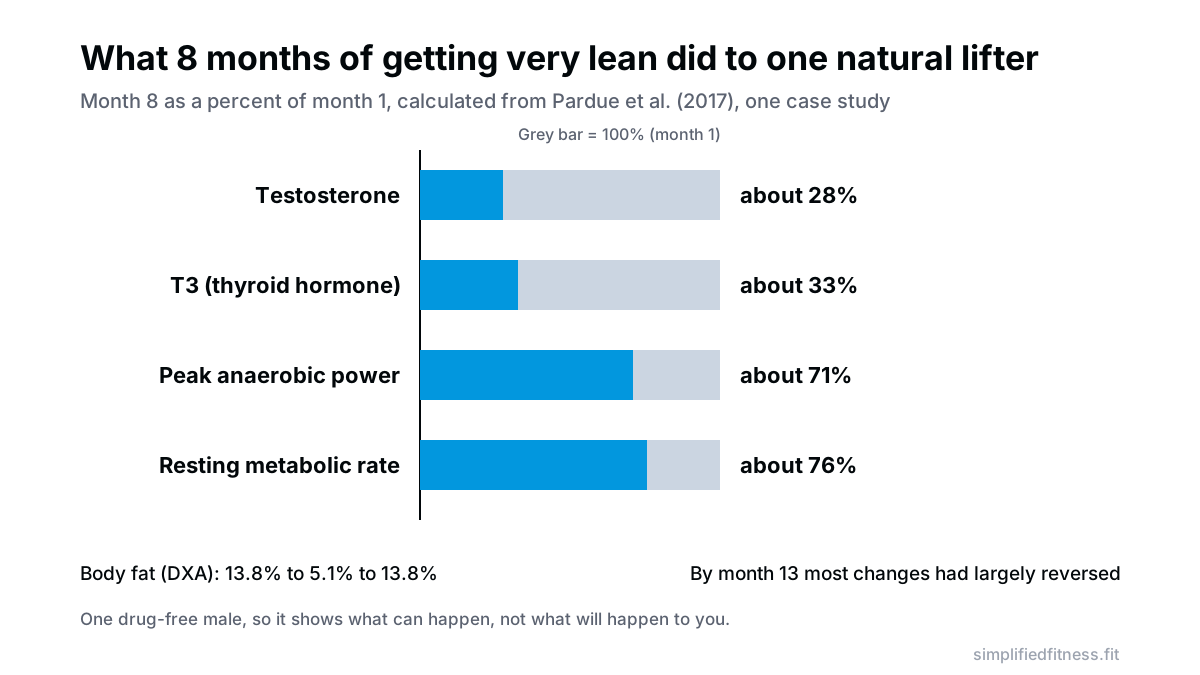
- Prolonged very low body fat plus low energy intake is linked to lower testosterone, lower thyroid hormones, lower power output and a lower metabolic rate in case studies of drug-free bodybuilders. In one man these changes largely reversed after recovery.
- In women, low body fat combined with low energy intake is linked to missed periods. One study of 131 elite adolescent dancers found those with secondary amenorrhea had lower body fat.
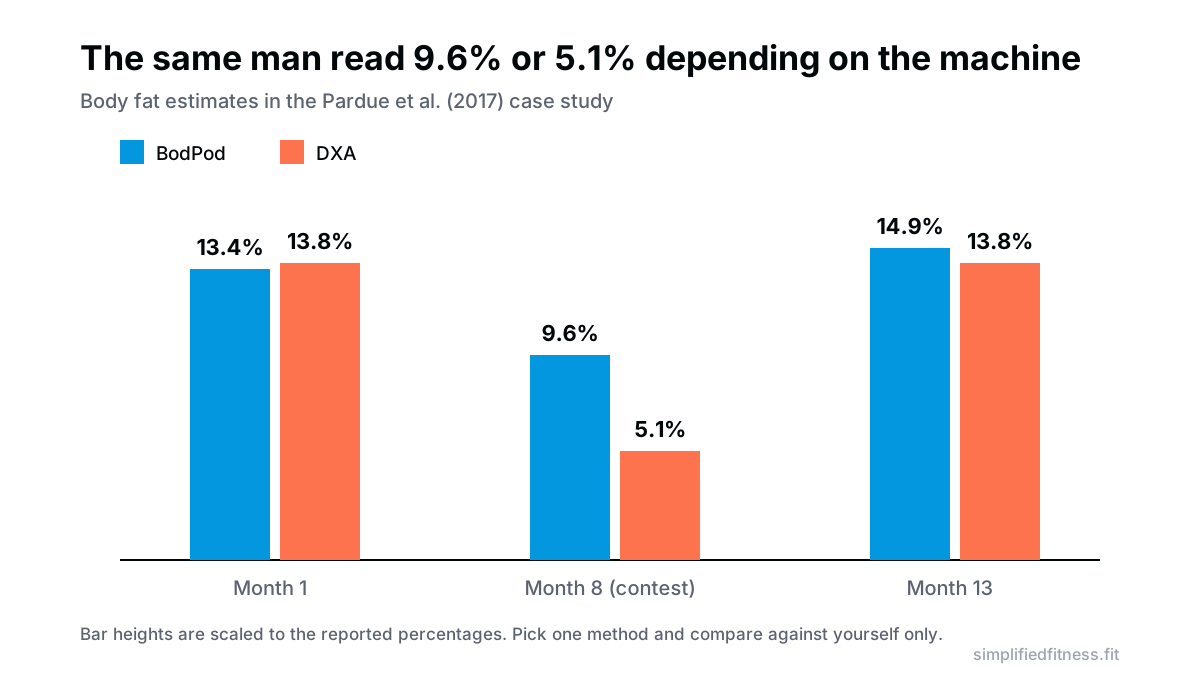
- Body fat numbers depend on the device. The same man read 9.6% on one machine and 5.1% on another, so track trends with one method.
Part of our complete guide: The No-BS Guide to Energy Balance, Fat Loss, Bulking & Body Recomposition
Table of contents
The optimal body fat percentage for natural lifters is not one magic number, but a range you can hold without wrecking your energy. For most people that is roughly 10-15% for men and 18-23% for women. These are practical coaching ranges, not research-proven optimums.
Below them, you can still get leaner for a few weeks, but the cost rises: hormones, sleep, strength and mood all start to pay. This guide sits inside our wider energy balance, fat loss, bulking and recomposition guide and focuses on one question: how lean is lean enough?
What is a healthy body fat range for men vs women?
Women carry more body fat than men on average, so the same number means a different level of leanness. A 2025 DXA study of 732 people (643 athletes from 18 sports plus 89 non-athletes) found average body fat of 18.2% in 454 males and 27.1% in 278 females (Hew-Butler et al., 2025). Those were mostly young college-age athletes, so do not treat them as targets for a 45-year-old.
The same paper looked at the lowest values in free-living athletes with unrestricted access to food. It reached roughly 10% for men and 16% for women, and the authors say it remains unclear whether those thresholds represent “healthy” levels. In other words, sitting near those numbers happens naturally for some athletes, and going well under them usually means you are dieting hard.
Essential fat vs storage fat: why you cannot get to zero
Not all fat is the “extra” kind. Essential fat sits in organs, nerves, bone marrow and cell membranes, and your body needs it to run. Storage fat is the energy reserve you can actually afford to lose.
The problem is that body fat percentage scans measure both together. The 2025 DXA paper says it remains unclear how much of the fat it measured is essential fat located within lean soft tissue (Hew-Butler et al., 2025). That is why textbook “essential fat” percentages are rough at best, and why no scan can tell you exactly where danger begins.
A natural bodybuilding review describes the lower physiological limit for males as about 4-5% body fat. It concluded that prolonged energy availability under 25 kcal per kg of fat-free mass, as men approach that limit, is linked to muscle loss, hormonal imbalances, psychological problems and effects on the cardiovascular system (Fagerberg, 2018). That review notes that no well-controlled studies exist in natural male bodybuilders, so it extrapolates from related research. Nobody should be anywhere near that range for lifestyle reasons.
What happens to your hormones when you get very lean?
The best look we have comes from case studies of drug-free physique athletes. They are small and they are not controlled trials, but they show what can happen.
In one drug-free male bodybuilder followed through 8 months of contest preparation and 5 months of recovery, testosterone fell from 623 to 173 ng/dL, T3 fell from 123 to 40 and T4 from 5.8 to 4.1, while cortisol and ghrelin (a hunger hormone) rose (Pardue et al., 2017). Intake dropped from 3,860 to 1,724 kcal a day, he lost 9.1 kg, peak anaerobic power fell from 753.0 to 536.5 W, and resting metabolic rate dropped from 107.2% to 81.2% of predicted. By month 13, the changes were largely but not entirely reversed.
A 2023 systematic review pooled 11 case studies of 15 apparently drug-free athletes (8 men, 7 women). It found marked changes across body composition, performance, hormones and mood, with high variability between people and different responses by sex (Schoenfeld et al., 2023). The honest summary: it is not an exact recipe. Some people tolerate prep better than others, and nobody knows in advance which group they are in.
What about libido and sleep? The hormone drops above are the likely mechanism for low drive, but the case study above tracked hormones, not sex drive. It also found subjective sleep quality fell during prep, while objective measures changed little (Pardue et al., 2017). So “I feel awful and sleep badly” is real, but it does not always show up on a sleep tracker.
Low energy availability is the real risk, not the number
The 2023 IOC consensus describes Relative Energy Deficiency in Sport (REDs) as a syndrome of health and performance problems in female and male athletes exposed to low energy availability, meaning too little energy intake relative to exercise energy expenditure. It also notes growing data on the impact in males (Mountjoy et al., 2023).
This matters for lifters because the framing is “too little fuel”, not “too little fat”. Someone at 12% eating well can be healthier than someone at 17% who has been under-eating for months. Body fat is a rough proxy. How you eat, sleep, train and feel is the real dashboard.
What does low body fat do to women?
The cleanest signal is the menstrual cycle. Among 131 elite adolescent dancers in China, 22.1% reported secondary amenorrhea, and those dancers had lower body fat than dancers without it (P = .041) (Liu et al., 2024). The authors suggest lower body fat may contribute to menstrual disorders. This was a cross-sectional study using recall, in adolescents, so it shows an association, not proof of cause. It also cannot give a single “safe” number.
For adult lifters, the practical point still holds. A period that becomes irregular or stops while you diet is a warning that energy intake is too low for you right now. It is not a badge of progress.
Why not just stay as lean as possible?
Because the other end has costs too. In men with obesity, low testosterone is common, and a meta-analysis of 24 studies found that both low-calorie diets and bariatric surgery raised total testosterone, with larger weight loss giving a larger rise (Corona et al., 2013). That is evidence about men with obesity, not about lifters at 20% versus 12%, so do not stretch it too far.
The sensible reading is a U-shaped picture: very high body fat and very low body fat with low energy intake both look worse for hormones than the middle. The middle is where most natural lifters should live most of the year.
How to stay in the sweet spot
The aim is to reach your lean range and keep the process gentle.
- Use a moderate rate. In a trial of 24 elite athletes who also lifted four times a week, the group targeting 0.7% body weight loss per week gained 2.1% lean mass, while the group targeting 1.4% a week saw no change in lean mass (Garthe et al., 2011). Details on deficit size are in our guide to setting the optimal caloric deficit.
- Take maintenance breaks. Planned stretches at maintenance may make a long cut easier to stick with. See diet breaks vs refeeds.
- Do not drop fats too low. Dietary fat supports hormone production, which we cover in the minimum fat threshold. Think roughly 20-30% of calories as a common coaching range.
- Keep protein high and keep lifting. Muscle preserved is leanness you do not have to starve for.
- Come back up afterwards. Ending a cut with a slow return to maintenance is better than a binge rebound. See reverse dieting vs going straight to maintenance.
How do I measure body fat without fooling myself?
Numbers differ by device. In the case study above, the same bodybuilder estimated 13.4% at month 1, 9.6% at month 8 and 14.9% at month 13 on BodPod, but 13.8%, 5.1% and 13.8% on DXA (Pardue et al., 2017). That is a 4.5-point gap at the leanest time point.
So do not chase a number from a social media post that does not say how it was measured. Our guide to body fat measurement methods covers accuracy, including why home smart scales can swing a lot from day to day. For a rough estimate, try the body fat calculator, and then pair it with the FFMI calculator to see your muscle level as well as your fat level. If you are unsure whether to cut or build first, read the skinny-fat dilemma.
A simple self-check
Before you push leaner, ask yourself these questions honestly:
- Is my strength holding or rising?
- Am I sleeping normally?
- Is my mood, drive and libido normal for me?
- Am I constantly cold or constantly hungry?
- For women: is my cycle regular?
If most answers are yes, your current range is probably working. If several are no, that is a signal to add calories and pause the cut, not to double down.
When to see a doctor
Speak to a doctor if you have missed or irregular periods, persistent fatigue, low mood, repeated injuries, signs of low testosterone, or if thinking about food and body weight is taking over your day. A doctor can test hormones and bone health, which a body fat number cannot. Obsessive thoughts about leanness can also be a sign of disordered eating or body dysmorphia, and a professional can help with that.
The bottom line
For most natural lifters, roughly 10-15% body fat for men and 18-23% for women is a realistic place to look good and feel good year-round. These are practical ranges, not proven optimums, and individual response varies a lot. Going well below them is not a free upgrade: in the best case studies available, deep leanness with low energy intake came with lower hormones, lower power and a slower metabolism that mostly recovered later. Pick a range, track it with one method, and use performance and health as your guide. If you want to set calories for it, start with the calorie calculator.
Frequently Asked Questions
What is the optimal body fat percentage for natural lifters?
A practical sweet spot is about 10-15% for men and 18-23% for women, though no study has proven these exact numbers as optimal. Lifters in this range can usually show muscle definition while keeping energy, training quality and hormones stable. Pick a range you can hold without constant hunger, then adjust based on how you feel and perform.
What is a healthy body fat percentage for men vs women?
Women carry more body fat than men on average, partly because of reproductive biology, so equal numbers do not mean equal leanness. In a 2025 DXA study of mostly college athletes, average body fat was 18.2% in males and 27.1% in females. Compare yourself to the ranges for your sex, not to a number you saw on a male fitness model.
Is 8 percent body fat healthy for a man?
It is rarely sustainable for natural men, and holding it for months is associated with hormonal and energy problems in case studies. Athletes at free-living food intake measured about 10% as the lowest whole-body value in a 2025 DXA study. If you reach 8% for a photo or event, plan to return to a higher, maintainable range afterwards.
Does low body fat lower testosterone?
Very low body fat combined with a long calorie deficit can lower testosterone. In a drug-free bodybuilder, testosterone fell from 623 to 173 ng/dL across 8 months of contest prep and mostly recovered afterwards. Moderate leanness alone is not the issue, so avoid prolonged hard dieting and use maintenance phases.
Can being too lean affect a woman's period?
Yes, low body fat with low energy availability can disrupt menstrual cycles. Among 131 elite adolescent dancers, those reporting secondary amenorrhea had lower body fat than those without it. If your period becomes irregular or stops while dieting, ease the deficit and see a doctor.
What is the difference between essential fat and storage fat?
Essential fat is the fat your body needs for normal function, found in organs, nerves, bone marrow and cell membranes, while storage fat is the energy reserve under the skin and around organs. Because essential fat sits inside lean tissue, scans cannot cleanly separate the two, which is one reason exact thresholds are uncertain. Aim to lose storage fat, not to chase the lowest number.
Can I stay at 10-12% body fat all year?
Many men can, especially if they eat near maintenance and sleep well, but individual variation is large. Some feel fine there, others notice poor sleep, low drive or constant hunger. Track mood, energy, libido, strength and sleep, and add 100-200 kcal a day if several of them slip.
What body fat percentage do you need to see abs?
It varies with genetics, where you store fat and how much muscle you carry, so no single number applies. Many men see upper abs in the low teens and clearer definition lower, while women usually need to be leaner relative to their norm. Do not chase abs below your sustainable range just for a look.
How fast should I lose fat to protect my hormones and muscle?
A moderate pace is safer for muscle. In a trial of 24 elite athletes, targeting a 0.7% body weight loss per week increased lean mass, while targeting 1.4% per week left it unchanged. Use the slower rate and take maintenance breaks.
Does being overweight also lower testosterone?
Yes, in men with obesity, low testosterone is common and tends to improve with weight loss. A meta-analysis of 24 studies found that diet and bariatric surgery both raised total testosterone, and larger weight loss gave larger rises. So the goal is the middle path: not too fat, not extremely lean.
How accurate are body fat percentage numbers?
They differ by method, sometimes by a lot. In one case study the same bodybuilder measured 9.6% on a BodPod and 5.1% on DXA at the same time point. Choose one method, measure under the same conditions, and use the trend rather than the absolute number.
What are signs I am getting too lean?
Common warning signs include poor sleep, low mood, constant hunger, feeling cold, falling strength, low libido, and in women missed periods. These signs are not diagnostic on their own, but several together suggest your energy intake is too low for too long. Raise calories toward maintenance and see a doctor if symptoms persist.
Should I see a doctor about low body fat?
Yes, if you have missed periods, persistent fatigue, repeated injuries or signs of low testosterone. A doctor can check hormones, bone health and nutrition, which this article cannot do. Do not self-diagnose from a body fat number.
Sources & References
Every claim above is checked against peer-reviewed research (PubMed, U.S. National Library of Medicine) or guidance from established health bodies. How we fact-check.
- Fagerberg P. Negative Consequences of Low Energy Availability in Natural Male Bodybuilding: A Review. Int J Sport Nutr Exerc Metab. 2018. PMID: 28530498
- Pardue A, et al. Case Study: Unfavorable But Transient Physiological Changes During Contest Preparation in a Drug-Free Male Bodybuilder. Int J Sport Nutr Exerc Metab. 2017. PMID: 28770669
- Schoenfeld BJ, et al. Alterations in Measures of Body Composition, Neuromuscular Performance, Hormonal Levels, Physiological Adaptations, and Psychometric Outcomes during Preparation for Physique Competition: A Systematic Review of Case Studies. J Funct Morphol Kinesiol. 2023. PMID: 37218855
- Hew-Butler T, et al. Evaluating lower limits of body fat percentage in athletes using DXA. J Clin Densitom. 2025. PMID: 39869984
- Liu Z, et al. Low Body Fat Percentage and Menstrual Cycle Disorders in Female Elite Adolescent Dancers. J Dance Med Sci. 2024. PMID: 38284148
- Mountjoy M, et al. 2023 International Olympic Committee's (IOC) consensus statement on Relative Energy Deficiency in Sport (REDs). Br J Sports Med. 2023. PMID: 37752011
- Corona G, et al. Body weight loss reverts obesity-associated hypogonadotropic hypogonadism: a systematic review and meta-analysis. Eur J Endocrinol. 2013. PMID: 23482592
- Garthe I, et al. Effect of two different weight-loss rates on body composition and strength and power-related performance in elite athletes. Int J Sport Nutr Exerc Metab. 2011. PMID: 21558571

Umair Hazrami · Founder & Head Coach, Simplified Fitness
Umair Hazrami founded Simplified Fitness and the Simplified Lifter channel to cut through fitness noise. With 4+ years of consistent training and 10+ coaching clients, he writes every guide from the peer-reviewed research and links the sources so you can check them. Our editorial standards.
Educational content only, not medical advice. If you have a medical condition, are pregnant, or take medication, talk to a qualified doctor before changing your diet, supplements or training. Full disclaimer.
Keep reading
Nutrition
Body Recomposition: Who Can Lose Fat and Build Muscle at the Same Time?
How to do body recomposition: who can lose fat and build muscle at once, what the trials show, and a protein, training and calorie protocol you can start today.
8 min read
Nutrition
Breaking Fat Loss Plateaus: Check Fluid, Hidden Calories and NEAT
How to break a fat loss plateau: a 3-step check of water masking, hidden calories and lower daily steps, plus the exact fix to restart steady fat loss.
8 min read

Nutrition
How to Calculate Macros: Step-by-Step Grams per Kilogram Formula for Protein, Fat and Carbs
How to calculate macros in grams per kg: set protein, set fat, fill the rest with carbs. Worked examples for 70, 80 and 90 kg lifters on a cut or a bulk.
9 min read
Nutrition
Daily Scale Weight Fluctuations: Sodium, Bowels, Glycogen and Water
Daily scale weight fluctuations are mostly water, glycogen and gut contents, not fat. Learn why your weight jumps overnight and how a 7-day average fixes it.
8 min read