Body Composition, Muscle Memory and Habits: A Lifter's Guide to Tracking
How to track body fat accurately without trusting a smart scale: DEXA limits, muscle memory, detraining and habit science, with every study linked.

TL;DR. The short answer
- No single body fat number is truly accurate. Smart scales (BIA) shift with hydration, and DEXA is a good tool but still an estimate, so track trends with waist, photos, scale averages and logged lifts.
- In one trial, drinking 2 L of water raised multi-frequency BIA body fat by about 2 percentage points within minutes, with no real fat gain.
- Muscle memory is real: people regain lost muscle faster than they built it. Whether permanent myonuclei explain it in humans is still disputed, with 2019 and 2022 papers against and a 2024 paper for.
- A few weeks off will not erase your gains. Strength and size can usually be held for months on roughly one hard session a week if the load stays heavy, though most of this evidence is in younger adults.
- Habits take longer than the '21 days' myth. A 2024 review found median times of about 59-66 days, with huge individual spread, so build a minimum routine you can keep on bad weeks.
Table of contents
If you want to know how to track body fat accurately, the honest answer is that no single tool gives you an accurate number. Smart scales, DEXA, calipers and tape all carry error, so the reliable method is to combine a few cheap measures and read the trend over weeks, not the figure on any one day.
That sounds less exciting than an expensive scan. It is also what the research supports, and it ties into everything else in this guide: why you do not lose your gains after a short break, why you regain them faster than you built them, and why the real bottleneck for most lifters is not biology at all. It is showing up for years.
This is the hub for that whole cluster. It sits beside our guides on energy balance and fat loss and progressive overload and plateaus, and each section below links to a deeper article if you want more.
How to track body fat accurately (and why every method is an estimate)
Almost every body fat method works by estimating, not by directly measuring. Fat cannot be pulled out and weighed in a living person, so each tool infers it from something else: electrical resistance, X-ray absorption, skin thickness, density, or body shape. Every inference rests on assumptions, mainly about how hydrated you are and what your lean tissue is made of.
The 2012 IOC working group position statement says this plainly: no universally applicable criterion or “gold standard” exists for body composition assessment (Ackland et al., 2012). Even the best-performing methods in one 70-athlete comparison, air displacement and DEXA, only reached moderate to substantial agreement with a six-compartment criterion model, and the other methods did worse (Cataldi et al., 2024).
So the goal shifts. You are not hunting for the true number. You are hunting for a measurement process that gives you the same wrong-by-a-bit answer every time, so that changes in it mean something.
The sections below rank the common tools by how much you can trust them for tracking. For a full method-by-method comparison, see body fat measurement methods compared.
Why are smart scale body fat readings so wrong?
Smart scales use bioelectrical impedance analysis, or BIA. A small current passes through your feet (and hands, on some models), and the scale estimates body water from how much the current is resisted. It then converts that into lean mass and fat using an equation built from a reference population. Water is the weak link, because anything that changes your hydration changes the reading.
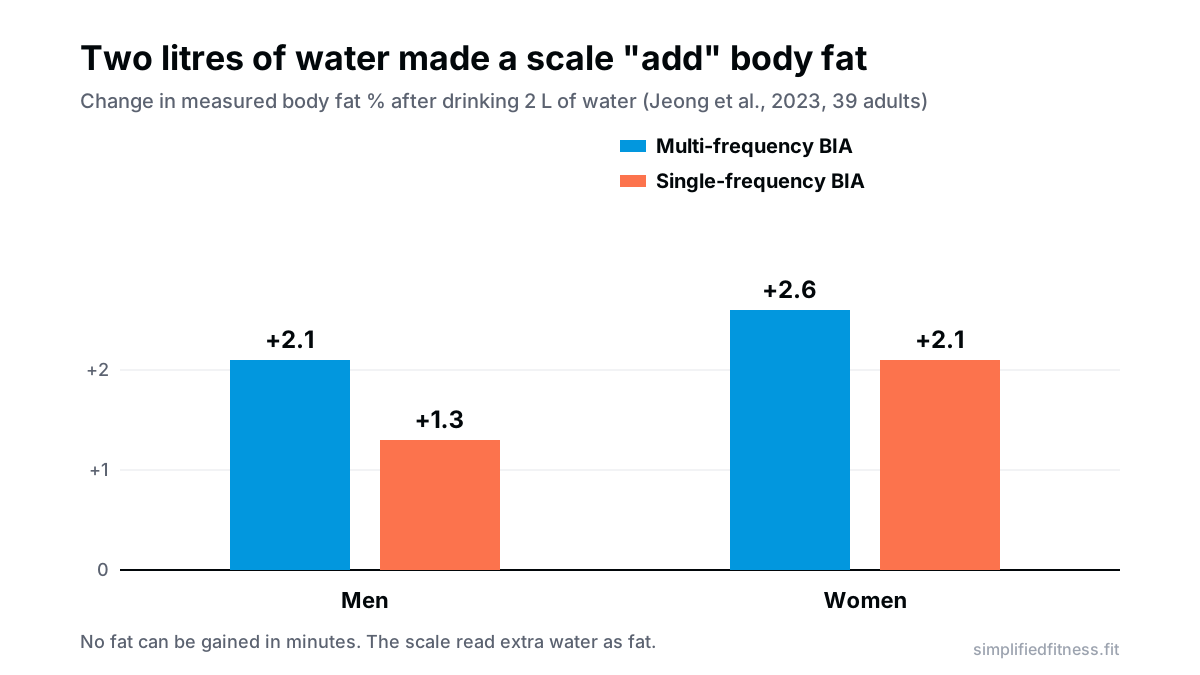
Here is a clean demonstration. In a 2023 study, 39 adults had their body composition measured before and after drinking 2 L of water. Multi-frequency BIA body fat percentage rose by 2.1 points in men and 2.6 points in women, and single-frequency BIA rose by 1.3 and 2.1 points. The authors concluded that multi-frequency BIA mislabels extra water mass as fat, so hydration needs to be standardised (Jeong et al., 2023).
Food does something similar. In 32 athletic men, measuring after a normal day of eating and drinking instead of after an overnight fast produced large changes in measured fat mass for bioimpedance spectroscopy and surface anthropometry, and large changes in fat-free mass for several models (Kerr et al., 2017).
But some BIA devices are reliable, aren’t they?
Yes, and this is where you should not swing too far the other way. Reliability (getting the same number twice) is different from accuracy (getting the true number). In a study of 67 healthy adults, three InBody models were highly repeatable, with intraclass correlations of 0.98 or higher for body fat percentage. Compared with DEXA, however, they consistently underestimated body fat and overestimated fat-free mass, and the minimum difference needed to call a real change in body fat was about 2.1 to 2.7 percentage points (McLester et al., 2020).
Those authors concluded the individual error was small enough for these devices to serve as a surrogate when DEXA is not available. So a decent multi-frequency device, used in the same conditions, is a usable trend tool. A cheap bathroom scale with a body fat tab, used at random times after chai and a water bottle, is not.
If you want the full mechanics, our deep dive on smart scales and BIA accuracy goes through skin temperature, calluses and electrode contact. For the daily weight swings that fool people even more often, read scale weight fluctuations from water, sodium and glycogen.
How accurate is a DEXA scan?
DEXA uses two low-dose X-ray beams to split the body into fat, lean tissue and bone. It is widely treated as the reference method in practice, and it has real strengths: bone density, limb-by-limb breakdowns and good precision. But it is not magic.
In the same hydration study, DEXA-measured fat-free mass rose by about 1.4 kg in men and 1.7 kg in women after the 2 L of water (Jeong et al., 2023). Percent hydration of fat-free mass varied from 63-73% in men and 58-78% in women in the athlete study, while standard DEXA calculations assume lean tissue hydration is fairly constant (Cataldi et al., 2024).
DEXA does appear more resilient than most methods when conditions are not standardised. In resistance-trained men who trained and overate for 6 weeks, most methods gave blunted or exaggerated change estimates when pre-test conditions were uncontrolled, though DEXA and select digital anthropometry methods held up better (Tinsley et al., 2022). Kerr and colleagues likewise found DEXA acceptable if acute food and fluid intake stayed below 500 g (Kerr et al., 2017).
Practical rules if you do book one:
- Go fasted and rested, ideally first thing in the morning.
- Skip hard training the day before, since it shifts fluid and glycogen.
- Use the same machine and the same clinic for repeat scans.
- Treat small changes between scans as unproven.
- Ask about the machine’s precision error rather than assuming it is tiny.
What is the best cheap system for tracking progress?
Skinfold calipers are the old-school alternative. A 2021 narrative review compared the “most accurate” (DEXA) and “most practical” (skinfolds) tools and, after weighing day-to-day variability, concluded that skinfolds appear least affected, hence the title “Come back skinfolds, all is forgiven” (Kasper et al., 2021). The catch is skill: a calliper reading is only as good as the person pinching, so it works best when the same trained person measures you every time.
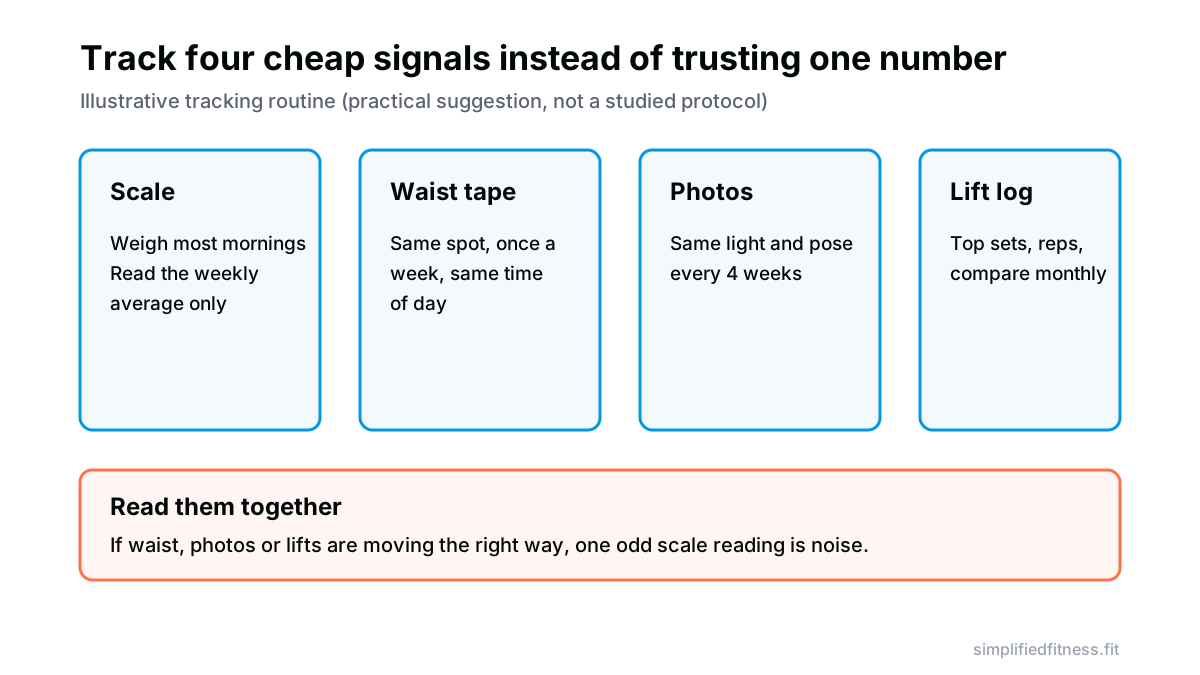
For everyone else, the practical stack is simple and costs almost nothing. This is a practical suggestion rather than a studied protocol, but each piece is standard coaching practice and is easy to repeat:
- Scale weight, averaged. Weigh most mornings under the same conditions and read the weekly average. A 2015 meta-analysis found that adding self-weighing to behavioural weight-loss programmes was associated with greater weight loss, with no significant difference between daily and weekly weighing. It found no good evidence for weighing as a standalone strategy (Madigan et al., 2015).
- Waist circumference. One tape, same spot (for example at the navel), same time of day, once a week. Our waist-to-height ratio calculator turns it into a simple number.
- Photos. Same light, same distance, same poses (front, side, back), every four weeks. Compare side by side, not in your head.
- Strength log. Your top sets for the main lifts. If they are holding or climbing during a diet, you are unlikely to be losing much muscle, whatever the scale says. Our guide to the training logbook explains what to record.
The full routine, with templates, is in the DIY physique tracking blueprint. If you want a rough estimate for fun, our body fat calculator uses the US Navy tape method. Treat it as one more estimate, not a diagnosis.
| Method | What it is good for | Main weakness |
|---|---|---|
| Smart scale (BIA) | Convenience, trend if standardised | Hydration and food shift the reading |
| DEXA | Bone, limb breakdown, fairly resilient | Hydration assumptions, cost, access |
| Skinfold calipers | Low cost, low day-to-day variability | Depends on the person measuring |
| Waist tape | Free, tracks central fat trend | Bloating and water move it daily |
| Photos | Shows what the mirror misses | Light and pose change the picture |
| Lift log | Indirect signal of muscle retention | Does not measure fat at all |
What is muscle memory, and is it in the myonuclei?
Muscle memory means a muscle that has been trained before regains size and strength faster than a muscle that never was. Anyone who has returned to the gym after a layoff has felt it: weights that felt impossible in week one feel normal by week three.
Part of that is neural and skill-based. You remember how to brace, hook your grip and groove a squat. Part of it may be cellular. Muscle fibres are huge cells with many nuclei, called myonuclei, and the idea is that training adds nuclei that stay behind when the fibre shrinks, letting it regrow faster.
The evidence for that second part is genuinely mixed, so here is what each side found.
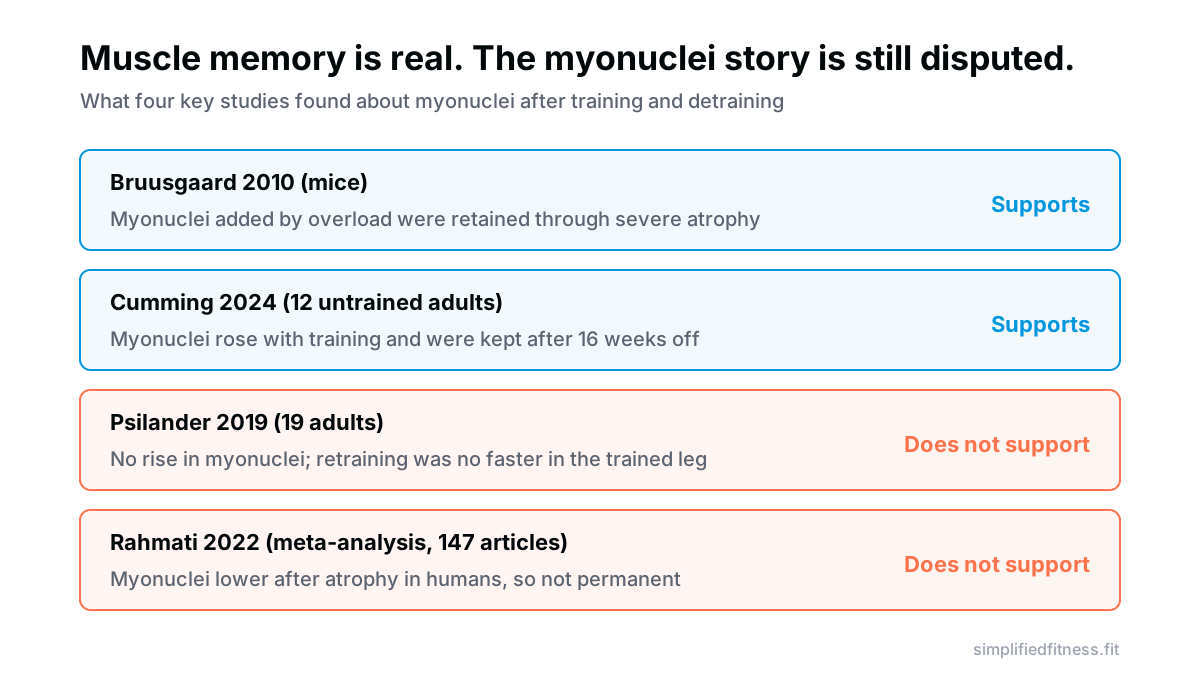
- Mouse data (supportive). In live-imaged mouse muscle, nuclei added during overload were retained through prolonged, severe atrophy, which the authors proposed could serve as a cellular memory (Bruusgaard et al., 2010).
- Human data, 2024 (supportive). In 12 untrained adults who trained one arm for 10 weeks, stopped for 16 weeks, then retrained, myonuclei rose by 13% in type 1 and 33% in type 2 fibres, and were maintained during detraining. But the previously trained arm did not show a clearly greater gain when retraining, so the authors said the physiological benefit remains to be determined (Cumming et al., 2024).
- Human data, 2019 (not supportive). In 19 adults who trained one leg for 10 weeks, detrained for 20 weeks and retrained, no increase in myonuclear number was detected and the trained leg did not respond better to retraining. The authors noted that this does not rule out muscle memory, because the design did not allow a rigorous test (Psilander et al., 2019).
- Meta-analysis, 2022 (not supportive). Across 147 articles, myonuclei were retained in rodents but human myonuclei were lower after atrophy, and the authors concluded that myonuclei are not permanent and that other mechanisms, such as epigenetics, may matter more (Rahmati et al., 2022).
Why might they disagree? Study design is the likely reason. Studies differ in muscles biopsied, training length, how long participants rested and how nuclei were counted, and all of the human studies here are small and used untrained participants. Biopsy counting is also technically difficult.
The cautious takeaway: muscle memory as a practical phenomenon is well supported by retraining data (next section). Whether “permanent myonuclei” are the reason in humans is unresolved, and epigenetic changes are a competing, still-developing explanation. The deeper science is in the biology of muscle memory.
How fast do you lose muscle when you stop training?
Slower than the fear suggests, and the regain is quick. The cleanest human data on this comes from a 2024 randomized trial of 55 untrained adults (average age 32). One group did 10 weeks of training, 10 weeks of detraining and then another 10 weeks of training. The other did 10 weeks of nothing and then 20 weeks of continuous training.
Strength and muscle size fell during the 10-week detraining block, but they were regained rapidly on return: in the first five weeks of retraining, gains in leg press strength and muscle cross-sectional area were greater than the same stretch of training in the continuous group. Both groups finished with similar results. The authors’ conclusion was that trainees need not be too concerned about occasional short breaks (Halonen et al., 2024).
Two honest limits apply. These were untrained people, so experienced lifters may behave differently. And a 10-week break is not a 3-week holiday, so the results do not give an exact “you lose X% after Y days” figure, and I would not trust any article that claims one for every lifter. Individual factors like age, training history, protein intake and sleep all matter.
Two things you may notice early are probably not muscle loss. Muscle can look flatter and the scale can drop within days of stopping, which is commonly attributed to lower carbohydrate stores and water, though that is a plausible explanation rather than something these studies measured. Do not panic over week-one changes. For a deeper breakdown, see our guide to detraining timelines.
How little training can maintain muscle?
This is the section for busy seasons, exams, long work trips and weddings. A 2021 narrative review in the Journal of Strength and Conditioning Research concluded that strength and muscle size in younger people can be maintained for up to 32 weeks with as little as one strength session a week and one set per exercise, provided the relative load stays high. In older adults, holding muscle size may take up to two sessions a week and two to three sets per exercise. The review’s main conclusion was that intensity seems to be the key variable for maintaining performance, despite big cuts in frequency and volume (Spiering et al., 2021).
That is a narrative review, not a meta-analysis, and the authors say there is insufficient data for specific recommendations for athletes. So treat it as a sound principle rather than a precise prescription.
In plain terms:
- Keep the weight heavy. Dropping to light pump work saves time but removes the thing that maintains you.
- Cut sets before cutting sessions. Two or three hard sets per movement, once or twice a week, is a legitimate maintenance block.
- Pick 4-5 compound or machine movements. A squat or leg press, a press, a row or pulldown, and a hinge covers most of the body.
- Stay near failure on the sets you do. If you only have 25 minutes, make those sets count.
This is the same logic we explore in maintenance volume science. It pairs naturally with the progressive overload guide, because maintenance is simply overload on pause.
What about vacations and hotel gyms?
Same rules, fewer tools. A two-week trip with three short sessions is plenty. Backpack push-ups, band rows, single-leg squats or step-ups to a chair, and a hotel gym dumbbell session can all deliver hard sets. Indian travellers also tend to have heavy, rich meals on trips (think wedding buffets and festival sweets), so a simple walk after meals plus one or two protein-focused meals a day beats trying to out-train a holiday. Our vacation and travel workout blueprint has ready sessions.
How do you restart after a long break?
Muscle memory gets you back to your old shape faster, but it does not instantly prepare your joints, tendons or soreness tolerance. The classic mistake is jumping straight to your old best lifts on day one.
A sensible ramp, based on coaching practice rather than a specific trial:
- Week 1: About 60-70% of your old working weights, 2-3 sets per exercise, stopping a few reps short of failure.
- Week 2: Add load or a set if form stayed crisp and soreness settled.
- Weeks 3-4: Return to normal volume and approach previous top sets.
- After that: Resume ordinary progressive overload.
Longer or more intense gaps need a longer ramp. If you return after illness, injury, surgery or a long medical absence, talk to a doctor or physiotherapist about when and how to restart. The return-to-gym protocol covers a step-by-step version.
How long does it take to build a gym habit?
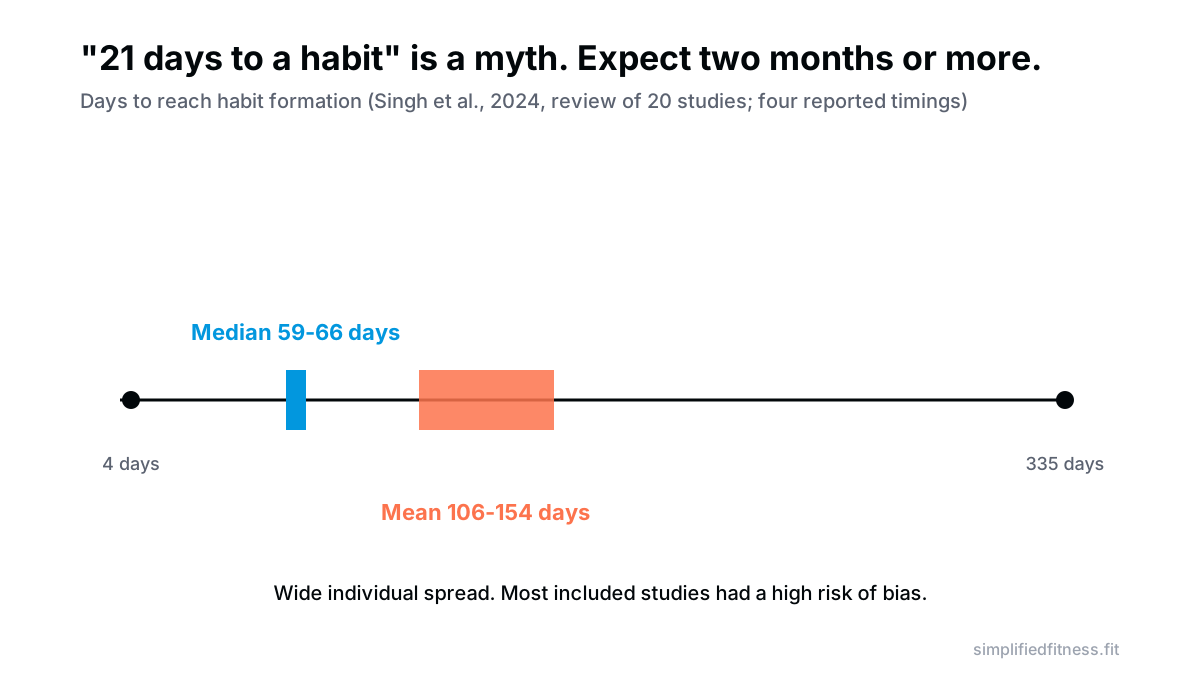
You have probably heard that habits take 21 days. The research does not support that. A 2024 systematic review and meta-analysis of 20 studies (2,601 participants) found median times to reach habit formation of about 59-66 days and mean times of 106-154 days, with a huge individual range of 4 to 335 days. Only four studies reported these timings, 11 of the 20 were rated at high risk of bias, and the authors noted that flossing and diet had the most evidence among the behaviours studied (Singh et al., 2024).
The same review reported that frequency, timing, individual choice and behavioural regulation influenced habit strength, and that morning practice and self-selected habits generally showed greater strength. That fits what most coaches see, though it comes from a small, mixed evidence base, so treat it as encouraging rather than conclusive.
What does that mean for a lifter?
- Tie training to a fixed cue. “After my morning tea” or “straight after office” beats “when I feel like it”.
- Choose the schedule yourself. Self-selected habits seem to stick better than ones imposed on you.
- Define a minimum version. Something like 20 minutes and three hard sets is a win on a bad day, so a missed hour never becomes a missed week.
- Remove friction. Pack the bag the night before, choose a gym you can reach in 15 minutes and keep a home plan for the days you cannot go.
- Review weekly. Ask what blocked you and fix that specific problem.
If you need a structure to attach the habit to, our free push, pull and leg plans and the personalised diet plan give you a ready routine to start with.
What is FFMI, and is there a natural muscle limit?
Fat-free mass index (FFMI) is your fat-free mass in kg divided by height in metres squared, often normalised to a 1.8 m height. It lets you compare muscularity across heights better than body weight does.
The most quoted number comes from a 1995 study of 157 male athletes (83 steroid users and 74 non-users). Normalised FFMI in non-users extended up to a well-defined limit of 25.0, a sample of 20 Mr America winners from 1939 to 1959 averaged 25.4, and many steroid users exceeded 25 with some above 30. The authors explicitly called their results preliminary (Kouri et al., 1995).
Treat that as a rough reference, not a law. It is a single 1995 male-only sample, it was designed to screen for steroid use rather than define human potential, and it depends on a body fat estimate, which as we have seen has error of its own. A lifter with an FFMI of 21-22 after a few years of training is not “stuck”. They are probably still progressing, and it takes years.
Try our FFMI calculator to see where you sit, then use the number to stay realistic, not to chase an arbitrary ceiling. For the psychology of comparing yourself with influencers, see muscle dysmorphia and realistic physique expectations. If you regularly feel distressed about your body or are restricting food or overtraining because of it, please speak to a doctor or a mental health professional.
How does it all fit together?
Body composition tools, detraining research and habit science are really the same story: progress is slow, noisy and survivable.
- Your measurements are noisy. Use several, repeat them under standard conditions and trust trends.
- Your gains are more durable than you fear. Short breaks cost little, and a heavy minimum routine can hold muscle for months.
- Your comeback will be faster than your first climb. Muscle memory is real, whatever the final mechanism turns out to be.
- Your habits decide the outcome. If a routine takes two months or more to feel automatic, it needs to be small enough to survive stress.
For the muscle-building fundamentals behind all this, start with our muscle hypertrophy guide for natural lifters. For long-term benefits beyond the mirror, see the lifelong muscle dividend.
If you want someone to build this into a plan around your schedule, that is what personal coaching is for. For medical concerns about body composition, unexplained weight change or an eating disorder, see a doctor first.
Go deeper: every guide in this topic
- Overcoming the All-or-Nothing Mindset: How Perfectionism Wrecks Long-Term Fitness
- How to Build a Gym Habit: The Behavioral Science of Sticking With It
- Best Way to Measure Body Fat: DEXA, Bod Pod, Calipers and 4C Compared
- Body Recomposition Limits: Who Can Recomp, and When Advanced Lifters Must Choose a Surplus or Deficit
- How Long Does It Take to Lose Muscle? A Realistic Detraining Timeline
- DIY Physique Tracking: Waist, Photos, Scale Averages and Strength
- Working Out During Exams, a New Baby or a Big Move: The 2-Day Minimum That Keeps Your Gains
- Goal Setting That Actually Works: Process Goals vs Outcome Goals in Strength and Fat Loss
- Gym Burnout and Apathy: Why Training Feels Like a Chore and How to Fix It
- How to Keep a Training Logbook: Track Weights, Reps and RIR to Keep Progressing
- The Lifelong Muscle Dividend: What Decades of Lifting Do for Aging and Longevity
- Maintenance Volume: How Little Training Keeps Muscle for Months
- Muscle Dysmorphia and Realistic Physique Expectations: What Fitness Influencers Don't Show You
- Muscle Memory Biology: Myonuclei, Epigenetics and Why Lost Muscle Often Returns Faster
- Returning to the Gym After a Long Break: A 4-Week Ramp-Up Plan
- Why Did I Gain 3 Lbs Overnight? Glycogen, Salt, Water and Gut Content Explained
- Skinny Fat? Cut, Bulk or Recomp: The Waist-to-Height Test and a 12-Month Roadmap
- Smart Scales and BIA Accuracy: Why Bioelectrical Impedance Misreads Body Fat
- Eating Healthy Under Social Peer Pressure: How to Train and Eat Well When Family and Friends Push Back
- Vacation Workout Routine: Keep Your Muscle Without a Gym
Frequently Asked Questions
How can I track body fat accurately at home?
You cannot get a perfectly accurate number at home, but you can get a reliable trend. Methods like BIA scales, calipers and tape all have error, so the mechanism that matters is consistency: same time, same conditions, same tool. Use waist circumference, a weekly scale average, monthly photos and your lift log together instead of trusting one body fat percentage.
Are smart scales accurate for body fat?
Not for the absolute number. Bioimpedance scales estimate fat from how an electrical current passes through you, and a 2023 study found drinking 2 L of water raised measured body fat by about 2 percentage points on multi-frequency BIA. Weigh at a consistent time, treat the body fat figure as a rough trend line and judge progress from your waist and lifts.
Is a DEXA scan the gold standard for body fat?
It is one of the better practical tools, but the 2012 IOC position statement notes there is no universal gold standard for body composition. DEXA still depends on assumptions such as hydration, and results shift with food, fluid and recent exercise. Book repeat scans under the same conditions, ideally fasted and rested, and compare like with like.
How accurate is a DEXA scan?
DEXA agrees well with more complex reference models in athletes (concordance of about 0.90-0.95 in one 70-athlete study), but it is not error free. It can misread hydration shifts, and in one trial 2 L of water raised DEXA fat-free mass by about 1.4-1.7 kg. Treat a change smaller than a few percent between scans with caution and keep your pre-scan routine identical.
Why does my body fat percentage change so much between measurements?
Water is the usual culprit. BIA reads water as lean tissue or fat depending on the algorithm, and food, fluid, sweat and time of day move it around. Measure first thing in the morning, after the toilet and before eating or drinking, every time.
Are skinfold calipers better than smart scales?
A 2021 narrative review concluded skinfolds were the least affected by day-to-day variability among common methods, although accuracy depends heavily on who is pinching. They need practice and the same person each time. If you cannot do that, a tape measure at the waist is a simpler, free substitute.
What is muscle memory in simple terms?
Muscle memory is the ability of a previously trained muscle to regrow faster after a break. Part of it is neural (your brain remembers the movement) and part may be cellular, such as extra nuclei in muscle fibres or lasting gene expression changes. In practice, expect to regain lost size and strength faster than it took to build them, so return to training instead of starting over mentally.
Do myonuclei really stay after you stop training?
The evidence conflicts. A 2024 study in 12 untrained adults found myonuclei were maintained after 16 weeks of detraining, while a 2022 meta-analysis of 147 articles concluded human myonuclei are not permanent, and a 2019 study found no extra nuclei at all. Treat permanent myonuclei as a plausible but unsettled mechanism, and rely on the practical fact that retraining is fast.
How fast do you lose muscle when you stop lifting?
Slower than most people fear. In a 2024 trial of untrained adults, strength and size fell over 10 weeks without training and were regained quickly once training resumed. The longer you are away, the more you lose, so keep some training going if you can.
How long does it take to lose strength after stopping?
It depends on training age and the length of the break. Research mostly comes from untrained or older subjects, so exact timelines for experienced lifters are uncertain. A 10-week break reduced strength and size in one trial, and that loss came back quickly. Precise data on 1-2 week breaks are lacking, but if 10 weeks off was recoverable, a short break is unlikely to cost much.
Can I maintain muscle on one workout a week?
Often yes, for a while. A 2021 review concluded strength and muscle size in younger people can be maintained for up to 32 weeks with as little as one strength session per week and one set per exercise, if the relative load stays high. Older adults may need about twice that, so use this as a holiday or busy-season plan, not a growth plan.
How should I train on vacation to keep my gains?
Keep intensity high and volume low. A couple of short sessions per week with hard sets near failure (push-ups with a backpack, band rows, single-leg squats, a hotel gym) should be plenty for a trip of one to three weeks, since a review found intensity matters more than frequency for maintenance. Do not stress if you only manage one session, because maintenance needs far less than building.
How do I get back into the gym after a long break?
Start below where you left off and rebuild over two to four weeks. Muscle memory means you regain quickly, but tendons and soreness catch up more slowly, so a sudden return to old numbers often ends in soreness or a tweak. Use about 60-70% of your old loads for the first week and add weight as soon as reps feel crisp.
How long does it take to form a gym habit?
A 2024 systematic review reported, from the four studies that measured it, median times of about 59-66 days, mean times of 106-154 days and individual cases from 4 to 335 days. The famous 21-day figure is not supported. Plan for a couple of months of deliberate effort and keep the routine small enough to survive stress and travel.
What is the best way to stay consistent with lifting?
Make the routine small, specific and tied to a cue. A 2024 review found morning practice and self-chosen habits generally showed greater habit strength. Fix your session days, set a minimum version of the workout for bad weeks, and write it in your phone calendar.
Does weighing myself every day help or hurt?
It can help if you read it as a trend. A 2015 meta-analysis found self-weighing added to a behavioural programme was associated with weight loss, with no significant difference between daily and weekly weighing, but no good evidence for weighing on its own. If daily numbers stress you out, weigh twice a week or use a monthly waist and photo check instead.
What is FFMI and what is a natural limit?
Fat-free mass index is fat-free mass in kg divided by height in metres squared, often adjusted to a height of 1.8 m. A 1995 study of 157 male athletes found non-users of steroids reached normalised values up to about 25, though the authors called it preliminary. Use it as a rough reference, not a hard ceiling, and remember it depends on a body fat estimate that has its own error.
Can I trust the FFMI calculator?
Only as far as you trust your body fat reading. FFMI uses your fat-free mass, which comes from a body fat estimate, so a 3-4 percentage point error moves the result noticeably. Use a good measurement under standardised conditions and treat the result as a ballpark.
Should I do a DEXA scan if I am a beginner?
Not necessarily. If it is affordable and you are curious, a single scan gives a baseline, but it will not teach you more than your waist, photos and lift log in the first months. Save the money for good food or coaching unless you have a specific medical or performance reason.
Why does my weight go up after a weekend of eating more?
A rapid jump is usually mostly food in your gut, water and stored carbohydrate rather than fat. Gaining a kilogram of actual fat takes a much larger surplus than most normal weekends create. Return to normal eating, keep drinking water and judge by your weekly average, not by Monday morning.
Is a bigger waist always fat gain?
Not always. Waist measurements move with digestion, bloating, sodium and water. Measure at the same time of day, in the same position, and look at the trend over three to four weeks.
Does muscle memory work after years of not training?
Probably in part, though the evidence is limited. The retraining trials we have lasted weeks to months, not decades, so we lack direct data on very long gaps. Expect an easier rebuild than a true beginner, and be patient with joints and connective tissue.
What should I do when motivation disappears?
Lower the bar instead of quitting. Motivation fluctuates, so the habit literature points to a smaller routine, a stable cue and a plan for bad days. Aim for two short sessions a week rather than zero, then rebuild.
Sources & References
Every claim above is checked against peer-reviewed research (PubMed, U.S. National Library of Medicine) or guidance from established health bodies. How we fact-check.
- Ackland TR, et al. Current status of body composition assessment in sport: review and position statement on behalf of the ad hoc research working group on body composition health and performance, under the auspices of the I.O.C. Medical Commission. Sports Med. 2012. PMID: 22303996
- Jeong S, et al. The effect of acute hydration on body composition assessed by multi-frequency and single-frequency bioelectrical impedance. J Sports Med Phys Fitness. 2023. PMID: 37335581
- McLester CN, et al. Reliability and agreement of various InBody body composition analyzers as compared to dual-energy X-ray absorptiometry in healthy men and women. J Clin Densitom. 2020. PMID: 30472111
- Kerr A, et al. Impact of food and fluid intake on technical and biological measurement error in body composition assessment methods in athletes. Br J Nutr. 2017. PMID: 28382898
- Tinsley GM, et al. Tracking changes in body composition: comparison of methods and influence of pre-assessment standardisation. Br J Nutr. 2022. PMID: 34325758
- Cataldi D, et al. Accuracy and precision of multiple body composition methods and associations with muscle strength in athletes of varying hydration: The Da Kine Study. Clin Nutr. 2024. PMID: 38104490
- Kasper AM, et al. Come back skinfolds, all is forgiven: a narrative review of the efficacy of common body composition methods in applied sports practice. Nutrients. 2021. PMID: 33806245
- Cumming KT, et al. Muscle memory in humans: evidence for myonuclear permanence and long-term transcriptional regulation after strength training. J Physiol. 2024. PMID: 39159314
- Psilander N, et al. Effects of training, detraining, and retraining on strength, hypertrophy, and myonuclear number in human skeletal muscle. J Appl Physiol. 2019. PMID: 30991013
- Rahmati M, et al. Myonuclear permanence in skeletal muscle memory: a systematic review and meta-analysis of human and animal studies. J Cachexia Sarcopenia Muscle. 2022. PMID: 35961635
- Bruusgaard JC, et al. Myonuclei acquired by overload exercise precede hypertrophy and are not lost on detraining. Proc Natl Acad Sci U S A. 2010. PMID: 20713720
- Halonen EJ, et al. Does taking a break matter: adaptations in muscle strength and size between continuous and periodic resistance training. Scand J Med Sci Sports. 2024. PMID: 39364857
- Spiering BA, et al. Maintaining physical performance: the minimal dose of exercise needed to preserve endurance and strength over time. J Strength Cond Res. 2021. PMID: 33629972
- Singh B, et al. Time to form a habit: a systematic review and meta-analysis of health behaviour habit formation and its determinants. Healthcare (Basel). 2024. PMID: 39685110
- Madigan CD, et al. Is self-weighing an effective tool for weight loss: a systematic literature review and meta-analysis. Int J Behav Nutr Phys Act. 2015. PMID: 26293454
- Kouri EM, et al. Fat-free mass index in users and nonusers of anabolic-androgenic steroids. Clin J Sport Med. 1995. PMID: 7496846

Umair Hazrami · Founder & Head Coach, Simplified Fitness
Umair Hazrami founded Simplified Fitness and the Simplified Lifter channel to cut through fitness noise. With 4+ years of consistent training and 10+ coaching clients, he writes every guide from the peer-reviewed research and links the sources so you can check them. Our editorial standards.
Educational content only, not medical advice. If you have a medical condition, are pregnant, or take medication, talk to a qualified doctor before changing your diet, supplements or training. Full disclaimer.
Keep reading

Health & Longevity
Overcoming the All-or-Nothing Mindset: How Perfectionism Wrecks Long-Term Fitness
The all-or-nothing mindset in fitness turns one missed workout into a lost month. Here is the research, the never-miss-twice rule and a 20-minute fallback plan.
10 min read
Health & Longevity
Are Deadlifts Bad for Your Lower Back? What Spinal Loading Research Shows
Are deadlifts bad for lower back health? The research shows spinal loads are high but tolerable, and trials use loaded lifting for back pain. How to hinge.
9 min read

Health & Longevity
Are Squats Bad for Your Knees? What the Research Actually Says
Are squats bad for your knees? Research on deep squats, kneecap stress and the knees-over-toes rule shows where the myth came from and how to squat safely.
9 min read

Health & Longevity
How to Build a Gym Habit: The Behavioral Science of Sticking With It
How to build a gym habit using habit science: how long it takes, why cues and low friction beat willpower, and what identity can and cannot do for consistency.
8 min read