Diet Breaks vs Refeeds: Do Hormones, Glycogen and Sanity Really Matter?
Diet breaks vs refeeds: which one helps a long cut? See what MATADOR, ICECAP and other trials found on fat loss, metabolism and hunger, and how to schedule one.
TL;DR. The short answer
- Diet breaks and refeeds are mainly adherence tools. In trained lifters, neither has been shown to burn more fat than simply staying in a steady deficit for the same number of dieting weeks.
- A 1-week diet break at maintenance calories lowered hunger and irritability in resistance-trained adults, and a meta-analysis found a smaller drop in resting metabolic rate with breaks than with continuous dieting.
- A 1-2 day carb refeed tops up glycogen, and carb overfeeding can raise leptin in lab studies. But no trial shows that this produces extra fat loss, and muscle glycogen was still not fully restored 12 hours after a very large carb intake in trained cyclists.
- The MATADOR trial (men with obesity, 2 weeks on and 2 weeks off) lost more fat than continuous dieting, but a trial in resistance-trained people (ICECAP) did not repeat that result.
- If you try a break, hold maintenance calories, keep protein and lifting the same, and expect a small scale jump that is not fat.
Part of our complete guide: The No-BS Guide to Energy Balance, Fat Loss, Bulking & Body Recomposition
Table of contents
Diet breaks vs refeeds is a fair question after eight weeks of salad and rice with no end in sight. Short answer: in trained lifters, neither has been shown to melt extra fat. What they can do is make a long cut easier to finish, and a 1-2 week break at maintenance may soften the drop in resting metabolic rate.
This article sits under our guide to energy balance, fat loss, bulking and recomposition. Here we separate the two tools, look at the MATADOR trial and the studies that followed, and end with a practical schedule you can actually use.
Diet breaks vs refeeds: what is the difference?
People use the words interchangeably. They are different tools.
A refeed is 1-2 days of higher calories, with most of the extra coming from carbohydrate. Protein stays about the same and fat usually drops. A diet break is 1-2 weeks at roughly maintenance calories, then back to the deficit.
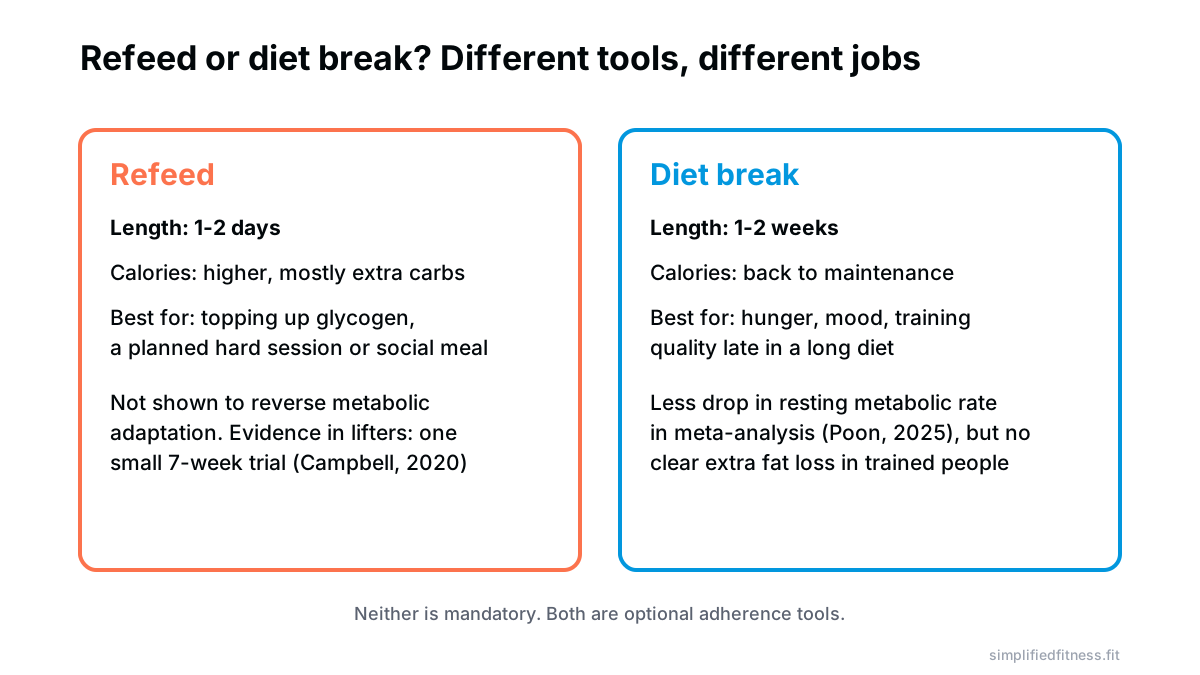
Both borrow from the same idea. Long dieting changes hunger, energy and training quality, and a planned pause might ease those. Whether it also changes your metabolism is a separate question, and the evidence is more modest than gym lore suggests.
What did the MATADOR study actually find?
MATADOR (Minimising Adaptive Thermogenesis And Deactivating Obesity Rebound) is the study behind most “diet break” content. It is worth reading carefully, because the headline gets stretched.
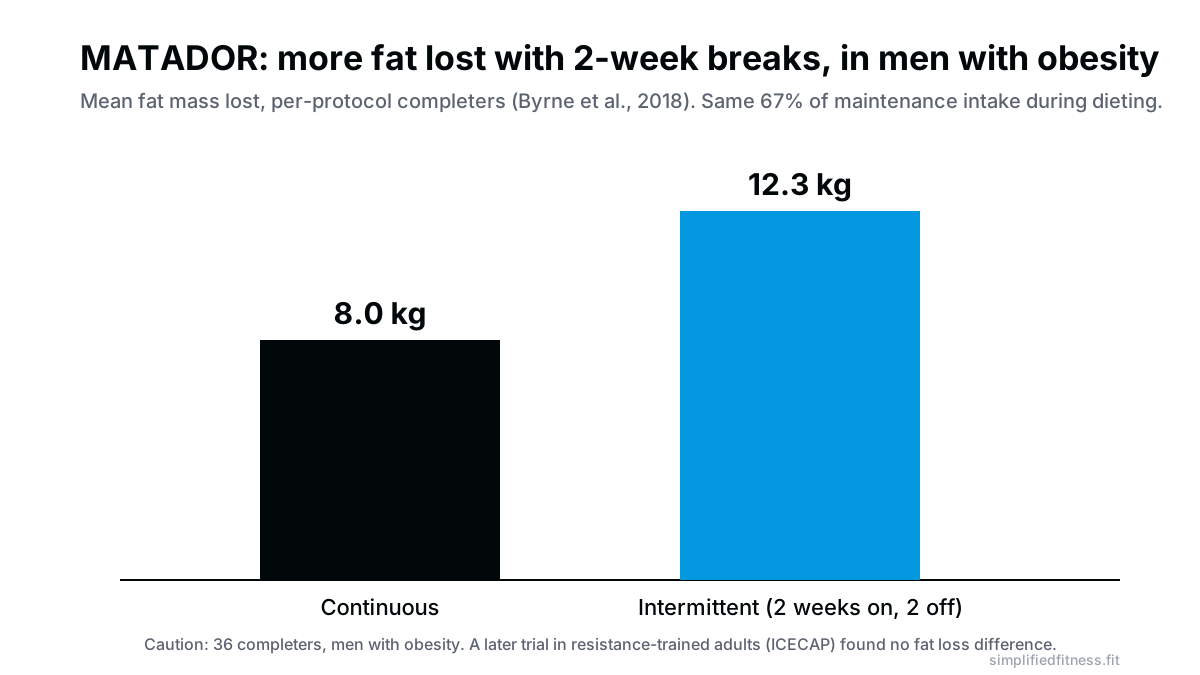
Byrne et al. (2018) randomised 51 men with obesity to one of two plans. Both ate 67% of their maintenance needs while dieting. One group dieted continuously for 16 weeks. The other alternated 2 weeks of dieting with 2 weeks at energy balance, finishing the same 16 weeks of dieting over 30 weeks in total.
Among those who completed the protocol, the intermittent group lost more weight (14.1 vs 9.1 kg) and more fat (12.3 vs 8.0 kg). Fat-free mass loss was similar. Weight barely moved during the maintenance blocks (0.0 kg on average). After adjusting for body composition, resting energy expenditure fell less in the intermittent group (about 360 vs 749 kJ per day).
Three cautions before you copy it:
- The participants had obesity (BMI about 34), not lean lifters in a late cut.
- The analysis counted people who completed the plan, which was 36 of 47 who started.
- The intermittent group took nearly twice as long. More time, not a magic trick.
The authors concluded that interrupting restriction with rest periods may reduce compensatory metabolic responses and improve weight-loss efficiency. “May” is doing real work in that sentence.
Do diet breaks work for lean, resistance-trained people?
Here the picture gets less exciting, and this is where it pays to look at several trials side by side. If you want the background on why your body adapts to dieting at all, read our piece on metabolic adaptation and adaptive thermogenesis.
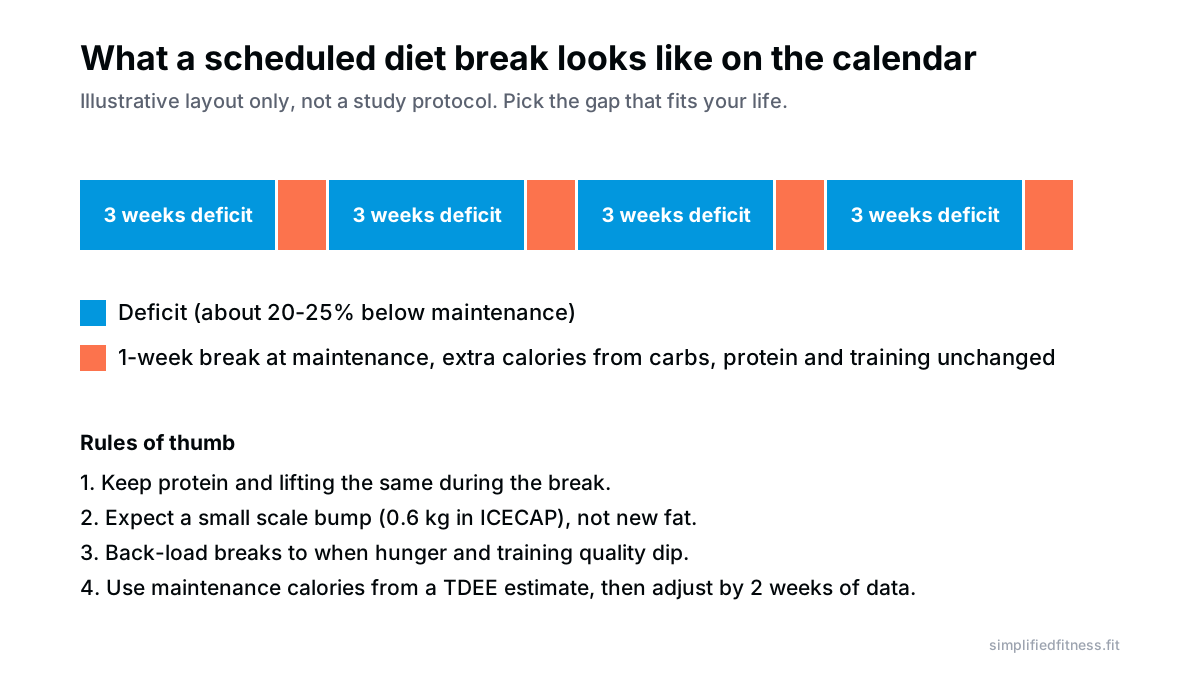
ICECAP (2021). Peos et al. randomised 61 resistance-trained adults (32 women) to 12 weeks of continuous moderate restriction or 4 blocks of 3 weeks dieting separated by 1-week maintenance breaks (15 weeks total). There were no significant differences in fat mass, body weight, fat-free mass, strength, endurance, resting energy expenditure, leptin, testosterone, IGF-1, T3 or ghrelin. The break group did report lower hunger and desire to eat, and higher satisfaction.
Siedler (2023). A trial of 38 resistance-trained women compared 6 weeks of a continuous 25% deficit with 1 week at energy balance after every 2 weeks of deficit (8 weeks total). Body composition and resting metabolic rate did not differ. The continuous group’s disinhibition score (a measure of loss of control around food) rose, while the break group’s fell slightly.
Meta-analysis (2025). Poon et al. pooled 12 randomized trials with 881 participants. Dieting with breaks and continuous dieting both improved body composition with no significant difference between them. Resting metabolic rate dropped significantly with continuous dieting only, and the compensatory drop was smaller with breaks. That effect was larger in people with overweight or obesity than in resistance-trained people.
Why might MATADOR and ICECAP differ? Different people (obesity vs trained adults), different break lengths, different deficit sizes and different follow-up. Nobody can say for sure which factor mattered.
Does a diet break help your head, not just your body?
This is where the evidence is most encouraging.
In a secondary analysis of ICECAP, 26 resistance-trained athletes who had completed the intermittent plan took a 1-week break where intake rose to predicted maintenance, mostly through carbohydrate. Fat mass did not change significantly. Body weight rose 0.6 kg, fat-free mass rose 0.7 kg, and resting energy expenditure rose from about 7000 to 7200 kJ per day. Leg muscle endurance improved, strength did not change, and participants reported less hunger and irritability, plus more fullness, satisfaction and alertness.
Notice what that does and does not say. It shows a break can make dieting feel easier and may help leg endurance. It does not show you will lose more fat afterwards.
A lot of cuts end when the effort of the diet starts to outweigh the visible progress. Knowing a planned break is two weeks away can make the hard stretch easier to stomach. If you are weighing how aggressive to go in the first place, our guide to setting a moderate versus aggressive calorie deficit is the better first lever.
What does a 48-hour carb refeed do to leptin and glycogen?
Leptin is the hormone that signals energy stores to your brain. It falls during a deficit, and refeed advice leans on the idea that a high-carb weekend lifts it back up.
There is some basis for the acute effect. In ten lean women, 3 days of carbohydrate overfeeding raised plasma leptin by 28% and 24-hour energy expenditure by 7%, while fat overfeeding did not. Those were overfeeding trials in healthy people, though, not lifters in a calorie deficit, and the authors saw no link between the leptin rise and the energy expenditure rise.
Within dieting trials, ICECAP found no differences in leptin between the diet-break and continuous groups. That is not proof that leptin never matters. It does mean “refeed to reset leptin” is a mechanism story, not an outcome that has been shown to produce more fat loss.
Glycogen is the more believable benefit. After glycogen-depleting exercise, well-trained cyclists who ate 10 g/kg of carbohydrate over 12 hours replenished liver glycogen within 6 hours, but muscle glycogen only reached about 69% of its starting level by hour 12. So muscle glycogen refills over a day or more rather than in one big meal. The results come from cyclists after a draining session, not lifters, so treat a refeed as a top-up, not a dramatic change.
Do refeeds work for fat loss in lifters?
The best direct evidence is thin. Campbell et al. (2020) randomised 27 resistance-trained men and women to about 7 weeks of a 25% deficit. One group did 2 consecutive high-carb days each week, with 5 days of restriction. Fat loss was similar between groups (2.8 vs 2.3 kg). Fat-free mass, dry fat-free mass and resting metabolic rate fell less in the refeed group.
It is a small, short trial, and the authors drew a strong conclusion from limited data. One study is a signal worth testing, not a rule.
So the honest read on refeeds: they are a reasonable, low-risk way to build a high-calorie, high-carb day into a hard week. They have not earned the claim that they preserve your metabolism.
How to schedule a diet break while cutting
If you decide to use one, keep it boring.
- Pick the timing. There is no proven best interval. Many lifters plan a break after 6-8 weeks of dieting or earlier if hunger, mood and training quality are tanking. Trials used 2-3 weeks of dieting between breaks, which is more frequent than most people would choose.
- Set calories at maintenance. Estimate with our calorie calculator, then adjust using 2 weeks of weight data. Guessing high turns a break into a surplus.
- Hold protein and lifting steady. Protein stays at your normal daily target. Keep the same program.
- Add calories mainly from carbs. That is what the trials did, and it suits training. In an Indian kitchen, that can mean an extra roti or a cup more rice at meals, with dal, curd and your usual paneer or soya portions staying put.
- Expect scale noise. Some rise from water, glycogen and food volume is normal. In ICECAP the 1-week break added 0.6 kg of body weight with no significant change in fat mass.
- Return to the deficit. After the break, resume the plan. If you slide into “one more week”, you are no longer on a diet break.
How to run a single-day refeed
For a refeed, raise carbohydrate by roughly 25-40% over your usual intake, hold protein steady, and keep fat on the lower side. These numbers are a practical rule of thumb, not a studied dose. Time it around your hardest lifting day.
If you are at the end of your cut and not sure what happens next, our guide to reverse dieting versus an immediate return to maintenance covers the exit.
Who should skip diet breaks, and when to see a doctor
Diet breaks are not for everyone.
- Short cuts. If you are dieting for 6-8 weeks, finishing the cut is simpler. The six-week trial above found no body composition benefit from breaks.
- People who do well with steady routines. If the structure of a continuous deficit helps you, you do not need the interruption.
- Anyone with a history of eating disorders, or who feels out of control around food. Planned restriction and release cycles can be risky. Speak to a doctor or a registered dietitian, not a blog.
If you have diabetes or take glucose-lowering medication, talk to your doctor before changing carbohydrate or calorie intake sharply. Unusual fatigue, missed periods, dizziness or hair loss while dieting also deserve a medical check, not another refeed.
If your scale stalls despite everything, check the basics first with our guide to breaking fat-loss plateaus before assuming you need a break. And if the real problem is that strict plans do not fit your life, flexible dieting may be the better fix.
The bottom line on diet breaks vs refeeds
For most lifters, the question is not which one burns more fat. It is which one helps you hold a deficit long enough to matter.
If you are at week 10 of a cut, hungry, sleeping badly and lifting worse, a 1-week break at maintenance is a reasonable, evidence-supported experiment. If you just want a bigger lunch before a hard leg day, a refeed is fine. Either way, keep protein and training steady and let the research temper your expectations.
Frequently Asked Questions
Do diet breaks help you lose more fat?
Not reliably. A 2025 meta-analysis of 12 randomized trials (881 people) found no significant difference in fat mass between dieting with breaks and continuous dieting. The main difference was a smaller fall in resting metabolic rate, so use breaks for adherence, not as a fat-loss accelerator.
What is the MATADOR study?
MATADOR was a randomized trial in 51 men with obesity comparing 16 weeks of continuous dieting with 16 weeks of dieting split into 2-week blocks, separated by 2-week maintenance blocks (30 weeks total). The intermittent group lost more fat (12.3 vs 8.0 kg) in people who completed the protocol. It was a study of men with obesity, so it does not prove the same result in lean lifters.
How long should a diet break be?
Research in lifters has used 1 week at maintenance calories, and MATADOR used 2 weeks. One week is a practical starting point because it is long enough to ease hunger and short enough to keep momentum. Set it by your own energy needs rather than guessing; our calorie calculator gives a maintenance estimate.
How often should I take a diet break?
There is no proven best gap. ICECAP used 1 week at maintenance after every 3 weeks of dieting, while another trial in women used 1 week after every 2 weeks. A common coaching approach, not one tested in trials, is a break every 6-8 weeks of dieting, or sooner if hunger, sleep and training quality are clearly slipping.
What is the difference between a refeed and a diet break?
A refeed is a short stretch, usually 1-2 days, with calories raised mainly through carbohydrate. A diet break lasts 1-2 weeks at maintenance calories. Refeeds are about a hard session or a meal out, while breaks are about giving your head and appetite a longer rest.
Does a 48 hour carb refeed raise leptin?
It can raise it briefly in controlled overfeeding studies, but that does not mean your fat loss speeds up. In ten lean women, 3 days of carbohydrate overfeeding raised leptin by 28% and 24-hour energy expenditure by 7%. These were not people in a calorie deficit, so treat the numbers as a lab finding rather than a dieting promise.
Will a refeed restart my metabolism?
There is no good evidence that a refeed restarts it. One 7-week trial in resistance-trained people reported a smaller drop in resting metabolic rate with weekly 2-day carb refeeds (about 38 vs 78 kcal/day), but it was small (27 people) and fat loss was similar. Do not expect a weekend of rice to reverse months of dieting.
Does a refeed refill muscle glycogen?
Partly. In well-trained cyclists after glycogen-depleting exercise, 10 g/kg of carbohydrate over 12 hours restored liver glycogen within 6 hours but muscle glycogen only reached about 69% of its starting level by hour 12. So muscle glycogen refills over a day or more, not one meal. A typical lifting session also drains less glycogen than that cycling protocol, so a refeed is best seen as a top-up.
Why did the scale go up after my refeed or diet break?
Extra carbohydrate stores glycogen with water, and more food means more weight in your gut. In ICECAP, a 1-week diet break raised body weight by 0.6 kg and fat-free mass by 0.7 kg with no significant change in fat mass. Weigh at the same time each morning and judge the trend over 2 weeks, not one jump.
Can diet breaks help with binge eating or diet fatigue?
They can help with diet fatigue. After a 1-week break, resistance-trained athletes reported less hunger and irritability and more fullness and alertness. If you binge often, feel out of control around food or dread eating, speak to a doctor or a registered dietitian rather than self-managing with breaks.
Do diet breaks work for vegetarians and Indian diets?
Nothing in the research is specific to vegetarian diets, but the principle works the same: calories go to maintenance and protein stays put. A break can mean adding roti or rice, a larger bowl of dal and curd, and keeping paneer or soya portions steady. Check that protein stays at your usual daily target.
Should I take a diet break if I am only cutting for 6-8 weeks?
Probably not. A six-week trial in resistance-trained women found diet breaks did not change body composition or resting metabolic rate compared with continuous dieting, and the plan took longer. On a short cut, finishing the cut then eating at maintenance is simpler.
Do I need to keep training during a diet break?
Yes, keep lifting as normal. Training is part of what protects muscle during and after a deficit, and a break at maintenance calories is a good time to push performance. In ICECAP, leg muscle endurance improved after the break.
Sources & References
Every claim above is checked against peer-reviewed research (PubMed, U.S. National Library of Medicine) or guidance from established health bodies. How we fact-check.
- Byrne NM, et al. Intermittent energy restriction improves weight loss efficiency in obese men: the MATADOR study. Int J Obes (Lond). 2018. PMID: 28925405
- Peos JJ, et al. Continuous versus intermittent dieting for fat loss and fat-free mass retention in resistance-trained adults: the ICECAP trial. Med Sci Sports Exerc. 2021. PMID: 33587549
- Peos JJ, et al. A 1-week diet break improves muscle endurance during an intermittent dieting regime in adult athletes: a pre-specified secondary analysis of the ICECAP trial. PLoS One. 2021. PMID: 33630880
- Poon ET, et al. Effects of intermittent dieting with break periods on body composition and metabolic adaptation: a systematic review and meta-analysis. Nutr Rev. 2025. PMID: 38193357
- Siedler MR, et al. The effects of intermittent diet breaks during 25% energy restriction on body composition and resting metabolic rate in resistance-trained females: a randomized controlled trial. J Hum Kinet. 2023. PMID: 37181269
- Campbell BI, et al. Intermittent energy restriction attenuates the loss of fat free mass in resistance trained individuals. A randomized controlled trial. J Funct Morphol Kinesiol. 2020. PMID: 33467235
- Dirlewanger M, et al. Effects of short-term carbohydrate or fat overfeeding on energy expenditure and plasma leptin concentrations in healthy female subjects. Int J Obes Relat Metab Disord. 2000. PMID: 11126336
- Fuchs CJ, et al. Carbohydrate intake of 10 g/kg body mass rapidly replenishes liver, but not muscle glycogen contents, during 12 h of post-exercise recovery in well-trained cyclists. J Physiol. 2025. PMID: 40836481

Umair Hazrami · Founder & Head Coach, Simplified Fitness
Umair Hazrami founded Simplified Fitness and the Simplified Lifter channel to cut through fitness noise. With 4+ years of consistent training and 10+ coaching clients, he writes every guide from the peer-reviewed research and links the sources so you can check them. Our editorial standards.
Educational content only, not medical advice. If you have a medical condition, are pregnant, or take medication, talk to a qualified doctor before changing your diet, supplements or training. Full disclaimer.
Keep reading
Nutrition
Body Recomposition: Who Can Lose Fat and Build Muscle at the Same Time?
How to do body recomposition: who can lose fat and build muscle at once, what the trials show, and a protein, training and calorie protocol you can start today.
8 min read

Nutrition
Breaking Fat Loss Plateaus: Check Fluid, Hidden Calories and NEAT
How to break a fat loss plateau: a 3-step check of water masking, hidden calories and lower daily steps, plus the exact fix to restart steady fat loss.
8 min read

Nutrition
How to Calculate Macros: Step-by-Step Grams per Kilogram Formula for Protein, Fat and Carbs
How to calculate macros in grams per kg: set protein, set fat, fill the rest with carbs. Worked examples for 70, 80 and 90 kg lifters on a cut or a bulk.
9 min read

Nutrition
Daily Scale Weight Fluctuations: Sodium, Bowels, Glycogen and Water
Daily scale weight fluctuations are mostly water, glycogen and gut contents, not fat. Learn why your weight jumps overnight and how a 7-day average fixes it.
8 min read