How to Calculate Macros: Step-by-Step Grams per Kilogram Formula for Protein, Fat and Carbs
How to calculate macros in grams per kg: set protein, set fat, fill the rest with carbs. Worked examples for 70, 80 and 90 kg lifters on a cut or a bulk.

TL;DR. The short answer
- Calculate macros in this order: protein at roughly 1.6-2.2 g/kg body weight, fat at roughly 0.6-1.0 g/kg, then carbs from whatever calories remain: Carbs (g) = [Calories - (Protein g x 4 + Fat g x 9)] / 4.
- Grams per kilogram beat fixed percentages like 40/40/20 because percentages make your protein depend on how many calories you eat, not on how much muscle you are trying to protect.
- Protein is the macro with the strongest evidence: a 2018 meta-analysis found gains in fat-free mass levelled off above about 1.6 g/kg/day, while lean dieters may benefit from more.
- Carbs are the flexible macro. In trials, carb intake mostly did not change strength performance in sessions of up to about 10 sets per muscle group, so adherence and appetite can guide the split.
- Your calorie target matters more than the split. Treat the macros as a starting point, track for 2-3 weeks, and adjust by about 100-200 kcal if your weight trend is off.
Part of our complete guide: The No-BS Guide to Energy Balance, Fat Loss, Bulking & Body Recomposition
Table of contents
To calculate macros, set your calories first, then protein at roughly 1.6-2.2 g per kg of body weight, then fat at roughly 0.6-1.0 g per kg. Carbs get everything that is left. The formula is Carbs (g) = [Calories - (Protein g x 4 + Fat g x 9)] / 4.
That is the whole method, and it works the same whether you are cutting or bulking. If you are still sorting out the calorie side, start with our guide to energy balance, fat loss and bulking. If you would rather skip the arithmetic, the macro calculator does it for you. Below, you will see why grams per kilogram beat the usual 40/40/20 percentages, and three worked examples you can copy.
What is the grams per kg macro formula?
Four steps. Do them in order.
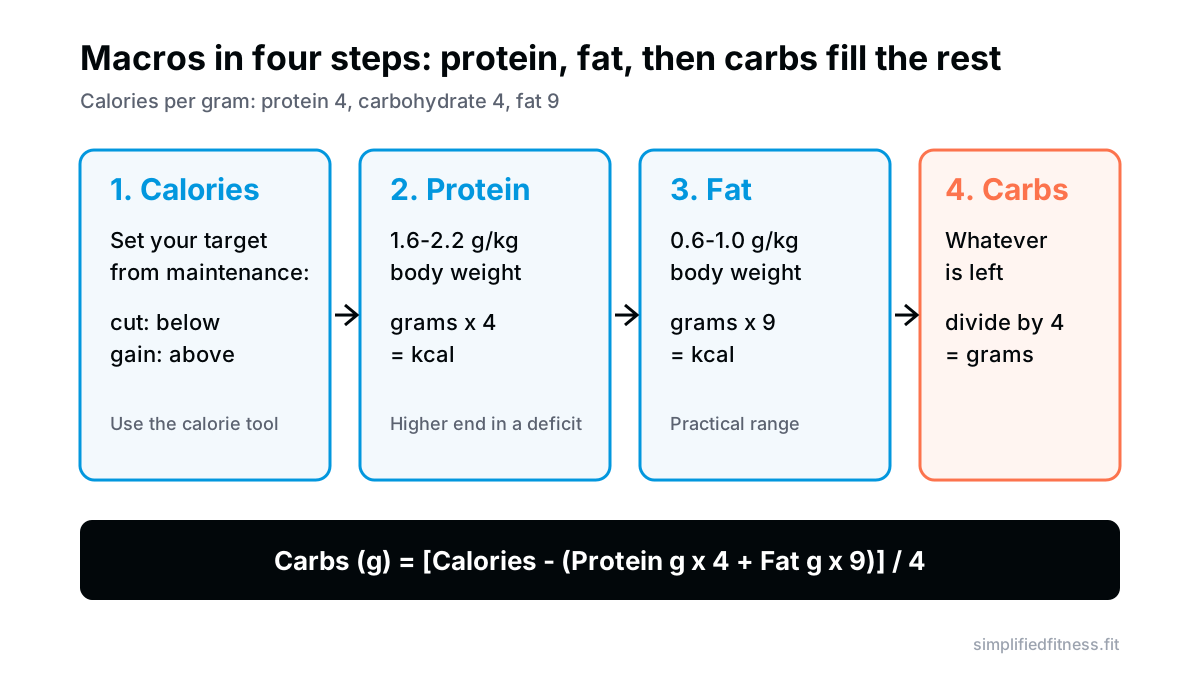
Step 1: Set your calorie target. You need a number for how much you will eat per day. Estimate maintenance with the calorie calculator, then go below it to cut or above it to gain. How far to go is covered in setting an optimal caloric deficit and lean bulking. Our guide to TDEE explains where the maintenance number comes from.
Step 2: Set protein. Multiply body weight in kg by 1.6-2.2. Multiply those grams by 4 to get protein calories.
Step 3: Set fat. Multiply body weight in kg by 0.6-1.0. Multiply those grams by 9 to get fat calories.
Step 4: Fill with carbs. Subtract protein calories and fat calories from your target. Divide what is left by 4. That is your carb grams.
Why 4 and 9? Protein and carbohydrate provide about 4 kcal per gram, fat about 9. These are the standard planning values, not exact absorbed energy, so treat the output as a starting estimate.
Why are grams per kg better than 40/40/20 percentages?
Because percentages hide what you actually care about.
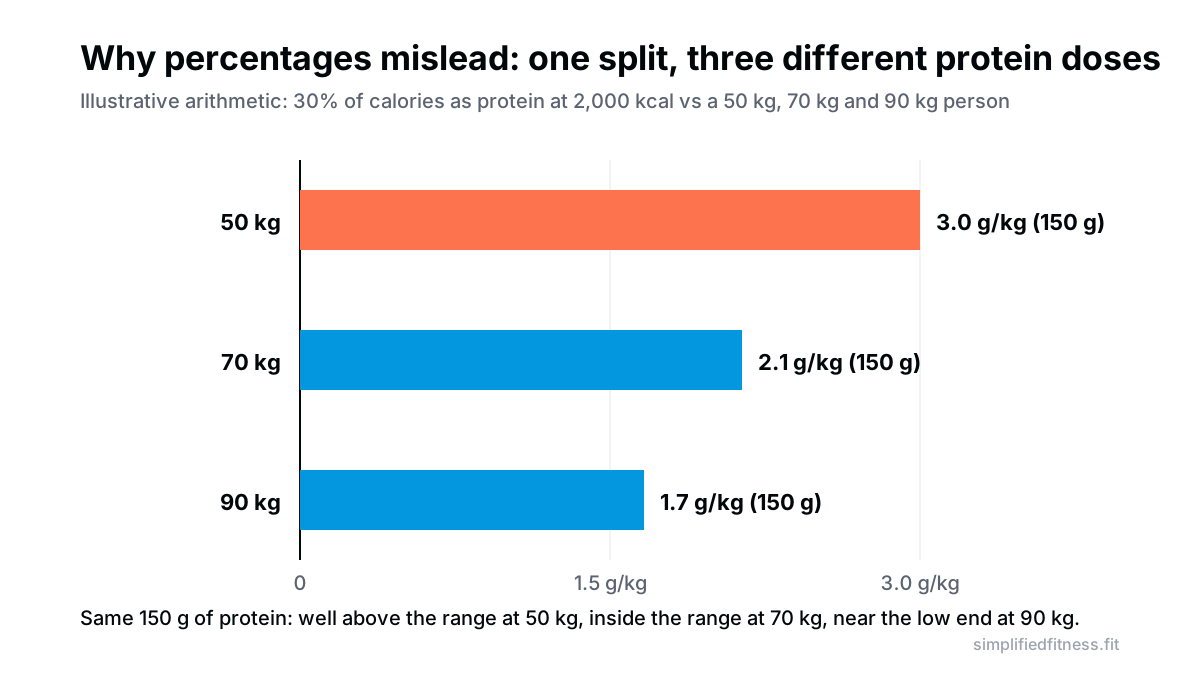
Say you eat 2,000 kcal and pick a split with 30% protein. That is 600 kcal, or 150 g of protein. For a 50 kg person that is 3.0 g/kg. For a 70 kg lifter, about 2.1 g/kg. For a 90 kg lifter, about 1.7 g/kg. Same percentage, three very different doses.
It gets worse when calories change. Cut from 2,800 to 2,200 kcal on a 40% protein split and your protein drops by 60 g without you touching anything. A deficit is exactly when you want protein to stay high, not drift down with the calorie total.
The 40/40/20 split has a second problem. At 2,000 kcal, 20% fat is only about 44 g. For a 70 kg person that is about 0.63 g/kg, which is right at the edge of the range below, and it leaves no room for the foods that make a diet livable.
Percentages are not useless. They are a handy way to describe a finished plan (“I end up around 25% protein”). They are just a poor way to build one.
How much protein should I eat per kg?
Start with 1.6-2.2 g/kg of body weight per day. The evidence for the lower anchor is solid.
A 2018 meta-analysis of 49 trials with 1,863 participants in healthy adults found that protein supplementation increased fat-free mass and strength during resistance training. Beyond total intakes of about 1.62 g/kg/day, it found no further gain in fat-free mass (Morton et al., 2018). The ISSN position stand lands in a similar place: 1.4-2.0 g/kg/day is sufficient for most exercising individuals (Jager et al., 2017).
So why 2.2 at the top? Because the range is a buffer, not a target to chase. Studies differ in how they measure muscle, and individuals vary. Going to 2.0-2.2 g/kg costs little and covers the uncertainty.
When to move toward the top of the range
Hard deficits and low body fat. A systematic review of six studies in resistance-trained, lean athletes who were dieting concluded that protein needs are likely 2.3-3.1 g/kg of fat-free mass, scaled upward with the severity of calorie restriction and leanness (Helms et al., 2014). Note the denominator: fat-free mass, not total weight. And only six studies fed that conclusion, so hold it loosely.
The ISSN reaches a comparable view, saying higher intakes (2.3-3.1 g/kg/d) may be needed to maximise lean mass retention in resistance-trained people during low-calorie periods (Jager et al., 2017).
Total weight or lean mass?
For most people, total body weight is fine and keeps the formula simple. If you carry a lot of extra body fat, base the protein on a goal weight instead, or you will overshoot. If you are already lean and cutting hard, the top of the range makes sense. Want a quick number? The protein calculator gives one.
How much fat do I need?
Aim for about 0.6-1.0 g/kg body weight. I will be straight about this one: that range is a practical coaching convention, not a figure from a single trial.
What the research does say is that going very low is not free. A 2021 systematic review and meta-analysis of six intervention studies (206 men) found that low-fat diets reduced total testosterone, free testosterone and dihydrotestosterone compared with higher-fat diets, though the authors said further randomised trials are needed to confirm the effect (Whittaker and Wu, 2021). Six small studies, 206 men in total, men only. It does not prove that 0.5 g/kg will hurt your gains. It does suggest not living at the floor without a reason.
On the other side, physique-sport guidance for contest preparation suggests fat of about 10-25% of calories, so that the remaining energy can go to carbohydrate to support training during a deficit (Roberts et al., 2020). That is guidance for competitors in prep, so it is a reference point and not a rule for everyone.
In practice, I would start around 0.8 g/kg and move within the range depending on food preference. Love ghee, paneer and nuts? Sit nearer 1.0 and cut carbs a little. Love rice and roti? Sit nearer 0.6-0.7 and keep more carbs.
How do I calculate carbs?
You do not choose carbs. You subtract.
- Protein grams x 4 = protein kcal.
- Fat grams x 9 = fat kcal.
- Calories minus both = carb kcal.
- Carb kcal / 4 = carb grams.
That is why the method always adds up: carbs absorb any rounding, so the total lands exactly on your calorie target.
Do carbs need to be high? Probably less than you have been told. A 2022 systematic review of 49 studies found carbohydrate intake did not improve performance in most trials: acutely, higher carbs did not help in 13 studies and helped in 6 (mostly with fasted control groups and workouts above 10 sets per muscle group), and longer-term strength changes were not influenced by carb intake in 15 of 17 studies (Henselmans et al., 2022). Its conclusion was that carbs per se are unlikely to affect strength training performance in a fed state in workouts of up to 10 sets per muscle group, with higher volumes possibly benefiting.
The practical read: carbs are the flexible dial. Many people simply feel better training with a decent amount of them, and that is a valid reason. It is just not a physiological requirement for every session.
Worked examples: 70 kg, 80 kg and 90 kg lifters
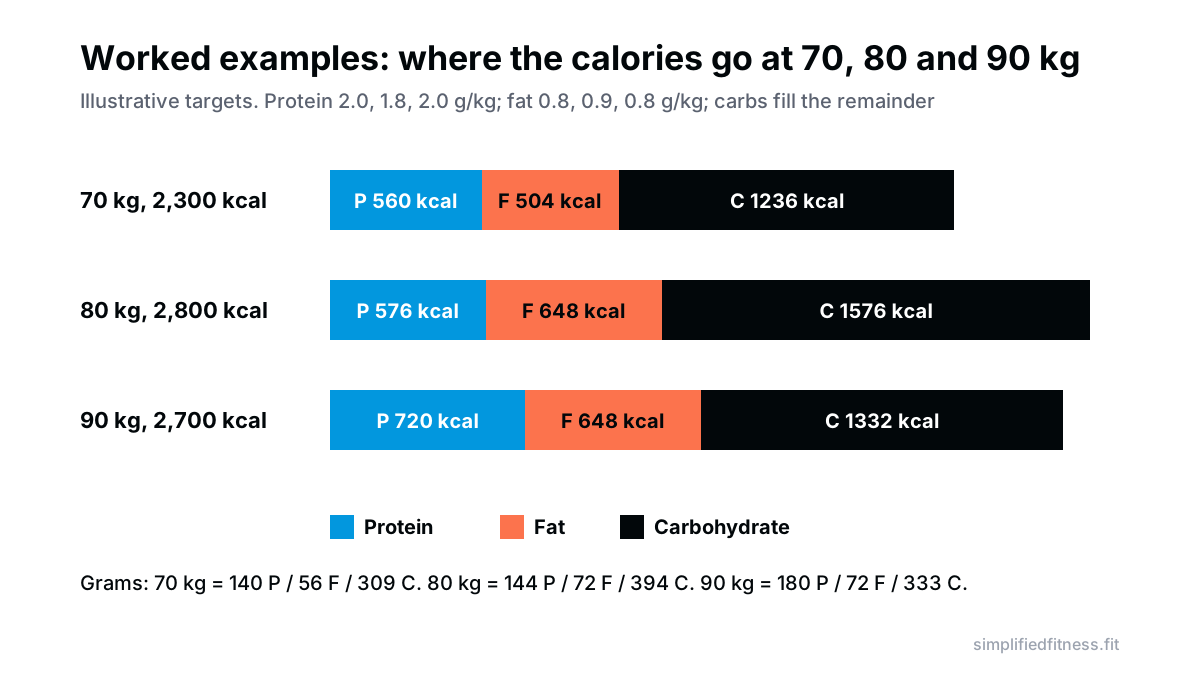
These are illustrative targets, not prescriptions. Calories are assumed for the example; use your own from the calorie calculator.
70 kg lifter, cutting at 2,300 kcal. Protein 2.0 g/kg = 140 g (560 kcal). Fat 0.8 g/kg = 56 g (504 kcal). Carbs = (2,300 - 560 - 504) / 4 = 1,236 / 4 = 309 g.
80 kg lifter, lean bulking at 2,800 kcal. Protein 1.8 g/kg = 144 g (576 kcal). Fat 0.9 g/kg = 72 g (648 kcal). Carbs = (2,800 - 576 - 648) / 4 = 1,576 / 4 = 394 g.
90 kg lifter, cutting at 2,700 kcal. Protein 2.0 g/kg = 180 g (720 kcal). Fat 0.8 g/kg = 72 g (648 kcal). Carbs = (2,700 - 720 - 648) / 4 = 1,332 / 4 = 333 g.
| Lifter | Calories | Protein | Fat | Carbs | Approx. split (P/F/C) |
|---|---|---|---|---|---|
| 70 kg, cut | 2,300 | 140 g | 56 g | 309 g | 24 / 22 / 54 |
| 80 kg, bulk | 2,800 | 144 g | 72 g | 394 g | 21 / 23 / 56 |
| 90 kg, cut | 2,700 | 180 g | 72 g | 333 g | 27 / 24 / 49 |
Notice the percentages come out different for each person. That is the point: the grams are anchored to the body, and the percentages are just what falls out afterward.
How do I turn these numbers into Indian meals?
A common problem on a vegetarian Indian diet is that the carbs arrive easily and the protein does not. Dal and rice together are mostly carbohydrate. That is fine for the carb target, but you will probably need dedicated protein foods: paneer, curd or hung curd, milk, soya chunks, eggs if you eat them, chicken or fish if you are not vegetarian, and a whey or plant protein scoop when the day runs short.
A simple way to plan: place your protein first at each meal, then add roti or rice to fill the carb number, then count the cooking oil. If appetite is low in summer heat, liquid options like lassi or a shake can help you land the numbers without forcing food.
If you want a full day laid out, see our free diet plan. Getting the portions right is easier with a kitchen scale, which is the subject of food logging precision.
What if the numbers do not fit?
Two things can go wrong.
Carbs come out tiny or negative. Your calorie target is too low for your protein and fat. Lower fat toward 0.6 g/kg, use the lower end of protein, or raise calories a little. Do not just delete carbs and hope.
You cannot hit the numbers every day. You do not have to. Protein is the one to protect daily. Fat and carbs can drift within a range, and your weight trend responds to the weekly average. If strict tracking wears you down, see our piece on flexible dieting and long-term adherence.
How do I adjust after a few weeks?
Run the plan for 2-3 weeks. Weigh yourself on the same mornings and look at the weekly average, not single days. If your trend is not moving the way you intended, change calories by about 100-200 kcal and take that change from or add it to carbs. Leave protein and your fat floor alone.
Recalculate when your body weight has changed by several kilograms or your training load changes a lot. The formula scales with you, which is the main reason to use it.
When to see a doctor or dietitian
These are general guidelines for healthy adults. If you have kidney disease, diabetes, a history of disordered eating, are pregnant or breastfeeding, or are under 18, talk to a doctor or registered dietitian before setting your own protein, fat and calorie targets. Counting and restricting food can worsen disordered eating in some people, so if tracking makes you anxious, stop and get support.
Frequently Asked Questions
How do I calculate macros for cutting or bulking?
Set your calorie target first (below maintenance to cut, above to bulk), then set protein at about 1.6-2.2 g/kg and fat at about 0.6-1.0 g/kg. Carbs are the remaining calories divided by 4. The formula is identical for cutting and bulking; only the calorie total and where you sit in the protein range change.
What is the grams per kg macro formula?
Protein grams = body weight x 1.6-2.2, fat grams = body weight x 0.6-1.0, carb grams = (total calories - protein x 4 - fat x 9) / 4. Because it scales with body weight, it protects muscle without depending on your calorie intake. Plug your numbers into the macro calculator to skip the arithmetic.
Is grams per kg better than percentages for macros?
For most lifters, yes. Percentages tie your protein to your calories, so the same 30% protein split gives a 50 kg person about 3 g/kg and a 90 kg person under 2 g/kg at 2,000 kcal. Setting protein and fat in g/kg first keeps the muscle-relevant numbers stable when calories change.
How much protein do I need per kg of body weight?
A 2018 meta-analysis of 49 trials found that gains in fat-free mass did not increase further above about 1.62 g/kg/day, and the ISSN says 1.4-2.0 g/kg/day is sufficient for most exercising people. Aiming for 1.6-2.2 g/kg gives a buffer. Pick the lower end if you are bulking comfortably and the higher end if you are in a hard deficit.
Should I use total body weight or lean body mass for protein?
Total body weight is fine for most people at moderate body fat, and it keeps the maths simple. If you carry a lot of extra fat, using a goal weight or an estimate of lean mass avoids overshooting. Research in lean dieters is usually expressed per kg of fat-free mass, so lean people cutting hard may want the upper end.
How much fat should I eat per day?
A practical range is about 0.6-1.0 g/kg body weight, which is a coaching convention rather than a number from one trial. Very low fat intakes can be a problem: a 2021 meta-analysis of 6 trials found low-fat diets lowered testosterone in men compared with higher-fat diets. If you go below about 0.6 g/kg for long, you are mostly removing food variety without a clear benefit.
How do I calculate carbs from protein and fat?
Multiply protein grams by 4 and fat grams by 9, add them, subtract the total from your calorie target, then divide the remainder by 4. For a 2,300 kcal target with 140 g protein and 56 g fat, that is (2,300 - 560 - 504) / 4, about 309 g carbs. If the answer is very low or negative, your calories are too low for that protein and fat.
How many calories are in a gram of protein, fat and carbs?
Protein and carbohydrate provide about 4 kcal per gram and fat provides about 9 kcal per gram. These are standard approximations used for food labels, so real absorbed energy varies a little by food. Use them for planning and let your weight trend over a few weeks confirm whether the target is right.
What macro split is best for fat loss?
There is no single best percentage split. Calories drive fat loss, protein protects muscle, and trials of carbs and strength performance mostly show little difference, so choose the mix you can stick to. Keep protein high, keep fat above the floor, and let carbs fill the rest around your training.
Do carbs matter for muscle gain?
Carbs help many people train hard, but they are not magic. A 2022 systematic review of 49 studies found carb intake did not improve strength training performance in most trials, especially in workouts of up to about 10 sets per muscle group. Higher-volume training may benefit more, so many lifters simply keep carbs moderate-to-high and enjoy the training quality.
How do I hit these macros on an Indian vegetarian diet?
It is doable but needs planning, because dal, rice and roti are carb-heavy with modest protein. Build protein around paneer, curd, soya chunks, milk, eggs if you eat them, and a whey or plant protein scoop if needed. Cook with a measured amount of oil or ghee, because a tablespoon is roughly 13-14 g of fat and fat adds up quickly.
How often should I recalculate my macros?
Recalculate after a meaningful weight change, roughly every 4-6 kg, or when your weight trend stalls for 2-3 weeks. Body weight and activity change your calorie needs, and protein and fat in g/kg shift with them. Adjust calories by about 100-200 kcal and usually change carbs first, leaving protein and the fat floor alone.
Do I need to hit macros exactly every day?
No. Daily numbers wobble, and being within roughly 5-10 g of protein and a small calorie range is fine for most people. What matters is the weekly average, since your weight trend responds to that. Hit your protein every day, and treat fat and carbs as a range.
What if my calculated carbs come out too low?
That usually means your calorie target is too low for your protein and fat choices, not that carbs are the problem. Lower fat toward 0.6 g/kg, choose the lower end of protein, or raise calories slightly. Very low intakes are not necessary for most lifters and can make training and adherence harder.
Sources & References
Every claim above is checked against peer-reviewed research (PubMed, U.S. National Library of Medicine) or guidance from established health bodies. How we fact-check.
- Morton RW, et al. A systematic review, meta-analysis and meta-regression of the effect of protein supplementation on resistance training-induced gains in muscle mass and strength in healthy adults. Br J Sports Med. 2018. PMID: 28698222
- Helms ER, et al. A systematic review of dietary protein during caloric restriction in resistance trained lean athletes: a case for higher intakes. Int J Sport Nutr Exerc Metab. 2014. PMID: 24092765
- Jager R, et al. International Society of Sports Nutrition Position Stand: protein and exercise. J Int Soc Sports Nutr. 2017. PMID: 28642676
- Whittaker J, et al. Low-fat diets and testosterone in men: Systematic review and meta-analysis of intervention studies. J Steroid Biochem Mol Biol. 2021. PMID: 33741447
- Roberts BM, et al. Nutritional Recommendations for Physique Athletes. J Hum Kinet. 2020. PMID: 32148575
- Henselmans M, et al. The Effect of Carbohydrate Intake on Strength and Resistance Training Performance: A Systematic Review. Nutrients. 2022. PMID: 35215506

Umair Hazrami · Founder & Head Coach, Simplified Fitness
Umair Hazrami founded Simplified Fitness and the Simplified Lifter channel to cut through fitness noise. With 4+ years of consistent training and 10+ coaching clients, he writes every guide from the peer-reviewed research and links the sources so you can check them. Our editorial standards.
Educational content only, not medical advice. If you have a medical condition, are pregnant, or take medication, talk to a qualified doctor before changing your diet, supplements or training. Full disclaimer.
Keep reading
Nutrition
Body Recomposition: Who Can Lose Fat and Build Muscle at the Same Time?
How to do body recomposition: who can lose fat and build muscle at once, what the trials show, and a protein, training and calorie protocol you can start today.
8 min read

Nutrition
Breaking Fat Loss Plateaus: Check Fluid, Hidden Calories and NEAT
How to break a fat loss plateau: a 3-step check of water masking, hidden calories and lower daily steps, plus the exact fix to restart steady fat loss.
8 min read

Nutrition
Daily Scale Weight Fluctuations: Sodium, Bowels, Glycogen and Water
Daily scale weight fluctuations are mostly water, glycogen and gut contents, not fat. Learn why your weight jumps overnight and how a 7-day average fixes it.
8 min read
Nutrition
Diet Breaks vs Refeeds: Do Hormones, Glycogen and Sanity Really Matter?
Diet breaks vs refeeds: which one helps a long cut? See what MATADOR, ICECAP and other trials found on fat loss, metabolism and hunger, and how to schedule one.
9 min read