Reverse Dieting vs Immediate Maintenance: How to Transition Out of a Deficit Without Rapid Fat Gain
Reverse dieting vs immediate maintenance: what the research says about leaving a deficit, how much weight to expect back, and a simple 4-week exit plan.

TL;DR. The short answer
- For most lifters, stepping up to an estimated maintenance intake within a week or two is a reasonable way to end a cut. A slow +50 kcal/week reverse diet has no controlled trial showing it prevents fat regain, and it keeps you under maintenance for weeks.
- A jump of a kilo or two on the scale in the first week is mostly water, glycogen and gut content coming back, not fat.
- In 19 natural physique athletes, fat mass and fat-free mass both rebounded mostly in the first 6 weeks after a contest. By week 12, fat mass was close to the starting level and fat-free mass was higher.
- Dieting lowers energy expenditure a little more than the weight loss alone explains, and larger post-diet increases in food intake were linked to faster recovery of metabolic rate. Some fat regain came with it.
- Use a 4-week test: eat at your estimated maintenance, track weekly average weight, then adjust by 100-200 kcal. If hunger, mood or sleep feel bad after a long cut, see a doctor.
Part of our complete guide: The No-BS Guide to Energy Balance, Fat Loss, Bulking & Body Recomposition
Table of contents
Reverse dieting vs immediate maintenance is the question almost every lifter asks in the last week of a cut. The short answer: for most people, moving to an estimated maintenance intake within a week or two is a reasonable default, and a slow +50 kcal a week reverse diet is optional, not required. We could not find a controlled trial showing that the slow ramp prevents fat regain better.
This article sits inside our wider guide to energy balance, fat loss, bulking and recomposition. Here we focus on one moment: the day your deficit ends.
What is reverse dieting, and where did the idea come from?
Reverse dieting means raising calories gradually after a diet, usually 50-100 kcal a week for 8 weeks or more. The promise is that a slow climb “rebuilds” your metabolism and keeps you from bouncing back to your old weight.
The idea is not made up from nothing. Dieting does change how your body spends energy. A review of metabolic adaptation in athletes describes how energy restriction brings changes in hormones, mitochondrial efficiency and energy expenditure that work to shrink the deficit, slow weight loss and encourage regain (Trexler et al., 2014).
So the problem is real. What is unproven is the solution. We found no trial showing that a 10-week drip-feed beats a faster return to maintenance. The slow ramp is a coaching convention, and it comes with a cost we will get to shortly.
Does your metabolism really slow after a long cut?
A little, and by less than gym folklore suggests.
In a classic study, people who kept their body weight 10% or more below their usual level burned about 6 kcal per kg of fat-free mass per day less in total (8 kcal in people with obesity), with resting and non-resting expenditure each dropping about 3-4 kcal per kg of fat-free mass (Leibel et al., 1995). That is a compensatory change, not a switched-off metabolism.
A later study followed 91 adults through an 8-week very-low-energy diet and 44 weeks of weight maintenance. Measured resting metabolic rate fell relative to what body composition predicted (ratio 1.004 to 0.963), and the reduction was still present at 52 weeks (0.984) (Camps et al., 2013). These were adults with a BMI near 32 on a very aggressive diet, so do not copy-paste the numbers onto a lean lifter.
What about lifters? In 19 natural physique athletes followed through contest prep, resting metabolic rate per kg of fat-free mass showed only a small, uncertain reduction, while thyroid hormones (FT3 and FT4) dropped and then returned to reference ranges by 12 weeks after the contest (Buechel et al., 2026). Strength was broadly maintained. Mood and sleep got worse during prep and improved afterward.
Honest summary: some adaptation, partly lasting in some groups, mostly recoverable once you eat more. Not a reason to panic, and not a reason to ration food for ten more weeks.
Reverse dieting vs immediate maintenance: what the evidence supports
Here is the part that gets lost in the argument. Both camps are partly right.
What reverse dieting gets right. Moving up gradually can feel safer, and it gives you more data points along the way. For someone who finishes a cut anxious about food, a structured ramp can calm things down.
What it gets wrong. If your ramp starts 500 kcal under maintenance and rises 50 kcal a week, you spend most of ten weeks still in a deficit. Look at the figure below.
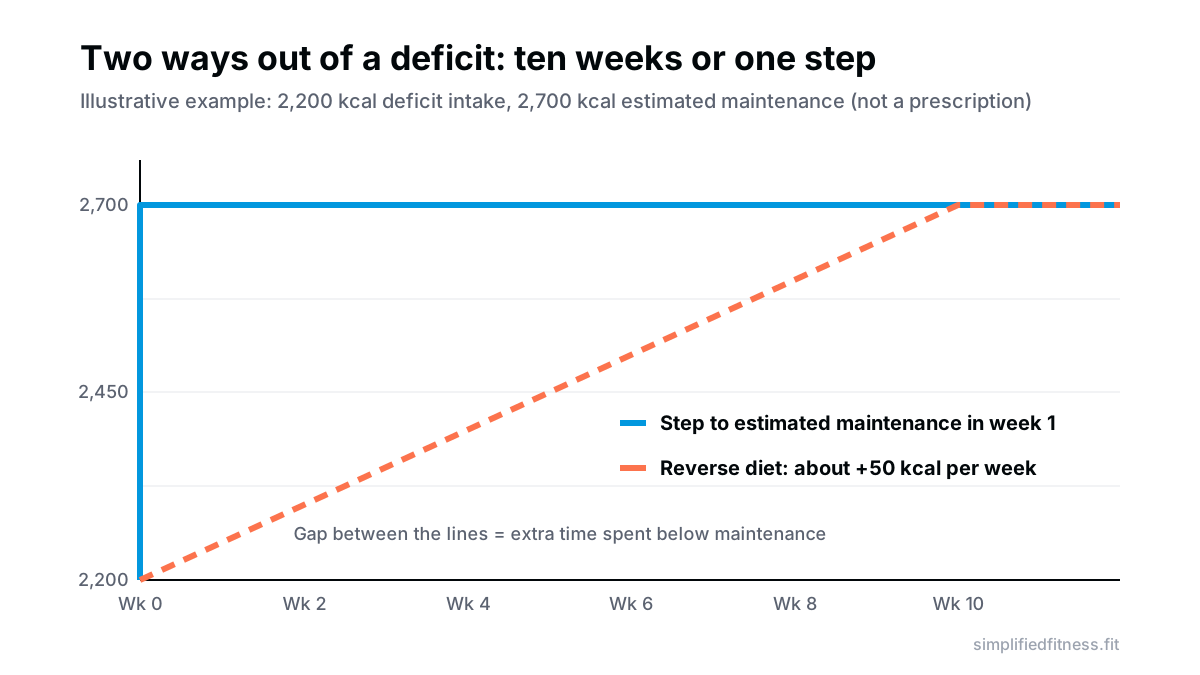
That is not a rebuild. That is a longer diet with nicer branding.
What the newest data says. The most relevant study for lifters is the 2026 post-competition recovery study. Both fat mass and fat-free mass rebounded mostly in the first 6 weeks after the contest (about +3.4 kg and +2.7 kg), and by week 12 fat mass was not clearly different from the starting value while fat-free mass was 1.6 kg higher (Buechel et al., 2026).
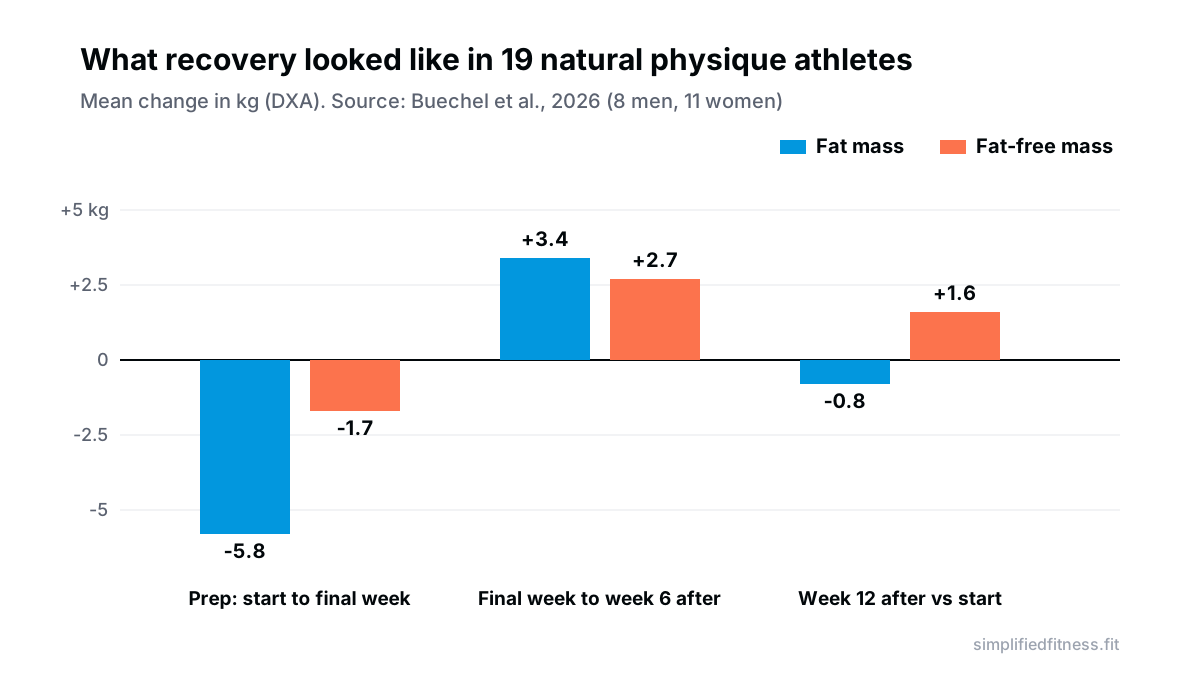
Larger post-competition increases in food intake were associated with greater recovery of resting metabolic rate in the exploratory modelling, but fat mass regain happened at the same time. The authors recommend treating recovery as a structured phase, with realistic expectations around fat gain and avoiding unnecessarily prolonged restriction.
Read that carefully. It is a small, observational study of 19 competitors who had been very lean. It cannot prove cause and effect, and the Bayesian modelling was described as exploratory. But it fits the practical picture: eat more, recover faster, accept some regain.
Why does the scale jump after a diet, and is it fat?
Usually not fat. Usually water.
Muscle glycogen binds water. In a crossover trial in 22 men, a moderate-carbohydrate diet gave lower muscle glycogen (367 vs 525 mmol per kg dry weight) and 0.7 kg lower body mass than a high-carbohydrate diet, with no change in short-term cycling performance (Schytz et al., 2023). That compared two diets over three days, not a post-cut rebound, but it shows how fast a pound or two of body mass can move without fat being involved.
After a long cut, glycogen and water stores are usually depleted, and food in the gut is lower too. Eating more rice, roti and fruit refills them. A jump of 1-2 kg in week one is common in practice, though the size varies from person to person. It is easy to misread, and it is why people panic and cut calories again.
If you want the full picture of what drives day-to-day scale noise, our guides on daily scale weight fluctuations and water retention and the whoosh effect go deeper.
How do I find my new maintenance calories after a cut?
Two steps: estimate, then test.
Your maintenance is lower than it was before the diet, because you weigh less and may be slightly adapted. Start with a calculator such as our calorie calculator using your current weight, not your old weight.
Equations are guesses. A systematic review of 29 studies in athletes found that predicted resting metabolic rate often differed from measured values, and that only a few equations performed acceptably, with accuracy varying by sex and athlete status (O’Neill et al., 2023). So treat the estimate as a starting line.
A cleaner method uses your own data. If you tracked food and weight through the cut, your average intake at the end, plus the deficit you were running, gives a personal estimate. Then run the test below. For a deeper look at how the components add up, see our explainer on total daily energy expenditure.
What is the simplest way to transition from deficit to maintenance?
Here is a template that matches how most lifters actually behave.
| Step | What to do | Why |
|---|---|---|
| Week 1 | Raise calories to your estimated maintenance in one or two steps | Ends the deficit and supports training |
| Weeks 2-3 | Hold intake. Weigh daily, average weekly | Lets the water and glycogen jump settle |
| Week 4 | Compare weekly averages. Rising steadily? Trim 100-200 kcal. Falling? Add 100-200 | Corrects the estimate with real data |
| After | Hold the new baseline 2-4 more weeks, then choose maintain, lean bulk or recomp | Gives you a reliable starting point |
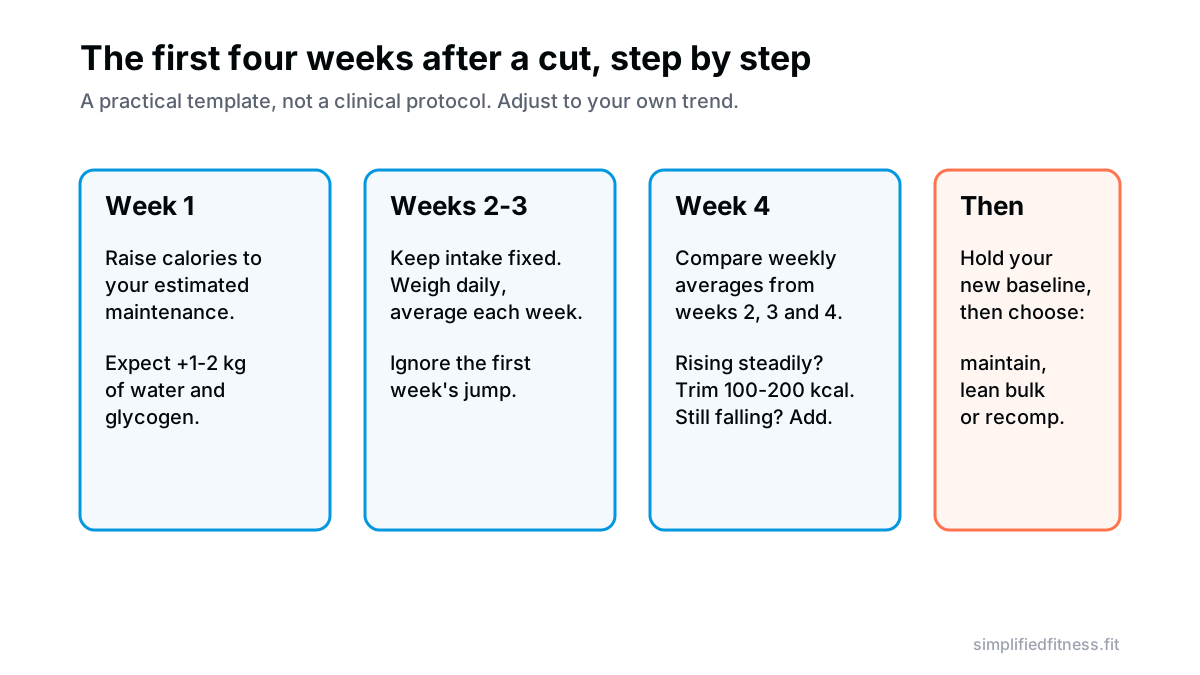
Keep protein where it was (our protein calculator helps), keep lifting hard, and let carbohydrates and fats take most of the extra calories. If you want a slower climb because it feels safer, a two-step version (half the gap now, the rest in 2 weeks) is a sensible middle path.
How do I manage hunger and cravings after dieting?
Expect appetite to be loud for a few weeks. This is normal after a deficit.
What helps in practice:
- Protein at every meal. Eggs, chicken, fish, paneer, soya chunks, dal plus curd.
- High-volume carbs. Rice with sambar, fruit, oats, potatoes. They fill the plate and refill glycogen.
- Fibre. Vegetables, dal, whole fruit.
- Planned flexibility. One or two foods you enjoy, in the plan, so there is no “off the wagon” moment.
- Sleep. Poor sleep makes hunger worse.
Hot weather and heavy sweating make this messier, because water balance also moves the scale. Keep your fluids consistent so you can read the trend.
When should I see a doctor?
Most post-cut issues are ordinary and fixable with food and time. A few are not.
See a doctor or registered dietitian if you notice any of these:
- Periods that have stopped or become irregular.
- Persistent dizziness, fainting, cold intolerance or extreme fatigue that does not improve after you eat more.
- Binge eating you cannot control, or intense fear of eating at maintenance.
- Mood changes that are getting worse, not better.
The physique athlete study above found eating-disorder symptoms were highest during preparation and fell during recovery, and the broader contest prep literature warns that aesthetic sports carry a higher risk of eating and body image disorders (Helms et al., 2014). If the cut felt like it took over your life, ask for support. That is strength, not weakness.
What should you do next?
Once your baseline is stable, you have a decision. Hold maintenance for a while, start a lean bulk, or try a body recomposition phase. If you are still mid-diet and just need a rest, a diet break or refeed is a different tool from a post-diet transition. And if the real problem was a deficit that was too harsh, read setting the optimal caloric deficit before your next cut.
To plan training around the new phase, our free plans are a good starting point.
The bottom line
You do not need ten weeks of micro-increases to finish a cut well. Step to an estimated maintenance, expect a water-driven jump, let a few weeks of averages correct the estimate, and accept a little regain as part of recovery. If a slow ramp keeps you sane, use it, just know that it is a choice and not a requirement.
Frequently Asked Questions
Should I reverse diet after cutting?
Not necessarily. No controlled trial we found shows that adding 50 kcal a week prevents fat regain better than moving to maintenance in one or two steps. A gradual rise can still be a fine choice if it keeps you calm and consistent, but it is a preference, not a physiological requirement.
What is reverse dieting?
Reverse dieting means raising calories slowly after a diet, often 50-100 kcal per week, with the goal of recovering metabolic rate while limiting fat gain. The idea is borrowed from the real phenomenon of metabolic adaptation, but the slow-ramp method itself has little direct research behind it. Treat it as a coaching habit rather than a proven protocol.
How do I find my new maintenance calories after a cut?
Start from an estimate, such as a calorie calculator, then test it. Eat that amount for 2-3 weeks, compare weekly average body weight, and adjust by 100-200 kcal if the trend rises or falls. Our calorie calculator gives a sensible starting figure, but prediction equations can miss measured values by a wide margin in athletes.
Why did I gain 2 kg in a week after my diet ended?
Most of it is almost certainly water and glycogen, not fat. Glycogen binds water, and a higher-carbohydrate diet raised muscle glycogen alongside about 0.7 kg more body mass in one controlled crossover study. Judge your progress by 2-3 weeks of weekly averages, not by day 3.
How much fat will I regain after a diet?
Some regain is normal and expected. In natural physique athletes who dieted for roughly 21 weeks, fat mass rose by about 3.4 kg in the first 6 weeks after the contest and was back near the starting value by week 12. Your own numbers will differ, since these were very lean competitors, so plan for a gradual rebound and not a perfect holding pattern.
Does metabolism slow down permanently after dieting?
The evidence suggests a modest, partly lasting reduction. In a study of 91 adults, metabolic rate stayed slightly below the level predicted from body composition at 52 weeks, and in physique athletes the reduction was small and recovered during refeeding. It is not a broken metabolism, but it is a reason to avoid dragging a deficit on for longer than needed.
How long should I stay at maintenance after a cut?
A common sensible window is at least 4 weeks, and many lifters prefer 4-8 weeks before starting a bulk. This gives hunger, training performance and sleep time to settle, and it gives you a reliable weight baseline. If you feel good earlier, no rule forces you to wait.
Can I go straight into a bulk after a cut?
You can, but a short maintenance phase makes the bulk easier to manage. Without it, you cannot tell how much of the early weight gain is water and glycogen versus new tissue. A few weeks at maintenance gives you a clean baseline to add 200-300 kcal on top of.
Why am I so hungry after dieting?
Hunger commonly stays elevated after weight loss, partly because appetite regulation shifts in the weight-reduced state. Eating at maintenance with enough protein, fibre and volume (dal, vegetables, curd, fruit) usually settles it over a few weeks. If the urge to binge feels out of control, speak to a doctor or dietitian.
Do I need to refeed or take a diet break before maintenance?
Not as a rule. A diet break or refeed is a tool for the middle of a long diet, while moving to maintenance is the end of it. If you are still dieting and want to pause, see our guide on diet breaks and refeeds.
Is it OK to eat more rice and roti straight after a cut?
Yes, and most of the first-week weight rise will be carbohydrate-related water, not fat. Rice, roti, oats and fruit refill glycogen, which helps training quality. Keep protein at your usual target (roughly 1.6-2.2 g/kg) and let carbs and fats fill the rest of your calories.
Do women need a different approach after a cut?
The principles are the same, but women should watch for missed or irregular periods, persistent fatigue and low mood, which can signal low energy availability. The physique athlete study above included 11 women and 8 men, and eating-disorder symptoms were highest during preparation. If your period has stopped, see a doctor before trying to troubleshoot with food alone.
Sources & References
Every claim above is checked against peer-reviewed research (PubMed, U.S. National Library of Medicine) or guidance from established health bodies. How we fact-check.
- Buechel C, et al. Post-competition recovery in natural physique athletes: body composition, metabolic adaptation, and refeeding responses. J Int Soc Sports Nutr. 2026. PMID: 42175739
- Trexler ET, et al. Metabolic adaptation to weight loss: implications for the athlete. J Int Soc Sports Nutr. 2014. PMID: 24571926
- Camps SG, et al. Weight loss, weight maintenance, and adaptive thermogenesis. Am J Clin Nutr. 2013. PMID: 23535105
- Leibel RL, et al. Changes in energy expenditure resulting from altered body weight. N Engl J Med. 1995. PMID: 7632212
- Schytz CT, et al. Lowered muscle glycogen reduces body mass with no effect on short-term exercise performance in men. Scand J Med Sci Sports. 2023. PMID: 36932633
- O'Neill JER, et al. Accuracy of resting metabolic rate prediction equations in athletes: a systematic review with meta-analysis. Sports Med. 2023. PMID: 37632665
- Helms ER, et al. Evidence-based recommendations for natural bodybuilding contest preparation: nutrition and supplementation. J Int Soc Sports Nutr. 2014. PMID: 24864135

Umair Hazrami · Founder & Head Coach, Simplified Fitness
Umair Hazrami founded Simplified Fitness and the Simplified Lifter channel to cut through fitness noise. With 4+ years of consistent training and 10+ coaching clients, he writes every guide from the peer-reviewed research and links the sources so you can check them. Our editorial standards.
Educational content only, not medical advice. If you have a medical condition, are pregnant, or take medication, talk to a qualified doctor before changing your diet, supplements or training. Full disclaimer.
Keep reading
Nutrition
Body Recomposition: Who Can Lose Fat and Build Muscle at the Same Time?
How to do body recomposition: who can lose fat and build muscle at once, what the trials show, and a protein, training and calorie protocol you can start today.
8 min read

Nutrition
Breaking Fat Loss Plateaus: Check Fluid, Hidden Calories and NEAT
How to break a fat loss plateau: a 3-step check of water masking, hidden calories and lower daily steps, plus the exact fix to restart steady fat loss.
8 min read

Nutrition
How to Calculate Macros: Step-by-Step Grams per Kilogram Formula for Protein, Fat and Carbs
How to calculate macros in grams per kg: set protein, set fat, fill the rest with carbs. Worked examples for 70, 80 and 90 kg lifters on a cut or a bulk.
9 min read

Nutrition
Daily Scale Weight Fluctuations: Sodium, Bowels, Glycogen and Water
Daily scale weight fluctuations are mostly water, glycogen and gut contents, not fat. Learn why your weight jumps overnight and how a 7-day average fixes it.
8 min read