P-Ratio Energy Partitioning: Do Surplus Calories Become Muscle or Fat?
P-ratio energy partitioning decides if surplus calories become muscle or fat. See how body fat, training, protein and sleep shape it, and where evidence ends.
TL;DR. The short answer
- The P-ratio is the share of a body weight change that is fat-free mass instead of fat. A higher P-ratio in a surplus means more of the gain is lean tissue.
- Starting body fat matters: in overfeeding studies of 3+ weeks, 60-70% of the weight gained by thin people was lean tissue, versus 30-40% in people with obesity.
- Eating more calories decides how much fat you store. In one controlled overfeeding trial, protein changed lean mass gained but not fat gained.
- Training and sleep plausibly help partitioning, but the direct evidence comes from small, short studies, often without a comparison group, so treat it as a strong lean, not a guarantee.
- Individual response varies a lot, so judge your own bulk by waist, strength and scale trends rather than a textbook number.
Part of our complete guide: The No-BS Guide to Energy Balance, Fat Loss, Bulking & Body Recomposition
Table of contents
Picture two lifters eating the same 300 kcal surplus for 12 weeks. One adds a visible chunk of muscle. The other mostly adds a softer waistline. The idea that explains part of that gap is the P-ratio, a way of describing energy partitioning: of the weight you gain, how much is fat-free mass and how much is fat.
It is a useful mental model, but it is easy to oversell. Below, I cover what the P-ratio is, what the research says actually shifts it, and where the evidence runs out. This article sits inside our wider guide to energy balance, fat loss, bulking and recomposition, so I will keep the calorie maths there and focus on partitioning.
What is the P-ratio?
The P-ratio comes from the work of Gilbert Forbes, who observed that the split between lean tissue and fat in a weight change depends on how much fat you carry to begin with. Kevin Hall later extended Forbes’s equation to cover larger weight changes and re-expressed it using an energy partitioning parameter called the P-ratio, and found the predictions compared favourably with human underfeeding and overfeeding data (Hall, 2007).
In plain gym language, a higher P-ratio during a surplus means more of the gain is fat-free mass. In a deficit, a higher P-ratio means more of the loss is lean tissue, which you do not want. So the “good” direction flips depending on whether you are bulking or cutting.
Two caveats up front. Fat-free mass is not the same as muscle: it includes water, organs and bone. And you cannot measure your own P-ratio at home. It is a concept, not a gauge.
Do leaner people gain more muscle in a surplus?
On average, in the studies that checked, yes.
Forbes reviewed overfeeding experiments lasting at least 3 weeks and reported that the weight gain of thin people was 60-70% lean tissue, whereas in people with obesity it was 30-40% (Forbes, 2000). He described the same pattern in the opposite direction for weight loss, with an inverse curvilinear relationship between initial body fat and the share of loss that was lean tissue.
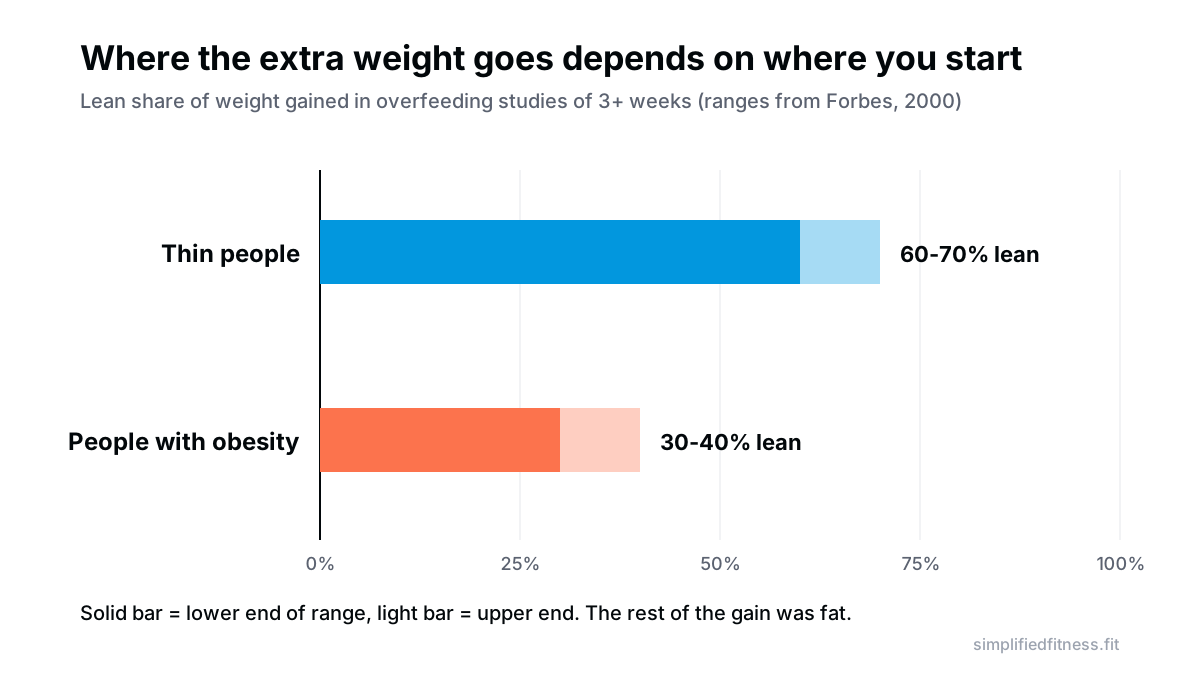
This is the scientific backbone behind the advice to lean out before a dedicated bulk. Notice what it does and does not say, though.
- It shows a trend across the body fat range. It does not show a cliff at 10% or 15%.
- Most of the subjects were not lifters. Lean tissue in that data is not all muscle.
- It is a review of earlier experiments, so it tells you about average tendencies, not what your body will do.
If you are curious where you sit, estimate it with our body fat calculator, and treat the result as a rough range, not a verdict. For what healthy ranges look like, see optimal body fat ranges for natural men and women.
Do calories or protein decide how much fat you gain?
Calories do most of the deciding on fat. This is easy to forget when the internet argues about macros.
In a controlled inpatient trial, 25 healthy adults were overfed by roughly 40% above their usual intake for 8 weeks on low (5%), normal (15%) or high (25%) protein diets. Body fat rose similarly in all three groups and made up 50% to more than 90% of the excess calories stored. Lean body mass rose significantly only in the normal and high protein groups (2.87 kg and 3.18 kg), while the low protein group gained no body protein (Bray et al., 2012). The authors concluded that calories alone account for the increase in fat, while protein affected energy expenditure and lean mass storage.
So protein is a lean-mass gatekeeper, not a fat-burning trick. Eat enough of it and your surplus has the raw material to build tissue. Eat a lot more of it and you do not avoid fat gain.
To set a protein target without guesswork, use the protein intake calculator.
Does training change where the calories go?
Almost certainly, but the direct evidence is thinner than people claim.
Lifting is the signal that tells the body there is something to build. In a 6-week study, resistance-trained men lifted under supervision while eating a high-calorie protein and carbohydrate supplement, aiming for at least 0.45 kg of weight gain a week. Fat-free mass rose by an average of about 4.8%, and nearly everyone gained muscle thickness and performance. On average, a gain of around 0.55% of body weight per week matched all the weight gained being fat-free mass, but there was a lot of variation around that estimate, and the authors could not predict individual results with precision (Smith et al., 2021). It was preliminary, with no comparison group, so it cannot show how much of that gain came from training and how much from eating more.
A second study points the other way on pushing food harder. In 21 resistance-trained men, 8 weeks of heavy lifting plus extra daily protein and carbohydrate (94 g protein and 196 g carbohydrate in one group, 312 g carbohydrate in the other) increased fat mass in both groups. Lean mass did not rise significantly in either, and the overfeeding did not preferentially improve body composition or strength (Spillane and Willoughby, 2016).
Why might those two studies look different? They used different populations, durations, supplements and surplus sizes, and neither abstract tells us how hard participants trained. A fair reading: lifters gain lean mass while overfeeding, bigger surpluses do not obviously buy more of it, and the fat that comes along is real. For how fast to aim, see target rates of weight gain for natural lifters.
Why do some people gain fat easily?
The honest answer: part of it is individual biology, and we cannot fully map it.
Some of the clearest data come from a twin study in which 24 young lean men (12 pairs of identical twins) were overfed by 84,000 kcal over 100 days. On average they gained 5.4 kg of fat mass and 2.7 kg of fat-free mass, but the individual differences were substantial. A follow-up analysis looked for baseline markers of response. Baseline fat-free mass, aerobic fitness, muscle oxidative capacity, androgen levels and leptin were among the most consistent correlates, but none of them individually had an overwhelmingly strong influence (Bouchard et al., 2014).
That is the scientific equivalent of “it is complicated”. It also explains why your friend who eats everything stays lean while you do not.
What about insulin sensitivity? It is the factor many articles lead with. I did not find a trial in lifters showing it alone decides partitioning, so I will not claim that. Treat any supplement or hack that promises to “fix your partitioning” with suspicion.
Does sleep affect muscle versus fat?
It plausibly does, although the studies are small and short.
In a crossover trial of 10 overweight adults on a calorie-restricted diet for 14 days, sleep opportunity of 5.5 hours instead of 8.5 hours cut the proportion of weight lost as fat by 55% (1.4 vs 0.6 kg) and increased fat-free mass loss by 60% (1.5 vs 2.4 kg) (Nedeltcheva et al., 2010). This was a deficit, not a surplus, in overweight adults, and the authors flagged the small size and short duration as limitations.
A second small crossover study in 13 healthy young adults found that one night of total sleep deprivation reduced postprandial muscle protein synthesis by 18%, raised cortisol by 21% and lowered testosterone by 24% (Lamon et al., 2021). That is an acute effect from a very extreme condition, not a normal bad night.
Put together: poor sleep is probably not helpful for partitioning, and the cost of fixing it is low. I would not claim more than that.
How to stack the odds in a surplus
You cannot dial your P-ratio up. You can stop working against it.
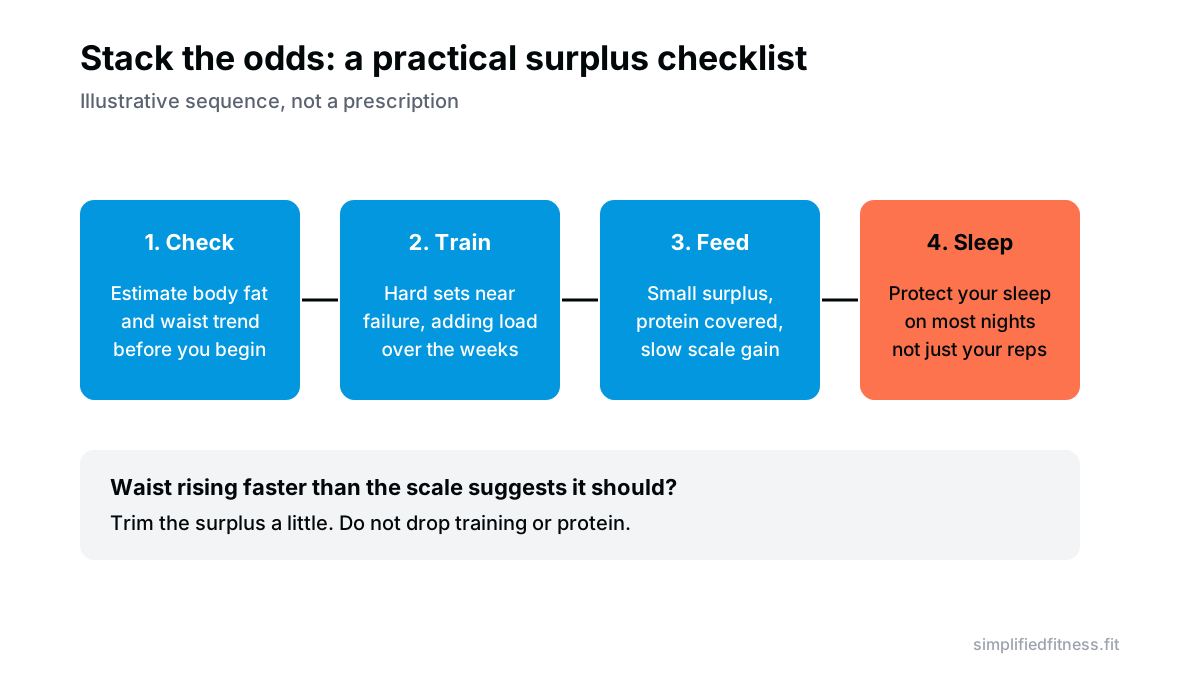
- Know where you start. Estimate body fat and take a waist measurement. If you are well above a lean range, a lean-out or recomposition phase first is reasonable. Our guide to body recomposition covers when that works, and the skinny-fat decision tree helps if you look slim but soft.
- Train with real effort. Hard sets, progressive load, steady frequency. The surplus supports this, it does not replace it.
- Keep the surplus modest. The evidence above gives no sign that a huge surplus builds proportionally more muscle. For the practical side, see our guide to lean bulking versus dirty bulking, and get a starting calorie number from the calorie calculator.
- Cover protein every day. In India that usually means dal, paneer, curd, soya chunks, eggs or chicken spread through the day, plus roti and rice for the calories. If a vegetarian diet makes the numbers hard, a protein powder is a convenience, not a requirement.
- Protect sleep. Heat, late phones and irregular shifts all chip away at it. It is the cheapest variable on this list.
- Review every 3 to 4 weeks. If strength is rising and the waist is climbing slowly, you are fine. If the waist is racing ahead of the lifts, trim the surplus a little.
When to see a doctor
Difficulty gaining weight despite eating well, unexplained weight loss, or weight gain that feels out of proportion to what you eat can have medical causes such as thyroid or hormonal conditions. This article is not a diagnosis. If something feels off, or you are on medication that affects appetite or weight, speak to a doctor.
The bottom line
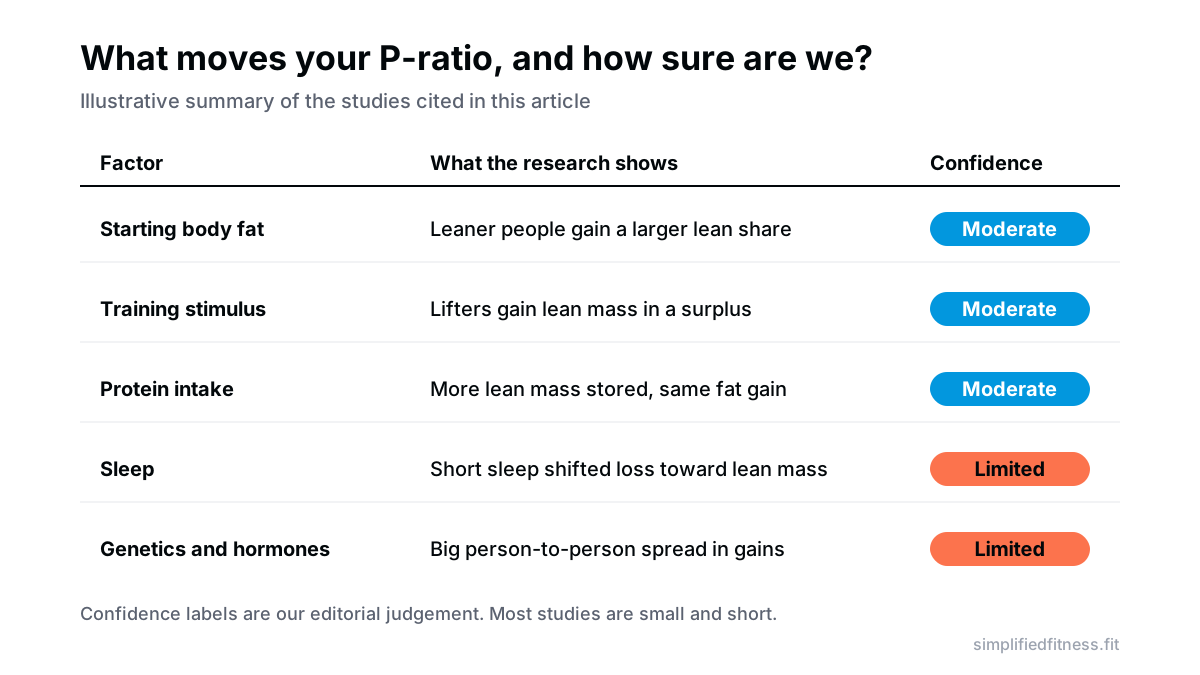
The P-ratio is a good way to think about quality of weight gain. The best-supported levers are your starting body fat, a real training stimulus and adequate protein, with sleep a plausible helper. Calories still decide how much fat you store.
Beyond that, people differ more than any article can account for. Start from a reasonable body fat, keep the surplus small, lift hard, and let your waist and your lifts tell you how your own body is partitioning.
Frequently Asked Questions
What is the P-ratio in bodybuilding?
The P-ratio (partitioning ratio) is the proportion of a weight change that is fat-free mass rather than fat. Kevin Hall extended Forbes's theory so it could be expressed as an energy partitioning parameter, and it fits real overfeeding and underfeeding data reasonably well. Use it as a way of thinking about quality of weight gain, not as a number you can measure at home.
Why do some people gain fat easily while others gain muscle?
Several factors overlap: starting body fat, training status, diet, sleep and individual biology. In a 100-day overfeeding study of 24 young lean men, gains in fat and fat-free mass varied widely between individuals despite an identical surplus. Rather than chasing a cause you cannot test, control what you can: surplus size, training quality, protein and sleep.
Do leaner people really gain more muscle in a surplus?
On average, yes, in the experiments that have looked. Overfeeding studies lasting at least 3 weeks found 60-70% of weight gained by thin people was lean tissue versus 30-40% in people with obesity. Note that lean tissue includes water and organs, not only muscle, and most of these subjects were not lifters.
Should I get to 10-15% body fat before bulking?
It is a sensible rule of thumb, not a proven threshold. The research supports a trend across the body fat range, not a cut-off at 10 or 15%. If you are well above that range, a lean-out phase first or a recomposition approach is a reasonable plan, and the waist-measure trend will tell you how it is going.
Does eating more protein reduce fat gain in a surplus?
Not by much, according to one controlled trial. In 25 overfed adults, fat gain was similar on low, normal and high protein diets, while lean mass rose only on the normal and high protein diets. So protein protects and builds lean tissue, but calories still determine fat storage.
Does training change how surplus calories are partitioned?
Training is the signal that gives extra calories somewhere useful to go. In a 6-week study of trained men overfeeding while lifting, nearly everyone gained fat-free mass, though individual results were unpredictable. Lift hard and progressively, because a surplus without that signal is far more likely to end up as fat.
Does a bigger surplus build more muscle?
Probably not beyond a modest amount. In resistance-trained men, 8 weeks of large daily protein and carbohydrate supplements on top of lifting did not produce a significant lean mass gain, while fat mass rose. That study had no group without the extra food, so it is a hint rather than proof, but a small surplus with a steady scale gain is usually the better trade.
Does sleep affect whether I gain muscle or fat?
It appears to. In a small crossover trial of 10 overweight adults on a diet, 5.5 hours of sleep opportunity cut fat loss and increased fat-free mass loss compared with 8.5 hours. Another small trial found one night of total sleep deprivation lowered muscle protein synthesis by 18%. Both studies were short, so treat sleep as a likely helper rather than a proven lever.
Is insulin sensitivity the main driver of the P-ratio?
It is a popular claim, but I did not find trial evidence in lifters that insulin sensitivity alone decides partitioning. Overfeeding research has found several baseline markers associated with response, including fitness, androgen and leptin levels, none of them overwhelming on its own. Do not buy supplements that promise to fix partitioning; sleep, training and a modest surplus are better bets.
Can I improve my P-ratio if I am already lean?
You can improve the conditions around it, but you cannot dial it to a target. Keep the surplus small, train progressively, hit your protein and sleep properly. Expect some fat gain with any real surplus, and judge success by the waist and lifts over several weeks.
How do I know if my bulk is partitioning well?
Track weekly average body weight, a waist measurement and your main lifts. If strength climbs and the waist grows slowly, partitioning looks fine. If the waist climbs quickly while lifts stall, trim calories modestly rather than adding more food.
Do vegetarians partition differently?
I did not find direct evidence that vegetarian diets change the P-ratio. What matters more is whether you reach your calorie and protein targets through dal, paneer, curd, soya and milk. Use our protein calculator to set a target and check that your usual meals actually get you there.
Sources & References
Every claim above is checked against peer-reviewed research (PubMed, U.S. National Library of Medicine) or guidance from established health bodies. How we fact-check.
- Hall KD. Body fat and fat-free mass inter-relationships: Forbes's theory revisited. Br J Nutr. 2007. PMID: 17367567
- Forbes GB. Body fat content influences the body composition response to nutrition and exercise. Ann N Y Acad Sci. 2000. PMID: 10865771
- Bray GA, et al. Effect of dietary protein content on weight gain, energy expenditure, and body composition during overeating: a randomized controlled trial. JAMA. 2012. PMID: 22215165
- Bouchard C, et al. Predictors of body composition and body energy changes in response to chronic overfeeding. Int J Obes. 2014. PMID: 23736367
- Smith RW, et al. Predicting adaptations to resistance training plus overfeeding using Bayesian regression: a preliminary investigation. J Funct Morphol Kinesiol. 2021. PMID: 33919267
- Spillane M, et al. Daily overfeeding from protein and/or carbohydrate supplementation for eight weeks in conjunction with resistance training does not improve body composition and muscle strength or increase markers indicative of muscle protein synthesis and myogenesis in resistance-trained males. J Sports Sci Med. 2016. PMID: 26957922
- Nedeltcheva AV, et al. Insufficient sleep undermines dietary efforts to reduce adiposity. Ann Intern Med. 2010. PMID: 20921542
- Lamon S, et al. The effect of acute sleep deprivation on skeletal muscle protein synthesis and the hormonal environment. Physiol Rep. 2021. PMID: 33400856

Umair Hazrami · Founder & Head Coach, Simplified Fitness
Umair Hazrami founded Simplified Fitness and the Simplified Lifter channel to cut through fitness noise. With 4+ years of consistent training and 10+ coaching clients, he writes every guide from the peer-reviewed research and links the sources so you can check them. Our editorial standards.
Educational content only, not medical advice. If you have a medical condition, are pregnant, or take medication, talk to a qualified doctor before changing your diet, supplements or training. Full disclaimer.
Keep reading
Nutrition
Body Recomposition: Who Can Lose Fat and Build Muscle at the Same Time?
How to do body recomposition: who can lose fat and build muscle at once, what the trials show, and a protein, training and calorie protocol you can start today.
8 min read
Nutrition
Breaking Fat Loss Plateaus: Check Fluid, Hidden Calories and NEAT
How to break a fat loss plateau: a 3-step check of water masking, hidden calories and lower daily steps, plus the exact fix to restart steady fat loss.
8 min read

Nutrition
How to Calculate Macros: Step-by-Step Grams per Kilogram Formula for Protein, Fat and Carbs
How to calculate macros in grams per kg: set protein, set fat, fill the rest with carbs. Worked examples for 70, 80 and 90 kg lifters on a cut or a bulk.
9 min read
Nutrition
Daily Scale Weight Fluctuations: Sodium, Bowels, Glycogen and Water
Daily scale weight fluctuations are mostly water, glycogen and gut contents, not fat. Learn why your weight jumps overnight and how a 7-day average fixes it.
8 min read