Water Retention and the Whoosh Effect: Why the Scale Suddenly Drops
Whoosh effect fat loss water retention explained: why the scale stalls for weeks then drops 1-2 kg overnight, what cortisol really does, and what to do.
TL;DR. The short answer
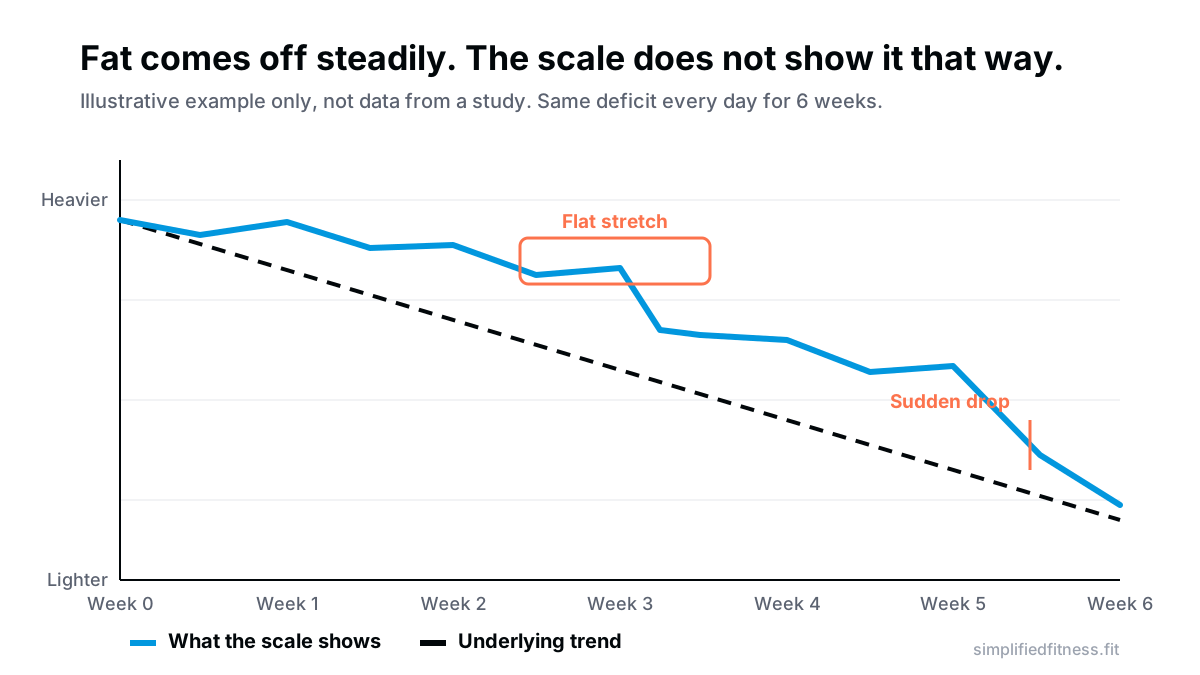
- The whoosh effect is a real pattern: scale weight sits flat for days or weeks during a deficit, then drops fast. In most cases fat loss did not pause; fluid shifts hid it, then released.
- The popular idea that fat cells fill with water as they empty is not supported by anything I could find in the research. Fluid sits in other compartments, not in the fat cell.
- Cortisol and aldosterone do affect salt and water handling, but the evidence that dieting stress alone causes weeks of masking in healthy lifters is thin. Treat it as a possible contributor, not a proven cause.
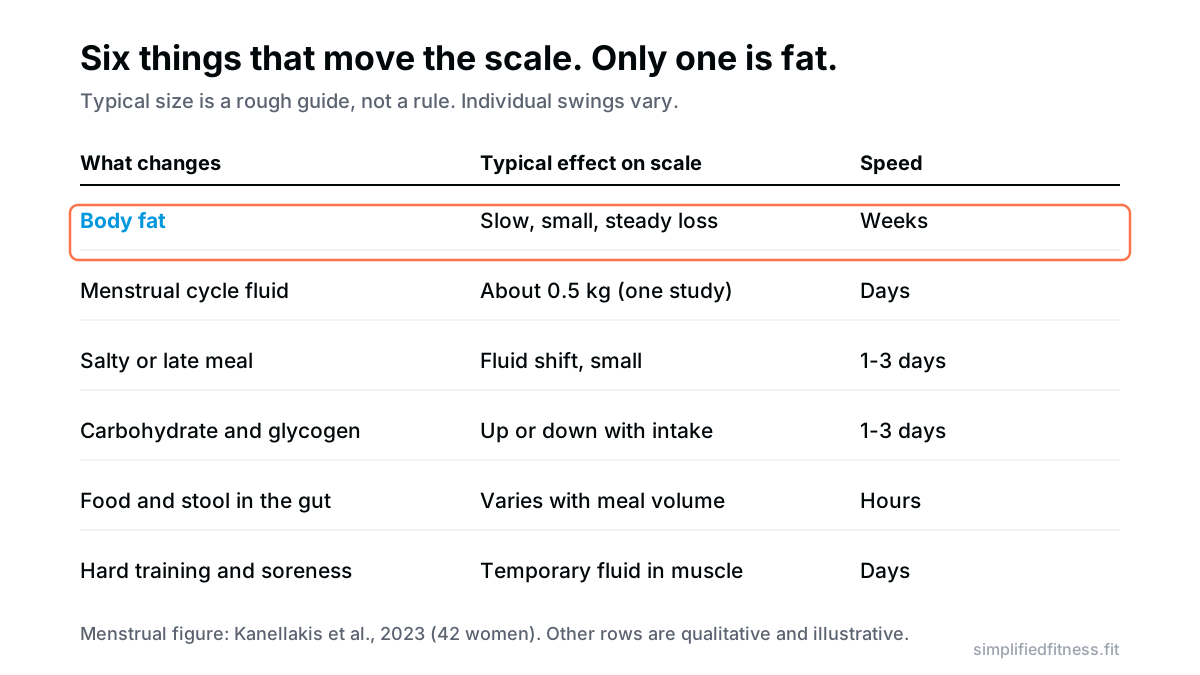
- Better-documented causes of a stuck scale are menstrual cycle fluid (about 0.5 kg in one study), sodium and meal timing shifts, glycogen, and gut contents.
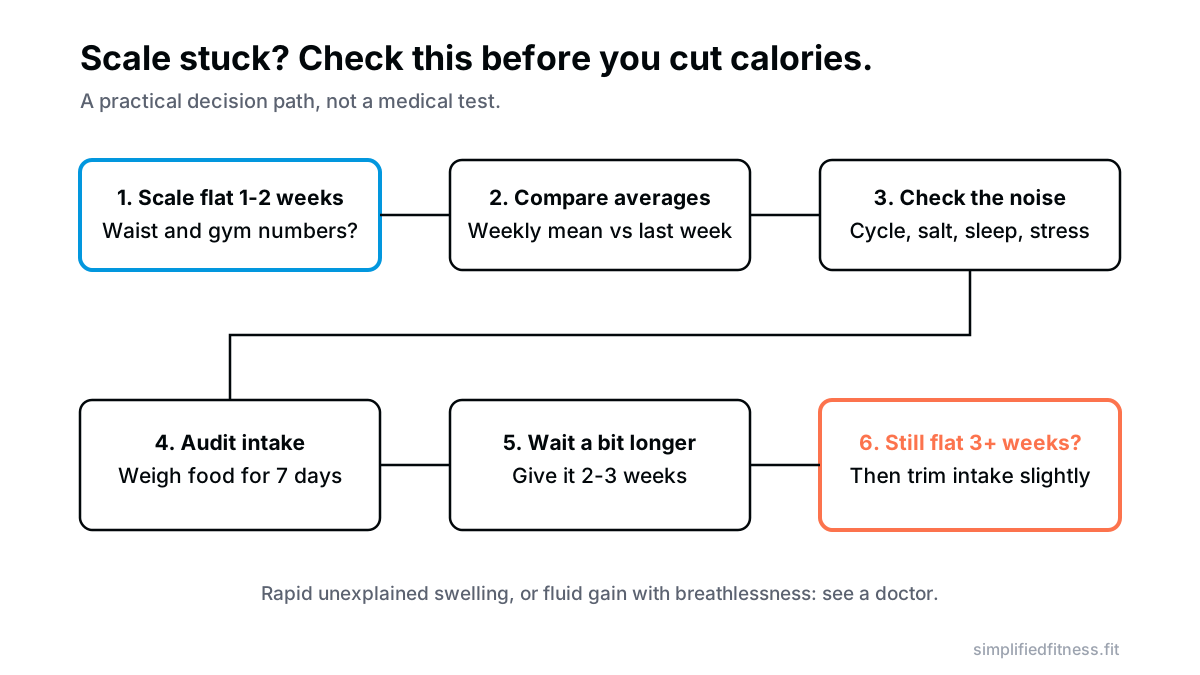
- Judge progress on weekly averages, waist and training numbers. Only change your calories after about 3 weeks of a flat trend across all of them.
Part of our complete guide: The No-BS Guide to Energy Balance, Fat Loss, Bulking & Body Recomposition
Table of contents
You ate in a deficit for two weeks and the scale did not move. Then one morning it is 1.5 kg lighter. Nothing changed that day. So what happened?
This pattern is what people call the whoosh effect, and the question behind it, whoosh effect fat loss water retention, comes down to one idea: fat loss kept going while fluid shifts hid it, then the fluid let go. That explanation is plausible and fits what we know about body water, but the exact mechanism is less settled than the internet suggests. This article sits inside our guide to energy balance, fat loss and recomposition, and it focuses on the sudden drop itself.
Quick version first, then the evidence.
What is the whoosh effect, really?
Your scale does not measure fat. It measures everything: fat, muscle, bone, blood, food in your gut, glycogen and the water attached to all of it. Fat is the slow part. Water and gut content are the fast part.
A deficit removes fat gradually. Hall and colleagues modelled this in adults and found that the bodyweight response to a change in energy intake is slow, with half times of about a year (Hall et al., 2011). That is a model, not a lifter-specific trial, but the message stands: fat loss is a quiet, steady process.
Fluid is not quiet. If a few hundred grams to a kilo of fluid is added on top of a slowly falling fat line, the scale looks flat. When the extra fluid clears, the scale catches down to the fat line in one or two mornings. That jump is the “whoosh”.
Do fat cells fill with water? (the myth)
The most repeated version of the story says that as a fat cell empties, it fills with water, and later “dumps” it. It sounds neat. It is also the part I would not repeat.
Fat cells store energy as triglyceride, which is oily and does not mix with water. I could not find a human study showing that fat cells swap lost fat for water, so there is no good basis for the claim as it is usually told. Extra fluid in a dieter is better explained by changes in the body’s fluid compartments: the blood, the space between cells, muscle and the gut. The scale reflects those, not a water-filled fat cell.
Why does the myth survive? Because the experience is real and people reach for the first tidy story. The experience just has a messier, more boring set of causes.
What does cortisol actually do to water retention?
This is the part of the brief that usually gets oversold, so let’s be careful.
Cortisol and aldosterone are stress and salt-handling hormones. Aldosterone tells the kidneys to hold on to sodium, and water follows. During severe stress such as blood loss, the body ramps these systems up to protect blood pressure. That is well established.
Is dieting stress enough to cause the same effect? Here the evidence is much thinner. A 1987 review of stress and salt and water balance noted that a variety of acute stressors raise cortisol, aldosterone, renin and vasopressin, but said the responses are brief and unlikely to contribute significantly to changes in salt or water balance, and it called for further study (Espiner, 1987). That review is old and is not about lifters in a deficit, so it does not close the question.
So here is the honest summary:
- What is plausible: a long deficit, hard training and poor sleep may raise stress hormones in some people, and that could nudge fluid handling.
- What is not shown: I found no trial that measured cortisol and body water in dieting lifters and linked them to a stalled scale and a later drop.
- What that means: treat cortisol as one possible contributor, not the proven reason for your stall.
If stress and sleep are wrecking your recovery, that is worth fixing for its own reasons. Our piece on cortisol and resistance training covers what the research does and does not show.
What actually moves scale weight (better-documented causes)
These are the things with firmer support behind them.
Menstrual cycle. In a study of 42 women weighed twice a week across a cycle, body weight was about 0.45 kg higher during menstruation than in the first week of the cycle, and the increase was attributed to a 0.474 kg rise in extracellular water (Kanellakis et al., 2023). No other body composition changes reached significance. Individual patterns vary, so this is an average, not a promise.
Sodium and fluid shifts. The popular belief is that more salt equals more stored water. A controlled metabolic-ward study of 32 healthy men found that going up to 550 mEq of NaCl a day raised plasma volume by about 315 ml, but total body water and body mass did not increase (Heer et al., 2000). Fluid moved between compartments rather than being stored. That is a short, male-only study at extreme intakes, so it does not mean salt can never move the scale. It does suggest the effect is subtler than “salt makes you bloated.”
Glycogen. Carbohydrate stored in muscle and liver comes with water. The classic figure is about 3 g of water per gram of glycogen, but a rodent study found muscle water did not track glycogen consistently and did not support that ratio (Sherman et al., 1982). The honest version is that glycogen is associated with water, but the exact amount is uncertain. Powerlifters use this knowledge: a review of short-term body mass manipulation lists gastrointestinal content, glycogen storage and body water as the main levers, and cautions that these tactics are for specific competition use (Renner et al., 2025).
Gut contents. Food, fibre and stool have weight. A big dal-chawal dinner, a fibre change or constipation shifts the number without touching fat.
Training. A new or harder session can leave temporary fluid in the muscle while it recovers. You can read more in our guide to daily scale weight fluctuations.
Why did I lose 2 kg overnight?
Run the arithmetic. One kilogram of body fat holds roughly 7,700 kcal as a common rule of thumb (approximate, and it varies). Losing even 1 kg of fat in a night would need a deficit of that size, which is not realistic. So a 1-2 kg overnight drop is nearly always fluid, glycogen or gut content.
In India, common triggers look like this:
- A salty restaurant or wedding meal, followed by normal eating, and the scale drops 2-3 days later.
- A heavy rice or roti dinner one day, a lighter one the next.
- A hot-weather week of heavy sweating, then rehydrating.
- Constipation clearing after a few days.
How to stop letting fluid fool you
You do not need to fix water. You need to read the scale properly.
- Weigh the same way each time. Morning, after the toilet, before food, similar clothes.
- Use weekly averages. Add up the week’s readings and divide. Compare to last week. Daily versus weekly weighing did not differ significantly in a meta-analysis of trials, so pick what you will actually keep doing (Madigan et al., 2015). Note that weighing helped most as part of a wider programme.
- Add a second measure. Waist at the navel once a week, plus your key lifts. If waist is shrinking and strength is holding, fat is going down. Our guide to DIY physique tracking walks through it.
- Keep salt, carbs and fibre steady. If your intake swings, so will the scale.
- Do not compare across menstrual phases. Compare same phase to same phase.
What if the scale really is stuck?
The whoosh story can become an excuse. If you have been flat for 3 weeks or more across scale average, waist and training, a fluid mask is a weaker explanation than eating more than you think. Most people undercount sauces, oil, snacks and weekend meals. Our guide to breaking fat loss plateaus covers hidden calories and NEAT.
Before you adjust anything, re-estimate your numbers with the calorie calculator and check your pace in the weight loss timeline calculator. If your deficit is large and you are tired, hungry and sleeping badly, a short planned diet break is a better tool than hoping for a whoosh. For the sleep side of it, see sleep restriction and fat loss.
When to see a doctor
Normal diet-related fluid changes are small and temporary. See a doctor if you notice:
- sudden or one-sided leg swelling, or swelling that is painful
- swelling together with breathlessness, chest pain or very little urine
- fast weight gain over a few days that you cannot explain
- persistent puffiness in the face, legs or around the eyes
- other symptoms such as unusual weakness, easy bruising or marked mood changes
A very high or prolonged cortisol state, such as Cushing syndrome, is a medical diagnosis. You cannot work it out from a scale. If you are worried, speak to your doctor.
The bottom line
The whoosh is real in the sense that scale weight can lag behind fat loss and then catch up. The fat-cells-fill-with-water story is not supported, and the cortisol explanation is plausible but unproven for ordinary lifters. The causes with better support are menstrual cycle fluid, sodium and fluid shifts, glycogen, gut contents and training.
Stay consistent, read the average, and give your plan 3 weeks before you change it.
Frequently Asked Questions
What is the whoosh effect in fat loss?
It is when your scale weight stays flat for days or weeks while you are in a calorie deficit, then drops suddenly by 1-2 kg or more. The idea is that fat loss continued underneath while fluid shifts hid it on the scale. The term is popular rather than scientific, so treat the mechanism as a plausible explanation, not a measured law. Track a weekly average so you can see the real trend.
Why did I lose 2 kg overnight?
A drop that fast is almost certainly fluid, glycogen or gut content, not fat. Burning 2 kg of fat would need a deficit of roughly 15,000 kcal in a night, which is not possible. Days of salty food, a high-carb meal, a late dinner or a period can all hold water, and releasing it shows up as a sudden drop. Do not read it as a new fat loss rate.
Do fat cells fill with water when you lose fat?
There is no good evidence that they do. Fat cells store triglyceride, an oily fat that mixes poorly with water, and I found no human study showing they swap lost fat for water. A stalled scale is better explained by fluid held elsewhere in the body. Judge fat loss with waist, photos and weekly averages instead of this myth.
Does cortisol cause water retention during a diet?
Cortisol and aldosterone can influence how the kidneys handle salt and water, but the effect of ordinary dieting stress is not well measured. A 1987 review noted that stress hormone responses to acute stressors are brief and unlikely to change salt and water balance much. Chronic or very high cortisol states, such as Cushing syndrome, are medical conditions. If you suspect one, see a doctor.
How long can water retention hide fat loss?
There is no firm number from research, and individual patterns vary. Short-term fluid swings of days are well documented, such as the roughly 0.5 kg extracellular water rise during menstruation in one study of 42 women. Anything flat for 3 weeks or more across scale, waist and gym performance deserves a calorie check rather than more waiting. Use weekly averages to decide.
Does a cheat meal cause a whoosh?
Sometimes the scale drops after a higher-calorie or higher-carb day, but a meal does not burn fat. A larger meal can change carbohydrate stores, sodium and gut content, and the scale may rebound or fall over the next few days as those settle. Do not use a cheat meal as a weight-loss tactic. Plan breaks for adherence instead, and see our guide on diet breaks versus refeeds.
Does eating more salt cause water retention?
Sort of, but less than most people assume. In a controlled study of 32 healthy men, very high sodium intake raised plasma volume by about 315 ml, yet total body water and body mass did not increase. Fluid shifted between compartments instead of being stored. Keep sodium steady day to day so it is not a variable in your weigh-ins.
Should I weigh myself every day while dieting?
Daily weighing works if you average the readings. A meta-analysis of trials found no significant difference in weight loss between weekly and daily weighing instructions. Because single readings are noisy, compare the average of this week with the average of last week. Skip daily weighing if it makes you anxious.
Does water retention mean I should cut calories more?
Not at first. A flat week or two inside a normal fluctuation range does not mean your deficit stopped working. Cutting further too early adds fatigue and hunger for no reason. Wait for roughly 3 weeks of a flat trend in weekly averages, waist and training before trimming intake slightly.
Does drinking more water help release water weight?
Drinking enough water is sensible, but I am not aware of strong evidence that forcing extra water breaks a stall. Your kidneys regulate fluid tightly, and large amounts do not reliably flush stored fluid. Drink to thirst, keep salt and carbs steady and let the average show the trend.
Can women see bigger whooshes around their period?
Many women do see a weight bump and then a release around menstruation. One study measured body weight in 42 women twice per week across a cycle and found about 0.45 kg higher weight during menstruation, mainly from extracellular water. Compare the same phase from month to month rather than week to week. Heavy swelling or severe pain is worth a doctor visit.
When should I see a doctor about water retention?
See a doctor if swelling is sudden, one-sided, painful, or comes with breathlessness, chest pain, very little urine or fast unexplained weight gain over days. Ordinary diet-related fluctuations are small and settle by themselves. Persistent puffiness in the legs, face or around the eyes is also worth getting checked. This article cannot diagnose a cause.
Sources & References
Every claim above is checked against peer-reviewed research (PubMed, U.S. National Library of Medicine) or guidance from established health bodies. How we fact-check.
- Espiner EA. The effects of stress on salt and water balance. Baillieres Clin Endocrinol Metab. 1987. PMID: 3327497
- Kanellakis S, et al. Changes in body weight and body composition during the menstrual cycle. Am J Hum Biol. 2023. PMID: 37395124
- Heer M, et al. High dietary sodium chloride consumption may not induce body fluid retention in humans. Am J Physiol Renal Physiol. 2000. PMID: 10751219
- Sherman WM, et al. Muscle glycogen storage and its relationship with water. Int J Sports Med. 1982. PMID: 7068293
- Hall KD, et al. Quantification of the effect of energy imbalance on bodyweight. Lancet. 2011. PMID: 21872751
- Madigan CD, et al. Is self-weighing an effective tool for weight loss: a systematic literature review and meta-analysis. Int J Behav Nutr Phys Act. 2015. PMID: 26293454
- Renner A, et al. Short term body mass manipulation in powerlifting: a narrative review and best practice recommendations. J Int Soc Sports Nutr. 2025. PMID: 41320256

Umair Hazrami · Founder & Head Coach, Simplified Fitness
Umair Hazrami founded Simplified Fitness and the Simplified Lifter channel to cut through fitness noise. With 4+ years of consistent training and 10+ coaching clients, he writes every guide from the peer-reviewed research and links the sources so you can check them. Our editorial standards.
Educational content only, not medical advice. If you have a medical condition, are pregnant, or take medication, talk to a qualified doctor before changing your diet, supplements or training. Full disclaimer.
Keep reading
Nutrition
Body Recomposition: Who Can Lose Fat and Build Muscle at the Same Time?
How to do body recomposition: who can lose fat and build muscle at once, what the trials show, and a protein, training and calorie protocol you can start today.
8 min read
Nutrition
Breaking Fat Loss Plateaus: Check Fluid, Hidden Calories and NEAT
How to break a fat loss plateau: a 3-step check of water masking, hidden calories and lower daily steps, plus the exact fix to restart steady fat loss.
8 min read

Nutrition
How to Calculate Macros: Step-by-Step Grams per Kilogram Formula for Protein, Fat and Carbs
How to calculate macros in grams per kg: set protein, set fat, fill the rest with carbs. Worked examples for 70, 80 and 90 kg lifters on a cut or a bulk.
9 min read
Nutrition
Daily Scale Weight Fluctuations: Sodium, Bowels, Glycogen and Water
Daily scale weight fluctuations are mostly water, glycogen and gut contents, not fat. Learn why your weight jumps overnight and how a 7-day average fixes it.
8 min read