CICO Science: Does Calories In vs Calories Out Really Work for Fat Loss?
CICO science explained: why energy balance governs fat loss, how insulin and thyroid fit in, and why calorie counting fails in practice. Studies linked.

TL;DR. The short answer
- Body weight change follows energy balance: if you take in less energy than you use over time, you lose body mass. No hormone or food group has been shown to suspend that rule.
- Hormones like insulin and thyroid hormone matter because they shift appetite and energy use, not because they bypass energy balance.
- In a 2017 meta-analysis of 32 controlled feeding studies, swapping carbohydrate for fat at equal calories did not raise fat loss. Lower-fat diets came out slightly ahead (about 16 g of fat per day).
- CICO is true as physics but unreliable as a bookkeeping method, because self-reported intake is often under-reported and expenditure shifts as you diet.
- If your weight will not move despite careful logging for several weeks, or you have symptoms like unusual fatigue or feeling cold, see a doctor rather than cutting calories further.
Part of our complete guide: The No-BS Guide to Energy Balance, Fat Loss, Bulking & Body Recomposition
Table of contents
Does CICO work? As physics, yes. Body weight changes follow the balance between energy in and energy out, and no hormone, food group or fasting window has been shown to switch that off. But the “calories in, calories out” slogan hides a lot: both sides of the equation move when you diet, and neither is easy to measure.
This article defends the science of CICO and explains where the slogan falls short. It sits inside our wider guide to energy balance for fat loss, bulking and recomposition, and it is the foundation for every cutting or bulking decision on this site.
What does “calories in, calories out” actually claim?
Two things, and people constantly mix them up.
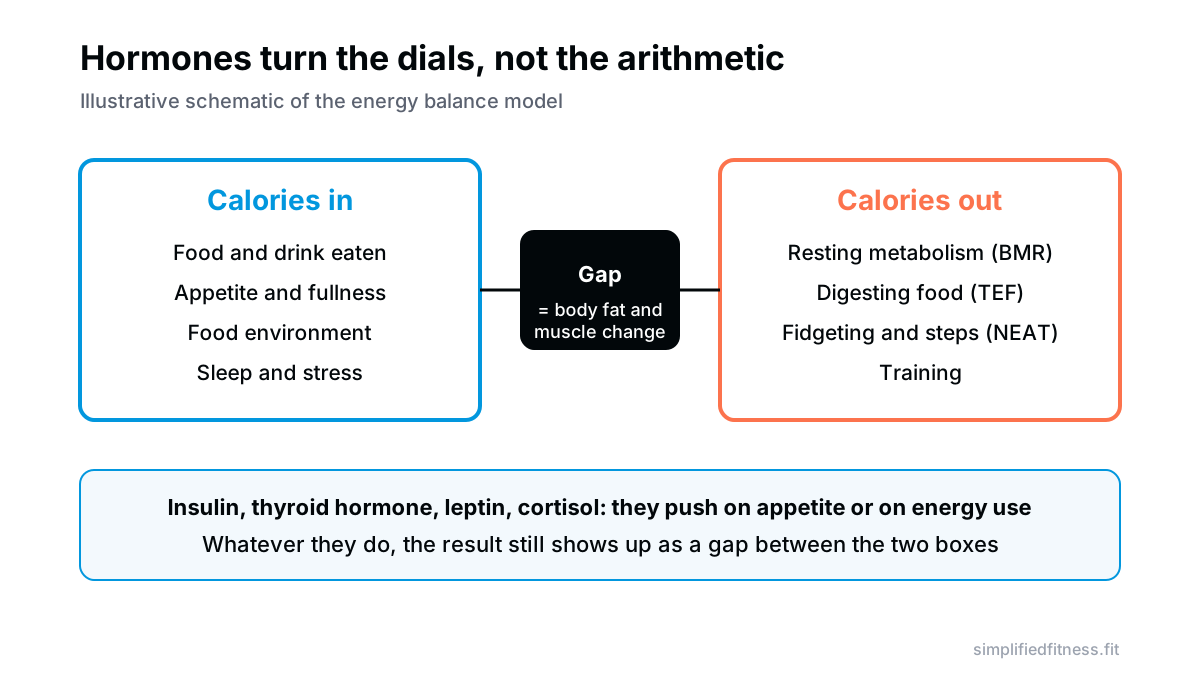
The first is a law of physics. Energy is not created or destroyed. The energy in food is either used for heat and movement, stored as fat, muscle or glycogen, or lost as waste. Over any stretch of time, if more energy goes in than gets used, the difference is stored. If less goes in, the body draws on its stores.
The second is a theory of why people gain weight. That is where most of the arguments start. A 2022 paper by Hall and colleagues makes this exact point: the principle of energy balance is a law of physics that is agnostic as to obesity mechanisms, while the “energy balance model” of obesity is a biological model in which the brain controls food intake through endocrine, metabolic and nervous system signals.
So when someone says “CICO is wrong because hormones matter”, they are usually attacking a cartoon version: the idea that weight is simply willpower and a calculator. Few researchers in the field hold that view.
Is the science of CICO real? What controlled studies show
When researchers lock people in a metabolic ward and control every meal, the picture is consistent: weight follows energy balance.
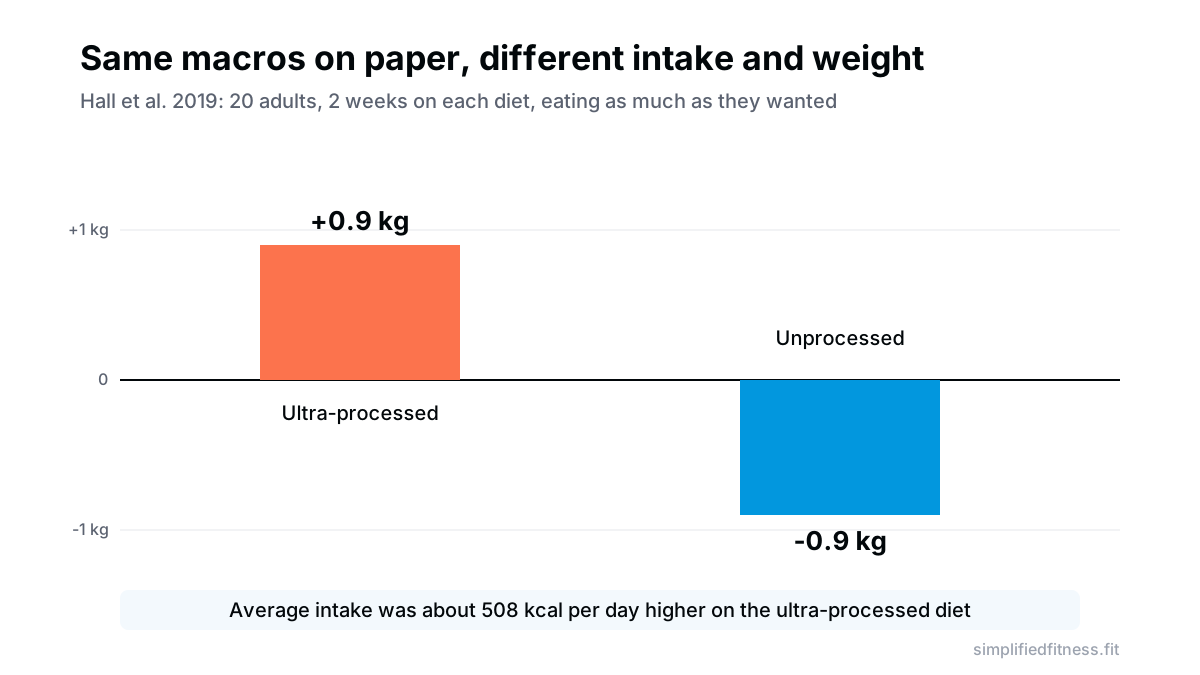
A 2019 NIH trial by Hall and colleagues is a good example. Twenty weight-stable adults (mean BMI 27) lived in a clinical centre and ate an ultra-processed diet for 2 weeks and an unprocessed diet for 2 weeks, in random order, eating as much or as little as they liked. Meals were matched for presented calories, energy density, macronutrients, sugar, sodium and fibre. Intake was about 508 kcal per day higher on the ultra-processed diet. Participants gained 0.9 kg on it and lost 0.9 kg on the unprocessed diet. Weight change was strongly correlated with energy intake (r = 0.8).
Read that carefully, because it supports CICO and complicates it at the same time. Weight tracked intake closely. But the food changed how much people ate without them trying. That is a story about appetite (the “in” side), not a broken equation.
This was a small, short trial of 20 adults, so treat the numbers as an illustration rather than a prediction for your own diet.
Do carbs, insulin or the keto diet get around thermodynamics?
This is the biggest objection, usually phrased as “insulin makes you store fat, so calories do not matter.”
The theory behind it is called the carbohydrate-insulin model. It predicts that if you swap carbohydrate for fat at the same calories, insulin falls, energy expenditure rises and you lose more body fat. That is a testable claim, and it has been tested.
A metabolic ward trial. In a 2016 study, 17 overweight or obese men ate a high-carbohydrate baseline diet for 4 weeks, then an isocaloric ketogenic diet for 4 weeks with protein held constant. Energy expenditure did rise slightly on the ketogenic diet (for example, 151 kcal per day by doubly labelled water). But body fat loss slowed, and the authors concluded the diet was not accompanied by increased fat loss, with the expenditure increases near the limits of detection.
A meta-analysis. A 2017 analysis of 32 controlled feeding studies with isocaloric swaps of carbohydrate for fat found that both energy expenditure (26 kcal per day) and fat loss (16 g per day) were greater with lower-fat diets, not lower-carb diets.
Why do findings differ at all? Studies use different durations, protein levels and ways of measuring expenditure. Small differences of 50-150 kcal per day are hard to detect and sit at the edge of measurement error. The cautious reading is this: low-carb diets can help some people eat less because they feel full or cut out snack foods, but there is no good evidence of a large metabolic advantage at equal calories.
Insulin is not irrelevant. It is part of the signalling system that governs fuel use and hunger. It just has not been shown to override energy balance. If you want the lifter angle, our piece on low-carb and ketogenic diets for hypertrophy goes deeper.
Where do thyroid hormone and other hormones fit in?
Hormones change CICO by pushing on one side of it.
Thyroid hormone is the classic example. It influences resting energy expenditure, so an underactive thyroid can lower the “out” side a bit. But how much? A 2026 systematic review and meta-analysis by Wolde Sellasie and colleagues pooled 23 studies (763 patients) of hypothyroid adults treated with levothyroxine until their thyroid levels normalised. Body weight fell by an average of 1.39 kg (95% CI: 0.23 to 2.56 kg), with reductions seen in overt hypothyroidism but not subclinical hypothyroidism. The authors described the effect as modest and discouraged levothyroxine solely for weight loss.
So an untreated thyroid problem is not a magic reason you cannot lose weight, and a normal thyroid is not a magic way to lose it. The effect is small compared with the swing created by what you eat and how much you move.
The same logic applies to cortisol, leptin and appetite hormones: they shift hunger and energy use. They do not cancel out a deficit.
Why does calorie counting fail so often?
If the physics is solid, why do so many people say counting “does not work”? Mostly because of the measurement, not the law.
Intake is under-reported. A review of studies using doubly labelled water (an objective measure of energy expenditure) found that when people record their own intake, it is generally under-reported compared with measured expenditure. The review noted that other factors beyond body size, such as dietary restraint, are involved. The in-gym version of this is the thing people forget: the tadka oil, the handful of peanuts, the extra spoon of ghee on roti. Our guide to hidden calories in Indian cooking covers where these hide.
Expenditure moves when you diet. In a 2011 Lancet modelling paper, Hall and colleagues showed that bodyweight response to a change in intake is slow, with half times of about 1 year, because expenditure adapts as weight changes. So a fixed “500 kcal deficit equals 0.5 kg per week forever” is not how it plays out. The model also found that a small persistent imbalance of about 30 kJ per day (roughly 7 kcal) underlies average weight gain at population level, which shows how small errors in tracking can matter over time.
Metabolic adaptation is real but not magic. A review of metabolic adaptation in athletes describes how energy restriction is accompanied by changes in hormones, mitochondrial efficiency and energy expenditure that minimise the deficit. That makes the deficit smaller than the spreadsheet says. It does not flip it into a surplus. We cover the details in our article on metabolic adaptation and why starvation mode is mostly a myth.
How does NEAT change the “calories out” side?
Not all of expenditure is under your control, and NEAT is the clearest example.
In a 1999 Science study by Levine and colleagues, 16 non-obese volunteers were fed 1,000 kcal per day above maintenance for 8 weeks. Two-thirds of the rise in daily energy expenditure came from NEAT (fidgeting, posture, daily activity). Changes in NEAT accounted for a 10-fold difference in fat storage between people, and predicted resistance to fat gain (r = 0.77).
Flip it around for a cut. When you eat less, daily movement can drift down without you noticing: fewer trips, more sitting, less fidgeting. That is one reason a deficit can shrink on its own. The study was in non-obese adults overeating, so the cutting application is an inference. Still, a simple step count is a cheap guard. Our guide to TDEE, BMR, TEF and NEAT breaks down each component.
So how do you use CICO properly?
Think of it as a feedback loop, not a formula.
- Get a starting estimate. Use the calorie calculator to estimate maintenance. Treat it as a first guess with a margin of error.
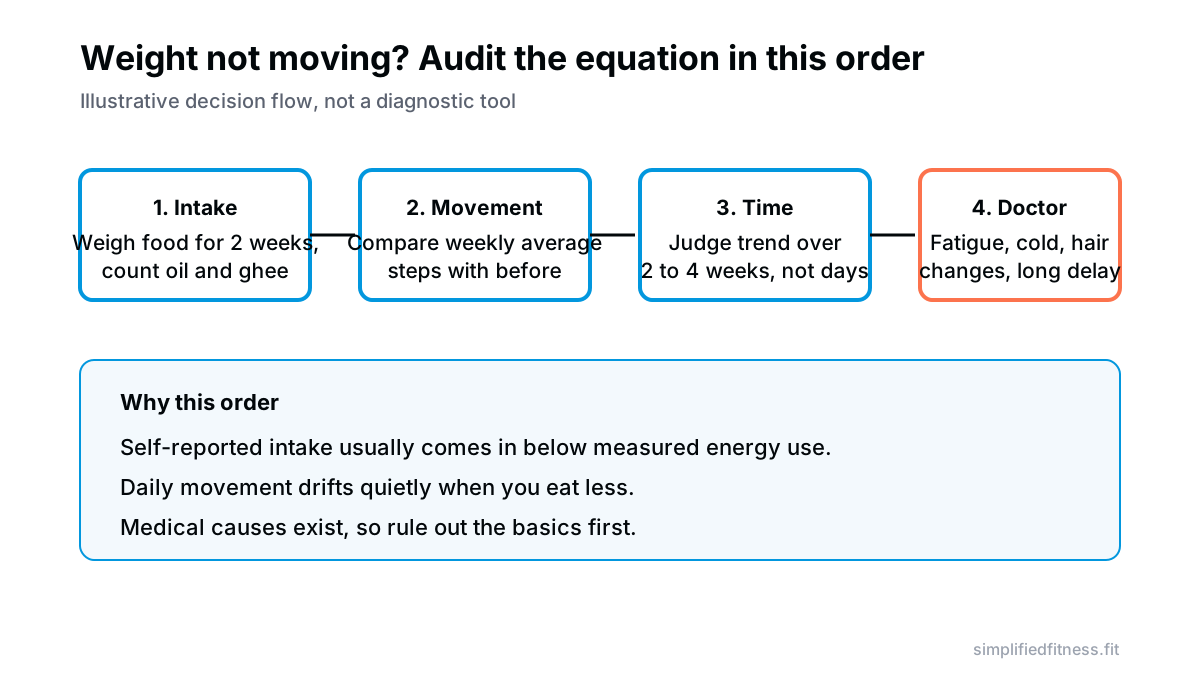
- Log accurately for 2 weeks. Use a digital scale for calorie-dense items such as oil, ghee, nuts, peanut butter, paneer and rice. See food logging precision.
- Track a weekly average. Weigh daily if it does not stress you, then compare weekly means.
- Adjust in small steps. If the trend is flat after 2-3 weeks, trim 100-200 kcal or add steps. Do not slash intake by half.
- Keep the food simple. Dal, eggs, curd, paneer, soya, chicken, vegetables, roti and rice are filling and easy to portion.
| Situation | Likely side of the equation | First thing to check |
|---|---|---|
| Weight flat, logging looks perfect | Calories in (under-reporting) | Weigh oil, ghee, snacks, weekend meals |
| Losing fast then stalling | Calories out (adaptation, lower NEAT) | Weekly step average, recalculate maintenance |
| Hungry all the time | Calories in (appetite) | Protein, fibre, volume of food, sleep |
| Tired, cold, hair changes plus flat weight | Possible medical issue | Talk to a doctor |
For a longer discussion of plateaus, see breaking fat loss plateaus.
The bottom line
CICO is true the way gravity is true. It does not tell you how to stay on a diet, how hungry you will be or what your expenditure will do. But it does rule out the claim that any single hormone or macronutrient lets you lose fat while eating more energy than you use.
The practical version is less dramatic. Eat in a modest deficit, pick foods that keep you full, protect your daily movement, lift to keep muscle, and judge progress on trends. If your own data stay stubborn after careful tracking, see a doctor instead of trusting a forum thread.
Frequently Asked Questions
Does CICO actually work for fat loss?
Yes, as a principle: sustained intake below expenditure leads to weight loss in controlled feeding studies. It works because body mass changes follow energy balance, and no tested diet has escaped that. The practical problem is measuring both sides accurately, so use a weekly average weight trend to adjust your intake.
Is calories in calories out a myth?
No, the principle is not a myth, but the oversimplified version is. Intake and expenditure are linked: appetite changes with body weight and energy use adapts when you eat less. Treat CICO as the rule of the game, not a promise that eating 500 kcal less always means exactly 0.5 kg lost.
Does insulin make you fat regardless of calories?
Current controlled trials do not support that. In a 2016 metabolic ward study, 17 overweight or obese men switched from a high-carbohydrate to an isocaloric ketogenic diet and did not lose more body fat. Insulin may influence hunger and fuel use, so manage total calories and food choices that keep you full.
Do low-carb diets burn more calories?
Probably not by a meaningful amount. A 2017 meta-analysis of 32 controlled feeding studies found energy expenditure and fat loss were slightly greater on lower-fat diets, by 26 kcal per day and 16 g of fat per day. Pick the carbohydrate level you can stick to, since adherence matters more than the macro split.
Can a slow thyroid stop me from losing weight?
It can make weight harder to manage, but the effect is usually modest. A 2026 meta-analysis of 23 studies found that treating hypothyroid adults to normal levels with levothyroxine reduced body weight by about 1.4 kg on average. If you suspect a thyroid problem, ask your doctor for a blood test rather than self-diagnosing.
Why am I not losing weight if I eat in a calorie deficit?
Most often the deficit is smaller than you think. Studies comparing self-reported intake with doubly labelled water measurements find under-reporting is common when people record their own food. Weigh your food for two weeks, include cooking oil and ghee, and judge progress on weekly averages.
How accurate is calorie counting?
It is approximate. Food labels, portion estimates and memory all add error, and research on self-reported intake generally finds under-reporting compared with measured energy expenditure. Use counting as a feedback tool: log consistently, watch the trend, then adjust by 100-200 kcal.
Is a calorie a calorie?
For energy balance, yes, but foods differ in how many calories you end up eating. In a 2019 inpatient trial of 20 adults, people ate about 508 kcal per day more on an ultra-processed diet and gained 0.9 kg in two weeks, versus losing 0.9 kg on an unprocessed diet. Build meals around dal, eggs, paneer, curd, vegetables and rice or roti, which are easier to keep portioned.
What is NEAT and why does it matter for CICO?
NEAT is non-exercise activity thermogenesis: fidgeting, standing, walking and other daily movement. In an 8-week overfeeding study of 16 non-obese adults, changes in NEAT explained a 10-fold range in fat storage. Track your daily steps, because NEAT is often the part of your expenditure that quietly falls when you diet.
Does the First Law of Thermodynamics apply to the human body?
Yes, energy is neither created nor destroyed in the body. Food energy is either used, stored or lost, and stored energy shows up as changes in body fat, muscle and glycogen. The law says nothing about how hungry you are or how much you move, which is where biology comes in.
Do I need to count calories to lose fat?
No, but you need some way of controlling intake. Counting is one option, while fixed portions, a repeating meal plan or limiting ultra-processed foods also work if your weight trend moves. Try our calorie calculator for a starting estimate, then adjust to your own results.
How many calories is a kilogram of body fat?
The old 7,700 kcal per kg rule is a rough estimate and the real figure changes with the mix of fat and lean tissue lost. A modelling paper in The Lancet showed weight response to a change in intake is slow, with half times of about 1 year, because expenditure falls as you lose weight. Do not expect linear loss, and reassess your intake every 2-4 weeks.
Does metabolic adaptation make CICO wrong?
No, it changes the numbers but not the rule. Energy restriction is accompanied by changes in hormones, mitochondrial efficiency and energy expenditure that reduce the deficit. If progress stalls, recalculate your targets rather than assuming the physics changed, and see our metabolic adaptation guide.
Sources & References
Every claim above is checked against peer-reviewed research (PubMed, U.S. National Library of Medicine) or guidance from established health bodies. How we fact-check.
- Hall KD, et al. Quantification of the effect of energy imbalance on bodyweight. Lancet. 2011. PMID: 21872751
- Hall KD, et al. Obesity energetics: body weight regulation and the effects of diet composition. Gastroenterology. 2017. PMID: 28193517
- Hall KD, et al. The energy balance model of obesity: beyond calories in, calories out. Am J Clin Nutr. 2022. PMID: 35134825
- Hall KD, et al. Ultra-processed diets cause excess calorie intake and weight gain: an inpatient randomized controlled trial of ad libitum food intake. Cell Metab. 2019. PMID: 31105044
- Hall KD, et al. Energy expenditure and body composition changes after an isocaloric ketogenic diet in overweight and obese men. Am J Clin Nutr. 2016. PMID: 27385608
- Levine JA, et al. Role of nonexercise activity thermogenesis in resistance to fat gain in humans. Science. 1999. PMID: 9880251
- Trexler ET, et al. Metabolic adaptation to weight loss: implications for the athlete. J Int Soc Sports Nutr. 2014. PMID: 24571926
- Wolde Sellasie S, et al. Levothyroxine therapy for euthyroidism restoration results in clinically insignificant weight and anthropometric changes: a systematic review and meta-analysis. Int J Obes. 2026. PMID: 42760327
- Hill RJ, Davies PS. The validity of self-reported energy intake as determined using the doubly labelled water technique. Br J Nutr. 2001. PMID: 11348556

Umair Hazrami · Founder & Head Coach, Simplified Fitness
Umair Hazrami founded Simplified Fitness and the Simplified Lifter channel to cut through fitness noise. With 4+ years of consistent training and 10+ coaching clients, he writes every guide from the peer-reviewed research and links the sources so you can check them. Our editorial standards.
Educational content only, not medical advice. If you have a medical condition, are pregnant, or take medication, talk to a qualified doctor before changing your diet, supplements or training. Full disclaimer.
Keep reading
Nutrition
Body Recomposition: Who Can Lose Fat and Build Muscle at the Same Time?
How to do body recomposition: who can lose fat and build muscle at once, what the trials show, and a protein, training and calorie protocol you can start today.
8 min read

Nutrition
Breaking Fat Loss Plateaus: Check Fluid, Hidden Calories and NEAT
How to break a fat loss plateau: a 3-step check of water masking, hidden calories and lower daily steps, plus the exact fix to restart steady fat loss.
8 min read

Nutrition
How to Calculate Macros: Step-by-Step Grams per Kilogram Formula for Protein, Fat and Carbs
How to calculate macros in grams per kg: set protein, set fat, fill the rest with carbs. Worked examples for 70, 80 and 90 kg lifters on a cut or a bulk.
9 min read

Nutrition
Daily Scale Weight Fluctuations: Sodium, Bowels, Glycogen and Water
Daily scale weight fluctuations are mostly water, glycogen and gut contents, not fat. Learn why your weight jumps overnight and how a 7-day average fixes it.
8 min read