Flexible Dieting (IIFYM) vs Rigid Restriction: Why Adherence Wins Long-Term
Flexible dieting (IIFYM) vs rigid clean eating: what trials and psychology research say about binge-restrict cycles, the 80/20 rule and sticking to a diet.

TL;DR. The short answer
- Flexible dieting (IIFYM) means hitting calorie and protein targets without banning foods. In a 10-week trial of resistance-trained people, it lost fat as well as a rigid food-list diet.
- Rigid restraint (strict rules, 'good' and 'bad' foods) is linked in observational studies to eating disorder symptoms, food preoccupation and less weight loss. These are associations, not proof of cause.
- In a 1-year trial of four popular diets, how closely people stuck to the plan predicted weight loss (r = 0.60). The diet type did not (r = 0.07, not significant).
- A practical version is 80/20: most calories from protein-rich, high-fibre whole foods, and a planned slice for foods you enjoy. The ratio is a rule of thumb, not a studied dose.
- If binge eating, guilt around food or purging is regular, see a doctor or a registered dietitian. This article is not a diagnosis.
Part of our complete guide: The No-BS Guide to Energy Balance, Fat Loss, Bulking & Body Recomposition
Table of contents
Flexible dieting is not a loophole. It is a way of hitting your calorie and protein targets without turning foods into enemies, and in a randomised trial in lifters it lost fat as well as a strict food-list diet. For most people the better diet is simply the one they can still follow in month six.
If you have ever eaten perfectly for five days, “ruined it” with one biscuit, and then eaten everything in sight until Monday, this is for you. The mechanics of calories sit in our guide to energy balance, fat loss, bulking and recomposition. Here we deal with the psychology that decides whether you actually follow them.
What is flexible dieting (IIFYM)?
IIFYM stands for “If It Fits Your Macros”. You set a daily calorie target and a protein target, then fit your food choices inside them. No food is banned. A gulab jamun is not “dirty”, it is roughly 150 calories you have to budget for.
Rigid dieting is the opposite. You follow a fixed list of allowed foods, with strict rules about timing and “cheat” days. Researchers separate these two styles as flexible and rigid control of eating, and they behave very differently in studies.
One caveat on the label. IIFYM taken literally (hit your macros with anything) can leave you short on fibre and micronutrients, and hungry. Good flexible dieting still builds most meals from whole foods. We will get to that.
Flexible dieting vs clean eating: what does the trial say?
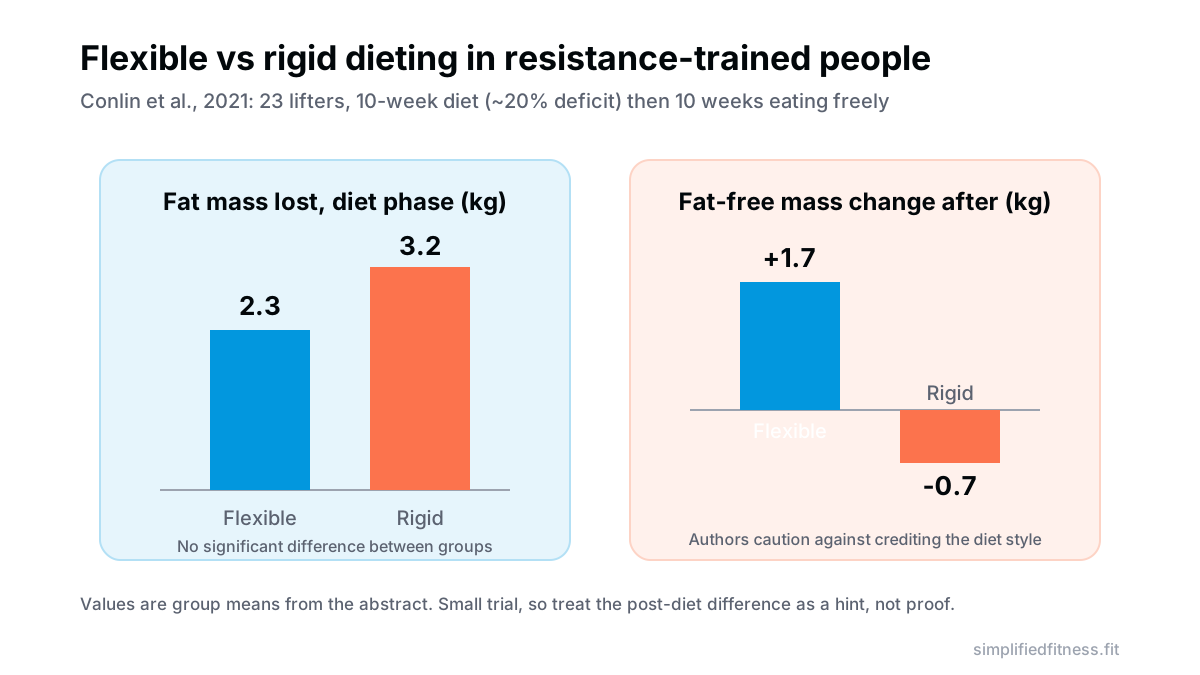
The cleanest test so far is small but useful. In a 2021 randomised trial, 23 resistance-trained men and women followed a roughly 20% calorie deficit for 10 weeks, then ate freely for 10 weeks. One group got a flexible plan with no specific foods. The other got a rigid plan built from specific foods (Conlin et al., 2021).
During the diet, both groups lost weight and fat, with no significant difference between them. The flexible group lost 2.3 kg of fat and the rigid group 3.2 kg. In the free-eating phase, the flexible group gained 1.7 kg of fat-free mass while the rigid group lost 0.7 kg.
Before anyone screenshots that last number, read the authors’ own caution. They did not attribute the fat-free mass difference to the diet style, because there was no clear physiological reason for it and the post-diet phase was not standardised. Twenty-three people is also a small sample.
Why rigid diets fail psychologically
Here the evidence is mostly observational, so read “linked to”, not “causes”.
A survey of 188 non-obese women found that rigid dieting strategies went with eating disorder symptoms, mood disturbance and excessive concern about body shape. Flexible strategies were not strongly tied to those outcomes. The study was cross-sectional, so cause could not be determined (Stewart et al., 2002).
Among 106 women trying to keep weight off, rigid restraint went with attentional bias towards food and body-shape cues. Flexible restraint predicted more weight lost and better maintenance over 6 months (Westenhoefer et al., 2013).
Does it hold in other groups? A study of 61 older women found that rising flexible restraint plus falling rigid restraint predicted greater weight loss over a 6-month programme (Berg et al., 2018). A study of 88 mostly male veterans pointed the same way on one point: a stronger intention to restrain, which the authors tied to rigid rule-following, went with more binge eating, although actual restraint behaviour went with more weight loss and less binge eating (Dochat et al., 2019).
That last result is a useful nuance. Controlling your food is not the problem. Controlling it by inflexible rules seems to be.
Different populations, short follow-ups, self-reported questionnaires. None of these are trials in lifters. But they agree on direction.
The binge-restrict cycle: how one slip becomes a binge
In a study of 104 men tracked in daily life, the urge to restrict helped explain how bad mood turned into binge eating. Emotion regulation difficulty was a separate pathway. The authors also noted that overeating and binge eating appear to have different causes (Kukk et al., 2020).
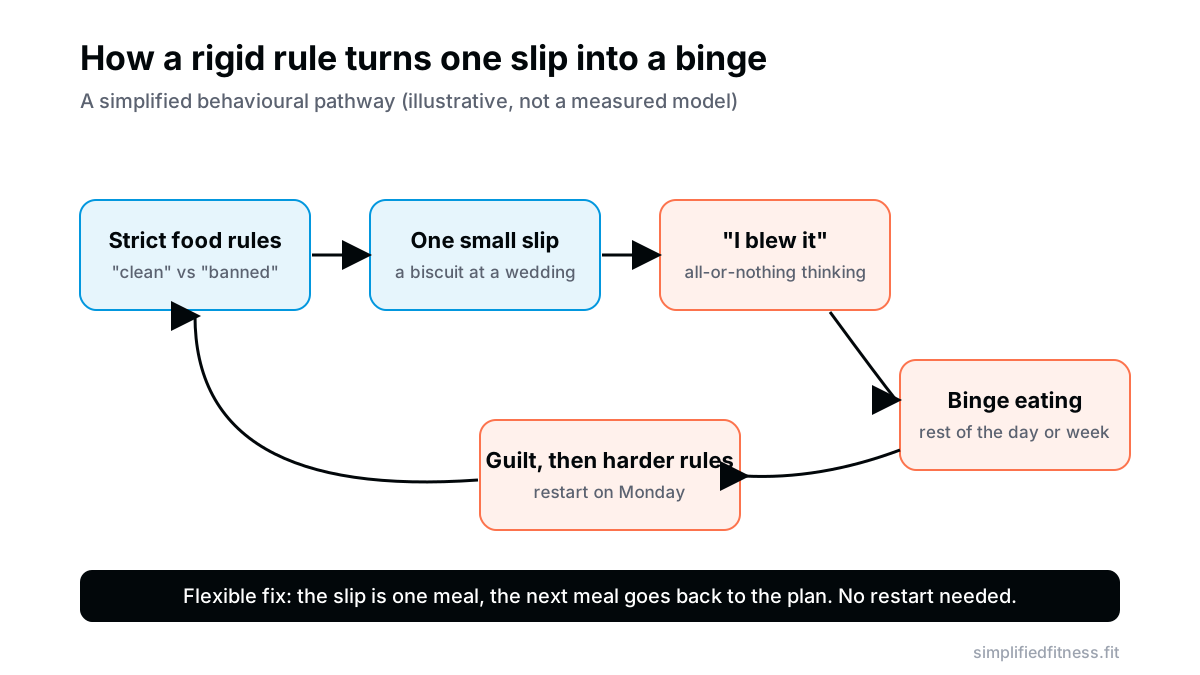
In the gym, this tends to look like a simple chain.
- Strict rules (“no sugar, no roti after 6pm”)
- One slip at a family function
- “Everything is ruined” thinking
- Eating well beyond hunger
- Guilt, then tighter rules on Monday
Does adherence really beat the “best” diet?
A 1-year randomised trial put 160 adults with overweight or obesity (and heart risk factors) on Atkins, Zone, Weight Watchers or Ornish. Average weight loss was modest, roughly 2.1 to 3.3 kg across the four, and only 50 to 65% of people completed it. What predicted results was adherence: self-reported adherence correlated with weight loss at r = 0.60, while diet type did not (r = 0.07, not significant) (Dansinger et al., 2005).
Note the limits. Adherence was self-reported, the people were not lifters, and the study cannot say why some people stuck with it. Still, it matches the ISSN position stand, which says the macronutrient split can be individualised to preference and recommends learning to cook and plan meals ahead (Aragon et al., 2026).
A practical way to do flexible dieting
Here is how to make flexible dieting work for lifting, not just for feeling relaxed.
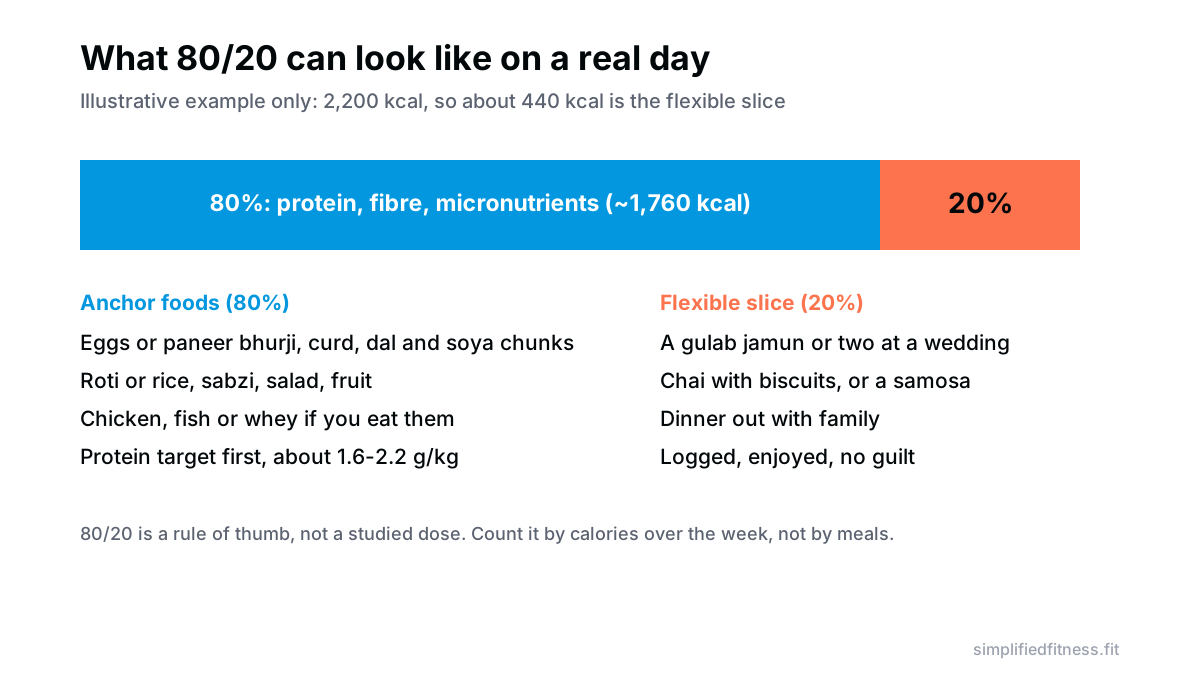
Protein first. The ISSN position stand suggests 1.6-2.2 g/kg a day with resistance training to support muscle (Aragon et al., 2026). A meta-analysis of 49 trials found protein supplementation added little extra lean mass beyond about 1.6 g/kg a day (Morton et al., 2018). Use our macro calculator to get your numbers, or follow the macro split formulas.
Anchor the day with whole foods. Eggs, paneer, curd, dal, soya chunks, chicken or fish, plus roti or rice, vegetables and fruit. These fill you up and cover fibre and micronutrients.
Spend the rest on food you enjoy. About 10-20% of weekly calories is a sensible budget. The exact ratio is a rule of thumb, not something a trial tested. Our guide to the 80/20 rule in nutrition covers the how-to in more detail.
Flexible dieting vs rigid: a quick comparison
| Flexible (IIFYM / 80-20) | Rigid (food lists, cheat days) | |
|---|---|---|
| Rule | Calorie and protein targets | Allowed and banned foods |
| One slip | One meal | “Ruined the day” |
| Social events | Planned for | Avoided or dreaded |
| Linked outcomes (observational) | More weight loss and maintenance | Food preoccupation, eating disorder symptoms |
| Risk | Under-eating fibre and micronutrients | Binge-restrict cycles |
| Fat loss in trained lifters (10 weeks) | Similar | Similar |
Flexible dieting for bodybuilding and physique goals
Many physique competitors use flexible dieting, and it fits the same logic: if calories and protein are right and you train hard, small foods do not move the needle. That applies to bulking and cutting.
Two cautions. First, precision still matters in a lean phase. If your weight stalls, check logging errors before blaming food choices (see food logging precision). Second, long deficits benefit from scheduled breaks, covered in diet breaks and refeeds. The habit side of all this is in the behavioural science of gym habits.
A simple week that stays flexible
Here is what this looks like when you strip it down. Most weekdays, you hit your protein target and eat the same few reliable meals: dal and roti, eggs, curd, a protein-rich snack. Boring is fine. Boring is easy.
Then you decide, in advance, where the enjoyment calories go. Maybe Friday chai and samosa, and a proper dinner out on Sunday. Planned treats feel like part of the diet. Unplanned ones feel like failure.
Weigh yourself a few times a week and look at the weekly average, not the daily number. If the trend is moving the wrong way for three or four weeks, trim the flexible slice a little. That is the whole adjustment. No restart, no punishment day.
If you travel, eat out a lot, or live in a joint family where you do not control the cooking, flexible dieting is usually the only version that survives. You cannot follow a rigid food list at someone else’s dining table.
When to get help
See a doctor or registered dietitian if you:
- binge eat regularly or feel out of control around food
- make yourself vomit, fast after eating, or use laxatives
- feel intense guilt or anxiety about eating off-plan
- have a history of an eating disorder and are considering tracking
Tracking can feed obsessive patterns in some people. If logging makes you anxious, stop and get support. This article is general education, not medical advice.
The bottom line
Flexible dieting does not beat clean eating on fat loss. It beats it on staying power. A 10-week trial in lifters showed similar fat loss, and observational studies tie rigid rules to food preoccupation and worse long-term outcomes.
Set your calories and protein, build most meals from whole foods, and give the remaining slice a place. Start with the macro calculator, then pick a training split from our free plans.
Frequently Asked Questions
What is flexible dieting (IIFYM)?
Flexible dieting, also called If It Fits Your Macros, means you set a calorie and protein target and fit any food into it instead of banning foods. The idea is that energy balance and protein drive body composition, so no single food is off limits. In practice, you still build most meals from whole foods and log the rest.
Is flexible dieting better than clean eating for fat loss?
Not better for fat loss itself, but easier for many people to sustain. A 2021 trial of 23 resistance-trained adults found flexible and rigid diets produced similar weight and fat loss over 10 weeks. Pick the style you can repeat for months, not the one that sounds purest.
Why do rigid diets fail psychologically?
Strict rules make one slip feel like total failure, which can trigger an overeating spree. Observational studies link rigid restraint to food preoccupation, binge eating and worse weight outcomes, though causation is not proven. Replace 'never' rules with a weekly budget so a slip stays one meal.
What is the 80/20 rule in nutrition?
It means roughly 80% of your calories come from nutrient-dense foods like dal, eggs, paneer, vegetables and fruit, and about 20% from foods you simply enjoy. It is a practical heuristic, not a number from a trial. Count it across the week, and protect your protein target first.
Can you build muscle with flexible dieting?
Yes, as long as calories and protein are right and you train with progressive overload. Protein supplementation research suggests gains in lean mass level off above about 1.6 g/kg per day in trained people. Hit that, eat mostly whole foods, and the occasional treat will not matter.
Does flexible dieting mean I can eat junk all day?
No. If every meal is chips and sweets, you will miss protein, fibre and micronutrients, and you will likely feel hungry. Flexible dieting works because most of your intake is still filling, protein-rich food. Fill your protein target first, then spend what is left.
Is restricting food linked to binge eating?
In observational research, yes. A study of 104 men found that the urge to restrict helped explain how negative mood led to binge eating. Because these studies are correlational, they show a pattern, not a guarantee. If you binge regularly, speak to a doctor or dietitian.
Why do I binge after being good all week?
Strict weekday rules plus a hungry body is a common recipe for a weekend rebound. Rigid thinking turns one off-plan food into 'I have already blown it', so the whole day goes. Eat enough protein and fibre on weekdays, and plan one or two treats so they are not a break from the rules.
How do I eat healthy without ruining my social life?
Treat social meals as planned flexible calories, not failures. Eat normally earlier in the day, prioritise protein at the event, enjoy the food you actually came for and return to your usual plan at the next meal. See our guide on weddings and family dinners for the full plan.
Do I need to track macros forever?
No. Tracking is a learning tool that teaches you portion sizes and protein content. Many people track for a few weeks or months, then use habits and rough checks. Keep a simple weekly check on weight and waist so drift is caught early.
Is IIFYM safe for people with a history of eating disorders?
Strict tracking can aggravate obsessive patterns in some people, so it needs individual judgement. If you have a history of an eating disorder or notice distress around logging, work with a doctor or registered dietitian before counting anything. Flexible does not have to mean precise.
How many cheat meals per week is okay?
There is no studied number, and the term itself pushes you towards an all-or-nothing frame. A practical approach is to budget about 10-20% of weekly calories for enjoyment foods and spread them out. A single bigger meal will not undo a week of consistent intake.
What matters most for long-term diet success?
Adherence. In a 1-year randomised trial of Atkins, Zone, Weight Watchers and Ornish diets, self-reported adherence correlated with weight loss (r = 0.60) while diet type did not (r = 0.07). Choose a plan with enough food you like that you can repeat it next month.
Sources & References
Every claim above is checked against peer-reviewed research (PubMed, U.S. National Library of Medicine) or guidance from established health bodies. How we fact-check.
- Conlin LA, et al. Flexible vs. rigid dieting in resistance-trained individuals seeking to optimize their physiques: A randomized controlled trial. J Int Soc Sports Nutr. 2021. PMID: 34187492
- Stewart TM, et al. Rigid vs. flexible dieting: association with eating disorder symptoms in nonobese women. Appetite. 2002. PMID: 11883916
- Westenhoefer J, et al. Cognitive and weight-related correlates of flexible and rigid restrained eating behaviour. Eat Behav. 2013. PMID: 23265405
- Berg AC, et al. Flexible Eating Behavior Predicts Greater Weight Loss Following a Diet and Exercise Intervention in Older Women. J Nutr Gerontol Geriatr. 2018. PMID: 29494790
- Dochat C, et al. Dietary restraint and weight loss in relation to disinhibited eating in obese Veterans following a behavioral weight loss intervention. Appetite. 2019. PMID: 31078701
- Kukk K, et al. Emotion regulation difficulties and dietary restraint independently predict binge eating among men. Eat Weight Disord. 2020. PMID: 31621002
- Dansinger ML, et al. Comparison of the Atkins, Ornish, Weight Watchers, and Zone diets for weight loss and heart disease risk reduction: a randomized trial. JAMA. 2005. PMID: 15632335
- Aragon AA, et al. International Society of Sports Nutrition position stand: diets for body weight reduction. J Int Soc Sports Nutr. 2026. PMID: 42867412
- Morton RW, et al. A systematic review, meta-analysis and meta-regression of the effect of protein supplementation on resistance training-induced gains in muscle mass and strength in healthy adults. Br J Sports Med. 2018. PMID: 28698222

Umair Hazrami · Founder & Head Coach, Simplified Fitness
Umair Hazrami founded Simplified Fitness and the Simplified Lifter channel to cut through fitness noise. With 4+ years of consistent training and 10+ coaching clients, he writes every guide from the peer-reviewed research and links the sources so you can check them. Our editorial standards.
Educational content only, not medical advice. If you have a medical condition, are pregnant, or take medication, talk to a qualified doctor before changing your diet, supplements or training. Full disclaimer.
Keep reading
Nutrition
Body Recomposition: Who Can Lose Fat and Build Muscle at the Same Time?
How to do body recomposition: who can lose fat and build muscle at once, what the trials show, and a protein, training and calorie protocol you can start today.
8 min read

Nutrition
Breaking Fat Loss Plateaus: Check Fluid, Hidden Calories and NEAT
How to break a fat loss plateau: a 3-step check of water masking, hidden calories and lower daily steps, plus the exact fix to restart steady fat loss.
8 min read

Nutrition
How to Calculate Macros: Step-by-Step Grams per Kilogram Formula for Protein, Fat and Carbs
How to calculate macros in grams per kg: set protein, set fat, fill the rest with carbs. Worked examples for 70, 80 and 90 kg lifters on a cut or a bulk.
9 min read

Nutrition
Daily Scale Weight Fluctuations: Sodium, Bowels, Glycogen and Water
Daily scale weight fluctuations are mostly water, glycogen and gut contents, not fat. Learn why your weight jumps overnight and how a 7-day average fixes it.
8 min read