Lean Bulking Calorie Surplus: Why a Small Surplus Beats a Dirty Bulk
Lean bulking calorie surplus explained: how many extra kcal build muscle, what the trials show on dirty vs clean bulking, and a weekly weight-gain target.

TL;DR. The short answer
- For most natural lifters, a lean bulking calorie surplus of roughly 10-15% above maintenance (often 200-400 kcal a day) is a sensible starting point. Trials have not pinned down an exact sweet spot, so treat it as a starting range to adjust.
- In an 8-week trial of 17 trained lifters, faster weight gain mainly predicted more skinfold (fat) gain, not more muscle thickness or squat strength.
- A reasonable scale target for novice and intermediate lifters is 0.25-0.5% of body weight per week, with advanced lifters going lower.
- A 1,000 kcal 'dirty bulk' surplus has no trial support for faster muscle growth. The available evidence suggests the extra calories mostly show up as fat that you then have to diet off.
- Protein above about 1.6 g/kg/day showed no further gain in fat-free mass in a large meta-analysis, so extra food should come mainly from carbs and fats, not endless protein.
Part of our complete guide: The No-BS Guide to Energy Balance, Fat Loss, Bulking & Body Recomposition
Table of contents
A lean bulking calorie surplus is small: roughly 10-15% above maintenance, or about 200-400 kcal a day for most lifters. Going bigger does not appear to speed up muscle growth. It mainly speeds up fat gain.
That is the core of it, and it sits inside the wider system we lay out in our guide to energy balance, fat loss, bulking and recomposition. This article covers the bulking half: how big the surplus should be, what trials say about dirty bulking, and how to steer with the scale.
One honest caveat before we start. Nobody has run a big trial that crowns an exact “best” surplus. What we have is a handful of small studies, some reviews and a lot of coaching experience. I will say which is which.
How many surplus calories do you need to build muscle?
Most reviewers land on a range, not a single number. A narrative review of off-season nutrition for natural bodybuilders recommends a hyper-energetic diet of about 10-20% above maintenance, with a target weight gain of about 0.25-0.5% of body weight per week for novice and intermediate lifters, and a more conservative approach for advanced lifters (Iraki et al., 2019).
Percentages turn into very different kcal numbers depending on your size. Here is the arithmetic.
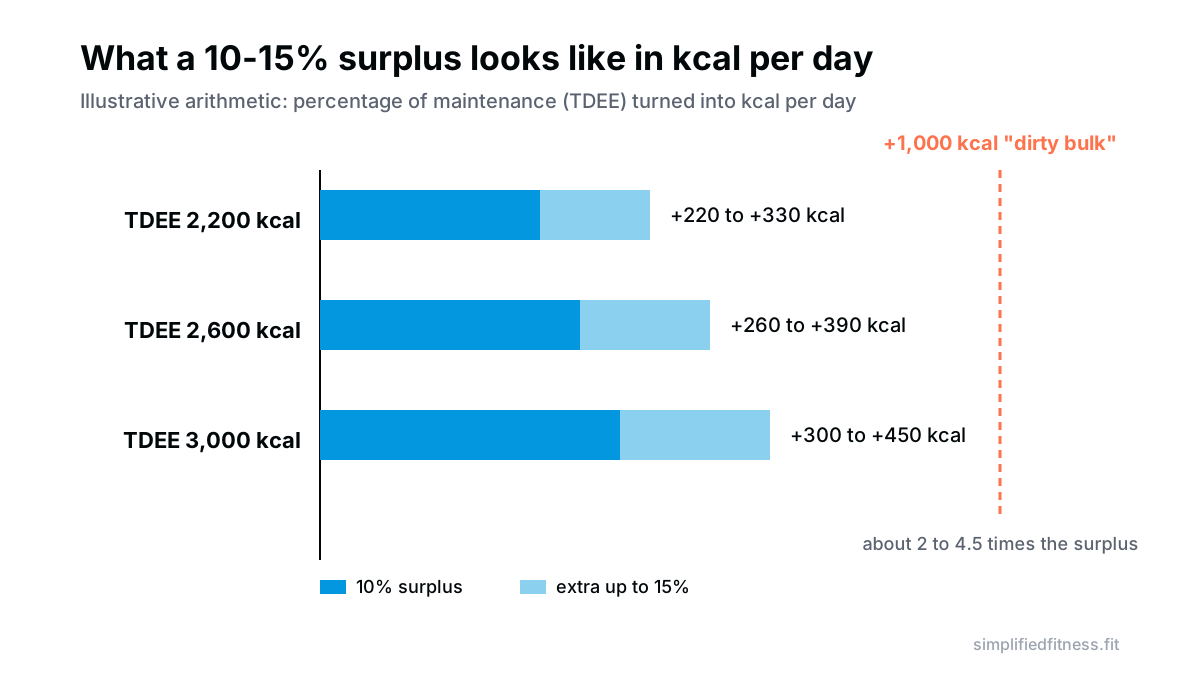
So where does “+200-300 kcal” come from? If your maintenance is around 2,000-2,500 kcal, that is about 10-15%, which sits inside the reviewed range. It is a practical heuristic for smaller lifters, not a trial-proven optimum. A 3,000 kcal lifter will likely need a few hundred more.
Find your starting maintenance with our calorie calculator, then confirm it with real weigh-ins. If TDEE itself feels fuzzy, our TDEE breakdown explains where the number comes from.
Does a bigger surplus build muscle faster?
This is the question that decides the dirty bulk debate, and the best direct evidence is small but useful.
Helms and colleagues randomised 21 resistance-trained lifters into maintenance, a 5% surplus and a 15% surplus for 8 weeks of training three days a week. COVID cut the sample to 17 completers. There was no evidence that the groups differed in muscle thickness or squat 1RM. The 15% group improved bench 1RM more than the others, and skinfold thickness rose more in the surplus groups than at maintenance (Helms et al., 2023).
Across all participants, how fast body mass rose predicted skinfold gain (R2 = 0.49) and only weakly predicted biceps thickness (R2 = 0.24). The authors concluded that faster body-mass gain, and by proxy bigger surpluses, mainly increases fat gain rather than 1RM or muscle thickness. They also noted that the biceps, the muscle trained hardest in this study, may have gained slightly more with bigger weight gain.
A second study points the same direction, with a caveat. Resistance-trained men trained for 8 weeks while overfeeding on a protein plus carbohydrate supplement (94 g protein and 196 g carbohydrate) or a carbohydrate-only supplement (312 g). Lean mass did not rise significantly in either group, while body mass, fat mass and body water rose in both, and neither supplement beat the other (Spillane and Willoughby, 2016). Both groups were overfed, though, so this compares two supplements and not “surplus vs no surplus.”
And the other side of the argument. A 2019 review concluded that the specific surplus needed to maximise hypertrophy is simply unknown. It also noted evidence of an anabolic stimulus from a surplus even independent of training, and argued that the old textbook sums based on the energy stored in new tissue likely miss the energy cost of building muscle and the body’s metabolic adjustments to eating more (Slater et al., 2019).
Put together, the picture is consistent. A surplus helps. A modest one seems to capture most of that help. The cautious takeaway is to eat a small surplus and let training do the heavy lifting.
Dirty bulk vs clean bulk: what actually separates them
The names are misleading. “Clean” and “dirty” sound like food quality, but the real difference is how much energy you eat above maintenance and how closely you watch the scale.
| Lean bulk | Dirty bulk | |
|---|---|---|
| Surplus | About 10-15% above maintenance | Often 1,000+ kcal a day |
| Scale target | 0.25-0.5% of body weight per week (novice to intermediate) | Whatever the scale does |
| Tracking | Weekly average weight, waist, lifts | Often none |
| Likely outcome | Slower scale gain, easier cut afterwards | Faster scale gain, more fat to remove |
| Evidence base | Reviews and small trials point this way | No trial shows faster muscle gain from huge surpluses |
Is any fat gain acceptable? Yes. Even a well-run lean bulk adds some fat. The aim is to keep it small, not to pretend it will be zero.
You do not need to eat “clean” either. Total energy drives most of the fat gain, so a daily gulab jamun is not the issue; a daily gulab jamun on top of an already generous surplus is. Our guide to hidden calorie traps in Indian cooking shows how oil, ghee and tadka can quietly shift your numbers in either direction.
What is the optimal rate of weight gain when bulking?
Use the scale as your steering wheel. The review above suggests 0.25-0.5% of body weight per week for novice and intermediate lifters.
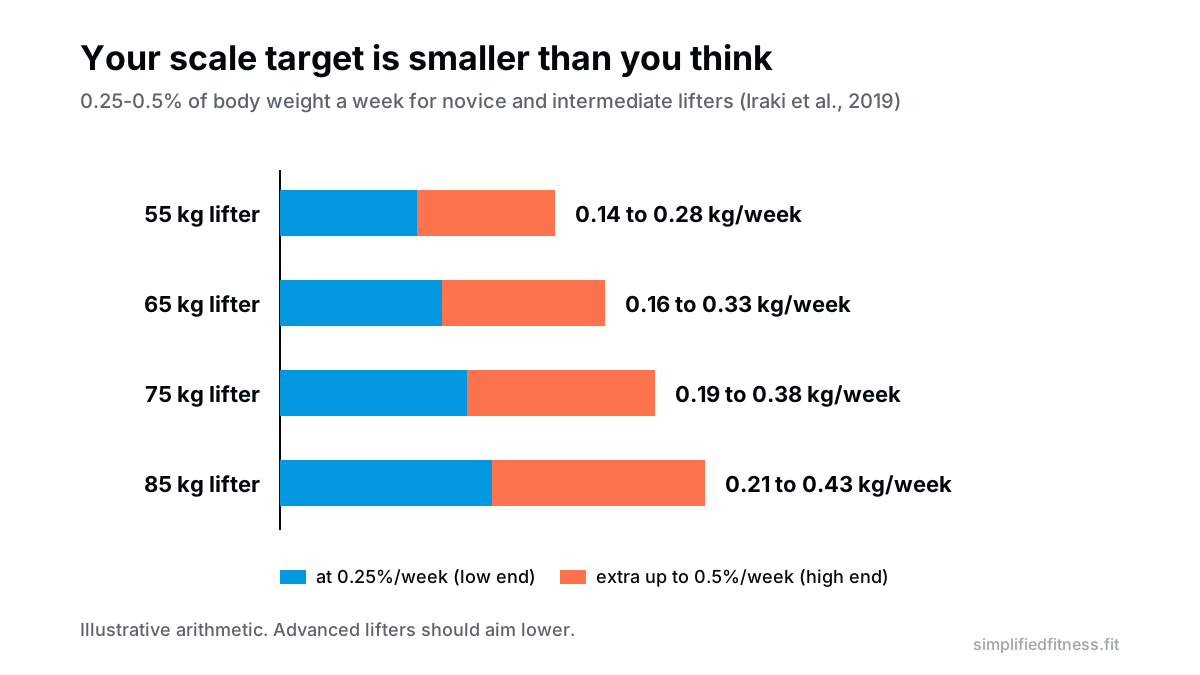
Those are small numbers. If you jump 2 kg in the first week, most of that is food in your gut, water and glycogen, not muscle.
Is faster ever fine? Beginners may get away with the upper end. A 6-week overfeeding study in 21 resistance-trained men (aiming for at least 0.45 kg a week) saw fat-free mass rise about 4.8% on average. About 0.55% body-mass gain a week corresponded, on average, to all of the gained mass being fat-free mass. But the authors flagged wide variation between individuals and poor prediction, so do not treat 0.55% as a magic line (Smith et al., 2021).
On the other side, a critical review of weight-gain guidance for athletes noted that the common advice of +300-500 kcal a day for about 0.45 kg a week, mostly lean mass, is supported by thin evidence, and that this pace may be hard for some athletes to hit (Larson-Meyer et al., 2022). Rules of thumb are a place to start, nothing more.
For month-by-month targets by training age, see our dedicated article on target rates of weight gain for natural lifters.
How to run a lean bulk week by week
Keep the process dull. Dull works.
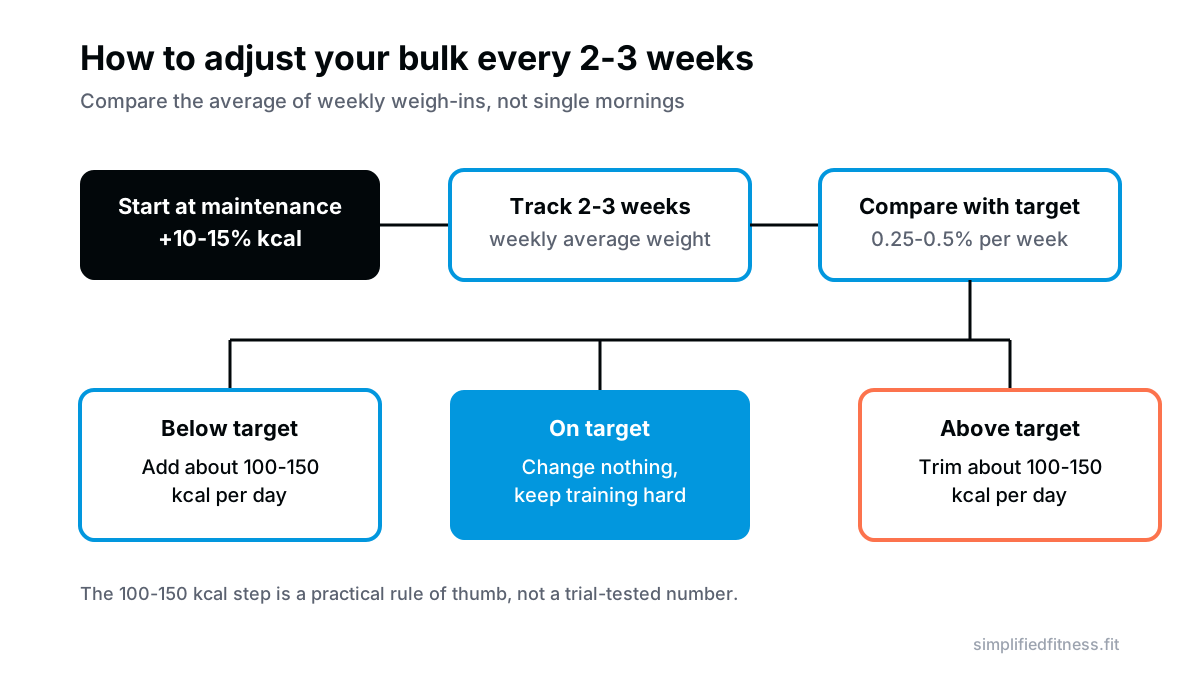
- Estimate maintenance with the calculator, then eat it for a week and weigh yourself daily to check.
- Add 10-15% and write the number down.
- Weigh each morning after the toilet and before food, then average the week.
- Compare the average of the last two weeks with your target rate.
- Adjust by about 100-150 kcal, then wait another 2-3 weeks before touching it again.
A common mistake is changing calories every time the scale jumps overnight. Salt, a late dinner and a hard leg day can all move the scale by a kilo or more without a gram of fat or muscle changing.
Also track something besides weight. Your waist at the navel once a week, a photo every two weeks and your main lifts tell you what the extra weight is made of. If your strength rises and your waist barely moves, the plan is working. If your waist climbs while your lifts stall, the surplus is too large.
Where should the extra calories come from?
Training and protein come first, then energy. The 2018 Morton meta-analysis of 49 trials (1,863 participants) found protein supplementation modestly increased fat-free mass and strength during resistance training, and that intakes beyond about 1.62 g/kg/day produced no further gains in fat-free mass (Morton et al., 2018). The off-season review gives a slightly wider safe range of 1.6-2.2 g/kg/day, fat at 0.5-1.5 g/kg/day, and the remainder as carbohydrate, at least 3-5 g/kg/day (Iraki et al., 2019).
In practice, that means the surplus is mostly rice, roti, potatoes, fruit, milk, peanuts and a little extra oil, not a fourth scoop of whey. If you are vegetarian, our Indian vegetarian lean bulking diet shows what 2,500 kcal looks like on a real plate, and our guide on optimal daily protein intake covers the protein side.
Struggling to eat enough? That is common, and appetite can dip further in hot weather. Liquid calories such as milk, lassi, banana shakes, and energy-dense foods like peanut butter and ghee in measured amounts, are practical options. The weight-gain review above supports larger portions, energy-dense foods and liquid calories as sensible strategies, even though hard outcome data are thin.
Who should be more cautious, or skip the bulk?
Not everyone should start with a surplus. If you carry a lot of body fat, a skinny-fat build may call for maintenance or a recomposition phase first. Our article on the skinny fat dilemma helps you decide.
If you have diabetes, high blood pressure, high cholesterol, kidney disease, a history of disordered eating, or you are pregnant, talk to a doctor or registered dietitian before deliberately eating above maintenance. Likewise, see a doctor if you gain weight rapidly without changing food, or feel unwell. Nothing here replaces individual medical advice.
Finally, remember the exit. A bulk is easier to end when the fat gained is small. A calm, modest cut afterwards is much easier than a long, aggressive one, and our guide to setting the right calorie deficit explains how to size it.
The short version
Eat a bit more than maintenance, lift hard, hit your protein, and let the scale rise slowly. A lean bulking calorie surplus does not make the gym session better, it just stops food from being the limiting factor. If the scale is racing ahead of your lifts, you are not bulking faster. You are just storing more.
Frequently Asked Questions
How many surplus calories do I need to build muscle?
Most evidence-based guidance points to about 10-20% above maintenance, which for many lifters is roughly 200-500 kcal a day. Trials have not identified one exact surplus that maximises muscle, so the number is a starting point rather than a law. Start near the low end, track your weekly average weight, and adjust.
Is a 200-300 kcal surplus enough to gain muscle?
For a smaller lifter, or someone with maintenance around 2,000-2,500 kcal, 200-300 kcal is roughly a 10-15% surplus, which falls inside the range reviewers suggest. Muscle is built mainly by training, protein and recovery, and the surplus only supplies spare energy. If your weekly average weight is not moving after 2-3 weeks, add about 100-150 kcal.
What is the difference between a lean bulk and a dirty bulk?
A lean bulk uses a small, controlled surplus and a slow scale target, while a dirty bulk eats well beyond maintenance with little tracking. In the 8-week Helms trial, larger surpluses mainly raised skinfold thickness rather than muscle thickness. The practical difference is how much fat you need to cut off afterwards.
Does eating more calories make you build muscle faster?
Not beyond a point. In a small trial of trained lifters, there was no evidence that a 15% surplus increased muscle thickness or squat strength more than a 5% surplus or maintenance, though bench press improved more and biceps may have gained slightly. Past a modest surplus, extra energy mostly adds fat, so stop raising calories once weight gain is on target.
How fast should I gain weight when bulking?
A narrative review for natural bodybuilders suggests about 0.25-0.5% of body weight per week for novice and intermediate lifters, and slower for advanced lifters. That is roughly 0.2-0.4 kg a week for a 75 kg person. Weigh daily or a few times a week, and judge the weekly average.
Can I build muscle without a calorie surplus?
Yes, especially if you are new to lifting, carrying extra body fat, or returning after a break. A review of the topic notes that the exact surplus needed for hypertrophy is unknown. For experienced, lean lifters, though, a small surplus usually makes steady gains easier to sustain and helps you add load over time.
Do I need to eat clean when bulking?
Food quality matters for health, fibre, micronutrients and appetite, but fat gain on a bulk is driven mainly by total energy. Most of your diet can be dal, paneer, eggs, curd, roti, rice, fruit and vegetables, with room for some favourite foods. Hit protein and calories first, then fill in quality.
How much protein do I need on a lean bulk?
A meta-analysis of 49 trials found no further gains in fat-free mass from protein intakes above about 1.62 g/kg/day, and reviewers of bodybuilding nutrition suggest 1.6-2.2 g/kg/day. The higher end is a safe margin rather than a proven need. Spend extra calories on carbs and fats once you reach that range.
How do I know if my surplus is too big?
If your weekly average weight rises faster than your target for 2-3 weeks, or your waist grows while lifts stall, the surplus is probably too big. In the Helms trial, faster body-mass gain tracked closely with skinfold gain. Trim 100-150 kcal a day and recheck in two weeks.
How long should a lean bulk last?
There is no fixed duration in the research, so it depends on your starting body fat, goals and how fast you gain. Many lifters run bulks of several months and stop when waist size or body fat has crept up more than they like. Set a stopping rule, such as a waist measurement, before you start.
Why am I gaining weight but not looking more muscular?
Early scale gain includes water, glycogen and food in your gut, and fat too if the surplus is large. Muscle gain is slow, and in a 6-week overfeeding study fat-free mass rose about 4.8% on average, with individual results that the researchers could not predict well. Check weekly averages, waist, photos and strength before deciding.
Is a lean bulk good for vegetarians in India?
Yes, but total calories and protein need planning because plant meals are bulky and lower in protein per rupee. Combine dal, paneer, curd, soya chunks and eggs if you eat them, and add calorie-dense items such as peanuts, milk and ghee in measured amounts. Use a calorie calculator to set the starting number.
Should I start a bulk if I am skinny fat?
It depends on how much body fat you carry and what you want to look like in six months. Starting a bulk from a higher body-fat level can add fat quickly, while a short maintenance or recomposition phase may suit you better. Read our skinny fat guide and decide before you raise calories.
Sources & References
Every claim above is checked against peer-reviewed research (PubMed, U.S. National Library of Medicine) or guidance from established health bodies. How we fact-check.
- Helms ER, et al. Effect of small and large energy surpluses on strength, muscle, and skinfold thickness in resistance-trained individuals: a parallel groups design. Sports Med Open. 2023. PMID: 37914977
- Slater GJ, et al. Is an energy surplus required to maximize skeletal muscle hypertrophy associated with resistance training. Front Nutr. 2019. PMID: 31482093
- Iraki J, et al. Nutrition recommendations for bodybuilders in the off-season: a narrative review. Sports (Basel). 2019. PMID: 31247944
- Larson-Meyer DE, et al. Weight gain recommendations for athletes and military personnel: a critical review of the evidence. Curr Nutr Rep. 2022. PMID: 35233712
- Smith RW, et al. Predicting adaptations to resistance training plus overfeeding using Bayesian regression: a preliminary investigation. J Funct Morphol Kinesiol. 2021. PMID: 33919267
- Spillane M, et al. Daily overfeeding from protein and/or carbohydrate supplementation for eight weeks in conjunction with resistance training does not improve body composition and muscle strength or increase markers indicative of muscle protein synthesis and myogenesis in resistance-trained males. J Sports Sci Med. 2016. PMID: 26957922
- Morton RW, et al. A systematic review, meta-analysis and meta-regression of the effect of protein supplementation on resistance training-induced gains in muscle mass and strength in healthy adults. Br J Sports Med. 2018. PMID: 28698222

Umair Hazrami · Founder & Head Coach, Simplified Fitness
Umair Hazrami founded Simplified Fitness and the Simplified Lifter channel to cut through fitness noise. With 4+ years of consistent training and 10+ coaching clients, he writes every guide from the peer-reviewed research and links the sources so you can check them. Our editorial standards.
Educational content only, not medical advice. If you have a medical condition, are pregnant, or take medication, talk to a qualified doctor before changing your diet, supplements or training. Full disclaimer.
Keep reading
Nutrition
Body Recomposition: Who Can Lose Fat and Build Muscle at the Same Time?
How to do body recomposition: who can lose fat and build muscle at once, what the trials show, and a protein, training and calorie protocol you can start today.
8 min read

Nutrition
Breaking Fat Loss Plateaus: Check Fluid, Hidden Calories and NEAT
How to break a fat loss plateau: a 3-step check of water masking, hidden calories and lower daily steps, plus the exact fix to restart steady fat loss.
8 min read

Nutrition
How to Calculate Macros: Step-by-Step Grams per Kilogram Formula for Protein, Fat and Carbs
How to calculate macros in grams per kg: set protein, set fat, fill the rest with carbs. Worked examples for 70, 80 and 90 kg lifters on a cut or a bulk.
9 min read

Nutrition
Daily Scale Weight Fluctuations: Sodium, Bowels, Glycogen and Water
Daily scale weight fluctuations are mostly water, glycogen and gut contents, not fat. Learn why your weight jumps overnight and how a 7-day average fixes it.
8 min read