The Mini-Cut Strategy: 3-6 Week Rapid Deficits to Clear Fat and Resensitize Appetite
A mini cut guide for lifters: how to run a 3-6 week aggressive deficit, keep protein and strength up, and return to a bulk, with every study linked.

TL;DR. The short answer
- A mini cut is a short, planned deficit of about 3-6 weeks, usually 25-35% below maintenance, used to trim a few kilos of fat during a long bulk. The percentages are coaching convention, not trial-tested numbers.
- To protect muscle, keep your main lifts heavy, keep weekly sets close to normal, and eat roughly 2.3-3.1 g of protein per kg of fat-free mass, per a systematic review in resistance-trained athletes.
- In one randomized trial of elite athletes, a target loss of 0.7% of body weight per week preserved and even added lean mass, while a 1.4% per week target did not. Bigger deficits cost you margin.
- The claim that a mini cut 'resets' appetite or insulin sensitivity is weakly supported. Appetite hormones shift against you during any weight loss, so treat the mini cut as a fat trim, not a hormone reset.
- Finish with 1-2 weeks at maintenance, then restart a small surplus. Do not keep extending the cut week by week.
Part of our complete guide: The No-BS Guide to Energy Balance, Fat Loss, Bulking & Body Recomposition
Table of contents
A mini cut is a short, planned calorie deficit, usually 3-6 weeks, that you drop into a long bulk to strip a few kilos of fat before you go back to eating for growth. This mini cut guide covers the rules that matter: how big the deficit should be, how to keep your muscle, and how to climb out of it.
It belongs to the wider topic of energy balance, fat loss, bulking and recomposition. If you are still deciding between gentle and harsh deficits in general, read moderate vs aggressive deficits first. This page is only about the short, sharp version.
One honest note before we start. Mini cuts are popular coaching practice, but there are almost no trials of mini cuts as such. What follows borrows from studies on short deficits, protein and training in lean, trained people, and I will say where the evidence runs out.
What is a mini cut, and when does it make sense?
Picture month eight of a bulk. Your lifts are up, your waist is up more, and the mirror stopped being fun. You could cut for 12 weeks, or you could take 4 weeks to tidy up and get back to growing. That second option is the mini cut.
It fits when:
- you are an intermediate or advanced lifter who has been in a surplus for a while
- you have gained fat faster than you wanted (see target rates of weight gain)
- you want a defined end date, not an open-ended diet
It does not fit when you have a lot of fat to lose, a history of disordered eating, or no appetite for tracking food. A normal, slower cut is the better tool for those cases.
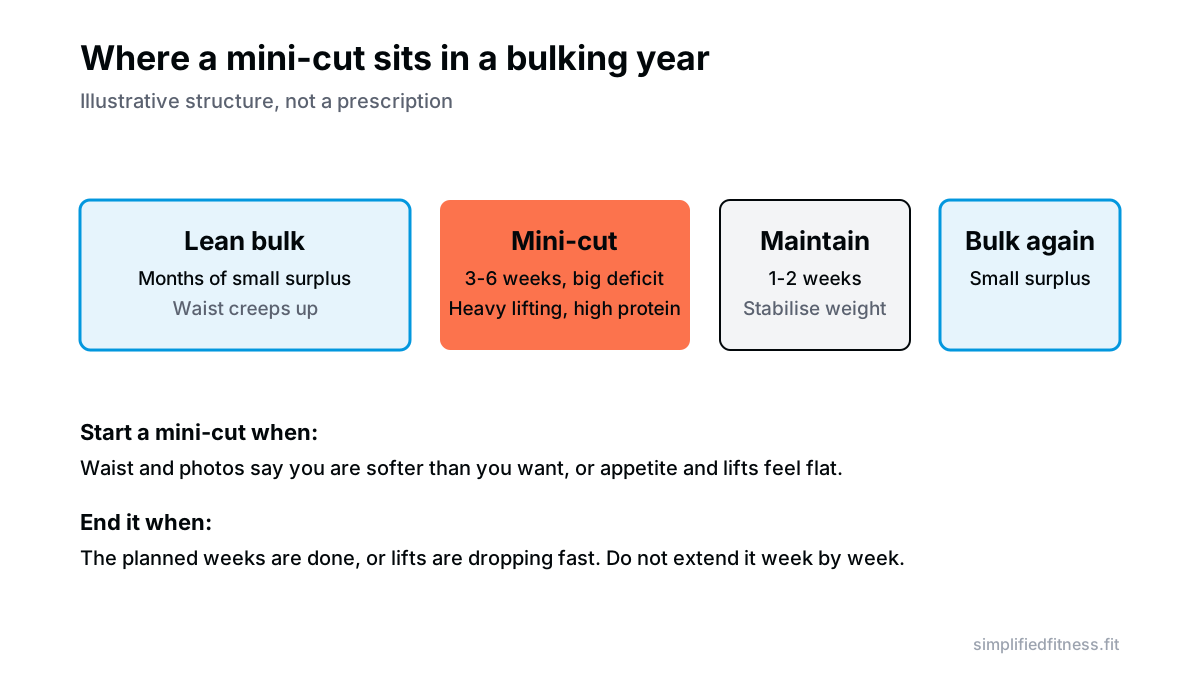
How aggressive should a mini cut deficit be?
The standard coaching answer is 25-35% below maintenance. For someone maintaining on 2,800 kcal, that is roughly 1,800-2,100 kcal a day. Treat those percentages as convention, not a trial-tested prescription.
The best direct evidence on speed comes from elite athletes. In a randomized trial of 24 athletes who lifted four times a week, one group aimed to lose 0.7% of body weight per week (intake cut about 19%, about 8.5 weeks) and the other 1.4% per week (intake cut about 30%, about 5.3 weeks). In practice the fast group averaged about 1.0% a week, and both groups lost a similar total of about 5.5% of body weight. Fat mass fell by 31% in the slow group and 21% in the fast group. Lean body mass rose 2.1% in the slow group and was unchanged in the fast group (Garthe et al., 2011).
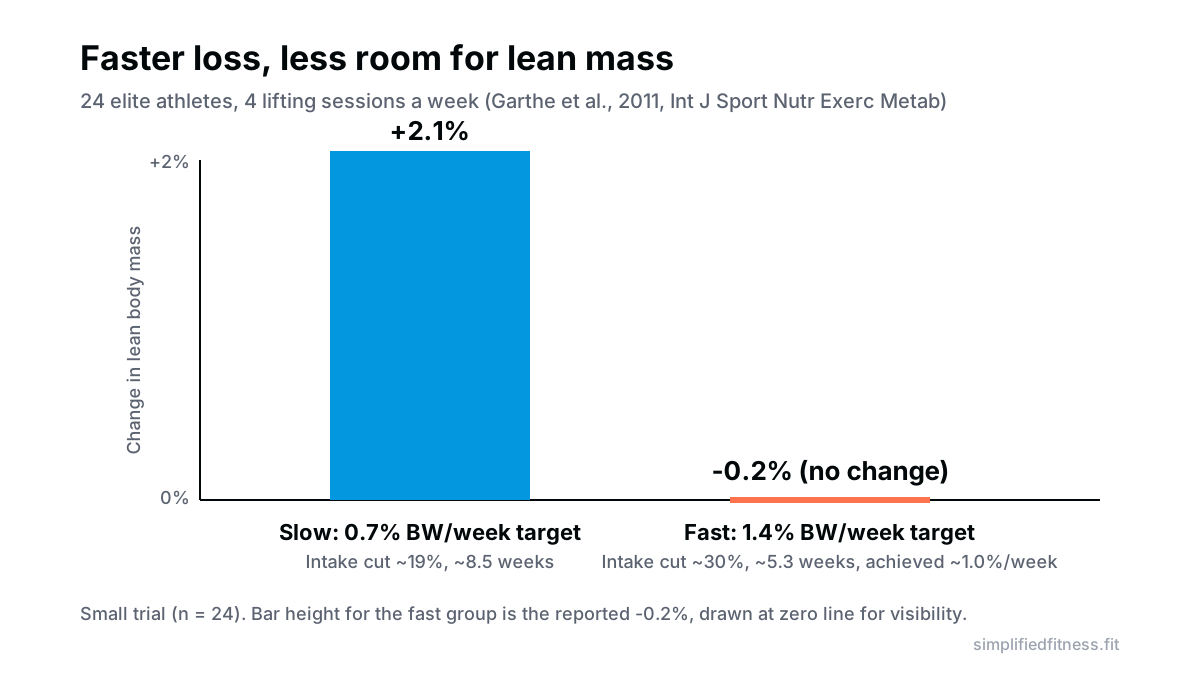
Read that carefully. The fast group did not lose muscle on average. They simply had less room to gain it, and the sample was small (13 versus 11 athletes). Still, the practical takeaway is cautious: if you feel flat after the first week, a deficit toward the 25% end is a sensible adjustment, not a failure.
To set your starting calories, use the calorie calculator, then track body weight and waist for a week and adjust. Your estimated maintenance is a guess until your own data confirms it.
How much protein do you need during a mini cut?
More than during a bulk. A systematic review of six studies in lean, resistance-trained athletes concluded that protein needs during energy restriction are likely 2.3-3.1 g per kg of fat-free mass, scaled upwards with the severity of the deficit and how lean you are (Helms et al., 2014). The one group that was lean, in a hard deficit and without novel training, and still held its fat-free mass ate 2.5-2.6 g/kg.
Fat-free mass is not the same as body weight. An 80 kg lifter at roughly 16% body fat has about 67 kg of fat-free mass, so the range works out to about 154-208 g of protein. If you do not know your body fat, 2.2-2.5 g per kg of body weight lands in a similar place for a reasonably lean lifter.
There is also a trial in young men. For 4 weeks they ate about 40% below requirements and trained hard six days a week. The group eating 2.4 g/kg gained about 1.2 kg of lean mass and lost 4.8 kg of fat, versus 0.1 kg and 3.5 kg in the 1.2 g/kg group (Longland et al., 2016). This was a proof-of-principle study with an intense program, so do not expect to gain muscle in a deficit if you are already well trained.
Should you cut training volume on a mini cut?
You will see “cut volume by 30%” repeated everywhere, usually to protect recovery. The evidence does not clearly support it, so here is both sides.
A 2022 review of 15 studies in resistance-trained athletes found that programs with 10 or more weekly sets per muscle group showed low-to-no lean mass loss (mostly in female athletes), and studies that raised volume over time seemed to show little lean mass loss compared with studies that cut it. But the authors also said the data were incomplete and the evidence was insufficient to conclude that higher volume spares more lean mass (Roth et al., 2022).
Why might coaches and the review disagree? Practical recovery. In a hard deficit you sleep worse, recover slower, and tolerate less junk volume. A coach cuts sets to keep sessions productive. The review is asking a narrower question: what keeps muscle.
My practical read: keep your heaviest sets heavy, keep your weekly sets near what you were doing, and trim only if you notice reps dropping across the week or joints complaining. If you do trim, remove the lightest, closest-to-failure accessory sets first, not the main lifts. Our guides on volume adjustments while cutting and proximity to failure in a deficit cover this properly.
The mini cut rules, on one page
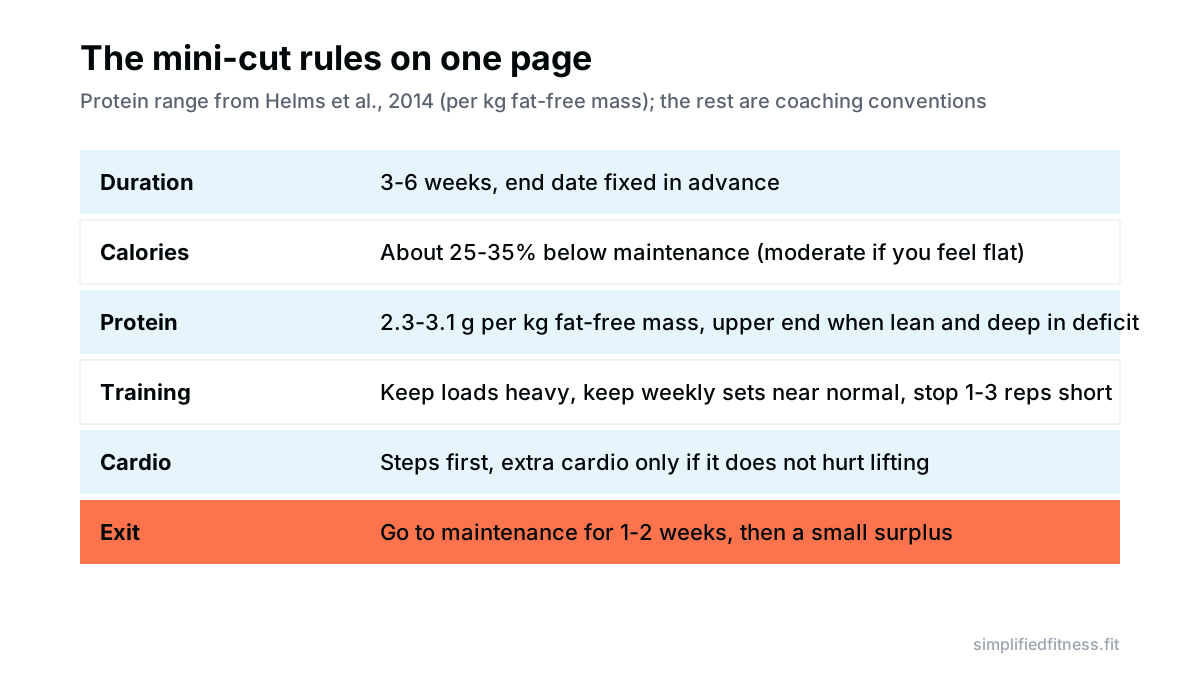
If you want a 4-week mini cut in practice:
- Fix the dates. Four weeks, written down. Not “until I look good.”
- Set calories. Start around 25-30% below estimated maintenance. Weigh daily, average weekly, and adjust only after seven days of data.
- Hit protein every day. This is the non-negotiable.
- Lift as you did. Same exercises, same loads, most sets 1-3 reps from failure.
- Move more before you add cardio. A higher step count costs less recovery than extra conditioning.
- Check in weekly. If strength on your main lifts falls noticeably two weeks running, ease the deficit or end early.
Does a mini cut resensitize appetite or fix insulin sensitivity?
This is the part I would be most careful about. The idea sounds neat: a few weeks lean, and your hunger and insulin response reset so the next bulk works better. I could not find trials showing that a mini cut does this in trained lifters.
What does exist points in the other direction for appetite. In 50 overweight or obese people on a 10-week very-low-energy diet, weight loss reduced leptin and several satiety hormones and increased ghrelin and subjective appetite. A year later those differences had not reverted to baseline (Sumithran et al., 2011). That was a different population and a more extreme diet, so it does not describe your 4-week cut exactly. It does tell you not to expect hunger to fall.
The honest framing: a mini cut removes fat and gives you a new starting point for the next bulk. Plan for more hunger, not less.
Do refeeds or breaks help during a short, hard deficit?
Possibly, in modest ways. The MATADOR trial in 51 men with obesity compared continuous dieting with alternating 2-week diet and maintenance blocks. The intermittent group lost more weight and fat (14.1 versus 9.1 kg total, with fat losses of 12.3 versus 8.0 kg), with similar fat-free mass loss (Byrne et al., 2018). Those were men with obesity over 30 weeks, which is a long way from a lean lifter’s 4-week sprint.
A closer match is a 7-week trial in 27 resistance-trained men and women eating about 25% less. One group had two consecutive higher-carbohydrate days each week. Fat loss was similar, but fat-free mass was better maintained in the refeed group (0.4 kg versus 1.3 kg lost) (Campbell et al., 2020). It is a small trial, so I would call it encouraging, not settled.
For a 4-week mini cut, a weekend of eating at or near maintenance, with carbs raised, is a reasonable and low-risk option if you find full-week deficits hard. Details are in our guide to diet breaks vs refeeds.
How do you come out of a mini cut?
This is where many people undo the work.
- Go to maintenance first. Eat around your estimated maintenance for 1-2 weeks, with protein still high. See reverse dieting vs going straight to maintenance.
- Expect a scale bump. A 1-2 kg rise is normally glycogen and water returning as you eat more carbohydrate. It is not fat.
- Restart the surplus small. Aim for the lower end of the monthly targets in the lean bulking guide. A big surplus right after a cut mainly rebuilds fat.
Then decide whether the next mini cut is even needed. If you keep needing one every few months, your surplus is probably too large.
Mini cut or a longer, gentler cut?
| Mini cut | Standard cut | |
|---|---|---|
| Length | 3-6 weeks | 8-16 weeks |
| Deficit | About 25-35% (convention) | About 15-25% |
| Best for | A few kg of fat late in a bulk | More than a few kg to lose |
| Main risk | Fatigue, hunger, muscle loss if prolonged | Adherence over months |
| Muscle retention | Good with protein and heavy lifting | Slightly easier to protect |
Neither is better in general. The mini cut is a tool for a specific moment.
Who should be careful
An aggressive deficit is not suitable for everyone. Skip it, or talk to a doctor or registered dietitian first, if you:
- have, or have had, an eating disorder or a difficult relationship with food
- are pregnant or breastfeeding
- are under 18
- have diabetes, a thyroid condition, or take medication that affects appetite or blood sugar
- feel dizzy, faint, unusually weak, or notice your period stops while dieting
The bottom line
A mini cut is a fixed-length, firmly controlled deficit: 3-6 weeks, protein at 2.3-3.1 g per kg of fat-free mass, heavy lifting preserved, and a planned return to maintenance. The deficit size is coaching convention, the athlete data favour a gentler pace when you can afford it, and the hormone-reset claim is not backed by good trials.
Pair it with a program that does not collapse under fatigue. Our free push, pull, legs plans are a simple place to start, and the macro calculator will turn your calorie target into daily numbers.
Frequently Asked Questions
What is a mini cut?
A mini cut is a short, deliberate calorie deficit of roughly 3-6 weeks, run in the middle of a longer muscle-building phase. It is used to remove a few kilos of fat that built up during the bulk. After it ends you return to maintenance and then a surplus.
How long should a mini cut last?
Most coaches use 3-6 weeks. The deficit is aggressive, and the longer you stay in it, the more training quality, sleep and mood tend to suffer. Fix the end date before you start and stick to it.
How much weight can you lose in a 4-week mini cut?
Roughly 2-4 kg of fat is a realistic ceiling for many lifters, and scale weight will usually drop a little more because of water and gut content. That figure is simple energy arithmetic, not a trial result, so it varies with your starting size and how well you track. Judge progress by waist measurement and photos as well as the scale.
How big should the deficit be in a mini cut?
Coaching convention is about 25-35% below maintenance. A trial in elite athletes compared a 19% cut with a 30% cut and found better lean mass outcomes with the gentler one. If you feel flat or your lifts fall quickly, move toward the smaller end.
How much protein do I need during a mini cut?
A systematic review in resistance-trained athletes estimated 2.3-3.1 g per kg of fat-free mass, scaled up with deficit severity and leanness. For a lifter around 15% body fat that works out to roughly 2.0-2.6 g per kg of body weight. Spread it over 3-4 meals and use our protein calculator for a number.
Will I lose muscle on a mini cut?
Some loss is possible, but trained lifters who keep lifting heavy and eat enough protein often lose little. In a review of resistance-trained athletes, several groups gained or lost nonsignificant amounts of lean mass during restriction. Keep your loads up and avoid dropping into a very large deficit for longer than planned.
Should I cut my training volume during a mini cut?
Not by default. A 2022 review found the evidence insufficient to say higher volume spares more lean mass, yet studies that raised volume over time showed little lean mass loss compared with studies that cut it. Keep intensity high, and trim sets only if recovery clearly falls apart.
Can I build muscle during a mini cut?
Mostly no, unless you are a beginner, returning after a break, or carrying a lot of body fat. In a 4-week trial in young men on a 40% deficit with hard training, the higher-protein group gained about 1.2 kg of lean mass. Trained lifters should aim to keep what they have.
Does a mini cut improve insulin sensitivity or reset hunger?
There is no good trial showing that a mini cut specifically does either in trained lifters. In people losing weight on a very low energy diet, appetite hormones actually shifted toward more hunger and stayed that way a year later. Expect hunger to rise during the cut, and plan food volume and protein accordingly.
What should I eat on a mini cut in India?
Build meals around protein you already eat: dal, paneer, curd, soya chunks, eggs, chicken or fish, with rice or roti measured by weight. Add vegetables and fruit for volume, and use whey if you cannot reach your protein target. See our 1,800-calorie Indian plans for examples.
How do I end a mini cut?
Raise calories to your estimated maintenance for 1-2 weeks, then move into a small surplus. The scale often jumps 1-2 kg as glycogen and water return, which is not fat. Keep training heavy through the transition.
Mini cut or just a longer, gentler cut: which is better?
For most people, a gentler deficit is easier to sustain and is less likely to cost muscle, as the athlete trial showed. A mini cut suits a lifter who is near the end of a bulk and wants a quick tidy-up with a fixed end date. If you have a lot of fat to lose, a standard cut is the better tool.
Who should not do a mini cut?
Anyone with a history of disordered eating, anyone who is pregnant or breastfeeding, and anyone with a medical condition affected by diet should skip aggressive deficits. People under 18 should not run them either. Speak to a doctor or registered dietitian first if you are unsure.
Sources & References
Every claim above is checked against peer-reviewed research (PubMed, U.S. National Library of Medicine) or guidance from established health bodies. How we fact-check.
- Garthe I, et al. Effect of two different weight-loss rates on body composition and strength and power-related performance in elite athletes. Int J Sport Nutr Exerc Metab. 2011. PMID: 21558571
- Helms ER, et al. A systematic review of dietary protein during caloric restriction in resistance trained lean athletes: a case for higher intakes. Int J Sport Nutr Exerc Metab. 2014. PMID: 24092765
- Roth C, et al. Lean mass sparing in resistance-trained athletes during caloric restriction: the role of resistance training volume. Eur J Appl Physiol. 2022. PMID: 35146569
- Longland TM, et al. Higher compared with lower dietary protein during an energy deficit combined with intense exercise promotes greater lean mass gain and fat mass loss: a randomized trial. Am J Clin Nutr. 2016. PMID: 26817506
- Byrne NM, et al. Intermittent energy restriction improves weight loss efficiency in obese men: the MATADOR study. Int J Obes (Lond). 2018. PMID: 28925405
- Campbell BI, et al. Intermittent energy restriction attenuates the loss of fat free mass in resistance trained individuals. A randomized controlled trial. J Funct Morphol Kinesiol. 2020. PMID: 33467235
- Sumithran P, et al. Long-term persistence of hormonal adaptations to weight loss. N Engl J Med. 2011. PMID: 22029981

Umair Hazrami · Founder & Head Coach, Simplified Fitness
Umair Hazrami founded Simplified Fitness and the Simplified Lifter channel to cut through fitness noise. With 4+ years of consistent training and 10+ coaching clients, he writes every guide from the peer-reviewed research and links the sources so you can check them. Our editorial standards.
Educational content only, not medical advice. If you have a medical condition, are pregnant, or take medication, talk to a qualified doctor before changing your diet, supplements or training. Full disclaimer.
Keep reading
Nutrition
Body Recomposition: Who Can Lose Fat and Build Muscle at the Same Time?
How to do body recomposition: who can lose fat and build muscle at once, what the trials show, and a protein, training and calorie protocol you can start today.
8 min read

Nutrition
Breaking Fat Loss Plateaus: Check Fluid, Hidden Calories and NEAT
How to break a fat loss plateau: a 3-step check of water masking, hidden calories and lower daily steps, plus the exact fix to restart steady fat loss.
8 min read

Nutrition
How to Calculate Macros: Step-by-Step Grams per Kilogram Formula for Protein, Fat and Carbs
How to calculate macros in grams per kg: set protein, set fat, fill the rest with carbs. Worked examples for 70, 80 and 90 kg lifters on a cut or a bulk.
9 min read

Nutrition
Daily Scale Weight Fluctuations: Sodium, Bowels, Glycogen and Water
Daily scale weight fluctuations are mostly water, glycogen and gut contents, not fat. Learn why your weight jumps overnight and how a 7-day average fixes it.
8 min read