Workout Split for Shift Workers and High-Stress Jobs: A Practical Guide
Need a workout split for shift workers or a high-stress job? Learn the rolling 8-day cycle, low-sleep day rules and machine swaps that keep progress alive.
TL;DR. The short answer
- A fixed Monday-to-Sunday plan breaks the moment your shifts change. A rolling 8-10 day cycle of 3-4 full sessions, done in order whenever you are rested enough, keeps training consistent without guilt.
- Sleep loss does not erase strength overnight. A 2018 systematic review found acute sleep deprivation had little effect on strength, while several nights of restricted sleep could reduce force on multi-joint lifts.
- On a short-sleep day, keep the weights roughly where they are, cut the number of sets, stop further from failure and lean on machines. Quality of reps drops before total volume does.
- Muscle responds to weekly hard sets, and training frequency matters little when volume is equal. So you can bundle your sets into the days you actually have.
- Persistent exhaustion, low mood, chest symptoms or pain that does not settle are medical questions, not programming ones. See a doctor.
Part of our complete guide: Best Workout Split for Muscle Growth: PPL vs Upper/Lower vs Full Body, What the Research Says
Table of contents
The best workout split for shift workers is not a split tied to weekdays at all. It is a short, ordered list of 3-4 full sessions that you run on a rolling 8-10 day cycle, doing the next one whenever you are rested enough. When sleep is short, you keep the weight, cut the sets and stop further from failure.
If you work 12-hour nights, hospital rotas, on-call tech weeks or a job that follows you home, the standard “Mon/Wed/Fri” plan was never written for you. This article is the practical version. For the bigger picture on how splits work, see our complete guide to workout splits and session architecture. If your problem is mainly rota timing and meals, the shift workers’ guide to sleep, meals and workouts goes deeper there.
Why a fixed 7-day split fails when your life is not fixed
A normal split assumes every week looks the same. Yours does not. Three night shifts, a day off that you spend asleep, then a week of days. Miss Monday’s chest session and the whole structure wobbles, and by Thursday you feel behind.
The most common mistake here is treating a missed session as a debt. You try to “catch up” by cramming two sessions into one day while already exhausted. That is a fast route to sloppy reps and a plan you resent.
The fix is to stop planning days and start planning an order.
What does the research say about training on too little sleep?
Less than you might fear for one rough night, more than you might hope for a rough fortnight.
A 2018 systematic review of 17 studies looked at sleep deprivation (no sleep) and sleep restriction (shorter sleep) in resistance exercise. The studies were rated moderate or weak in quality, so treat conclusions as provisional. It found that sleep deprivation had little effect on muscle strength, while consecutive nights of sleep restriction could reduce force output in multi-joint movements, but not single-joint ones. Hormonal results were conflicting (Knowles et al., 2018).
So the movements most likely to feel worse are your squats, presses and rows. Curls and lateral raises hold up better.
A later crossover trial adds detail. Ten resistance-trained women completed nine nights of restricted sleep (5 hours in bed) and normal sleep (7+ hours), with four sessions per trial. Total volume load fell trivially, under 1%. But bar speed on lower-body compound lifts dropped by up to 15%, speed loss within a set was up to 7% greater on back squats, session perceived exertion rose 11% and salivary cortisol area under the curve rose 42% (Knowles et al., 2022).
Read that carefully. The women still completed almost all of their planned volume. It just moved slower and felt harder. That is a small sample, tested in women only, over nine nights. It suggests how you feel on the bar may be an earlier warning light than the numbers in your log.
Does high stress at work slow recovery too?
Possibly, in the short term. In a study of 31 undergraduate resistance-training students, those reporting more life-event stress and higher perceived stress recovered leg force more slowly across the first hour after a heavy leg press session. The effect showed in muscle function, but not in how energetic, fatigued or sore they felt (Stults-Kolehmainen and Bartholomew, 2012).
That last detail matters. You can feel fine and still be recovering slower. But this was young students, one hour after one session. It does not prove stress shrinks your long-term gains. It is a reasonable nudge to build slack into your plan.
How many sessions do you actually need?
Fewer than gym culture suggests.
For muscle size, a 2017 meta-regression of 15 studies found a graded dose-response: more weekly sets tended to produce more growth, with each added set linked to about 0.37% extra gain in muscle size (Schoenfeld et al., 2017). That says more is better on average. It does not say you can afford it when you are sleeping 5 hours.
On frequency, a 2019 meta-analysis of 25 studies found no significant difference between higher and lower frequencies when volume was equated, including in resistance-trained people. The authors concluded that individuals can pick weekly frequency by preference (Schoenfeld et al., 2019).
For a shift worker this is liberating. Ten hard sets for your back can come from two longer sessions or three short ones. Pick whichever your rota allows.
And the floor is lower than you think. A 2020 systematic review of six studies in resistance-trained men found that a single set performed 1-3 times per week was enough to improve strength. A meta-analysis of five of these studies estimated an overall 1RM increase of 12.09 kg (95% CI 8.16 to 16.03 kg). Gains were suboptimal compared with higher doses, and evidence in women, in deadlifts and in highly trained lifters is limited (Androulakis-Korakakis et al., 2020).
So in your worst weeks, a minimum dose is not failure. It is a legitimate plan.
What does a rolling workout split look like?
Here is a simple version. Four sessions, one flex day, rest days where they land.
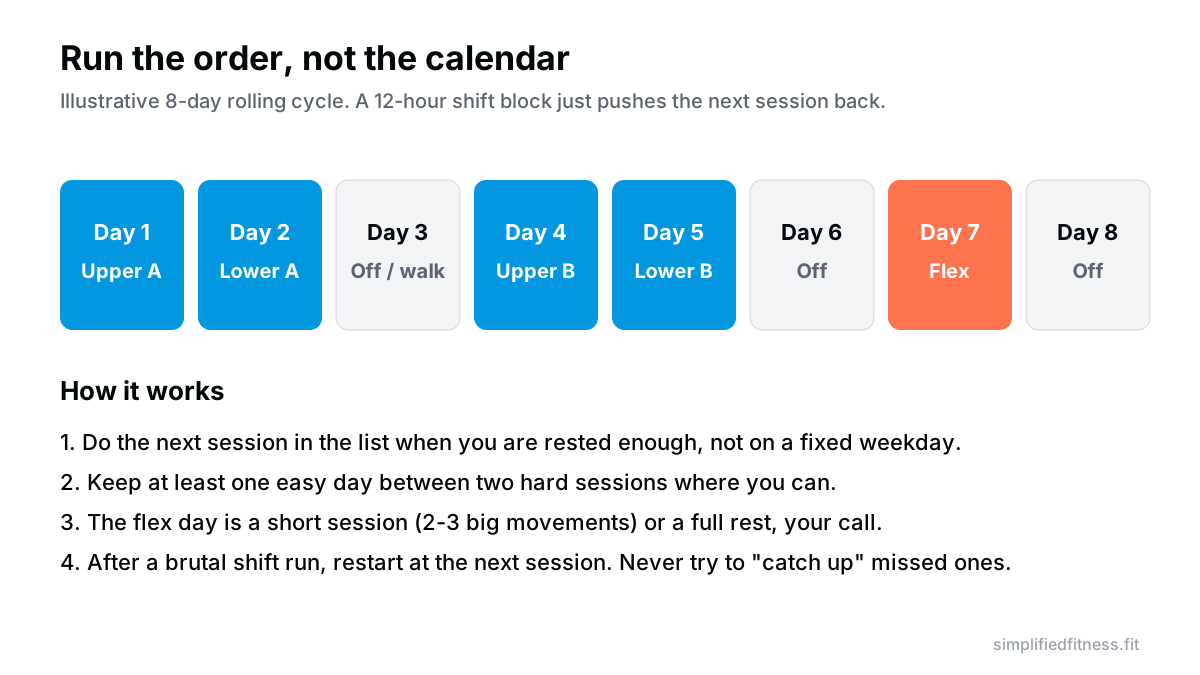
The rules are short:
- Do the next session on the list when you are rested enough.
- Leave at least one easier day between two hard sessions where you can.
- Never double up to catch up.
- Cycle length stretches from 8 to 10 days in rough weeks. That is fine.
On paper, a full-body version works too: three sessions (A, B, C) in the same rolling order. Choose full-body if your sessions are unpredictable, since every session then covers every muscle and you never miss “leg day” for a fortnight. See our comparison of full-body, upper/lower and push-pull-legs splits for the trade-offs.
A sample Upper A and Lower A
| Session | Exercise | Sets x reps |
|---|---|---|
| Upper A | Incline dumbbell press or machine chest press | 3 x 8-12 |
| Upper A | Chest-supported row | 3 x 8-12 |
| Upper A | Dumbbell shoulder press | 2 x 8-12 |
| Upper A | Wide-grip lat pulldown | 2 x 10-12 |
| Lower A | Leg press or hack squat | 3 x 8-12 |
| Lower A | Seated leg curl | 3 x 10-12 |
| Lower A | Hip thrust | 2 x 8-12 |
| Lower A | Standing calf raise | 2 x 10-15 |
Upper B and Lower B swap in different exercises (for example, pulldown for row emphasis, stiff-leg deadlift for the hamstrings). Total is about 10 sets per session, around 45-60 minutes. These numbers are a sensible starting template, not a prescription from a trial.
How do I adjust a session on a low-sleep day?
Use the dose, not the plan. Keep the structure, change how much and how hard.
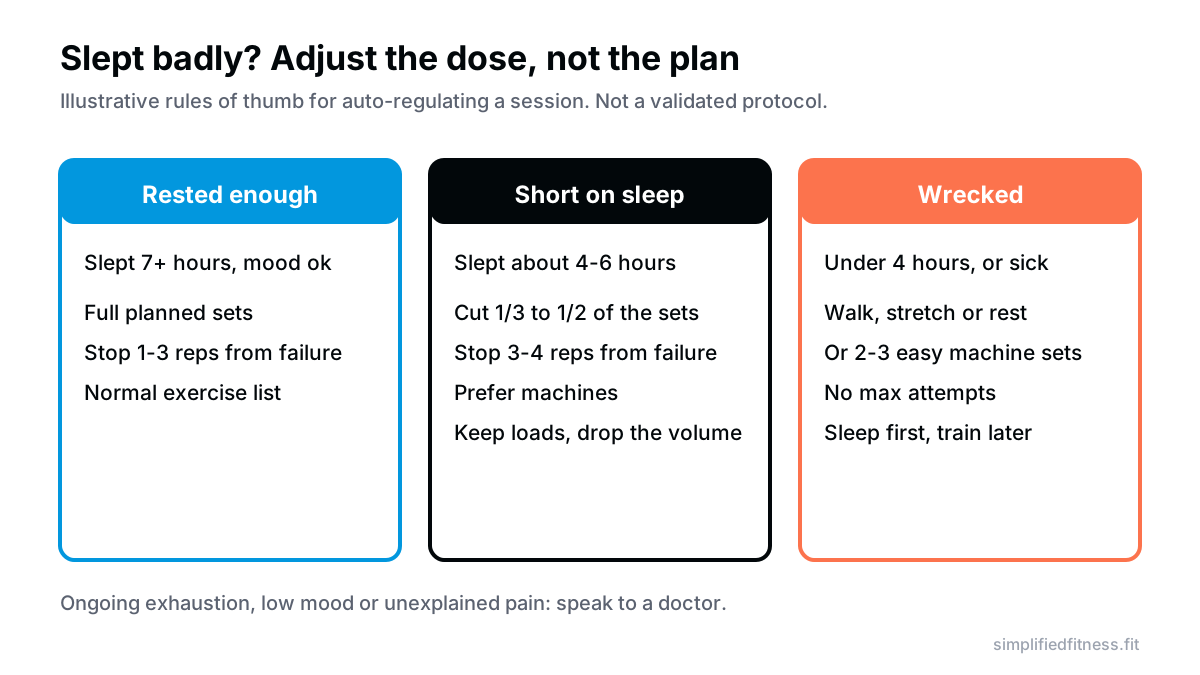
Why cut sets rather than weight? Because the research above suggests the thing that degrades is rep quality and perceived effort. Fewer, cleaner sets keeps the stimulus without piling junk work on a tired system. The weights can stay roughly where they are, as long as the bar still moves with decent speed.
A practical way to do this is effort rating. Use reps in reserve (RIR) or RPE: stop sets 3-4 reps short of failure when tired instead of 1-2. Our guide to reps in reserve and RPE and the RIR/RPE calculator explain how to score it.
There is some research behind effort-based auto-regulation. In a three-week study of 12 nationally qualified powerlifters, an RPE-stop method (sets stop once a target RPE is reached) produced different weekly volumes depending on how much load dropped between sets, so volume could be adjusted by the method (Helms et al., 2018). That is a short observational study in strong competitive lifters. It shows volume can be steered by RPE, not that it improves results. For more, see our piece on auto-regulating set volume with readiness and velocity.
Which exercises are best when you are exhausted?
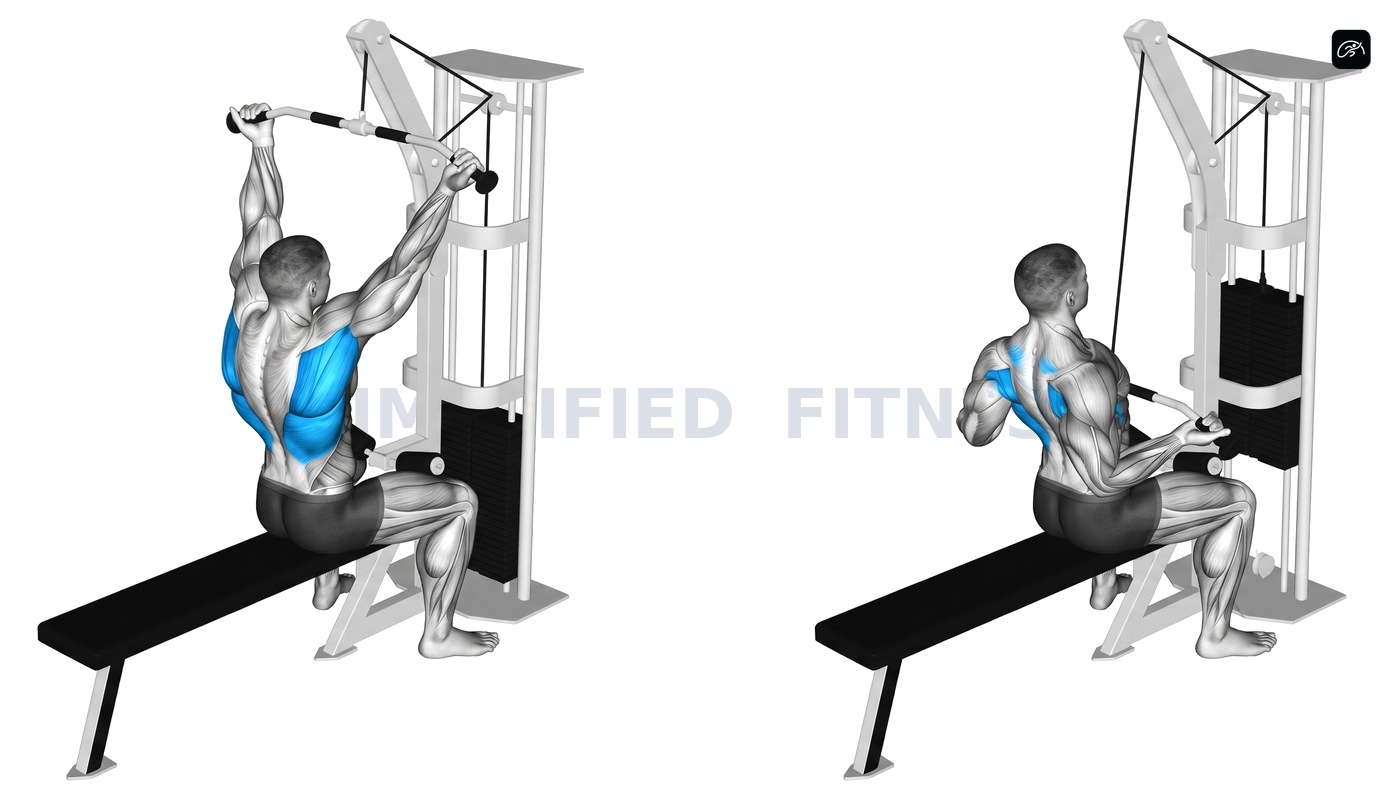
Choose the ones where a bad day cannot hurt you much. Machines and cable work remove balance and bar-path demands, which is useful when your focus is shot. Leg press, seated leg curl, chest-supported row and lat pulldown are good defaults. This is a practical judgment based on how technical each lift is, not a finding from a trial.
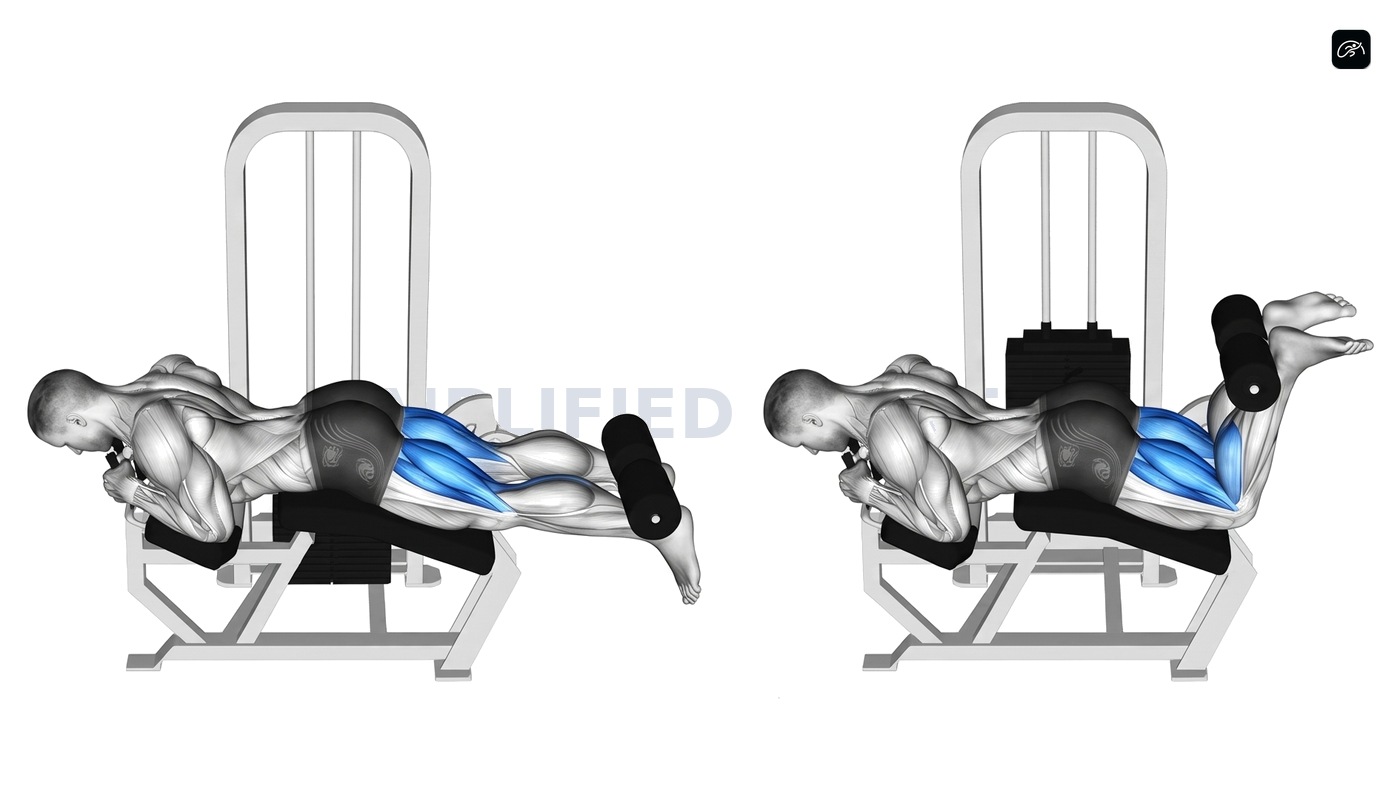
Save heavy barbell squats and deadlifts for days you feel sharp. A related idea is covered in our article on stimulus-to-fatigue ratio in exercise selection: the best exercise on a tired day is the one that gives you the most growth for the least fatigue.
What if I can only train twice a week?
Then run two full-body sessions and be done. A 2-day plan is a real programme. The minimum-dose evidence above, from trained men, shows even very low doses can still build strength, though more slowly than higher doses. For a full plan, see 2-day-per-week lifting routines for busy professionals, and for holding muscle during an awful month, read about maintenance volume.
Pick 5-6 movements: a squat or leg press pattern, a hinge, a press, a row or pulldown, and one arm or calf finisher. Two hard sets each, twice a week, is a reasonable floor for holding on and making slow progress.
Timing, food and caffeine around shifts
Treat training like another appointment inside your sleep schedule. Train in the same part of your wake period each cycle, ideally not straight after a shift ends if you are fighting to sleep.
Food is a practical lever. In an Indian context, an easy approach is to carry two protein-heavy options you can eat without cooking: paneer or egg bhurji in a roti wrap, curd with roasted chana, or a dal and rice tiffin. Aim for protein at each meal rather than loading it into one sitting. For a starting number, use our protein calculator.
Caffeine may help. The 2018 review listed it, along with group training and training before long periods of wakefulness, as a possible strategy for lifting under inadequate sleep (Knowles et al., 2018). Just keep it to the early part of your waking day so it does not cost you the sleep you need. Keep the daily total moderate too: food safety authorities such as EFSA put the safe upper level for most healthy adults at around 400 mg a day, and less in pregnancy or if you have a heart condition.
When to see a doctor
Programming cannot fix everything. Speak to a doctor if you have constant fatigue even after rest, mood that is persistently low, palpitations, chest pain or breathlessness with exertion, loud snoring with daytime sleepiness, or pain that does not settle in a few days. These could have causes that need a proper check, and this article cannot diagnose them. Long-term shift work and chronic sleep loss are also worth discussing with your doctor for general health reasons.
A one-page summary you can screenshot
- Write 3-4 sessions as an ordered list.
- Do the next one when rested enough, not on a weekday.
- Cut sets, not weights, on short-sleep days.
- Stop 3-4 reps from failure when tired.
- Prefer machines when exhausted.
- Have a 2-3 set minimum version for chaos weeks.
- Track how reps feel, not only the numbers.
To check whether your weekly sets are in a reasonable range, try the training volume calculator.
Frequently Asked Questions
What is the best workout split for shift workers?
A rolling upper/lower or full-body cycle of 3-4 sessions per 8-10 days suits most shift workers better than a fixed weekly split. A meta-analysis of 25 studies found training frequency did not meaningfully change muscle growth when weekly volume was equated, so you lose very little by shifting days around. Write your sessions as an ordered list and do the next one when you are rested enough.
Can I build muscle on night shifts?
Yes, but expect to progress more slowly in heavy shift blocks than in a calm month. Muscle growth follows total hard sets, food and recovery, none of which require a daytime schedule. Pick a consistent training slot around your sleep, keep protein regular and accept a lower volume during the toughest stretches.
Does lack of sleep reduce muscle growth?
Evidence on muscle growth itself is thin, but evidence on training performance is clearer. A 2018 systematic review of 17 studies (mostly moderate or weak quality) found that consecutive nights of sleep restriction could reduce force on multi-joint lifts. Treat poor sleep as a reason to lower volume and effort for that session, and fix sleep where you can.
Should I train after a night shift or sleep first?
Sleep first in most cases. Training on a few hours of rest tends to feel heavier and slower, and it competes with the sleep you need to recover. If you must train before sleeping, keep it short and submaximal, and use a post-sleep window for harder sessions.
How many days a week should a busy nurse or doctor lift?
Two to four sessions a week is a realistic range. A 2020 systematic review in resistance-trained men found one hard set, 2-3 times per week, still increased squat and bench press strength, though less than higher doses would. Start at the low end during heavy rota weeks and add sessions when life calms down.
How should I train on 4 or 5 hours of sleep?
Keep the session but shrink it. Roughly a third to half fewer sets, reps stopped a little further from failure, and machines instead of heavy barbell work is a sensible approach. This is a coaching rule of thumb rather than a tested protocol, so adjust it to how you feel.
Does stress make muscle recovery slower?
It may. A 2012 study of 31 university students found higher life-event stress and perceived stress were linked to slower recovery of leg force in the first hour after hard leg pressing. That is a short-term study in young students, so use it as a reason to be flexible, not as proof about long-term growth.
What are the best exercises for tired lifters?
Stable machines and cable movements are easier to do safely when you are fatigued, because balance and bar path are taken care of. Leg press, seated leg curl, chest-supported rows and lat pulldowns cover most muscles with less technical risk. Save heavy free-weight lifts for days when you feel sharp.
Is a deload week necessary for shift workers?
Not on a fixed schedule, since your rota already creates natural low-volume weeks. Reduce volume when sleep, mood or performance clearly dip, and resume when they recover. Our guide to progressive overload and deloads covers the signs to look for.
Can caffeine help me train when I am sleep deprived?
It may help, and the 2018 review lists caffeine as one strategy that could assist training under inadequate sleep. The catch is that caffeine late in your wake period can wreck the sleep you are trying to protect. Use it early in your waking day and stop several hours before you plan to sleep; around 8 hours is a common rule of thumb.
How do I avoid injury when lifting while exhausted?
Lower the technical demand and the effort level. Choose machines and controlled tempo, add an extra warm-up set and avoid grinding reps to failure. Stop the set if form falls apart, and see a clinician for pain that lasts more than a few days.
How do I stay consistent when my schedule changes every week?
Plan sessions, not days. Keep a short list of 3-4 workouts, do the next one when you can and set a minimum version (2-3 sets of your main lifts) for chaotic days. Consistency over months beats a perfect plan that you abandon in week three.
Sources & References
Every claim above is checked against peer-reviewed research (PubMed, U.S. National Library of Medicine) or guidance from established health bodies. How we fact-check.
- Knowles OE, et al. Inadequate sleep and muscle strength: Implications for resistance training. J Sci Med Sport. 2018. PMID: 29422383
- Knowles OE, et al. Sustained sleep restriction reduces resistance exercise quality and quantity in females. Med Sci Sports Exerc. 2022. PMID: 36136596
- Stults-Kolehmainen MA, Bartholomew JB. Psychological stress impairs short-term muscular recovery from resistance exercise. Med Sci Sports Exerc. 2012. PMID: 22688829
- Helms ER, et al. Rating of perceived exertion as a method of volume autoregulation within a periodized program. J Strength Cond Res. 2018. PMID: 29786623
- Androulakis-Korakakis P, et al. The minimum effective training dose required to increase 1RM strength in resistance-trained men: a systematic review and meta-analysis. Sports Med. 2020. PMID: 31797219
- Schoenfeld BJ, et al. Dose-response relationship between weekly resistance training volume and increases in muscle mass: a systematic review and meta-analysis. J Sports Sci. 2017. PMID: 27433992
- Schoenfeld BJ, et al. How many times per week should a muscle be trained to maximize muscle hypertrophy? A systematic review and meta-analysis of studies examining the effects of resistance training frequency. J Sports Sci. 2019. PMID: 30558493

Umair Hazrami · Founder & Head Coach, Simplified Fitness
Umair Hazrami founded Simplified Fitness and the Simplified Lifter channel to cut through fitness noise. With 4+ years of consistent training and 10+ coaching clients, he writes every guide from the peer-reviewed research and links the sources so you can check them. Our editorial standards.
Educational content only, not medical advice. If you have a medical condition, are pregnant, or take medication, talk to a qualified doctor before changing your diet, supplements or training. Full disclaimer.
Keep reading

Programming
2-Day per Week Lifting Programs: Minimum Effective Dose for Busy Professionals
Can a 2 day a week workout routine hypertrophy goals support? Yes. Get a ready two-day full-body plan, the research behind it and how to run it in 60 minutes.
9 min read
Programming
30-Minute High-Density Hypertrophy Sessions: Micro-Workouts for Time-Constrained Lifters
Can a 30 minute workout for muscle growth work? See how paired sets, Myo-reps and machine setups fit 16 hard sets into half an hour, plus a 4-day plan.
10 min read

Programming
The 7-Minute Dynamic Warm-Up: A Fast Routine to Prep Joints Before Lifting
A dynamic warm up for lifting takes about 7 minutes, not 25. See the 2-3-2 routine, what the research says about stretching and foam rolling, and what to skip.
9 min read

Programming
Antagonist Paired Sets: Cut Workout Time by About 40% Without Losing Reps
Antagonist paired sets supersets time saving explained: pairing push and pull cuts a session by roughly 40% keeping reps. Pairings and rest times included.
8 min read