Full-Body Workouts 3 Days a Week: The Hypertrophy Plan That Actually Works
A full body workout 3 days a week can build muscle as well as bigger splits when volume is equal. Here is the science and a free 8-week A/B/C program.

TL;DR. The short answer
- Yes, a full body workout 3 days a week can build muscle. When weekly hard sets are matched, a 2019 meta-analysis of 25 studies found no meaningful hypertrophy difference between training frequencies.
- Each muscle gets hit three times a week, so you only need about 2-4 hard sets per muscle per session. Weekly volume still matters: more sets tend to produce more growth up to a point.
- Rotate exercises across Sessions A, B and C so the same joints and patterns are not hammered back to back. Squat on Monday, hinge on Wednesday, hip thrust on Friday.
- Session length is the real catch. Keep it to 12-18 hard sets (roughly 60-75 minutes) and the plan stays sustainable.
- In one 10-week trial of trained men, a split routine grew the thigh muscle slightly more than total body training. Evidence is small, so treat it as a caveat, not a verdict.
Part of our complete guide: Best Workout Split for Muscle Growth: PPL vs Upper/Lower vs Full Body, What the Research Says
Table of contents
A full body workout 3 days a week hypertrophy plan can build muscle about as well as a 4 or 5 day split, as long as your weekly hard sets are similar. The research does not show that frequency itself drives growth. Volume, effort and consistency do the work.
That is good news if you only have Monday, Wednesday and Friday free. This guide is part of our complete guide to workout splits and session architecture. If you want the side-by-side comparison of every split first, read full body vs upper/lower vs PPL. Here we do the other job: hand you a full, ready-to-run 8-week program.
Does a full body workout 3 days a week work for hypertrophy?
Mostly yes, with one honest caveat. Let’s look at what the studies actually say.
A 2016 meta-analysis of ten studies found that training a muscle twice a week beat once a week, with effect sizes of 0.49 versus 0.30 (Schoenfeld et al., 2016). It said it could not tell whether three times beat twice.
A bigger 2019 meta-analysis of 25 studies then found no significant difference between higher and lower frequencies when volume was equated, including in resistance-trained people. The authors concluded that for a given volume, you can choose frequency by preference (Schoenfeld et al., 2019). Non-volume-equated studies did favour higher frequency, but the gap between 1 and 3+ days a week was modest.
Why the apparent conflict? The 2016 paper pooled only ten studies and could not test three times against twice. The 2019 update had more than twice the data and found that, once weekly sets were matched, frequency made no significant difference. The edge for higher frequency only showed up in studies where it also meant more total sets.
Single trials point the same way. In 28 resistance-trained men, training 3 or 6 days a week with equal volume produced similar strength and fat-free mass gains over 6 weeks (Colquhoun et al., 2018). In 21 trained participants, 2 versus 4 whole-body sessions a week produced no differences in muscle growth or strength over 9 weeks (Hamarsland et al., 2021). Both studies are short and small, so take them as supporting evidence rather than proof.
The caveat: split routines may edge out full body for some muscles
Fairness requires one more study. In 21 resistance-trained men, a 10-week total body program and a split routine both improved strength and muscle thickness. Total body did slightly better on one strength measure (isokinetic bench press at 25 cm/s), while the split group gained more thigh (vastus lateralis) thickness (Bartolomei et al., 2021). The authors suggested total body may suit strength and a split may suit growth in experienced lifters.
It is one small trial, and only one of the three muscles measured showed a difference. A reasonable reading: for most people, the differences are small. If you are advanced and your legs lag, you can give them an extra set or two rather than abandoning the format.
How many sets does each session need?
The most common mistake with full body training is copying a bodybuilder’s chest day onto every muscle three times a week. You would be in the gym for three hours.
Instead, think weekly. A meta-regression of 15 studies found each extra weekly set was linked to about a 0.37% larger gain in muscle size, a graded dose-response (Schoenfeld et al., 2017). An older meta-analysis found multiple sets beat a single set for hypertrophy (Krieger, 2010).
So aim for roughly 6-12 hard sets per muscle per week. Split across three days, that is 2-4 sets per muscle per session. For a deeper look at how volume behaves, see per-session set volume caps and 1x vs 2x vs 3x frequency with equated volume.
A hard set here means roughly 1-3 reps from failure, using good form. Warm-up sets do not count.
How to build Sessions A, B and C
The trick that makes three full body days feel different is rotation. You hit the same muscles each session, but through different exercises and patterns.
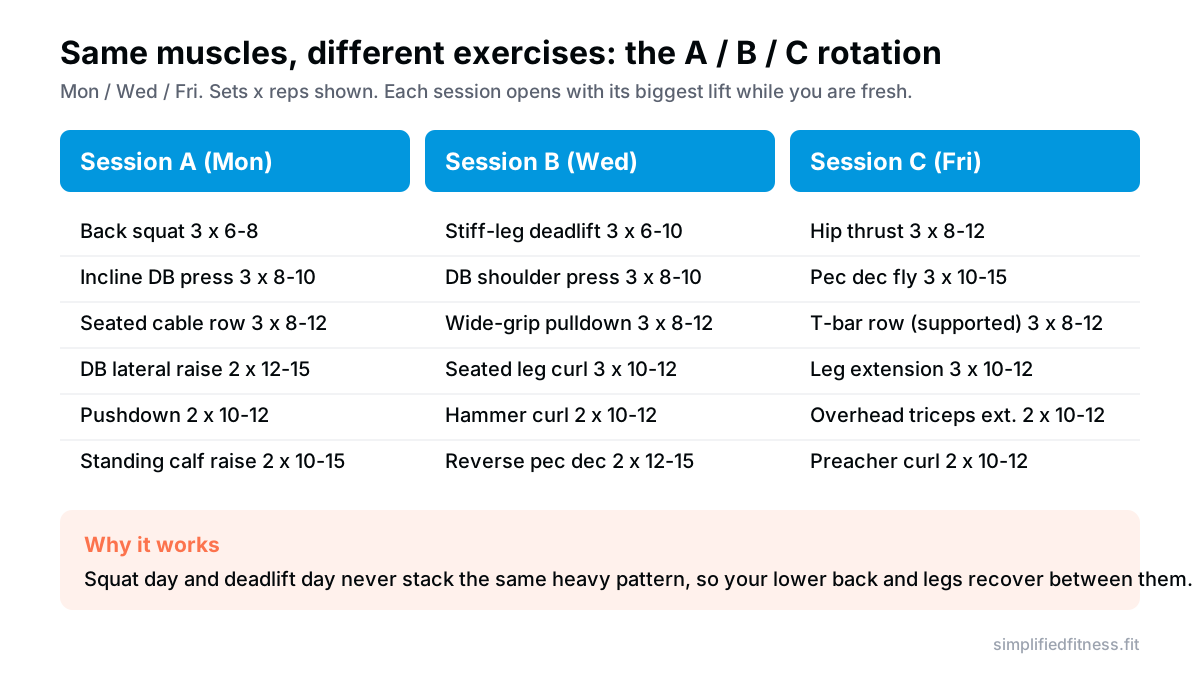
Four rules sit behind the layout.
1. One big lower body lift per day, never two. Squat on A, stiff-leg deadlift on B, hip thrust on C. Your lower back and hips get a day of recovery between heavy loading.
2. Alternate press and row angles. Incline press on A, overhead press on B, pec dec on C. Seated row on A, pulldown on B, supported T-bar row on C. Same muscles, different joint angles.
3. Heaviest, most technical lift goes first. Fatigue builds across a session, so give your top priority the freshest legs and shoulders. If shoulders are your weak spot, move lateral raises to the front of a session.
4. Small muscles ride at the end. Arms, calves and rear delts need fewer sets and less setup, so they close out each day.
The program: ready to run, Mon/Wed/Fri
Rest 2-3 minutes after big lifts and 60-90 seconds after isolation work. Pick a load where the last rep of each set leaves about 1-3 reps in the tank. If you are unsure how that feels, use our RIR and RPE calculator and read the RIR and RPE scale guide.
Session A (Monday)
| Exercise | Sets x reps |
|---|---|
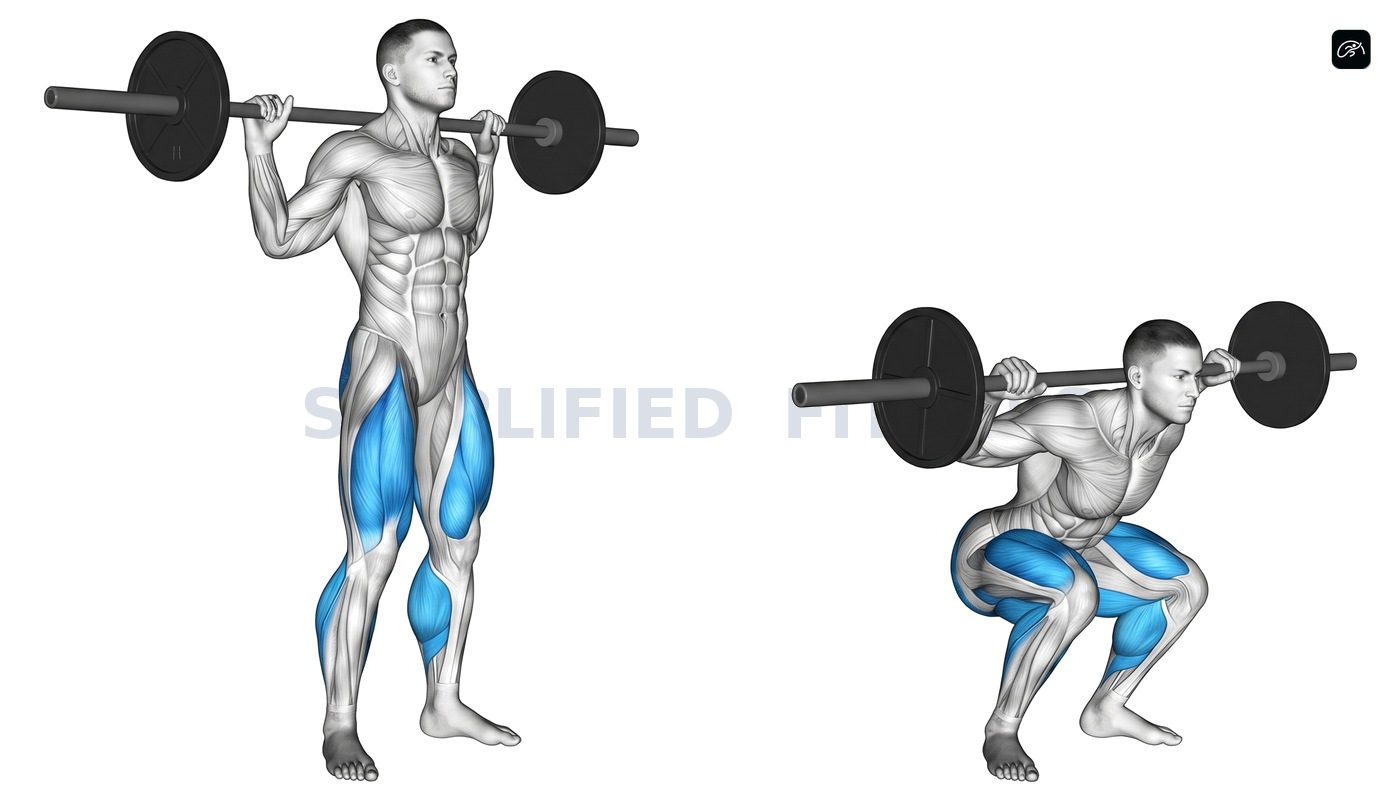
| Barbell back squat | 3 x 6-8 |
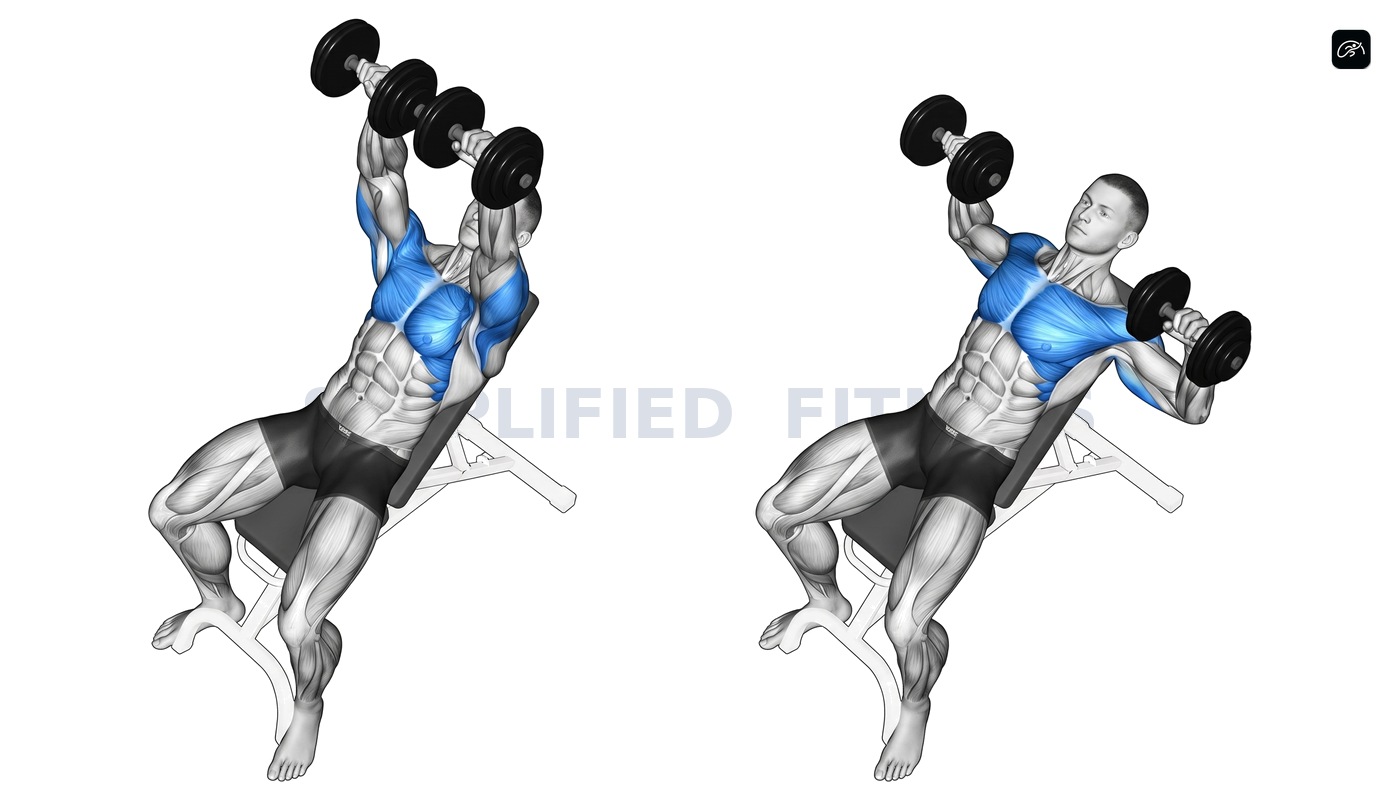
| Incline dumbbell press | 3 x 8-10 |
| Close-grip seated cable row | 3 x 8-12 |
| Dumbbell lateral raise | 2 x 12-15 |
| Triceps pushdown (straight bar) | 2 x 10-12 |
| Standing calf raise | 2 x 10-15 |
Session B (Wednesday)
| Exercise | Sets x reps |
|---|---|
| Stiff-leg deadlift | 3 x 6-10 |
| Dumbbell shoulder press | 3 x 8-10 |
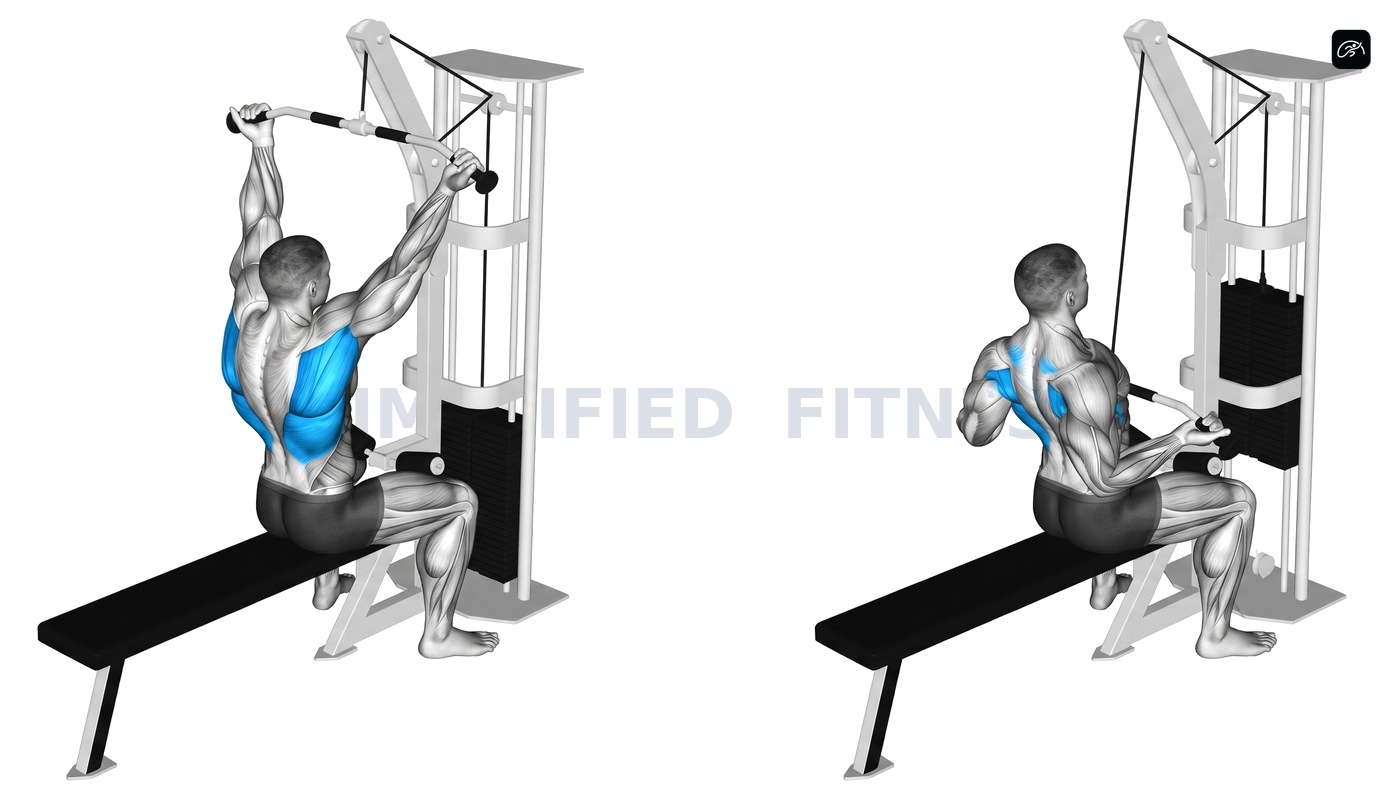
| Wide-grip lat pulldown | 3 x 8-12 |
| Seated leg curl | 3 x 10-12 |
| Hammer curl (cable) | 2 x 10-12 |
| Reverse pec dec fly | 2 x 12-15 |
Session C (Friday)
| Exercise | Sets x reps |
|---|---|
| Hip thrust | 3 x 8-12 |
| Pec dec fly | 3 x 10-15 |
| Chest-supported T-bar row | 3 x 8-12 |
| Single-leg extension | 3 x 10-12 |
| Overhead triceps extension | 2 x 10-12 |
| Preacher curl (dumbbell) | 2 x 10-12 |
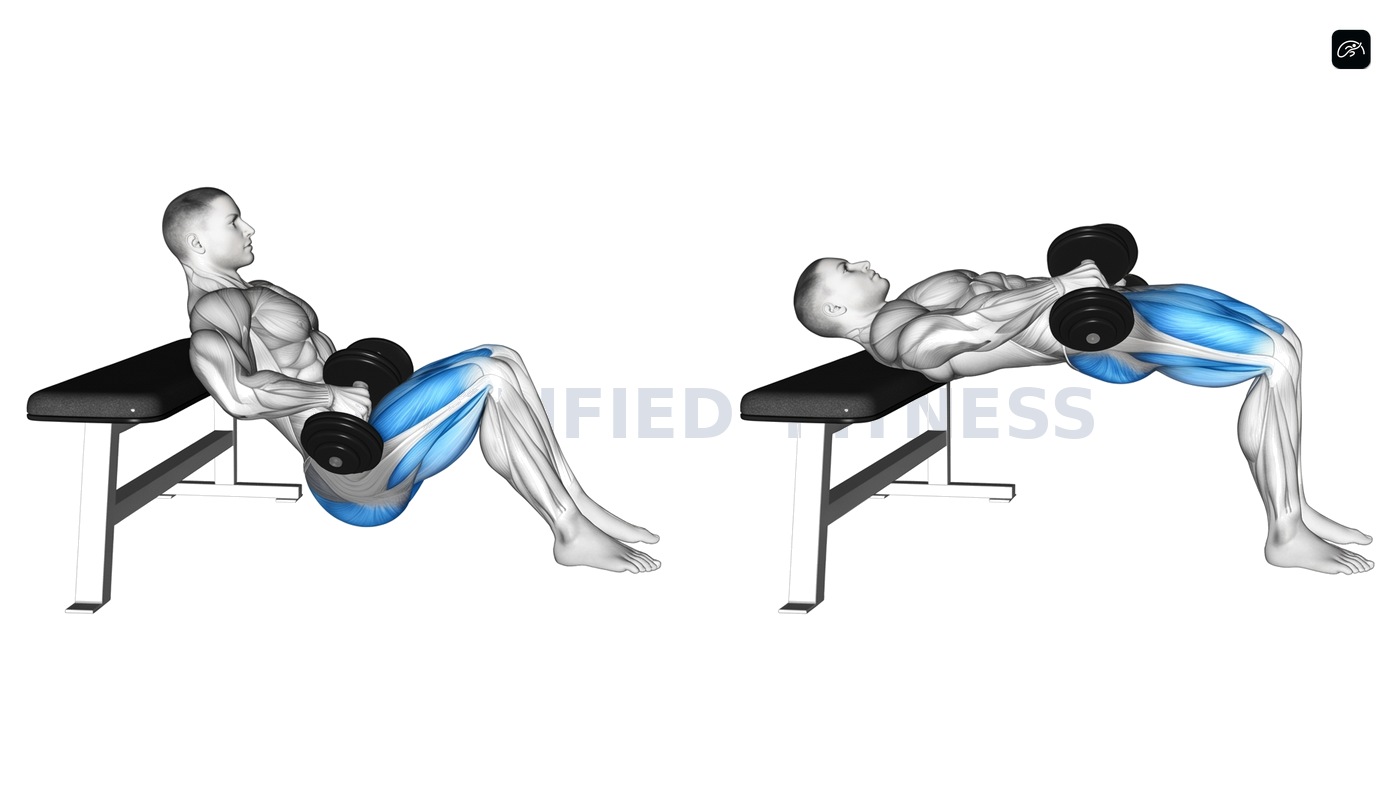
Calf raises appear on Session A only to keep Session C shorter. If calves are a priority, add 2 sets on Friday.
What your weekly volume looks like
Add it up and you get roughly 9 direct sets for back, 6 each for quads, chest and hamstrings, 3 for glutes plus plenty of indirect work from squats and deadlifts, about 4 each for biceps and triceps, and 2 for calves.
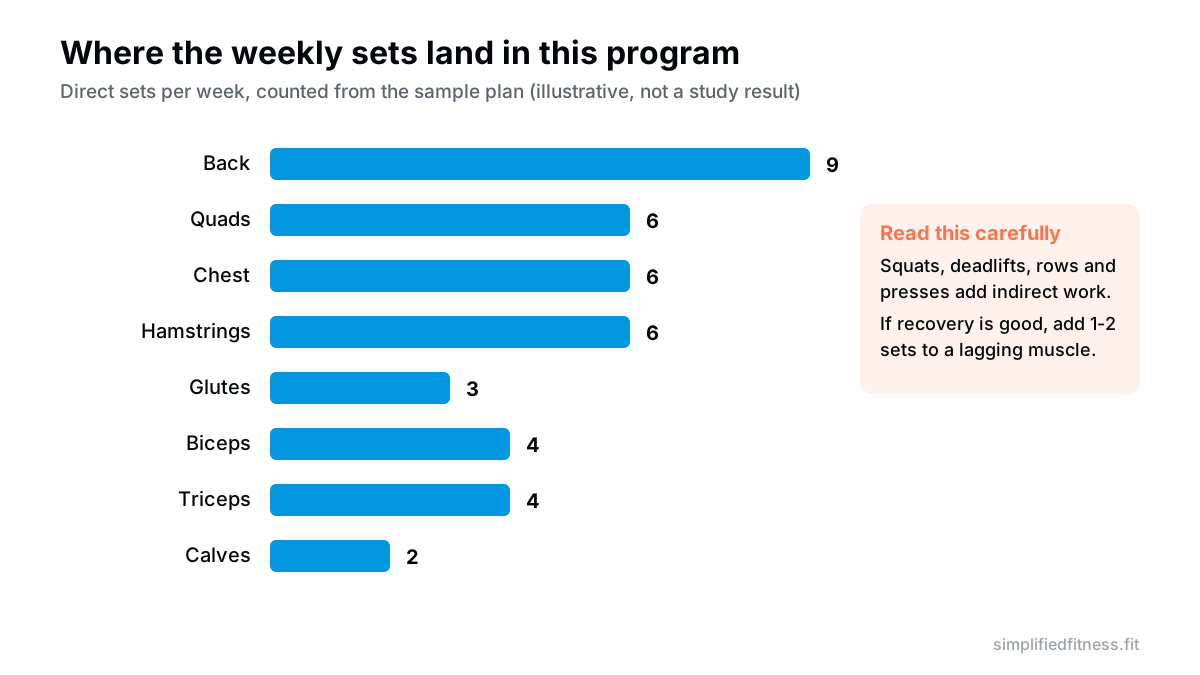
Is that enough? For beginners and early intermediates, usually yes. The volume literature says more sets tend to mean more growth up to a point, but nobody can give you your ideal number. Start here, then add sets slowly. We cover how to find your own ceiling in volume landmarks (MV, MEV, MAV, MRV).
The 8-week progression
A program is only as good as the way it progresses. This is a practical template, not something tested in a trial.
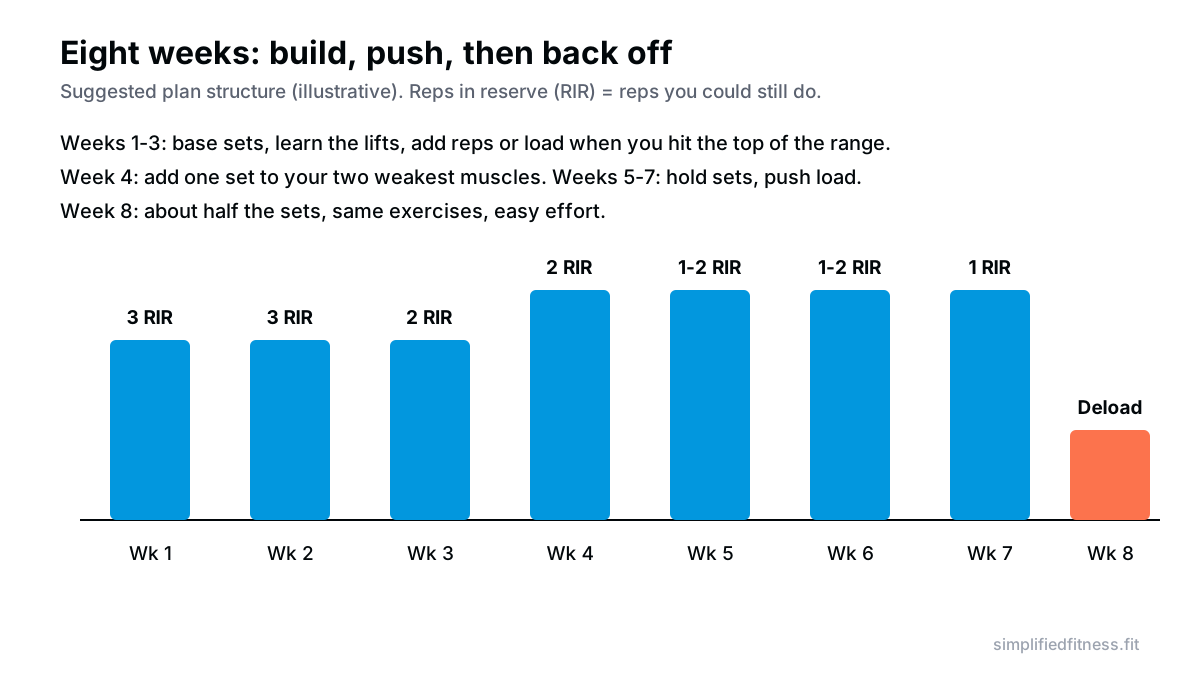
- Weeks 1-3: run the sets as written at about 2-3 reps in reserve. Learn the lifts. Add a rep each session where you can.
- Week 4: add one set to your two weakest muscles. Keep everything else.
- Weeks 5-7: hold sets, push load and effort toward 1-2 reps in reserve on the last set of each exercise.
- Week 8: deload. Do roughly half the sets with the same exercises and easy effort. Then restart at week 1 with slightly heavier weights.
For load increases use double progression: when every set hits the top of the rep range, add the smallest jump you have.
Fitting it into a real week (and an Indian kitchen)
Mon/Wed/Fri is ideal. Tue/Thu/Sat also works. Avoid back-to-back training days where you can.
Food keeps this plan running. A meta-analysis of 49 studies found that extra protein stopped adding measurable muscle gains above roughly 1.6 g/kg of body weight a day (Morton et al., 2018), so that is a sensible daily target. Estimate yours with the protein calculator. If you have kidney disease, check with your doctor before raising protein. On a vegetarian budget that usually means dal and roti, curd, paneer, soya chunks and eggs if you eat them. Our free workout plans and diet plan pair well with this program.
In hot weather, sessions often feel harder than the numbers say. Drink water, keep warm-ups shorter, and let your effort slide to 2-3 reps in reserve on bad days instead of grinding.
Who should pick something else?
Full body three days a week is not for everyone.
- You want 4 or more training days. Look at the upper/lower split guide.
- You are advanced with a stubborn body part. A split with more per-muscle volume may suit you better, per the small trial above.
- You hate long sessions. Consider fewer exercises per day, or two harder days a week.
Health note: if you have heart disease, uncontrolled blood pressure, joint pain that sharpens with a lift, or any injury, see a doctor or physio before starting. Sharp or radiating pain is a reason to stop, not push through.
The bottom line
Three full body days a week can build serious muscle. The evidence says frequency matters far less than total hard sets, effort and consistency. A rotation of Sessions A, B and C keeps joints fresh, keeps sessions near an hour, and gives every muscle three chances a week to grow. Run the 8-week plan, track your lifts, and add volume only when you are recovering well.
Frequently Asked Questions
Can you build muscle with full body workouts 3 days a week?
Yes. When weekly hard sets are equated, a 2019 meta-analysis of 25 studies found no significant difference in hypertrophy between lower and higher training frequencies. Three full body sessions simply spread your weekly volume across three days. Pick a volume you can recover from and progress it over time.
Is a 3 day full body split good for natural lifters?
It works well for most natural lifters, especially beginners and intermediates with a busy week. Training each muscle three times means every session needs fewer sets per muscle, which keeps fatigue manageable. If you plateau after a year or two, add a set or two per muscle before changing the whole split.
How many sets per muscle per session in a full body routine?
Roughly 2-4 hard sets per muscle per session is a sensible range. A meta-analysis of weekly volume found more sets generally produced more growth, so 6-12 direct sets per muscle per week is a practical target. Start at the low end and add sets only when recovery is good.
How long should a full body workout take?
Most people finish 12-18 hard sets in about 60-75 minutes with 2-3 minutes of rest on big lifts. Rest less on isolation work to save time. If sessions drift past 90 minutes, cut a low-value exercise rather than rushing your heavy sets.
Should I train full body on consecutive days?
Mon/Wed/Fri is the cleanest setup because muscles get roughly 48 hours between sessions. Training on consecutive days is possible, but heavy squats and deadlifts back to back often make the second session worse. If you must train on consecutive days, use lighter, lower-fatigue exercises on one of them.
Is full body better than upper lower or push pull legs?
Not clearly. A 2019 meta-analysis concluded that for a given volume, people can choose a frequency based on preference. Full body suits 3 days a week, upper/lower suits 4, and PPL suits 5-6. The best split is the one you will actually attend.
Do I need to train to failure on full body days?
No. Training close to failure on most sets, say 1-3 reps in reserve, is enough for most lifts, and leaving a rep or two in the tank makes high frequency easier to recover from. Save the hardest efforts for the last set of safer exercises like machines and cables.
What if I miss a day in my 3 day plan?
Just run the next session in the rotation and shift the week. Because each session covers the whole body, a missed day costs you one third of your weekly sets, not an entire muscle group. Avoid doubling up two sessions in one day.
Can I do a full body workout with only dumbbells at home?
Yes. Swap the barbell squat for goblet or split squats, the deadlift for dumbbell Romanian deadlifts, and the machines for dumbbell or band versions. Keep the same movement patterns and the same weekly set counts, since the research is on sets and effort, not on equipment.
Is full body training good for fat loss as well?
It can be a good option, because lifting gives your body a reason to hold on to muscle while you eat in a calorie deficit. The fat loss itself comes from the deficit, not the split, so keep your protein high and your lifting intensity up. Use our protein calculator to set a daily target.
How do I progress a 3 day full body program?
Use double progression: stay at the same weight until you hit the top of the rep range on all sets, then add a small amount of load. Add a set to a lagging muscle only when your recovery and performance are good. Take an easy deload week about every 6-10 weeks, or sooner if lifts keep dropping.
Is it OK to do full body workouts as a beginner?
Yes, it is one of the best starting formats. Practising squat, press and row patterns three times a week speeds up skill learning, and the per-session volume is low enough that soreness stays manageable. Start with 2 sets per exercise for the first couple of weeks.
Sources & References
Every claim above is checked against peer-reviewed research (PubMed, U.S. National Library of Medicine) or guidance from established health bodies. How we fact-check.
- Schoenfeld BJ, et al. How many times per week should a muscle be trained to maximize muscle hypertrophy? A systematic review and meta-analysis of studies examining the effects of resistance training frequency. J Sports Sci. 2019. PMID: 30558493
- Schoenfeld BJ, et al. Effects of Resistance Training Frequency on Measures of Muscle Hypertrophy: A Systematic Review and Meta-Analysis. Sports Med. 2016. PMID: 27102172
- Colquhoun RJ, et al. Training Volume, Not Frequency, Indicative of Maximal Strength Adaptations to Resistance Training. J Strength Cond Res. 2018. PMID: 29324578
- Hamarsland H, et al. Equal-Volume Strength Training With Different Training Frequencies Induces Similar Muscle Hypertrophy and Strength Improvement in Trained Participants. Front Physiol. 2021. PMID: 35069251
- Schoenfeld BJ, et al. Dose-response relationship between weekly resistance training volume and increases in muscle mass: A systematic review and meta-analysis. J Sports Sci. 2017. PMID: 27433992
- Bartolomei S, et al. A Comparison Between Total Body and Split Routine Resistance Training Programs in Trained Men. J Strength Cond Res. 2021. PMID: 32168178
- Krieger JW. Single vs. multiple sets of resistance exercise for muscle hypertrophy: a meta-analysis. J Strength Cond Res. 2010. PMID: 20300012
- Morton RW, et al. A systematic review, meta-analysis and meta-regression of the effect of protein supplementation on resistance training-induced gains in muscle mass and strength in healthy adults. Br J Sports Med. 2018. PMID: 28698222

Umair Hazrami · Founder & Head Coach, Simplified Fitness
Umair Hazrami founded Simplified Fitness and the Simplified Lifter channel to cut through fitness noise. With 4+ years of consistent training and 10+ coaching clients, he writes every guide from the peer-reviewed research and links the sources so you can check them. Our editorial standards.
Educational content only, not medical advice. If you have a medical condition, are pregnant, or take medication, talk to a qualified doctor before changing your diet, supplements or training. Full disclaimer.
Keep reading

Programming
2-Day per Week Lifting Programs: Minimum Effective Dose for Busy Professionals
Can a 2 day a week workout routine hypertrophy goals support? Yes. Get a ready two-day full-body plan, the research behind it and how to run it in 60 minutes.
9 min read
Programming
30-Minute High-Density Hypertrophy Sessions: Micro-Workouts for Time-Constrained Lifters
Can a 30 minute workout for muscle growth work? See how paired sets, Myo-reps and machine setups fit 16 hard sets into half an hour, plus a 4-day plan.
10 min read

Programming
The 7-Minute Dynamic Warm-Up: A Fast Routine to Prep Joints Before Lifting
A dynamic warm up for lifting takes about 7 minutes, not 25. See the 2-3-2 routine, what the research says about stretching and foam rolling, and what to skip.
9 min read
Programming
Antagonist Paired Sets: Cut Workout Time by About 40% Without Losing Reps
Antagonist paired sets supersets time saving explained: pairing push and pull cuts a session by roughly 40% keeping reps. Pairings and rest times included.
8 min read