Upper/Lower Split (4 Days/Week): Why It Remains the Gold Standard for Intermediates
Upper lower split 4 days a week explained: why it works, what the research says on frequency and volume, and a full Upper A/B and Lower A/B routine.

TL;DR. The short answer
- An upper lower split 4 days a week trains every muscle twice weekly, which is enough frequency for muscle growth, and leaves three rest days for recovery.
- The science does not say 4 days is magic. When weekly sets are equal, training a muscle 2x or 3x per week gives similar muscle growth, so the split wins on practicality and spacing.
- A good starting target is roughly 10-15 hard sets per muscle per week, split across two sessions. Volume matters more than the split name.
- Use two different days for each half: Upper A as a press day, Upper B as a pull day, Lower A as a quad day, Lower B as a hamstring and glute day.
- If you can only train 3 days, or you are a true beginner, a full-body plan can do the same job.
Part of our complete guide: Best Workout Split for Muscle Growth: PPL vs Upper/Lower vs Full Body, What the Research Says
Table of contents
An upper lower split 4 days a week is a good default for most intermediates because it trains every muscle twice a week, keeps each session manageable, and leaves three full rest days. It is not the only way to grow. It is simply the plan that makes the research-backed basics (enough frequency, enough sets, enough recovery) easiest to hit.
This guide covers why it works, what the evidence does and does not say, and a complete Upper A / Upper B / Lower A / Lower B template. For how it compares with other layouts, see our workout splits pillar guide, and for the head-to-head version, full body vs upper lower vs push pull legs.
What is an upper lower split?
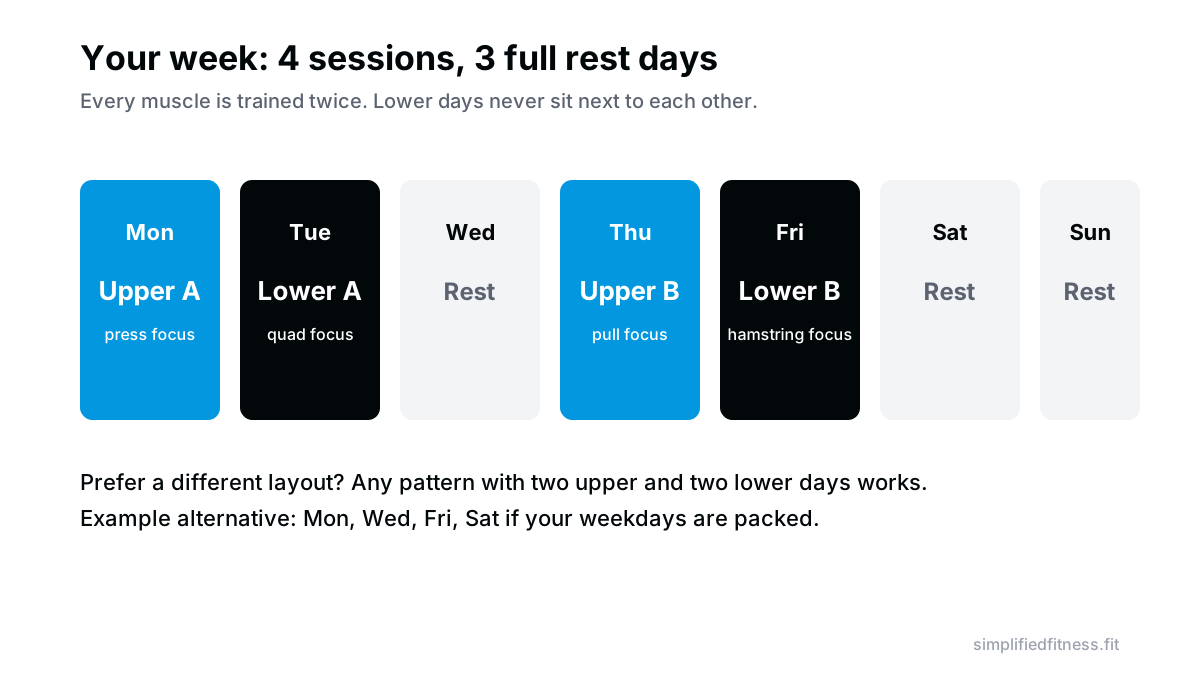
You divide the body into two halves. Upper days train chest, back, shoulders and arms. Lower days train quads, hamstrings, glutes and calves. Four sessions a week means you do each half twice, usually as Upper A, Lower A, Upper B, Lower B.
The “A” and “B” matter. If Upper B is just a copy of Upper A, you lose variety and may run out of useful angles. We design each pair so the A day leans on one thing and the B day on another.
Why is the upper lower split the gold standard?
Calling it “gold standard” is a coach’s opinion, not a study result. Here is the honest case for it.
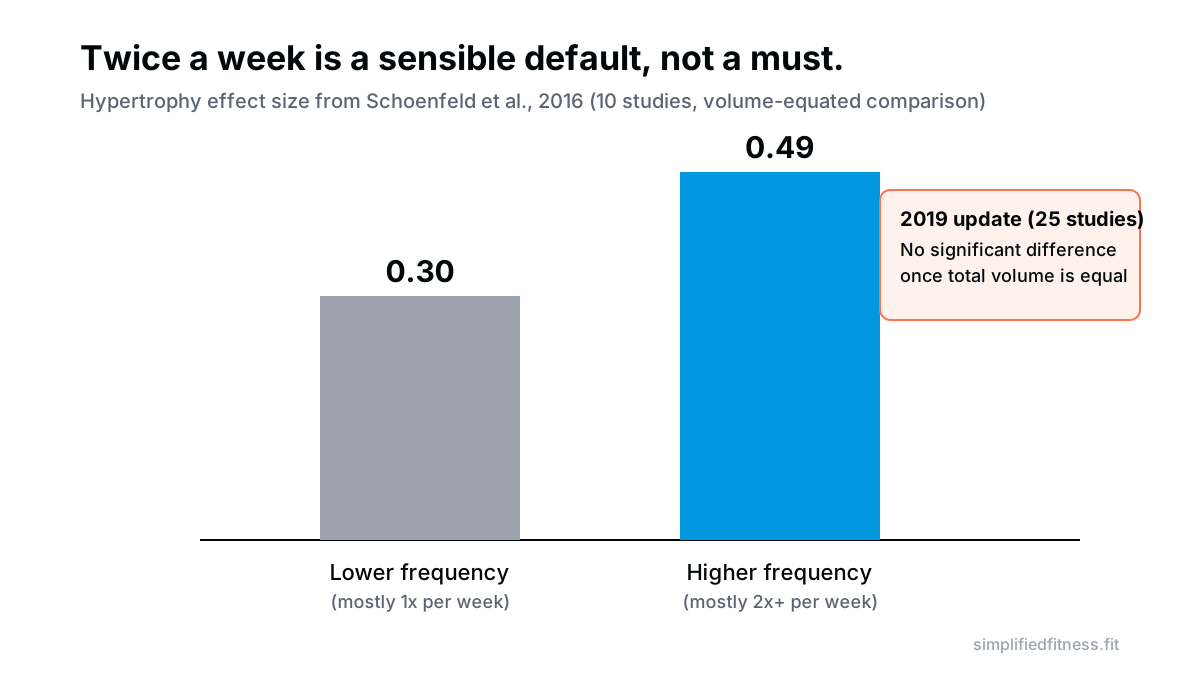
1. Twice-weekly frequency is well supported. A 2016 meta-analysis of 10 studies found that training a muscle twice a week was linked to a larger hypertrophy effect size than once a week (0.49 vs 0.30), and the authors concluded major muscles should be trained at least twice weekly (Schoenfeld et al., 2016). Whether three times beats twice was unresolved at that point.
2. Once weekly sets are matched, frequency matters little. A larger 2019 meta-analysis of 25 studies found no significant difference between higher and lower frequencies when volume was equated, including in resistance-trained people and in upper and lower body separately (Schoenfeld et al., 2019). The authors concluded frequency can be chosen by personal preference for a given volume.
3. It makes weekly volume easy to reach. Across 15 studies, each extra weekly set was associated with a small increase in muscle growth (about 0.37% more gain per set), with a graded dose-response overall (Schoenfeld et al., 2017). Four sessions, each covering half the body, let you accumulate those sets without any single workout turning into a marathon.
4. The calendar works. Mon/Tue/Thu/Fri leaves Wednesday plus the weekend free. For many working people in India, that is easier to protect than a 6-day plan.
Is training a muscle more than twice a week better?
Probably not, if total sets match. In a 9-week trial in 21 trained participants (11 men, 10 women), two whole-body sessions a week produced similar muscle growth and strength gains to four sessions a week with equal weekly volume (Hamarsland et al., 2021). In 67 untrained people over 8 weeks, a twice-a-week split and a four-times-a-week full-body routine also gave similar results with equal set volume (Evangelista et al., 2021).
Not every trial agrees. One 6-week study in 18 recreationally trained men compared 4 low-volume sessions with 2 high-volume sessions at equal weekly volume. Both groups gained fat-free mass, but only the 2-day group increased arm circumference and elbow flexor thickness, and only that group lost fat mass (Yue et al., 2018). It is a small, short study, so I would not read much into it. The takeaway is that results may vary by muscle, and neither schedule is clearly superior.
How many sets per muscle on an upper lower split?
A practical starting point for most intermediates is about 10-15 hard sets per muscle per week, which means 5-8 sets per muscle in each of the two sessions. That range is a coaching convention informed by the dose-response data above, not a number any single trial proves. The 2017 meta-analysis found more volume tended to mean more growth but could not pin down where returns flatten (Schoenfeld et al., 2017).
How to use that:
- Start near 10 sets per muscle per week and only add when you are recovering and progressing.
- Count only hard sets, roughly 1-3 reps short of failure.
- Compound lifts also hit other muscles (bench press hits triceps and front delts), so you rarely need to do arm work as a separate high-volume block. Our weekly set volume dose-response guide goes deeper, and the training volume calculator can tally your week.
Upper A and Upper B: how to design them
Upper A (press emphasis) starts with a heavy press, followed by a row, then shoulders and arms. Upper B (pull emphasis) starts with a vertical or horizontal pull, followed by an incline press, then rear delts and arms.
Rotating the lead exercise keeps your first, freshest sets for a different movement each day.
Upper A (Monday)
| Exercise | Sets | Reps |
|---|---|---|
| Flat barbell or dumbbell bench press | 3 | 5-8 |
| Chest-supported or seated cable row | 3 | 8-12 |
| Dumbbell shoulder press | 3 | 8-12 |
| Wide-grip lat pulldown | 2 | 10-12 |
| Dumbbell lateral raise | 3 | 12-20 |
| Triceps pushdown | 3 | 10-15 |
| Hammer or preacher curl | 2 | 10-15 |
Upper B (Thursday)
| Exercise | Sets | Reps |
|---|---|---|
| Wide-grip lat pulldown or pull-up | 3 | 6-10 |
| Incline dumbbell press | 3 | 8-12 |
| One-arm dumbbell or machine row | 3 | 8-12 |
| Pec-dec or cable fly | 2 | 12-15 |
| Dumbbell lateral raise or rear delt fly | 3 | 12-20 |
| Overhead triceps extension | 3 | 10-15 |
| Incline or preacher curl | 3 | 10-15 |
Across the week that gives about 11 direct sets for the back, 8 for chest, 6 each for side delts and triceps and 5 for biceps, plus plenty of indirect work from presses and rows. That sits at the lower end of the target range on purpose, so you have room to add sets to lagging muscles. Look for exercise-specific advice in the guides to incline vs flat bench angles and chest-supported rows.
Lower A and Lower B: quad vs hamstring emphasis
Lower days are where this split earns its keep, because you can split the leg workload instead of doing one brutal session.
Lower A (quad emphasis): squat pattern first, then a leg press or extension, then a hamstring curl and calves. Lower B (hamstring and glute emphasis): hip hinge first, then a lunge or hip thrust, then leg curls and calves.
Lower A (Tuesday)
| Exercise | Sets | Reps |
|---|---|---|
| Barbell back squat (or hack squat) | 3 | 5-8 |
| Romanian deadlift | 2 | 8-10 |
| Leg press | 3 | 10-15 |
| Single-leg extension | 2 | 12-15 |
| Seated leg curl | 3 | 10-15 |
| Standing calf raise | 3 | 10-15 |
Lower B (Friday)
| Exercise | Sets | Reps |
|---|---|---|
| Stiff-leg or Romanian deadlift | 3 | 6-10 |
| Hip thrust | 3 | 8-12 |
| Bulgarian split squat or lunge | 3 | 8-12 |
| Seated leg curl | 3 | 10-15 |
| Adductor machine | 2 | 12-15 |
| Standing calf raise | 3 | 10-15 |
Quad and hamstring exercise choices are covered in quad anatomy and training and seated vs lying leg curls.
How to progress on this split
Use double progression. Pick a rep range, such as 8-12. When you hit 12 reps on every set with solid form, add the smallest load jump available and start again at 8. Write numbers down; progress you cannot see is hard to manage.
Keep most sets 1-3 reps from failure so the second session of the week does not suffer. If your lifts drop for two sessions in a row, trim a set or two per exercise for a week. Our progressive overload and deloads guide covers what to do when progress stalls.
Upper lower vs full body vs PPL: which should you pick?
| Setup | Best for | Trade-off |
|---|---|---|
| Full body, 3 days | Beginners, 3-day schedules | Sessions get long if you add sets |
| Upper lower, 4 days | Intermediates with 4 days | Needs 4 fixed days |
| Push pull legs, 5-6 days | Lifters who enjoy daily gym time | Takes more days to train each muscle twice |
If you can only train three days, see our 3-day full body plan. If you want to spread weekly sets deliberately, read distributing weekly volume across splits. For more on frequency itself, see 1x vs 2x vs 3x per week.
Who should not use it, and when to see a doctor
If you are brand new to lifting, a simpler full-body plan with lighter volume is usually kinder to your joints and your schedule. If you have a known injury, chest pain, dizziness during exercise, or pain that lingers or is sharp rather than muscular soreness, speak to a doctor or physiotherapist before pushing on. Nothing here is a diagnosis.
The bottom line
The upper lower split earns its reputation through practicality. It gives you twice-weekly frequency, enough room for 10-15 hard sets per muscle, and three rest days, all in four manageable sessions. The research says frequency matters less than total volume once you reach twice a week, so the best split is the one you can run consistently.
Want the done-for-you version? Grab our free workout plans, and use the protein calculator to set your daily target so the training has something to build with.
Frequently Asked Questions
Is a 4 day upper lower split good for building muscle?
Yes, it is a very good fit for most intermediates. It trains each muscle twice a week, which a 2016 meta-analysis linked to better growth than once a week (a larger 2019 analysis found frequency matters little once weekly sets are equal), and it keeps sessions short enough to stay hard. Run it for 8-12 weeks, track your reps, and add load when you hit the top of the rep range.
Why is the upper lower split so popular?
It balances frequency, volume and recovery with only 4 gym visits. Each session covers about half the body, so you can do enough sets per muscle without 2-hour workouts. It is also easy to schedule around work, which is why so many coaches default to it.
How many days a week should I do upper lower?
Four days is the standard, with two upper and two lower sessions. Three days also works if you alternate (upper, lower, upper one week, then lower, upper, lower the next), though each muscle then gets trained about 1.5 times a week. Pick the version you can actually repeat for months.
What is the best weekly schedule for upper lower?
Monday upper, Tuesday lower, Thursday upper, Friday lower is the classic pattern. It gives you Wednesday and the weekend off, so recovery is spread out. If your week is different, any layout with two upper and two lower days works, as long as you avoid back-to-back days that hit the same muscles hard.
Upper lower vs push pull legs: which is better?
Neither is better by default. Push pull legs usually needs 5-6 days to hit each muscle twice, while upper lower does it in 4. Choose the one your schedule supports, because when weekly sets are equal, frequency differences are small.
Upper lower vs full body: which should I pick?
Full body suits 3 days a week and beginners; upper lower suits 4 days and people who want more sets per muscle without longer sessions. Evidence in volume-matched trials shows similar results across frequencies. Move to upper lower when full-body sessions start feeling too long to train hard.
How many sets per muscle per week on an upper lower split?
A sensible range for most intermediates is about 10-15 hard sets per muscle per week, split across the two days. A 2017 meta-analysis found more weekly sets were linked to more growth, with diminishing returns not yet well defined. Start near 10 and add sets only when progress stalls and you are recovering well.
How many exercises per session should I do?
Most upper lower sessions use 5-7 exercises with 2-4 hard sets each. That keeps total volume useful without dragging the workout past about 60-75 minutes. If your last exercises are sloppy because you are tired, cut one.
Can I do an upper lower split at home with dumbbells?
Yes. Swap barbell lifts for dumbbell presses, rows, split squats and Romanian deadlifts, and use a bench or backpack for support. The principle is the same: two upper and two lower days with enough hard sets. Progress by adding reps first, then load.
Is upper lower good for fat loss?
It can be, because the lifting protects muscle while you eat in a calorie deficit. Fat loss itself comes from the deficit, not the split. Keep protein high (for example dal, paneer, eggs, curd or soya in each meal) and keep the lifting hard.
Should I train to failure on an upper lower split?
Not every set. Taking most sets to about 1-3 reps short of failure lets you recover for the next session, and the last set of an isolation exercise is a sensible place to push closer. Training twice a week per muscle means yesterday's fatigue matters more than on a once-a-week plan.
Is it okay to do lower body twice a week every week?
Yes, as long as the two sessions are spaced out and you manage total sets. Making Lower A quad focused and Lower B hamstring and glute focused shifts the stress so one muscle is not hammered twice. If your knees or back complain, trim volume and see a physiotherapist if pain persists.
How long should I stay on an upper lower program?
As long as you keep progressing, which for many intermediates is 8-16 weeks before a small change. Swap a few exercises or rep ranges rather than the whole template. Take an easier week if performance drops for two sessions in a row.
Sources & References
Every claim above is checked against peer-reviewed research (PubMed, U.S. National Library of Medicine) or guidance from established health bodies. How we fact-check.
- Schoenfeld BJ, et al. Effects of Resistance Training Frequency on Measures of Muscle Hypertrophy: A Systematic Review and Meta-Analysis. Sports Med. 2016. PMID: 27102172
- Schoenfeld BJ, et al. How many times per week should a muscle be trained to maximize muscle hypertrophy? A systematic review and meta-analysis of studies examining the effects of resistance training frequency. J Sports Sci. 2019. PMID: 30558493
- Schoenfeld BJ, et al. Dose-response relationship between weekly resistance training volume and increases in muscle mass: A systematic review and meta-analysis. J Sports Sci. 2017. PMID: 27433992
- Hamarsland H, et al. Equal-Volume Strength Training With Different Training Frequencies Induces Similar Muscle Hypertrophy and Strength Improvement in Trained Participants. Front Physiol. 2021. PMID: 35069251
- Evangelista AL, et al. Split or full-body workout routine: which is best to increase muscle strength and hypertrophy? Einstein (Sao Paulo). 2021. PMID: 34468591
- Yue FL, et al. Comparison of 2 weekly-equalized volume resistance-training routines using different frequencies on body composition and performance in trained males. Appl Physiol Nutr Metab. 2018. PMID: 29216446

Umair Hazrami · Founder & Head Coach, Simplified Fitness
Umair Hazrami founded Simplified Fitness and the Simplified Lifter channel to cut through fitness noise. With 4+ years of consistent training and 10+ coaching clients, he writes every guide from the peer-reviewed research and links the sources so you can check them. Our editorial standards.
Educational content only, not medical advice. If you have a medical condition, are pregnant, or take medication, talk to a qualified doctor before changing your diet, supplements or training. Full disclaimer.
Keep reading

Programming
2-Day per Week Lifting Programs: Minimum Effective Dose for Busy Professionals
Can a 2 day a week workout routine hypertrophy goals support? Yes. Get a ready two-day full-body plan, the research behind it and how to run it in 60 minutes.
9 min read
Programming
30-Minute High-Density Hypertrophy Sessions: Micro-Workouts for Time-Constrained Lifters
Can a 30 minute workout for muscle growth work? See how paired sets, Myo-reps and machine setups fit 16 hard sets into half an hour, plus a 4-day plan.
10 min read

Programming
The 7-Minute Dynamic Warm-Up: A Fast Routine to Prep Joints Before Lifting
A dynamic warm up for lifting takes about 7 minutes, not 25. See the 2-3-2 routine, what the research says about stretching and foam rolling, and what to skip.
9 min read
Programming
Antagonist Paired Sets: Cut Workout Time by About 40% Without Losing Reps
Antagonist paired sets supersets time saving explained: pairing push and pull cuts a session by roughly 40% keeping reps. Pairings and rest times included.
8 min read