Home Gym Workout for Hypertrophy: A Dumbbell, Band and Pull-Up Bar Plan
A home gym workout for hypertrophy using adjustable dumbbells, bands and a pull-up bar. Includes a 4-day plan and how to progress overload without a rack.
TL;DR. The short answer
- You can build muscle with dumbbells, bands and a pull-up bar. Meta-analyses of sets taken to failure find similar muscle growth across light and heavy loads, though heavier loads build more maximal strength.
- When your dumbbells stop getting heavier, progress with more reps, deeper range, slower lowering, harder variations (one-leg, one-arm) and shorter rests before you reach for more weight.
- More weekly hard sets tend to give more growth, with each extra set linked to roughly 0.37% more muscle gain in one meta-regression. Roughly 8-12 hard sets per muscle per week is a sensible home starting point.
- A 4-day upper/lower split trains each muscle twice a week and fits in 45-60 minutes per session with minimal equipment.
- Light-load sets need real effort. In one trial, light sets stopped well short of failure grew far less muscle than light sets taken to failure.
Part of our complete guide: Best Workout Split for Muscle Growth: PPL vs Upper/Lower vs Full Body, What the Research Says
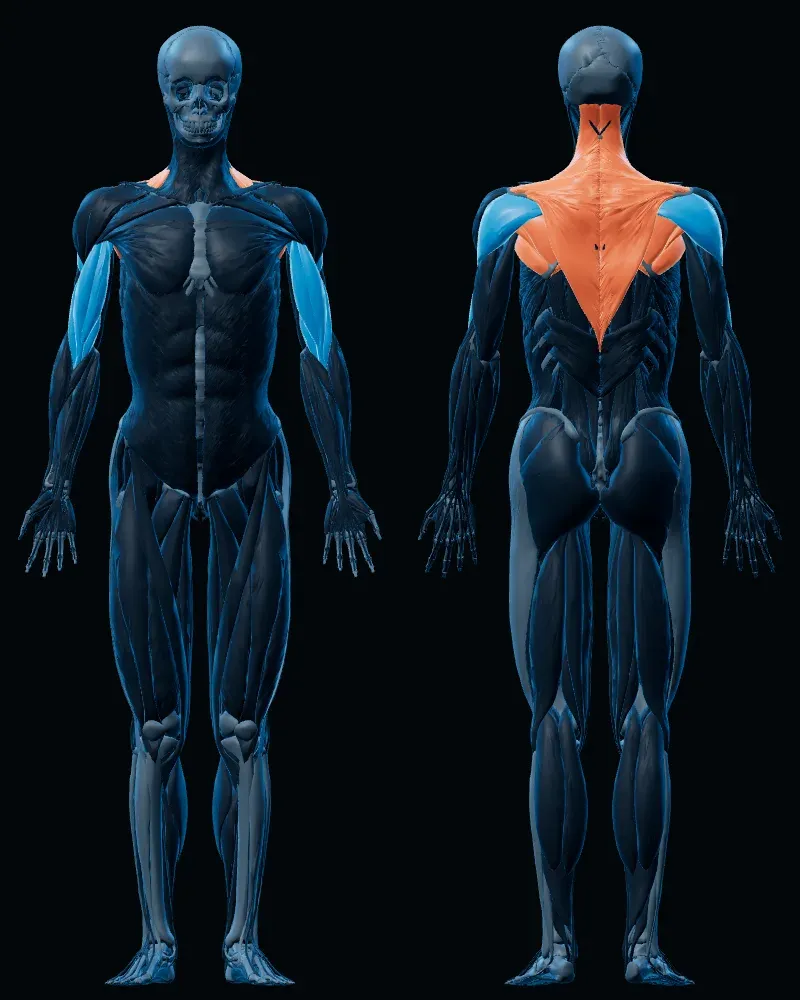
Muscles worked: upper back
Main movers: traps, rhomboids, teres major, infraspinatus and teres minor
Assisting: rear delts, biceps and brachialis
Table of contents
Yes, a home gym workout for hypertrophy works. Adjustable dumbbells, a set of bands and a doorway pull-up bar are enough to build muscle, as long as your sets are hard and you keep making them slightly harder over time. Heavy barbells are not the requirement. Effort and progression are.
This guide gives you the evidence, a 4-day plan, and a practical way to keep progressing when your dumbbells top out. It sits inside our complete guide to workout splits and session architecture, so if you want the bigger picture on how to organise a week, start there.
Can you build muscle with dumbbells only?
For most people, yes. The reason is that hypertrophy does not seem to depend on one magic load.
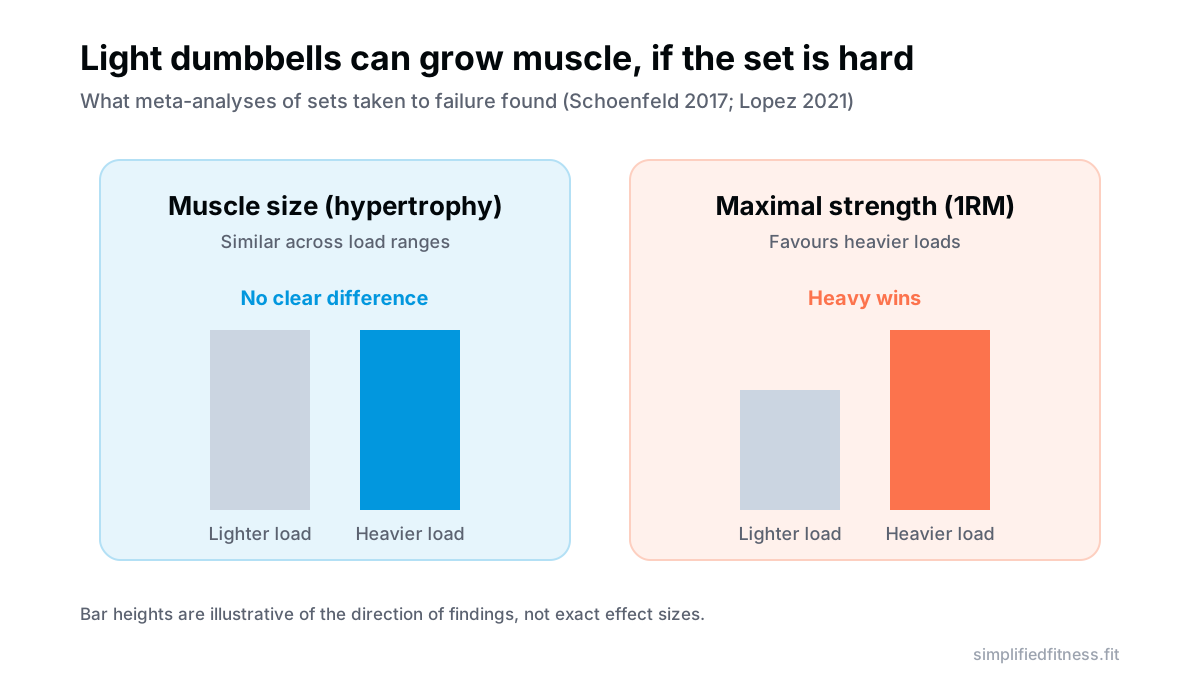
A 2017 systematic review and meta-analysis of 21 studies compared low-load (60% of 1RM or less) and high-load training, with all sets taken to failure. Changes in muscle hypertrophy were similar between the two, while gains in 1RM strength favoured heavier loads (Schoenfeld et al., 2017). A 2021 network meta-analysis of 28 studies and 747 healthy adults reached the same verdict: hypertrophy looked load independent, strength was better with high loads, and untrained people grew more than trained ones (Lopez et al., 2021).
Authors of a 2021 review argue that muscle growth can be obtained across a wide spectrum of loading zones, which challenges the old “8-12 reps for size, 15+ for endurance” rule (Schoenfeld et al., 2021).
There is a catch, and it matters at home. In an 8-week trial in 25 untrained men, light-load training (30% 1RM) to failure grew the quadriceps by about 7.8%, while light-load training stopped short of failure grew it by only 2.8% (Lasevicius et al., 2022). That was untrained men training one muscle group, so don’t treat the numbers as universal. The message holds though: light weights work if the set is genuinely hard.
What equipment do you actually need?
Keep it boring and cheap.
- Adjustable dumbbells. The single most useful purchase. Check the top weight: many pairs max out too low for legs.
- A doorway or wall-mounted pull-up bar. It gives you vertical pulling, which is the hardest pattern to replace.
- 2-3 loop bands of different thickness. Useful for pushdowns, face pulls, leg curls and making push-ups harder.
- A floor mat. For hip thrusts, floor presses and general comfort.
- A sturdy chair, sofa edge or bench. For split squats, incline work and chest-supported rows.
Budget in India: a good adjustable pair and a pull-up bar cost far less than a year of most gym memberships, but prices vary a lot by brand and city, so compare before you buy. If the bar is a doorway type, make sure the frame and mounting are rated for your body weight.
How does progressive overload work at home?
Progressive overload means asking more of the muscle over time. Adding weight is one way. At home you will run out of that lever first, so use the others.
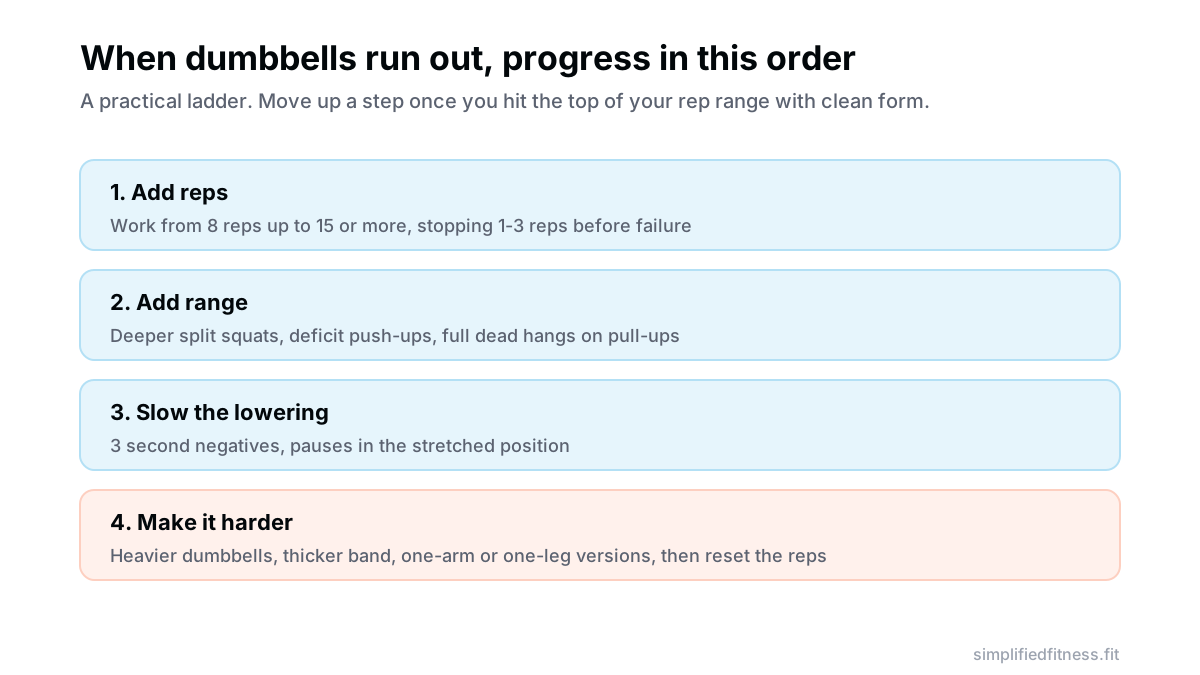
Here is how it looks in practice. You do dumbbell shoulder presses for 3 sets of 8. Next week you manage 9, 8, 8. A fortnight later it’s 10, 9, 9. When you can hit 12-15 clean reps across the board, that is your cue to use heavier dumbbells or a harder variation and drop back to 8.
Four things to know:
- Reps are real progress. Because load and hypertrophy are largely uncoupled in the research above, getting from 8 to 15 reps at the same weight is a legitimate overload.
- Range counts. A systematic review of range of motion found full range appeared to benefit lower-body hypertrophy compared with partial range, while upper-limb evidence was limited and conflicting (Schoenfeld and Grgic, 2020). So deepen your split squats before you cut depth.
- Tempo is free. A 3 second lowering makes a light dumbbell feel much heavier. No evidence we found says it is superior to normal tempo for growth, so use it as a way to keep sets hard, not as a magic trick.
- Single-limb versions multiply load. A one-leg movement turns the same pair of dumbbells into a much heavier challenge for the working leg.
Our deeper guide on progressive overload, deloads and plateaus covers what to do when progress stalls.
How hard should each set be?
Close to failure, but not necessarily to it.
A 2023 meta-analysis of 15 studies found a trivial advantage for training to “set failure” versus non-failure, and no advantage specifically for momentary muscular failure (Refalo et al., 2023). In plain terms, you do not need to grind every set into the ground, and the authors suggest the relationship between effort and growth may not be linear.
A workable rule at home: stop most sets with 1-3 reps in reserve, and take the final set of an exercise closer to failure. With light weights, lean towards the harder end, because the Lasevicius trial above suggests easy light sets underperform. Our guide to rep ranges, RIR and rest intervals goes deeper, and you can use the RIR and RPE calculator to practise estimating effort.
How many sets do you need per week?
More hard sets tend to give more growth, with diminishing returns.
A 2017 meta-regression of 15 studies found a graded dose-response: each additional weekly set was associated with an increase in muscle gain of about 0.37%, and higher-volume groups gained about 3.9% more than lower-volume groups. Categorising volume as under 5, 5-9 and 10 or more sets per muscle showed a trend towards more growth with more sets (P = 0.074) (Schoenfeld et al., 2017). Most of those studies were short, so the numbers do not tell you what is sustainable for years.
Practical home target: roughly 8-12 hard sets per muscle per week to start, split across two sessions. Count them with the training volume calculator, and see our weekly set volume dose-response guide for how to tune it.
What does a 4-day home gym plan look like?
An upper/lower split fits a small space well. Each muscle trains twice a week, sessions stay under an hour, and you only need a few exercises per session. For the reasoning behind this layout, see our upper/lower split guide.
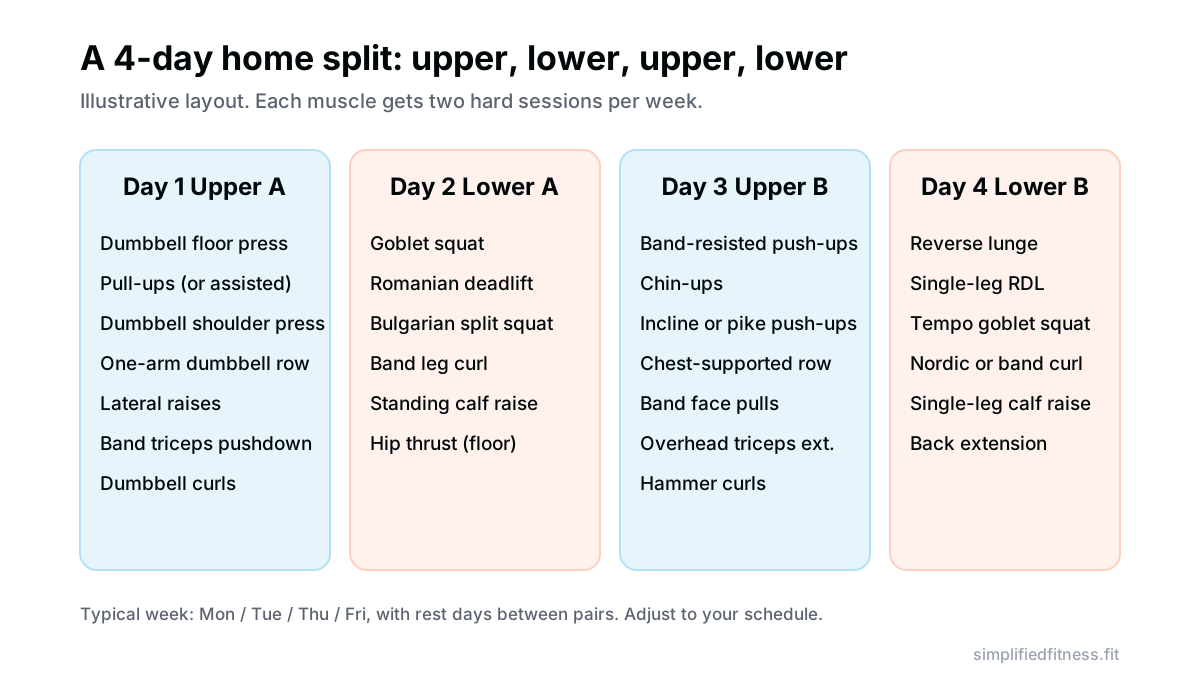
Use 3 sets per exercise as a starting point. Aim for 6-12 reps on dumbbell moves and 12-20 on band moves and calves, and adjust to what makes the set hard.
Upper body specifics
Push. A floor press or push-up variation is the horizontal press. Push-ups become more demanding by elevating your feet, adding a band across the back, or slowing the lowering. Our push-up progressions guide walks through them. A band-resisted push-up is a common and reasonable way to progress, although we did not find long-term hypertrophy trials on that exact variation.
Pull. Pull-ups and chin-ups are your vertical pull. If you cannot do them yet, use a thick band for assistance or slow negatives. Add a one-arm dumbbell row for horizontal pulling. Compare the two grips in pull-ups vs chin-ups.
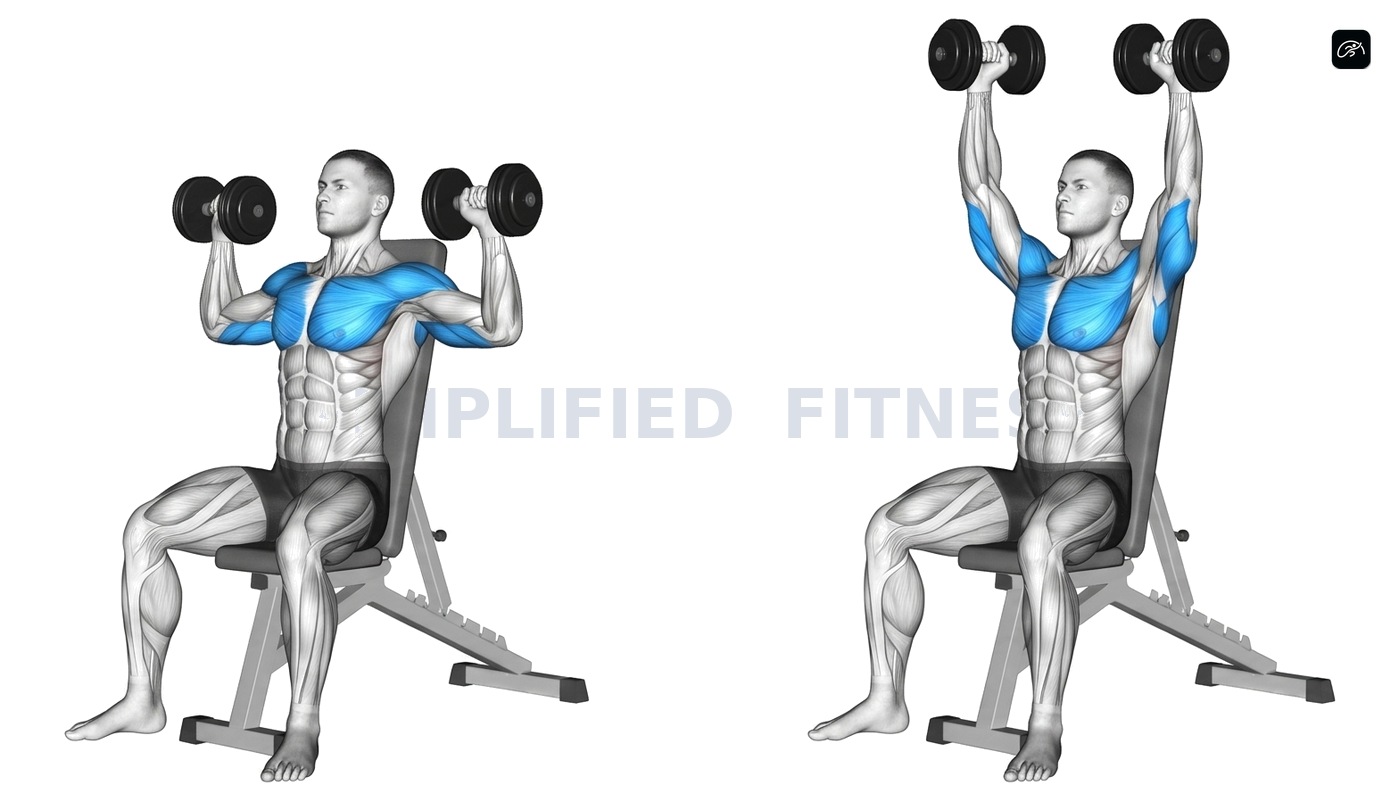
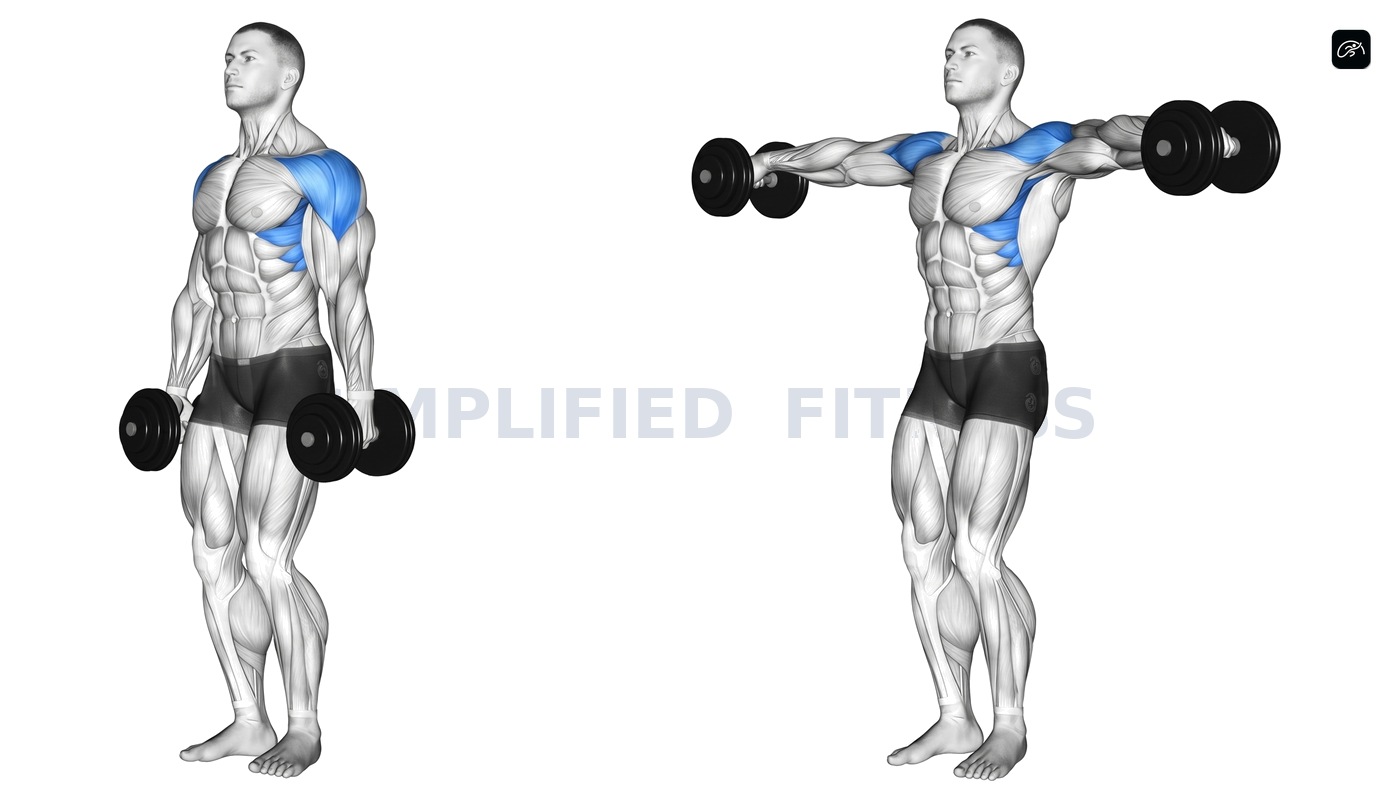
Shoulders and arms. Dumbbell presses, lateral raises and band face pulls cover the shoulders. Curls and overhead triceps extensions finish the arms. Lateral raises and curls are excellent at home because light dumbbells actually suit them.
Lower body specifics
This is where most home plans fall apart, because a pair of dumbbells is too light for a heavy squat. The fix is single-leg work. Bulgarian split squats, reverse lunges and single-leg Romanian deadlifts get hard fast. More detail is in our guide to Bulgarian split squats and lunges. A band around the feet can add a hamstring curl, and floor hip thrusts handle the glutes.
Are lengthened partials useful with light dumbbells?
They are a useful tool, not a miracle.
A within-participant 2025 trial in 30 resistance-trained people compared lengthened partials with full range over 8 weeks of upper-body training and found similar muscle thickness gains, with Bayes factors providing moderate support for equal improvement (Wolf et al., 2025). A larger 12-week multi-site randomised trial with 297 participants likewise found that differences in arm and thigh muscle area between lengthened-partial and full range of motion were likely small; the authors judged them practically equivalent, although the result did not clear their strict statistical threshold for formal equivalence (Gschneidner et al., 2025).
So both approaches appear reasonable. The practical use at home is simple: when you cannot go heavier, finish a set with a few reps in the stretched half of the movement, such as the bottom of a dumbbell curl or split squat. We cover this fully in the lengthened partials guide.
What about resistance bands?
Be honest about what you do and do not know.
Bands change resistance as they stretch, so they are hardest at the end of the movement and easiest at the start. That makes them natural for finishing positions such as face pulls and pushdowns, and weaker for loading the stretched position. That is mechanical reasoning, not a trial result. We did not find strong long-term trials in healthy trained lifters comparing band training with free weights for hypertrophy, so use bands to add variety and assist, and lean on dumbbells and bodyweight for your hardest sets.
A note on safety
Home training has fewer safety nets. Without a spotter, stop sets short of risky failure on overhead and bench-style presses, and choose movements where you can safely drop the weight. Check your pull-up bar and anchor points before loading them.
Persistent joint pain, chest pain, dizziness or numbness during exercise needs a doctor, not a new program. If you have a medical condition or an injury, get advice before you start.
Putting it together
Pick your four sessions. Hit roughly 8-12 hard sets per muscle per week. Log every set. Add a rep, a bit of range, a slower lowering or a harder variation each week or two, and bump the weight when you reach the top of your rep range. Eat enough protein: our protein calculator will give you a starting target.
That is the entire plan. The equipment is the easy part. Showing up and pushing the sets is the hard part.
Frequently Asked Questions
Can you build muscle with dumbbells only?
Yes, for most people dumbbells alone can build a lot of muscle. A network meta-analysis of 28 studies found no differences in hypertrophy between low, moderate and high loads when sets were taken to failure. Pick exercises you can load safely, take sets close to failure, and add reps or harder variations when the weight stops going up.
Do you need heavy weights to build muscle?
No. Hypertrophy appears to be similar across a wide range of loads, while maximal strength favours heavier training. The catch is effort: light sets work when they are taken close to failure. Aim for 1-3 reps in reserve on your last set.
How do I progressive overload at home?
Progressive overload means giving the muscle a slightly greater challenge over time, and weight is only one lever. You can add reps, deepen the range, slow the lowering phase, move to single-limb versions, or shorten rests. Change one thing at a time and log it so you can see the trend.
Can resistance bands replace weights?
Bands can provide a real training stimulus, but we did not find strong long-term hypertrophy trials comparing them directly with free weights, so treat them as a useful tool, not a proven equal. Resistance rises as the band stretches, which makes them better for finishing positions than for the stretched position. Combine them with dumbbells and bodyweight work, and use thicker bands or double them as you get stronger.
Is a doorway pull-up bar enough for back training?
It covers the vertical pulling pattern very well, which is hard to get with dumbbells. You still want a horizontal pull, so add one-arm dumbbell rows or band rows. Check that the bar and door frame are rated for your body weight.
How many sets per week do I need for each muscle?
More hard sets generally produce more growth up to a point. A 2017 meta-regression linked each additional weekly set to about 0.37% more muscle gain, and splitting volume into under 5, 5-9 and 10+ sets per muscle showed only a trend towards more growth with more sets. Start around 8-10 and add sets only if recovery and progress allow.
How often should I train each muscle at home?
Twice a week is a practical default. It lets you spread volume across two sessions, which keeps sets higher quality than cramming them into one. A 4-day upper/lower split does this without extra complexity.
Are lengthened partials good for home workouts?
They can be a handy way to keep exercises hard when the dumbbells are light. Two 2025 trials found similar growth between lengthened partials and full range of motion, so they look like a reasonable option, not a replacement for full range. Use them as a finisher on safe, stable exercises.
How do I train legs without a squat rack?
Use single-leg work such as Bulgarian split squats, reverse lunges and single-leg Romanian deadlifts, which become hard quickly with modest loads. Add slow lowering and pauses. A heavy backpack can add load for goblet-style movements.
How long should a home workout take?
Most people do well with 45-60 minutes, four times a week. Shorter, focused sessions work if the sets are hard. Stop when form degrades, not when the clock says so.
How do I know I am progressing without a gym scale?
Track reps, load and variation in a notebook, and compare the same lift every 2-4 weeks. Rising reps at the same weight is progress. Measure body weight and waist weekly if you also want body composition trends.
Should I take every set to failure at home?
Not necessarily. A 2023 meta-analysis found no evidence that training to momentary failure beats stopping short of it for hypertrophy. Keeping 1-3 reps in reserve on most sets, with the last set of an exercise closer to failure, is a sensible approach.
Sources & References
Every claim above is checked against peer-reviewed research (PubMed, U.S. National Library of Medicine) or guidance from established health bodies. How we fact-check.
- Schoenfeld BJ, et al. Strength and Hypertrophy Adaptations Between Low- vs. High-Load Resistance Training: A Systematic Review and Meta-analysis. J Strength Cond Res. 2017. PMID: 28834797
- Lopez P, et al. Resistance Training Load Effects on Muscle Hypertrophy and Strength Gain: Systematic Review and Network Meta-analysis. Med Sci Sports Exerc. 2021. PMID: 33433148
- Schoenfeld BJ, et al. Loading Recommendations for Muscle Strength, Hypertrophy, and Local Endurance: A Re-Examination of the Repetition Continuum. Sports (Basel). 2021. PMID: 33671664
- Lasevicius T, et al. Muscle Failure Promotes Greater Muscle Hypertrophy in Low-Load but Not in High-Load Resistance Training. J Strength Cond Res. 2022. PMID: 31895290
- Schoenfeld BJ, et al. Dose-response relationship between weekly resistance training volume and increases in muscle mass: A systematic review and meta-analysis. J Sports Sci. 2017. PMID: 27433992
- Refalo MC, et al. Influence of Resistance Training Proximity-to-Failure on Skeletal Muscle Hypertrophy: A Systematic Review with Meta-analysis. Sports Med. 2023. PMID: 36334240
- Schoenfeld BJ, et al. Effects of range of motion on muscle development during resistance training interventions: A systematic review. SAGE Open Med. 2020. PMID: 32030125
- Wolf M, et al. Lengthened partial repetitions elicit similar muscular adaptations as full range of motion repetitions during resistance training in trained individuals. PeerJ. 2025. PMID: 39959841
- Gschneidner D, et al. The effects of lengthened-partial range of motion resistance training of the limbs on arm and thigh muscle area: A multi-site randomised trial. J Sports Sci. 2025. PMID: 41055237

Umair Hazrami · Founder & Head Coach, Simplified Fitness
Umair Hazrami founded Simplified Fitness and the Simplified Lifter channel to cut through fitness noise. With 4+ years of consistent training and 10+ coaching clients, he writes every guide from the peer-reviewed research and links the sources so you can check them. Our editorial standards.
Educational content only, not medical advice. If you have a medical condition, are pregnant, or take medication, talk to a qualified doctor before changing your diet, supplements or training. Full disclaimer.
Keep reading

Programming
2-Day per Week Lifting Programs: Minimum Effective Dose for Busy Professionals
Can a 2 day a week workout routine hypertrophy goals support? Yes. Get a ready two-day full-body plan, the research behind it and how to run it in 60 minutes.
9 min read
Programming
30-Minute High-Density Hypertrophy Sessions: Micro-Workouts for Time-Constrained Lifters
Can a 30 minute workout for muscle growth work? See how paired sets, Myo-reps and machine setups fit 16 hard sets into half an hour, plus a 4-day plan.
10 min read
Programming
The 7-Minute Dynamic Warm-Up: A Fast Routine to Prep Joints Before Lifting
A dynamic warm up for lifting takes about 7 minutes, not 25. See the 2-3-2 routine, what the research says about stretching and foam rolling, and what to skip.
9 min read
Programming
Antagonist Paired Sets: Cut Workout Time by About 40% Without Losing Reps
Antagonist paired sets supersets time saving explained: pairing push and pull cuts a session by roughly 40% keeping reps. Pairings and rest times included.
8 min read