Hybrid Training Scheduling: How to Pair 4 Days of Lifting with Running
Hybrid training scheduling made simple: a 4-day lifting plus 2-3 day running week, where to place hard runs, how to fuel it and what the research says.

TL;DR. The short answer
- A workable hybrid week is 4 lifting days (Upper/Lower) plus 2-3 runs, with the hard run kept off heavy leg days and never placed the day before one if you can avoid it.
- Concurrent training does not erase muscle gain for most people. An umbrella review of 17 meta-analyses found strength, power and hypertrophy outcomes were comparable to lifting alone in recreationally trained adults.
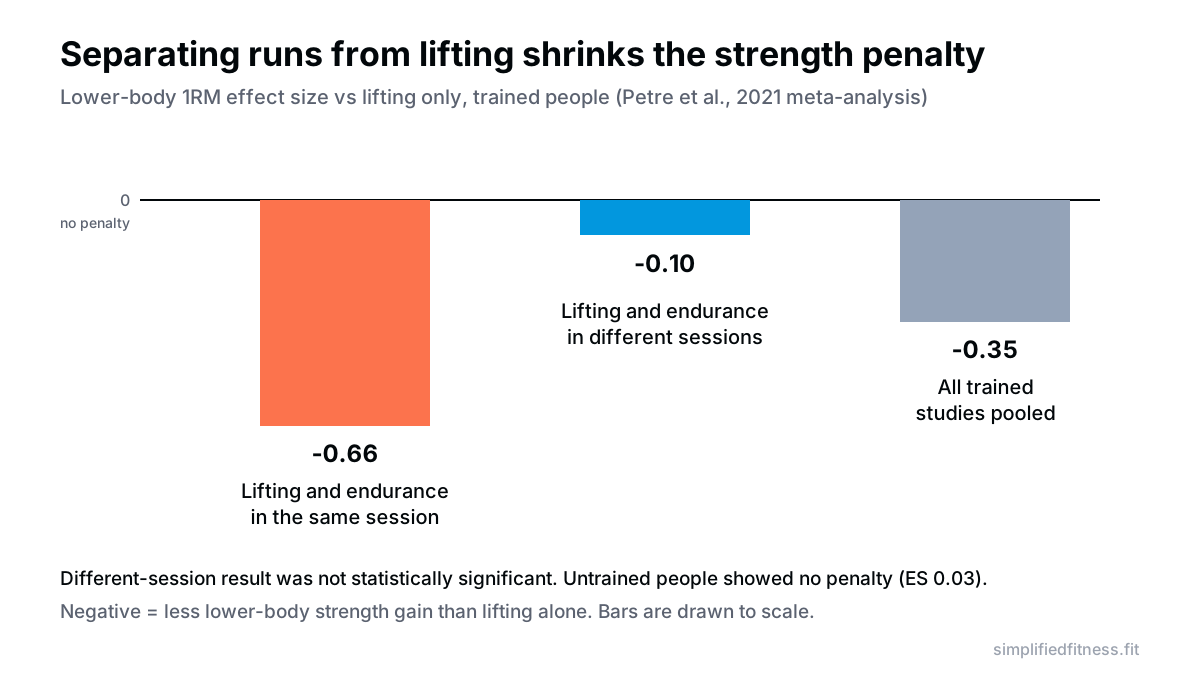
- Interference is mostly a running, high-volume and same-session problem. In trained lifters, the lower-body strength penalty was larger when lifting and endurance shared a session (effect size -0.66) than when they were split (-0.10, not significant).
- If you must combine them in one session, lift first. A meta-analysis found a lifting-then-endurance order gave about 6.9% more lower-body dynamic strength than the reverse.
- Eat enough overall: protein around 1.4-2.0 g/kg per day (ISSN) and enough carbohydrate to cover your runs. Under-eating is what usually breaks a hybrid plan.
Part of our complete guide: Best Workout Split for Muscle Growth: PPL vs Upper/Lower vs Full Body, What the Research Says
Table of contents
Good hybrid training scheduling comes down to one rule: give your legs one hard thing at a time. Lift four days a week (Upper/Lower), run two or three days, and keep your hard run away from heavy squat and deadlift days. Do that, eat enough, and most recreational lifters can build muscle and a decent 5k or 10k together.
This is a practical calendar article inside our guide to workout splits and session architecture. We will cover the weekly layout, why it is built that way, what the research on interference says, and how to fuel it. For the molecular detail of why running and lifting compete, see the AMPK and mTOR interference explainer.
What is a good hybrid athlete workout schedule?
Here is a template. It assumes the 4-day Upper/Lower split as the lifting backbone.
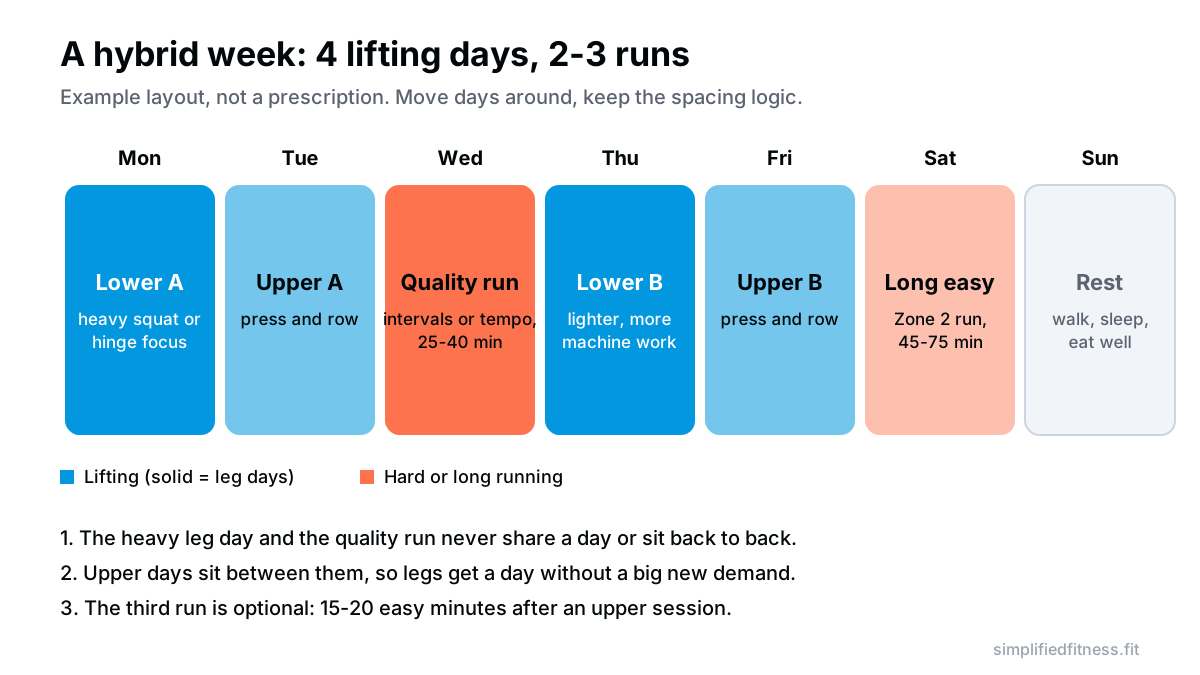
- Monday, Lower A: your heavy leg day. Squat or leg press, a hinge, a few accessories.
- Tuesday, Upper A: presses and rows. Legs get a break from big loads.
- Wednesday, quality run: intervals or a tempo, 25-40 minutes. Beginners make this an easy run too.
- Thursday, Lower B: lighter and more machine-based. Think leg curls, hip thrusts, single-leg work.
- Friday, Upper B: second upper session.
- Saturday, long easy run: conversational pace, 45-75 minutes.
- Sunday: rest, walk, sleep.
Want a third run? Add 15-20 easy minutes after an upper session. That is it. Do not add it to a leg day.
The most common mistake here is treating every run as a workout. Most of your running should feel easy enough to chat through. If you want the aerobic base without the leg damage, our piece on Zone 2 cardio for lifters goes deeper, and the heart rate zone calculator gives you a starting range.
Does running kill your gains? What the research says
Short answer: not for most people, but it is not free either. Here is what different studies found.
What the reassuring studies found. An umbrella review pooled 17 meta-analyses covering 144 studies in healthy adults. Compared with lifting alone, concurrent training gave comparable strength, power and hypertrophy outcomes, and it improved aerobic capacity (Held et al., 2026). The authors point to recreationally trained people as the group this applies to, and note data on elite athletes is scarce.
What the cautious studies found. The 2012 Wilson meta-analysis (21 studies) reported mean hypertrophy effect sizes of 1.23 for lifting alone and 0.85 for concurrent training. It also found that running, but not cycling, was linked to decrements in hypertrophy and strength, and that more frequent and longer endurance work meant more interference (Wilson et al., 2012). A 2022 meta-analysis of 15 studies looking at muscle fibre size found a small negative effect of adding aerobic work (standardized mean difference -0.23), more clearly for type I fibres when the aerobic work was running (Lundberg et al., 2022).
Why they may disagree. They measure different things. Whole-muscle size, fibre size and 1RM strength do not always move together. The studies also mix untrained students with trained athletes, and they use very different running doses.
Practical takeaway. If you are a recreational lifter running a few easy sessions a week, the evidence says you can progress. If you are chasing a strength peak, the penalty is a bit more likely and worth managing with the scheduling below. We cover the wider debate in does cardio kill gains.
Who gets hit hardest by interference?
Training status matters. In a meta-analysis of 27 studies on lower-body 1RM, concurrent training reduced squat and leg press strength in trained people (effect size -0.35), but not in moderately trained (-0.20, not significant) or untrained people (0.03) (Petré et al., 2021).
Sex may matter too. A 2024 review of 59 studies found blunted lower-body strength gains in males (-0.43) but not females (0.08), with no sex difference for upper-body strength, power or VO2max. It also found hypertrophy data were too thin to conclude anything (Huiberts et al., 2024). Note that far fewer women were studied, so treat this as a pointer, not a promise.
For you, the takeaway is simple. The stronger and more advanced you are, the more it pays to schedule carefully.
Should you run on a separate day from lifting?
If you can, yes. The same Petré analysis found that the penalty in trained lifters showed up mainly when lifting and endurance shared a session (effect size -0.66), while separate sessions were close to neutral (-0.10, not significant) (Petré et al., 2021).
Real life does not always allow it. If you only have one slot a day:
- Lift first, run second. A meta-analysis of 10 studies found a resistance-then-endurance order gave about 6.9% more lower-body dynamic strength than the opposite order, with no difference in lower-body hypertrophy (Eddens et al., 2018).
- Keep the run easy after a leg day.
- Prefer upper-body days for the run add-on.
The umbrella review saw no significant sequence effect overall, only a trend favouring lifting first (Held et al., 2026). So the evidence is suggestive, not iron-clad. For more on the timing question, see timing cardio and weights: before, after or separate days.
Running vs cycling: which suits a lifter better?
The research leans toward cycling being gentler on lifting adaptations. Wilson et al. found a decrement with running but not cycling (Wilson et al., 2012), and Lundberg et al. saw the fibre-size signal only with running (Lundberg et al., 2022). Both are indirect comparisons across different studies, so the evidence is limited.
But if your goal is a 5k or 10k, you have to run. So the practical approach is: run specifically for your goal, and use a bike or incline walk for extra easy volume. We compare them in cycling vs running for lifters.
How do I manage leg recovery in a hybrid week?
Think in terms of total stress. Every hard leg session, hard run and poor night of sleep draws from one account.
- Count your hard days. Heavy lower sessions plus quality runs add up to your hard leg days. Aim for no more than three in a week, and fewer if you are new.
- Make Lower B lighter. Fewer sets close to failure, more machines, less spinal load.
- Hold running volume steady while you add lifting load, and vice versa. Change one thing at a time.
- Watch the signals. Heavier-feeling warm-ups, stalled lifts across two weeks and a resting heart rate creeping up all say the same thing: back off a run first.
- Sleep. Seven to nine hours is a sensible target for most adults.
If you ever have chest pain, fainting, unusual breathlessness or palpitations during running, stop and see a doctor. That is not something to train through.
How should I fuel lifting plus running?
You are asking your body for two things, so food has to go up a bit, not down.
Protein. The ISSN position stand says 1.4-2.0 g/kg per day is sufficient for most exercising people, and that endurance athletes should focus on adequate carbohydrate (Jäger et al., 2017). For a 70 kg person, that means about 98-140 g of protein a day. Use the protein calculator to get your own number.
Carbohydrate. The joint position statement from the ACSM, the American Dietetic Association and Dietitians of Canada makes the same general point: eat adequately before, during and after exercise to maintain blood glucose and speed recovery (ACSM et al., 2000). It is an older statement, but the basic point still stands. In practice that means not skipping carbs before a run or a leg day.
What that looks like in India:
- Before a long run: a banana with a few dates, or poha, or a roti with a spoon of peanut butter.
- After: rice or roti, dal, curd, and paneer or eggs. Vegetarian lifters can get to their protein target using dal, paneer, curd, soya chunks and milk, but it takes planning.
- In heat: water through the day, add salt or nimbu pani on long runs.
Our free diet plan is a decent starting template, and you can adjust portions up around run days.
What about the health benefits of running itself?
Running is worth doing for reasons beyond race times. A 2020 meta-analysis of 14 cohort studies (232,149 people) found that running was associated with 27% lower all-cause mortality, 30% lower cardiovascular mortality and 23% lower cancer mortality than no running, and found no clear dose-response trend. Any amount, even once a week, was better than none (Pedisic et al., 2020).
This is observational data, so it shows association, not proof of cause. But it is a good reason not to overdo running for health alone. Two or three easy runs fit the pattern.
A simple way to start
- Pick the 4-day Upper/Lower split and keep your current lifting numbers as the baseline.
- Add the Saturday long easy run first, at 30-45 minutes.
- After two weeks, add the Wednesday run, easy at first.
- If lifting stalls for two weeks, drop the Wednesday run to easy or remove it.
- Raise food around the runs before you chase pace.
For a plan geared at a specific race, our lifting plus 5k/10k programming guide goes deeper. And if you need a lifting template to start with, try our free workout plans.
The bottom line
Hybrid training works for most recreational lifters. The interference effect is real but small, mostly shows up with running, high volume and same-session training, and is easiest to manage by spacing sessions and eating enough. Keep hard runs off leg days, make most miles easy, and let the lifting numbers tell you whether the balance is right.
This article is general information, not medical advice. If you have a heart condition, joint problems or have been inactive for a long time, check with a doctor before starting a running plan.
Frequently Asked Questions
What is a good hybrid training schedule for 4 days of lifting?
A simple layout is Lower A on Monday, Upper A on Tuesday, a quality run on Wednesday, Lower B on Thursday, Upper B on Friday, a long easy run on Saturday and rest on Sunday. This keeps hard running away from heavy leg work and gives legs at least one lighter day between big demands. Adjust the days to your life, but keep that spacing.
Can you lift 4 days a week and run at the same time?
Yes, for most recreational lifters. An umbrella review of 17 meta-analyses reported that combined training gave comparable strength and hypertrophy to lifting alone while also improving aerobic capacity. Start with two easy runs a week and add a third only if your lifting performance holds.
Should I run before or after lifting?
If both happen in one session, lift first and run after. A meta-analysis of 10 studies found a lifting-then-endurance order produced about 6.9% more lower-body dynamic strength than endurance first, with no difference for hypertrophy. If strength is your goal, split the two into separate sessions instead.
How many hours should I separate running and lifting?
There is no exact number the research has locked in, but separate sessions beat same-session training for strength in trained people. In one meta-analysis the strength penalty was -0.66 same-session versus -0.10 across different sessions. A practical target is morning and evening, or better, different days.
Will running kill my muscle gains?
Not for most people at sensible volumes. A 2012 meta-analysis found interference depended on modality, frequency and duration, and that running hurt hypertrophy and strength more than cycling did. Keep most runs easy, keep weekly running volume modest and your gains should continue.
Is running worse than cycling for muscle growth?
It may be, in the research we have. Wilson et al. found that running, but not cycling, was linked to decrements in hypertrophy and strength, and a 2022 review of muscle fibre size found a similar signal for type I fibres. The evidence is limited, so treat cycling as a handy option on heavy-leg weeks rather than a rule.
How many runs per week can a lifter do?
Two to three runs is a sensible ceiling for a lifter who wants to keep progressing in the gym. One easy run, one longer easy run and an optional short quality session covers most 5k and 10k goals. A large 2020 meta-analysis found even once-a-week running was associated with lower mortality than none, so more is not always needed for health.
What is Zone 2 and why do hybrid athletes use it?
Zone 2 is steady, conversational-pace effort, usually the pace where you can still speak in full sentences. It builds aerobic base with low muscle damage, so it fits around leg days better than hard intervals. Use the heart rate zone calculator to estimate your range, but the talk test works fine.
Do I need to eat more as a hybrid athlete?
Usually yes. Running adds energy cost on top of lifting, and the ISSN notes endurance athletes should focus on adequate carbohydrate, with protein supporting recovery. Raise food gradually, for example an extra roti or cup of rice and a banana around runs, and watch your weight trend.
How much protein do hybrid athletes need?
The ISSN position stand says 1.4-2.0 g/kg of body weight per day is sufficient for most exercising people. For a 70 kg person that is about 98-140 g. Spread it over three or four meals using dal, paneer, curd, eggs, soya or chicken, and check your number with the protein calculator.
How do I run in Indian summer heat and still lift well?
Move runs to early morning or late evening, slow your pace and drink water through the day. Heat raises heart rate at the same pace, so judge easy runs by effort rather than speed. If you feel dizzy, stop, and see a doctor if symptoms keep happening.
What if my legs feel heavy on lower-body days?
Heavy legs usually mean running volume, intensity or food is too high for your recovery. Cut one run, make the quality session easier or drop a set or two from Lower days for a week. If it lasts more than two weeks, check sleep and calories before changing anything else.
Can beginners follow a hybrid plan?
Yes, and beginners tend to tolerate it best. In the Petre meta-analysis untrained people showed no lower-body strength penalty from adding endurance work (effect size 0.03). Begin with three lifting days and two easy runs, then build.
Sources & References
Every claim above is checked against peer-reviewed research (PubMed, U.S. National Library of Medicine) or guidance from established health bodies. How we fact-check.
- Wilson JM, et al. Concurrent training: a meta-analysis examining interference of aerobic and resistance exercises. J Strength Cond Res. 2012. PMID: 22002517
- Huiberts RO, et al. Concurrent Strength and Endurance Training: A Systematic Review and Meta-Analysis on the Impact of Sex and Training Status. Sports Med. 2024. PMID: 37847373
- Held S, et al. Maximizing Adaptations in Concurrent Training: An Umbrella Review of Meta-analyses. Sports Med. 2026. PMID: 41762427
- Petré H, et al. Development of Maximal Dynamic Strength During Concurrent Resistance and Endurance Training in Untrained, Moderately Trained, and Trained Individuals: A Systematic Review and Meta-analysis. Sports Med. 2021. PMID: 33751469
- Eddens L, et al. The Role of Intra-Session Exercise Sequence in the Interference Effect: A Systematic Review with Meta-Analysis. Sports Med. 2018. PMID: 28917030
- Lundberg TR, et al. The Effects of Concurrent Aerobic and Strength Training on Muscle Fiber Hypertrophy: A Systematic Review and Meta-Analysis. Sports Med. 2022. PMID: 35476184
- Pedisic Z, et al. Is running associated with a lower risk of all-cause, cardiovascular and cancer mortality, and is the more the better? A systematic review and meta-analysis. Br J Sports Med. 2020. PMID: 31685526
- Jäger R, et al. International Society of Sports Nutrition Position Stand: protein and exercise. J Int Soc Sports Nutr. 2017. PMID: 28642676
- American College of Sports Medicine, et al. Joint Position Statement: nutrition and athletic performance. Med Sci Sports Exerc. 2000. PMID: 11128862

Umair Hazrami · Founder & Head Coach, Simplified Fitness
Umair Hazrami founded Simplified Fitness and the Simplified Lifter channel to cut through fitness noise. With 4+ years of consistent training and 10+ coaching clients, he writes every guide from the peer-reviewed research and links the sources so you can check them. Our editorial standards.
Educational content only, not medical advice. If you have a medical condition, are pregnant, or take medication, talk to a qualified doctor before changing your diet, supplements or training. Full disclaimer.
Keep reading

Programming
2-Day per Week Lifting Programs: Minimum Effective Dose for Busy Professionals
Can a 2 day a week workout routine hypertrophy goals support? Yes. Get a ready two-day full-body plan, the research behind it and how to run it in 60 minutes.
9 min read
Programming
30-Minute High-Density Hypertrophy Sessions: Micro-Workouts for Time-Constrained Lifters
Can a 30 minute workout for muscle growth work? See how paired sets, Myo-reps and machine setups fit 16 hard sets into half an hour, plus a 4-day plan.
10 min read

Programming
The 7-Minute Dynamic Warm-Up: A Fast Routine to Prep Joints Before Lifting
A dynamic warm up for lifting takes about 7 minutes, not 25. See the 2-3-2 routine, what the research says about stretching and foam rolling, and what to skip.
9 min read

Programming
Antagonist Paired Sets: Cut Workout Time by About 40% Without Losing Reps
Antagonist paired sets supersets time saving explained: pairing push and pull cuts a session by roughly 40% keeping reps. Pairings and rest times included.
8 min read