Exercise Order in Workout Science: What to Do First in the Gym and Why
Exercise order in workout science: heavy compounds first, supported machines next, isolations last. See what the research says and when to break the rule.
TL;DR. The short answer
- Put the exercise you most want to improve first. Strength gains are largest in whichever lift sits at the start of the session, according to a 2021 meta-analysis of 11 studies.
- For most people that means heavy, balance-demanding compounds (squat, bench, deadlift) first, supported multi-joint machines second, and single-joint isolations last.
- For muscle size alone, the meta-analysis found no clear difference between starting with multi-joint or single-joint work, so order matters less for hypertrophy than for strength.
- Pre-exhaustion (isolation before compound) did not beat the normal order in the trials we found, and it can cut your reps on the big lift.
- A lagging muscle can move up the order. Treat it as a priority choice, not a rule of physiology.
Part of our complete guide: Best Workout Split for Muscle Growth: PPL vs Upper/Lower vs Full Body, What the Research Says
Table of contents
Exercise order in workout science comes down to one idea: the exercise you do first gets your best effort, so put your priority lift there. For most lifters that means heavy compounds first, supported machines second and single-joint isolations last.
That is the practical rule behind the session design covered in our guide to workout splits and session architecture. Here we look at why it works, what the research does and does not show, and when it is fine to break it.
What should you do first in the gym?
Do the exercise you most want to get better at, straight after your warm-up. In a typical session, that is a squat, bench press, deadlift or overhead press.
Why? Because everything after the first lift is done with some fatigue in the bank. A 2012 review of exercise order found that total repetitions, and so volume, are greater when an exercise is placed at the beginning of a session (Simao et al., 2012). The effect did not depend on how much muscle the exercise used.
The review also concluded that exercises should be ordered by priority for the goal of the programme, whether they involve a large or small muscle group. So “big muscles first” is a shortcut. Priority is the real rule.
The three-tier order ladder
Most programmes work well with a simple ladder. It is not a law of physiology, just a sensible way to spend your energy.
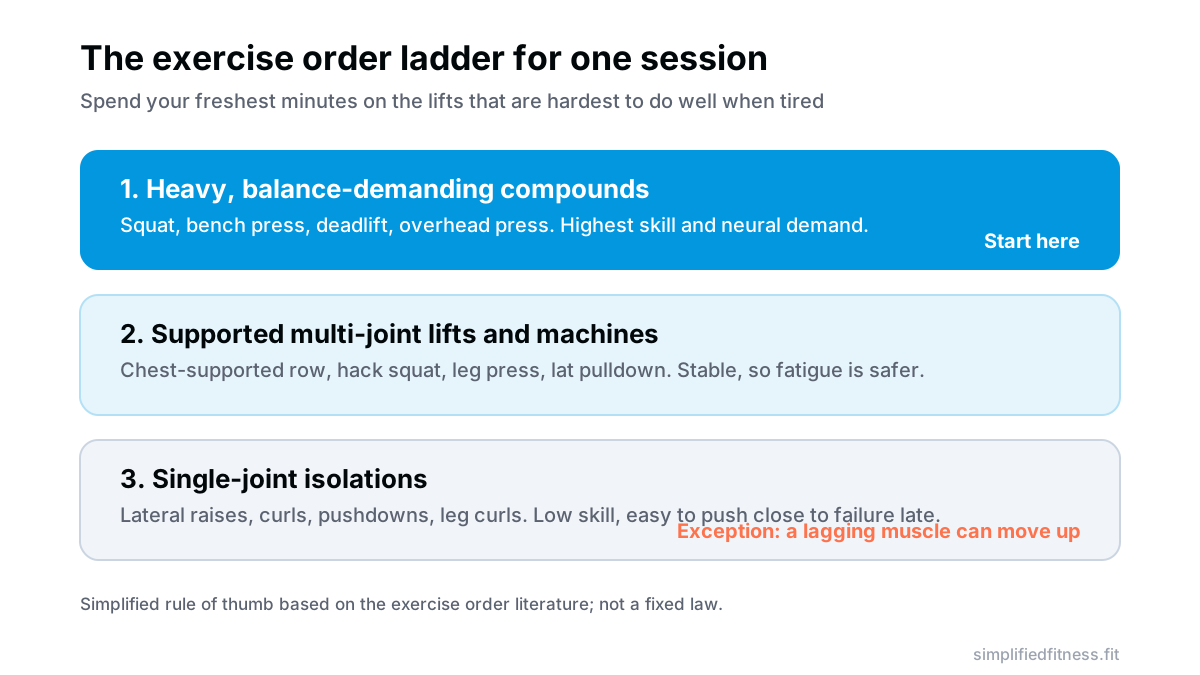
Tier 1: heavy compounds with high neural and balance demands. Squats, bench press, deadlifts, overhead press. They need coordination, bracing and a stable bar path. Technique tends to wobble first when you are tired, and a heavy squat with shaky technique is a lift you want to avoid.
Tier 2: supported multi-joint lifts and machines. Chest-supported rows, hack squats, leg press, lat pulldowns. The machine or bench holds you steady, so fatigue is less risky.
Tier 3: single-joint isolations. Curls, lateral raises, pushdowns, leg curls. Low skill, low load, and you can safely take them close to failure late in the session.
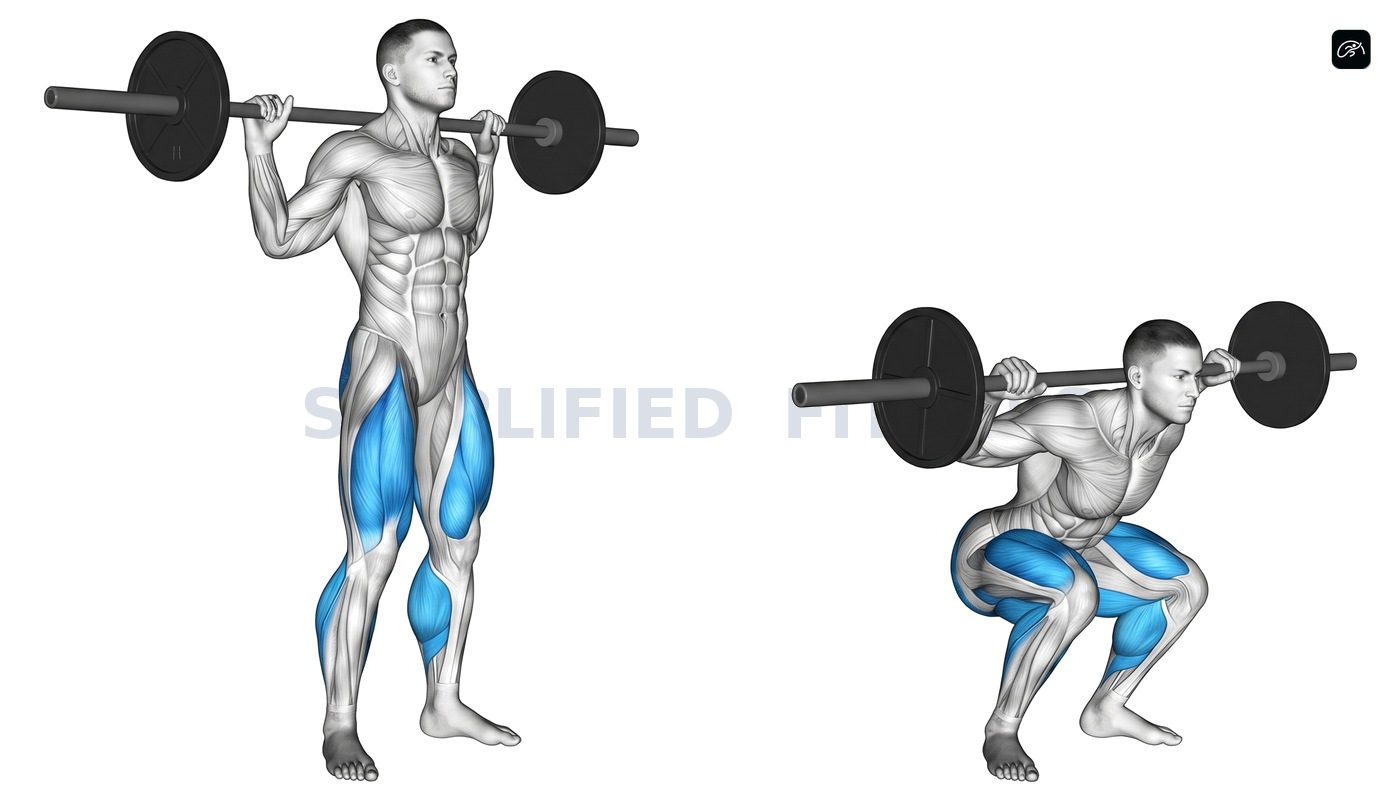
“Neural demand” is not a mystical term. It simply means how much coordination, balance and maximal effort the lift asks for. A barbell back squat is high. A cable curl is low. We cover the stimulus side of this in stimulus-to-fatigue ratio in exercise selection.
What does the research actually show?
The best evidence is a 2021 systematic review and meta-analysis of 11 studies of good to excellent quality (Nunes et al., 2021). The findings are more nuanced than gym lore suggests.
- Across all strength tests combined, there was no difference between orders (ES = -0.11).
- For strength in multi-joint exercises, starting the session with multi-joint lifts was favoured (ES = 0.32).
- For strength in single-joint exercises, starting with single-joint lifts was favoured (ES = -0.58).
- For hypertrophy, there was no significant effect of order (ES = 0.03).
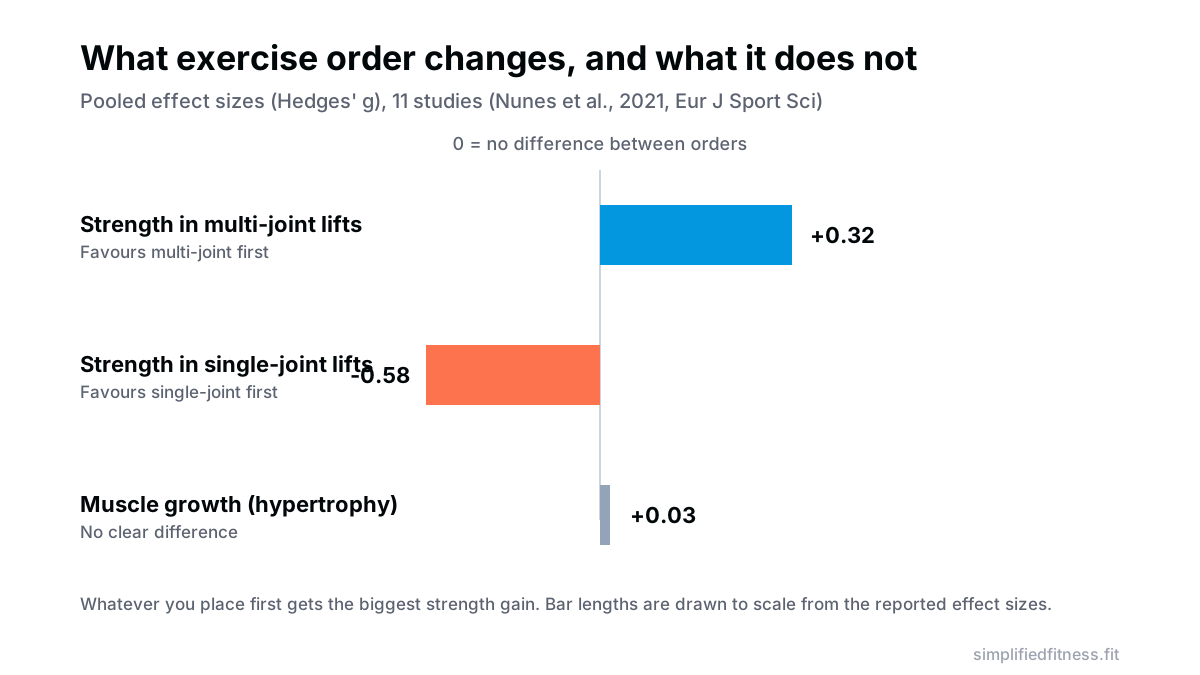
The authors’ conclusion is that strength increases are largest in exercises performed at the beginning of a session. For hypertrophy, both multi-joint-first and single-joint-first orders may produce similar results.
Read that carefully. It does not say order is irrelevant. It says order mostly decides which lift gets the strength benefit. And if your goal is purely muscle size with equal hard sets, you have more freedom than the internet suggests.
A smaller trial points the same way. In 16 trained men over 6 weeks, both groups improved 1RM on all lifts with no significant difference between groups. Effect sizes, however, favoured large-muscle-first for bench press and lat pulldown, and small-muscle-first for triceps extension and biceps curl (Assumpcao et al., 2013). Small sample, short study, and the headline test was not significant, so treat it as supporting rather than proof.
Does pre-exhaustion change the picture?
Pre-exhaustion flips the ladder on purpose: an isolation exercise right before a compound for the same muscle, such as pec deck flys before bench press. It is the obvious objection to “compounds first”, so here is the short version.
- A 2003 study of 17 men found that after a knee extension set, rectus femoris and vastus lateralis activation during the leg press was lower, and leg press reps dropped significantly (Augustsson et al., 2003).
- A 12-week trial in 39 trained participants found no significant between-group differences in strength or body composition between pre-exhaustion, the same exercises with rest between them, and a compound-first order (Fisher et al., 2014).
So pre-exhaustion can cost you reps on the big lift and has not shown a clear payoff. It is not superior, and compound-first stays the safer default. We go through the full pre-exhaustion literature in why compounds go before isolations; this article sticks to how to rank everything else in the session.
When can you break the rule?
Order is a priority tool. If something is a priority, move it up.
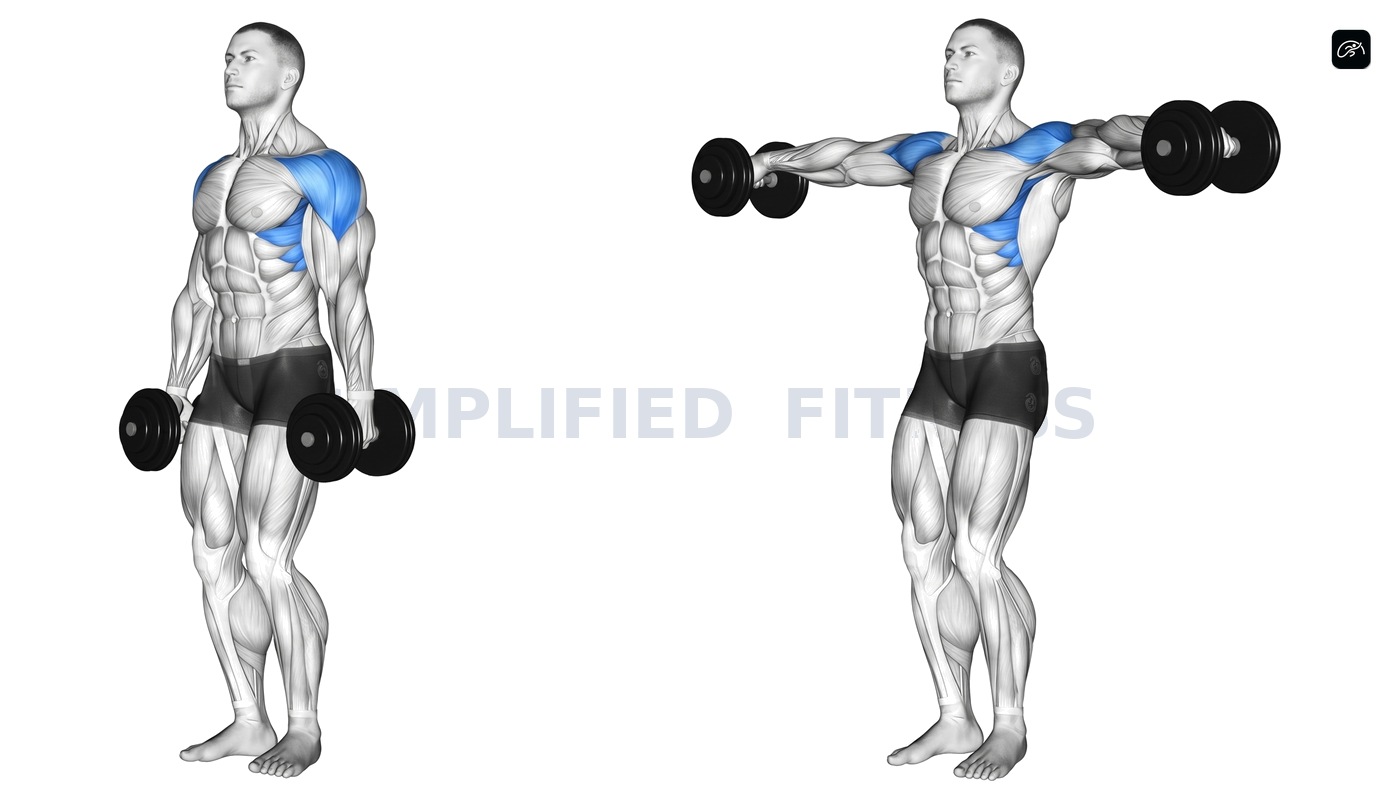
A lagging muscle. If your side delts are far behind your chest, put lateral raises first on shoulder or push day. The 2012 review’s logic supports this: order by importance for the goal. We should be honest that direct trials of “lagging muscle first” are limited, so this is a reasoned application, not a proven protocol. Run it for a block of 6-8 weeks and watch your main presses.
A skill or sport focus. If you are working on a competition bench or a specific technique, that lift goes first. Always.
A balanced pair. Some sessions, like push day, hold several exercises that compete for the same triceps and shoulders. If your triceps fail before your chest does on bench, check your arrangement. Our push day plan shows a workable order.
Time pressure. On a short day, do the first two tiers and trim isolation volume. The 30 minute high density workouts guide shows how.
How to sequence a real session
Here is a push day example in the order we would use for most people.
| Slot | Exercise | Tier | Why it sits here |
|---|---|---|---|
| 1 | Barbell or dumbbell bench press | 1 | Heavy, balance and skill demand |
| 2 | Incline dumbbell press | 2 | Stable bench, still a multi-joint lift |
| 3 | Pec deck fly | 3 | Isolation, safe to push close to failure |
| 4 | Dumbbell lateral raise | 3 | Low load, low skill |
| 5 | Triceps pushdown | 3 | Triceps already worked by presses |
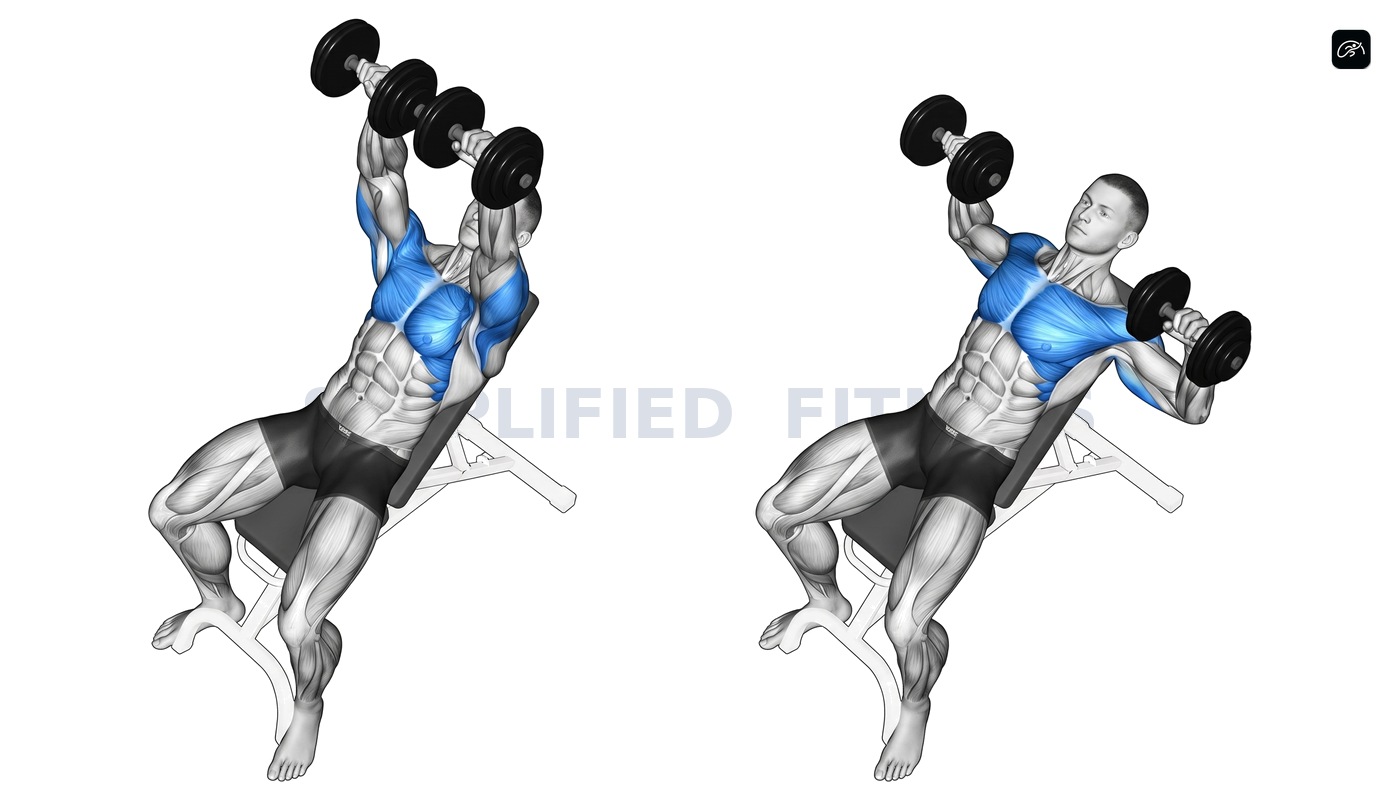
And a leg day: squat, then a leg press or hack squat, then leg curls and calf raises. Fit warm-up sets before the first lift, not as extra work. Our warm-up and ramp-up guide covers how to do that without tiring yourself.
Use the RIR and RPE calculator to keep effort sensible across the session. Most people do well taking compounds to about 1-3 reps in reserve, and isolations a little closer to failure. A 2023 meta-analysis found no evidence that training to momentary failure beats stopping short of it for muscle growth (Refalo et al., 2023), so you do not need to grind every set.
Common mistakes with exercise order
- Starting with the exercise you enjoy. Fun and priority are different things. Usually the hardest lift is the one you should do first.
- Doing isolations first “to warm up”. A lateral raise or curl will not warm up a squat. Do ramp-up sets of the actual lift.
- Changing the order every week. You lose your ability to compare. Keep it stable for a block.
- Treating order as the main lever. Weekly hard sets, effort and consistency matter more. Order is the fine-tuning.
- Piling on exercises. Seven or eight movements means the last ones get little quality. Trim instead.
To understand how fatigue builds across sets, read our piece on central vs peripheral fatigue in lifting.
Who should be careful
If you have an injury, joint pain or a medical condition, check with a doctor or physio before changing your programme. Chest pain, dizziness or sharp pain during a heavy lift means stop and get checked. This article is general education, not personal medical advice.
The bottom line
Put the exercise that matters most first. For most people that is a heavy compound, then supported multi-joint work, then isolations. The evidence says order mainly decides which lift gets the biggest strength gain, and matters less for muscle size when total hard sets stay the same.
Pre-exhaustion did not beat the standard order in the trials we looked at, so treat it as an occasional variation. If a muscle lags, move it up for a block and see what happens. Then get back to the boring work: enough hard sets, steady progression, and showing up.
Frequently Asked Questions
What exercise should I do first in my workout?
Do the exercise that matters most for your goal first, which for most lifters is a heavy compound like a squat, bench press or deadlift. A 2021 meta-analysis found strength gains were largest in the exercises placed at the start of a session. Pick your one priority lift, put it right after your warm-up, and save the rest for later.
Does exercise order matter for muscle growth?
For muscle size, the evidence says it matters less than most people think. A 2021 meta-analysis found no significant difference in hypertrophy between multi-joint-first and single-joint-first orders. Keep your total hard sets and effort the same, and use order mainly to protect your performance on the lifts you care about.
Should I do compound or isolation exercises first?
Compounds first is the sensible default. Heavy multi-joint lifts demand balance, skill and a lot of energy, so they suffer most when you start them tired, and a 2012 review found total reps are higher on an exercise placed early. Do your compound first, then isolations, unless a specific muscle is your priority.
Is pre-exhaustion training better for building muscle?
No, the trials we reviewed do not support it. A 12-week study in 39 trained people found pre-exhaustion gave no greater strength or body composition benefit than a compound-first order, and a 2003 study found it reduced leg press reps and quad activation. If you want to try it, treat it as a variation for a stubborn muscle, not an upgrade.
Should I train lateral raises before bench press?
Not usually. Lateral raises are low skill and low load, so they cost relatively little, but doing them first can still take something out of your shoulders before you press. Bench first, lateral raises after, unless your side delts are your biggest weak point, in which case do them first and keep the volume small.
What is neural demand in exercise selection?
Neural demand is how much coordination, balance and maximal effort an exercise asks of your nervous system. Squats and deadlifts score high because you stabilise a heavy load while many joints move, while a cable curl scores low. Practically, you place high-demand lifts early, while your technique and focus are sharpest.
Does the first exercise really get stronger faster?
Yes, the research points that way. In the Nunes meta-analysis, strength gains were largest in the exercises performed at the beginning of the session, for both multi-joint and single-joint lifts. A likely reason is that the first lift gets more quality reps before fatigue builds, so put your priority lift first.
How do I order exercises for a lagging muscle?
Move the lagging muscle's best exercise to the start of the session so it gets your freshest effort. A 2012 review suggests ordering by priority of importance for your goal, regardless of muscle size. Keep the change for a block of several weeks, and check whether your main lifts are suffering.
Should I do machines before or after free weights?
Free-weight compounds usually go first because they need more balance and skill. Stable machines like a chest-supported row or leg press tolerate fatigue better, so they fit in the middle of the session. If a machine is your main lift for that muscle, you can start with it.
Do I need to change the order every workout?
No. Keep a consistent order so you can track progress and compare week to week. Rotating the first exercise across a block is fine, but random reshuffling makes it hard to know what is working.
Does exercise order change for beginners?
The same logic applies, and it matters even more for safety. Beginners are still learning balance and bracing, so they should learn big lifts when fresh. Research on order includes many untrained participants, so treat the details as a guide rather than a certainty.
How many exercises should I do per session?
Most sessions work well with 4-6 exercises, which keeps quality high from first to last set. The more exercises you add, the more the last ones suffer from fatigue. If your final lift feels sloppy, trim volume before changing the order.
Sources & References
Every claim above is checked against peer-reviewed research (PubMed, U.S. National Library of Medicine) or guidance from established health bodies. How we fact-check.
- Nunes JP, et al. What influence does resistance exercise order have on muscular strength gains and muscle hypertrophy? A systematic review and meta-analysis. Eur J Sport Sci. 2021. PMID: 32077380
- Simao R, et al. Exercise order in resistance training. Sports Med. 2012. PMID: 22292516
- Fisher JP, et al. The effects of pre-exhaustion, exercise order, and rest intervals in a full-body resistance training intervention. Appl Physiol Nutr Metab. 2014. PMID: 25092528
- Augustsson J, et al. Effect of pre-exhaustion exercise on lower-extremity muscle activation during a leg press exercise. J Strength Cond Res. 2003. PMID: 12741886
- Assumpcao CO, et al. Influence of exercise order on upper body maximum and submaximal strength gains in trained men. Clin Physiol Funct Imaging. 2013. PMID: 23701174
- Refalo MC, et al. Influence of Resistance Training Proximity-to-Failure on Skeletal Muscle Hypertrophy: A Systematic Review with Meta-analysis. Sports Med. 2023. PMID: 36334240

Umair Hazrami · Founder & Head Coach, Simplified Fitness
Umair Hazrami founded Simplified Fitness and the Simplified Lifter channel to cut through fitness noise. With 4+ years of consistent training and 10+ coaching clients, he writes every guide from the peer-reviewed research and links the sources so you can check them. Our editorial standards.
Educational content only, not medical advice. If you have a medical condition, are pregnant, or take medication, talk to a qualified doctor before changing your diet, supplements or training. Full disclaimer.
Keep reading

Programming
2-Day per Week Lifting Programs: Minimum Effective Dose for Busy Professionals
Can a 2 day a week workout routine hypertrophy goals support? Yes. Get a ready two-day full-body plan, the research behind it and how to run it in 60 minutes.
9 min read
Programming
30-Minute High-Density Hypertrophy Sessions: Micro-Workouts for Time-Constrained Lifters
Can a 30 minute workout for muscle growth work? See how paired sets, Myo-reps and machine setups fit 16 hard sets into half an hour, plus a 4-day plan.
10 min read
Programming
The 7-Minute Dynamic Warm-Up: A Fast Routine to Prep Joints Before Lifting
A dynamic warm up for lifting takes about 7 minutes, not 25. See the 2-3-2 routine, what the research says about stretching and foam rolling, and what to skip.
9 min read
Programming
Antagonist Paired Sets: Cut Workout Time by About 40% Without Losing Reps
Antagonist paired sets supersets time saving explained: pairing push and pull cuts a session by roughly 40% keeping reps. Pairings and rest times included.
8 min read