The Arnold Split (Chest/Back, Shoulders/Arms, Legs): Does It Work for Natural Lifters?
Does the Arnold split workout routine work for natural lifters? See how chest/back supersets, arm days and weekly volume play out, with a 3, 5 and 6 day setup.
TL;DR. The short answer
- The Arnold split pairs chest with back, shoulders with arms, and gives legs their own day. It can work for natural lifters, but only if weekly volume is managed, because the pressing and pulling days overlap heavily with the arm day.
- Twice a week per muscle is a sensible default: one meta-analysis favoured it over once a week, while a larger one found frequency matters little when weekly sets are equal. The 6-day version (each day twice) makes it easiest to spread your sets.
- Chest/back supersets are a time saver. Trained men do more total work in less time with antagonist pairs, and longer-term studies suggest similar muscle growth to straight sets.
- Versus push/pull/legs, the main difference is how you spread fatigue. When weekly hard sets are equal, the evidence says split choice matters far less than adherence and recovery.
- If your elbows, shoulders or sleep complain on the arm day, cut sets before cutting days. Persistent joint pain or numbness is a reason to see a doctor or physiotherapist.
Part of our complete guide: Best Workout Split for Muscle Growth: PPL vs Upper/Lower vs Full Body, What the Research Says
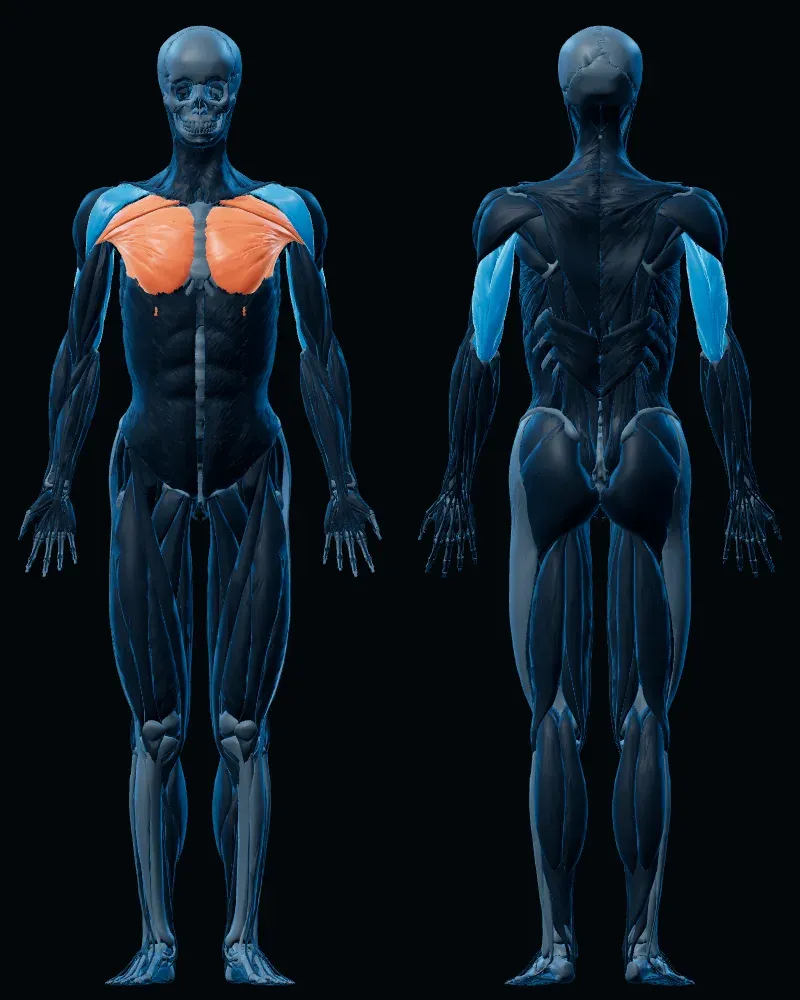
Muscles worked: chest
Main movers: pectoralis major
Assisting: front delts and triceps
Table of contents
The Arnold split workout routine can work for natural lifters, but it is easy to overdo. It trains chest and back together, shoulders and arms together, and legs on their own day, and the arm day is where most people quietly pile on too much volume.
This guide covers how the split is built, what the research says about antagonist pairing and training frequency, and how to run it on 3, 5 or 6 days without grinding yourself down. It sits inside our wider guide to workout splits and session architecture, so if you are still choosing a split in general, start there.
What is the Arnold split?
It is a three-day rotation, usually written as:
- Day 1: chest and back
- Day 2: shoulders and arms (biceps, triceps, often forearms)
- Day 3: legs (quads, hamstrings, glutes, calves, often abs)
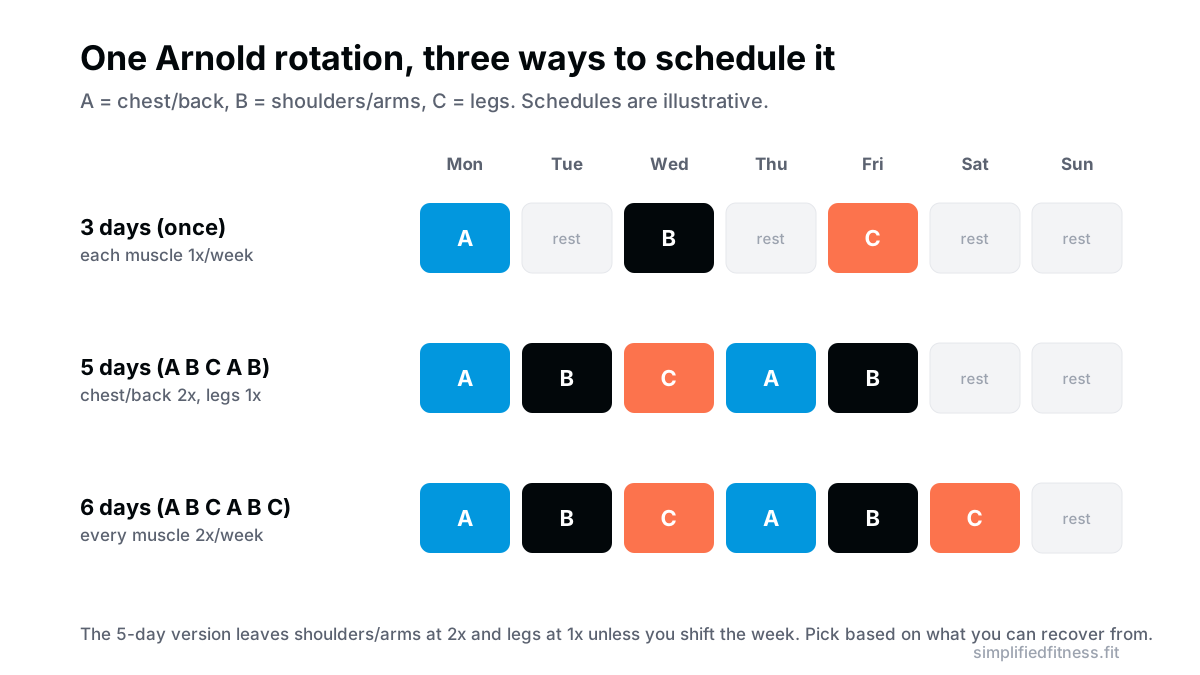
The classic version repeats the rotation twice, so you train six days and rest on the seventh. Each muscle is trained twice a week. That is the version most people picture, and it is closest to what bodybuilders popularly describe from that era.
The idea behind it is simple. Chest and back are opposing muscles, so you can alternate them and keep the session moving. Shoulders and arms are small muscles that finish the job on a day of their own. Legs get the whole session because they are big, tiring and need real effort.
Chest and back together: why antagonist pairing works
Chest (pressing) and back (pulling) work in opposite directions. While you rest from a bench press set, the muscles that pull are fresh, so you can do a row without waiting for the chest to recover. That is an agonist-antagonist paired set, or just a superset.
What do the studies show? In 15 trained men, alternating bench press and seated row produced greater volume load (weight times reps) across three sets than doing all the bench sets and then all the row sets, with 2-minute rests in both conditions (Paz et al., 2017). In another study of 16 trained men, alternating bench pull and bench press also led to more total work in the same time, and the authors judged paired sets more efficient (Robbins et al., 2010).
Both are acute, single-session experiments in men, so they show you can do more work in a given time, not that you will build more muscle. For longer-term results, a 2025 narrative review concluded that chronic data generally show supersets and traditional straight sets lead to similar hypertrophy and strength, while supersets cut session time by around half (Mang et al., 2025). The authors also note the research is quite mixed in how it defines and measures things.
On hormones, one small study of 12 recreationally trained men found acute testosterone, growth hormone and cortisol responses to paired and straight sets were broadly similar (Miranda et al., 2020). Do not read much into acute hormone blips. They are not a reliable predictor of how much muscle you will gain.
The “massive pump” part of the Arnold split’s reputation is real in the sense that you feel it, but a pump is a sensation, not a measure of growth. Judge the split by whether your reps and loads climb over weeks.
If you want the full breakdown of how to run supersets well, see our guide to antagonist paired sets and supersets for time efficiency.
How should I order exercises on chest/back day?
Put the lift you most want to improve first, while you are fresh. In a crossover study of 13 recreationally trained men, doing a pec deck before a chest press (pre-exhaustion) did not increase chest activation in the press, and total work was similar either way. Triceps activity was higher when the press came after the pec deck, which suggests the triceps may become the limiter (Gentil et al., 2007). It was one set, in a small sample.
A practical chest/back day looks like this:
- Heavy press (flat or incline dumbbell press), paired with a heavy row or pulldown
- Second press or fly variation, paired with a second pulling movement
- One isolation pair, such as pec deck with a reverse fly
Rest 60-90 seconds between the two exercises of a pair, and 1-2 minutes after the pair, so you can hit your reps. If your numbers drop hard from set to set, lengthen the rest.
Shoulders and arms day: where overlap bites
This is the day that decides whether the split works for a natural lifter. Your front delts and triceps already worked on Day 1 through every press. Your biceps already worked through every row and pulldown. Then Day 2 hits them directly.
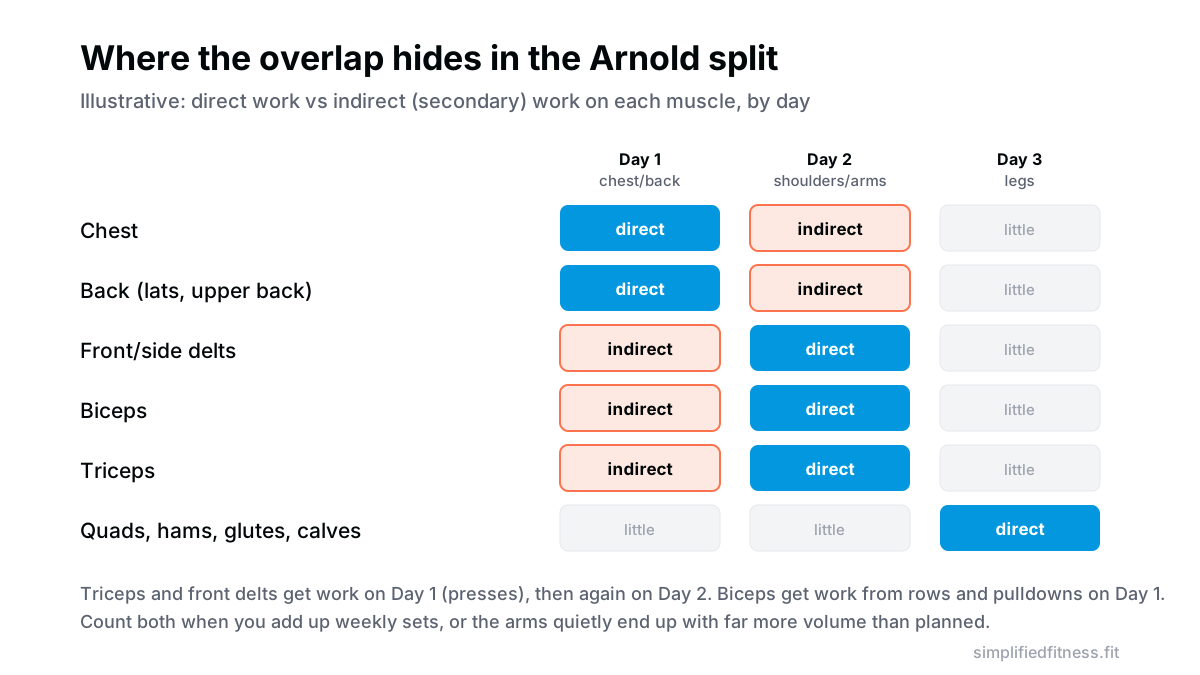
Here is the most common mistake. Someone programs 16 direct sets of triceps on arm day, forgets that bench press, incline press and dips already counted, and then wonders why the elbows hurt by week three. How many sets is too many? There is no single number, but our guide on direct vs indirect arm volume covers how to count it.
A sensible shoulders/arms day:
- 3-4 sets of an overhead press variation or a machine shoulder press
- 3-4 sets of lateral raises (side delts get little from most chest work)
- 2-3 sets of rear delt work
- 3 sets for biceps, 3 sets for triceps, optionally paired
Biceps and triceps pairs are another antagonist pairing, and fit the time-saving logic above. Our piece on antagonist arm supersets goes into that.
Legs day: keep it a real session
Legs get their own day, so use it. A solid structure is a squat or leg press, a hip hinge such as a stiff-leg deadlift, a quad isolation and a hamstring curl, then calves.
Because it falls on Day 3, you will have had two days of upper body work before it, and a rest day or a restart of Day 1 after it. In the 6-day version, legs are trained twice a week. If you start on Monday, the two leg sessions fall on Wednesday and Saturday, 3 days apart, then 4 days apart across the Sunday rest. That spacing is fine for most people. If your legs are not recovered by the second session, cut the first session’s sets before skipping the day.
Does the Arnold split work for natural lifters? Volume and frequency
The honest answer depends on two variables the research has looked at carefully.
Frequency. A 2016 meta-analysis of 10 studies found that, on a volume-equated basis, training a muscle twice a week produced greater hypertrophy than once a week (effect size 0.49 vs 0.30), and suggested major muscle groups be trained at least twice a week. Whether three times beat twice was unclear (Schoenfeld et al., 2016).
A larger 2019 meta-analysis of 25 studies then found no significant difference between higher and lower frequencies when volume was equated, including in resistance-trained people. It concluded that individuals can choose their weekly frequency per muscle based on personal preference (Schoenfeld et al., 2019).
Why the difference? The 2019 review had more studies and handled volume matching differently. Taken together, a reasonable reading is that twice a week is a safe default, and that once a week can work too if total weekly sets are high enough.
Volume. A 2017 meta-regression of 15 studies found a graded dose-response: each additional weekly set was associated with an extra 0.37% gain in muscle size, and higher-volume groups gained about 3.9 percentage points more than lower-volume groups (Schoenfeld et al., 2017). More is generally better, but that is an average across studies. It does not tell you your personal ceiling, and these trials were short.
So what does that mean for you? The Arnold split lets you use a high weekly volume across six sessions, but your recovery, sleep and food set the real limit. For a natural lifter, a starting point of roughly 10-12 hard sets per muscle per week (counting indirect sets at about half) is a cautious one. If you are recovering well and progressing, add a set or two. If your performance slides, back off. Our weekly set volume guide explains the curve in more detail.
Arnold split vs PPL
| Factor | Arnold split | Push/pull/legs |
|---|---|---|
| Sessions in a 6-day week | Chest/back, shoulders/arms, legs, twice | Push, pull, legs, twice |
| Chest and back | Same day, supersets | Separate days |
| Arms | Dedicated day | Triceps on push, biceps on pull |
| Shoulders | Own day with arms | Pressing on push day |
| Main benefit | Time-efficient torso days, arm focus | Clean separation of pressing and pulling fatigue |
| Main risk | Overlap of pressing and arm work | Long push days if you add lots of volume |
For a deeper look at PPL itself, see our push/pull/legs guide, and for how both compare with full body and upper/lower, see workout splits compared.
Given the frequency evidence above, neither split is inherently superior. If you like pairing chest and back and want a clearly labelled arm day, the Arnold split suits you. If you want to separate pressing fatigue from pulling, PPL suits you.
How to run the Arnold split without overtraining
Here are three ways, based on how many days you can actually train.
6 days (rotation twice). Closest to the classic version. Keep each session to 60-75 minutes, about 10-12 working sets per major muscle group per week at first, and one full rest day. Use the second round to repeat or slightly vary the first.
5 days. Chest/back, shoulders/arms, legs, chest/back, shoulders/arms, then two rest days. Upper body gets twice a week, legs once. Add a few more leg sets to that single session if legs are a priority.
3 days. Run the rotation once a week, spaced out (for example Monday, Wednesday, Friday). Each muscle gets one session, so each session needs more sets to reach decent weekly volume. This is workable for busy lifters, but a full body or upper/lower plan may fit better.
Food and recovery on a six-day split
Six sessions a week means more total work to recover from. A few basics help:
- Protein: spread across 3-4 meals. Dal, curd, paneer, soya chunks, eggs, chicken or fish and whey all count. Our protein calculator gives a daily target for your body weight.
- Calories: under-eating on a high-volume split is the fastest way to stall. If you are cutting, drop sets before you drop to very low calories.
- Sleep: a major recovery lever. If you are regularly sleeping under 6 hours, a 6-day split is probably too much.
- Deloads: as a rule of thumb rather than a proven interval, plan a lighter week every 6-8 weeks, or sooner if performance has dropped for two weeks.
Who should avoid or modify the Arnold split
- Beginners: simpler plans usually build the base more safely. Start with fewer sessions.
- Anyone with shoulder or elbow pain: the heavy overlap of pressing and arm work can aggravate irritated joints. Reduce volume and choose gentler variations, and see a doctor or physiotherapist for pain that is sharp, persistent, or comes with numbness or weakness.
- Lifters with limited recovery: high stress, poor sleep or demanding jobs make a 6-day plan hard to sustain. A 3-4 day plan is a smarter fit.
The bottom line
The Arnold split is a legitimate, enjoyable split built around antagonist pairing and an arm and shoulder day. The research does not say it is better than other splits, and it does not say it is worse. When weekly hard sets are matched, frequency matters little, and paired sets seem to give similar growth in less time. What matters is counting your weekly volume honestly, including the indirect sets on arms, and recovering from it.
If you want to see how much volume you are really doing, try the training volume calculator, or browse our free workout plans for a ready-made template to adapt.
Frequently Asked Questions
What is the Arnold split?
The Arnold split is a three-day rotation: chest and back together, shoulders and arms together, then legs. It is named after Arnold Schwarzenegger, who popularised high-volume bodybuilding routines. You can run the rotation once a week, or twice for a 6-day week.
Is the Arnold split good for natural lifters?
It can be, as long as total weekly sets stay inside what you can recover from. Research shows more weekly sets generally give more growth, but also that gains taper, so piling on volume has limits. Start with 10-12 hard sets per muscle per week and add only when progress stalls.
How many days a week should I do the Arnold split?
Six days a week (the rotation twice) trains every muscle twice, a sensible default that makes weekly sets easy to spread, although a 2019 meta-analysis found frequency matters little when volume is equal. Five days works if you accept that some muscles get hit less often. Three days works for beginners or busy lifters, but each muscle then gets one session per week.
Arnold split vs PPL: which is better?
Neither is clearly better. A 2019 meta-analysis found that when volume is equal, training frequency does not meaningfully change muscle growth, so you can choose by preference. The Arnold split gives dedicated arm and shoulder time, while PPL spreads pressing across pushes and separates back from chest.
Why pair chest and back together?
They are antagonists, so one muscle can recover while the other works. Studies in trained men show paired sets let you complete more total work in the same time. It also keeps the session efficient, which helps if you only have an hour.
Do chest and back supersets build more muscle?
Not necessarily more, but the same in less time. A 2025 narrative review concluded supersets and traditional sets lead to similar hypertrophy and strength, with supersets taking about half the time. If you are not short on time, straight sets with full rest are equally fine.
Should I train arms on a separate day?
Only if your arms are a priority and your weekly volume allows it. Biceps and triceps already get indirect work from rows, pulldowns and presses on the chest/back day. A separate arm day is useful when you want more direct arm sets without crowding the pressing day.
Can I do the Arnold split on 5 days a week?
Yes. A common layout is chest/back, shoulders/arms, legs, chest/back, shoulders/arms, then rest. That gives upper body muscles two sessions and legs one, so you may want to add a little leg volume elsewhere or accept legs as a lower priority.
How many sets per muscle per week on the Arnold split?
A reasonable natural starting point is about 10-12 hard sets per muscle per week, counting indirect work at roughly half. Meta-analysis data show each extra weekly set is linked to a small additional gain, about 0.37% in muscle size. Raise sets slowly and track whether your performance holds up.
Is the Arnold split good for beginners?
Beginners usually do well on simpler plans such as full body or upper/lower. The Arnold split needs more gym days to train each muscle twice, and the high-volume versions can be too much early on. Start with fewer sets per session and build up over a few months.
What order should I do exercises on chest/back day?
Put the lift you most want to improve first. In a study of recreational men, performing the chest press before the pec deck produced the same total work, and doing the isolation exercise first did not boost the target muscle. Start with a heavy press or row, then add isolation work.
What if my shoulders or elbows hurt on the Arnold split?
Reduce volume on the pressing and arm exercises first, since shoulders and triceps are hit on both Day 1 and Day 2. Swap to joint-friendlier variations and add rest between those two days. If pain persists, is sharp, or comes with numbness or weakness, see a doctor or physiotherapist.
Do I need to train twice a day like Arnold reportedly did?
No. Two sessions a day is a scheduling choice, not a requirement, and the research on frequency is about how often a muscle is trained per week, not how many sessions a day. For most natural lifters, one focused session per day is enough.
How should vegetarians fuel the Arnold split?
Aim for enough total protein spread across meals, using dal, paneer, curd, soya chunks, eggs if you eat them, and whey if you use it. High-volume splits raise your recovery demands, so adequate calories and sleep matter as much as protein. Use the protein calculator to get a daily target.
Sources & References
Every claim above is checked against peer-reviewed research (PubMed, U.S. National Library of Medicine) or guidance from established health bodies. How we fact-check.
- Schoenfeld BJ, et al. How many times per week should a muscle be trained to maximize muscle hypertrophy? A systematic review and meta-analysis of studies examining the effects of resistance training frequency. J Sports Sci. 2019. PMID: 30558493
- Schoenfeld BJ, et al. Effects of Resistance Training Frequency on Measures of Muscle Hypertrophy: A Systematic Review and Meta-Analysis. Sports Med. 2016. PMID: 27102172
- Schoenfeld BJ, et al. Dose-response relationship between weekly resistance training volume and increases in muscle mass: A systematic review and meta-analysis. J Sports Sci. 2017. PMID: 27433992
- Paz GA, et al. Volume Load and Neuromuscular Fatigue During an Acute Bout of Agonist-Antagonist Paired-Set vs. Traditional-Set Training. J Strength Cond Res. 2017. PMID: 28933712
- Robbins DW, et al. The effect of an upper-body agonist-antagonist resistance training protocol on volume load and efficiency. J Strength Cond Res. 2010. PMID: 20847705
- Mang ZA, et al. The Acute and Chronic Effects of Superset Resistance Training Versus Traditional Resistance Training-A Narrative Review. J Strength Cond Res. 2025. PMID: 41118588
- Gentil P, et al. Effects of exercise order on upper-body muscle activation and exercise performance. J Strength Cond Res. 2007. PMID: 18076251
- Miranda H, et al. Acute Hormone Responses Subsequent to Agonist-Antagonist Paired Set vs. Traditional Straight Set Resistance Training. J Strength Cond Res. 2020. PMID: 29979283

Umair Hazrami · Founder & Head Coach, Simplified Fitness
Umair Hazrami founded Simplified Fitness and the Simplified Lifter channel to cut through fitness noise. With 4+ years of consistent training and 10+ coaching clients, he writes every guide from the peer-reviewed research and links the sources so you can check them. Our editorial standards.
Educational content only, not medical advice. If you have a medical condition, are pregnant, or take medication, talk to a qualified doctor before changing your diet, supplements or training. Full disclaimer.
Keep reading

Programming
2-Day per Week Lifting Programs: Minimum Effective Dose for Busy Professionals
Can a 2 day a week workout routine hypertrophy goals support? Yes. Get a ready two-day full-body plan, the research behind it and how to run it in 60 minutes.
9 min read
Programming
30-Minute High-Density Hypertrophy Sessions: Micro-Workouts for Time-Constrained Lifters
Can a 30 minute workout for muscle growth work? See how paired sets, Myo-reps and machine setups fit 16 hard sets into half an hour, plus a 4-day plan.
10 min read
Programming
The 7-Minute Dynamic Warm-Up: A Fast Routine to Prep Joints Before Lifting
A dynamic warm up for lifting takes about 7 minutes, not 25. See the 2-3-2 routine, what the research says about stretching and foam rolling, and what to skip.
9 min read
Programming
Antagonist Paired Sets: Cut Workout Time by About 40% Without Losing Reps
Antagonist paired sets supersets time saving explained: pairing push and pull cuts a session by roughly 40% keeping reps. Pairings and rest times included.
8 min read