Workout Splits Compared: Full Body vs Upper/Lower vs PPL vs Bro Split
Which is the best workout split compared head to head? Full body, upper/lower, PPL and bro split ranked by the research on muscle growth and real-life fit.

TL;DR. The short answer
- No split has been shown to beat the others for muscle growth when weekly sets per muscle are matched. A 2019 meta-analysis of 25 studies found no meaningful frequency effect on hypertrophy once volume was equated.
- Where studies do not equate volume, higher frequency tends to look better, mostly because it lets people fit in more total sets. A split is a tool for distributing volume, not a growth hack.
- The pattern that tends to be easiest to manage is training each muscle about twice a week: upper/lower for 4 days, or PPL run twice for 6 days. Full body suits 2-3 day weeks.
- A classic bro split (one muscle per day, once a week) can work, but if you want 10-12 weekly sets for a muscle, all of them land in a single session, and one missed day means a muscle goes 2 weeks untrained.
- Choose the split you can repeat for a year, not the one that looks best on paper.
Part of our complete guide: Best Workout Split for Muscle Growth: PPL vs Upper/Lower vs Full Body, What the Research Says
Table of contents
If you want the best workout split compared fairly, here is the honest answer: the research does not crown a winner. When the number of hard weekly sets per muscle is matched, full body, upper/lower, push/pull/legs (PPL) and body-part “bro” splits tend to produce broadly similar muscle growth. The split mostly decides how your sets are spread across the week, and whether you can stick to it.
That makes this a scheduling decision more than a biology one. (For the full framework on session design, see our complete guide to workout splits and session architecture.) Below we compare the four big options, show what the studies actually found, and help you choose.
Which workout split builds the most muscle?
Let’s start with the study most people skip. A 2019 systematic review and meta-analysis pooled 25 studies on training frequency. It found no significant difference between higher and lower frequency when volume was equated, including in resistance-trained people and for both upper and lower body. The authors concluded that, for a given volume, people can choose a weekly frequency per muscle based on personal preference (Schoenfeld et al., 2019).
So why does the internet insist twice a week is better? Because an earlier analysis of 10 studies found that training a muscle twice a week gave a greater effect size than once a week (0.49 vs 0.30), and concluded that major muscles should be trained at least twice weekly (Schoenfeld et al., 2016). Why the conflict? The later review pooled 25 studies instead of 10, and it separated volume-equated comparisons from the rest. The 2019 authors also noted that when volume was not equated, higher frequencies did show a modest edge, probably because they let people do more total work.
Does weekly volume matter more than the split?
It looks that way. A meta-regression of 15 studies found a graded dose-response: more weekly sets were associated with more muscle growth, with each additional set linked to about 0.37% more gain (Schoenfeld et al., 2017). That is an average across mostly short studies, so treat the number as a direction, not a promise.
Strength tells a similar story. In a 6 week trial of 28 resistance-trained men, training 3 days a week and 6 days a week produced similar gains in squat, bench, deadlift and fat-free mass when volume and intensity were equated (Colquhoun et al., 2018). Six weeks is short, and the sample was small, so it fits the pattern rather than proving it.
If you want to see where your own numbers land, our weekly set volume dose-response guide and the free training volume calculator are the next stops.
Full body vs upper/lower vs PPL vs bro split at a glance
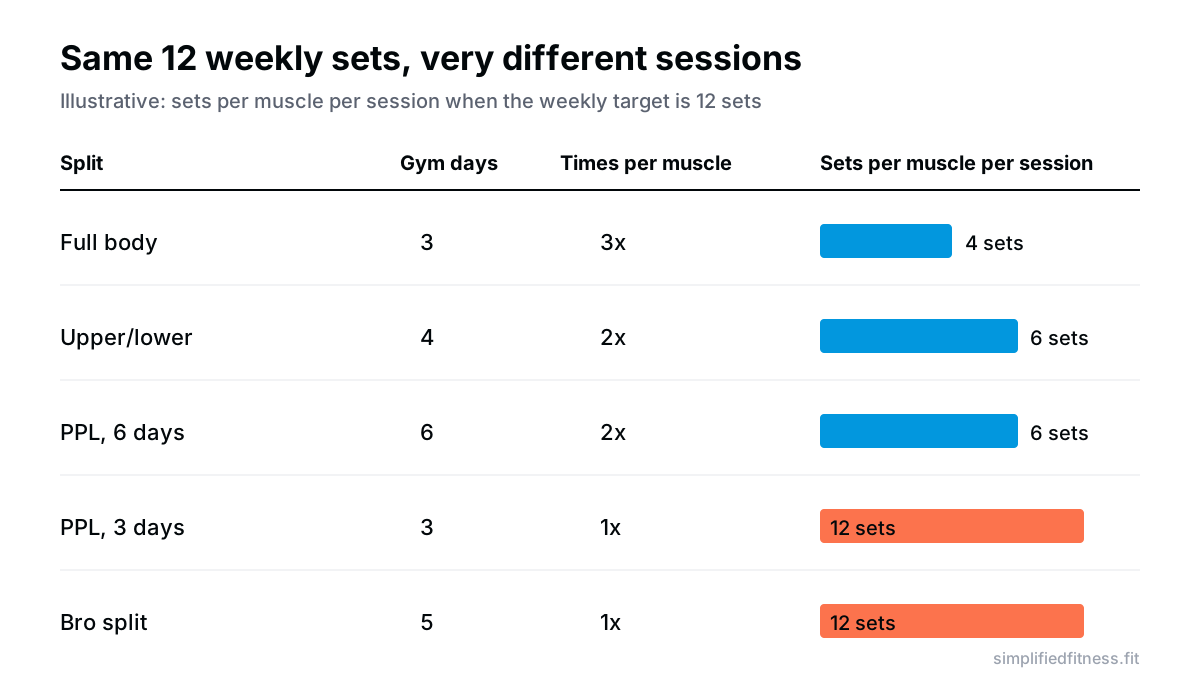
Here is the practical comparison. The table assumes you are aiming for the same weekly volume on each plan.
| Split | Typical days | Times per muscle | Main strength | Main catch |
|---|---|---|---|---|
| Full body | 2-3 | 2-3x | Forgives missed days, flexible | Long sessions if you pack in too many exercises |
| Upper/lower | 4 | 2x | Balanced, easy to progress | Needs 4 reliable days |
| PPL (6 day) | 6 | 2x | High volume, short focused sessions | Needs 6 days and good recovery |
| PPL (3 day) | 3 | 1x | Simple, easy to learn | Each muscle only trained once, so weekly sets must fit in one session |
| Bro split | 5 | 1x | Lots of attention per muscle, fun | One missed day leaves a muscle untrained for about 2 weeks |
Full body split: the forgiving one
Full body means you train most major muscles every session, usually 2-3 days a week. Each muscle gets hit often, so weekly sets are split into small chunks.
The strengths are flexibility and recovery rhythm. If you miss Wednesday, you do not lose “chest day.” The weakness is session length. Squat, press, row, hinge and a few accessories can easily stretch past 90 minutes if you are not strict. For a ready-made template, see our 3 day full body hypertrophy plan.
In a 10 week trial of 21 resistance-trained men, a total body group and a split routine group both improved strength and muscle thickness. Total body did better on one strength test (a slow-speed isokinetic bench press), while the split group gained more in vastus lateralis thickness (Bartolomei et al., 2021). That is a tiny study with mixed results, so it does not crown either format.
Upper/lower split: the balanced 4 day option
Upper/lower alternates upper-body days with lower-body days, run 4 days a week (for example Mon, Tue, Thu, Fri). Every muscle is trained twice, and sessions are a manageable length.
For most people with 4 days available, this is where I would start. It is easy to progress, easy to recover from, and flexible if life interrupts. The downside is that upper-body days can get crowded (chest, back, shoulders and arms in one session). Full details are in our upper/lower split guide.
PPL: flexible between 3 and 6 days
Push (chest, shoulders, triceps), pull (back, biceps) and legs. Run it six days, and each muscle gets trained twice weekly with short, focused sessions. Run it three days, and each muscle gets trained once, which is less ideal for spreading volume.
Six day PPL gives plenty of room for volume, but it also demands six days of life and enough sleep and food. If you want to try it, use our free push day, pull day and leg day templates, and read the PPL variations guide to choose a version.
Bro split: is it as bad as people say?
A bro split trains one muscle (or pair) per day, once a week: chest Monday, back Tuesday, shoulders Wednesday, and so on. It gets mocked online, but the evidence does not say it fails.
In the 10 week trial above, the split routine group gained slightly more vastus lateralis thickness than total body (Bartolomei et al., 2021). And in a 6 week trial of 18 recreationally trained men with equalized weekly volume, a high volume, low frequency group (2 days a week) increased arm circumference and elbow flexor thickness, while the low volume, high frequency group (4 days) did not, though both gained fat-free mass and lower body thickness (Yue et al., 2018). Small, short studies in young men, so treat them as hints that training a muscle less often is not a dead end, not as proof that bro splits are better.
A within-subject study of 24 strength-trained men had each person train one leg once a week and the other leg three times a week on a single exercise (the leg press). Over 9 weeks, both legs gained similar strength and quadriceps size, whether or not volume was equalized (Neves et al., 2022). When the higher frequency allowed more total volume, effect sizes were somewhat larger, though the difference was not statistically significant.
So the real problems with the bro split are practical, not mystical:
- All of a muscle’s weekly volume lands in one session, which can mean heavy, tiring, repetitive sets.
- A missed day leaves that muscle untrained for nearly two weeks.
- Smaller muscles, like arms, can end up with little direct work unless you plan for it.
Which split should you choose?
Start with how many days you can actually train for the next 6 months, not the best week you can imagine.
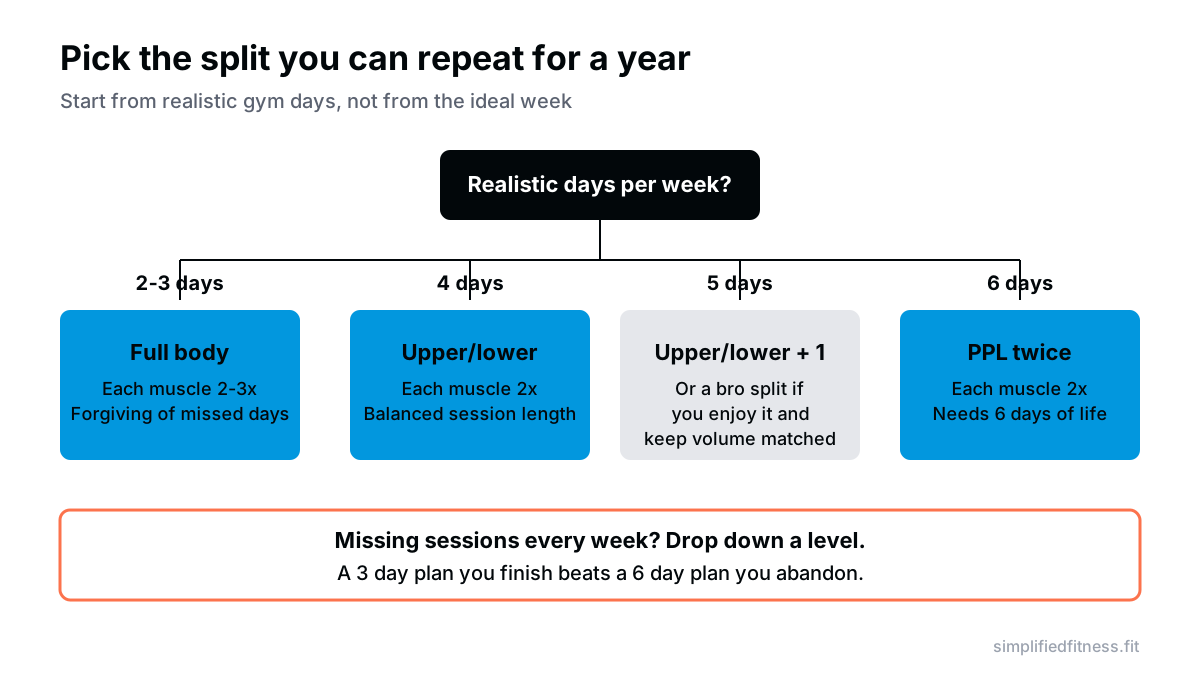
- 2-3 days: full body. Our 2 day per week routine for busy professionals shows how to make that work.
- 4 days: upper/lower.
- 5 days: upper/lower plus a fifth session, or a bro split if you enjoy it and keep volume matched.
- 6 days: PPL twice.
- Shift work or high stress: see splits for high stress careers and shift work.
How to set up your sets per session
Once you pick a split, count weekly hard sets per muscle and divide by the number of sessions that train it. Many lifters start around 10-12 hard sets per muscle per week and adjust from there. That is an experience-based starting point, not a rule from the studies above.
So for a muscle trained twice a week, that is about 5-6 sets per session. Once a week, that jumps to 10-12 in a single session, and the later sets tend to be lower quality. Our guide to per session set caps covers where those diminishing returns appear.
Pair your split with enough protein too. For vegetarians in India, dal, paneer, curd, soya chunks and eggs (if you eat them) can all contribute. Use the protein calculator to get a daily number.
When to see a doctor
If a split leaves you with persistent joint pain, sharp pain during lifts, dizziness, or soreness that does not settle after several days, stop and speak with a doctor or physiotherapist. More days do not need to mean more pain.
The bottom line
Full body, upper/lower, PPL and bro splits can all build muscle when weekly volume is matched and effort is high. Twice-a-week training is a sensible default because it spreads volume out and forgives a missed session, but the evidence does not show it is magic. Pick the split that fits your calendar, count your weekly sets, add weight or reps over time, and stay with it for at least a few months before judging.
Frequently Asked Questions
What is the best workout split for building muscle?
There is no single best split, because research shows similar muscle growth across splits when weekly sets per muscle are matched. A 2019 meta-analysis found no significant frequency effect on hypertrophy at equal volume. Pick the split that fits the days you can really train, and then focus on weekly volume and progressive overload.
Is full body or upper/lower better for beginners?
Both work, and the better one is the one you will attend consistently. Full body gives each muscle several exposures a week and forgives a missed session, while upper/lower asks for 4 days. If you can only commit to 3 days, start with full body, and move to upper/lower when you can reliably train 4.
Is PPL better than a bro split?
Not automatically. When volume is equal, evidence suggests similar growth, but a 6 day PPL hits each muscle twice a week and spreads the sets across two sessions, while a bro split packs them into one. That spread usually makes sessions less exhausting, so many lifters find PPL easier to keep up, though the research does not show it is superior.
Is a bro split bad for muscle growth?
No, a bro split is not bad, it is just less flexible. One small trial in trained men found slightly more quadriceps growth with a split routine than with total body training, so the format is not a dead end. The practical risk is that each muscle only gets one shot per week, and one skipped day means that muscle waits nearly 2 weeks.
How many days a week should I train to build muscle?
Most people do well with 3-5 days, depending on how much weekly volume they want and can recover from. The evidence points to volume per muscle, not session count, as the driver. If you only have 2-3 days, full body sessions can still deliver enough weekly sets.
Is training a muscle twice a week better than once?
Possibly, but the benefit seems to come from extra volume, not frequency itself. A 2016 meta-analysis found twice a week beat once a week, while the larger 2019 meta-analysis found no meaningful difference when volume was equated. Training each muscle twice is a sensible default because it makes volume easier to spread out.
Does a full body split work for muscle growth in trained lifters?
Yes. In a 10 week trial of 21 trained men, both total body and split routines increased muscle thickness and strength. The total body group did a bit better on one strength measure, while the split group gained more in the vastus lateralis (a quadriceps muscle), so differences were small and mixed.
Can I build muscle training only 3 days a week?
Yes. A 3 day full body or upper/lower hybrid can give most muscles 2-3 weekly exposures and a solid number of sets. In a 6 week trial, training 3 days a week produced similar strength and fat-free mass gains to 6 days when volume and intensity were equated. Make every session count and track your lifts.
What is the best workout split for a busy schedule?
Full body 3 days a week, or an upper/lower rotation you can do 2 to 4 days, is the most forgiving. Because every session covers many muscles, a missed workout costs less than missing a body-part day. Pick fixed days, and use a rolling schedule (next workout in the cycle) rather than 'Monday is chest'.
How many sets per muscle per week do I need on any split?
A 2017 meta-analysis found a graded dose-response, with more weekly sets generally linked to more growth. Many lifters start around 10-12 hard sets per muscle per week and adjust from there, keeping in mind that returns diminish. Count sets across the week, then divide by the number of sessions that train that muscle.
Should I switch splits to avoid plateaus?
Switching split alone rarely fixes a plateau. Stalls usually come from too little volume, poor recovery, low protein or not enough progressive overload. Check those first, and change split only if your current one no longer fits your schedule.
Is a 5 day split better than a 3 day split?
Not by itself. Five days allow more total sets with shorter sessions, which can help if you can recover from the volume, but training volume is the main driver, not the number of days. If a 3 day plan already has you doing enough hard sets, adding days may not add much.
How should I split my workouts if I am vegetarian in India?
The split does not change with diet, but recovery does depend on enough total protein and calories. Dal, paneer, curd, soya and eggs (if you eat them) can all help you reach your daily protein target. Use the protein calculator to set a number, then pick a split you can recover from.
Sources & References
Every claim above is checked against peer-reviewed research (PubMed, U.S. National Library of Medicine) or guidance from established health bodies. How we fact-check.
- Schoenfeld BJ, et al. How many times per week should a muscle be trained to maximize muscle hypertrophy? A systematic review and meta-analysis of studies examining the effects of resistance training frequency. J Sports Sci. 2019. PMID: 30558493
- Schoenfeld BJ, et al. Effects of Resistance Training Frequency on Measures of Muscle Hypertrophy: A Systematic Review and Meta-Analysis. Sports Med. 2016. PMID: 27102172
- Schoenfeld BJ, et al. Dose-response relationship between weekly resistance training volume and increases in muscle mass: A systematic review and meta-analysis. J Sports Sci. 2017. PMID: 27433992
- Colquhoun RJ, et al. Training Volume, Not Frequency, Indicative of Maximal Strength Adaptations to Resistance Training. J Strength Cond Res. 2018. PMID: 29324578
- Bartolomei S, et al. A Comparison Between Total Body and Split Routine Resistance Training Programs in Trained Men. J Strength Cond Res. 2021. PMID: 32168178
- Yue FL, et al. Comparison of 2 weekly-equalized volume resistance-training routines using different frequencies on body composition and performance in trained males. Appl Physiol Nutr Metab. 2018. PMID: 29216446
- Neves RP, et al. Effect of different training frequencies on maximal strength performance and muscle hypertrophy in trained individuals-a within-subject design. PLoS One. 2022. PMID: 36228016

Umair Hazrami · Founder & Head Coach, Simplified Fitness
Umair Hazrami founded Simplified Fitness and the Simplified Lifter channel to cut through fitness noise. With 4+ years of consistent training and 10+ coaching clients, he writes every guide from the peer-reviewed research and links the sources so you can check them. Our editorial standards.
Educational content only, not medical advice. If you have a medical condition, are pregnant, or take medication, talk to a qualified doctor before changing your diet, supplements or training. Full disclaimer.
Keep reading

Programming
2-Day per Week Lifting Programs: Minimum Effective Dose for Busy Professionals
Can a 2 day a week workout routine hypertrophy goals support? Yes. Get a ready two-day full-body plan, the research behind it and how to run it in 60 minutes.
9 min read
Programming
30-Minute High-Density Hypertrophy Sessions: Micro-Workouts for Time-Constrained Lifters
Can a 30 minute workout for muscle growth work? See how paired sets, Myo-reps and machine setups fit 16 hard sets into half an hour, plus a 4-day plan.
10 min read

Programming
The 7-Minute Dynamic Warm-Up: A Fast Routine to Prep Joints Before Lifting
A dynamic warm up for lifting takes about 7 minutes, not 25. See the 2-3-2 routine, what the research says about stretching and foam rolling, and what to skip.
9 min read
Programming
Antagonist Paired Sets: Cut Workout Time by About 40% Without Losing Reps
Antagonist paired sets supersets time saving explained: pairing push and pull cuts a session by roughly 40% keeping reps. Pairings and rest times included.
8 min read