Hotel Gym Workout Routine: How to Keep Your Muscle on the Road
Build a hotel gym workout routine that keeps your muscle with 10 kg dumbbells, a bench and a cable stack. Includes a 30-minute session and the evidence.

TL;DR. The short answer
- A good hotel gym workout routine is 2-3 full-body sessions a week, built from high-rep sets of 12-30 taken to within 1-3 reps of failure, using single-limb moves to make light dumbbells hard.
- Reviews of loading research find similar muscle growth across a wide range of loads when sets are taken close to failure, so a 10 kg dumbbell can still work if the set is genuinely hard.
- Going to absolute failure is not required: a 2023 meta-analysis found no clear hypertrophy advantage for momentary failure over stopping short.
- For a short trip, keeping muscle needs far less training than building it. Even about half your usual volume held muscle size in one trial of untrained men.
- Myo-reps and unilateral work are tools for saving time and raising difficulty, not magic. Evidence on both is limited or short-term, so use them as options.
Part of our complete guide: Best Workout Split for Muscle Growth: PPL vs Upper/Lower vs Full Body, What the Research Says
Table of contents
A good hotel gym workout routine is two or three short full-body sessions a week, built around high-rep sets taken close to failure and single-limb exercises that make light dumbbells feel heavy. You do not need a barbell or a 40 kg dumbbell to keep your muscle. You need hard sets and a plan.
This guide is part of our series on workout splits and session architecture. It is built for the lifter who walks into a cramped room with a bench, dumbbells that stop at 10 kg, a cable stack and a treadmill with an “out of order” sign. Below: why light weights can still work, how to make them hard, and a 30-minute session you can copy.
Why can a tiny hotel gym still keep your muscle?
The old rule said 8-12 reps was the only “muscle building” zone and anything above that was “endurance”. Research has moved on. A 2021 review argues that muscular adaptations can be obtained, and in some cases optimised, across a wide spectrum of loading zones, not only in the moderate range (Schoenfeld et al., 2021).
The strongest piece of supporting evidence is a 2017 meta-analysis of 21 studies where all sets were taken to momentary failure. Strength gains favoured heavy loads, but changes in muscle hypertrophy were similar between low and high loads (Schoenfeld et al., 2017). An earlier 2016 meta-analysis found loads at or below 50% of 1RM still produced substantial strength and muscle gains in untrained people, with a non-significant trend favouring heavier loads (Schoenfeld et al., 2016).
Two honest caveats. First, “similar” does not mean “identical”, and those older trials often used sets to failure and, in places, untrained participants. Second, light loads only work if the set is hard. Fifteen easy reps with a 10 kg dumbbell is not a training set, it is a warm-up.
How hard should light sets be?
Close, but you do not have to grind to absolute failure. A 2023 meta-analysis of 15 studies found a trivial advantage for training to “set failure” versus non-failure (effect size 0.19), but no advantage for momentary muscular failure versus non-failure (0.12, confidence interval crossing zero) (Refalo et al., 2023). The authors suggest a non-linear relationship between proximity to failure and hypertrophy.
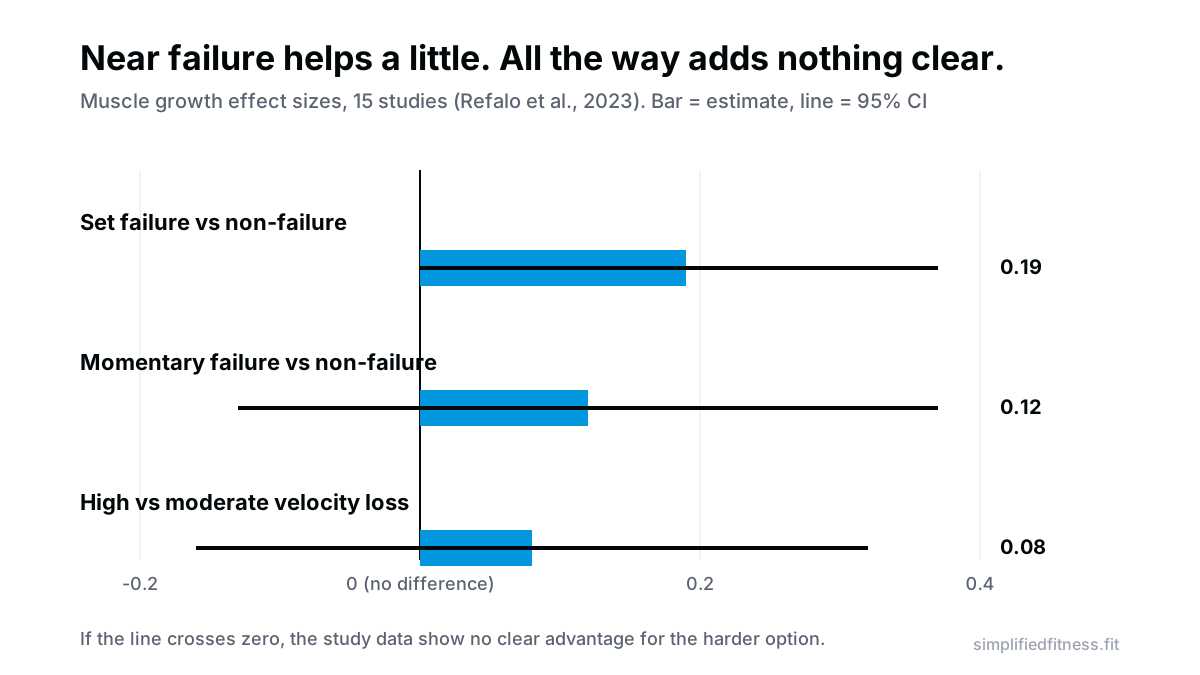
In practice, with light dumbbells, this means:
- Stop 1-3 reps before failure on compound moves like split squats and presses.
- Go closer, 0-1 reps in reserve, on safe isolation moves like curls, lateral raises and cable work.
- Skip failure on moves where a failed rep can hurt you, such as heavy overhead presses without a spotter.
Not sure how to judge “2 reps left”? Our RIR and RPE calculator helps you practise it, and the full evidence is in our training to failure vs RIR breakdown.
What is the best way to make 10 kg dumbbells harder?
Swap what you do, not just how much you lift. The decision flow below shows the order I would try things.
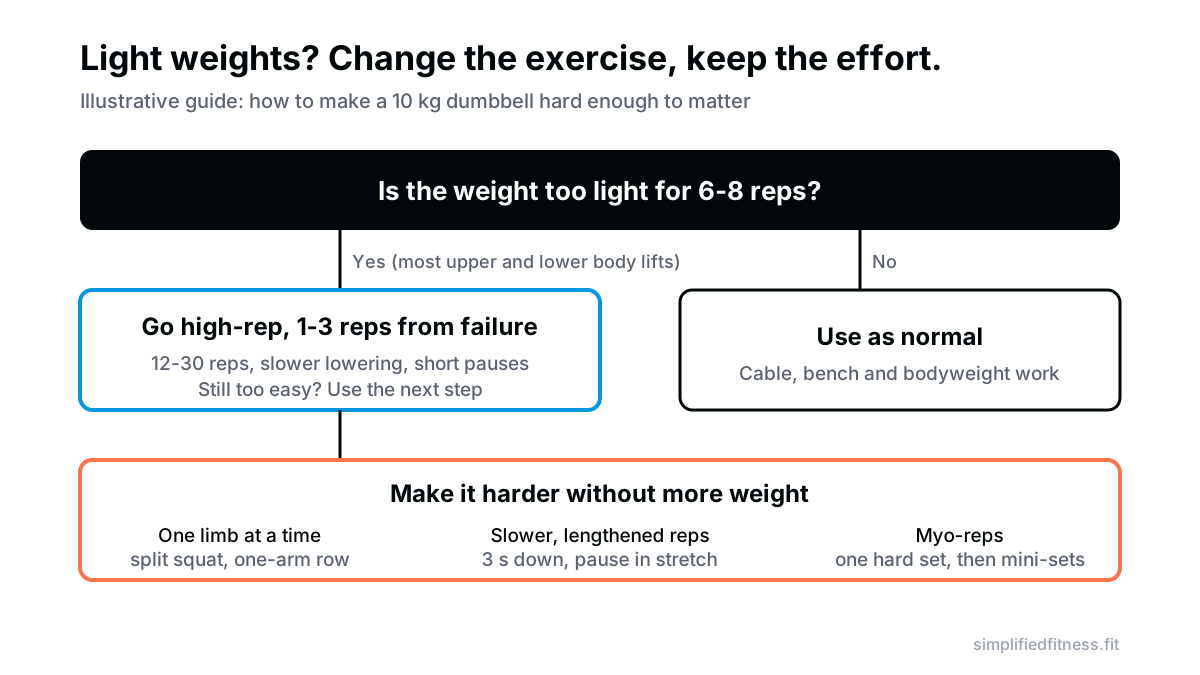
Go single-limb
A 10 kg dumbbell in one hand during a Bulgarian split squat puts most of your bodyweight, plus the dumbbell, on one leg. That is a serious load for a quad. A one-arm row or one-arm press does the same for the upper body, and you can lean on the bench for stability.
Is unilateral work superior for muscle? Not by itself. A 2025 meta-analysis of 9 studies found no significant difference in muscle hypertrophy between unilateral and bilateral training, noting the evidence is limited (Kassiano et al., 2025). Bilateral training produced bigger gains in bilateral strength, and unilateral training in unilateral strength. So single-limb training is not magic, it is a practical way to raise difficulty when equipment is limited. For more on the leg versions, see our guide to Bulgarian split squats and lunges.
Slow down and use the stretch
When you cannot add weight, add time under tension and range of motion. Lower the weight for 3 seconds, pause for 1 second at the stretched position (bottom of a split squat, bottom of a curl) and then drive up. This is a coaching tactic more than a research-proven protocol, so use it as a tool to make sets harder, not as a guaranteed growth hack.
Use myo-reps for efficiency
Myo-reps are one hard “activation” set followed by several short mini-sets with brief rests. In an eight-week trial, 22 resistance-trained men did either myo-reps or traditional straight sets on bench press variations and a cable fly, twice a week. Both groups gained muscle size and strength with no difference between them, while the myo-rep group did about 30% less volume load (Bradshaw et al., 2026).
That is encouraging for a time-short traveller, but it is one small study on upper-body lifts, so keep expectations modest. We cover the method in detail in our rest-pause and myo-reps guide.
How much training do you actually need on a trip?
Less than you think. Maintaining muscle takes far less work than building it. In a trial of 33 untrained young men, participants first trained three times a week for eight weeks, then did eight more weeks of reduced training. Dropping to one or two sessions a week, with total volume-load roughly halved, left quadriceps size and half-squat strength statistically unchanged, while the group that stopped completely lost about 5% of quadriceps size and about 23% of half-squat 1RM (Tavares et al., 2017).
Remember who the subjects were: untrained men, over a modest time frame. Experienced lifters may behave differently. Still, a review of minimal-dose training suggests that lower session volumes, with either higher loads at lower frequency or lower loads at higher frequency, can improve strength and function (Fyfe et al., 2022). For the longer story, see our guide to how little training keeps muscle and the dedicated vacation and travel workout guide.
A workable target for most trips is 8-12 hard sets per session, two or three sessions a week. If you are building rather than maintaining, count weekly sets per muscle with our training volume calculator.
What does a 30-minute hotel workout look like?
Here is a full-body template. It works with dumbbells up to 10 kg, an adjustable bench and one cable stack.
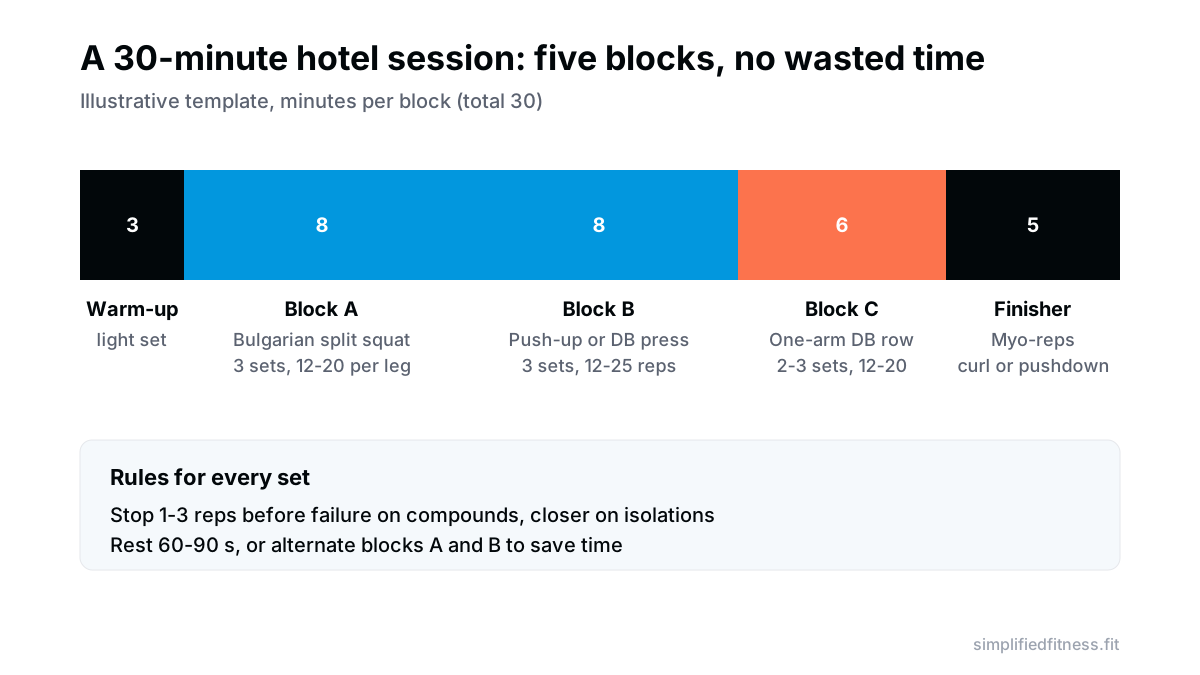
| Block | Exercise | Sets x reps | Notes |
|---|---|---|---|
| Warm-up | Light goblet squat, push-up | 1 x 10 each | Stop well short of failure |
| A | Dumbbell Bulgarian split squat | 3 x 12-20 per leg | Feet on bench, 1-3 reps left |
| B | Push-up or one-arm dumbbell press | 3 x 12-25 | Slow 3-second lowering |
| C | One-arm dumbbell row | 2-3 x 12-20 per arm | Chest on the bench if needed |
| Finisher | Cable curl or pushdown | 1 myo-rep set | 15-20 reps, then 3-4 mini-sets of 3-5 |
Rest 60-90 seconds between sets, or alternate blocks A and B to save time. For a three-day trip, run it as is. For a week, alternate with a second session that swaps in lateral raises, hip hinges with a single dumbbell and cable face pulls or rows.
If you want the generic version of the full-body idea, our guide to 30-minute high-density hypertrophy workouts covers the structure, and home gym hypertrophy training is useful if you pack bands.
What about a hotel with no gym, or a broken treadmill?
You can still keep muscle for a short trip with bodyweight sessions. Push-ups with your feet elevated, split squats, single-leg hip thrusts off a chair, pike push-ups and towel rows are a decent toolbox. The principle is identical: pick hard variations, use single limbs, slow the lowering and finish 1-3 reps short of failure.
The treadmill is not essential. A 5-minute walk is a fine warm-up, and it does not replace the hard sets that tell muscle to stay.
Eating and sleeping on the road
Protein needs do not change because the gym is small. Aim for a steady daily intake, spread across meals, using what you can find: eggs, curd, paneer, dal, chickpeas or chicken. Our protein calculator gives a daily target for your weight.
Travel also costs sleep. Do not add extra sessions to compensate for a rough night. Two good sessions will beat four tired ones.
When to see a doctor
If travel brings new pain, swelling, dizziness or chest symptoms during exercise, stop and get medical advice. Do not push through joint pain to hit a rep target, and check with a doctor before training at high intensity if you have a heart, blood pressure or joint condition.
The bottom line
Your hotel gym workout routine does not need to be clever. It needs two or three honest full-body sessions, sets taken close to failure, and single-limb or slow-tempo variations to turn light dumbbells into a real stimulus. The evidence on light-load training, proximity to failure and reduced-volume maintenance is encouraging, but much of it comes from short trials and untrained participants, so treat the plan as a sensible bridge, not a replacement for your home program.
Use the push day plan as a reference for what you are replacing, and pick up your normal training when you are back.
Frequently Asked Questions
Can you build or keep muscle with a hotel gym?
Yes, keeping muscle is very realistic, and some growth is possible too. Muscle responds to hard sets across many loads, and reviews find similar hypertrophy with light and heavy loads when sets are taken close to failure. Plan 2-3 short full-body sessions with high reps and stop 1-3 reps before failure.
What should I do if the hotel gym only has dumbbells up to 10 kg?
Use unilateral moves, slower reps and higher rep ranges so the weight feels heavy. Bulgarian split squats, one-arm rows and one-arm presses turn a light dumbbell into a hard set because you load one limb at a time. Aim for 12-30 reps and stop when you have 1-3 reps left.
How many days a week should I train while travelling?
Two to three full-body sessions is a sensible target for most trips. Research on reduced training in untrained men found that cutting volume by roughly half, with one or two sessions a week, preserved muscle size over eight weeks. If your schedule is packed, two solid sessions beat four rushed ones.
Do I need to train to failure with light weights?
Not necessarily. A 2023 meta-analysis found no evidence that training to momentary muscular failure beats stopping short for hypertrophy, though sets near failure matter when loads are light. Finish most sets with 1-3 reps in reserve, and push the last set of an isolation exercise closer to failure.
How long should a hotel workout be?
Thirty minutes is enough for a useful full-body session when you cut rest time and pick efficient exercises. You get about 8-12 hard sets across legs, push and pull. If you have more time, add sets rather than more exercises.
Are myo-reps good for hotel workouts?
They can be a time saver. In one 2026 trial of 22 resistance-trained men over eight weeks, myo-reps matched traditional sets for muscle size and strength while using about 30% less volume load. The study was small and used bench press variations, so treat it as promising, not settled.
Are unilateral exercises better than bilateral ones for muscle?
Not for muscle size, according to the evidence we have. A 2025 meta-analysis of 9 studies found no significant difference in hypertrophy between unilateral and bilateral training, though the literature is limited. Unilateral lifts are useful in a hotel because they make light dumbbells harder.
What can I use instead of a barbell squat in a hotel?
A Bulgarian split squat with dumbbells, a goblet squat, step-ups on a bench or single-leg bodyweight squats all work. They train the quads and glutes with far less load than a barbell. Take sets close to failure and use a slow lowering phase to make up for the missing weight.
Will I lose muscle if I skip the gym for a week of travel?
A short break is unlikely to cost you much, though no study here tested one week. In the reduced-training trial in untrained men, eight weeks of complete rest lost about 5% of quadriceps size. Our guide on detraining timelines covers the details, but a short break is not a crisis.
How do I train chest in a hotel gym without a barbell?
Use push-ups, dumbbell presses on a bench and the cable stack for flyes. Push-ups with your feet elevated or a slow tempo make them harder. Take every set within 1-3 reps of failure and keep reps in the 12-30 range.
How should I eat while travelling to keep muscle?
Keep protein steady across the day and choose what is available, such as eggs, curd, paneer, dal or chicken. Protein needs do not change because the gym is small. Use our protein calculator to set a daily target and aim to hit it at most meals.
Is bodyweight training enough if the hotel has no gym at all?
It can maintain muscle for a short trip, especially if sets are taken near failure. Push-ups, split squats, pike push-ups and towel rows work with no equipment. Add a resistance band to your bag for pulling movements.
Can I just do cardio on the treadmill and skip weights?
For a trip of a few days, you will not lose much muscle either way, but cardio alone does not give your muscles the hard-set signal they need to be maintained. Resistance work is what holds onto muscle. Do a short strength session and use the treadmill only for a warm-up or a walk.
Sources & References
Every claim above is checked against peer-reviewed research (PubMed, U.S. National Library of Medicine) or guidance from established health bodies. How we fact-check.
- Schoenfeld BJ, et al. Loading Recommendations for Muscle Strength, Hypertrophy, and Local Endurance: A Re-Examination of the Repetition Continuum. Sports (Basel). 2021. PMID: 33671664
- Refalo MC, et al. Influence of Resistance Training Proximity-to-Failure on Skeletal Muscle Hypertrophy: A Systematic Review with Meta-analysis. Sports Med. 2023. PMID: 36334240
- Schoenfeld BJ, et al. Strength and Hypertrophy Adaptations Between Low- vs. High-Load Resistance Training: A Systematic Review and Meta-analysis. J Strength Cond Res. 2017. PMID: 28834797
- Schoenfeld BJ, et al. Muscular adaptations in low- versus high-load resistance training: A meta-analysis. Eur J Sport Sci. 2016. PMID: 25530577
- Kassiano W, et al. Comparison of Muscle Growth and Dynamic Strength Adaptations Induced by Unilateral and Bilateral Resistance Training: A Systematic Review and Meta-analysis. Sports Med. 2025. PMID: 39794667
- Bradshaw JT, et al. Similar Strength and Hypertrophic Adaptations in Less Time? Myo-Reps vs. Traditional Straight-Sets in Resistance-Trained Men. J Strength Cond Res. 2026. PMID: 42112925
- Tavares LD, et al. Effects of different strength training frequencies during reduced training period on strength and muscle cross-sectional area. Eur J Sport Sci. 2017. PMID: 28316261
- Fyfe JJ, et al. Minimal-Dose Resistance Training for Improving Muscle Mass, Strength, and Function: A Narrative Review of Current Evidence and Practical Considerations. Sports Med. 2022. PMID: 34822137

Umair Hazrami · Founder & Head Coach, Simplified Fitness
Umair Hazrami founded Simplified Fitness and the Simplified Lifter channel to cut through fitness noise. With 4+ years of consistent training and 10+ coaching clients, he writes every guide from the peer-reviewed research and links the sources so you can check them. Our editorial standards.
Educational content only, not medical advice. If you have a medical condition, are pregnant, or take medication, talk to a qualified doctor before changing your diet, supplements or training. Full disclaimer.
Keep reading

Programming
2-Day per Week Lifting Programs: Minimum Effective Dose for Busy Professionals
Can a 2 day a week workout routine hypertrophy goals support? Yes. Get a ready two-day full-body plan, the research behind it and how to run it in 60 minutes.
9 min read
Programming
30-Minute High-Density Hypertrophy Sessions: Micro-Workouts for Time-Constrained Lifters
Can a 30 minute workout for muscle growth work? See how paired sets, Myo-reps and machine setups fit 16 hard sets into half an hour, plus a 4-day plan.
10 min read
Programming
The 7-Minute Dynamic Warm-Up: A Fast Routine to Prep Joints Before Lifting
A dynamic warm up for lifting takes about 7 minutes, not 25. See the 2-3-2 routine, what the research says about stretching and foam rolling, and what to skip.
9 min read
Programming
Antagonist Paired Sets: Cut Workout Time by About 40% Without Losing Reps
Antagonist paired sets supersets time saving explained: pairing push and pull cuts a session by roughly 40% keeping reps. Pairings and rest times included.
8 min read