Weekend Warrior Lifting: Can You Make Solid Hypertrophy Gains Training Only on Sat/Sun?
Can a weekend warrior workout split build muscle? Yes: Saturday upper, Sunday lower, with sample routines and what back-to-back lifting does to recovery.
TL;DR. The short answer
- Yes, you can build muscle lifting only on Saturday and Sunday. Frequency matters little for hypertrophy when weekly volume is matched, so two hard days can work if you hit roughly 6-10 hard sets per muscle.
- Back-to-back days are fine for muscle growth if the two sessions load different muscles. Saturday upper and Sunday lower keeps local fatigue apart, so neither session starts with sore, weakened target muscles.
- The real overlap is not the muscles, it is the spine, grip and general tiredness. Use supported rows on Saturday and keep one heavy spinal lift on Sunday.
- Large observational studies link 1-2 weekly sessions of activity with lower mortality than no activity, though most of that data is leisure-time cardio, not lifting.
- If you have chest pain, dizziness or a medical condition, see a doctor before cramming your week's training into two days.
Part of our complete guide: Best Workout Split for Muscle Growth: PPL vs Upper/Lower vs Full Body, What the Research Says
Table of contents
You can build muscle lifting only on Saturday and Sunday. A weekend warrior workout split works when each muscle gets enough hard sets across the two days and you pick exercises that do not stack fatigue on the same tissue. Saturday upper and Sunday lower is the cleanest way to do it.
If your week is 70 hours of work and your gym time is whatever is left, this guide is for you. It sits inside our wider guide to workout splits and session architecture, and it overlaps a little with the 2-day-per-week routine for busy professionals. The difference here is the constraint: both days are back to back.
Is a weekend warrior workout split enough to build muscle?
Short answer, yes. Muscle grows in response to enough hard sets, repeated over months, with food and sleep behind it. The calendar day you do those sets is secondary.
The best evidence for that comes from frequency research. A 2019 meta-analysis of 25 studies found no significant difference in hypertrophy between higher and lower training frequencies when volume was equated, including in resistance-trained people and for both upper and lower body (Schoenfeld et al., 2019). The authors concluded that, for a given volume, you can pick a weekly frequency per muscle based on preference.
Volume is the lever that does matter. A 2017 meta-regression of 15 studies found a graded dose-response: each additional weekly set was associated with a small increase in muscle gain, with higher-volume groups gaining roughly 3.9% more than lower-volume ones (Schoenfeld et al., 2017). Those were mostly short trials, so treat the exact numbers as rough.
A newer 2026 meta-regression of 67 studies (2,058 participants) found gains in size and strength rise with volume but show diminishing returns. Frequency’s effect on hypertrophy was compatible with negligible, while strength did improve with higher frequency (Pelland et al., 2026).
Is weekend warrior training healthy, or just good for muscle?
The “weekend warrior” label comes from public health research, not from lifting. It describes people who fit their weekly activity into one or two sessions.
A pooled analysis of 11 UK cohorts (63,591 adults aged 40+) found lower all-cause mortality hazards versus inactive people: HR 0.70 for weekend warriors and 0.65 for regularly active people (O’Donovan et al., 2017). A US cohort of 350,978 adults reached a similar conclusion. For the same total amount of moderate-to-vigorous activity, weekend warriors and regularly active people had comparable mortality risk (HR 1.08 for weekend warrior versus regular, 95% CI 0.97-1.20). In that cohort the weekend warrior versus inactive estimate (HR 0.92) was less clear, with a confidence interval that crossed 1 (Dos Santos et al., 2022).
An accelerometer-based UK Biobank study, which avoids the memory errors of self-report, also found similar all-cause mortality reductions for weekend warriors (HR 0.72) and regular exercisers (HR 0.74) (Huang et al., 2025).
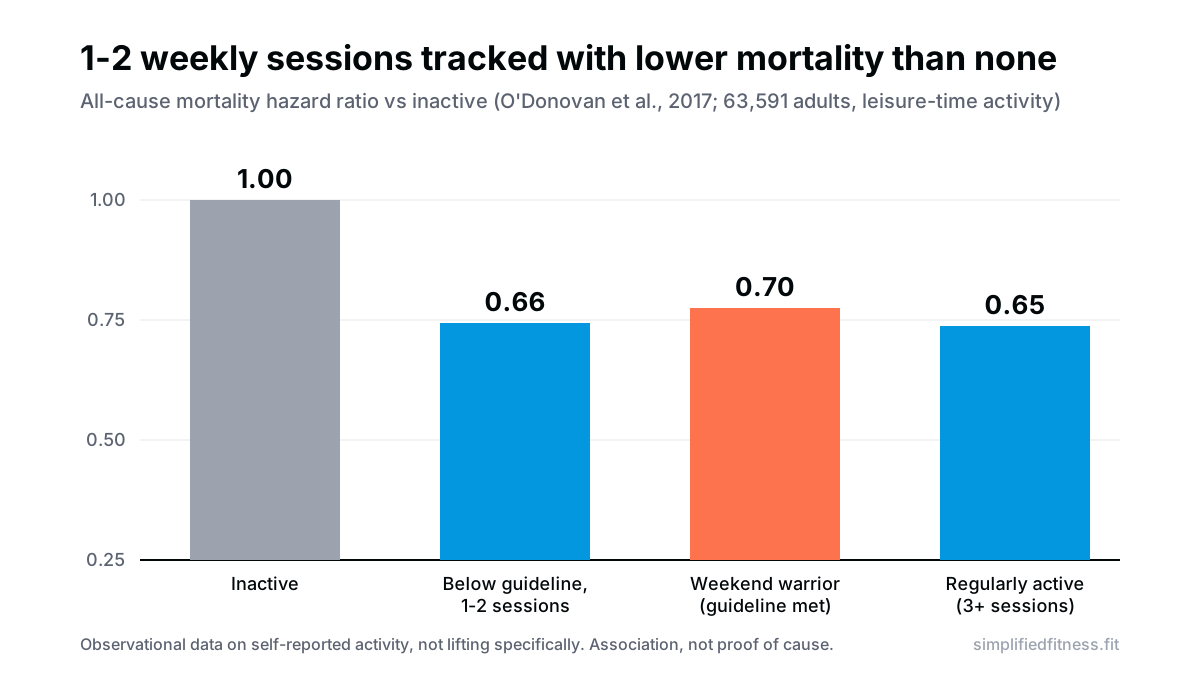
Be honest about the limits here. These are observational studies, so they show association, not cause. The activity was mostly leisure-time aerobic and sport, not hypertrophy lifting. And in the UK data, even people below the activity guideline who did 1-2 sessions a week had lower risk, so these studies say little about how much lifting you need. Read it as encouraging, not as a guarantee that two lifting days equal seven.
Can your muscles grow when you train two days in a row?
This is the question that makes people nervous. Hasn’t everyone said you need 48 hours between sessions?
That rule is about the same muscle. Recovery is largely local, so training chest on Saturday does not stop your quads from working on Sunday. The overlap you need to manage is how tired you are overall, not whether your legs are sore from the bench press.
Local recovery data is worth knowing, though. In 16 highly trained men, 8 sets of preacher curls cut elbow flexor peak torque by 26.8% right afterwards, compared with 15.1% after seated rows. A day later, strength was still 8.4% below baseline after the curls but had returned to baseline after the rows. Soreness lasted longer after the single-joint work too (Soares et al., 2015).
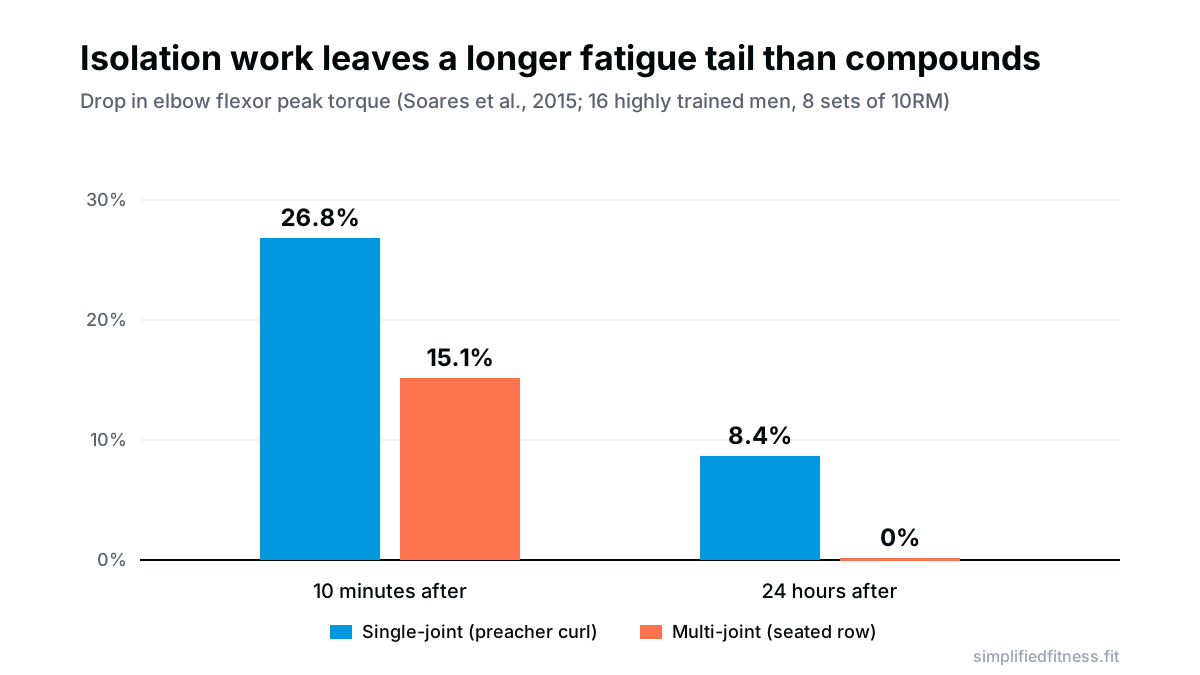
That was one muscle group in one small lab study, so do not extrapolate it to every exercise. But it supports the plan: do not hit the same muscle on consecutive days. Another study of 10 men found sets taken to failure produced greater fatigue and slower neuromuscular recovery, with mechanical muscle function still reduced 48 hours after the session (Pareja-Blanco et al., 2020). Sunday’s squat will feel worse if Saturday ground you into the floor.
Saturday upper, Sunday lower: how to set it up
Here is the core idea. Put everything that works the chest, back, shoulders and arms on Saturday. Put everything that works the quads, hamstrings, glutes and calves on Sunday. Your upper body then gets Sunday through Friday off, and your lower body gets Monday through Saturday off. That is six full days for each.
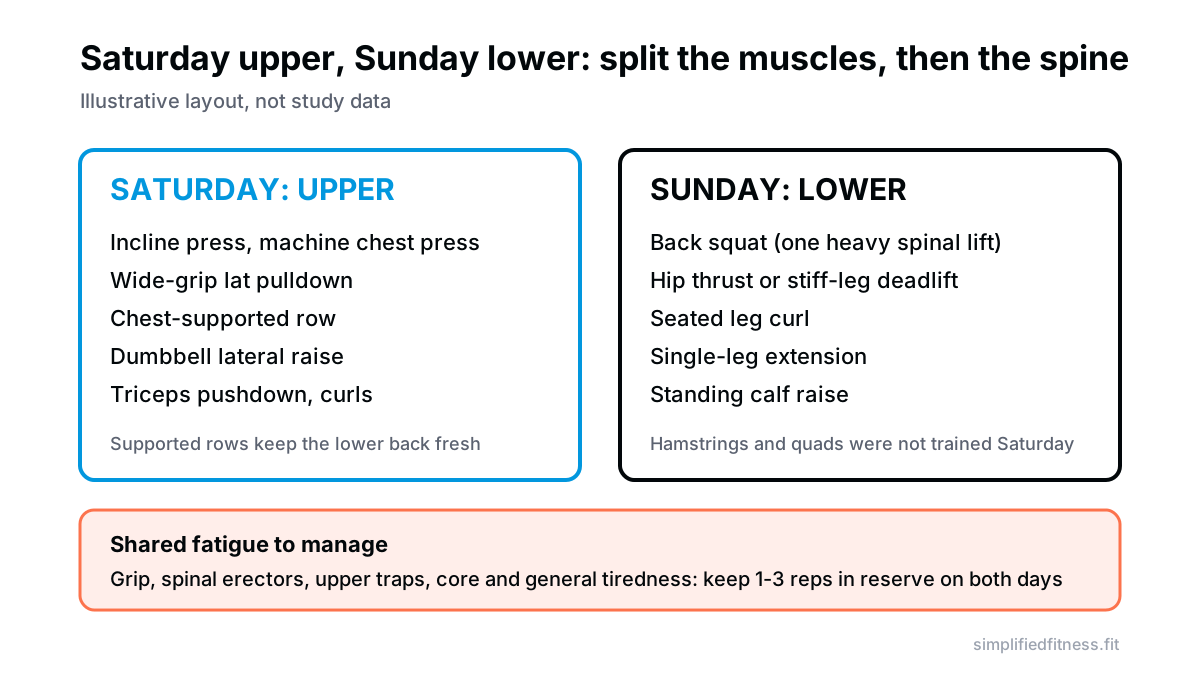
That long gap is a hidden advantage. Since your muscles will be fully recovered when you return, you can train Saturday hard without worrying about a Tuesday session. The limit is Sunday: you walk in already carrying Saturday’s fatigue.
What actually overlaps
Four things carry over, even with a clean upper/lower split.
- Spinal erectors and lower back. Heavy barbell rows on Saturday and heavy deadlifts or squats on Sunday hit the same tissue. Swap in a chest-supported row on Saturday and the problem mostly disappears.
- Grip. Pulldowns, rows and pressing all use your hands. If your grip is gone by Sunday’s deadlift, use straps or pick a hip thrust.
- Upper traps and neck. Shrugs on Saturday plus a heavy bar on your back on Sunday can leave you stiff. Keep Saturday shrugs light, or skip them.
- General tiredness. You do not have a separate nervous system for each day. Sleep and food after Saturday decide how Sunday goes.
How many sets do you need across two days?
A sensible target for most lifters is roughly 6-10 hard sets per muscle per week, taken at 1-3 reps in reserve. With a weekend split, that is a single exposure per muscle. Do not cram all of it into one movement. Arms and front delts can sit a little lower on direct sets, because presses and pulls already train them.
A lot of lifters assume more is the answer when they only train twice. It usually is not. Long sessions get sloppy, and the later sets are junk. Our guide on how long a workout should last before quality drops explains why. If a session runs past about 75 minutes, trim accessory work first and protect the big lifts.
Not sure how many sets you are doing? Use the training volume calculator to count weekly sets per muscle, and the RIR and RPE calculator to calibrate how hard “1-3 reps in reserve” feels.
Sample weekend lifting routine: upper/lower
This sample is built for 60-75 minutes per day. Rest 2-3 minutes after heavy compounds, 60-90 seconds after isolation work. Stop each set with 1-3 reps in reserve, with the final set of isolation moves allowed to go closer to failure.
Saturday: upper
| Exercise | Sets x reps | Notes |
|---|---|---|
| Incline dumbbell press | 3 x 6-10 | Main chest lift |
| Machine chest press | 3 x 8-12 | Second chest lift, stable and easy to push |
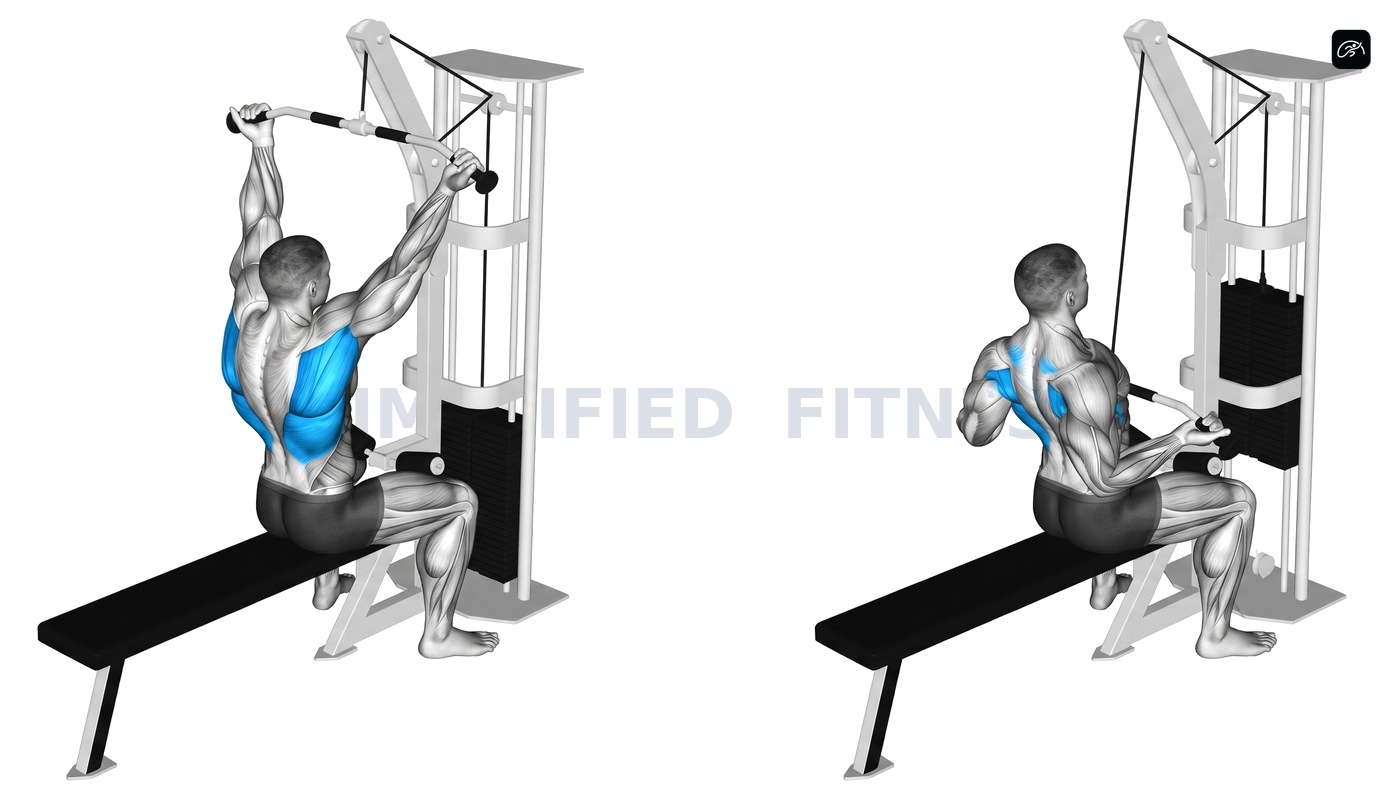
| Wide-grip lat pulldown | 3 x 8-12 | Full stretch at the top |
| Chest-supported T-bar row | 3 x 8-12 | Spares the lower back |
| Dumbbell lateral raise | 3 x 12-20 | Cheap volume for side delts |
| Triceps pushdown | 2 x 10-15 | |
| Dumbbell preacher curl | 2 x 10-15 |
Sunday: lower
| Exercise | Sets x reps | Notes |
|---|---|---|
| Barbell back squat | 3 x 5-8 | The one heavy spinal lift |
| Hip thrust | 3 x 8-12 | Glutes without more spinal load |
| Seated leg curl | 3 x 10-15 | Hamstrings, no back demand |
| Single-leg extension | 2-3 x 10-15 | Quads |
| Standing calf raise | 3 x 10-20 | Pause at the stretch |
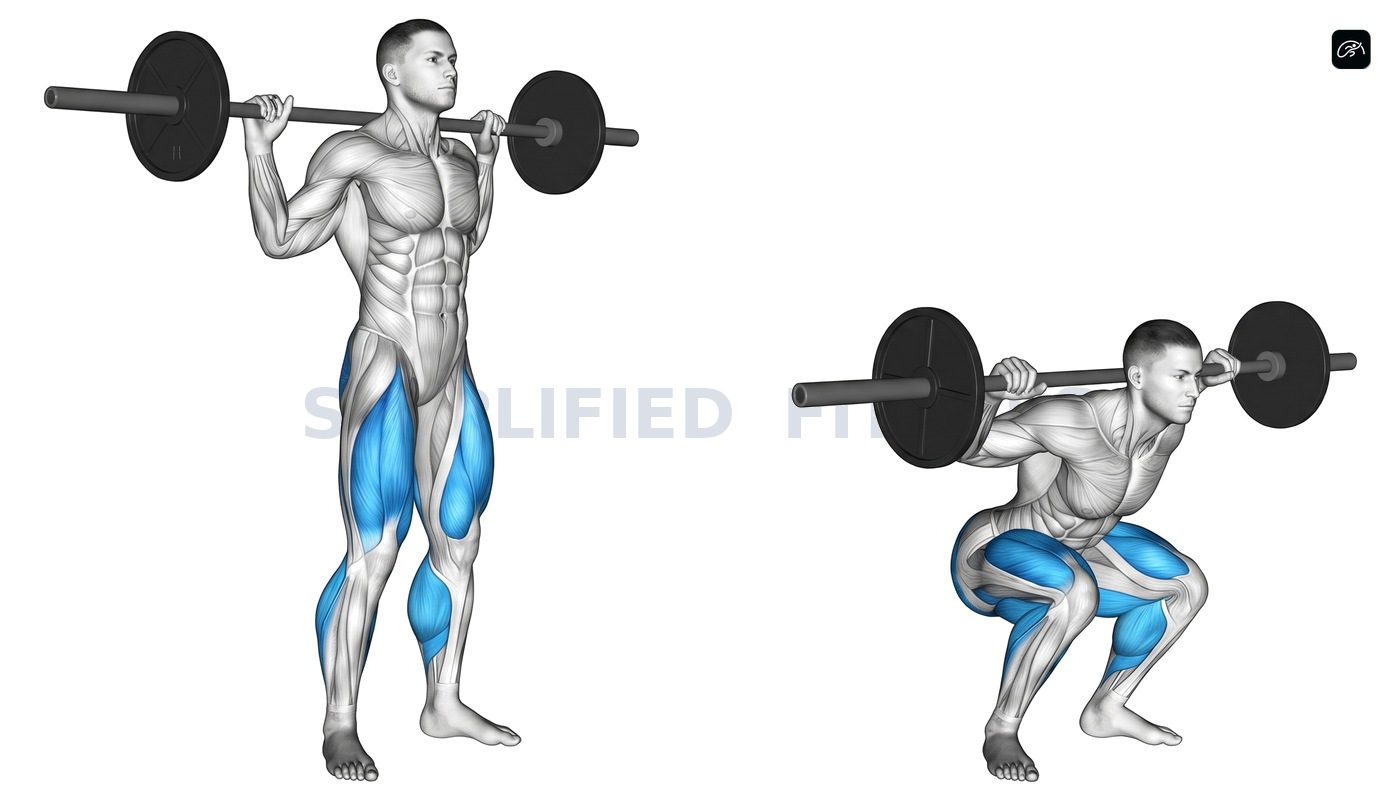
Prefer a stiff-leg deadlift to the hip thrust? Fine, but then treat it as your hamstring and glute exercise and drop the squat to a lighter, lower-effort set so you are not stacking two heavy spinal lifts. We have a ready-made leg day plan if you want a complete Sunday session to copy.
The alternative: two full-body days
Upper/lower is not your only option. If you want each muscle hit twice, you can run two full-body sessions instead. The frequency meta-analysis suggests the hypertrophy outcome is similar when volume is matched (Schoenfeld et al., 2019), so it comes down to what suits you.
| Upper/lower (Sat/Sun) | Full body x2 (Sat/Sun) | |
|---|---|---|
| Exposures per muscle | 1 | 2 |
| Sets per muscle per session | 6-10 | 3-5 |
| Session length | Longer, more focused | Slightly shorter, broader |
| Local fatigue overlap | Low | Higher (same muscles back to back) |
| Spinal loading | Easy to separate | Needs deliberate planning |
| Best for | Lifters who like focused sessions | Lifters who want more practice on main lifts |
The catch with full body on consecutive days is that you train the same muscles 24 hours apart. Keep the second day lighter and use a different exercise for each muscle, such as a squat Saturday and a leg press or split squat Sunday. If you want to see a three-day version, our full body workouts, 3 days per week plan shows how the structure changes when you have another day.
How to keep the weekend plan going for months
Consistency is the whole game here. You have 104 training days a year and zero slack. Some practical rules.
- Fix the time. Same hour both days, same bag packed the night before. If it depends on mood, it will lose to your inbox.
- Start easier than you think. Your first two or three weekends should sit at the low end of the set ranges. A big jump after weeks of desk work is how people end up with a tweaked back.
- Have a short version. When you only have 40 minutes, drop to 2 sets per exercise and cut the isolation work. A short session beats a skipped one.
- Do not skip Sunday because Saturday hurt. Soreness is not a reason to miss a session. If it is bad, cut your sets by a third and keep moving.
- Eat protein through the week. Your muscles do not know it is Wednesday. Our protein calculator gives a daily target, and dal, paneer, curd, eggs, chicken and soya chunks make it doable on a vegetarian or mixed Indian diet.
- Move on weekdays. Easy walking is unlikely to hurt recovery, and the public health data links more activity with better outcomes, even if lifting stays on the weekend.
If your job is truly shift-based and your weekends move around, see our guide to workout splits for high-stress careers and shift work. If you eventually get a third or fourth day, the 4-day upper/lower split is the obvious next step.
When to see a doctor
A weekend-only routine is common and often fine, but it can mean going from inactivity to hard training abruptly. See a doctor first if you have known heart or blood pressure problems, chest pain or pressure with exertion, unexplained shortness of breath, fainting, or if you are returning after a long layoff with other health conditions. Stop training and seek care for chest pain, severe dizziness or pain that is sharp, worsening or lingering beyond a few days. This article does not diagnose or replace medical advice.
The bottom line
A weekend warrior workout split builds muscle if you treat it like a real program: roughly 6-10 hard sets per muscle, effort at 1-3 reps in reserve, progression over months, and protein every day. Saturday upper and Sunday lower keeps local fatigue apart, and a supported row plus one heavy spinal lift keeps the overlap small.
It is not perfect. Strength tends to benefit from more frequent practice, and the health data comes mostly from cardio and leisure activity rather than lifting. But two good days beat five missed ones. Start with the sample routines above, count your sets, and adjust after four to six weeks based on how Sunday actually feels.
Frequently Asked Questions
Can you build muscle lifting only on weekends?
Yes, a weekend-only schedule can build muscle if total weekly volume and effort are adequate. A 2019 meta-analysis found training frequency does not meaningfully change hypertrophy when volume is equated, so how you split the sets matters less than whether you do them. Aim for roughly 6-10 hard sets per muscle across Saturday and Sunday and add load or reps over time.
Is it OK to lift two days in a row?
Yes, as long as the two days do not hammer the same muscles. Muscle recovery is local, so training upper body on Saturday and lower body on Sunday means each muscle still gets days of rest before you train it again. If a lift still feels flat on Sunday, cut a set rather than skipping the session.
What is the best weekend warrior workout split?
Saturday upper and Sunday lower is the cleanest option because the two days share almost no prime movers. Two full-body days are a reasonable alternative that hits each muscle twice but needs tighter exercise selection to avoid repeating heavy spinal loading. Pick the version you will actually show up for every single weekend.
How many sets per muscle should a weekend lifter do?
About 6-10 hard sets per muscle per week is a sensible target for most people, and the research shows more sets generally produce more growth with diminishing returns. A 2017 meta-analysis found each added weekly set was associated with a small extra gain in muscle size. If your schedule only allows one session per muscle, spread those sets over 2-4 exercises instead of one marathon movement.
Does muscle recover enough between Saturday and Sunday?
For the muscles you trained on Saturday, 24 hours is not full recovery, but they do not need to recover because Sunday trains different muscles. One study in highly trained men found arm strength was still reduced a day after hard curls, but back to baseline a day after rows. That is why a Saturday-Sunday split should separate muscle groups instead of repeating them.
Should I do full body twice or upper/lower on the weekend?
Both work, and the evidence does not crown a winner for hypertrophy when volume is the same. Upper/lower gives you more sets per muscle in one session with less overlap, while full body twice gives each muscle two exposures at a lower dose per session. Choose upper/lower if you can tolerate longer sessions, and full body if you prefer shorter sessions and more practice on each lift.
Is weekend warrior exercise healthy?
Observational studies suggest yes. A pooled analysis of 63,591 adults found weekend warriors had a lower all-cause mortality hazard (HR 0.70) than inactive people, similar to regularly active people (HR 0.65). These are associations from mostly self-reported leisure activity, so add walking or steps on weekdays where you can.
Do I need to train to failure on weekends?
No. Stopping 1-3 reps short of failure still builds muscle and leaves you fresher for the second day. Research on sets taken to failure shows slower neuromuscular recovery that can last up to 48 hours, which is the opposite of what a back-to-back schedule needs. Save true failure for the last set of low-risk isolation exercises.
How do I avoid injury cramming a week of training into two days?
Ramp up gradually, warm up properly and avoid piling on volume in your first few weekends. A big jump in training load after a sedentary week is an easy way to strain something, so start at the low end of the set range. Stop a set if form breaks, and see a doctor for pain that does not settle within a few days.
What should I do from Monday to Friday?
Weekday movement does not have to be lifting. Walking, taking stairs and sleeping enough all support recovery and health, and none of it competes with your Saturday and Sunday sessions. Eat enough protein every day, since muscle building does not pause just because the gym does.
Can I gain strength training only twice a week?
Yes, but strength usually responds more to frequency than size does. A 2026 meta-regression found frequency had an identifiable positive effect on strength gains, with diminishing returns, while its effect on hypertrophy was compatible with negligible. Practice your main lifts on both days (a lighter second exposure) if strength is a priority.
Is it better to do one long weekend session or two shorter ones?
Two shorter sessions are usually easier to do well. Quality tends to fall late in very long workouts, and splitting sets across two days lets you spend fewer sets on any single muscle per session. If you have time for only one day, it still beats nothing, but two days is the better build.
Sources & References
Every claim above is checked against peer-reviewed research (PubMed, U.S. National Library of Medicine) or guidance from established health bodies. How we fact-check.
- O'Donovan G, et al. Association of weekend warrior and other leisure time physical activity patterns with risks for all-cause, cardiovascular disease, and cancer mortality. JAMA Intern Med. 2017. PMID: 28097313
- Dos Santos M, et al. Association of the weekend warrior and other leisure-time physical activity patterns with all-cause and cause-specific mortality: a nationwide cohort study. JAMA Intern Med. 2022. PMID: 35788615
- Huang C, et al. Accelerometer-derived weekend warrior physical activity and all-cause and cause-specific mortality. Mayo Clin Proc. 2025. PMID: 40057865
- Schoenfeld BJ, et al. Dose-response relationship between weekly resistance training volume and increases in muscle mass: a systematic review and meta-analysis. J Sports Sci. 2017. PMID: 27433992
- Schoenfeld BJ, et al. How many times per week should a muscle be trained to maximize muscle hypertrophy? A systematic review and meta-analysis of studies examining the effects of resistance training frequency. J Sports Sci. 2019. PMID: 30558493
- Pelland JC, et al. The resistance training dose response: meta-regressions exploring the effects of weekly volume and frequency on muscle hypertrophy and strength gains. Sports Med. 2026. PMID: 41343037
- Soares S, et al. Dissociated time course of muscle damage recovery between single- and multi-joint exercises in highly resistance-trained men. J Strength Cond Res. 2015. PMID: 25807025
- Pareja-Blanco F, et al. Time course of recovery from resistance exercise with different set configurations. J Strength Cond Res. 2020. PMID: 30036284

Umair Hazrami · Founder & Head Coach, Simplified Fitness
Umair Hazrami founded Simplified Fitness and the Simplified Lifter channel to cut through fitness noise. With 4+ years of consistent training and 10+ coaching clients, he writes every guide from the peer-reviewed research and links the sources so you can check them. Our editorial standards.
Educational content only, not medical advice. If you have a medical condition, are pregnant, or take medication, talk to a qualified doctor before changing your diet, supplements or training. Full disclaimer.
Keep reading

Programming
2-Day per Week Lifting Programs: Minimum Effective Dose for Busy Professionals
Can a 2 day a week workout routine hypertrophy goals support? Yes. Get a ready two-day full-body plan, the research behind it and how to run it in 60 minutes.
9 min read
Programming
30-Minute High-Density Hypertrophy Sessions: Micro-Workouts for Time-Constrained Lifters
Can a 30 minute workout for muscle growth work? See how paired sets, Myo-reps and machine setups fit 16 hard sets into half an hour, plus a 4-day plan.
10 min read

Programming
The 7-Minute Dynamic Warm-Up: A Fast Routine to Prep Joints Before Lifting
A dynamic warm up for lifting takes about 7 minutes, not 25. See the 2-3-2 routine, what the research says about stretching and foam rolling, and what to skip.
9 min read

Programming
Antagonist Paired Sets: Cut Workout Time by About 40% Without Losing Reps
Antagonist paired sets supersets time saving explained: pairing push and pull cuts a session by roughly 40% keeping reps. Pairings and rest times included.
8 min read