How Long Should a Workout Last? Set Quality Beyond 60-75 Minutes
How long should a workout last? No study shows a hard cutoff, but 45-75 minutes of dense work usually beats a 2-hour grind. See the evidence and how to fix it.
TL;DR. The short answer
- For most lifters, 45-75 minutes of focused work is plenty. No trial identifies a hard 60-75 minute cliff, so treat that range as a practical rule of thumb, not a biological law.
- Sessions that run long usually do so because of extra sets, long rests and phone time. Muscle growth tracks hard sets per week, and the evidence for very high per-muscle volume is mixed.
- Resting more than about 60 seconds between sets gave a small hypertrophy edge in a 2024 meta-analysis, possibly by protecting volume load, and resting beyond about 90 seconds added little. Very short rests mostly cost you reps.
- Glycogen use rises with more sets and longer sessions, and dehydration can cut work in later sets. A snack, water and a sensible set count handle most of this.
- If your strength collapses halfway through every session, check sleep, food, heat and set count first. Persistent unexplained fatigue or weakness is a reason to see a doctor.
Part of our complete guide: Best Workout Split for Muscle Growth: PPL vs Upper/Lower vs Full Body, What the Research Says
Table of contents
How long should a workout last? For most lifters, 45-75 minutes of focused work covers a warm-up and enough hard sets to grow. Past that, set quality often slips, but the research does not show a hard cutoff at 60 or 75 minutes, so treat those numbers as a guide, not a rule of nature.
If you spend two or two and a half hours in the gym and your strength falls apart in the second half, this guide is for you. It sits inside our complete guide to workout splits and session architecture, and it deals with one question: what actually limits a session, and what do you do about it?
I want to be straight about something up front. The idea that “set quality collapses after an hour” is popular, and it is partly right in practice. But the exact numbers float around gyms far more than they appear in trials. So we will separate what is measured from what is plausible.
Does set quality really fall off after 60-75 minutes?
Sometimes, yes. Not for a biological reason that flips at minute 61.
What the trials measure is weekly volume, rest times, fuel and hydration. They rarely time a single session against rep quality. So the honest summary is this: long sessions tend to contain more sets, more accumulated fatigue and more dead time, and those things reduce the quality of late sets.
What actually degrades late sets
Let us go through the usual suspects, one at a time, with what the evidence says.
Glycogen and fuel
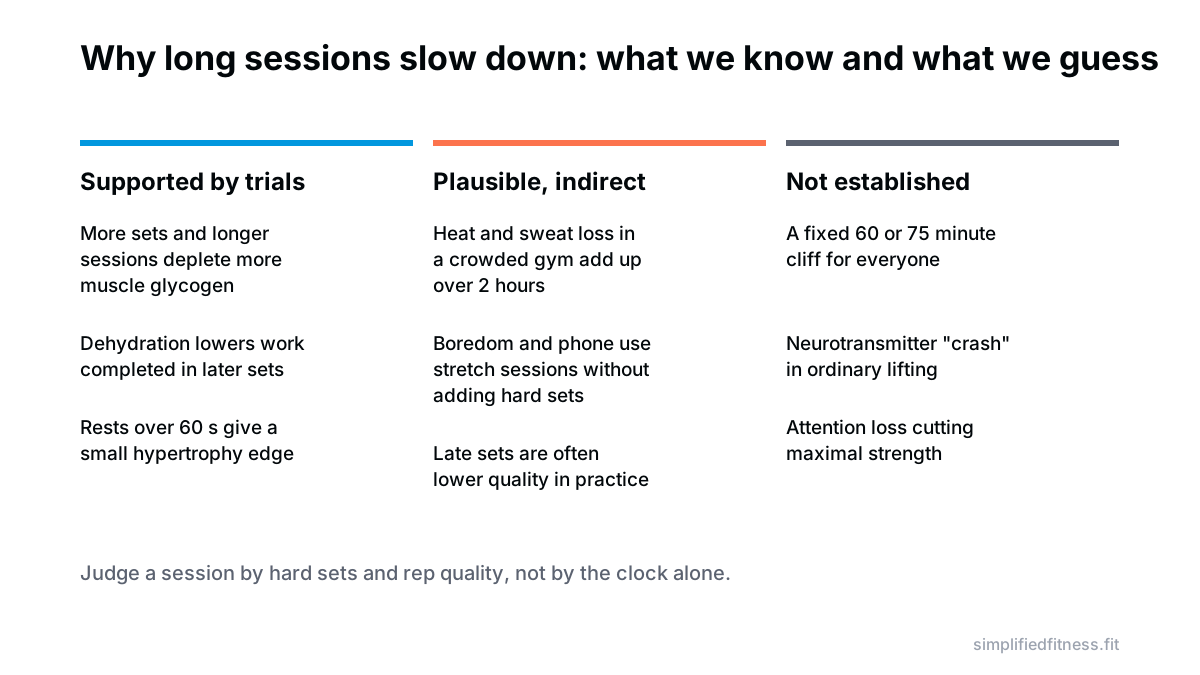
A 2025 meta-analysis of 20 studies (168 men and 12 women) found a single resistance session lowers muscle glycogen in the vastus lateralis. Depletion was larger with more sets and longer session duration, and smaller at higher intensity (Hamidvand et al., 2025). It also varied by training status. So the “more sets and more time use more fuel” part is supported.
Whether that fuel use hurts your performance is a separate question. A systematic review of 49 studies concluded that carbohydrate intake is unlikely to affect strength training performance in a fed state in workouts of up to about 10 sets per muscle group. Higher-volume sessions may benefit, though the authors said more rigorous trials are needed (Henselmans et al., 2022). Benefits showed up mostly where control groups were fasted and workouts had over 10 sets per muscle.
My read: if you train fed and do a normal number of sets, fuel is rarely your bottleneck. If you train fasted at 6 am and then do 25 sets, it might be.
Hydration and heat
Training in a warm, humid gym is a reality for a lot of us in India. In a small lab study of seven resistance-trained men, being dehydrated by about 2.5% or 5% of body mass did not change jump height, peak power or peak force. But it reduced the work completed in later sets of a six-set squat protocol (Judelson et al., 2007).
Seven people, one lab, one exercise. Take it as a signal, not a verdict. Still, the pattern matches what many lifters feel: first sets fine, later sets heavy and slow.
Attention and “brain fatigue”
This is the claim I would be most careful with. A systematic review of 11 studies on mental fatigue found endurance performance dropped, but maximal strength, power and anaerobic work were not affected (Van Cutsem et al., 2017). The mental fatigue there came from long demanding cognitive tasks, not from lifting itself.
So “your brain is cooked after an hour” is not a well-supported explanation for losing strength. Neurotransmitter depletion during ordinary lifting is a popular story too, but I did not find direct trial evidence for it. What I do see in the gym is simpler: people get bored, scroll, and drift.
Do more sets in one session help you grow?
Weekly volume matters. A 2017 meta-regression of 15 studies found a graded dose-response: each additional weekly set was associated with a 0.37% larger gain in muscle size (Schoenfeld et al., 2017).
Then the picture gets less tidy. A 2022 systematic review of trained young men found no difference between moderate (12-20 weekly sets) and high (over 20) volume for the quadriceps or biceps, though higher volume looked better for the triceps. The authors suggested 12-20 weekly sets per muscle may be a sensible standard recommendation (Baz-Valle et al., 2022).
Why do they differ? The first pooled many studies, including less-trained participants and different measures. The second was restricted to trained men with at least a year of experience. So a cautious takeaway: more weekly volume tends to help up to a point, and past that point returns shrink and vary by muscle.
What does this have to do with duration? Weekly sets are spread across sessions. A 2-hour session that crams 25 sets into one muscle group is not the same as spreading those sets over two days. Our guide on per-session set caps goes deeper, and junk volume and diminishing returns covers what happens past the useful range.
Is your rest time the problem?
Often it is the opposite of what people expect. Many lifters rest too little to look efficient, then lose reps.
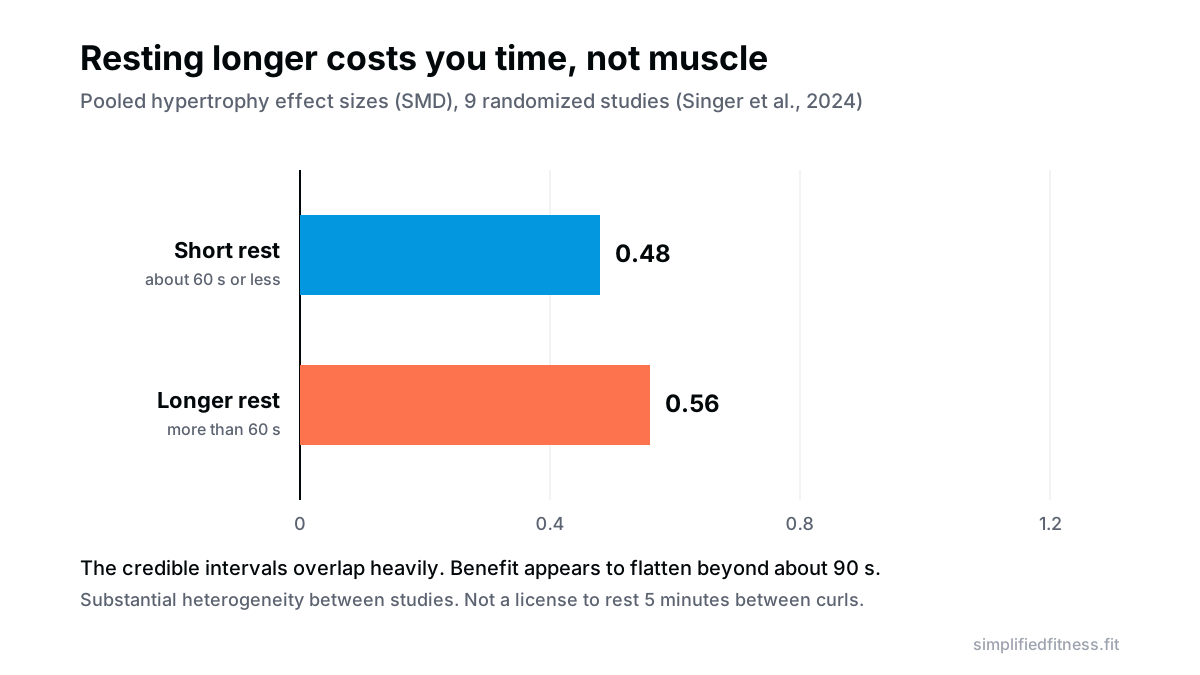
A 2024 Bayesian meta-analysis of 9 randomized studies found a small hypertrophy benefit for rests above 60 seconds, possibly because longer rests protect volume load. It detected no appreciable difference when resting more than 90 seconds (Singer et al., 2024). Results varied a lot between studies.
One trial in 21 resistance-trained men compared 1-minute with 3-minute rests over 8 weeks. Both groups did 3 sets of 7 exercises, three times a week. The 3-minute group gained more squat and bench strength and more thigh muscle thickness (Schoenfeld et al., 2016). It is a small trial, and its result was stronger than the pooled meta-analysis above, so treat it as one data point that leans the same way.
The practical point: shortening a workout by cutting rests on your big lifts is a poor trade. Cut other things first. More on timing in rest intervals for hypertrophy.
Where do the extra 60 minutes actually go?
The most common mistake I see in long sessions is not too many hard sets. It is too many easy ones. A session can feel exhausting and still contain only 10 hard sets, surrounded by phone checks, long chats, five warm-up sets per lift and a fourth and fifth “finisher” exercise for the same muscle.
Here is a realistic budget for a tight 70-minute session. It is illustrative, not study data.
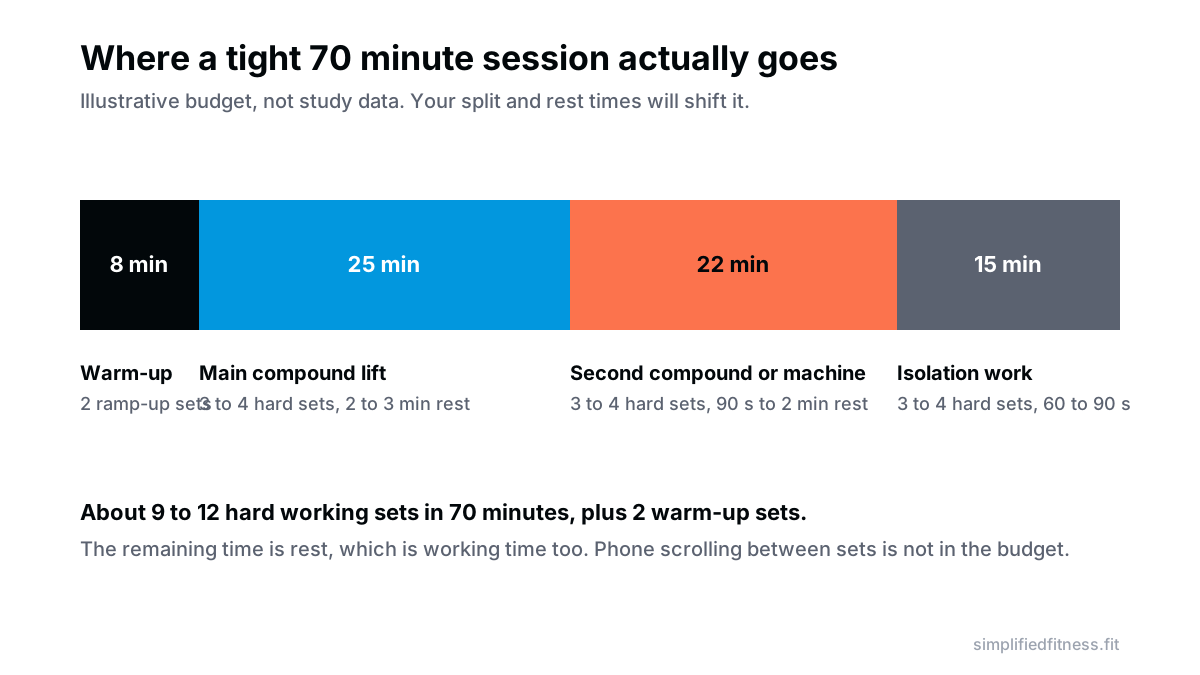
If your sessions run twice that, ask where the time goes before you ask what your brain is doing.
How do I structure a session for maximum density?
Density means more hard work per minute, not shorter rests everywhere. A simple recipe:
- Start with your priority lift. Put the exercise you most want to improve first, when you are freshest. See exercise order science.
- Warm up with 2 ramp-up sets, not 6. A short, specific warm-up is enough. Our 7-minute dynamic warm-up covers the joint prep.
- Cap hard sets per muscle per session. Roughly 3-4 per exercise and two or three exercises per muscle is plenty for most people on a given day.
- Pair non-competing exercises. A push and a pull can share rest time. See antagonist supersets.
- Keep a clock on rests. 2-3 minutes on compounds, 60-90 seconds on isolations.
- Stop when the sets stop being hard and clean. If your last set is a grind with ugly form, that is the signal.
For a 30-minute option, our 30-minute high-density express workouts show how far you can compress things without wrecking the stimulus.
What if I really do need a long session?
Some people do, and that is fine.
- Heavy strength work. Squats and deadlifts with 3-5 minute rests simply take time.
- Advanced lifters with high weekly volume. Splitting across more days is usually better, but not always possible.
- Beginners learning movements. Slow, careful practice is a fair use of time.
If you must go long, fuel and hydrate. Eat a proper meal 1-3 hours before, bring water, and consider a small carb snack mid-session if you are fasted or doing very high volume, since the evidence suggests benefits may show up at higher volumes. In a hot gym, add electrolytes if you sweat heavily.
Sleep matters too. If you are short on sleep, a long session is the worst place to push, so see our sleep and recovery guide.
A simple 4-week fix for a 2-hour lifter
- Week 1. Do not change the exercises. Just time your rests and cut phone use between sets. Note your final-set reps.
- Week 2. Drop the lowest-value accessory exercise per muscle. Keep top-set effort high.
- Week 3. Pair two non-competing exercises as supersets.
- Week 4. Compare your top-set weight and reps with week 1. If they held or rose, keep the shorter version.
If you want a ready structure, our free push pull legs plan and the wider plans hub are already built around tight sessions.
When to see a doctor
Hard training should make you tired, not unwell. Chest pain, fainting, dizziness, unusual breathlessness, or fatigue and weakness that do not improve with rest and decent food are not normal training effects. Stop and see a doctor. Do not diagnose yourself from a blog post, ours included.
The bottom line
How long should a workout last? Long enough for a short warm-up and roughly 9-15 hard sets with proper rest, which for most people lands between 45 and 75 minutes. There is no proven cliff at minute 60, but long sessions tend to go wrong in predictable ways: junk volume, wasted time, too little fuel, too little water.
Count hard sets, protect rest on your big lifts, and stop when quality stops. Then compare your results over a month. That beats any rule printed in any article, including this one.
Frequently Asked Questions
How long should a workout last?
For most lifters, 45-75 minutes of focused training is enough to cover a warm-up and roughly 9-15 hard sets. No study sets a universal cutoff, so judge a session by the quality of your last working sets, not the clock alone. If your final sets are far weaker than your first, trim volume or rest more sensibly next time.
Is working out for over an hour bad?
No, it is not harmful in itself, but it is often inefficient. Longer sessions tend to deplete more muscle glycogen and add junk volume rather than extra stimulus. If you stay productive and recover well, an hour and a half can be fine, but test whether the last 30 minutes earns its place.
Do muscles stop growing after 60 minutes of lifting?
There is no evidence of a 60-minute switch-off for muscle growth. Hypertrophy responds to hard sets, effort and weekly volume, and the trials we have measure weekly sets, not minutes. What happens in practice is that late sets get sloppier, so the growth stimulus per set can fall.
Why does my strength drop in the second half of my workout?
Common reasons are accumulated fatigue from earlier sets, short rest, low fuel, dehydration and poor sleep. A meta-analysis found glycogen depletion rises with more sets and longer sessions, and a small lab study found dehydration reduced work in later squat sets. Eat before you train, sip water through the session and put your priority lift first.
How many sets should I do in one workout?
Many lifters do well with about 9-15 hard sets per session across the muscles trained that day. Weekly volume matters more than any single session, and per-muscle volume of roughly 12-20 sets a week is a reasonable range in trained lifters. If you need more weekly sets, spread them over extra sessions rather than stretching one.
Does the 45-75 minute rule apply to everyone?
No, it is a rule of thumb. A big powerlifter taking 4-minute rests between heavy squat sets will legitimately need longer than someone doing machine work on short rests. Use the rule as a prompt to audit your session, not a stopwatch.
Do longer rest periods make a workout too long?
Not usually. A 2024 Bayesian meta-analysis found a small hypertrophy benefit for rests above 60 seconds and no clear difference beyond about 90 seconds, so resting 2 minutes is rarely the problem. Wasted time is more often scrolling, chatting and extra warm-up sets. Time your rests with a clock for a week and see.
Does mental fatigue affect lifting performance?
A systematic review of mental fatigue found endurance performance dropped, while maximal strength, power and anaerobic work were not affected. That suggests attention fade is a weaker explanation for late-session strength loss than many people assume. Focus still helps technique, so keep your phone away during hard sets.
Should I eat during a long workout?
For most sessions of an hour or so, a normal meal beforehand is enough. A systematic review concluded carbohydrate intake is unlikely to change performance in a fed state in workouts up to about 10 sets per muscle group, though higher volumes may benefit. If you train fasted early or run very high volume, a banana, dates or a sweet drink can help.
Is it okay to train 2 hours if I am a bodybuilder?
Some advanced lifters train that long, but most people who think they need it are padding sessions with junk volume. Trials of very high volume show mixed results across muscles, and more is not reliably better. Split the work over more days before you extend a single session.
Does gym heat in India make long workouts worse?
It can. A small study found that losing about 2.5-5% of body mass in fluid reduced work completed in later sets of a squat session, so sweaty, humid sessions deserve a water bottle. Hydrate before and during training, and keep sessions tighter in a hot, crowded gym.
How do I shorten my workout without losing results?
Cut low-value sets, pair non-competing exercises and keep rests to what you need. Superset a push and a pull, drop the third and fourth accessory exercise for a muscle already trained hard, and put the most important lift first. Track your top-set performance for four weeks to confirm progress holds.
When should I see a doctor about workout fatigue?
See a doctor if you get chest pain, dizziness, fainting, unusual breathlessness, or fatigue and weakness that does not improve with rest and food. These are not normal results of training and can signal a medical problem. Do not push through them in the gym.
Sources & References
Every claim above is checked against peer-reviewed research (PubMed, U.S. National Library of Medicine) or guidance from established health bodies. How we fact-check.
- Schoenfeld BJ, et al. Dose-response relationship between weekly resistance training volume and increases in muscle mass: A systematic review and meta-analysis. J Sports Sci. 2017. PMID: 27433992
- Baz-Valle E, et al. A systematic review of the effects of different resistance training volumes on muscle hypertrophy. J Hum Kinet. 2022. PMID: 35291645
- Singer A, et al. Give it a rest: a systematic review with Bayesian meta-analysis on the effect of inter-set rest interval duration on muscle hypertrophy. Front Sports Act Living. 2024. PMID: 39205815
- Schoenfeld BJ, et al. Longer interset rest periods enhance muscle strength and hypertrophy in resistance-trained men. J Strength Cond Res. 2016. PMID: 26605807
- Hamidvand A, et al. Acute effects of resistance exercise on skeletal muscle glycogen depletion: a systematic review and meta-analysis. Physiol Rep. 2025. PMID: 41420384
- Henselmans M, et al. The effect of carbohydrate intake on strength and resistance training performance: a systematic review. Nutrients. 2022. PMID: 35215506
- Judelson DA, et al. Effect of hydration state on strength, power, and resistance exercise performance. Med Sci Sports Exerc. 2007. PMID: 17909410
- Van Cutsem J, et al. The effects of mental fatigue on physical performance: a systematic review. Sports Med. 2017. PMID: 28044281

Umair Hazrami · Founder & Head Coach, Simplified Fitness
Umair Hazrami founded Simplified Fitness and the Simplified Lifter channel to cut through fitness noise. With 4+ years of consistent training and 10+ coaching clients, he writes every guide from the peer-reviewed research and links the sources so you can check them. Our editorial standards.
Educational content only, not medical advice. If you have a medical condition, are pregnant, or take medication, talk to a qualified doctor before changing your diet, supplements or training. Full disclaimer.
Keep reading

Programming
2-Day per Week Lifting Programs: Minimum Effective Dose for Busy Professionals
Can a 2 day a week workout routine hypertrophy goals support? Yes. Get a ready two-day full-body plan, the research behind it and how to run it in 60 minutes.
9 min read
Programming
30-Minute High-Density Hypertrophy Sessions: Micro-Workouts for Time-Constrained Lifters
Can a 30 minute workout for muscle growth work? See how paired sets, Myo-reps and machine setups fit 16 hard sets into half an hour, plus a 4-day plan.
10 min read

Programming
The 7-Minute Dynamic Warm-Up: A Fast Routine to Prep Joints Before Lifting
A dynamic warm up for lifting takes about 7 minutes, not 25. See the 2-3-2 routine, what the research says about stretching and foam rolling, and what to skip.
9 min read
Programming
Antagonist Paired Sets: Cut Workout Time by About 40% Without Losing Reps
Antagonist paired sets supersets time saving explained: pairing push and pull cuts a session by roughly 40% keeping reps. Pairings and rest times included.
8 min read