Antagonist Paired Sets: Cut Workout Time by About 40% Without Losing Reps
Antagonist paired sets supersets time saving explained: pairing push and pull cuts a session by roughly 40% keeping reps. Pairings and rest times included.
TL;DR. The short answer
- Antagonist paired sets (alternating opposing muscles, like bench press then row) let you finish the same sets in roughly 40-50% less time than straight sets with long rests.
- A 2025 meta-analysis of 19 studies found similar total reps and volume load, and similar strength and muscle growth over time, versus traditional sets.
- The catch: supersets feel harder. Perceived exertion and blood lactate run higher, so recovery between sessions may matter more.
- Pair opposites (push with pull, quads with hamstrings, biceps with triceps) and rest about 60 to 90 seconds after each exercise, so each muscle still gets roughly 3 minutes between its own sets.
- Reciprocal inhibition is a tidy theory, but the studies mostly show the practical benefit: the working muscle rests while you train its opposite.
Part of our complete guide: Best Workout Split for Muscle Growth: PPL vs Upper/Lower vs Full Body, What the Research Says
Table of contents
If your workouts run to two hours, antagonist paired sets supersets time saving is the simplest fix I know. You alternate two exercises for opposing muscles (bench press, then row, then bench press again), and the muscle you are not using rests while the other works. In the research, that keeps reps and volume about the same as straight sets in far less time.
This is a deep dive within our complete guide to workout splits and session architecture. Here we only care about one question: how do you finish the same work in 45 minutes without quietly getting weaker?
What are antagonist paired sets?
Antagonist paired sets (APS, also called agonist-antagonist supersets) are two exercises for opposing muscle groups, done back to back with the rest taken after the pair or after each exercise. Chest and upper back. Quads and hamstrings. Biceps and triceps.
Here is the usual straight-set version of a chest and back day: three sets of bench press with 2-3 minutes rest, then three sets of rows with 2-3 minutes rest. Lots of standing around. Now the paired version: bench press, rest, row, rest, bench press, rest, row. Each muscle still gets a long recovery. You just fill that recovery with useful work.
Antagonist paired sets supersets time saving: how much, really?
Reviews usually quote about 50%. A 2025 narrative review describes supersets as reducing session duration by roughly 50% compared with traditional training (Mang et al., 2025). A 2025 meta-analysis of 19 studies and 313 people found a shorter session and clearly higher training efficiency (SMD 1.74) for supersets (Zhang et al., 2025).
Real life lands a bit lower, because most of us still rest between rounds. Here is an illustrative calculation, not study data. Assume a 40-second set, 6 sets total, and 3-minute rests for straight sets versus 90 seconds after every set when paired.
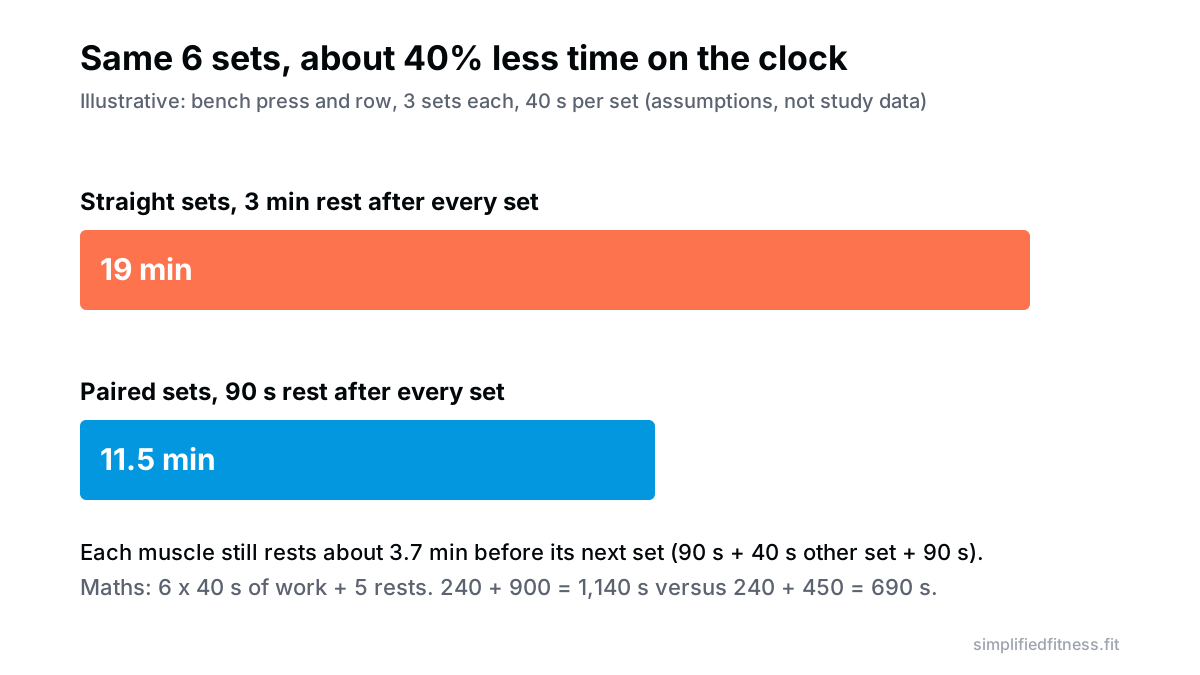
That is where the “about 40%” in the title comes from. Your numbers will change with set length, exercise choice and how crowded the gym is.
Will I lose strength or reps?
Short answer: not in the studies we have, with some caveats.
In a 2010 study, 16 trained men did 3 sets of bench pull and bench press either as traditional sets or in alternating pairs, both taking about 10 minutes. Volume load per set and across the session was higher with the paired version, and paired sets were more efficient in volume per unit of time (Robbins et al., 2010). A 2017 trial with 15 trained men (bench press and wide-grip seated row) also found greater volume load under paired sets, along with greater EMG fatigue indices (Paz et al., 2017).
Note the design, though. Those acute studies used fixed time or fixed 2-minute rests, so the straight-set rests were not always long.
The pooled picture is more useful. The 2025 meta-analysis found similar total reps (SMD -0.03) and volume load (SMD 0.05), and similar chronic changes in maximal strength (SMD 0.10) and muscle hypertrophy (SMD -0.05) (Zhang et al., 2025). For agonist-antagonist pairs specifically, the subgroup analysis showed more reps completed than with traditional sets (SMD 0.68).
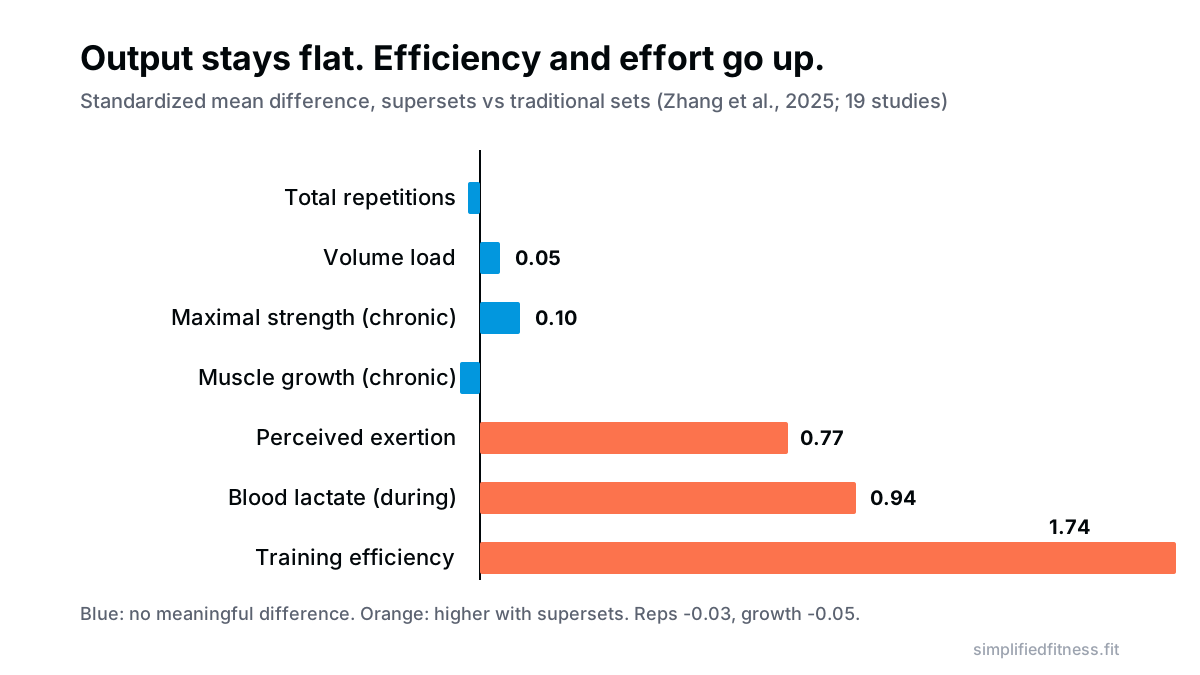
The same review warns that supersets tend to produce higher internal load and muscle damage, with higher perceived exertion, which may mean you need longer to recover between sessions (Zhang et al., 2025). The 2025 narrative review adds that power output is typically greater with traditional sets (Mang et al., 2025). So if you are chasing a maximal single or explosive work, do that first as a straight set.
Does reciprocal inhibition explain why supersets work?
Reciprocal inhibition is the idea that when one muscle contracts, the nervous system relaxes its opposite. People then argue that training the antagonist “primes” the agonist for a stronger set. It sounds neat, and a few studies hint at it.
In a 2014 study, 15 recreationally trained men did knee extension to failure either alone or after knee flexion with rests from none to 5 minutes. They completed significantly more knee extension reps when the pair was done with no rest, 30 seconds or 1 minute than when extension was done alone, and some muscle activity measures were higher too (Maia et al., 2014). That is one small acute study on a single leg exercise pair.
Here is the honest summary. The mechanism is plausible but not proven, results across studies are mixed, and for your training it matters less than the simple fact that each muscle gets time off. You do not need the theory to use the tool.
What rest time works best between paired sets?
Rest still matters. In a 2022 crossover study, 18 recreationally trained men did paired sets of bench row with bench press and lat pulldown with overhead press, using 1, 2 or 3 minutes of rest between pairs, or a self-selected rest. One minute gave significantly less total volume than the other options, and 2 minutes gave less than 3 minutes. But 2 minutes and self-selected rest did not differ on volume, session time or efficiency, so the authors suggested those two had the best cost-effectiveness (Behenck et al., 2022).
| Rest between pairs | Total volume | Session time | Verdict |
|---|---|---|---|
| 1 minute | Lowest | Shortest | Most efficient on paper, costs reps |
| 2 minutes | Lower than 3 min | Moderate | Good balance |
| Self-selected | Similar to 3 min | Moderate | Good balance |
| 3 minutes | Highest | Longest | Best for heavy sets |
Do not cut rest to the bone just because you are pairing. The long-rest evidence still applies to the muscles doing hard sets. An 8-week study in 21 resistance-trained men found that 3-minute rests produced greater strength gains and more thigh muscle thickness than 1-minute rests (Schoenfeld et al., 2016). Pairing is how you get long rests per muscle and a short session. For more on rest times, see our guides on 2 to 3 minute rests versus short rests and where short rests do and do not make sense.
Which exercises should you pair?
The goal is two exercises that do not fight over the same muscles or the same grip.
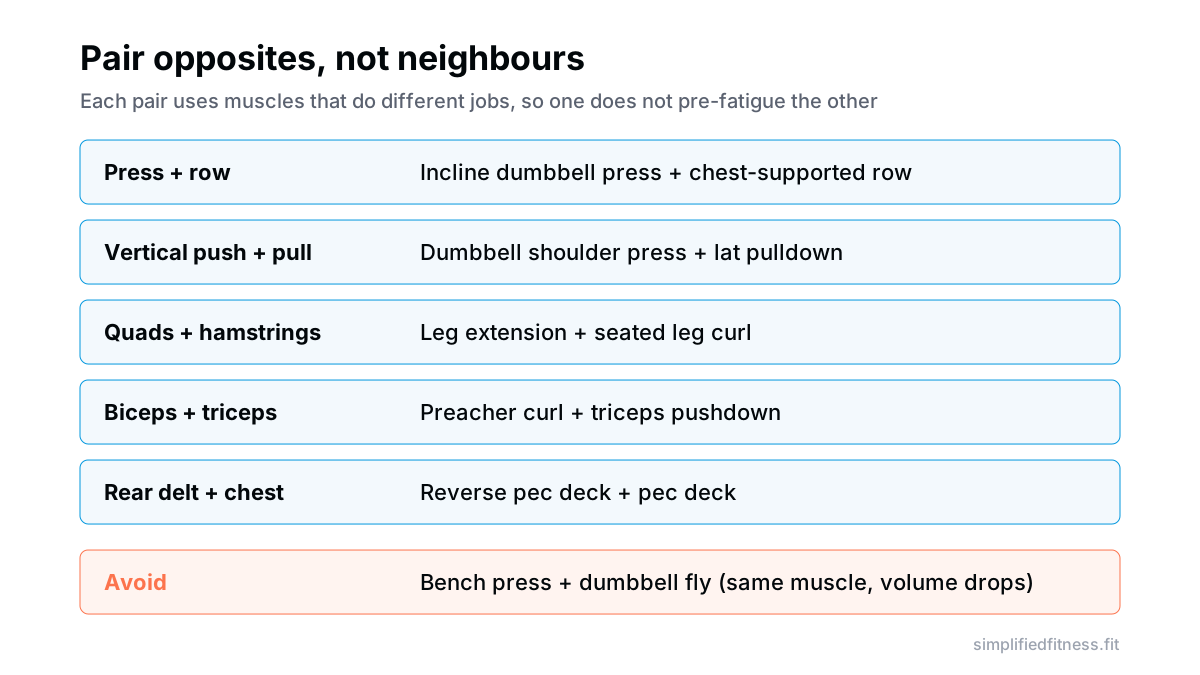
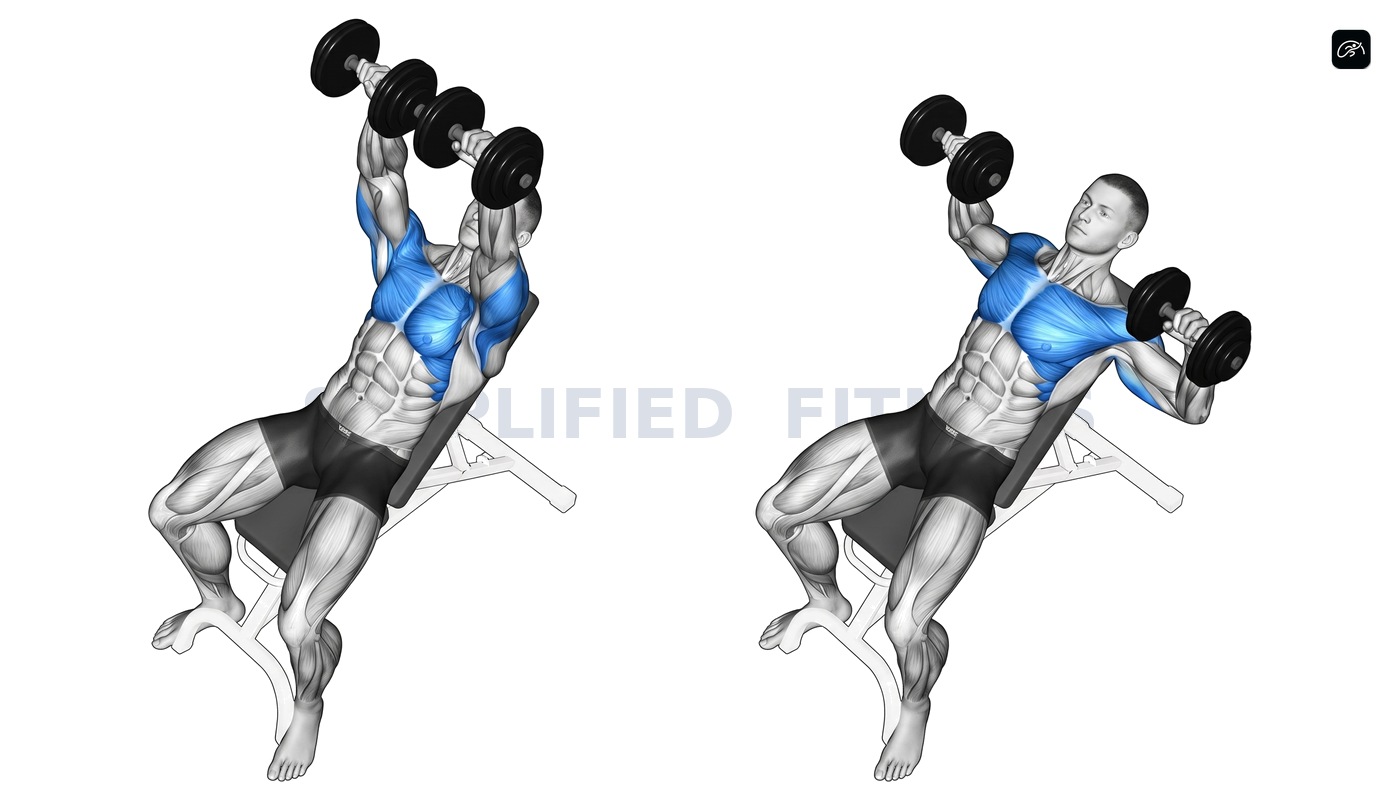
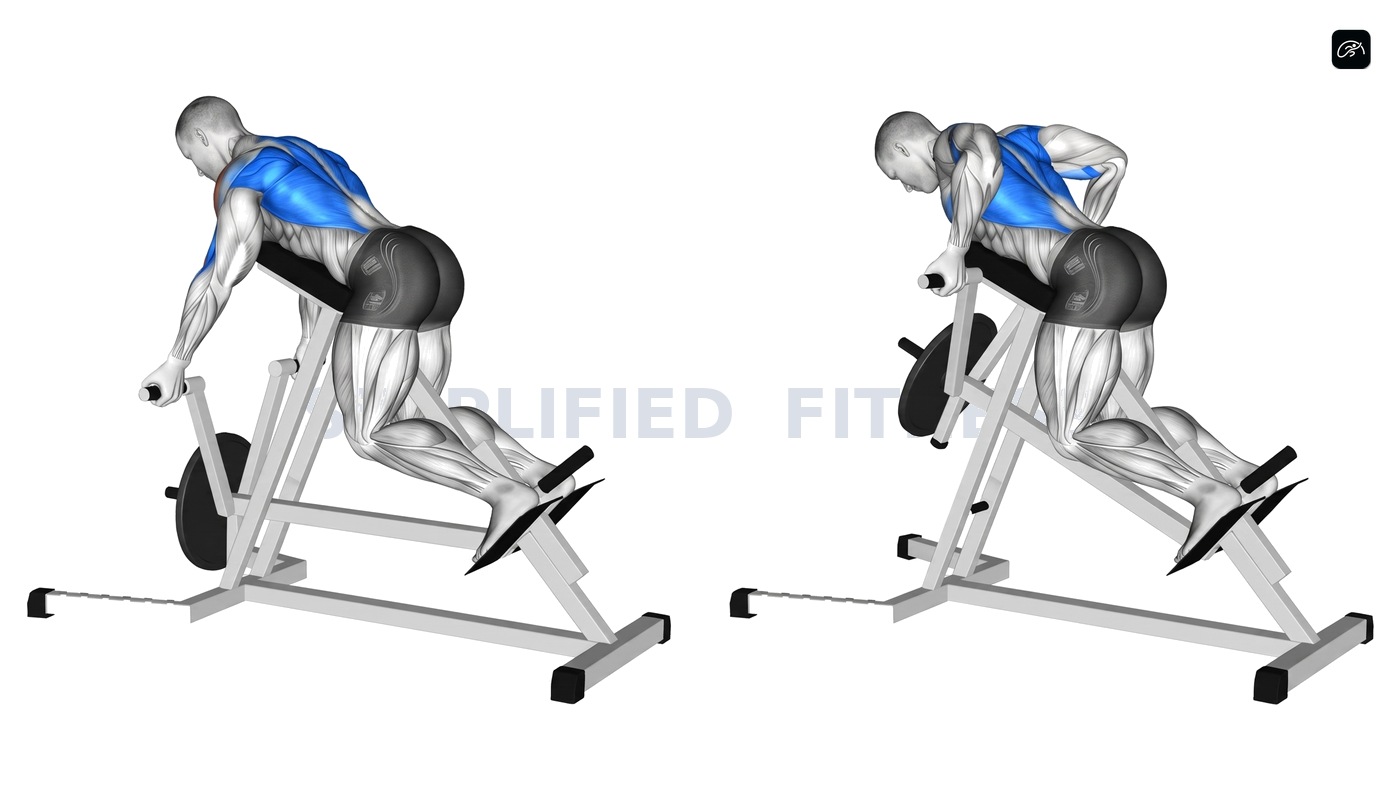
The pair that fits most gyms is a press with a supported row. The chest-supported version takes lower back and balance out of the equation, so fatigue stays in the target muscles.
Why not pair similar muscles? The meta-analysis found that supersets of similar biomechanics reduced volume load compared with traditional sets, while agonist-antagonist supersets were better for maintaining training volume (Zhang et al., 2025). Same muscle twice in a row is a different tool with a different cost.
Keep the secondary exercise honest too. In a 2025 crossover study of 14 resistance-trained men, a bench pull after bench press at about 33% or 66% of maximal reps did not significantly change bench press velocity or perceived exertion. The harder 66% version did produce higher blood lactate than the control and the 33% version (Márquez et al., 2025). In plain terms: stopping your pull set well short of failure keeps the metabolic cost down. That is a short study with a small sample, so use it as a loose guide.
For biceps and triceps pairing details, see our guide on antagonist arm supersets.
A 45-minute upper body session with antagonist paired sets
Here is a sample layout. It is illustrative, not prescriptive, and you should scale sets to your own recovery. Use our training volume calculator to check weekly hard sets per muscle.
- Warm-up (5 min): a couple of light ramp-up sets on the first press.
- Pair A (12 min): incline dumbbell press + chest-supported row, 3 rounds, 8-10 reps, 60-90 s after each exercise.
- Pair B (10 min): dumbbell shoulder press + lat pulldown, 3 rounds, 8-12 reps.
- Pair C (8 min): reverse pec deck + pec deck, 2-3 rounds, 12-15 reps.
- Pair D (8 min): preacher curl + triceps pushdown, 2-3 rounds, 10-15 reps.
That is roughly 40-45 minutes, depending on the gym. Our push, pull and leg day plans show how this fits a weekly layout, and our 30-minute express workouts guide covers even tighter schedules.
When supersets are the wrong tool
Pairing is not always the right choice. A few cases.
- Your heaviest lift of the day. Do it as a straight set, fully rested. Squats, deadlifts and heavy bench work are usually better kept separate.
- Sessions where you already feel run down. The pooled data suggest higher perceived exertion and internal load, so supersets may need more recovery between sessions (Zhang et al., 2025).
- Power training. Power output tends to be greater with traditional sets (Mang et al., 2025).
- Busy gyms in peak hour. If you are hogging two stations, you are not making friends. Pick pairs that sit near each other.
Where to place pairs within the session also matters. Our guide to compounds before isolations covers ordering, and the guide on how long a workout can run before quality drops explains why shorter often works better.
Practical tips for Indian gyms
- Hot, humid gyms: your heart rate climbs faster in a paired session. Carry water, and use the 90 second rest if you are flagging.
- Vegetarian diets: shorter sessions do not change protein needs. Keep dal, paneer, curd or soya in your meals so your total daily protein supports the same training volume.
- Equipment: a bench, one pair of dumbbells and a cable station is enough for most pairs.
- Budget: pairing costs nothing, which is why it beats most “time-saving” gadgets.
When to see a doctor
Paired training raises your heart rate more than straight sets. If you have high blood pressure, a heart condition, or you get chest pain, unusual breathlessness, dizziness or fainting with exercise, check with a doctor before changing your training. The 2025 meta-analysis found blood pressure responses similar between supersets and traditional sets (Zhang et al., 2025), but that is group data, not clearance for your own heart or blood pressure.
The bottom line
Antagonist paired sets give you a way to train the same muscles, with the same rest per muscle, in roughly 40-50% less time. Pooled research says reps, volume, strength and muscle growth stay similar, with higher effort. Start with one pair per session, keep your hardest lift as a straight set, rest about 90 seconds after each exercise and track your numbers for a month.
Frequently Asked Questions
What are antagonist paired sets?
They are two exercises for opposing muscle groups done back to back, such as a chest press followed by a row, then repeated. One muscle rests while the other works, so you spend less time standing around. Pick two movements that do not use the same muscles and alternate them for 2-4 rounds.
Do supersets save time compared with straight sets?
Yes. A 2025 narrative review put the reduction at about 50% compared with traditional training, and a 2025 meta-analysis found a clear gain in training efficiency (SMD 1.74). The saving comes from sharing rest periods between two muscles instead of resting separately for each. In our own illustrative example with proper rests, the saving is closer to 40%.
Will I lose strength if I superset?
Not in the studies so far. The 2025 meta-analysis found no meaningful difference in maximal strength gains (SMD 0.10) between supersets and traditional sets. The chronic trials are few and short, so keep your heaviest lifts well rested. Use your logbook to confirm your numbers keep climbing.
Do supersets build as much muscle as straight sets?
Current evidence says roughly yes. The same meta-analysis found muscle hypertrophy was similar between the two approaches (SMD -0.05), and a 2025 narrative review reached a similar tentative conclusion. Chronic trials are still few, so treat this as promising rather than settled. Match total hard sets and progress your loads.
What is reciprocal inhibition and does it make supersets work?
Reciprocal inhibition is the nervous system relaxing one muscle while its opposite contracts. Some studies on antagonist pairing suggest the agonist can perform slightly better after antagonist work, but the research is mixed on whether this is the reason supersets work. The reliable benefit is simply extra recovery time for each muscle, so do not pick pairings based on this theory alone.
What is the best rest time between paired sets?
Around 2 minutes or a self-selected rest looks like a good compromise. In 18 recreationally trained men, 1 minute rest gave less total volume, while 2 minutes and self-selected rest had similar volume, time and efficiency. If your lifts are heavy, drift toward 2-3 minutes.
Can I superset heavy compound lifts like squats and deadlifts?
It is usually not worth it. Heavy lower-body compounds tax your whole body and your grip, so pairing them with anything demanding tends to hurt the quality of both. Keep the big lifts as straight sets and save pairing for presses, rows, machines and isolation work.
Is pairing the same muscle twice (a compound set) better?
For time saving without lost reps, antagonist pairs are the safer choice. The meta-analysis found that similar biomechanical supersets (working the same area back to back) reduced volume load compared with traditional sets. Pair different muscles when volume matters.
Do supersets feel harder than normal sets?
Yes, often. The pooled data showed higher perceived exertion (SMD 0.77) and higher blood lactate during training with supersets. That is partly because you are doing more work per minute. Keep an extra rep or two in reserve at first and adjust your weekly volume if you feel flat.
Are supersets good for fat loss?
They may help a little, but the evidence is about energy cost during the session, not fat loss over months. The meta-analysis found a higher energy cost during supersets (SMD 1.93), though results varied a lot. Fat loss still comes from your weekly calorie balance, so use supersets mainly to fit training into a busy day.
How should I superset in a crowded Indian gym?
Pick pairs that sit near each other, such as a cable row station and a chest press, or dumbbells plus a bench. Use one pair of dumbbells and one machine so you are not hogging two stations. If someone needs your equipment, let them work in between your rounds.
How many sets and exercises should I superset in a session?
Two to four pairs is plenty for a 45-minute session. Each pair of exercises with 3 rounds takes roughly 10-12 minutes with 90 seconds rest. Start with your main push-pull pair and add a leg pair and an arm pair if time allows.
Should beginners use antagonist paired sets?
They can, once your technique on both exercises is solid. Beginners often improve from simply showing up, so the time saving is most useful if the alternative is skipping workouts. Learn each exercise on its own first, then pair them.
When should I see a doctor about supersets?
Talk to a doctor first if you have high blood pressure, heart disease or unexplained chest pain, dizziness or breathlessness with exercise. The 2025 meta-analysis found similar blood pressure responses between supersets and traditional sets, but that does not replace personal advice. Stop and seek help for chest pain or fainting.
Sources & References
Every claim above is checked against peer-reviewed research (PubMed, U.S. National Library of Medicine) or guidance from established health bodies. How we fact-check.
- Zhang X, et al. Superset Versus Traditional Resistance Training Prescriptions: A Systematic Review and Meta-analysis Exploring Acute and Chronic Effects on Mechanical, Metabolic, and Perceptual Variables. Sports Med. 2025. PMID: 39903375
- Mang ZA, et al. The Acute and Chronic Effects of Superset Resistance Training Versus Traditional Resistance Training-A Narrative Review. J Strength Cond Res. 2025. PMID: 41118588
- Robbins DW, et al. The effect of an upper-body agonist-antagonist resistance training protocol on volume load and efficiency. J Strength Cond Res. 2010. PMID: 20847705
- Paz GA, et al. Volume Load and Neuromuscular Fatigue During an Acute Bout of Agonist-Antagonist Paired-Set vs. Traditional-Set Training. J Strength Cond Res. 2017. PMID: 28933712
- Maia MF, et al. Effects of different rest intervals between antagonist paired sets on repetition performance and muscle activation. J Strength Cond Res. 2014. PMID: 25148302
- Behenck C, et al. The Effect of Different Rest Intervals Between Agonist-Antagonist Paired Sets on Training Performance and Efficiency. J Strength Cond Res. 2022. PMID: 32541619
- Márquez G, et al. Effects of Varying Antagonist Exercise Volume in Upper-Body Supersets on Mechanical, Metabolic, and Perceptual Responses in Resistance-Trained Men. J Funct Morphol Kinesiol. 2025. PMID: 41283526
- Schoenfeld BJ, et al. Longer Interset Rest Periods Enhance Muscle Strength and Hypertrophy in Resistance-Trained Men. J Strength Cond Res. 2016. PMID: 26605807

Umair Hazrami · Founder & Head Coach, Simplified Fitness
Umair Hazrami founded Simplified Fitness and the Simplified Lifter channel to cut through fitness noise. With 4+ years of consistent training and 10+ coaching clients, he writes every guide from the peer-reviewed research and links the sources so you can check them. Our editorial standards.
Educational content only, not medical advice. If you have a medical condition, are pregnant, or take medication, talk to a qualified doctor before changing your diet, supplements or training. Full disclaimer.
Keep reading

Programming
2-Day per Week Lifting Programs: Minimum Effective Dose for Busy Professionals
Can a 2 day a week workout routine hypertrophy goals support? Yes. Get a ready two-day full-body plan, the research behind it and how to run it in 60 minutes.
9 min read
Programming
30-Minute High-Density Hypertrophy Sessions: Micro-Workouts for Time-Constrained Lifters
Can a 30 minute workout for muscle growth work? See how paired sets, Myo-reps and machine setups fit 16 hard sets into half an hour, plus a 4-day plan.
10 min read

Programming
The 7-Minute Dynamic Warm-Up: A Fast Routine to Prep Joints Before Lifting
A dynamic warm up for lifting takes about 7 minutes, not 25. See the 2-3-2 routine, what the research says about stretching and foam rolling, and what to skip.
9 min read
Programming
The Arnold Split (Chest/Back, Shoulders/Arms, Legs): Does It Work for Natural Lifters?
Does the Arnold split workout routine work for natural lifters? See how chest/back supersets, arm days and weekly volume play out, with a 3, 5 and 6 day setup.
10 min read